Tag Archives: Garrison Keillor

On Reading “On the Road” (again?)

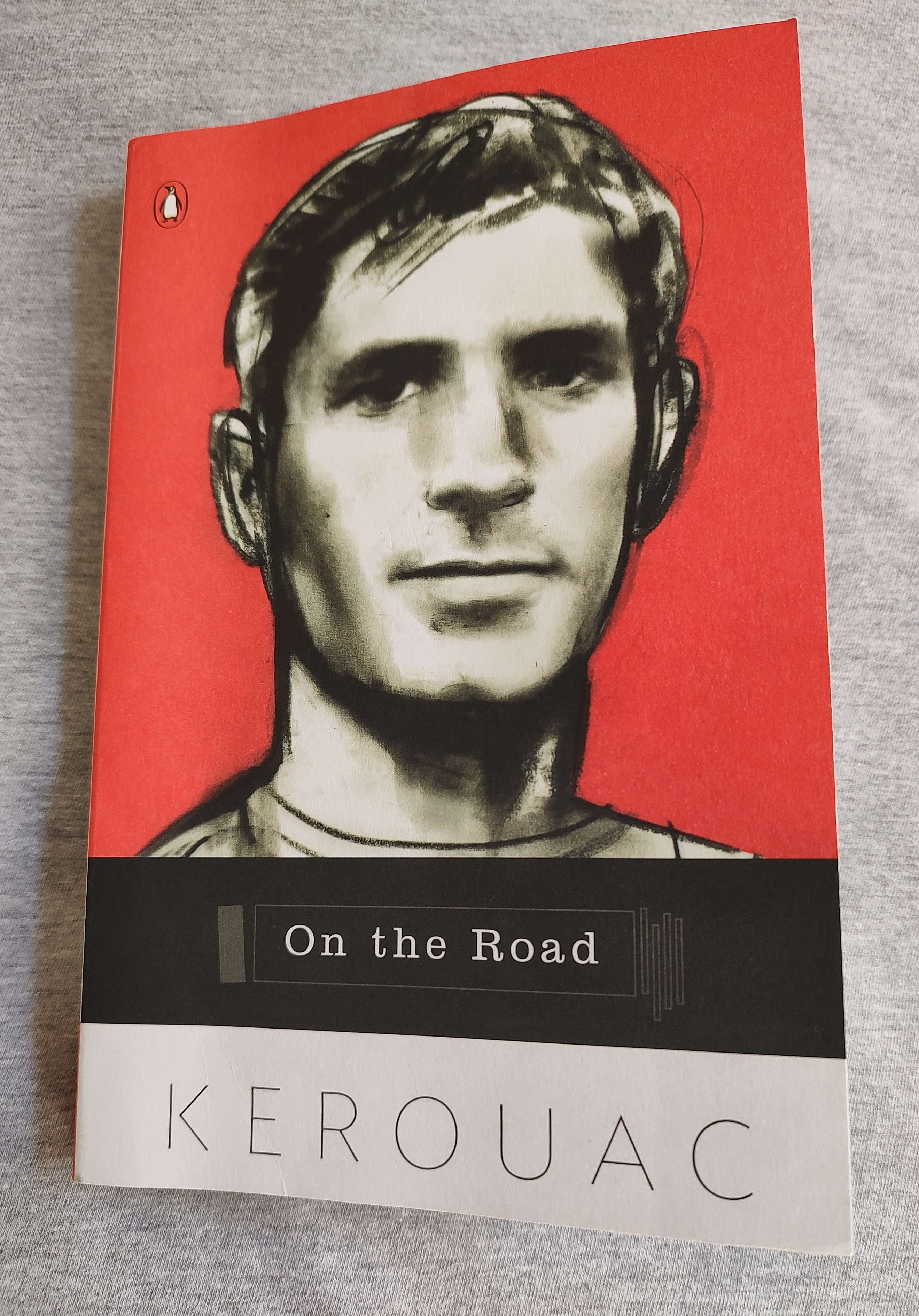
It’s June, the days are sultry, and the wanderlust sets in. But since summer travel is not in my plans this year, I decided to read On the Road. Or re-read. I’m not really sure. Jack Kerouac’s beat novel is so endemic to American culture in the second half of the twentieth century, it’s one of those books we know even if we never read it. I read it recently and I’m still not sure if I had read it previously. It felt familiar.

I know I’ve read other Kerouac, so it only makes sense that I surely read On the Road years ago. An early ‘60s television series, “Route 66,” was inspired by On the Road; I watched it when I was barely in elementary school and, for third grade me, it defined what it meant to be “cool,” for better or worse. So my references for On the Road predate my knowledge that there was a book by that name.

For the record, The Subterraneans is still my favorite Kerouac book. I lent so many copies of The Subterraneans that were never returned that the last time I bought it, I bought two copies so I would be sure to have at least one copy in my library. I did lend out that other copy and, of course, it was never returned.

The impetus for my recent reading of On the Road was a book about the Grateful Dead. Here Beside the Rising Tide by Jim Newton purports to be a biography of Jerry Garcia, but it really becomes a chronicle of the counterculture of Garcia’s time. While reading it, Neal Cassady’s name occasionally popped up and set me to thinking about On the Road. Kerouac’s Dean Moriarty in On the Road and other books is a barely disguised version of the author’s buddy, Neal Cassady, who was a muse for the Beat writers and is iconic in ’50s and ’60s counterculture. He drove the bus for Ken Kesey’s Merry Pranksters and the Electric Kool-Aid Acid Tests, for which the Grateful Dead was the house band (bus band?). The Grateful Dead song “Cassidy” is the first song I want to hear when a member of the Dead passes on; even though the song’s namesake is the daughter of a Grateful Dead roadie, Neal Cassady is present in the lyrics.

So, I just finished reading On the Road, perhaps for the first time. And I really like it, again maybe. But I have issues: I have always thought of Neal Cassady as one of my counterculture heroes, but I really got tired and annoyed with Dean Moriarty while reading the book (“Yass! Man! Go! Go! Phew! Yass! Ahem! …”). I knew guys like Cassady, mainly in college and grad school. I enjoyed hanging with them back then, as I recall. You might know the type: frantic, charismatic, a maverick, always on the make and take, womanizer, manizer, pretentious in an aw shucks way, in their seventh year of working toward a B.A. in philosophy. They’re fun but tend to get boring and tiresome and you just want them to shut up sometimes. Or, better yet, go away for a while.

I get the sense at times that Sal Paradise, the book’s Kerouac stand-in, feels that way about Dean. Sal hangs and goes the distance with Dean throughout the book. He misses Dean when he’s not there. Sal clearly wants Dean’s approval, but he doesn’t always present him in the most flattering terms. I’m reminded of a friend of mine who was raised in a very middle of the road Midwest family. Occasionally, though, he tried to take a walk on the wild side, or at least visit it. He told me once that every morning as he looked in the bathroom mirror, he said to himself Don’t be shocked by anything that happens today. I can imagine Sal Paradise doing that, but he’d never reveal it.

From a twenty-first century perspective, it’s hard to know where to even start in terms of On the Road’s treatment of women. It’s staggering to realize that there was a time fairly recently when those sorts of attitude toward women would have been deemed acceptable on any level. You might say Well it’s a product of a different time and a different mindset. But then, you look around and see what’s happening around us today – among the billionaires on private islands, at the Pentagon, on the grounds of the UFC next door to what used to be “the People’s House” – and maybe the mindset hasn’t changed so much after all. I’m sorry to get all wound up: I just read a pastor’s letter “explaining” why women shouldn’t be allowed behind the pulpit. My irritation is deep. I’m keeping the faith but losing my religion.

Perhaps my reaction to Dean Moriarty and the rest is just the collateral damage of maturity. I’m sure I didn’t feel such reservations when I first knew of Cassady and read Kerouac and the Beats. In a recent column, octogenarian Garrison Keillor writes, “Jumpin’ Jack Flash, it’s a gas, gas, gas is all well and good when you’re in your twenties but when the Stones come back fifty years later and fans with walkers and canes are dancing, is this something we really need to see?” I see what he means.

But when all is said and done, I really enjoyed reading On the Road. Yes, despite everything.

You dig? Cool! Ahem.
Fall Risk

It’s December and I went down to Fairhope and Baldwin County for my annual getaway. There were new restaurants to discover, old favorites to visit, a perfect massage treatment with Claudia at the Grand Hotel, an Advent service at the Anglican church at Point Clear, drives along the bay and past orchards of satsumas and pecans, interactions with writer friends, and general rest, reading, and relaxation. The weather took a gloomy turn so a planned visit to write about the oyster beds at Murder Point on the Gulf of Mexico will have to wait for another year.

On the second full day, at lunch after the massage, I got a phone call that my mother had a medical incident the previous night. She was resting and recovering in the hospital and I was assured that there was no need to cut my trip short – that she was well cared for where she was. After that call, it was a juggling game of should I stay or should I go. I decided to spend the night and decide the next morning.

The next morning, after church, I decided to have lunch and decide. After lunch, I decided that since I only had another day left in my trip, I might as well stay unless something happened that would require me to head back to Birmingham. You see how this is going to go.

So, on that last full day of indecision, I stumbled, twisted my ankle, and had to be helped up to my room. Since I couldn’t put weight on my left foot, the ever-gracious security staff at the hotel brought a wheelchair up and carried me to the ER of the local hospital. That’s how the last day of the getaway I look forward to all year turned into a seven-hour stint in the ER.

I am no stranger to hospitals in the past decade; stoicism is the key whenever you find yourself in one. Everybody at the ER at Thomas Hospital was great, even though it was a day-long affair. Unfortunately, it wasn’t my first time there; I took a fall at the pool about fifteen years ago and was witness to Thomas’s brand of medical hospitality. I am not clumsy (he said, after the fall) and those two tumbles fifteen years apart are the only falls I’ve taken during that time.

Which brings me to the reckoning of the wristbands. When I was admitted to the ER, I was given three wristbands. The first was my identification, with name and birthdate. The second red band was for an allergy alert. I had a reaction to penicillin as a young boy and have been told to avoid penicillin. (If you must have a drug allergy, penicillin is the way to go; there are so many things you can take instead.) The third wristband, yellow, said “FALL RISK.”

Sitting for hours, trying not to stare at the other suffering people all around, one seeks out distractions. At some point, I decided to study my wristbands. The name and birth date checked out. It was the parenthetical that drew focus. “(70-year-old man)” it said. It didn’t seem quite real, but there it was. ALLERGY was something I am used to and that one got a passing glance. Then there was FALL RISK. There I lingered. “(70-year-old man).” “FALL RISK.”

FALL RISK was there, obviously, because I was in the ER as the result of a fall. But the idea of being described as a fall risk suddenly made me feel very old. The people in the Thomas waiting room that I had thought of as “the old ones,” on their walkers and crutches and in their wheelchairs, were suddenly my peers. As I departed hours later in a wheelchair with an orthopedic boot and a new set of crutches, I joked to the nurse that over time I would morph my awkward stumble into a skiing accident.

_______________________________________________

I have tried to model my attitude toward getting older on humorist Garrison Keillor, who is in his eighties now and shares his essays online at “Garrison Keillor and Friends.” Keillor (perhaps too often) begins his contemporary essays by stating that “I’m an old man.” But he celebrates the fact that he can leave behind concerns that he had when he was younger and cherishes little things that he once didn’t attend to. His is a fresh, frank, sometimes repetitive and self-indulgent, take on life and the events of the day. I try to keep it in mind as I spend hours on end with my mom at her rehab facility, observing her fellow clients. I refer to the experience as my “Ghost of Christmas Yet to Come” – a specter I hope to somehow avoid.

________________________________________________

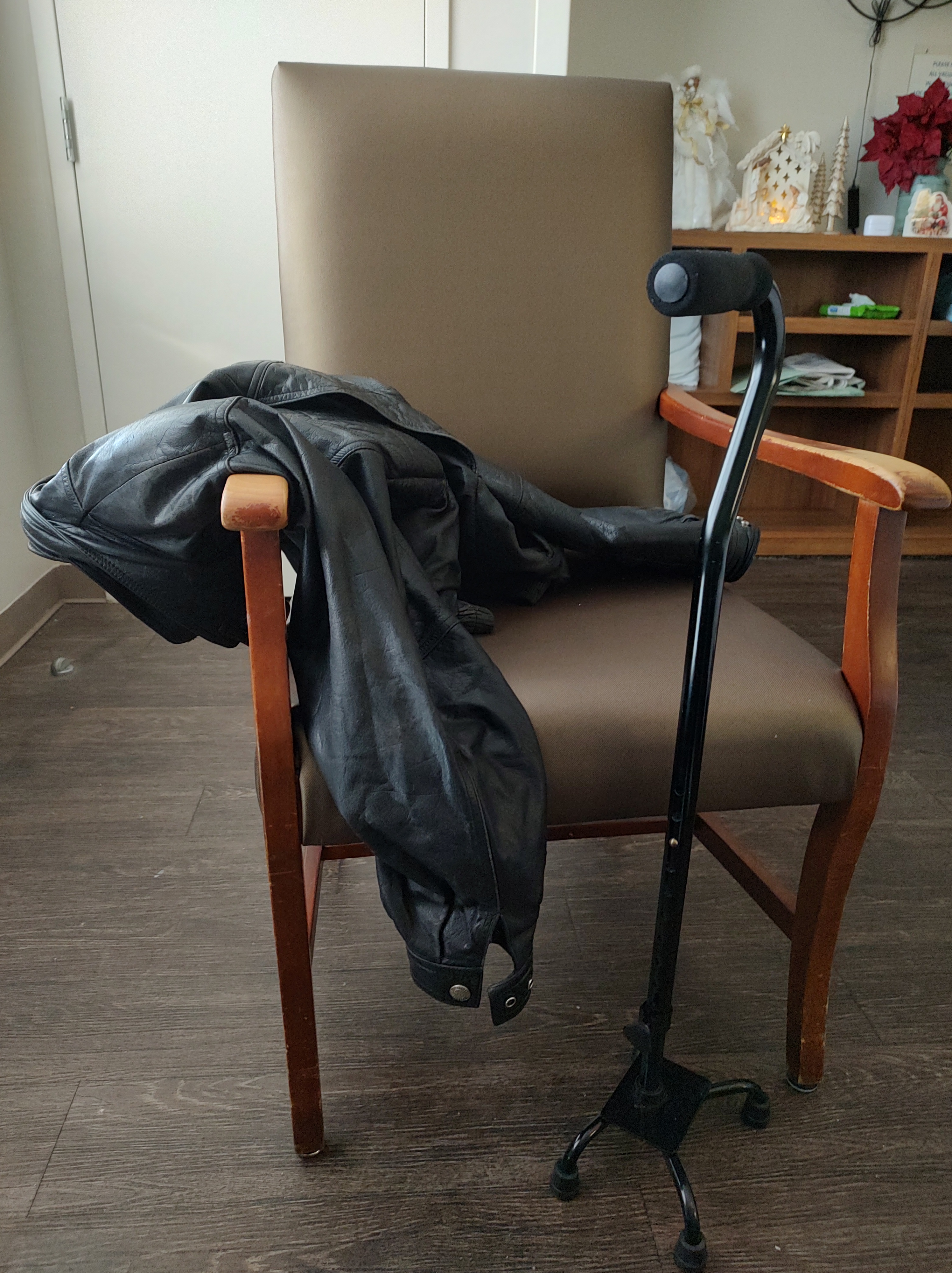
I realize that it’s a form of bigotry to say that I have respect for the aging process and old people while resisting the inevitability of becoming one myself. And while I do not try to hide my aging, I feel a need to defy aging stereotypes. Sometimes, validation comes at unexpected moments. Last night, after a 50+ hour session of sitting up with my mother at her rehab facility, I ducked out to the grocery store to pick up some things. The weather here has turned cold and I was wearing my most vintage item of clothing – a black leather jacket that I picked up in Indiana in 1994. As I was paying, the teenager who was bagging my groceries said, “Man, that jacket is dope.” When I realized that he wasn’t being ironic, I thanked him. “How old is that jacket?” he asked.

“A lot older than you,” I replied. “Over thirty years.”

To which he replied, “I want to have a jacket like that one day.”

As I left the store, I felt a little less tired. The limp from that skiing injury was somehow less pronounced.

Jacket | Cane | Hospital


Calm

 A friend sent a brief message to me last week. It was “a wish for calm.” He knows that I am going through a challenging time as a caregiver and I can think of no better wish than for calm to wash over me and the person I’m assisting. I responded that I perhaps should wish for “stoicism” also.

In times like these, the day-to-day distractions become ever more dear. Keeping the backyard bird feeders filled has become a veritable obsession that pays off, on occasion, with dozens of birds crowding two feeders, the ground, and a birdbath. Hummingbird feeders hang ready but there have only been a few sightings here in mid-April. Docile mourning doves predominate. When I come out to refresh the feeders, I see the doves sitting in the branches of the trees beyond the fence, watching and softly cooing.

The cardinals seem to prefer to visit in early morning and dusk. Two cardinal couples are around daily, and occasionally others will join in.

Spring happened fast this year. Suddenly, everything was green and lush. There has been no time to work in the flower beds, but perennials have popped up and winter pansies are hanging on until warmer weather settles in for the season. Easter came along faster than the Easter lilies this year. My mother has two patches of Easter lilies that look like they don’t plan to bloom for a while. The winter view down into Oxmoor Valley is now hidden by the curtain of green.

My life-long monitoring of the bird activity was heightened by the months of pandemic. Indeed, my whole endurance of another home-bound time of life was prepared, perhaps, by the pandemic experience. One of the few online sites that I follow is “Diary of a Gen-X Traveler” in which a midwestern couple shares their experiences as European travelers – primarily in Greece and Italy. During the pandemic, they shared adventures hiking and walking around places near their home in Iowa. The freshness of those takes on everyday things made the pandemic posts as interesting to me as the spectacular continental sights that they usually shared.

More recently, I look forward to three weekly posts by Garrison Keillor on his “Garrison Keillor and Friends” website. At eighty going on eighty-one, Keillor seems to be awestruck by his age. He has become assertively cheerful in extolling daily life in Manhattan and in his travels for solo performances across the United States. A proud Democrat, he finds common bonds across party lines and beyond the trivia of the “red state / blue state” dichotomy. His is a fresh wisdom nurtured through years of astute empathy and observation and he never fails to make me smile and sometimes laugh heartily.

My endurance of the news of the day has finally waned and whole days go by without the television being turned on. I keep up, more or less, in magazines and online and try to stave off the existential dread that will dominate the rest of the year. Reading is, as always, my favorite escape and even if I read about troubling things, there is solace in sitting with a book or magazine close at hand.

In addition to calm stoicism, I strive also for “comfort and joy” – a favorite phrase from “God Rest Ye Merry, Gentlemen,” a favorite Christmas song. Really, who could wish for more in their life than to have comfort and joy? Just to be clear, I don’t base my life on upbeat Christmas carol lyrics; another favorite Christmas lyric is Christina Rosetti’s “In the Bleak Midwinter,” which paints a cold and grim picture of the nativity.

Today, the tidings of joy make way for the promise of summer and hope for calm, peace, and justice to come.