Tag Archives: Atticus Finch

Growing Up with Atticus

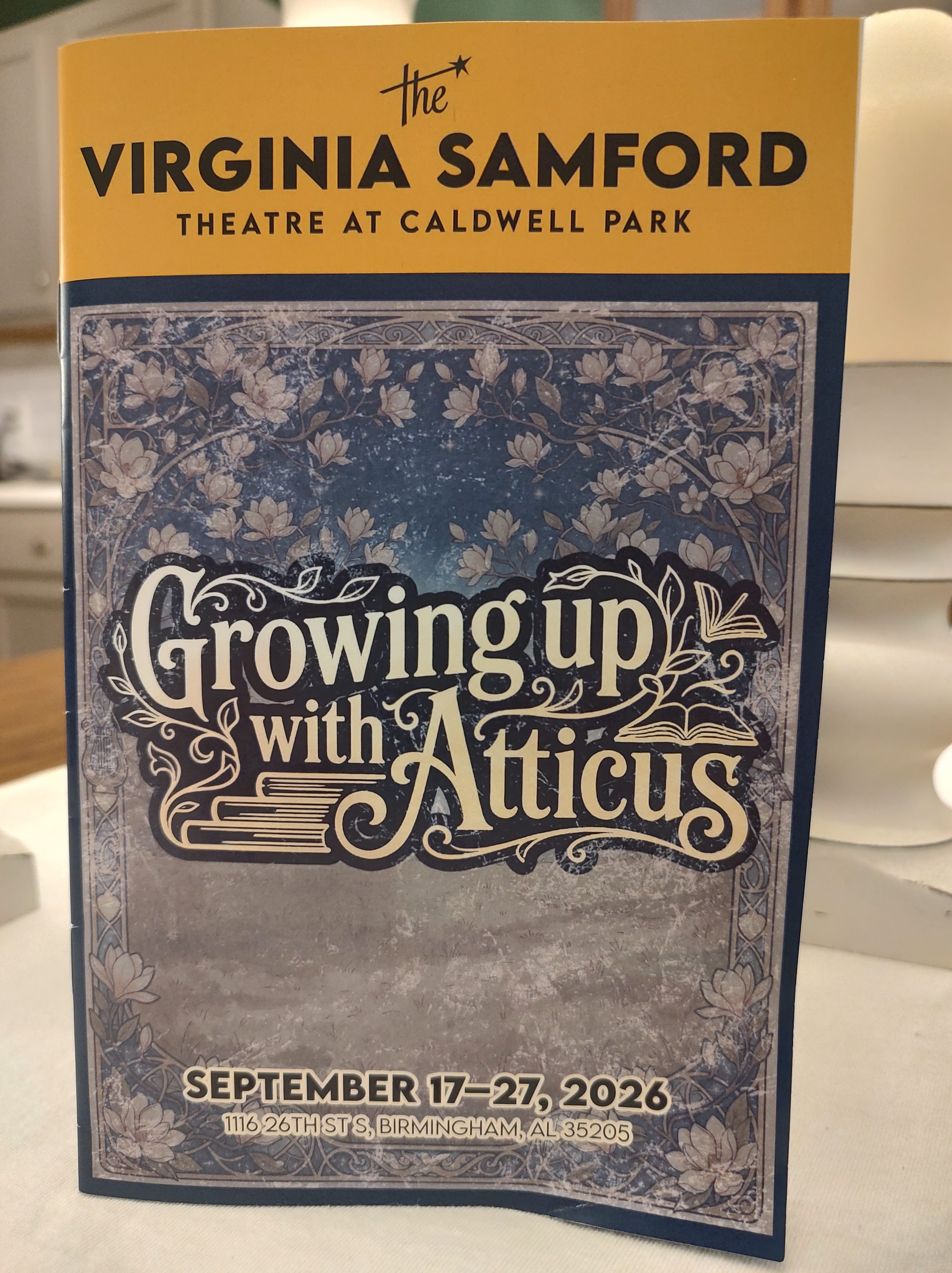
Birmingham’s Virginia Samford Theatre is celebrating its centennial in the 2026-2027 season. In 1927, it was founded as The Little Theatre, home to Birmingham’s community theatre. By the time I was growing up in the city, it was Clark Memorial Theatre, home to Town and Gown Theatre. When Town and Gown was dissolved at the turn of the century, the building was purchased and restored, renamed Virginia Samford Theatre, and continues to be a home for local live theatre.

The building has a rich history beyond the theatre and its shows. Writer and actor Fannie Flagg, as a shy fifteen-year-old, found her “tribe” at Town and Gown after volunteering to be a spotlight operator for a show and eventually became an actor on its stage. In the 1960s, Town and Gown gained a reputation for hosting successful auditions for major films looking for juvenile actors. Auditions for the film adaptation of Carson McCullers’s The Heart Is a Lonely Hunter, to be filmed in Selma, were held there and a young Sondra Locke lied about her age and landed the lead. I auditioned there for the juvenile lead in The Reivers, the film adaptation of William Faulkner’s last novel, starring Steve McQueen. I only got one callback but one of my classmates was flown to Los Angeles to audition with McQueen. Even so, a Hollywood kid was cast in that one. But Town and Gown’s most notable coup in film casting is the fact that Philip Alford and Mary Badham – neither of whom had previous acting experience – were cast as Jem and Scout Finch in the acclaimed and enduring film adaptation of Harper Lee’s To Kill a Mockingbird, starring Gregory Peck in his Oscar-winning role as Atticus Finch.

That history gives added luster to the fact that Virginia Samford Theatre opened its centennial season with the world premiere of Growing Up with Atticus, starring Mary Badham – “Scout” from the movie, and Cecilia Peck – Gregory Peck’s daughter. Growing Up with Atticus, directed by David Strickland, is presented as a conversation between two life-long friends, amplified by clips from To Kill a Mockingbird, photos, scrapbook images, and footage from various projects by Mary Badham and Cecilia and Gregory Peck.

Mary and Cecilia have known each other since childhood and have remained close ever since. That bond is evident in the comfort they share with each other onstage, sitting in chairs with a pitcher of tea, as they reminisce about the filming of To Kill a Mockingbird. Mary was eight years old when she was cast in Mockingbird and was ten when she was nominated for an Academy Award as Supporting Actress in the film; she is still the youngest Supporting Actress nominee in Academy history. The supporting actress Oscar that year went to Patty Duke, another juvenile actor, for her role as Helen Keller in The Miracle Worker, still another film adaptation of an Alabama-set literary work. Growing Up with Atticus incorporates video from the 1963 Oscar ceremony, including Gregory Peck’s acceptance speech, with Mary Badham’s explanation of why the cameras couldn’t find her when her name was called as a nominee.

It is those kinds of personal, intimate revelations that make the two-woman stage presentation so captivating. The show is a lovefest – from the haunting film score by Elmer Bernstein that plays as the audience is seated to the testimonials of the audience during a second act Q&A. The Q&A makes each performance a unique and singular experience. At the matinee I attended, a woman in the audience recounted how her father was imprisoned for his political activism and was inspired by the example of Atticus Finch standing up for what is right. A young girl who asked a question was named “Scout” to honor the book and movie’s influence on her parents. Audience members spoke of traveling from Arkansas, Louisiana, Virginia – just to see the show.

The performance includes content about the Civil Rights movement and the 1963 “Birmingham Campaign” in particular. Mary Badham recounts her chilling first encounter with racism on a Birmingham city bus with her nanny when the driver stopped the bus and separated her from her nanny so they would each be sitting in the racially “correct” seats.

During the Q&A that I attended, it was revealed that Sephira Shuttlesworth, the widow of Rev. Fred Shuttlesworth, was in the audience. Rev. Shuttlesworth was a guiding force in the Birmingham civil rights movement and Mrs. Shuttlesworth spoke briefly to the audience with words that were powerful, moving, and hopeful. After Mrs. Shuttlesworth was recognized, one audience member spoke up to say that Dr. King “got the credit” for the Birmingham Campaign, but Rev. Shuttlesworth “did the work.”

After I attended Growing Up with Atticus, I was asked if I enjoyed “the play.” I’m not sure how to respond since it isn’t really a play; it’s an event, an experience, and, at times, it feels like a revival meeting. There is one scene in the performance, however, that is theatrical in a way that elicits chills in the recounting. Cecilia and Mary discuss the pivotal nighttime scene when Atticus is sitting and reading in front of the courthouse, keeping vigil while Tom Robinson is imprisoned inside. On the screen above them, that scene from the movie is shown: A lynch mob arrives and confronts Atticus. Soon after, Jem, Scout, and their friend Dill arrive to check on Atticus. In the confusion that ensues, Scout recognizes Mr. Cunningham – the father of her classmate, Walter – and says “hey’’ to him. As Scout’s monologue continues, it is picked up by present-day Mary standing at the front of the stage. Another light comes up on Cecilia Peck standing beside the lamp, in the place her own father stood in the movie. As the filmed scene ends, Cecilia Peck and Mary Badham stand together, reflecting that powerful father-daughter moment on screen almost sixty-five years ago.

The magnificent performance and inspirational life-long influence of Gregory Peck is a focus of Growing Up with Atticus, but Harper Lee, Alabama, the Badham family, “the Book,” and “the Movie” also are prominently featured throughout. Ultimately, it seems, the conversation and interaction with Ms. Badham and Ms. Peck is about Family – the one we’re born into and the ones we choose. Cecilia Peck talks about the powerful bond her parents had with Harper Lee throughout their lives and her family’s annual visits to Lee in New York and, later, Monroeville. She introduced her husband, son, and the son’s girlfriend in the audience at that matinee. The son’s name – Harper Peck.

For their performance coda, Badham and Peck chose the words that Gregory Peck wrote in his notes at the end of his script for To Kill a Mockingbird – words that guide his portrayal of Atticus and words we’re urged to remember and live by: “Fairness, Courage, Stubbornness, Love.”

Atticus

IMG_1866  Sargent Shriver is one of my liberal heroes among 20th Century American politicians. A member of the Kennedy clan by marriage (to Eunice Kennedy), Shriver created and was the first director of the Peace Corps, provided the impetus for the War on Poverty, founded Head Start, Job Corps, VISTA, and Legal Services for the Poor, and, following Eunice’s lead, co-founded Special Olympics.

Shriver was from Maryland and had deep Maryland roots. When Scott Stossel’s excellent Shriver biography Sarge: The Life and Times of Sargent Shriver was published in 2004, this passage, early in the book, leapt out and intrigued me:

William Shriver [Shriver’s great-grandfather], although he was opposed to slavery, was a great champion of states’ rights and ardently supported the Southern cause. Six of his nine sons would serve in the Confederate army. Just across the road lived William’s brother Andrew, who, despite being a slave owner, was a staunch Unionist; his son was serving in the Twenty-sixth Emergency Regiment of Pennsylvania Volunteers.

In our contemporary era, Civil War studies do not seem to acknowledge such complexity. In our time, we tend to find the most simplistic explanations, get them trending on the internet and in the classroom, and let them be until a new trend emerges.

I have not spent a lot of time on my family genealogy but I do know that I, like Shriver, have ancestors who fought on both sides during the Civil War. Shriver’s were from Maryland; mine were from Alabama, Mississippi, and Tennessee. To the best of my knowledge, none of my ancestors owned slaves. At that time, and based on the history of the parts of the South where they settled, they may have never even seen a slave.

In Tennessee native Richard Tillinghast’s great poem “Sewanee in Ruins” (1981), he writes:

For the flaw in their neo-classical structure –
the evil of owning human beings –
they paid, all of them and all of us,
punished by a vengeance only New England could devise –
though only three Tennesseans out of a hundred in 1860
had owned a slave.

Today, however, we don’t seem to be able to acknowledge such complexity and contradiction. We lack context. We lack nuance. We want easy answers. And unless we can look back at history with context, nuance, and perspective, we will never be truly educated and will never understand where we come from

Because we lack context, there are those who want to vilify Abraham Lincoln as a racist based on statements he made in his time and in his place that might have been progressive then but would be shocking if uttered today. W.E.B. Du Bois was aware of these contradictions. And because W.E.B. Du Bois was a brilliant and perceptive man he wrote, about Lincoln, “I love him not because he was perfect but because he was not and yet triumphed.”

As a university professor I have been astonished that college educators are being mandated to emphasize “critical thinking” in our QEPs (Quality Enhancement Plans) as if “critical thinking” is a new concept. I was taught that higher education and critical thinking are synonymous and as a teacher I have always emphasized critical thinking; it’s my job. The problem is that well-meaning Ph.D. and Ed.D.-types – many of whom haven’t been in front of a classroom in decades, if ever – have created an educational environment that doesn’t encourage students to think at all. It will take us a couple of generations to recover from the damage done by “No Child Left Behind.”

It’s hard to think critically when all of the information you are given is oversimplified and sanitized and you are constantly being told what to think. It’s hard to think critically when you are not allowed to have perspective. “Politically correct” thinking is, I think, anathema to “critical thinking.” “Information” does not equal “Knowledge.”

James Baldwin, who was educated in a more progressive education system than we have now, wrote, “The paradox of education is precisely this — that as one begins to become conscious one begins to examine the society in which he is being educated.” That is the paradox that we must strive to renew as we re-learn how to convert information into knowledge.

Here’s perspective: Hugo Black of Alabama, one of the great liberal justices of the U.S. Supreme Court, whose hand is on some of the most sweeping civil rights legislation and social reform in American history, joined the Ku Klux Klan in the 1920s as a young Birmingham attorney and politician. His membership is neither justified nor forgivable but it’s complicated. Black, in retrospect, said that back then “I would have joined any group if it helped me get votes.” When FDR’s appointment of Black to the Supreme Court was confirmed by the U.S. Senate, that body was aware of his past membership in the Klan. The Senate – which was a more rational institution then than it is now – looked past Black’s past to what he had become and confirmed a man who is still considered one of the most liberal and progressive members in U.S. Supreme Court history.


Michiko Kakutani, literary critic for the New York Times, who has always had a tin ear for nuance (bless her heart), declares Atticus Finch to be a racist in her review of Harper Lee’s newly published Go Set a Watchman. I’m not sure, based on the evidence, that is what this novel is saying. One of the great talents shared by most Southerners in my experience is a talent for nuance. Many non-Southerners find that talent to be dissembling and irritating; I find a talent for nuance to be vanishing but still a great advantage in most human relations.

The copy of Harper Lee’s new/old novel Go Set a Watchman that I pre-ordered in February was at my front door when I arrived home from a friend’s funeral this past Tuesday, the day of its release.

I finished it this weekend.

It’s an interesting read and I was entertained. It is especially intriguing as the draft for what would become To Kill a Mockingbird. I’m not sure if I think it should have been published and I’m pretty convinced that Harper Lee’s sister, Alice – who handled Harper Lee’s legal and professional affairs, would have never allowed its publication if she had lived (she died last year at 103).

Unfortunately, driven by curiosity, I read the advance press and reviews so the book itself didn’t have many surprises. The big headline and web buzz has been that Atticus Finch has now been revealed as a racist by well-meaning reviewers like Kakutani.

I have to disagree. Atticus Finch has now been revealed as a product of his times. The book, even though it has only now been published, was written sixty years ago and in it Atticus expresses views that were not uncommon to thoughtful and concerned persons – Northern and Southern – of the 1950s. They might be repugnant to us now but it is essential to look at them critically and with perspective and context.

Some detractors of To Kill a Mockingbird – Flannery O’Connor famously and Truman Capote allegedly – dismissed it as a “children’s book.” That doesn’t seem to me to be a flaw although it is true that most readers of Mockingbird come to it at a fairly young age. But I think a root of that criticism may be the feeling that Atticus Finch is just too good to be true.

Now we know that Atticus – like Lincoln, like Jefferson, like all of us – is a flesh and blood human being and a product of his times as we all are (“let he who is without sin” etc. …). Real people have real flaws. In the 1950s and 1960s there were well-meaning people who urged caution and restraint in the Civil Rights Movement and who had doubts and fears about the right way to proceed. Martin Luther King, Jr.’s “Letter from Birmingham Jail” was originally addressed to well-meaning but reluctant Birmingham clergymen who were expressing concern that the Movement should be showing more patience and restraint. Go Set a Watchman presents Atticus Finch as another of these people urging caution and restraint and, let’s be honest, harboring a fear of the unknown.

What has been overlooked by reviewers, I think, is that Jean Louise, the grown up Scout from Mockingbird, has more than her share, by contemporary standards, of jarring and politically incorrect statements. Harper Lee’s Go Set a Watchman may be flawed and incomplete but it is unflinchingly honest.

In Go Set a Watchman, Atticus attends a Citizen’s Council meeting and curtly introduces a rabidly racist speaker to spew his venom; “because he wanted to” is Atticus’s explanation to Jean Louise. It is also revealed that Atticus attended one Klan meeting decades earlier but did not join and did not go back. It is suggested by Atticus’s law clerk that Atticus’s attendance at incendiary meetings is a way to find out who stands where on the issues of the day. Based on Atticus’s statements to Scout, however, it is suggested that Atticus might have common ground with some of their more reactionary rhetoric. Troubling statements are made.

There is nuance here.

Harper Lee, even as she was writing in the mid-1950s, was aware of the various nuances involved in what was going on in her hometown and in the country. She explored them as she wrote Go Set a Watchman and she eased them toward perfection as she rewrote the earlier novel and created To Kill a Mockingbird. In Mockingbird Lee found a way to make the issues enduring and universal. If she had stopped with Watchman, she would have had, I think, a minor novel exploiting the headline issues of the day and passing quickly from memory. In Watchman Lee presents an Atticus who is struggling with his beliefs and with his traditions and who, we can only hope, will come out on the right side of history. In To Kill a Mockingbird – even though it is set two decades earlier – she brings Atticus’s promise to fruition.

If I ever have a son (and I can almost guarantee that is never going to happen) I would still be proud to name him “Atticus.”