Tag Archives: Alabama books

The Myth of Water Renewed


Almost exactly ten years ago, I wrote about traveling back to my house after attending a reading in Decatur. It was a full moon, and I took the Upper River Road, a favorite rural drive through farmland just south of the Tennessee River. In the full moon afterglow of the reading, I noted the white intensity of the newly opened cotton in the fields and the freshness of a brief shower as I crossed the river that glowed in moonlight filtered through thin clouds. I had become more attuned to my senses – prompted in part by the poems I had just heard.

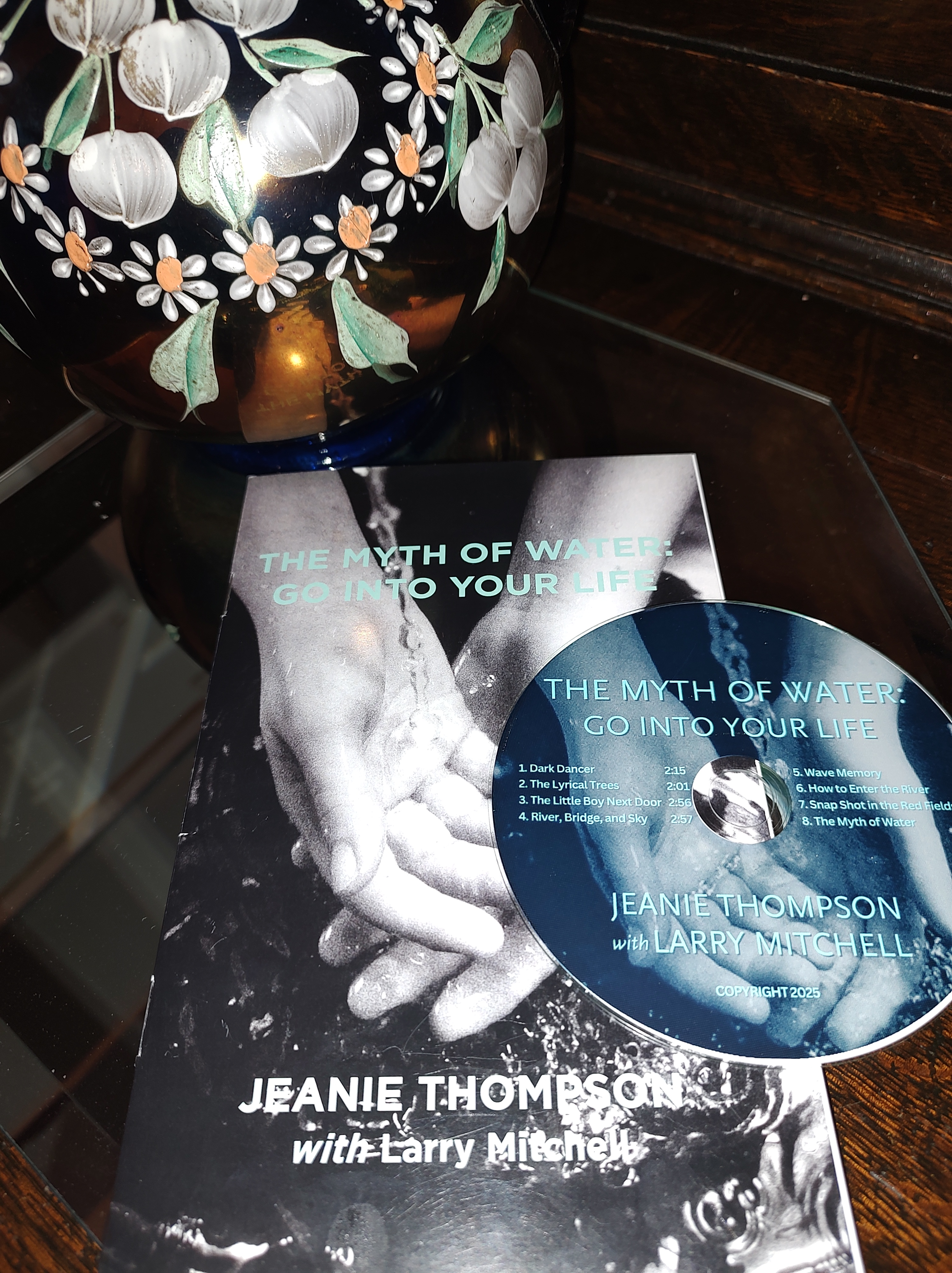
The reading was by poet Jeanie Thompson presenting poems from her newly released book, The Myth of Water, a contemplative meditation on the life of Helen Keller. The poet breaks through the silence of Keller, who was struck blind and deaf after a fever at an early age. Thompson explores what Helen Keller must have been thinking, feeling, and seeing in her heart and in her mind’s eye.

Keller, of course, with the patient guidance of her teacher, Anne Sullivan, was taught to navigate and communicate with the world around her. She earned a college degree and became a beloved icon of strength, grace, advocacy. Her remarkable success and leadership inspired world leaders and she is a beacon of unfettered possibility whose spirit and courage still speak to us today.

In 2016, poet Jeanie Thompson’s book, The Myth of Water: Poems from the Life of Helen Keller, moved beyond the public image and explored the possibilities and inner life of Helen, the woman. I had first read the poems on the page, but listening to the poet’s steady, clear, unhurried voice bestowed added texture and meaning.

In 2025, Thompson went into the Opelika, Alabama, recording studio of Grammy-winning guitarist/engineer/producer Larry Mitchell and added a new vision and texture to her remarkable poems of senses denied and discovered. The result is The Myth of Water: Go into Your Life, a CD and booklet containing Thompson’s reading of eight of her poems with sense-enhancing underscoring by Mitchell (www.jeaniethompson.com; available in digital format at The Myth of Water: Go Into Your Life | Jeanie Thompson).

Five of the poems are from the thirty-seven poem cycle The Myth of Water with three additional selections from Thompson’s previous books, Litany for a Vanishing Landscape, How to Enter the River, and White for Harvest. Those three poems, written before the Helen poems, remind the reader just how skillfully Thompson’s poems have always evoked the senses and the natural world. “Snapshot in the Red Fields,” from White for Harvest, provides a sensory depth that is thrilling and visceral as a farmer, surveying his newly plowed field, “would just as soon dive into it, and forget himself, / down into its depths, rather than to ever know / that season would not come again.” “The Lyrical Trees,” from Litany for a Vanishing Landscape, vividly paints a cold winter landscape as Mitchell’s chords emphasize the visual references and three trees rise “in twists that dancers dream to imitate.” Mitchell’s mesmeric percussive beat takes you into “How to Enter the River,” one of Thompson’s signature early poems, as the reader and the person paddling the boat become one with the nature that surrounds them.

It is in the Helen poems that the full triumph of the collaboration of words and music is felt. The first poem, “Dark Dancer,” addresses Helen’s great love, Peter Fagan, the man who “shook language / in my face and asked me to dance syntax / with you.” It is a poignant rendering of the occasion on which Fagan fails to arrive at Helen’s sister’s house for their planned elopement. Helen, alone on the porch, feels the morning arrive in “a rumble from the street / signaling day.” That sense of loss also finds voice in “The Little Boy Next Door,” inspired by the photograph of Helen with a young boy nestled in her arms. She “felt the quickening of a mother’s desire for his / small body on hers” and later, when Peter did not arrive, she “mourned the child lost / to me.”

In “River, Bridge, and Sky,” Helen is on a ship with Polly, her companion after “Teacher,” Anne Sullivan, has died. Helen and Polly each silently remember this day is the birthday of Teacher as Helen ponders the world that Teacher opened for her – as she “Begged me / to enter a land you / promised I would see.” Later, “Wave Memory” considers the moment at Ivy Green, Helen’s family home, when Helen, “just a babe,” experiences “the receding sound of Mother’s / breath at the phantom’s ear.” “No mooring, no anchor” is the plaintive refrain.

There is a moment in “River, Bridge, and Sky” when Helen acknowledges the whispers of some that “‘She who doesn’t know light, / much less a flower, writes this?’.” Many don’t realize that Helen Keller had sight and vision for the first nineteen months of her life; she later described vague, uncertain images as if from a dream (she even used the word “nightmare”). Even so, in these poems I am struck by Thompson’s ability to evoke the senses of touch, smell, and taste that Helen retained to capture the reality of her world.

There is triumph and resolve in “The Myth of W-A-T-E-R,” the final piece in this collection. In it, Helen clarifies the moment of finding language with Teacher at the pump and acknowledges the myth: “You may have your play, your frozen moment in time / if these please you.” In “The Myth of W-A-T-E-R,” Helen takes charge of her story and follows the command to “Go into your life!”

The Helen poems have a wistful longing, calm acceptance and resolve. Jeanie Thompson’s vocal performance has always served her words well and, with this collaboration, Larry Mitchell’s masterful guitar work, moody percussion, and evocative keyboard work have added new meaning and texture. Listen to the subtle shifts in tempo, the moments that words and music call forth excitement, anticipation, or loss. These are poems I have visited often over the years, but the addition of Mitchell’s music lends a different way to understand Thompson’s words and intent. Thompson and Mitchell have made some live appearances to perform their work on The Myth of Water. I hear there are more to come. Be watchful for those. I hope to experience these poems in a live setting soon.
Dura and Houston McCarn

I recently reviewed The Ballad of Fiddling Tom Freeman: Music, Moonshine & Murder in Bug Tussle, Alabama, by Joyce H. Cauthen with Robin Sterling, for Alabama Writers’ Forum and First Draft magazine. I was compelled to add the following note to my author bio: [Journey] was pleased to find that his great-grandparents, John Houston McCarn and Dura Evelyn Graves McCarn, are a part of Fiddling Tom’s story; he is quick to point out that they appear in the context of music – not moonshine and murder.

The Ballad of Fiddling Tom Freeman includes generous excerpts from an autobiographical book Freeman wrote that was never published. Cauthen took his manuscript, her own research and information on historical contexts, and Robin Sterling’s extensive research to bring Freeman’s story and the story of his community to light. She contacted me just before the book’s publication to tell me that she had found my family connection to a part of Freeman’s story.

I chose not to include the family connection in my review. The book has so many fascinating anecdotes and information that it was a challenge to figure out what to leave out. But this is my essay about my great-grandparents so I will feel free to focus on my kin.

(L-R) Houston, Jewel, and Dura McCarn

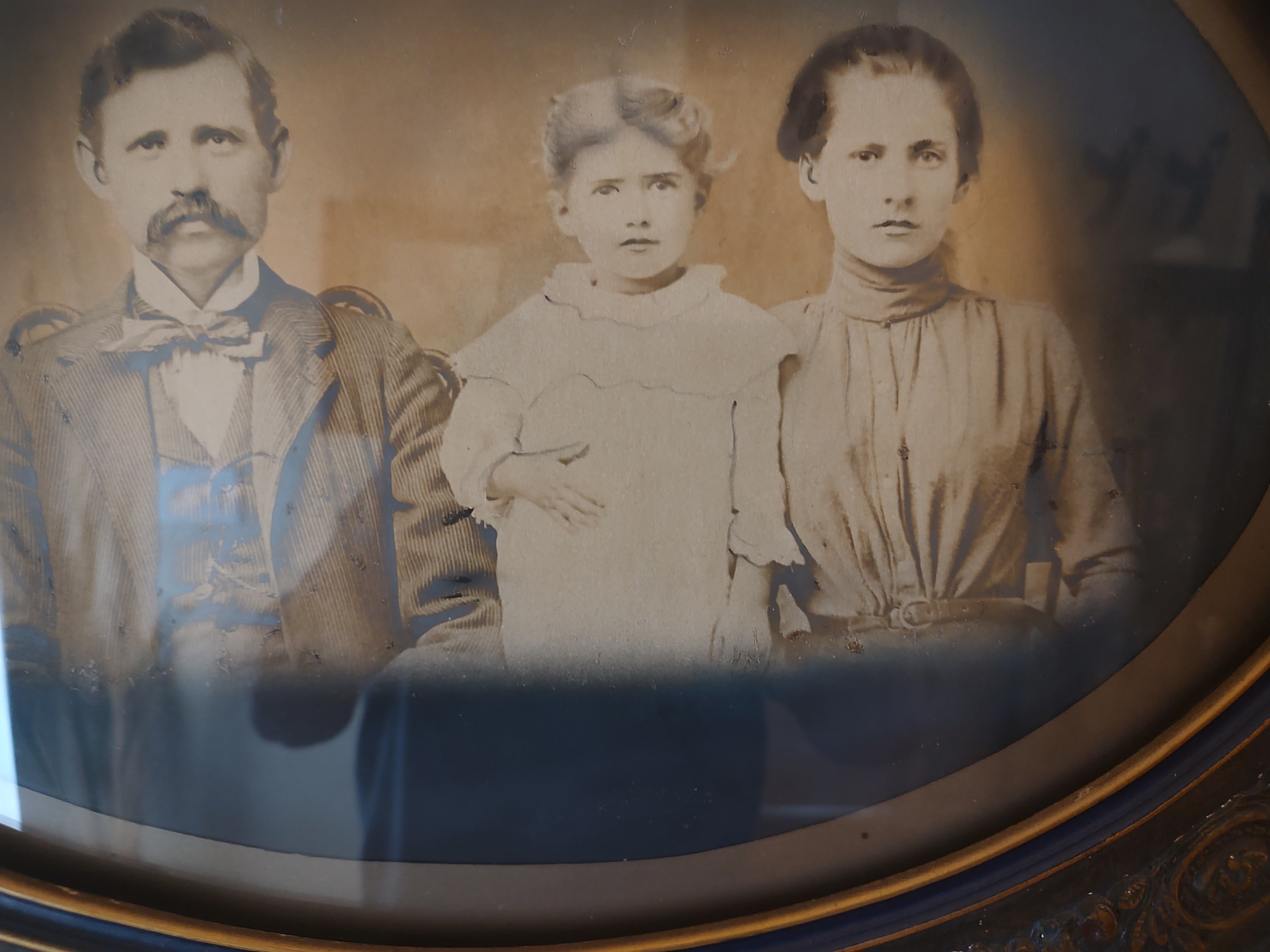
I have written about my great grandfather, John Houston McCarn, who was a schoolteacher in and around Cullman County. He was born in 1865 and didn’t die until 1959, so I have vague memories of him from when I was very young. As I grew older, it dawned on me that this old man that I had first-hand memories of was born the year the Civil War ended. Houston married Dura Evelyn Graves, who was fifteen years his junior, and they had seven children together. Their first-born daughter, Jewel, died in childhood in 1909, the year my grandmother, Eula, was born. Dura died an early death in the 1920s. Houston and Dura raised their family in a dogtrot-style house, always referred to as “the homeplace,” on a large farm in the community of Bremen. That house is long gone but I remember it, too. When I knew it, the dogtrot had been closed in and my grandmother’s sister, Bessie, lived there.

I’m writing now about things that happened in the late-19th and early-20th centuries before electricity and mass media changed the dynamics of how neighbors interacted with and entertained each other. Grandpa Houston played the fiddle, as did his daughter Nadine. Son Burnett played guitar and Eula played the piano. I assume Bessie, Ray, and Zell played instruments, also, and I seem to remember my grandmother saying that Dura played the piano. I imagine the family gathering on the wide porch or in front of the fireplace and playing music together. I’m told that Grandpa had a lot of books, so perhaps they read or told stories together, too. Family histories are derived from stitching together the bits and pieces of stories that come down through the years.

Bremen was up the mountain from the community of Wilburn, which over time came to be called “Bug Tussle.” According to Cauthen, “Bug Tussle” was the informal designation not just for Wilburn, but for parts of the communities that surround it. Bremen was close so some might have placed Grandpa’s farm in Bug Tussle. Either way, Bremen’s proximity to Bug Tussle is how my ancestors became a part of Freeman’s story.

The most satisfying part of the book’s comments about my great-grandparents is that they confirm stories about the two that I have heard all my life. Tom Freeman calls my great-grandfather “Uncle Houston McCarn.” He writes that “Uncle Houston” would drive his horse and buggy down Brushy Pond Mountain and say, “Fiddling Tom, go home with me & fiddle some for me tonight.” Houston had the first car in his community, according to my grandmother, but never bothered to learn to drive himself. Tom and his fiddle would hop in the buggy and go to Bremen, play well into the next morning, and after going to bed around 3:00 AM, Dura would wake them for breakfast at 4:00. On another visit to play at Houston’s house, Tom claims, “I played 63 hours with only four hours out to sleep.” Tom challenges any doubters of the veracity of his claim to contact J.H. McCarn.

Houston taught at one and two-room schools through the years and often went to college in the summers to augment his already impressive education. While he was away, he’d leave his children to toil with the sharecroppers to tend to the farm. He used his education to be a good teacher, but a stern taskmaster. Tom calls Houston “one of the best old-timer school teachers I ever saw.” Tom’s son had “Uncle Houston” as a teacher and Tom writes that he “learned my boy more in one day than he had ever learned in 5 years of going to school.”

Tom’s grandson Donald Freeman shared another Houston McCarn teaching story with Joyce Cauthen. He heard it from his grandfather: A group of parents went to the local school commission asking for a teacher who could control the unruly boys who kept running teachers off from the McKinley Chapel school. The commission told the parents, “Yes, we have one, but you might not want him.” The parents wanted him anyway and Houston McCarn arrived at the school on the first day with “a six-foot hickory limb and a double barrel shotgun. Within two days you could hear a pin drop.”

My great-grandmother Dura McCarn died when my grandmother was a young girl so we only knew her through the fond memories of Grandmother and her siblings. Tom, though, also knew Dura (he calls her “Dewey”) and he can back up her children’s affectionate words. She was, he writes, “one of the best women I ever met in my life.”

Cicero is given credit for saying that “the life of the dead is placed in the memory of the living” in the 1st Century BC. That idea persists today in the idea of the “second death” – when there is no living memory of those who have passed on to “the next thing,” as my parents’ friend Phoebe Barr used to say. I must say I’m grateful to Fiddling Tom Freeman and his chronicler, Joyce Cauthen, for helping to extend the living memory of Houston and Dura McCarn.

New Book Reviews for Alabama Writers’ Forum

My latest reviews about two sharply contrasting books have just been posted on Alabama Writers’ Forum. Deep South Dynasty by Kari Frederickson is a fascinating history of an influential Alabama family, the Bankheads. Barry Marks’s new poetry, My Father Should Die in Winter, examines grief and hope. Check them out at https://www.writersforum.org/news_and_reviews/