I recently reviewed The Ballad of Fiddling Tom Freeman: Music, Moonshine & Murder in Bug Tussle, Alabama, by Joyce H. Cauthen with Robin Sterling, for Alabama Writers’ Forum and First Draft magazine. I was compelled to add the following note to my author bio: [Journey] was pleased to find that his great-grandparents, John Houston McCarn and Dura Evelyn Graves McCarn, are a part of Fiddling Tom’s story; he is quick to point out that they appear in the context of music – not moonshine and murder.
The Ballad of Fiddling Tom Freeman includes generous excerpts from an autobiographical book Freeman wrote that was never published. Cauthen took his manuscript, her own research and information on historical contexts, and Robin Sterling’s extensive research to bring Freeman’s story and the story of his community to light. She contacted me just before the book’s publication to tell me that she had found my family connection to a part of Freeman’s story.
I chose not to include the family connection in my review. The book has so many fascinating anecdotes and information that it was a challenge to figure out what to leave out. But this is my essay about my great-grandparents so I will feel free to focus on my kin.

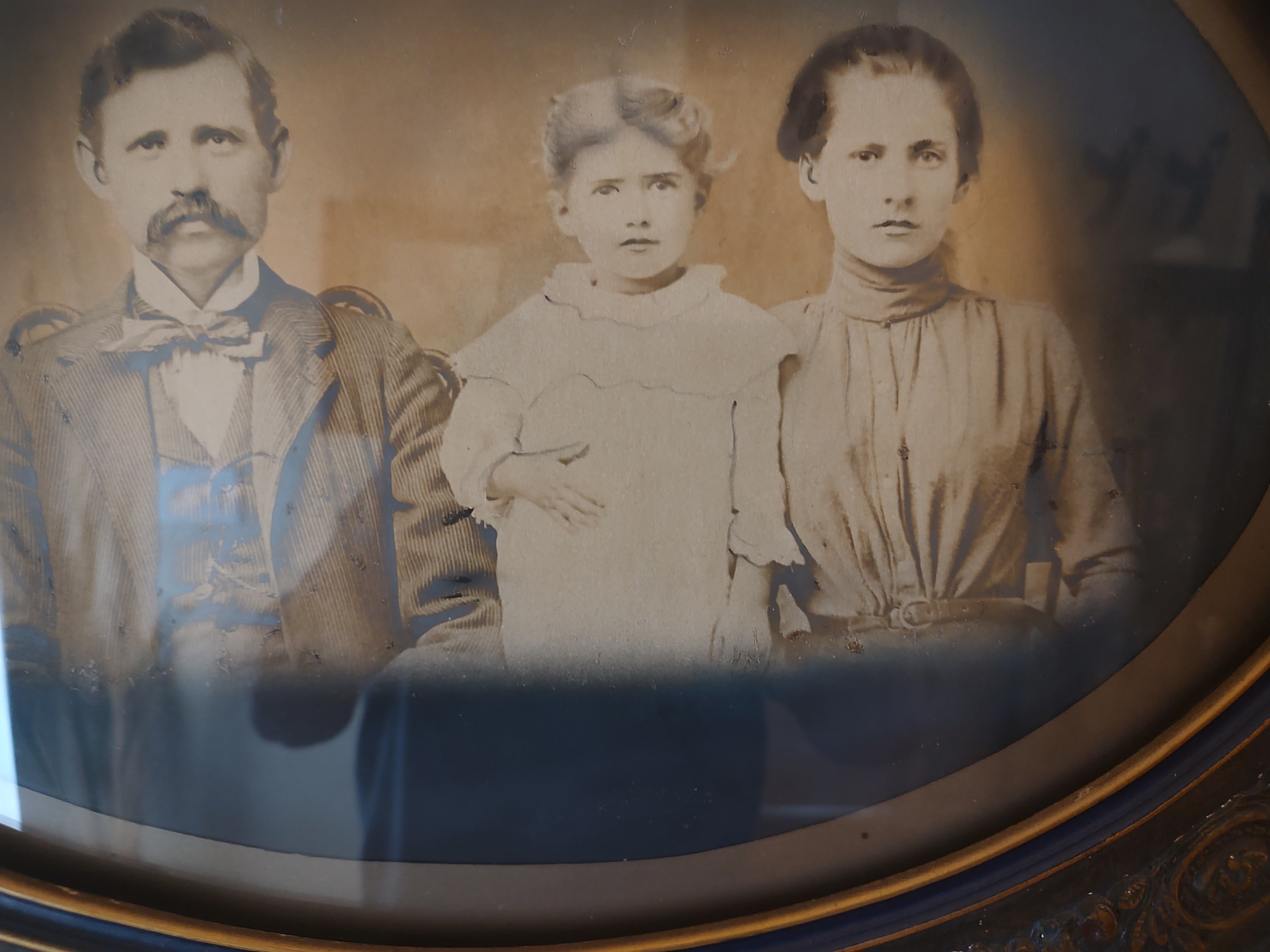
(L-R) Houston, Jewel, and Dura McCarn
I have written about my great grandfather, John Houston McCarn, who was a schoolteacher in and around Cullman County. He was born in 1865 and didn’t die until 1959, so I have vague memories of him from when I was very young. As I grew older, it dawned on me that this old man that I had first-hand memories of was born the year the Civil War ended. Houston married Dura Evelyn Graves, who was fifteen years his junior, and they had seven children together. Their first-born daughter, Jewel, died in childhood in 1909, the year my grandmother, Eula, was born. Dura died an early death in the 1920s. Houston and Dura raised their family in a dogtrot-style house, always referred to as “the homeplace,” on a large farm in the community of Bremen. That house is long gone but I remember it, too. When I knew it, the dogtrot had been closed in and my grandmother’s sister, Bessie, lived there.
I’m writing now about things that happened in the late-19th and early-20th centuries before electricity and mass media changed the dynamics of how neighbors interacted with and entertained each other. Grandpa Houston played the fiddle, as did his daughter Nadine. Son Burnett played guitar and Eula played the piano. I assume Bessie, Ray, and Zell played instruments, also, and I seem to remember my grandmother saying that Dura played the piano. I imagine the family gathering on the wide porch or in front of the fireplace and playing music together. I’m told that Grandpa had a lot of books, so perhaps they read or told stories together, too. Family histories are derived from stitching together the bits and pieces of stories that come down through the years.
Bremen was up the mountain from the community of Wilburn, which over time came to be called “Bug Tussle.” According to Cauthen, “Bug Tussle” was the informal designation not just for Wilburn, but for parts of the communities that surround it. Bremen was close so some might have placed Grandpa’s farm in Bug Tussle. Either way, Bremen’s proximity to Bug Tussle is how my ancestors became a part of Freeman’s story.
The most satisfying part of the book’s comments about my great-grandparents is that they confirm stories about the two that I have heard all my life. Tom Freeman calls my great-grandfather “Uncle Houston McCarn.” He writes that “Uncle Houston” would drive his horse and buggy down Brushy Pond Mountain and say, “Fiddling Tom, go home with me & fiddle some for me tonight.” Houston had the first car in his community, according to my grandmother, but never bothered to learn to drive himself. Tom and his fiddle would hop in the buggy and go to Bremen, play well into the next morning, and after going to bed around 3:00 AM, Dura would wake them for breakfast at 4:00. On another visit to play at Houston’s house, Tom claims, “I played 63 hours with only four hours out to sleep.” Tom challenges any doubters of the veracity of his claim to contact J.H. McCarn.
Houston taught at one and two-room schools through the years and often went to college in the summers to augment his already impressive education. While he was away, he’d leave his children to toil with the sharecroppers to tend to the farm. He used his education to be a good teacher, but a stern taskmaster. Tom calls Houston “one of the best old-timer school teachers I ever saw.” Tom’s son had “Uncle Houston” as a teacher and Tom writes that he “learned my boy more in one day than he had ever learned in 5 years of going to school.”
Tom’s grandson Donald Freeman shared another Houston McCarn teaching story with Joyce Cauthen. He heard it from his grandfather: A group of parents went to the local school commission asking for a teacher who could control the unruly boys who kept running teachers off from the McKinley Chapel school. The commission told the parents, “Yes, we have one, but you might not want him.” The parents wanted him anyway and Houston McCarn arrived at the school on the first day with “a six-foot hickory limb and a double barrel shotgun. Within two days you could hear a pin drop.”
My great-grandmother Dura McCarn died when my grandmother was a young girl so we only knew her through the fond memories of Grandmother and her siblings. Tom, though, also knew Dura (he calls her “Dewey”) and he can back up her children’s affectionate words. She was, he writes, “one of the best women I ever met in my life.”
Cicero is given credit for saying that “the life of the dead is placed in the memory of the living” in the 1st Century BC. That idea persists today in the idea of the “second death” – when there is no living memory of those who have passed on to “the next thing,” as my parents’ friend Phoebe Barr used to say. I must say I’m grateful to Fiddling Tom Freeman and his chronicler, Joyce Cauthen, for helping to extend the living memory of Houston and Dura McCarn.