Monthly Archives: June 2015

Eat Fresh, Eat Local

IMG_1570  Somewhere in chef Jeremiah Tower’s very entertaining memoir, California Dish (2004), he repeats the snarky comment made by a French chef about the cuisine of Alice Waters, the 1970s pioneer in the California Cuisine movement: “That’s not cooking; that’s shopping!”

I love that quote and am wholeheartedly among the growing movement of people who know that the freshness and quality of the ingredients we use are just as important as what we do with and to those ingredients. This used to be the position of tree-huggers and the fringe but the crowds flocking to local farmers markets are evidence that the philosophy is now mainstream and still growing.

It’s not food snobbery. It’s just learning something anew that previous generations understood and accepted as a way of life.

My Grandmother Harbison always had good food warming in the oven and usually there was a pot of fresh-made vegetable soup on the stove. In addition to that, there was always a fresh cake of cornbread in an iron skillet and more often than not a cake or dessert of some kind. She continued cooking even when her health began to limit what she was able to do.

I always knew that whenever I dropped by my grandmother’s house one of the first questions would be “Are you hungry?” Even if I wasn’t particularly hungry, Grandmother would lay out a table full of food within minutes. And I would always find an appetite for it.

It used to amuse me when I would drop by and Grandmother would have plenty of food in the house but would say “Would you rather go pick up some ‘tacahs’?” referring to a Taco Bell down on the highway.

“No — I’d rather eat a bowl of your vegetable soup,” I’d reply. Sometimes she would insist on riding with me to pick up a bag of tacos anyway – neither she nor my grandfather drove. I realized that while fast food was nothing novel and special for me and I was craving home cooking – real food, my grandmother had been cooking for family and crowds for most of her life and rarely went to a restaurant or hamburger stand. It was an enjoyable change for her to have a fast food taco now and then.

Today I came in from work and surveyed my supply of food. It’s a hot and rainy day and I was in the mood for a salad. The first thing I spotted was a Cherokee Purple tomato on the kitchen counter that I picked up at Greene Street Farmers Market at Nativity a few days ago (www.greenestreetmarket.com). It was getting a little ripe and I needed to eat it before I traveled for the 4th of July holiday in a day or two.

My friend Judy Prince from Paint Rock Valley told me a few years ago that she planned to “bring back” Cherokee Purples, an heirloom tomato with a bruise of purple skin and a deep burgundy fleshy meat. Based on recent observations at a variety of farmers markets, I have to say to Judy, “Mission accomplished.” Practically everybody with tomatoes at the market had some Cherokee Purples in the mix.

With my Cherokee Purple as the centerpiece, I pulled out some lush green leaf lettuce from the local J. Sparks Hydroponic Farm (www.jsparksfarms.com), washed and tore it, and made a crisp bed of lettuce. I chopped up a purple bell pepper from the organic RiverFly Farms in Paint Rock Valley (www.lifeasweknowhim.com) and a pretty baby onion from another Greene Street stand. Fresh basil and mint came from pots in my back yard and I crumbled the “Garden Blend” of goat cheese from Humble Heart (www.humbleheartfarms.com) on top of the mix. I finished it off with salt and pepper and drizzles of a good olive oil and balsamic vinegar that I have on-hand.IMG_1846

It was a lordly summer lunch made even more special by the fact that I know each purveyor (except for the oil and vinegar) by name and had bought all of the ingredients directly from the farmers who grew them. As we “re-learn” the benefits and pleasures of fresh local food, we are making a connection with generations before us who took fresh food from the area for granted. How lucky they were, if they only knew.

A few weeks ago, on Father’s Day weekend, my family decided to forego the hassle of a restaurant and eat a farm-fresh Sunday dinner at my parents’ house as a joint celebration of Father’s Day and my mother’s birthday a couple of days later. On Saturday morning, I went to my personal favorite farmers market, Pepper Place Market in Birmingham (www.pepperplacemarket.com), and surveyed the prospects among the booths.

Pepper Place sprawls along the site of an old Dr. Pepper plant that has been transformed into a design center and dining district. Pepper Place Market takes over the exteriors on Saturdays from 7:00 a.m. to noon and has over 100 vendors in three distinct areas. The Market started in 2000 and has gotten a little large and crowded but I find that if you get there by 8:00 a.m. it’s easier to navigate and there are fewer baby carriages to maneuver around. I came away with tomatoes, okra, corn on the cob, and lady peas and made the next day’s meal of creamed corn, fried okra, and the lady peas cooked in chicken broth. Mother cooked a pork roast and cornbread. Once again, it was an exceptional meal which mostly bypassed the middle step by buying directly from the growers.

Sometimes, at the various farmers markets I attend, I look at the people around me and wonder if all the trendy people are an indication that the slow food and farm-to-table movements are merely a current and growing trend; I wonder if we will all go back to opting for “convenience.”

I think not. I think that as we have begun to re-learn food and as more and more local chefs and restaurateurs serve local food from local purveyors that is superior in quality, we will opt for the smart way and support the movement as we see how it benefits all of us in so many ways. Unless I am actually in California, I vow to never again eat another grocery store tomato from California that was chemically treated and travelled across the continent while infinitely better tomatoes were on a vine just steps away.

IMG_1569American Farmland Trust (www.farmland.org), the people responsible for those “No Farms No Food” bumper stickers, is doing good things in support of local farms. Their website includes great information about local farmers markets nationwide. Visit one soon if it’s not already a part of your routine.
“Iron Butt”

IMG_1822   When I am asked “where are you from?” my automatic response is “Birmingham.” I was born in a military hospital at Fort Benning across the Chattahoochee River from Alabama in the final days of my father’s military service. But my parents are from Birmingham, both sets of grandparents lived there, and I moved there when I was a month old.

My father’s work frequently moved the family while I was growing up so I left Birmingham three times in my growing up years and moved back three times between birth and age 15. During all my years in Tuscaloosa at the University, I was less than an hour away and was in town frequently. I also had one enjoyable stint living in Birmingham as an adult for four years in the early ‘90s. If the right opportunity presented itself, I’d gladly move back.

I’ve lived away from Birmingham more than I’ve lived in Birmingham but it is always “home” to me. And those of us who call Birmingham “home” are a strangely loyal and proud bunch. The allure of the city is not always apparent to people who don’t know the place but I am always intrigued by the affectionate responses I get from displaced Birminghamians around the country.

When I was young my parents would talk about being young marrieds in Chicago in the early ‘50s – Dad was military and Mother worked for an insurance company – and running into people from Birmingham in Grant Park and other Chicago locales. The energy of the talk would escalate if the Birminghamians happened to be from Ensley, my dad’s old neighborhood and the place where he and Mother met.

When I was working in Texas, I met an older theatre volunteer who had been born and raised in Birmingham and her eyes would glisten as she fondly recalled growing up in the city. She had not returned since she got married and stranded in Texas 42 years earlier. When I was going home to Alabama for the holidays, she asked me to bring her back a six-pack of Buffalo Rock, a strong and spicy dark ginger ale that originated and is still made in Birmingham.

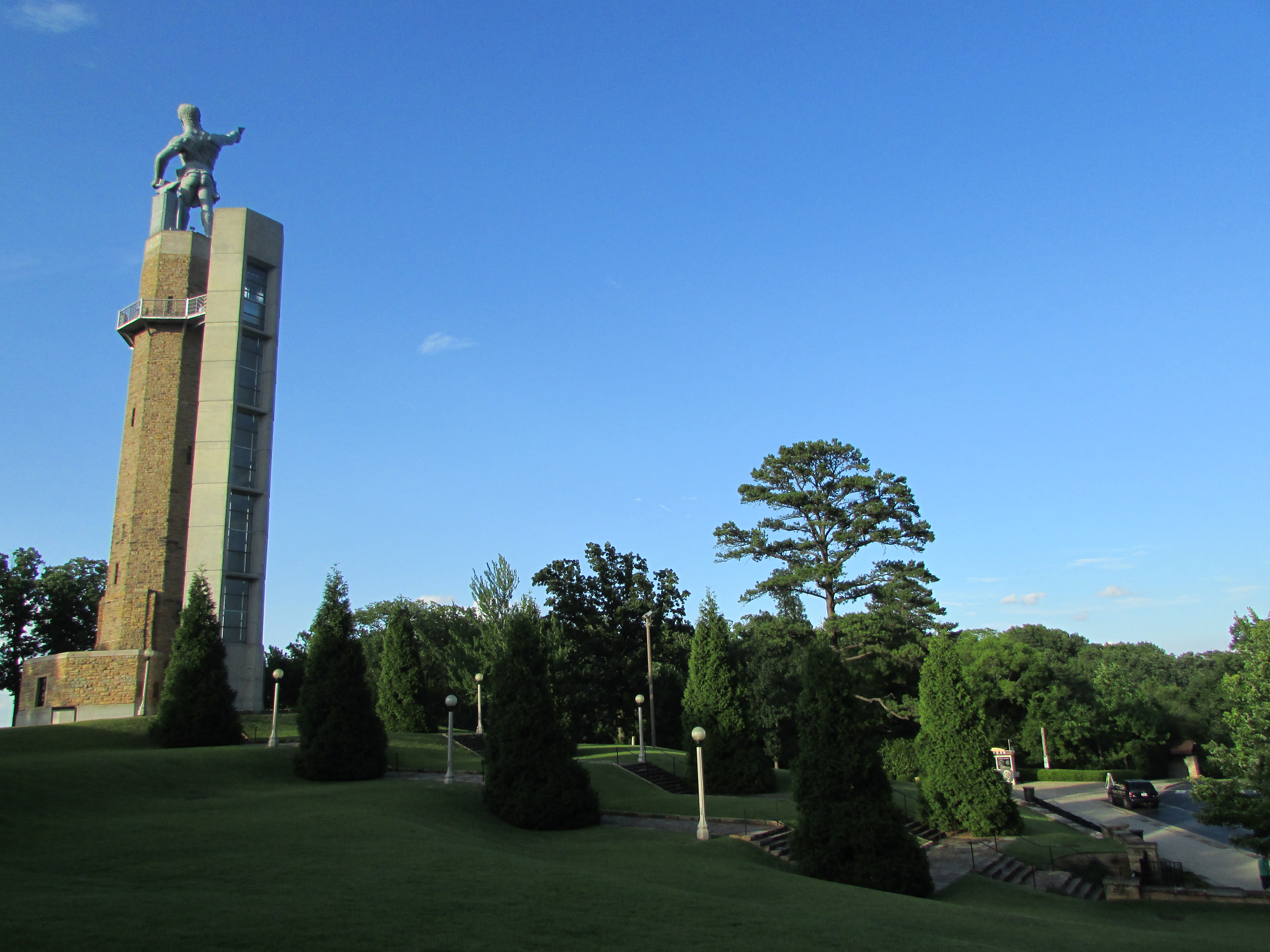
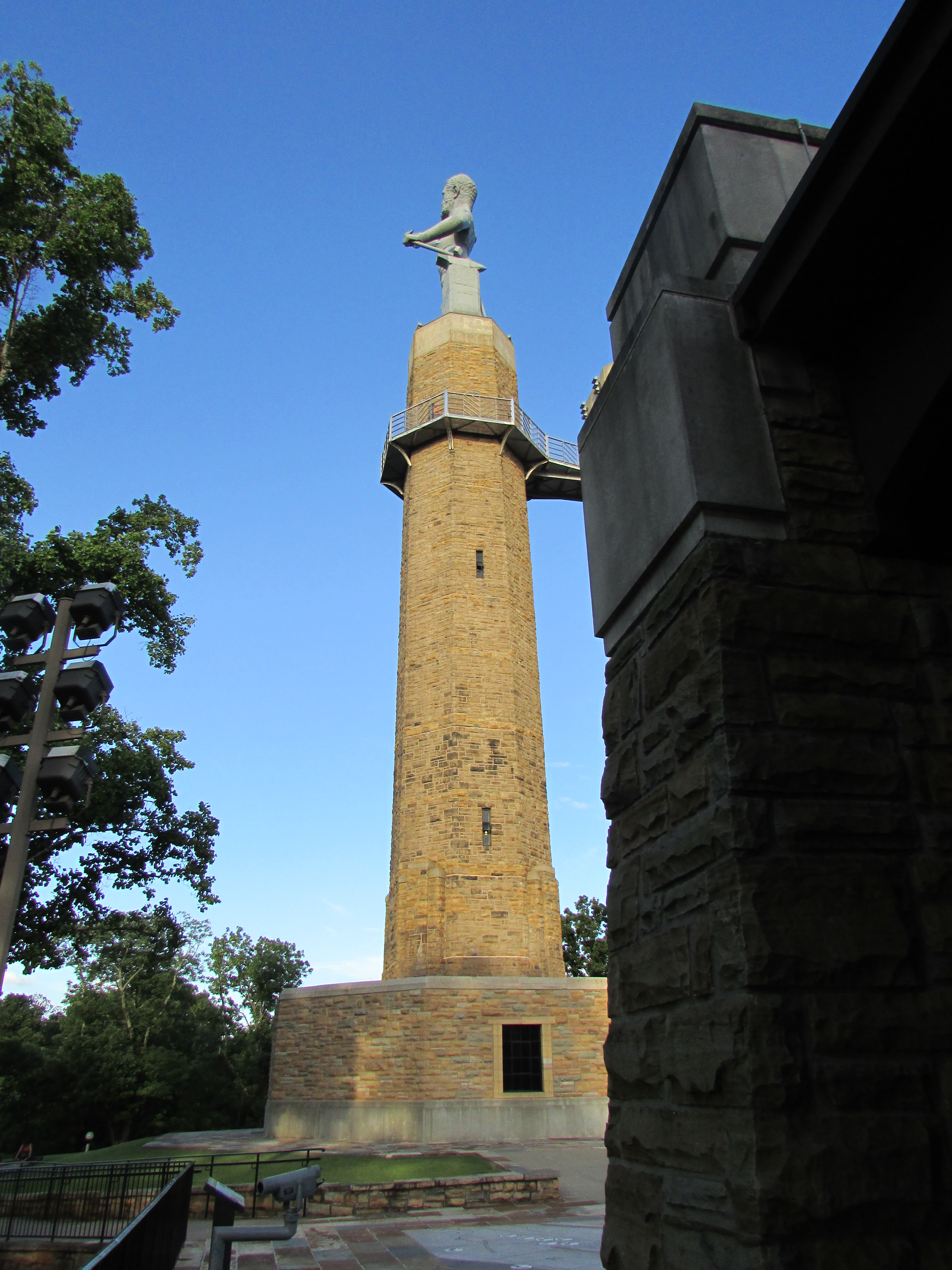
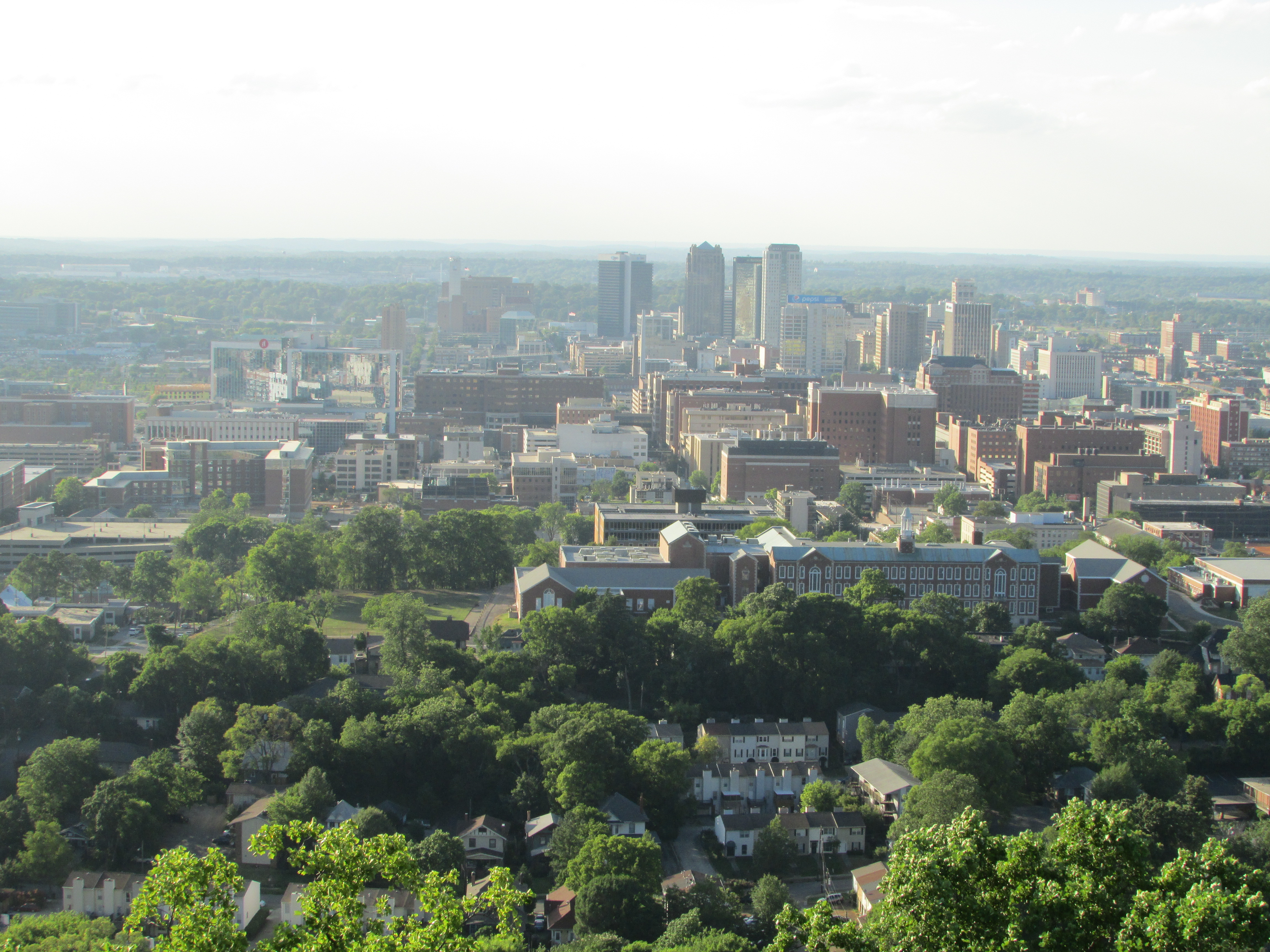
IMG_1807These memories are sparked by a visit to Vulcan Park this evening (www.visitvulcan.com). Vulcan, the Roman god of the forge, is the symbol of Birmingham and the representation of the city’s industrial history. A 56 foot tall iron statue of Vulcan overlooks the city from a 123 foot tall stone pedestal atop Red Mountain. Vulcan atop his perch is visible from locations throughout the city and whenever I return to Birmingham I always look for my first glimpse of Vulcan from the interstate. Vulcan means “home” to me.

Vulcan made his debut as Birmingham’s exhibit in the 1904 St. Louis World’s Fair. The city was only 33 years old at that time and had already become the industrial center of the South. Civic leaders commissioned the colossus from sculptor Giuseppe Moretti and it was fabricated with iron from the Birmingham area. Vulcan was a popular attraction in St. Louis, winning a Grand Prize.

Vulcan is a burly, bearded guy standing next to his block and an anvil with a hammer in his left hand. In his right hand he holds a newly forged spear point aloft. He is naked except for a blacksmith’s apron. The apron partially covers him in front but his back is bare with buttocks exposed. Before a recent restoration, he was angled on his pedestal so that his back side was aimed toward Homewood, a suburb just over the mountain from Birmingham, and Vulcan was affectionately called “Moon over Homewood.” His current angle finds his back side aimed more toward the television stations that share the mountain with him and The Club, an exclusive private dining club that looms over the city like an embedded spaceship. I like the idea that he moons The Club. IMG_1831

On his return to Birmingham after the St. Louis Exposition, Vulcan was homeless for a while and was reassembled at the Alabama State Fairgrounds in Five Points West. The original spear point had gone missing and Vulcan at the Fairgrounds became an advertising tool, holding aloft such things as an ice cream cone, a Coca Cola bottle, and a pickle sign.

In the 1930s the WPA built the park and pedestal on the mountain where Vulcan has resided ever since. Starting  after World War II and continuing through my childhood, Vulcan held aloft a torch that was a safety beacon. It burned green if there had been no traffic fatalities in the city and burned red for twenty-four hours after a local traffic fatality. It was a kitschy idea but as a young boy I would always check the torch color.

As a child I liked to be on Vulcan’s observation deck around sunset when the sky around the city would turn golden orange as molten iron was poured into blast furnaces.  All Birmingham knows that on the 4th of July “if you can see Vulcan, you can see the fireworks” and thousands gather around the city on both sides of Red Mountain to catch the annual Independence Day fireworks display. As a kid, we usually watched from a hill in front of the Belcher house in the western section on Bessemer Superhighway. IMG_1833

In the ‘70s the park had a major overhaul that resulted in a lot of the original character of the WPA-built park and pedestal being sacrificed. The observation deck near the top of the pedestal was enclosed so one still had sweeping views of the city but couldn’t look up at Vulcan. The beautiful stone of the pedestal was hidden by cladding.

Finally, in the late ‘90s, the Vulcan Park Foundation was founded and money was raised to remove and restore Vulcan to his original design, including the restored spear point in the uplifted hand, and to reclaim the 1930s beauty of the WPA’s stone work and design on the pedestal and grounds. Vulcan was back on his pedestal in 2003 and the park reopened to the public in 2004. Vulcan looks better than ever and the park is a beautiful place with a visitors center and a museum with permanent exhibits as well as changing ones. A multitude of informational displays and narratives are placed throughout the grounds and it is a unique and special place to learn about Birmingham’s vibrant and colorful industrial history. There are still remnants of mine entrances and trestle beds in the park and along the paths.

In my house, I have hanging a framed triptych of black and white photographs of Vulcan that were taken by a Birmingham photographer while the statue was in pieces fifteen years ago. There is a shot of the disembodied but still noble head, one of a sandaled foot, and one of Vulcan’s buttocks. The photographer simply labeled that last shot as “Iron Butt.”

Any proud Birmingham boy or girl should know exactly to whom that label refers.

IMG_1820

Eccentric in Mississippi

In early 1999 I was Managing Director at a not-for-profit professional theatre in Jackson, Mississippi’s historic Belhaven neighborhood. One morning, as I was working at my desk, an intense young man walked in to see me. He introduced himself as Patrick and announced that there were Eames-style mid-20th century chairs in the side alley outside a backstage exit of the theatre and that he wanted them.

I knew the chairs he was referring to. They were molded plastic chairs in the style of American design icons Charles and Ray Eames. Actors and crew used them to gather and smoke backstage during rehearsal and work breaks and performances.

“They’re out there in the elements getting weathered and ruined,” the guy said, “and all they’re being used for is smoke breaks.” He had clearly pre-planned his appeal. He said he would bring metal folding chairs to replace the ones he would like to trade. He explained that he collected mid-century modern chairs and would make sure the alley chairs didn’t get ruined further.

He made sense. Any old chair would serve the purpose that the plastic chairs were serving and here was somebody who would treasure chairs that we were allowing to rust and fade in the alley. Also, that Eames style has been copied and replicated so many times that the fading chairs would have minimal monetary value in their dilapidated condition.

I told Patrick I would need to discuss the matter with the props and scenery staff and that I would give him an answer by the next morning. Later that day, I made the case for the swap to the properties master and technical director and they agreed to the trade. I gave Patrick a call. He arrived soon after to trade weathered cheap metal chairs for weathered cheap plastic ones.

A couple of mornings later my phone rang. It was Patrick. He thanked me again for the chair deal and said, “I’m an artist and I would like to paint you if that’s okay.”

I was flattered. How often does one get asked to sit for a painting? (I’m usually the guy who’s asked to take the picture.)

On the other hand, I really didn’t know Patrick and knew nothing at all about what kind of art he created.

“What would you need from me?” I asked.

“Just let me paint you. I don’t do many portraits and when I do, I prefer to do it in the subject’s environment. So I’d want to come paint you at your house.”

“How many sittings?”

“One.”

“When?”

“How about Monday night after my AA meeting? Around 8.”

I thought about it and said “Sure, okay.” I wasn’t sure I had made a wise decision and decided not to mention the upcoming sitting with anybody until I saw how it all turned out.

On Monday night Patrick arrived at my door with his canvas and supplies. He set up quickly and I asked him what he wanted me to do.

“Just talk to me,” he said cheerfully. “You don’t have to pose or be still or anything. I can see what I need while we’re talking.”

So he began to paint and we chatted. Patrick was very forthcoming and spoke frankly about a lot of things including his travels, his bipolar disorder, and his history with addiction. After about ninety minutes he stopped and announced that he was done.

“Can I look at it?”

“Sure,” said Patrick. “You can keep it. After the paint has had enough time to dry I’ll need to take it back for a few days to apply a protective coating. But it’s yours.”

I thanked him for the painting as he packed and went out into the night. After he left I sat across the room and stared at the painting. That was pretty weird I thought.

A few days later, after I had gotten more comfortable with the new painting, I asked a couple of people who worked in the theatre if they knew of a local artist named Patrick Grogan. They perked up. They did know his work and I got the idea that he was pretty well-respected by the artistically connected people I was talking with.

“He’s kind of a local character but he’s good. I like his work. It’s really different,” said one person who was also a painter.

They wanted to know why I was asking and I finally admitted that Patrick had recently painted my portrait. This information was met with general excitement and enthusiasm.

“How much did he charge?” I was asked.

“Actually, he just sort of gave it to me,” I answered sheepishly.

That caused everybody to buzz and everybody was anxious to come by my place to check out the portrait. I was just relieved that this stranger I had allowed into my house was a known quantity.

Now that I knew that Patrick was known around Jackson, I began to seek out his work and found that most of his art focuses on animals and Native American themes and imagery. It has a distinctly American West vibe … well, American West on peyote.

Friends began to come by to see my portrait and they all were impressed and couldn’t believe that the artist just gave it to me. Soon after, some Patrick Grogan paintings were being displayed in a local designers’ showcase house to benefit some Jackson organization. A couple of colleagues asked if I would arrange a lunch at the show house with Patrick so that they could meet him and see the work on display.

I contacted Patrick and asked if he’d be interested. He said he was always interested in a free meal and we set a luncheon time. On the scheduled date, I bowed out due to some work-related matters and sent my colleagues along to meet Patrick. Since I wasn’t there, what I know about the lunch is second-hand.

I heard that one of my colleagues, after telling Patrick how much she liked his painting of me, proposed to Patrick that she would like to commission him to paint a portrait of her sons.

He declined.

“Of course I’d pay you,” she said, pressing on.

Patrick apparently said something along the lines of “Doesn’t matter. I wanted to paint Edward; I don’t want to paint your kids.” The luncheon quickly came to an end.

Soon after these events, I took another job and left Jackson. Patrick was hard to keep up with but I heard from him infrequently and heard reports about him over the years.

When I met Patrick in Jackson, he was living down the street from the theatre in a 4-plex on Fortification Street. A couple of years later, that building – to the delight of some and the dismay of others – became a large canvas for Patrick to paint on and he covered the facade of the two-story building with trippy and vividly colorful images of many things including religious images, Native Americans, wild animals, totems, birds, and a dachshund to the right of the front door. Like or loathe it, the 4-plex became a Jackson landmark and provoked a lot of discussion.

I’ve heard about various Patrick Grogan exhibits here and there over the years and he apparently has a mural in the food court of a Jackson mall. His work is hard to label but one writer in Jackson referred to him as an “eccentric artist” and I think that works as well as anything. A profile in the Jackson Free Press was simply titled “King Freak.” That works too. www.jacksonfreepress.com/news/2011/jan/05/king-freak.

A few years ago I ran across a terrific little book for young people called Birding for Children www.birdingforkids.com. The book has a text by Art Minton and is beautifully illustrated by Patrick. Browsing through that charming book and looking at Grogan’s body of work it is easy to understand his identification with Walter Anderson, another “eccentric” Mississippi artist. Patrick’s anthropomorphic animals also remind me of the work of Alabama sculptor Frank Fleming.

I have heard and read several conflicting versions of an incident in 2009 when Patrick attended a service at a traditionally white Jackson church wearing blackface makeup and a hoodie to make a point about exclusion in the church (or something). In Patrick’s version, ushers escorted him out of the building during a prayer and roughed him up. In the version of others, Patrick came and went without incident but made a lot of people a tad uncomfortable.

In all fairness to that uncomfortable congregation, I suspect that if Patrick had entered any church service in Jackson — white or black or mixed or whatever — in blackface makeup and a hoodie, the same responses would very likely have occurred.

Patrick has traveled a lot and could probably go to some place like New Orleans or San Francisco, Key West or Austin, and easily blend in with a larger community of “fringe” characters but I like that he chooses to stay around Jackson and be a provocateur. It’s his home, after all, and he has as much right to be there as anybody.

Back in 1999, after the sitting was over and Patrick had given the painting to me, he turned the canvas around for me to see for the first time. “What do you think?” he asked.

“I think I look old and fat.”

He laughed. “I don’t agree but I paint what I see,” he said. “I don’t try to flatter. I guarantee after you live with it for a while you’ll love it.”

And he was right. I love the painting and it has had pride of place in every place I’ve lived ever since.

And I look so young.

100_3255

(NOTE ON THE ARTIST: There is a website, www.patrickgrogan.com, that has not been updated in many years. But it has nice examples of Patrick Grogan’s work, including a photo of the Fortification Street house.)

A Summer Memory

IMG_1784  As the fireflies begin to emerge at dusk this evening, I am reminded of a distant summer Sunday night.

It was the summer before my senior year in college and I was, as always, poor and working part-time jobs to try to pay the bills. My friend Joni invited me over for “afternoon tea” at her house, a small garage apartment in the backyard of a pretty little Tudor in the area we all referred to as the “student ghetto” not far from the Strip and the University campus.

Joni was an art student, a painter. We met through working concerts and events for the University Program Council. I would occasionally visit her in the Woods Hall art studios at Woods Quad, still one of my favorite places on the campus.

IMG_0653

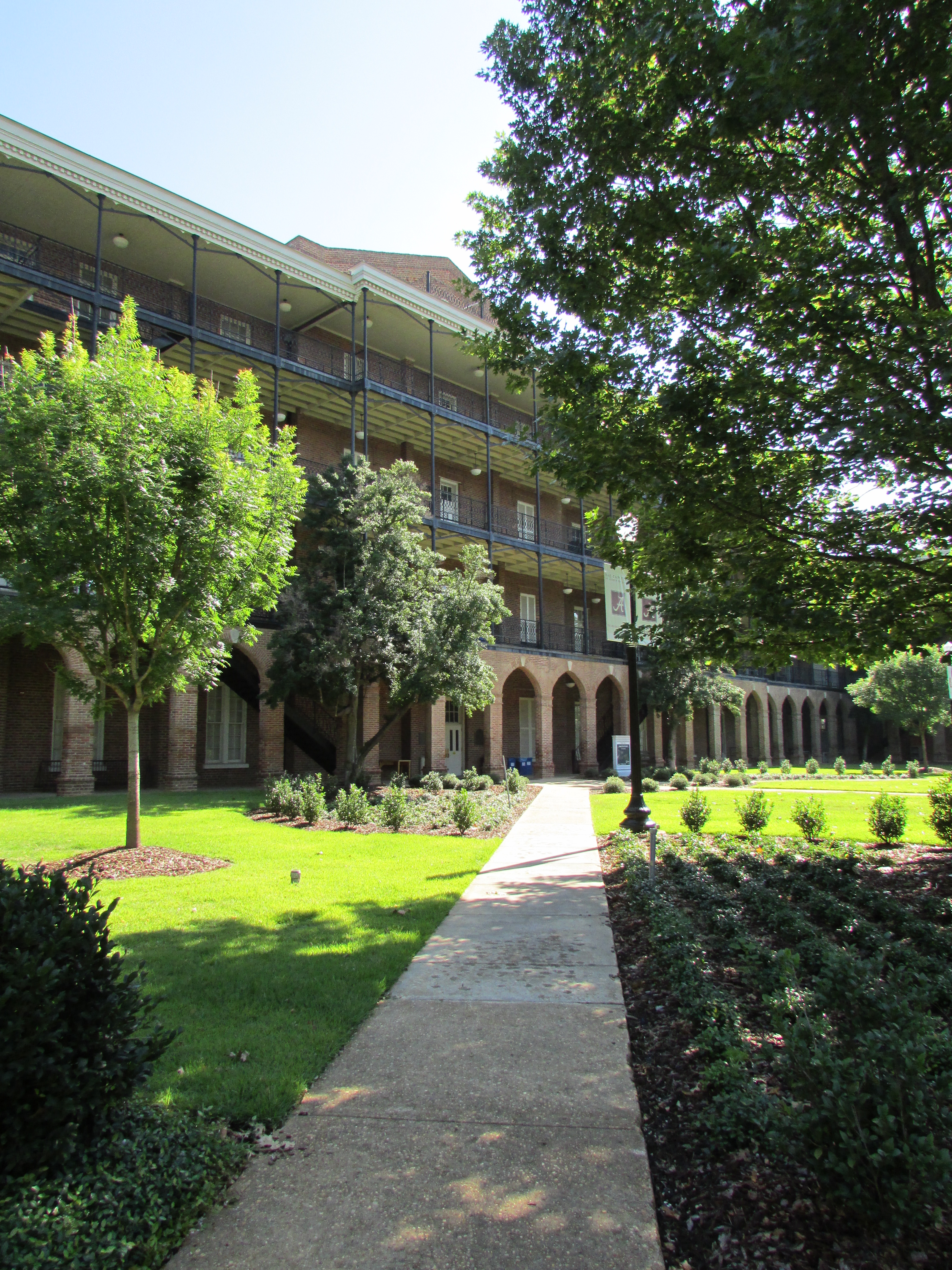
The four-story Woods Hall, a Gothic Revival structure with cast iron galleries along the upper floors, was the first building built on the University of Alabama campus after the campus, including the library, was burned by Croxton’s Army during the Civil War. Only one library book was saved — a copy of the Quran.

The Woods Hall art studios always had a calming effect on me. The rich and pungent smell of oil paints, solvents, and various chemicals had a heady impact as one wandered through the studios looking at finished and unfinished works on easels or at paintings that leaned against the thick walls to dry. The Woods Hall elevator was always covered with the best graffiti on campus

My friend Joni was probably as broke as I was – as we all were in those days, it seemed. But she was known as a good host who threw great parties. Her October masquerade birthday parties were legendary.

Joni’s summer afternoon tea with me was to celebrate a painting she had just completed with inspiration provided by me. One time at my apartment she had spotted a panel of 1950s-era drapes that I always kept close by. These colorful drapes of barkcloth fabric with big tropical looking flowers and flowing shapes are among my very first memories. I remember the barkcloth drapes on the windows in the living room of the first house I can recall from childhood. The room had a red sofa, a green chair, and a table set that included a coffee table, two end tables, and a 2-tiered lamp table that took pride of place in the picture window.

Years later, my mother was getting rid of the old drapes which she hadn’t used in years, I asked if I could have a panel since the pattern was such a primal memory for me. She gave me all of them and I have kept them ever since – although some have been repurposed or given away. Two panels are framed in my current dining room as I write this. I still have two throw pillows covered with the fabric.

Joni saw a panel of the barkcloth draped over hooks in my living room and was immediately taken with it. She said she’d like to use the pattern in a painting. I gave her a spare panel of the drapery for reference.

Now, weeks later, the painting was complete and I arrived for the viewing on a sultry summer late-afternoon, making my way down the driveway to a walkway leading to Joni’s second-floor apartment. The doors and windows were open and strategically placed fans were blowing the thin curtains on each window.

Joni welcomed me and got quickly to the first order of business – the reveal of the new painting. It was resting on a chair in a corner of the room. The finished painting was of Joni’s cat perched on an upholstered side chair. The cat’s eyes were wide open, staring intently at the observer. The long window behind the cat was partially covered by my drapes. A jungle of green was seen through the window. Now that I think about it, Joni’s paintings were often reminiscent of the Naïve French painter Henri Rousseau in their use of color and unbridled primitive appeal.

It was a lovely painting made lovelier by the memories evoked by my favorite draperies. (I spotted that same barkcloth drapery pattern in a John Waters film many years ago.)

After we had admired the painting, Joni said, “Time for tea!” and motioned for me to sit at a small table next to a window overlooking her front yard – which was the back yard of the Tudor. Two places were set with teacups in saucers and paper napkins. Joni brought out a plate of saltine crackers and a store-bought container of pimento cheese with a knife to spread the cheese. From the small refrigerator, she produced an old tin coffee pot and began to pour.

The coffee pot was full of ice and tap water. The icy water was a perfect antidote for a steamy hot day. After pouring, Joni set the pot in the middle of the table. Sugar was offered in case I would prefer “sugar water” but I took mine straight. We refilled our cups from the pot as needed and spread pimento cheese on crackers as the sun set. The sky slowly darkened and the fireflies began to emerge from wherever they had been hiding all day. The cold coffee pot began to sweat and a small slick slowly spread around it on the patterned oilcloth table covering.

Joni and I laughed and talked into the evening; I still remember it as one of the most pleasant “tea” services I ever experienced.

Joni and I graduated around the same time. She left town and I lost touch. I heard she briefly dated a friend of mine but I never saw her again after Tuscaloosa. I’d love to let her know that I still have fond memories of that frugal and elegant Sunday evening.

These are moments brought to mind by fireflies in summer.

On (re)Reading Walker Percy

IMG_1782  One of my assignments during graduate school was to assist the surly and pompous professor who briefly headed up the playwriting and dramaturgy program. He was a Boston native, out of Yale and Carnegie-Mellon, and some kind of Orson Welles scholar. His current assignment was at a Southern university but he made no effort to disguise his contempt for Southerners and the South.

I found him rude and offensive but tolerably amusing and treated him with a level of respect he had not earned. One afternoon we sat in his office discussing scripts that had been submitted to the department’s playwriting program and that conversation veered off onto a number of topics.

“Welles Scholar” leaned back in his chair, eyed me seriously, and said, “I like you, Journey. You’re that rare breed – an intelligent Southerner.”

I seriously eyed him back and said, “Y’know, that may be one of the most insulting things that’s ever been said to me.” I told him I had to get to a seminar and politely excused myself, fuming.

From that moment on, I detested “Welles Scholar” and was delighted to see him leave at the end of that academic year. I’m sure he meant the statement as a compliment to me but the cluelessness, arrogance, and stupidity which informed the comment made me angry and still makes me angry whenever I think about it.

I had not thought of the Welles Scholar story for a number of years but it came back to me this week as I was renewing my acquaintance with the writing of Walker Percy.

The great writer Walker Percy (1916-1990) is legitimately claimed by three states – Alabama, Louisiana, and Mississippi. He was born in Birmingham and lived there until he was 13. After the death of his father, his mother moved the family to Georgia. When she died, he and his brothers were taken in by a bachelor uncle in Greenville, Mississippi. He graduated from the University of North Carolina, earned a medical degree from Columbia, and contracted tuberculosis that lead to a lengthy recovery at a sanitorium in upstate New York. Percy spent the bulk of his adult years in the New Orleans area, eventually settling with his wife, Mary Bernice (“Bunt”), and children across Lake Pontchartrain in Covington, Louisiana.

Percy’s writing is deeply probing and intellectual, mixing Existentialist philosophy and scientific inquiry with Roman Catholic theology and the search for spiritual fulfillment. He deals brilliantly with the South and the complexity of the Southern “character.” He writes with amused suspicion and insight about both the South and other parts of the country but the observations are always filtered through a sense of what it means to be “Southern” in all of its forms.

Percy’s novels often focus on a flawed protagonist who doesn’t quite seem to belong anywhere but continues the quest for meaning and belonging nevertheless. Percy’s books are challenging and they tackle some weighty issues with an underlying wit, compassion, and turn of phrase that make them compelling and entertaining.

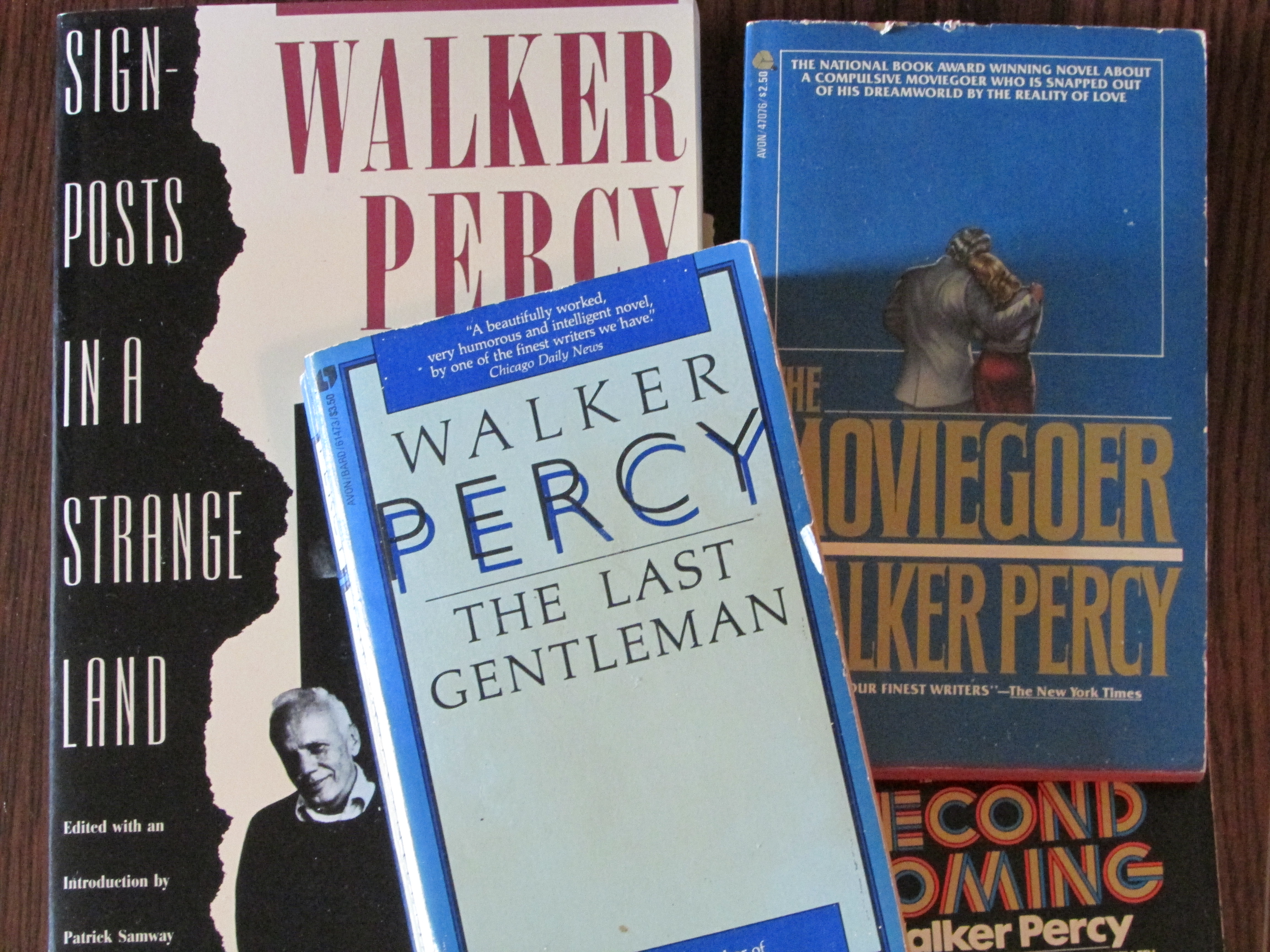
Percy’s first published novel, The Moviegoer (1961), is still his most acclaimed. I discovered that book, and Percy, early in my college years and it is still a favorite literary discovery; I find new areas for focus with each reading.

Until this week, I had not read Percy in a while. I ran across an item about him recently and decided it was time to revisit him. Since I had never read his second novel, The Last Gentleman (1966), I pulled it from my bookshelf and started to read. Here’s the odd thing: I began to run across passages that had been obviously underlined by me – they were the sorts of sentences and words that I would have underlined. The book was also full of evidence of previously dog-eared pages.

I still underline passages in books and frequently dog-ear pages. I was never one to write comments in the margins, although I occasionally do that too. This is one of the reasons I will always want to deal with the object of the book; I take pleasure in the tactile physical presence as I do in the words contained therein.

So I was quickly aware that I had already read The Last Gentleman at some point in time. At the beginning I thought Okay, it will start coming back to me as I read on. I read on. It all felt new to me and the last moment of the last page surprised me as if it were brand new. It was an eerie and enjoyable experience. The effect was heightened by the fact that the main character, Will Barrett (usually referred to, ironically, as “the engineer”), suffers from episodes of déjà vu and amnesia. My previously underlined passages were a form of déjà vu for me, the reader, and the fact that I had no memory of the story was my amnesia.

Another odd thing is that the city in which much of the book takes place is clearly based on Birmingham (Walker Percy confirmed as much) and a frequently mentioned landmark in the book is clearly a veiled reference to George Ward’s old “Vestavia” estate on the crest of Shades Mountain that gave Birmingham’s Vestavia Hills suburb its name. (That estate, by the way, is now the location of Vestavia Hills Baptist Church for those readers who know Birmingham geography.) I am surprised that I didn’t remember any of that from my previous reading.

Although I still don’t recall reading the book the first time, I’m sure that I thoroughly enjoyed it that first time just as I thoroughly enjoyed it this week. That certainty is based on the passages I underlined.

Buoyed by my rediscovery of The Last Gentleman, I grabbed The Moviegoer and had the opposite experience of total recall and recognition. It was like revisiting an old friend and I remembered and enjoyed each juicy detail. The Moviegoer is a New Orleans novel and Percy makes no effort to disguise the geography or the names of the actual places. The Moviegoer is the “Ur-text” for all of Percy’s concerns and themes in his novels, essays, and philosophical writings to come.

I wonder if any other writer uses the word “malaise” as often as Percy. The word peppers the text of The Moviegoer. Even so, I think Percy has an ongoing optimism tempered with realism that informs all of his writing. It is much-discussed in Percy scholarship that his early life was dogged by suicide – his grandfather and father committed suicide and he always believed that his mother’s fatal car wreck was a suicide.

The novels I read this week are at least half a century old but I still share the protagonists’ sense of displacement and mistrust in a modern world transitioning to post-modern (post-future? – where are we now?) modes. The changes seem large to the ’60s protagonists – how would the world appear to and discombobulate them half a century later?

The issues that occupy Percy and his characters never go away or find resolution; they just morph as the decades fall into place, one after another. How fortunate we are to have access to timeless writing that deals with these issues so searchingly, so entertainingly, and with such compassion and humor.

That Welles Scholar comment about the rarity of the “intelligent Southerner” came back to me while I was reading Percy, one of the most probingly intelligent of 20th Century American writers — as well as one of the most Southern. I fantasized a face-off between “Welles Scholar” and Percy.

Percy would have eaten him alive.