
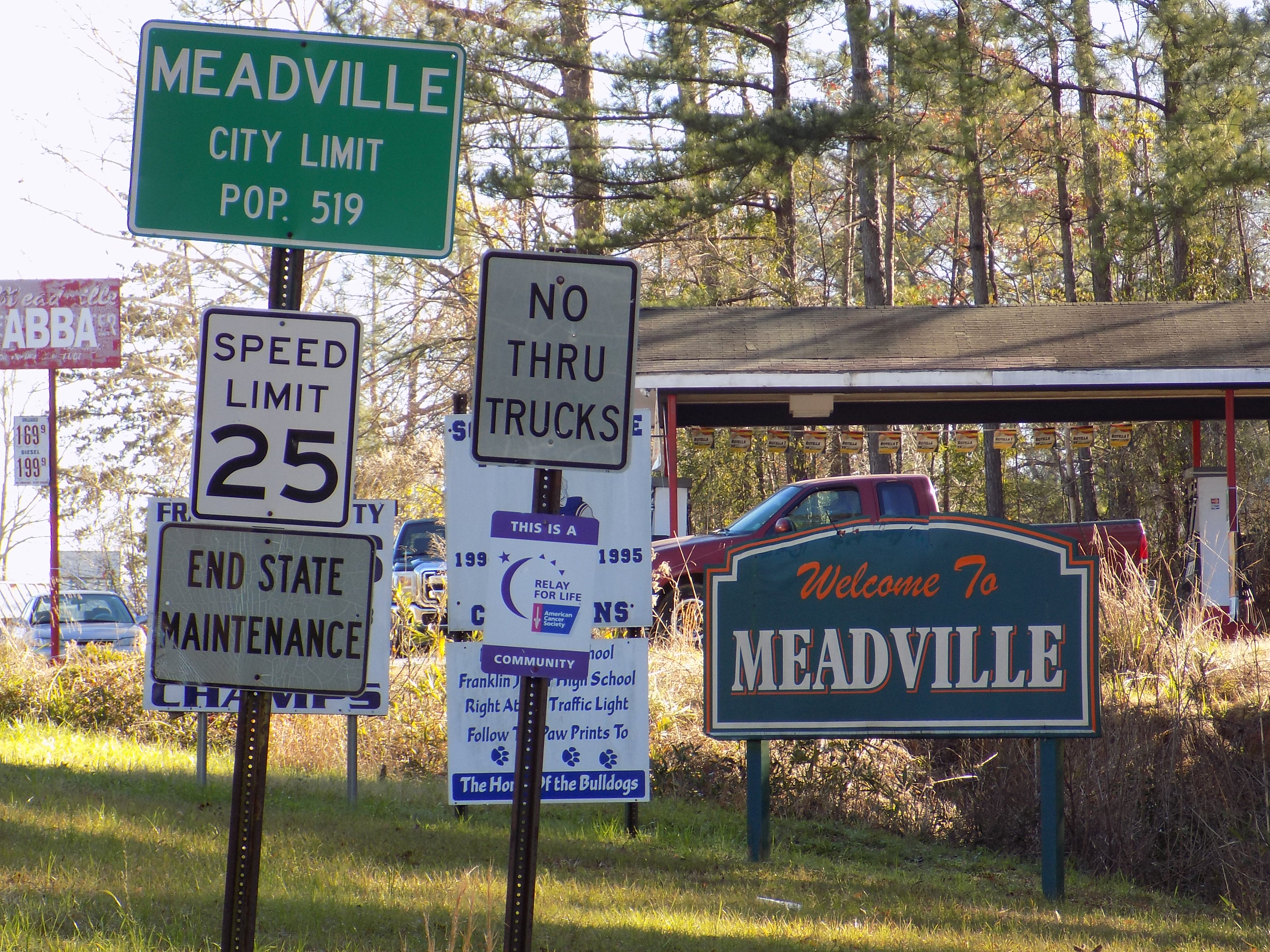
 I refused to turn the radio on as I followed the ambulance in a constant driving rain. I suspected there were tornadoes nearby; if there were, I didn’t want to know. It turns out I was right. And suddenly, after eyes glued to the back of an ambulance for 315 miles, I find myself in Meadville, Mississippi.
I feel like I had a primer on health care inadequacy after a week spent in ultimately futile battle with the inhumanity of Medicare regulations and the rampant cruelty and indifference of large hospital corporate administrators. My father had been released from his hospital five miles from his home and Mother to a facility 315 miles and five hours away.
The critical care ambulance drove nonstop from Birmingham to Meadville, Mississippi, and I followed behind. When we reached the small hospital in a steady drenching rain I was greeted with the news that the area we had driven through had been peppered with tornado watches, warnings, and a few actual touchdowns, just as I suspected.
I have spent plenty of time in Mississippi and briefly lived there on three separate occasions during the ‘70s and ‘90s but I had never heard of Meadville in southwestern Mississippi somewhere between Brookhaven and Natchez. It is a two-traffic light town with a small hospital that houses a unit specializing in weaning patients like my dad off ventilators. 
From the outside, the one-story beige brick facility looks like a mid-20th century elementary school. On the inside is a staff of caring and highly competent medical professionals, under the leadership of “Dr. Ben” Yarbrough, with the common goal of helping people.
My mother’s health problems prohibit her travel with Dad so I came along for the first week to meet his caregivers and make sure he gets settled in comfortably.
When I started the “Professional Southerner” journal in 2014, my goal was to use it as an escape and diversion – to use it as a way of forgetting my job and stresses. In the past nine months, however, that has become a challenge as my father’s health declined and he was continuously hospitalized starting in October. Distractions have become hard to come by.
Instead of focusing on Dad’s hospitalization and treatment, however, I want to write about that much-vaunted Mississippi hospitality; it has been visible in full force since I arrived here a few days ago, soaked and exhausted.
Shortly after we arrived, Mitzi, the ward clerk, asked if there were any special needs. I told her that my parents are life-long Baptists and that Dad likes to be prayed with. I wondered if she might put me in touch with a local Baptist minister so that I could invite him to visit with Dad. Within minutes, I had a name and an email address and the next day Bro. Marvin Howard of Mt. Zion Baptist showed up at Dad’s bedside to talk with him and pray for his healing and recovery. He asked for Mother’s number in Birmingham so that he could let her know he had seen Dad and promised to come by one or two times a week during Dad’s stay. He invited me to come out to his house if I needed a place to stay; he offered to have me out for a home-cooked meal with him and his wife.
Since the nearest commercial lodging to Meadville is a half hour away in either direction, I came prepared to stay in Dad’s room. The accommodations are tight and, despite several nurses’ best efforts to position my convertible chair/bed, I was awakened several times on the first night by nurses or nurses’ assistants climbing into the bed with me to position themselves to turn Dad.
On day two we switched to a recliner in another part of the room but every time I moved the recliner sort of folded up on me. The nurse was very concerned for my comfort but I assured her that it is about Dad’s comfort and well-being and not mine; I can fend for myself.
I usually don’t eat meals on a very regular schedule but, living in the hospital with not much distraction, I find that mealtimes at the small hospital cafeteria are how I gauge the day. The breakfast service includes an array of breakfast staples to choose from – grits, scrambled eggs, sausage and bacon, biscuits and gravy, a selection of breads, jams, and jellies.
Lunch service changes daily but there is a selection to choose from each day, and desserts – pies, cake, bread pudding – are generous and plentiful. It’s a small hospital and the cafeteria ladies quickly learn your face and tastes. Even so, eating in the cafeteria here conjures memories of a childhood of frequent moves with Dad’s work and the constant feeling of being the “new kid” — when lunch time was often the most awkward time of the day.
For supper, a box meal is prepared and waiting for patients’ guests who are staying at the hospital. If you snooze you lose since the boxes are only available for pick-up from 5:30 to 6:00. One of the cafeteria ladies gave me a container of vegetable soup last night to take with me and warm in the microwave if I got hungry later.
On the morning of day three, the ward clerk called me away from Dad’s room and said that the local Methodist church has a former pastorium a half mile from the hospital that is no longer being occupied. She said that she had heard I wasn’t getting much sleep in the hospital and asked if I would care to stay there so I might get a decent night’s sleep. It was like a weight had been lifted since I had already started dreading that night’s sleep in the crowded little hospital room.
I gratefully took the offer. Dr. Bo Gabbert, a retired physician from the area who is active in the Meadville Methodist Church, showed up at the hospital later to pray with Dad, take me to the house, and turn over the key.
As I was sitting in Dad’s room writing this post this morning (after a good night’s sleep), Dr. Gabbert reappeared in Dad’s room with a gift. It’s a prayer shawl knitted by ladies from the church. A card with the shawl contains a prayer for recovery on the front and the signature of all of the ladies who worked on it on the back. The shawl is specifically crimson for Dad’s beloved Alabama Crimson Tide.
This is Dad’s fourth day of treatment in Meadville and marked improvements have already occurred in his breathing and physical health. The treatment will take a while and I anticipate a number of trips back and forth to Meadville but Franklin County Memorial Hospital is giving me a lesson in what a difference a caring community and committed and caring medical professionals can make.
One of Mississippi’s many great writers, Tennessee Williams, penned that famous line about depending on “the kindness of strangers.” Dad and I came to Meadville as strangers among strangers but have quickly and lovingly been absorbed into a community of unmatched kindness and generosity.
It is a time for hope and giving thanks. 
Note: My father, Grover E. Journey, passed away at Franklin County Memorial Hospital in Meadville at 9:35 p.m. on Monday, March 21. He was buried on Thursday, March 24, at Elmwood Cemetery in Birmingham. We will always remember the kindness of the people of Meadville.

 Professional Southerner