Monthly Archives: December 2018

Fear Not

My annual getaway to the Grand Hotel in Point Clear just ended and I am here to report to all of the people that harbored trepidations about the resort’s recent overhaul that I think it will be okay for them to go back; they’ll be fine with the changes.

A Grand Hotel has been located on the “point” of Point Clear on Mobile Bay’s eastern shore since 1847. When I visited in December 2017, much of the facility was a construction site and I was told that “every inch” of the facility was being touched by a massive renovation. I was eager to see what the final results looked like and am happy to report that they are finished and the place looks great.

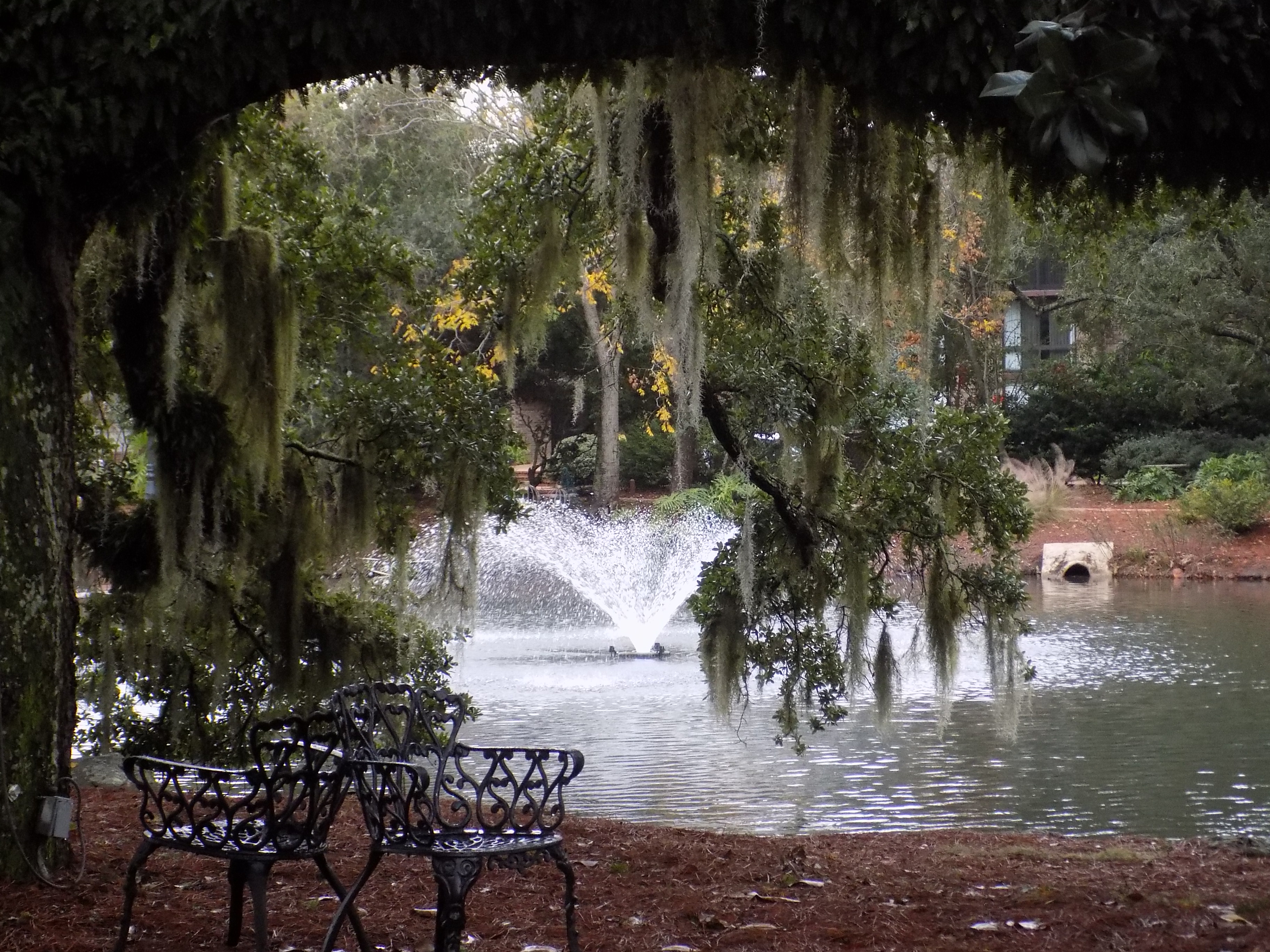
Driving through the gate, one is not aware of all of the work that has been done. The grounds are immaculate as always, the live oaks are decked out for the holidays, and what blooms this time of year is blooming in profusion. My recently planted camellia bush did not have a single bloom this year so I was a tad jealous of the profusion of camellias all around the lagoon.

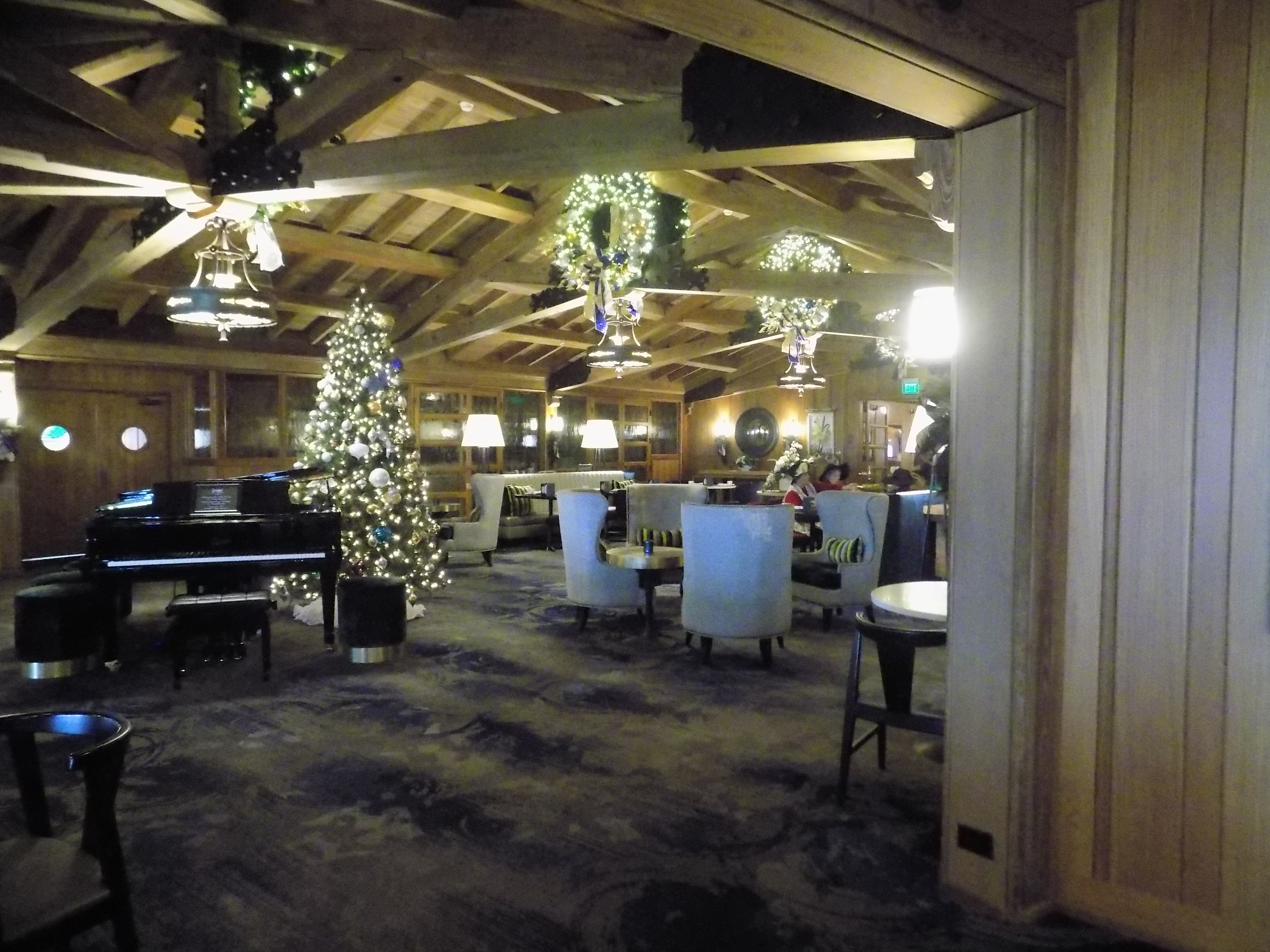
Most of the renovation work is interior and the result is a fresher, lighter, and more open effect with calm shades of blues and greys predominant.

The most visible change in the main building’s lobby area is a new casual food option, Local Market, in the space once occupied by the gift shop. A gift shop boutique, Oak and Azalea, is now located off the Grand Hall. Bayside Grill and Southern Roots are new dining options flanking the Grand Hall, as is the new 1847 Bar. The Grand Hall itself is now the setting for an afternoon High Tea in addition to breakfast and Sunday brunch. On one afternoon as I passed through, groups of hat-wearing ladies were enjoying the High Tea service. Gone is the 4:00 p.m. community tea that was a beloved tradition in years past, but the warm aromas of a wood fire from the fireplaces still waft through the main building on a crisp December evening. 
Old traditions remain. The Sunset Bell still rings thirty minutes before sunset, summoning guests to gather for the usually spectacular Mobile Bay sunset. The historical salute to the Grand’s military history is still an afternoon tradition, culminating in the firing of the Civil War-era cannon on the edge of the Bay.

One of the first things I checked was if Bucky’s Lounge was still there. Bucky’s, a gathering spot overlooking the Bay, is named to honor Bucky Miller, a mainstay who worked at the resort in many capacities over sixty years from the 1940s to his death in 2002. A life-size statue of Bucky, right hand outstretched to greet a guest, has stood outside the lounge for years. A subtle new touch is Bucky’s image smiling on the guests from one of the lounge walls.  More patio firepits have expanded Bucky’s out and closer to the Bay.

I do have to register one gripe about the changes: One of the stalwarts of the Grand’s appetizer offerings has always been an order of crab claws. For some reason, crab claws are missing from the current menus. I asked one of the wait staff for confirmation that the popular appetizer is, indeed, gone from all menus. It seems like a slight omission, but it is also something that is so simple and popular that it doesn’t make a lot of sense to get rid of it. If I have a complaint to register about the updates, it’s simply that I want crab claws back on the menu. 

Throughout the various buildings of the resort, the fresher theme persists. In my favorite room with a spectacular view in the Spa building, the footprint is the same but the furnishings are somehow more functional and comfortable. In my room, I spent a lot of time lounging on a corner chaise that was a perfect spot for reading, writing, and napping.

The Grand is still a great spot to relax, both indoors and out. Any worries about the changes should be calmed by how well those changes were handled. I hope to be going there for holiday retreats for years to come. 

“The Mad Potter of Biloxi”

George E. Ohr ceramic

I first saw photos of architect Frank Gehry’s Santa Monica house in the 1970s and filed him away as an architect I wanted to keep tracking. Gehry and his wife bought a two-story pink Dutch Colonial bungalow on a conventional neighborhood street and the rule-bending architect began his process of revision and deconstruction. Parts of the interior were stripped down to the studs and exterior additions incorporated materials such as plywood, corrugated steel, glass cubes, aluminum siding, and chain-link fencing. To be honest, I didn’t think the end product was very appealing to look at but I was drawn to the audacity of it and how Gehry thumbed his nose at convention – and the neighbors – and created a functioning house that still remains a home for the Gehry family forty years later.

Keeping track of Gehry was a smart move as his architecture flourished internationally with hallmark commissions like the Guggenheim Museum in Bilbao, Spain, and the Walt Disney Concert Hall in Los Angeles.

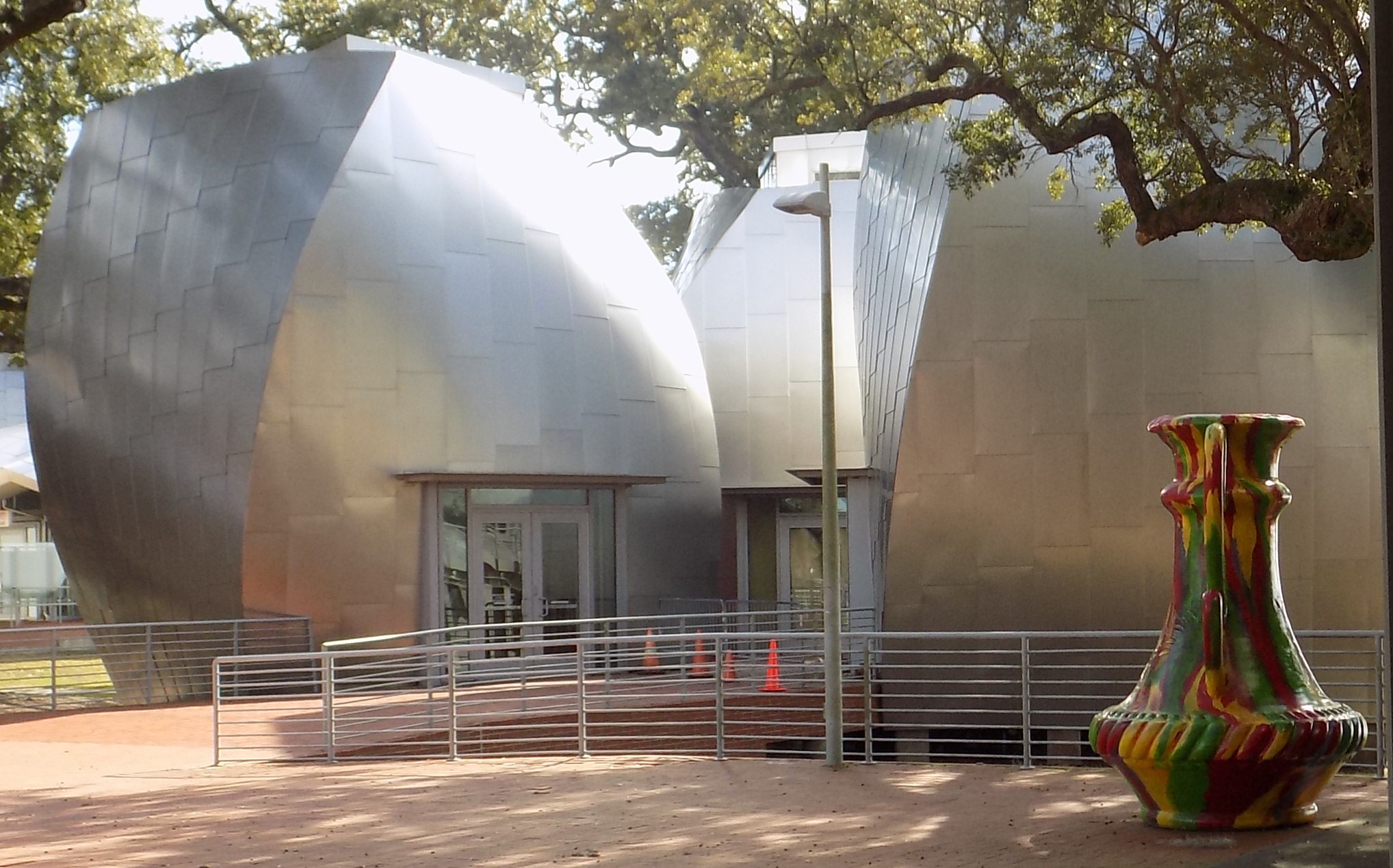
“The Pods”: Ohr-O’Keefe Museum of Art; Biloxi, Mississippi

The Ohr-O’Keefe Museum of Art on Beach Boulevard in Biloxi, Mississippi, is a Gehry design that was years in the making (www.georgeohr.org). Showcasing the work of potter George E. Ohr (1857-1918), the self-proclaimed “mad potter of Biloxi,” the museum campus was well-underway when I stopped to photograph the construction site in August 2005. The “O’Keefe” of the museum’s title refers to a prominent Biloxi family that was key to the project being built. Two weeks after I photographed the construction, Hurricane Katrina dumped a casino barge on the site and construction of the museum facility was delayed until 2008.  The “pods,” a grouping of metallic structures primarily housing Ohr’s work, finally opened in 2014.

I drove over to Biloxi in 2010 when the first three buildings of the campus were newly opened. Gehry’s design plotted the five structures to leave intact the live oaks already established on the site. A brick courtyard centers the facility. The east side of the campus includes three structures – a welcome center with gift shop and two intimate galleries. The gift shop features a generous selection of pottery and ceramics by artists from within the region. The Beau Rivage Casino Gallery of African American Art includes changing shows focused on African American artists. The IP Casino Resort and Spa Exhibitions Gallery houses temporary shows.

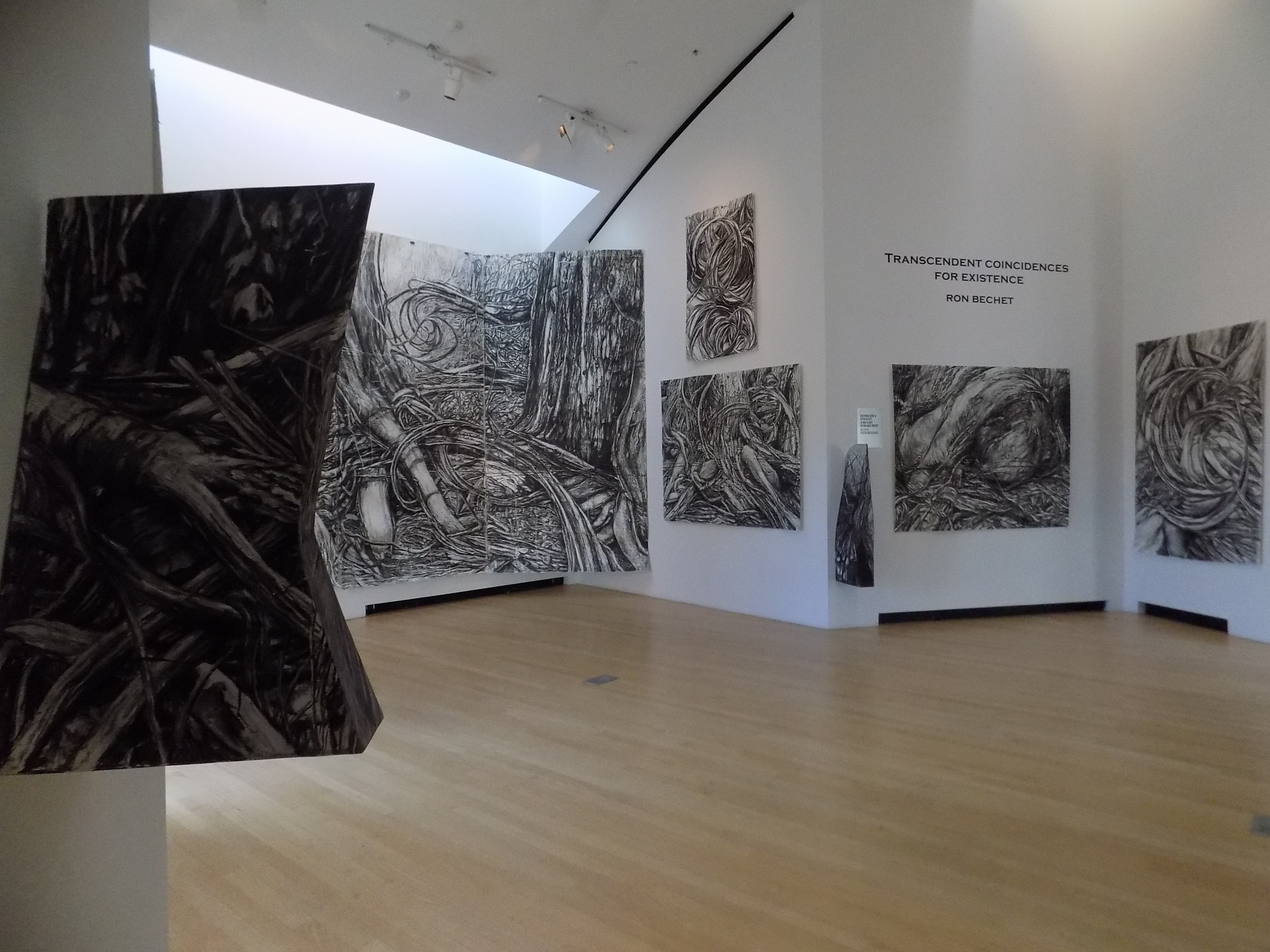
View of “Transcendent Coincidences for Existence” by Ron Bechet; Ohr-O’Keefe Museum of Art

On a recent visit in December 2018, the Beau Rivage Gallery featured the show, “Transcendent Coincidences for Existence.” by New Orleans artist Ron Bechet. Bechet’s large charcoal works explore interconnected roots, trunks, and botanical decay – knotted and matted and decomposing.

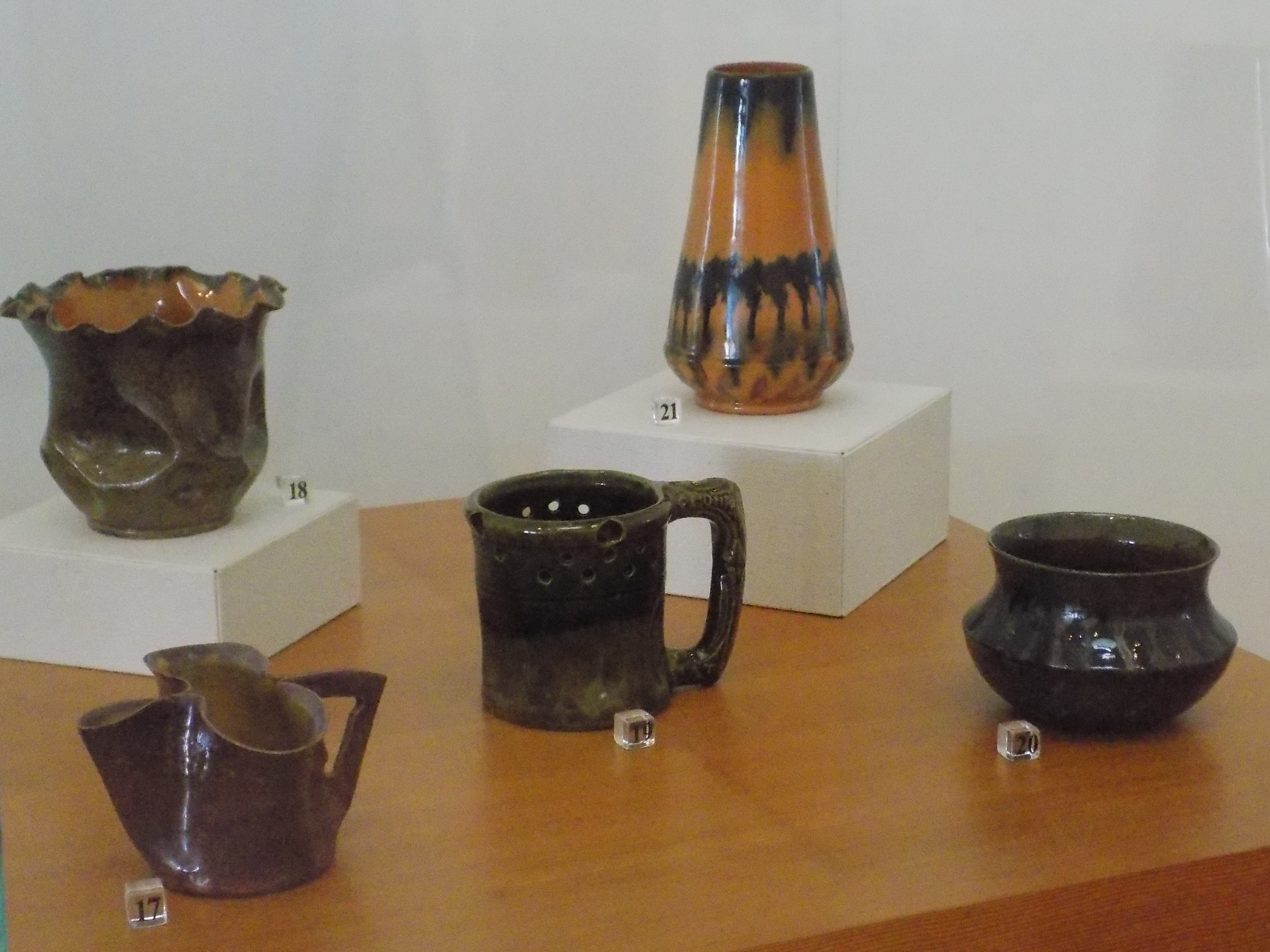
A small cove of the Beau Rivage Gallery houses a permanent exhibit exploring the Ohr legacy, “I Am the Potter Who Was.” Ohr spent much of his life courting scandal and controversy and his ceramics did not sell very well in his lifetime. His ceramics’ queer twisted shapes with random pinches and extreme glazes did not find a significant market while he was alive but he is now considered a modernist pioneer in ceramics.

George E. Ohr ceramics at Ohr-O’Keefe Museum of Art

The IP Casino Gallery was showing a juried exhibit, “Echoes of Ohr,” a survey of contemporary ceramic arts with nods to the Ohr legacy.

The west side of the campus features the most audacious architecture – three metallic pods which house some of the Ohr collection and a multi-story City of Biloxi Center for Ceramics with working artist studios and kilns. The Pleasant Reed Interpretive Center anchors the north end of the museum campus. The Pleasant Reed house was a preserved 19th century Biloxi house that had served as the home of Pleasant Reed and his family in the African American community of Biloxi. The house and its furnishings were destroyed by Hurricane Katrina and a replica of the house was built to replace it. Currently, the Pleasant Reed Interpretive Center features an exhibit, “City Within a City: African American Culture in Biloxi,” documenting Biloxi’s vibrant and self-sufficient African American community after World War II.

As much as I appreciate George Ohr and the offerings within the museum, the main draw of the Ohr-O’Keefe for me is still the distinctive Frank Gehry architecture along the Mississippi Gulf Coast. I keep returning to see how these quirky buildings continue to dance with the landscape of live oaks looking out to the Gulf and the pine forests of the barrier islands. It’s a pleasure to come across the humble museum campus amid the high-rise casinos that dominate the Beach Boulevard drive. I continue to be surprised at how much of the property along the stretch of highway remains vacant since the hurricane. I recall the grand residences that once lined this scenic drive.

Ohr-O’Keefe Museum of Art; Biloxi, Mississippi

The Ohr-O’Keefe is a gem on many levels and ought to be a destination for lovers of art and architecture. It seems that the facility has been under-supported and under-appreciated in its community. George Ohr famously said, “When I am gone, my work will be praised, honored, and cherished. It will come.” Let’s hope that his namesake museum will not have to wait so long to come into its own well-deserved prominence.

Peace and Justice

The Sunday morning church bells were pealing as I walked away from the National Memorial for Peace and Justice in Montgomery, but the words that were ringing in my ears were those of artist and 2018 MacArthur Fellow Titus Kaphar:

We’re having a national conversation right now about public monuments. And in this discussion … we have this sort of binary conversation about keeping these sculptures up or taking them down. And I actually think that that binary conversation is problematic. I think there is another possibility, and I think that possibility has to do with bringing in new work that speaks in conversation with this old work. It’s about a willingness to confront a very difficult past…

Kaphar made that statement as part of a radio interview on NPR and I thought it was perhaps the most coherent and rational statement I’ve yet heard about our ongoing conversation about controversial history and what to do with the monuments that commemorate it.

The National Memorial for Peace and Justice, better known – unfortunately – as “the lynching memorial,” is an important project of Equal Justice Initiative (www.museumandmemorial.eji.org), founded by Montgomery-based attorney Bryan Stevenson. It is an outdoor memorial to over 4000 known African American lynching victims between the years 1877 and 1950. The names (or lynching date, if the name is unknown) are engraved on over 800 slabs representing each U.S. county in which a lynching is documented during those years.

The Memorial sits on a six-acre site overlooking Montgomery. The main structure is entered after taking a winding path up a hill with informational narratives at regular intervals. Upon entering the main structure, the first slabs sit at eye level. There are clearly visible names of counties and states and the victims and lynching date for each. Gradually, the floor begins a gradual rake and the slabs hang over the visitors’ heads, suggesting the hanging bodies of the victims. It’s not hard to recall Maya Lin’s Vietnam Veterans Memorial in Washington, in which the wall starts slowly at your feet and gradually towers over the viewer as one walks deeper into the war.

At one end of the Memorial for Peace and Justice is a water wall with words of comfort and dedication. This, too, reminds one of the Civil Rights Memorial, a few blocks away at the Southern Poverty Law Center, also by Maya Lin, with its water rushing over the framing wall and the black granite table marking the deaths of Civil Rights martyrs (www.splcenter.org.what-we-do/civil-rights-memorial/history).  

In the middle of the National Memorial for Peace and Justice is a peaceful grassy hill. Stopping there, one sees the skyline of modern Montgomery through the slabs – even catching a glimpse of the Capitol dome at times. Standing there, one is surrounded by the silence of the victims memorialized in the stark slabs hanging from every side.

As one leaves the memorial, there are rows of identical slabs for each county represented in the Memorial, waiting to be claimed by the designated county when it has documented its movement to rectify the issues that lead to the lynchings within its borders.

In my home city of Birmingham, a monument to Confederate veterans has stood for 113 years in the city’s Linn Park downtown. For the past several years, its base was blocked by a black plywood barrier erected by a previous city administration. The fate of that monument has been tied up in legal battles for years. Here’s my modest proposal: Take down the plywood box, keep the Confederate monument where it’s been for over a century, and hang Jefferson County’s slab of lynching victims beside it. Let them interact and let the observers begin to interpret and heal.

In downtown Montgomery, in the entertainment district now called “The Alley,” one may find the EJI’s “Legacy Museum,” which places our national lynching history in more context and documentation. Both the Memorial and the Legacy Museum are touching and transformative memorials to a history that is too often overlooked.

Too often, I find that our national history is narrowed down to the victimized and the guilty. The EJI’s well-documented and striking efforts seem to go beyond that — to spotlight uncomfortable history without placing blame on the descendants whose hands were not involved.

I hope for a day when we might remember our history without being forced to wallow in it.

Montgomery is a city full of history, museums, and memorials – to the Confederacy, to Civil Rights, … to Hank Williams. These latest powerful Montgomery memorials document a history that we must never forget. But neither should we wallow in the shame and guilt of it. We should – together – work toward a future in which the sins of the past may never be forgotten, but neither should they be exploited to expedite and fuel the sins of the future.

Artist Titus Kaphar has a powerful piece called “Doubt” in the Legacy Museum. He should have the last word:

I think one of our challenges is that we sort of consistently try to make public sculpture in a way that it’s a sentence with a period at the end. And inevitably it’s not — it’s a comma, and there should be a clause after that. 

“Peace, Be Still”

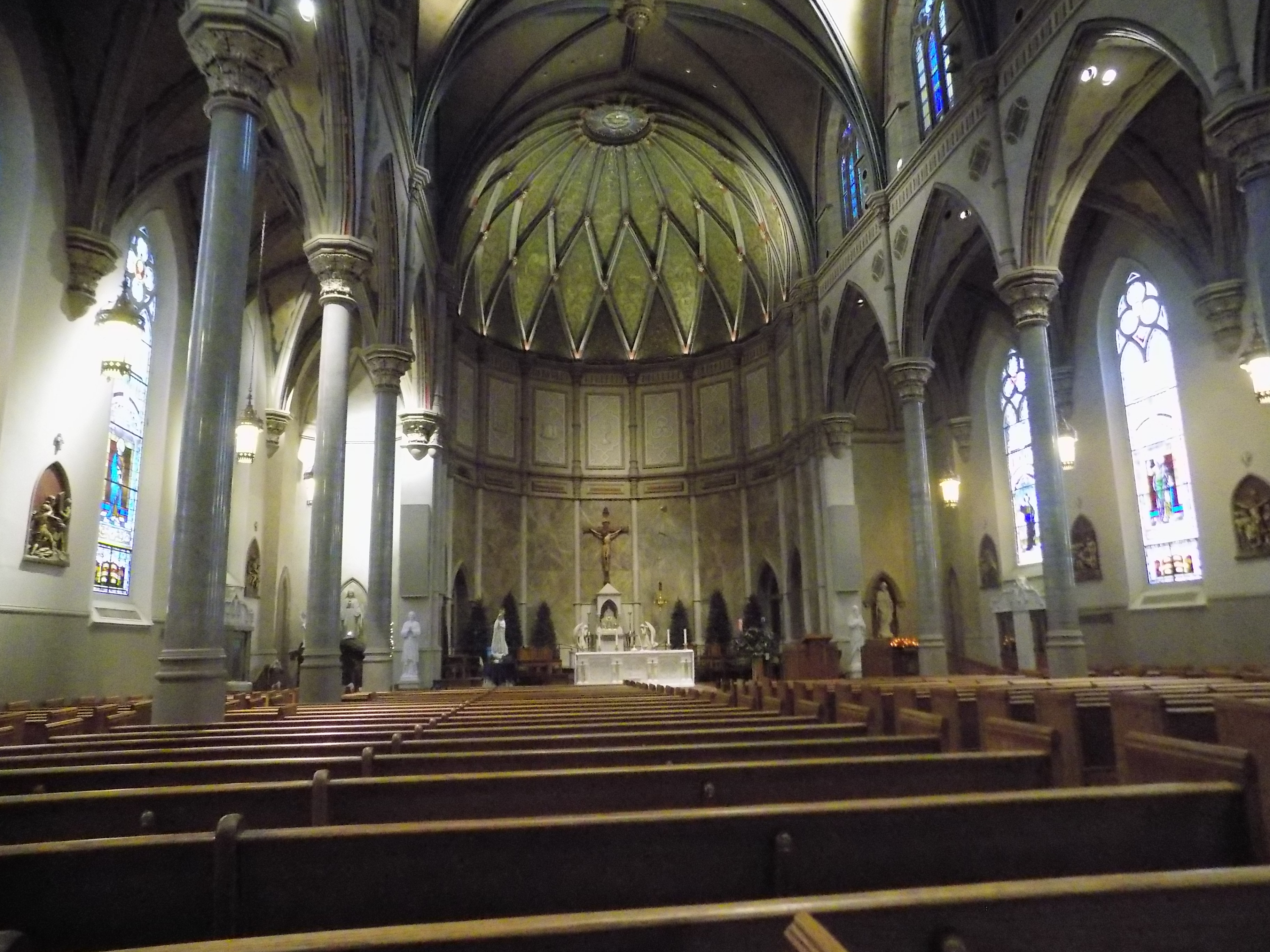
Cathedral of Saint Paul, Birmingham

The overly attributed quip, “If you remember the ‘60s, you weren’t really there,” does not apply to me.

I remember the ‘60s very well but I was too young, at the time, to be “really there.” I remember the decade as energetic and often frightening with assassinations, bombings, riots, Vietnam, constant protests, and the birth and maturation of an array of social movements. It was also a time of great music and free-wheeling fashion. It was scary at times, but it was also hopeful with optimism, a desire for change, and a constant moving forward toward an idealistic place that seemed inevitable and just around the bend.

Now, we’re again in challenging times with mercurial instability and megalomania occupying the White House. I cringe with shame and embarrassment for my country at incessant narcissistic White House tweets from a cowardly bully that are mistaken for policy statements. We are in the midst of crises with an ongoing stream of mass shootings, a commander-in-chief who demeans women, environmental disaster, an embattled education system, the complicity of our congress with corrupt insurance companies threatening our health care, a growing racial divide, and a protective executive relationship with  a corrupt, repressive, and murderous Saudi regime. Authoritarian dictators are given respect and deference by a White House that insults our nation’s trusted democratic allies. The NRA has abandoned any lofty Constitutional goals it claimed to espouse and become, instead, an enabler of domestic terrorism.

These days, we seem lacking in the optimism and hope that characterized the ‘60s. Mass protests, which had an impact during the ‘60s and early ‘70s, now seem naïve and pointless in the current environment saturated with meaningless social media. I’m embarrassed when I hear the same tired chants and cheers – even when I agree with the sentiments that inspire them.

In Lanford Wilson’s great play, Fifth of July, June Talley – a former ‘60s activist – tells her daughter, “You’ve no idea the country we almost made for you. The fact that I think it’s all a crock now does not take away from what we almost achieved.”

Later in the play, one of June’s fellow sojourners from the activist days says to that same daughter, “How straight do you have to be to see that nothing is going to come from it? But don’t knock your mother, ’cause she really believed that ‘Power to the People’ song, and that hurts.”

As much as I try to be engaged in progressive change, I grow weary of the constant divide and the shouting from every side. The message with every issue seems to be Either you’re totally with us or you’re against us. There seems to be no acceptable middle zone anymore. Civility, compromise, and diplomacy are forgotten relics in contemporary social discourse. It’s trickling down from the top in our country.


As regular readers of this journal know, I put a good bit of thought into my annual holiday card – trying to find the best reflection of where my life and thoughts are each year when the holidays roll around. I have written in the past about the “brief meditation” of signing and addressing each card and remembering the recipient. My Christmas card this year bears a simple message: “Peace, Be Still.” It’s a quote from the Bible, from the Gospel of Mark’s version of Jesus calming the stormy sea.

I wanted to change up my Christmas card a bit this year. Instead of the exterior scenes I usually use (most often of small country churches), I used an interior from the Cathedral of St. Paul in Birmingham. The cathedral was empty on the Christmas Eve morning when I photographed it last year – a peaceful place to relax and retreat. As I moved around the space, taking photographs, a couple of women arrived to prepare for Christmas Eve mass.

In these times of stress, I seek quiet times and calm – a time to reflect. I try not to add to the raucous din that surrounds me.

At this holiday season, it seems more than ever that everybody needs to take a moment to regroup, to be still – to focus on the positive things in our lives and try to tune out the negativity that bombards us. In doing so, we may be better able to address the adversity and strife that surround us with clear heads and rational responses in the year ahead – a year for which I am reserving a great deal of optimism.

Current challenges may be resolved while new challenges inevitably emerge but we all need to step back and re-energize on occasion. The holidays seem the ideal time to pause and reflect.

May our holidays be happy and peaceful ones. May our new year be a time of hope and progress.

Peace on Earth. “Peace, be still.”

Cathedral of Saint Paul, Birmingham