Monthly Archives: December 2020

Christmas Card 2020: Looking Forward

Sacred Heart Chapel; Mobile Bay, Alabama

A holiday ritual that wasn’t curtailed this year was the sending of Christmas cards. Professional Southerner posts in previous years have detailed my annual search for historic and/or picturesque churches to be found around Alabama during the December holiday season. One of these structures usually is featured on the next year’s Christmas greeting.

This year’s church, Sacred Heart Chapel, overlooking Mobile Bay from Baldwin County’s Eastern Shore, is a church that dates from the 1880s.  I’ve photographed the chapel many times over the years. Until 2019, none of my images struck my fancy as being Christmas card-worthy, although the building is a lovely example of 19th Century Southern coastal architecture. Its large front porch is a particularly charming feature.

The chapel is only used for summer services. A year ago, walking along the deserted grounds, I was struck by the simple grace of the Gothic windows against the white planks of the building. Beyond the porch, the broad churchyard sweeps down to a vista across Mobile Bay, interrupted only by the ruins of an old pier from a previous hurricane.

Even before the pandemic, I had decided that the side view of Sacred Heart would be the 2020 Christmas card image. There was something hopeful in that outward view. Comes the pandemic, and I was firm in my conviction that whatever hope I saw in that particular image would be part of a holiday message this year.

The main message inside the card includes the message “Looking Forward to Christmas and the Year to Come.” And, as always, “Peace on Earth.”


The search for an image for the 2021 Christmas card is more abbreviated this year since I was not able to travel the length of the state to photograph churches and other scenes of December.

Among the tourism trails of north Alabama is the North Alabama Hallelujah Trail (www.northalabama.org/trails/hallelujah) featuring thirty-two places of worship that are at least 100 years old and stand on their original sites. Many of these are examples of vernacular Southern church architecture, others are Gothic or grander, one is a synagogue, and one is simply an open-air facility with cedar posts and a roof.

My mother’s family is from Cullman County, Alabama, — the descendants of Scotch-Irish immigrants who landed in Virginia and the Carolinas in the late 18th-early 19th century and settled in the frontier of Alabama soon afterward. My annual Christmas cards have featured churches from all over Alabama but I never located one in Cullman county that called out to be used. Family-related churches in Cullman around the communities of Kinney Grove, Ryan’s Creek, and Bethany – some of which were built by some of those ancestors – have been replaced by more prosaic modern buildings that don’t make the Christmas card cut.
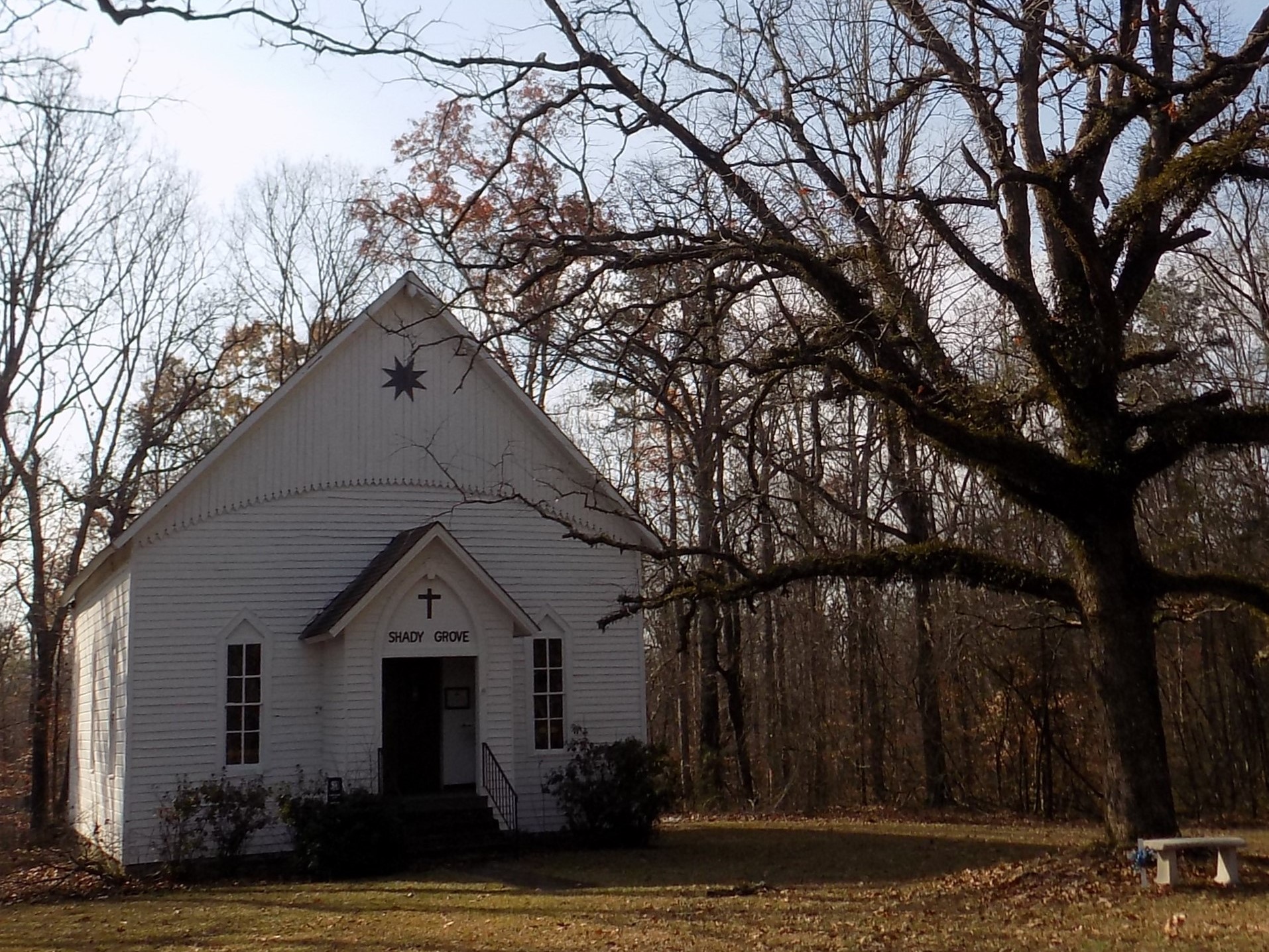
Shady Grove Church; Cullman County, Alabama

The Hallelujah Trail features a church in the Cullman County community of Logan. A couple of weeks ago, I had the perfect opportunity to travel down to see it in person. Much of Cullman County is off-the-beaten-path and Logan seems even more remote than most. It’s beautiful hilly country with plenty of farms, pine thickets, and ponds along the narrow roads.

At the end of one particular road is Shady Grove Church, which started out in the 19th Century as pews in an arbor. The current building dates to the late 1800s. It’s a serene place on a lonely road, surrounded by the quiet of pristine forests. Across the road from the church is an old cemetery which holds generations of locals along with the remains of soldiers from both the Union and Confederate armies.

Shady Grove Church interior; Cullman County, Alabama

The doors to the building were locked but, through a window in the front door, the entirety of the church interior is visible. A unique touch, a hand-carved church structure, decorates the arched cove behind the pulpit. A wooden outhouse provides necessary services behind the building. Somebody had made the effort to install fresh flowers in small vessels in each window; it’s a small touch – but one that speaks to the dedication that keeps Shady Grove Church a place worthy of a remote road trip.

In activist/poet/writer Katha Pollitt’s “Plague Poem,” she muses, “Perhaps it is best that we go away now” as she considers ongoing environmental and social sins. It’s an interesting thought, but this Christmastime, I choose to hope for the best and for an opportunity to right the wrongs that plague us when we get to the end of this current spate of unfortunate circumstances.

Merry Christmas … And all hope for an amazing and triumphant New Year.

Shady Grove Church window; Cullman County, Alabama
Cancelled

Based on years past, I should be a couple of hours away from my annual December getaway to Point Clear on Mobile Bay as I type this sentence. A couple of months ago, I optimistically booked a room at the Grand Hotel for December 13 through 18. I knew I might have to cancel, but I wanted to be ready just in case things had changed by now.

When I booked my room, the resort was still dealing with damage from Hurricane Sally in September. I have been exceptionally conscious and careful during the pandemic and was impressed with the safety protocols the resort has in place. My plan was to stay close to my room, reading and writing, to take regular walks around the grounds and community, and to have room service and takeout. It seemed to me to be a responsible way to get a break and finally to celebrate my retirement.

As the dates got closer and the news reports grew more grim, I realized that the responsible thing is to cancel for the time being. The world around us and people depending on us make it feel imperative to take a stand. And, as my friend Deborah says, now that I’m retired, I can go down any time I please … once the health crisis has passed, anyway.

It will be the first time I have missed the December escape since 2005 – the year of Hurricane Katrina and its extensive damage to Mobile and Baldwin Counties.


Even as I entered my cancellation, the music and memories of Baldwin County and Mobile Bay invaded my thoughts. I think about downtown Fairhope, the intersection of Section Street and Fairhope Avenue, and the light-bedecked trees along the sidewalks. The planters, hanging from the light posts, complement the plantings of poinsettias and pansies in the ground-level beds.

I think of the Camellia Café, Dragonfly, Panini Pete’s, the Wash House, and other places to grab a great meal. I think of Market by the Bay and its abundance of fresh catch seafood.

I think of drives to lonely overlooks across the bay, to Magnolia Springs, and to the search for bags of fresh local pecans and satsumas.

At the Grand, the gentle surf grazes the docks and, beyond the marina, the lights of Mobile, across the bay, glisten beyond the traffic of the causeway.

The Grand sunset, usually spectacular, will still be there when I return. And, upon that return, I think I will cherish the place more than ever.


For now, I slowly and surely prepare my house to sell and keep my eyes and ears open for possible places to move in Birmingham.

To stay grounded, I read as much as possible. After reading stacks of magazines, a few books, and news articles, I have found comfort and solace in reading a couple of very good cookbooks. Sean Brock’s second book, South: Essential Recipes and New Explorations, is as thoughtful and thorough a consideration of Southern foodways and contemporary thought on the subject as one might find. Kelly Fields’s chatty The Good Book of Southern Baking: A Revival of Biscuits, Cakes, and Cornbread is as inspiring as one might expect from the dedicated and well-travelled James Beard Award-winning pastry chef.

I feel grateful, as I read these books on food, to have spoken with and experienced meals prepared by both of these chefs. I first had Brock’s food at an unforgettable dinner at Alabama Chanin’s factory in Florence. I met and broke bread with Fields at two dinners at the same place. Her New Orleans bakery and restaurant, Willa Jean, is a singular New Orleans experience.

I am also, grudgingly perhaps, becoming more susceptible to the necessity of streaming video. I have even fallen prey to the New Age-y call of calm.com, and especially its hypnotic video series, “The World of Calm.” My most frequent stream, however, has been the Spike Lee-directed concert movie, David Byrne’s American Utopia, which is a most hopeful document of our country and its current situation. I have lost touch with how many times I’ve watched it already.

To satisfy my former habit to watch a movie in an honest-to-goodness cinema, I have been able to venture to Sidewalk Cinema + Film Center in the basement of the Pizitz building in downtown Birmingham. The not-for-profit indie theatre limits each screening to twelve patrons in well-spaced seats in a 100-seat theatre and I have enjoyed welcome escapes there to view films like On the Rocks and Mank. Each visit to Sidewalk Cinema makes me more anxious to move back home to Birmingham when the time is right.

Holiday season 2020 is a unique and memorable one. Perhaps it has made us a little more aware of the pleasures of the simple things. Be safe as we move into a promising new year.

December 2020

Strawberry Fields; Central Park by S. Greg Panosian

November 2020 in north Alabama ended with a day of persistent wet snow flurries. There were temperatures in the 70s last week; the ground was far too warm for accumulation, but November snow is rare and seemed to energize the people in the grocery check-out.

My cashier asked if I was enjoying the snow; I am sorry that I truthfully answered that I am not a big fan of snow and cold weather. It turned out she was from Alaska and was excited to see any snow, so the remainder of our transaction was a bit chilly (pun intended, I guess).

As this dismal year draws to a close, I look forward to a responsible conclusion to the holiday season. I relish the start of a new year and a new administration and the promise it holds.


In this December of 2020, I am startled to realize that in a few days we will mark the 40th anniversary of John Lennon’s murder. For most Baby Boomers, the event is one that is etched in memory.

In that week of December 1980, I was completing my first semester in graduate school and giving final exams to my English 101 composition students as a graduate teaching assistant. On Monday night, I had just completed grading a round of exams when my friend Bill Golightly dropped by to see if I wanted to go downtown to the Chukker; I had no exams on Tuesday, as either a student or a teacher, so I grabbed a jacket and we headed out.

In those days, the Chukker proudly did not have a phone or a television. It had a sparse menu, drinks, pool, pinball, and music.

Most people seem to have first heard about the death of John Lennon from Howard Cosell during Monday Night Football’s Dolphins-Patriots game.

Cosell’s voice wasn’t heard in the Chukker that night, but Bill and I noticed that the bartender, Deborah, had walked into the back room and was quietly weeping. When she had collected herself, we called her over and asked if she was okay.

“John Lennon was shot. He’s dead,” was her answer.

One of her friends had apparently stopped by to tell her the news. The entire room went silent. Of course, we asked the pointless question, “Are you sure?”

Bill and I decided we needed confirmation. “Barry will know,” I said. “Let’s call Barry.” The nearest pay phone was a block away so we hurried there to call our friend, Barry, who always seemed to be an insider with the latest news from the music scene. By that time, though, cars were cruising down 6th Street with John Lennon or classic Beatles songs blaring from car radios and stereos. So, we knew.

I called Barry anyway. He picked up on the first ring. “Is it true?”

“It’s true.”

Bill and I headed back to my neighborhood, which I fondly referred to as the “student ghetto.” Music by the Beatles and Lennon was coming out of every window, it seemed, as other friends joined us for what turned into an impromptu wake at my place.

I had no reason to be on campus the next day, so I stayed in on Tuesday. The phone rang often. Friends from all over the country felt a need to call and commiserate. We were all checking on one another.

I won’t embellish: I was never really a major Beatles fanatic. I enjoyed the music as soon as it hit and appreciated its overwhelming brilliance and cultural influence; some of the Beatles songs are among my favorites. On the night that the Beatles made their live American debut on “The Ed Sullivan Show,” we were at church. But at a fellowship at someone’s home later, the kids gathered in one of the bedrooms and played “I Wanna Hold Your Hand” over and over.

I would like for “In My Life” to be played at my memorial. The unobtrusive George was my favorite Beatle. Post-Beatles, I rooted for John Lennon in his challenges and was happy that he seemed to have gotten himself and his music in a good place.

His passing – and so violently – was a generational touchstone for so many of us. Our years of coming to consciousness were marked by Cold War, Vietnam, assassinations, and social upheaval. To have one of our icons – the auteur of “Give Peace a Chance” – gunned down on Central Park West, outside his home with his wife looking on, defied, for the moment, logic and rational comprehension.

On Wednesday of that week, I returned to campus to give a final to one of my freshman composition classes. The final part of the exam was a short essay – an analysis of a contemporary song lyric. The options were lyrics by Bob Dylan, Joni Mitchell, and Bruce Springsteen. One of my students chose Mitchell’s “Shades of Scarlett Conquering” for his explication essay. He entitled it “Give Peach a Chance.” The title was a stretch, but much appreciated.

A few years later, on my first trip to New York City, the only photographs I took were at Strawberry Fields, the area of Central Park dedicated to the memory of John Lennon. This was not intentional; when I got home, I realized that in five days in New York the Central Park memorial was the only time I took a picture.


The Chukker is long closed. Bill Golightly died on January 2 of this year. And John Lennon would be 80 if he had lived.

I am embracing the holiday spirit, but a piece of music that sticks in my mind today is Olivier Messiaen’s chamber piece, “Quartet for the End of Time.” Messiaen composed the piece while he was a prisoner of war in a German stalag during World War II. The quartet premiered in a 1941 prison performance with other prisoners of war playing the other parts. It is an introspective and solemn work; somehow, too, it is jubilant and hopeful. It seems to be an ideal composition for an uncertain time.