

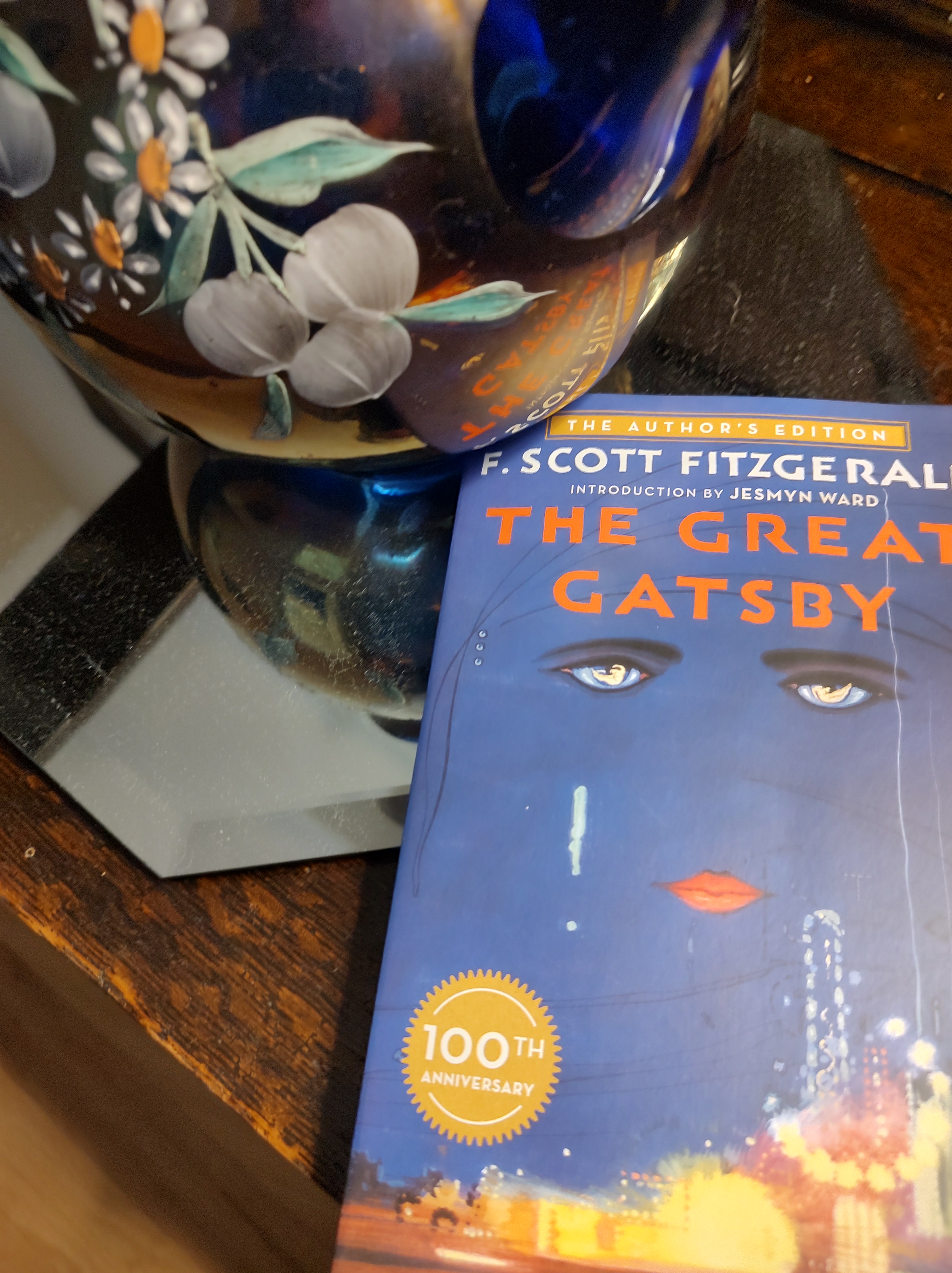
 The university where I taught was hosting a mini-symposium about F. Scott Fitzgerald’s The Great Gatsby in conjunction with the local library and the National Endowment for the Arts. I was the moderator and had gathered the participants for a planning session before the event. At some point in the conversation, I casually stated that I thought the Twenties would have been an exciting time to be alive.
There was a moment, and then one of the professors muttered, “As long as you were white.” Another chimed in, “… and a man.”
I was chastened and kept my mouth shut. However, some of my favorite writers were publishing in the 1920s – William Faulkner, T.S. Eliot, Gertrude Stein, etc. George Gershwin was composing. The Harlem Renaissance highlighted the talents of Hughes and Hurston and so many others. The New Yorker magazine was founded, and modern art was bursting forth. Speaking strictly for myself, I still think it would have been an inspiring time to be alive (if only one could maneuver a way to exit prior to the Great Depression).
And in 1925, F. Scott Fitzgerald’s The Great Gatsby was published. I try to stop myself from writing about my ritual of reading F. Scott Fitzgerald’s The Great Gatsby on every Summer Solstice. But since much commotion heralded the centennial of that enduring novel in April of this year, I need to address my ritual once more. It began in high school when we were assigned Gatsby in an American lit class. I think that’s a good age to read the book for the first time – a time when adult thoughts are edging out the preoccupations of childhood and adolescence, when many are just getting an inkling of what romantic love might be all about. Cynicism hasn’t yet taken hold.
In the book, Daisy muses that she always looks forward to the longest day of the year and then forgets it when it comes. “We ought to plan something,” her friend Jordan dreamily says. For some reason – mainly because I always looked for the longest day of the year and then forgot about it until it was past – I thought I should plan to read The Great Gatsby on the longest day of the year.
And so I did. I am prone to such plans and then letting them slide away, but I have stuck to the reading Gatsby thing. By my calculations – I might have missed a year somewhere along the way – I have read Gatsby annually, and on the same day, for over half of the hundred years since its publication.
Over the years, it never gets old; there’s always a new moment or turn of phrase to discover. I look forward to the Summer Solstice just because I know I will be revisiting the Eggs of Long Island. As I grow older, Gatsby grows in meaning and grace. Over time, my waning tolerance for the arrogance and wealth of Tom and Daisy Buchanan has decreased and James Gatz of North Dakota has begun to look increasingly foolish and naïve in his quixotic quest. I understand how careless Jordan Baker could inspire a fleeting adolescent crush in any number of grown men. (When Tom is in the middle of one of his racist rants, Jordan breezily shuts him down with “We’re all white here.”) I feel sorry for the Wilsons – Myrtle and George – and think that we all have known marriages like theirs, one way or the other. And now, when I read the book, I think They’re all so young.
But of all of them, it is Nick Carraway, the narrator, whose voice I most enjoy visiting once a year. I sort of trust him when he says he is one of the “few honest people that I have ever known,” although anyone who would say that about himself is already suspect (it’s kind of like declaring yourself a “stable genius”).
____________________
I underline passages in books, although I have always done it sparingly, like a standing ovation. Each time I read Gatsby I linger over lines and passages I underlined in past summers. Sometimes it makes perfect sense; other times, I think Why did that catch my attention? Occasionally, it takes me right to a certain place in my life and I know what prompted those words to grab me at that specific time. At one point in the book, Nick realizes that it is his thirtieth birthday and the “portentous, menacing road of a new decade. … the promise of a decade of loneliness, a thinning list of single men to know, a thinning briefcase of enthusiasm, thinning hair.” I can tell you exactly when I underlined that passage. I have gone through several paperbacks of The Great Gatsby since my ritual began. I keep them even after they fall apart and are replaced. One remaining copy was damaged after it was thrown up into the air to avoid an incoming wave on a beach somewhere. It avoided the surge, but not the saltwater.
____________________
On those first readings of The Great Gatsby, I was not aware of Fitzgerald’s Alabama connections. Zelda Sayre was a new name to me. It was only after Fitzgerald’s daughter, Scottie, came to speak to my sophomore lit class, that I began to realize the significance of Alabama in the Fitzgerald biography. It was while he was stationed in Montgomery that Scott and Zelda met. Later, in 1931 and 1932, when they briefly rented a house in Montgomery’s Cloverdale neighborhood, Zelda worked on her novel, Save Me the Waltz, and Scott wrote part of Tender Is the Night. Their daughter, Scottie Fitzgerald Lanahan, moved to Alabama around the time she spoke to my class. She became active in social advocacy and politics in Alabama later in life, partially to atone for some of the Jim Crow legislation of her prominent politician grandfather, and spent her final years in her mother’s hometown.
Anyone familiar with Fitzgerald’s story will recognize the influence of Zelda on Scott’s writing, and especially in his creation of Daisy Buchanan in Gatsby. Zelda famously said, “Mr. Fitzgerald — I believe that is how he spells his name — seems to believe that plagiarism begins at home.”
____________________
One of Andy Kaufman’s most frustrating stunts was when he decided to read The Great Gatsby to an audience. He would start reading in a sonorous voice and he would not stop. Audiences would catcall and scream for him to stop and he would taunt them, threatening that if they did not quieten down, he would stop reading. They would persist, but he would not stop. Eventually, after his reading had taken the audience beyond the breaking point, he told them if they did not stop, he would have to play the recording he brought. As the audience pleads for him to play the recording, he finally puts down the book and cues up the record – a recording of Andy Kaufman reading The Great Gatsby.
It’s a brilliant piece and, in its building tension and absurdity, there is an underlying truth. The Great Gatsby is so beautifully written, the words are so crisp and precise, that I always want to read passages aloud just to hear the words. Kaufman picked up on that urge and his madcap stunt shows just how outrageous and cloyingly precious it is to force people to listen.
Kaufman’s stunt aside, the theatre ensemble called Elevator Repair Service won massive acclaim and made its reputation with a production called Gatz in which The Great Gatsby is performed, word for word, from start to finish. Set in a drab office, a bored office worker pulls out a copy of Gatsby and begins to read it aloud. The other workers begin to recite the text – in its entirety – and play the various characters, all in their office setting. The performance lasted eight hours including two short breaks, an intermission, and a dinner break. It was a hit and has been toured and revived by Elevator Repair Service several times since its 1999 premiere. It probably sounds like torture to many — as torturous as that Kaufman bit — but, given the opportunity, I would happily sit through Gatz.
_____________________
There is one passage in Gatsby that I always ponder; it never ceases to intrigue me and is one of many moments that feeds my deep affection for the story. It comes at the end of Chapter VI after Gatsby opens up to Nick about his Daisy obsession. Nick notes that despite Gatsby’s
… appalling sentimentality, I was reminded of something – an elusive rhythm, a fragment of lost words, that I had heard somewhere a long time ago. For a moment a phrase tried to take shape in my mouth and my lips parted like a dumb man’s … But they made no sound, and what I had almost remembered was uncommunicable forever.
That moment passes; it’s not referenced again. No other writer has so effectively captured that moment of something “on the tip of the tongue” that is almost there and disappears, never to return. I am not sure that any other writer has tried.




 Professional Southerner