Category Archives: memoir

Handkerchief Etiquette

IMG_1871 Years ago, when I was still working in professional theatre, I managed a tour of a show about the life of an Appalachian woman. The tour spent a week in Birmingham and I arranged tickets for my parents, my brother, and my sister-in-law. As a surprise, I got a seat with the family so that we could watch the performance together.
At one particularly moving moment in the play I heard my mother begin to sniffle. Without fanfare my dad quietly removed a handkerchief from the inside breast pocket of his suit jacket and slipped it to my mother. Seconds later my sister-in-law began to tear up and my dad once again reached into the same pocket, produced another cloth handkerchief, and passed it to her.

My sister-in-law seemed duly impressed and so was I. I knew my dad always carried a handkerchief but his preparedness for a two-hankie moment was the sign of a true gentleman. I made a mental note to always have a couple of handkerchiefs on stand-by in my breast pockets whenever I wear a dress jacket.

A few years ago, while giving a final exam in early December, one of my students was sniffing and snorting and coughing and had come unprepared with anything to control her malady. I quietly stepped over to her desk and offered her a clean handkerchief from my suit jacket.

She looked at me as if something indecent was occurring. “What is that?” she demanded.

“It’s a clean handkerchief. You sound like you need it,” I said quietly.

Her eyes rolled and she said, “I don’t think so,” and continued to work on her test. When she turned the paper in, I was frankly a little hesitant to handle it knowing the number of germs that had been spewed over it.

I thought that particular student’s reaction was odd until a few semesters later when, during a lecture, a student was suffering with a distracting runny nose and sneezing. I pulled out a clean handkerchief and asked him if he would like to take it. He turned me down and – since it was a lecture and not a test – I suggested that he might like to go to the restroom for some tissue.

As he left the room I asked the class “What’s the deal with students today and handkerchiefs?”

One student chimed in. “Well, you must admit that it’s pretty weird to lend somebody something to blow their snot in.”

“Oh no no no,” I said. “If somebody offers you a handkerchief, it is not a loan; it is a gift. If I give you my handkerchief I have no intention of taking it back.”

Once again, I felt like a dinosaur as I understood that a common courtesy that I took for granted was completely unknown and misunderstood by my students’ generation. I was heartened a bit in a recent episode of the television series “Aquarius” in which David Duchovny plays a Los Angeles policeman in the 1960s. After delivering bad news to a mother he mutters  to a colleague that “there goes another handkerchief” (or words to that effect). I was glad that I was not delusional in my memory that long ago a society existed in which the role of the man’s handkerchief was understood. (Of course the plot of “Aquarius” deals with the fact that Charles Manson also ran free in that long ago society but that’s a topic for another day.)

In our frightened and germophobic contemporary world I am aware of the wariness and warnings about cloth handkerchiefs. Still, blowing one’s nose or coughing discreetly into one’s handkerchief seem safer and more civilized to me than the currently approved “vampire sneeze” of coughing into the crook of one’s arm.

Oh well. The art of the handkerchief seems to have pretty much disappeared (although the recent surge in pocket squares might be a portent of something). But, finally, this is all one needs to know about a proffered handkerchief: If you take it, it’s yours.

Please don’t offer to give it back.

A Summer Memory

IMG_1784  As the fireflies begin to emerge at dusk this evening, I am reminded of a distant summer Sunday night.

It was the summer before my senior year in college and I was, as always, poor and working part-time jobs to try to pay the bills. My friend Joni invited me over for “afternoon tea” at her house, a small garage apartment in the backyard of a pretty little Tudor in the area we all referred to as the “student ghetto” not far from the Strip and the University campus.

Joni was an art student, a painter. We met through working concerts and events for the University Program Council. I would occasionally visit her in the Woods Hall art studios at Woods Quad, still one of my favorite places on the campus.

IMG_0653

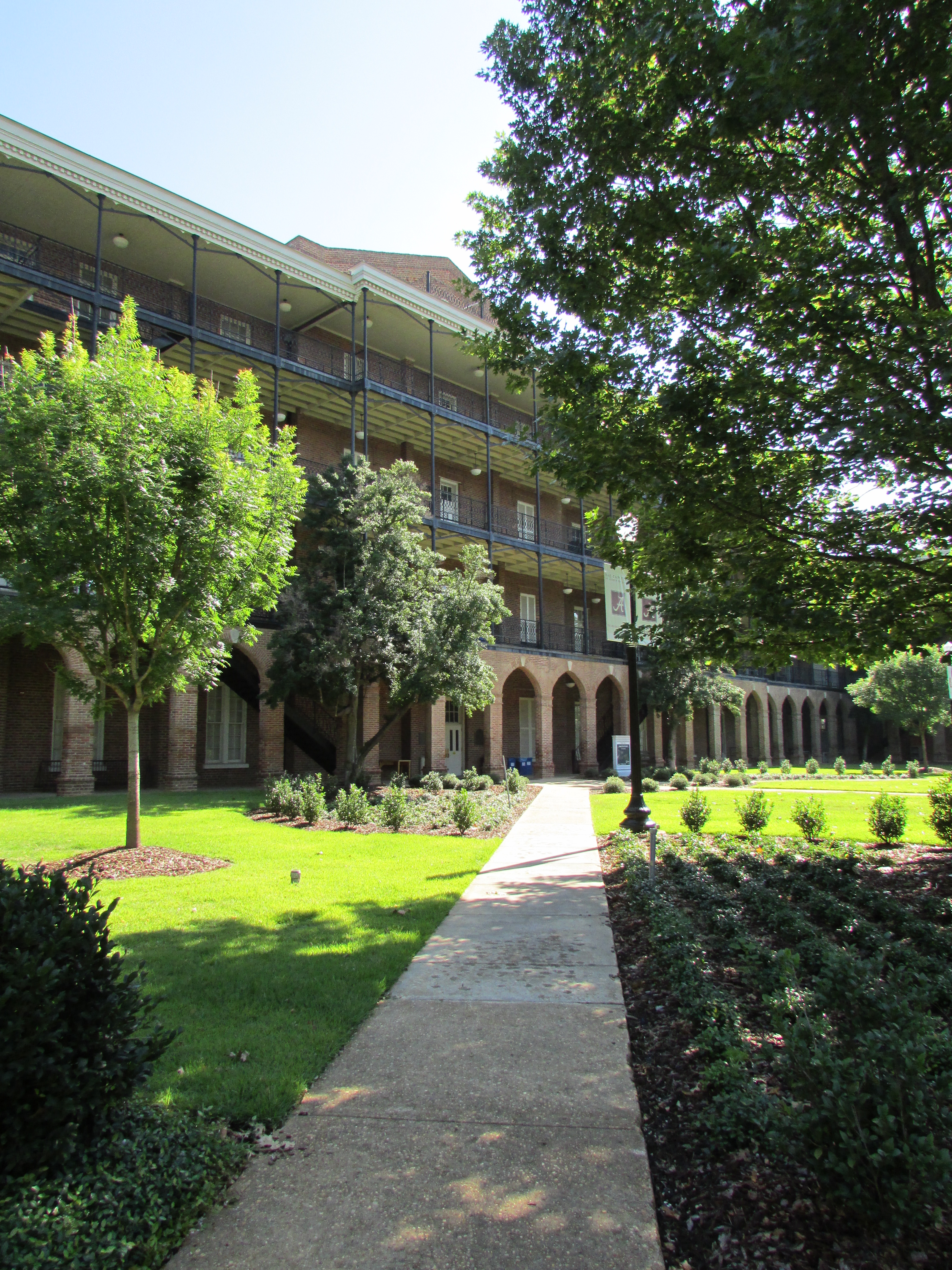
The four-story Woods Hall, a Gothic Revival structure with cast iron galleries along the upper floors, was the first building built on the University of Alabama campus after the campus, including the library, was burned by Croxton’s Army during the Civil War. Only one library book was saved — a copy of the Quran.

The Woods Hall art studios always had a calming effect on me. The rich and pungent smell of oil paints, solvents, and various chemicals had a heady impact as one wandered through the studios looking at finished and unfinished works on easels or at paintings that leaned against the thick walls to dry. The Woods Hall elevator was always covered with the best graffiti on campus

My friend Joni was probably as broke as I was – as we all were in those days, it seemed. But she was known as a good host who threw great parties. Her October masquerade birthday parties were legendary.

Joni’s summer afternoon tea with me was to celebrate a painting she had just completed with inspiration provided by me. One time at my apartment she had spotted a panel of 1950s-era drapes that I always kept close by. These colorful drapes of barkcloth fabric with big tropical looking flowers and flowing shapes are among my very first memories. I remember the barkcloth drapes on the windows in the living room of the first house I can recall from childhood. The room had a red sofa, a green chair, and a table set that included a coffee table, two end tables, and a 2-tiered lamp table that took pride of place in the picture window.

Years later, my mother was getting rid of the old drapes which she hadn’t used in years, I asked if I could have a panel since the pattern was such a primal memory for me. She gave me all of them and I have kept them ever since – although some have been repurposed or given away. Two panels are framed in my current dining room as I write this. I still have two throw pillows covered with the fabric.

Joni saw a panel of the barkcloth draped over hooks in my living room and was immediately taken with it. She said she’d like to use the pattern in a painting. I gave her a spare panel of the drapery for reference.

Now, weeks later, the painting was complete and I arrived for the viewing on a sultry summer late-afternoon, making my way down the driveway to a walkway leading to Joni’s second-floor apartment. The doors and windows were open and strategically placed fans were blowing the thin curtains on each window.

Joni welcomed me and got quickly to the first order of business – the reveal of the new painting. It was resting on a chair in a corner of the room. The finished painting was of Joni’s cat perched on an upholstered side chair. The cat’s eyes were wide open, staring intently at the observer. The long window behind the cat was partially covered by my drapes. A jungle of green was seen through the window. Now that I think about it, Joni’s paintings were often reminiscent of the Naïve French painter Henri Rousseau in their use of color and unbridled primitive appeal.

It was a lovely painting made lovelier by the memories evoked by my favorite draperies. (I spotted that same barkcloth drapery pattern in a John Waters film many years ago.)

After we had admired the painting, Joni said, “Time for tea!” and motioned for me to sit at a small table next to a window overlooking her front yard – which was the back yard of the Tudor. Two places were set with teacups in saucers and paper napkins. Joni brought out a plate of saltine crackers and a store-bought container of pimento cheese with a knife to spread the cheese. From the small refrigerator, she produced an old tin coffee pot and began to pour.

The coffee pot was full of ice and tap water. The icy water was a perfect antidote for a steamy hot day. After pouring, Joni set the pot in the middle of the table. Sugar was offered in case I would prefer “sugar water” but I took mine straight. We refilled our cups from the pot as needed and spread pimento cheese on crackers as the sun set. The sky slowly darkened and the fireflies began to emerge from wherever they had been hiding all day. The cold coffee pot began to sweat and a small slick slowly spread around it on the patterned oilcloth table covering.

Joni and I laughed and talked into the evening; I still remember it as one of the most pleasant “tea” services I ever experienced.

Joni and I graduated around the same time. She left town and I lost touch. I heard she briefly dated a friend of mine but I never saw her again after Tuscaloosa. I’d love to let her know that I still have fond memories of that frugal and elegant Sunday evening.

These are moments brought to mind by fireflies in summer.

Food Memory: My Father’s Barbecue

IMG_1760  With Memorial Day weekend comes the traditional kick-off to cooking out and barbecue season. Although it’s always cook-out season in the South, it was a rougher than usual winter and it’s good to know that outdoor activities and barbecue are in full swing.

At some point in the ‘90s, when my job was frequently moving me around the country, I gave away my barbecue grill. Now, two decades later, I still haven’t replaced it.

That was not necessarily the plan. I gave the grill away so I wouldn’t have to move it anymore and I had every intention of replacing and upgrading it when I got settled in a new place. Now, even though I still think about purchasing a new grill (I’m attracted these days to the Big Green Egg) I am in no rush. My standard line is that I can find much better barbecue than I make so why would I want to take the time and trouble to grill my own?

I’m a pretty good cook, it’s true. But I know many people who grill and barbecue better than I. When it comes to barbecue, I prefer to be a connoisseur rather than a master. I once toyed with the idea of pursuing Kansas City BBQ Society judge certification but after exploring the rules I realized I prefer to consume barbecue as an amateur. Over the years, I have found some prize-winning barbecue to be lacking and the barbecue that breaks all of the rules is sometimes among the best.

In other words, I’m not that interested in measuring the smoke ring and analyzing if it “pulls” properly or “falls” off the bone; I’m not interested in quibbling over what’s authentic barbecue and what is just grilled meat. I’m interested in how it tastes and makes me feel.

As I write this, I am still in the afterglow of a quick stop at the original Dreamland location in Jerusalem Heights, Tuscaloosa. Driving away from that storied place, I realized that one of the things I love most about Dreamland is that slight glorious burn from the sauce that lingers in the front of the throat for a good hour or so after the meal is done.

I can give a long and ever-evolving litany of good barbecue joints around the country and I have been to quite a few. But some of the best and most fondly remembered barbecue of my life was cooked in the backyard by my father, Grover Journey.

Dad usually fired up the grill on Memorial Day, Independence Day, and Labor Day. He would start gathering his meat – pork ribs, sausage, and chicken – a couple of days in advance. He was picky about his meat choice. Mother would prepare traditional sides in the kitchen and I often made a huge green salad loaded with chopped vegetables.

My dad, who smoked cigarettes for about 50 years, has COPD – emphysema – now and as his breathing problems got worse he eventually stopped cooking at the barbecues. If the family is together for a warm weather holiday, my brother sometimes serves as pitmaster. Other times, we just buy meat and the sides at a local joint.

But when Dad was younger and healthy, he preferred to do the cooking himself. On the few occasions when I asked him to show me how he did it, he was never particularly forthcoming. I think he grilled his meat by instinct and it would have disturbed his mojo to divulge too much. I get that. I am much more comfortable handling my kitchen and my cooking alone; when I have “help,” things begin to go awry.

One thing I do know: Dad’s technique broke the rules. I read and watch what other pitmasters say and I realize that my father’s way didn’t conform with conventional ‘cue wisdom in many aspects.

Having said that, it always had a phenomenal taste so, in this case, rules be damned.

With the approach of Memorial Day, I recently decided to make another effort to pry loose any of my father’s grilling secrets. I chose to make it part of a recent dinner conversation.

“Dad, what did you use to marinate your meat before you’d barbecue?” I asked innocently.

“I didn’t marinate it,” he said.

“I thought I remembered some kind of pre-soak or marinade you used to do,” I responded.

“No.”

Mother chimed in. “I remember you used to soak it in vinegar.”

He denied it. My mother and I both seem to recall that he would pre-soak the meat in apple cider vinegar but memory is a tricky thing.

This exchange sort of stopped my query cold.

Later that evening, I ventured forth and asked him a little bit more about his technique. I asked him what sauce he used because I remember that he would use store-bought sauce as a base. But in my memory (there’s tricky memory again) he used the bottled sauce as a base only and added his own ingredients to it.

Once again I hit a wall. He told me that he always used Kraft “Original” Barbecue Sauce.

“And what did you add to it?” I asked. I am sure I remember seeing cups of melted butter on the shelf next to the grill, among other things

“Nothing,” he said. “Just Kraft Original.”

“Oh… Okay.” I usually know better than to push on at these moments.

And since I didn’t pursue it, Dad volunteered a good bit of additional information. He said he liked to cook over low heat for several hours. This is the way I remember it, too. He would start early in the day (but did not pull the all-nighters that some pitmasters swear by). The stealthy aroma would waft over the neighborhood until the wait was almost too much to handle and it would seem like the time to sit down and eat would never come.

Dad would sit patiently in a lawn chair, armed with tongs and a spray bottle of water to hit the flames when they flared up. I think the water in the bottle may have been spiked with apple juice but I dared not bring it up in that recent Q and A.

Dad mentioned that he liked to mop some sauce on the meat at the beginning before he put it on the grill. This is one of those areas where many of the “experts” would disagree but I remember it as part of his technique and am a witness that, in my dad’s case, it worked splendidly.

He would continue to mop sauce on throughout the cooking process as he turned the meat over. And he liked to turn the meat a lot (I know, I know – breaking the rules but it worked).

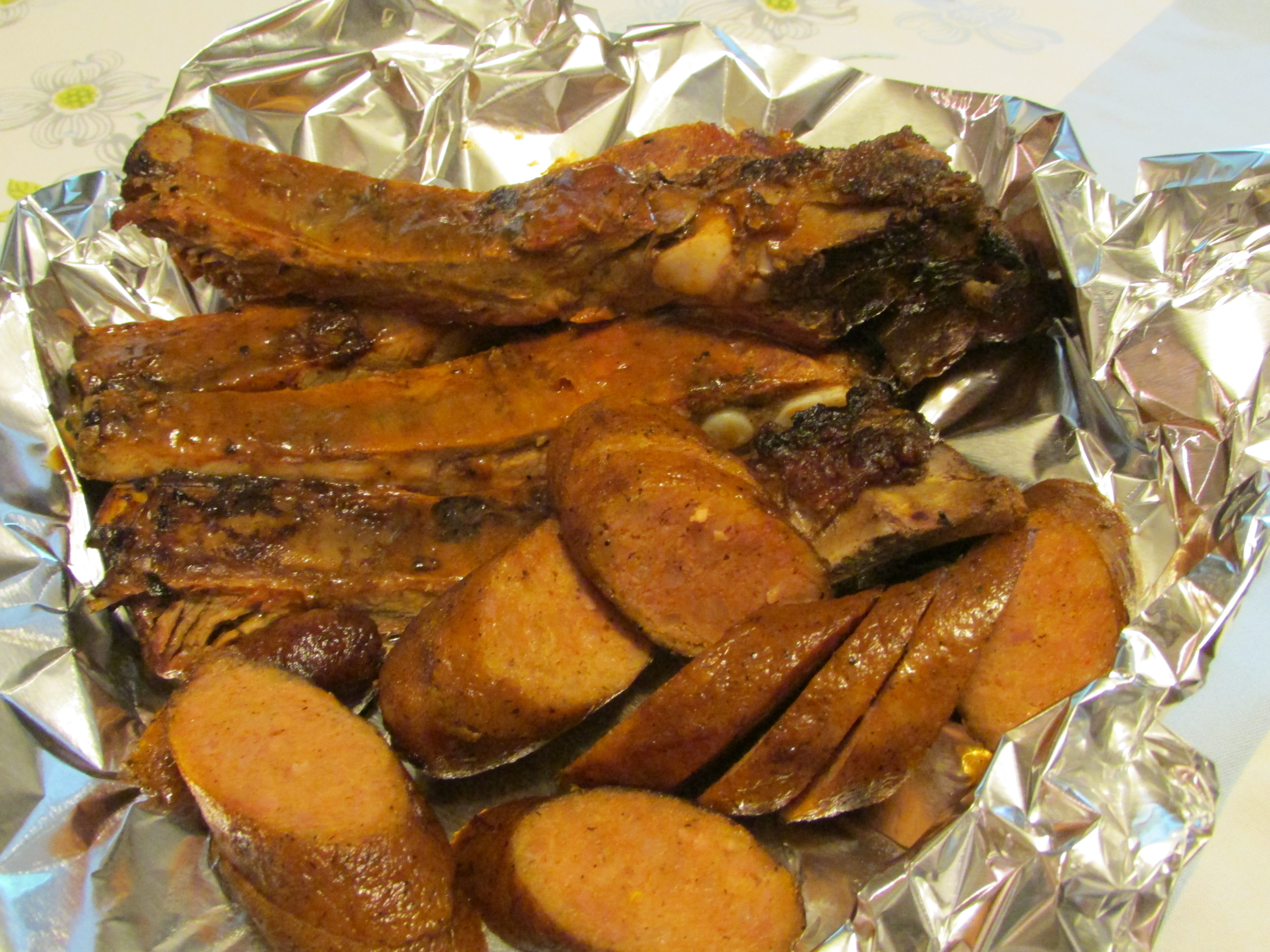
As the various meats were finished, he would pile them on platters, wrap them in aluminum foil, and send them in the house to rest. Huge platters of pork ribs, chicken, and sausages would line the kitchen counter along with Mother’s sides. They always cooked several times more food than was needed for the meal. I counted on it; I liked to be able to carry barbecue leftovers home.

Once, my sister-in-law’s grandparents were visiting from California and joined us for Labor Day barbecue. Spotting the spread, Buster, the grandfather, exclaimed at all of the food. “Do you always eat like this?” he spurted.

“Every single day,” my dad playfully shot back in a dead-pan lie.

All of that sauce slathered on gave the meat a flavorful black char  — the bark. The meat was always moist all the way through and never tasted burned or overdone. Even those who considered themselves wizards at the grill were always impressed by my father’s barbecue.

He broke the rules and did it up right.

I’m pretty sure I’ll never get the low-down on the specifics of his technique.

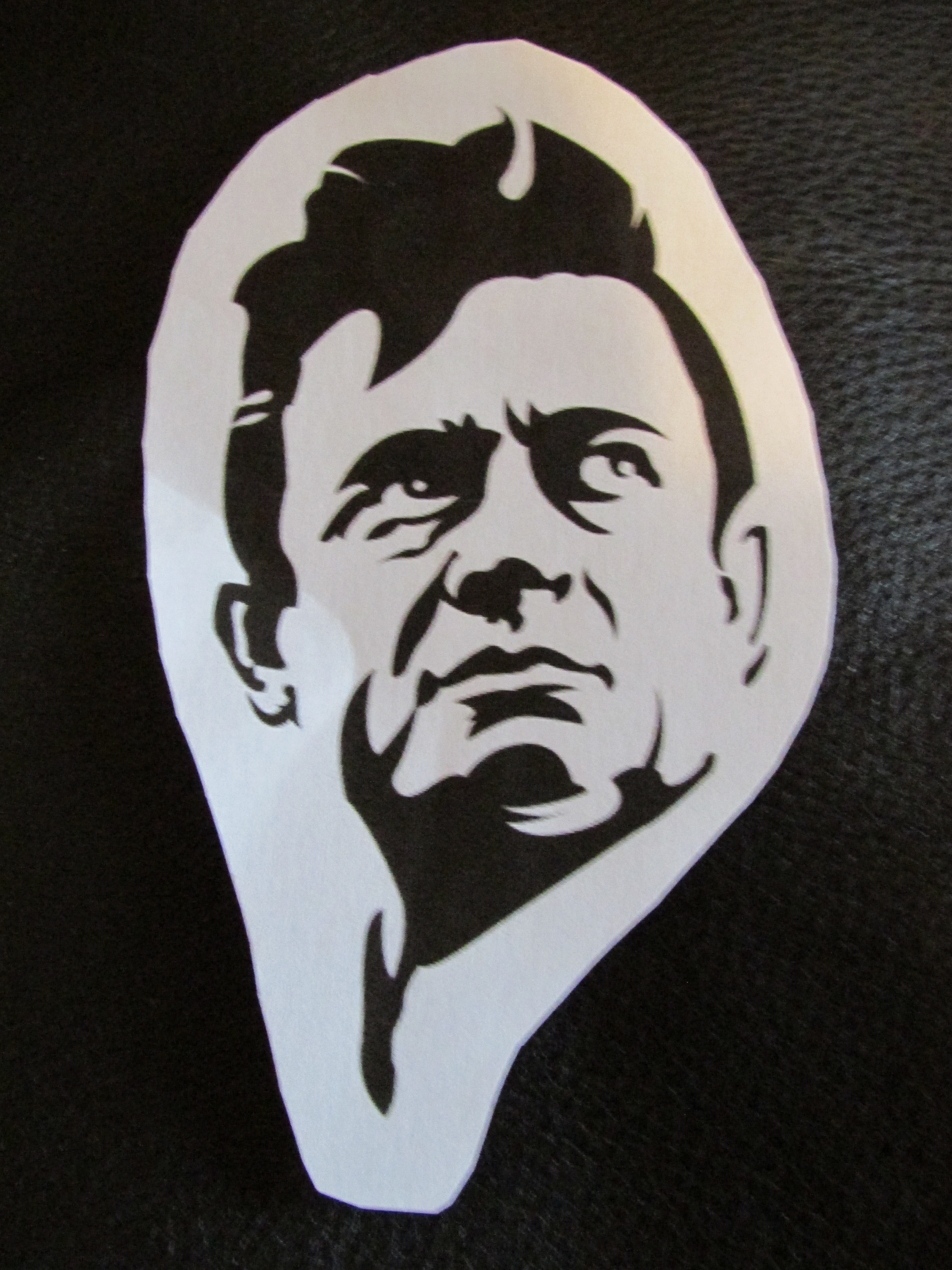
“Hello … I’m Johnny Cash”

IMG_0878      I still remember 1968, of course, as a watershed year in the U.S. and world events. Vietnam was going full-force and the nightly news always opened with that day’s casualties from the war. Johnny Watts, a family friend from our Birmingham neighborhood, was one of that year’s casualties. I had spent much of the early part of the year as an inquisitive little news junkie watching assassinations, riots, televised funerals, the May ’68 Paris protests, and out-of-control political conventions in Chicago and Miami Beach. In November 1968 Richard Nixon was elected. ‘Nuff said.

In fall 1968 I was a surly teenager who was miserable when my father’s job transferred the family from Birmingham to Nashville. The Nashville junior high school I transferred to was far behind the Birmingham school I had transferred from in most of my courses and I dreaded getting out of bed each morning. I look back now and realize that I was a nightmare for my parents during that time.

Looking back, there’s not much to redeem my year in Nashville from late-1968 to late-1969. But I find that much of what I remember and think fondly of – and it had its moments – is centered on the music and entertainment industry, fitting recollections for a year in “Music City.” We moved to a suburban area called Antioch and it turned out that Dolly Parton – then a young singer on Porter Wagoner’s television show – lived down the street. She would wave to my little brother as she drove past the house in one of her Cadillacs (gifts from Porter, we were told) on Saturday afternoons on the way to perform at the Opry.

One Saturday morning, Dad had business on Nashville’s Broadway and we had driven into town with him. Mother, my brother Rick, and I were sitting in the car waiting when Mother said, “That’s Bill Monroe.” I looked up to see a very distinguished man wearing a suit and a grey hat strolling down Broadway. There was the “Father of Bluegrass” and, while it didn’t fully register then, it totally registers now that here was the man who invented one of the most complex and culturally pristine genres of American music.

It was the late ‘60s and I was a Rolling Stones and rock ‘n’ roll fan but the move to Nashville forced me to attend to Nashville’s pervasive country music culture. This wasn’t totally foreign to me since I had family members who played bluegrass and my Granddaddy Harbison was an avid listener to country music.

Besides Dolly Parton down the street, local television stations would air a smorgasbord of syndicated country shows on the weekends. I wouldn’t admit it but I would watch the thirty-minute syndicated shows of Porter Wagoner, Bill Anderson, Marty Robbins, Billy Walker, Lester Flatt and Earl Scruggs, and others late into the night. The Happy Goodman Family and other gospel groups had Sunday morning gospel shows. I am a little amazed that I remember this. I am more amazed that I’m owning up to it.

A Nashville indie television station aired an afternoon teen dance program called “17 Time.” It is thanks to “17 Time” that the Ohio Express song “Chewy Chewy” will be forever etched in my mind.  My brother, who was a toddler and could not have known better, loved “Chewy Chewy” and it was on our turntable incessantly. While I’m venting, the same toddler also made “Bang Shang a Lang” by The Archies a staple in the house. You owe me big time, Rick; actually, I just re-listened to both of those bubblegum hits and I have to admit that they’re both pretty catchy in an insipid way.

The 1968 Elvis Presley television special “Elvis” aired on December 3, 1968, less than a month after we moved to Nashville. I remember lingering with my 21-month-old brother in the television section at Sears while Mother and Dad were buying things for the house (or maybe Christmas presents). I caught a few minutes of the acoustic set with Elvis performing in the round with messy hair and a black leather jacket. Elvis had been relegated to teeny bopper movies by this point in his career but it was obvious that this television special denoted something big and new in his future. I wished I had stayed home to watch it and the next day, at my new school, Elvis was all my classmates were talking about.

“Did you see Elvis last night?” one asked.

“I saw a little of it while I was at Sears,” I said.

“Oh man,” came the reply. “Elvis is back!”

Apparently that was the consensus since that telecast will forever be known as the “Elvis Comeback Special.”

On the day I enrolled at my new Nashville school, a new girl was enrolling with me. She was moving to town from Los Angeles and her dad, she said, was a television producer. This was fitting since it was days after Nixon had won the presidency with his “Southern Strategy” and the entertainment world was looking to Nashville and the South for inspiration and ratings.

Within weeks, in early 1969, two of the major networks announced television variety shows that would be filmed in Nashville. ABC was going to shoot “The Johnny Cash Show” as a summer replacement variety show. CBS was going to shoot a cornpone answer to NBC’s popular “Laugh-In” and call it “Hee Haw.” Local television reported that the cast and creative staff of “Hee Haw” took a hayride from the airport to downtown. It was a corny publicity stunt but it was supposed to signify that Hollywood was coming to Nashville. The Cash show and “Hee Haw” began production in 1969. Nashville entertainment was getting the big head and going mainstream.

Even though I pretended to be too sophisticated to watch “Hee Haw,” I will say that I often did and that “Gloom, Despair and Agony on Me,” one of its signature songs, summed up my adolescent angst at the time. Years later, when I was griping about something to my friend Clay Christian, I was taken aback when I realized that he was softly mouthing “Gloom, Despair, and Agony on Me.” I got over my bad self and started to sing along: “Deep dark depression, excessive misery / If it weren’t for bad luck I’d have no luck at all / Gloom, despair, and agony on me.” It’s no “He Stopped Loving Her Today,” but it’s a classic in its own right.

That may have cemented my friendship with Clay forever.

As entertaining as all of these things may have been, the major event was “The Johnny Cash Show.” Cash was already a popular entertainer in my household and this was before he had quite achieved massive hipster cool beyond the rockabilly set. The show was filmed in Ryman Auditorium when it was still the home of the Grand Ole Opry.

When ABC began shooting shows I did not rest until my parents got tickets to a taping. On a Tuesday night my mother, our next door neighbor, and I traveled to the Opry House to see the show. My dad and the husband next door babysat Rick and the neighbors’ baby. Here’s context: Standing in line at the Opry House, people nearby were debating the merits of the 1966 Mike Nichols film Who’s Afraid of Virginia Woolf? starring Elizabeth Taylor and Richard Burton. Mike Nichols died yesterday.

When we were finally seated in the Ryman and waiting for the taping to begin, I excused myself to go to the restroom. I had no idea where the restroom was and just started walking down the nearest stairs I found. Finally, when I got to the bottom of the stairs, I walked down a hallway. I didn’t see a restroom but heard voices from a room off the hall. I walked into the room and found myself in what I suppose was a dressing room. Johnny Cash, Carl Perkins, and the Statler Brothers, instruments in hand, were sitting there.

Conversation stopped. “Do you know where the restroom is?” I said. I realized later how ridiculous that sounds.

I don’t remember who told me to go back up the stairs but somebody did and I eventually found the restroom. I made my way back to my seat. I’m not sure I mentioned what had just happened.

Eventually, the show started up. On a darkened stage, a spot hit the man in black, He strummed a chord on his guitar, turned and looked at the camera, and snarled, “Hello … I’m Johnny Cash.”

Think about this: It was Johnny Cash performing on the Ryman stage. His back-up singers were June Carter and the Carter Family. Mother Maybelle Carter, the matriarch of twentieth century country music, was on that stage along with her daughters — June’s sisters – Anita and Helen. Carl Perkins and the Tennessee Three were playing. The Statler Brothers were backup singers and comic relief.

The guests that night were singers Gordon Lightfoot and Evie Sands. Dan Blocker, who played “Hoss Cartwright” on the iconic TV western “Bonanza,” was a guest on that show also but he was not present for the taping we attended. He was only announced and talked about as if he were there. His actual performance came at later tapings and was spliced into the finished product.

A comedy duet, Dick Clair and Jenna McMahon, provided comedy relief. Clair and McMahon were probably pretty innocuous as a quipping married couple but they seemed terribly witty and urbane to me at age 14. Because I had seen them at Cash’s show, I kept up with Clair and McMahon on the television sitcom and variety circuit for years. Dick Clair would be among the many entertainment talents who died of AIDS in the 80s.

It was a television taping so there was lots of downtime while sets and new set-ups were underway. I’m sure my mother and our neighbor got bored but I was mesmerized the whole night. I enjoyed watching Johnny Cash and June Carter banter when the cameras weren’t on.

That was the only taping of the Cash show that I got to attend. The taping I saw turned out to be the second show aired in the summer of 1969. The first show had Joni Mitchell and Bob Dylan as guests. “Best of” videos are available and I strongly recommend them to anyone interested in music.

The Cash show is still legendary among fans of American popular music of every genre. I almost made a list of the artists who appeared but couldn’t figure who I might possibly leave out.

Johnny Cash’s album, “Johnny Cash at San Quentin,” was released in the summer of 1969 as the television show premiered. It was a constant on my turntable for years. I can truthfully say that I was a Johnny Cash fan before it was cool (outside country circles) to be a Johnny Cash fan.

Over 34 years later, my phone rang around 3:00 a.m. on a September morning. The call was from my brother, Rick, who was the anchor of an early morning news program at the time. He was on the set reviewing the overnight news breaks.

“Don’t panic, Mother and Dad are fine,” he said. “And I would never call at this hour but in this case I thought I should make an exception … Johnny Cash is dead. I thought you’d want to know.”

His was the first of many calls I got that day.