I Want My Sidewalk 2019

 Birmingham’s Sidewalk Film Festival (www.sidewalkfest.com) is always the final full weekend in August before college football season commences. Although the festival events begin several days before the weekend main event, Sidewalk, for me, always begins on Friday evening and ends late on Sunday night. During that time, there are several hundred screenings of every variety of shorts, documentaries, animation, and feature-length moving pictures at venues throughout the northside of downtown.

2019 marked the 21st edition of Sidewalk. In the early years, I would pride myself on how many screenings I could cram into a 48-hour period. Nowadays, I study the schedule carefully, curate a schedule that fits my time, and allow myself time to breathe. At Sidewalk, it’s impossible to see everything one might want to see; that’s part of the charm and mystique.

Sidewalk’s most exciting new addition to downtown Birmingham this year is the Sidewalk Cinema and Film Center, a two-theatre complex in the basement level of the Pizitz building that will screen indie films 365 days a year. With the two screens at the Pizitz, the Alabama, the Lyric, the Carver, Red Mountain Theatre’s cabaret space, and the McWane Center’s IMAX, Birmingham’s downtown “theatre district” is once again living up to its name.

Friday, August 23

Traditionally, my Sidewalk weekend begins with lunch at Chef Frank Stitt’s Chez Fonfon. My weekend pass is waiting at the Central Ticket Office at the Pizitz, around the block from the Alabama, Sidewalk’s most storied venue (www.alabamatheatre.com).

In the early days of Sidewalk, the Opening Night presentation was often a cutting-edge film which might open to mixed response. I remember the grumbling after John Sayles’s Silver City opened Sidewalk in 2004. It wasn’t Sayles’s best, but I was happy to catch a new Sayles movie on a big screen in Birmingham.

Since those days, the Opening Night film is most often a goofy documentary geared to a broad general audience. Although I enjoy being there for the opening festivities, I am sometimes likely to leave when the feature starts. A few years ago, when they opened with a documentary about some cat that was a sensation on the internet, I didn’t even bother to attend opening night.

This year, the opening feature is I Want My MTV. The 2019 documentary, directed by Tyler Measom and Patrick Waldrop, premiered in May at the Tribeca Film Festival. I Want My MTV is both informative and a great feel-good way to open Sidewalk 21. Alan Hunter, one of the original MTV veejays interviewed in the doc, is a Birmingham native, a founder of Sidewalk, and, for many years, was the very popular opening night emcee for the festival.

A short documentary, “Lost Weekend,” is screened prior to the feature. “Lost Weekend,” by Birmingham filmmakers Bradford Thomason and Brett Whitcomb, chronicles the climaxes and misadventures of a young Pennsylvania man who wins a 1980s MTV contest in which the prize is a weekend for two to hang out in Detroit with Van Halen’s concert tour. Everything you expect to happen in that scenario, happens.

Alan Hunter is on hand to help introduce the feature film, which focuses on the genesis and early years of what was then a music video network that became a major force of 1980s popular culture.

As the Opening Night movie ends, the sell-out Alabama Theatre audience flows onto 3rd Avenue North in front of the theatre for the opening night street party. I have no doubt a good time will be had by all, but I walk through the festivities and straight to my room at the Tutwiler Hotel.

Saturday, August 24

When I arrive back at the Alabama on a bright and sunny Saturday morning, I don’t quickly comprehend why there are “cigarette girls” in the theatre lobby offering packs of candy cigarettes to patrons. However, I am there to attend a screening of the new documentary, Mike Wallace Is Here, directed by Avi Belkin, and am about to watch an hour and a half of on-screen smoking from a time when on-screen cigarette smoking was common, even for reporters on the job.

The life of Wallace, the legendary investigative news man who is best remembered for his decades on “60 Minutes,” is examined in detail in a fascinating no-holds-barred way that is reminiscent of the interviewing style of Wallace himself. His detailed examination into every story he covers is as incisive and prickly with Bette Davis and Barbra Streisand as it is with the Ayatollah Khomeini and John Ehrlichman.

After the screening, I grab a quick bite at the Pizitz Food Hall and head to the Alabama School of Fine Arts for a block of Alabama- and politically-themed documentary shorts. My favorite is Carroll Moore’s “Dawoud Bey: The Birmingham Project,” an examination of Bey’s photography mission to capture images of children the same age as the “four little girls” of the Birmingham church bombing were when they were murdered in 1963. He also includes homage to the two young boys who were murdered later in the day during the bombing’s aftermath.

“Call Me,” directed by Megan Friend and Norris Davis, is a most entertaining exploration of the rhymes and reasons behind attorney Alexander Shunnarah’s ubiquitous billboards that cover the state of Alabama. The 9-minute short includes the full 48-second Alexander Shunnarah / Jurassic Park parody by Kelly Coberly.

Other documentaries in the block explore political activism to get out the vote (“Woke Vote”); emergency responders in Tuscaloosa (“Druid City Strong”); photographic documentation of abandoned buildings in Birmingham (“Walls of Jericho”); diversity and inclusion in a rural Alabama climbing expedition (“The People of Climbing”); student debt (“A Generation Drowning”); and a 70-year-old murder case that went unpunished (“Murder in Mobile”).

From the School of Fine Arts, it’s a short walk to Birmingham Museum of Art for Vita and Virginia (2018), a British film directed by Chanya Button. This is another biographical exploration of the tortured romance of Virginia Woolf (Elizabeth Debicki) and Vita Sackville-West (Gemma Arterton). This latest one is adapted from the 1992 play of the same name by actor/playwright Eileen Atkins.

Vita and Virginia lingers over the cat and mouse game that leads up to the affair of Woolf and Sackville-West in the artistic communities of 1920s England – particularly the Bloomsbury group. The story is told realistically, but with the occasional inclusion of tangled imagery that seeks to capture Virginia Woolf’s mental instability and emotional confusion. There is a stilted, stagey formality to the dialogue at times, but one adjusts to the play’s pace and structure. Atkins based much of her play on the letters of the two title characters; there are some fine moments when the camera rests on a face speaking directly into the camera, delivering emotional and occasionally laughably over-the-top declarations.

Despite noble and occasionally brave performances, Debecki and Arterton seem miscast to me.

Among the supporting actors, Peter Ferdinando delivers an understated, complex, and compassionate performance as Leonard Woolf and Isabella Rossellini has a fine turn as Vita’s snarky mother, Baroness Sackville.

By the time Vita and Virginia is over, a passing thunderstorm drenches downtown and Museum maintenance staff is scrambling to deal with puddles and leaks outside the main entrance as I make haste to get back to the Tutwiler to change and join a friend for dinner.

Sunday, August 25

I will not go to church today, but I waken to the pealing of church bells throughout the city – not an unpleasant way to meet the day. And I plan to attend something equally spiritual and, to my tastes, more inspirational.

A few months ago, when I first heard the buzz about the new Aretha Franklin documentary, Amazing Grace (1972/2018), I remember thinking I hope that’s scheduled to play Sidewalk this year.

It was.

In 1972, director Sydney Pollack and his crew filmed the two-night recording session of what would be Aretha Franklin’s best-selling live gospel album, Amazing Grace. The recording took place in the sanctuary of the New Temple Missionary Baptist Church in Los Angeles. Franklin was supported by legendary gospel singer James Cleveland, the Southern California Community Choir, and an all-star group of musicians. Mick Jagger and Charlie Watts are spotted in the audience.

For some reason, during Pollack’s recording of the two services, the audio and video were not synched, the footage was deemed unusable, and eventually the film was presumed lost.

Fast forward to the early 2000s: the “unusable footage” is rediscovered, producer Alan Elliott supervises a team of digital experts in the rehabilitation of the “lost” footage, and the resulting movie is a revelation. During her lifetime, Franklin kept suing to halt screenings of the reconstructed movie. After her death, the family consented to the release and it is finally being shared with audiences world-wide.

No real effort was made to mold the concert into something “cinematic.” Much of the footage is raw and immediate, with awkward camera movement, sloppy zooms, finding focus – all still there for the world to see.

So is raw emotion – James Cleveland breaking down in sobs at one point; the choir clearly overcome by the event they are witnessing and being a part of; Rev. C.L. Franklin – Aretha’s father – jumping up to wipe the sweat from her face and neck as she plays the piano. His handkerchief completely covers her face at one point just before she starts to sing. The audience, lost in emotion and awe, becomes a part of the power of the film and Pollack’s camera crew scrambles to capture it all.

You must see it.

As the Sidewalk audience gathers outside the Lyric Theatre for the screening, ladies distribute church fans on the sidewalk. When the audience is seated in the theatre, Birmingham-based gospel singer Belinda George Peoples emerges from the wings to sing “Amazing Grace” a capella. By the end of Peoples’s performance, the audience is singing along.

The event feels more like a church service than a movie screening as the audience claps and sways with Aretha’s powerful sound on songs like “What a Friend,” “Wholy Holy,” “God Will Take Care of You,” and the title song. There’s a very effective medley of the gospel standard “Precious Lord (Take My Hand)” with Carole King’s “You’ve Got a Friend.”

But the song that gets to me most is Franklin at the piano playing and singing “Never Grow Old,” with the camera closing in tight. It moves me to see a young Aretha Franklin (she was 29 when the album was made) plaintively repeating the phrase “never grow old” and its contemplation of eternity. Mick Jagger is there, also 29-years-old at the time, and, in the Lyric, I am sitting a few seats down from a friend I knew in college in the ‘70s.

When our work here is done and the life crown is won

And our troubles and trials are over

All our sorrow will end, and our voices will blend

With the loved ones who’ve gone on before

Never grow old, never grow old

In a land where we’ll never grow old

I leave the theatre and drive across town to have lunch with Mother. I have a list of movies I plan to see later on Sunday afternoon, but – blessedly assured that I have gotten what I came for – I actually feel a little sanctified as I hit the road for home.

Archival photo of Alabama Theatre, Birmingham; 1934

Friends of the Cafe | Chef Cheetie Kumar | Conversion

 I have often confessed that my least favorite ethnic cuisine is Indian — Asian Indian (curse you, Christopher Columbus). This bias is borne by an aversion to the texture of much Indian food served in American restaurants, which all too often tastes and looks like baby food to my eye and palate. Also, and probably most importantly, since the 1980s I have often been dragged to Indian restaurants by people I didn’t particularly like. Personal and cultural prejudices are often odd things to pinpoint.

Having once again made my confession, I confess further that I have always enjoyed the blends of spices and ingredients of Indian cuisine. I vividly remember a vendor distributing samples of her Indian foods on the grounds of the New Orleans Jazz and Heritage Festival in 1983; I hypnotically followed her back to her tent to savor more.

But, then, people and mediocrity muddled my perceptions.

A couple of years ago, Chef Asha Gomez and fabulous food inspirations from her birthplace in southern India and her adopted home of the American South made me once again and seriously rethink my reaction to Indian cuisine. This revelation came, not surprisingly, at a Friends of the Café event at the Alabama Chanin factory in Florence – the source of many of my recent food-related revelations (www.alabamachanin.com).

More recently, I have been reading Kevin Alexander’s new book, Burn the Ice: The American Culinary Revolution and Its End (Penguin Press, 2019), and one of my favorite threads in this wonderfully readable narrative is the story of Anjan and Emily Mitra and the evolution of their San Francisco restaurant DOSA and beyond (www.dosasf.com). Their effort to fight the stereotypes of Indian food with authentic and heartfelt cuisine makes me long for what I have obviously been missing.

Now, last week, Chef Cheetie Kumar – born in India, filtered through the Bronx, and the chef/owner of Raleigh’s Garland (www.garlandraleigh.com) — sealed the deal for me with an enthusiastically complex five-course meal at the most recent Friends of the Café dinner in Florence. My hesitation about authentic Indian cuisine has mostly been eradicated as of last week. Kumar’s Florence menu was not exclusively Indian, but the Indian details and techniques were a compelling presence throughout the evening.

I am being converted to a finer appreciation of Indian cuisine.

The August edition of the Friends of the Café events tends to be particularly frenetic since it occurs as a sort of preamble to fashion designer Billy Reid’s “Shindig,” a weekend of music, food, and fashion throughout the Shoals community.

The Friends of the Café events are always fund-raisers, often for Southern Foodways Alliance. John Paul White (www.johnpaulwhite.com), a talented musician on the Shoals-based Single Lock Records roster (www.singlelock.com), performed soulfully and authentically before and after the meal. The loquacious Eric Solomon of European Cellars, who curated the wines with Chef Kumar, spoke often and at length about his pairings.

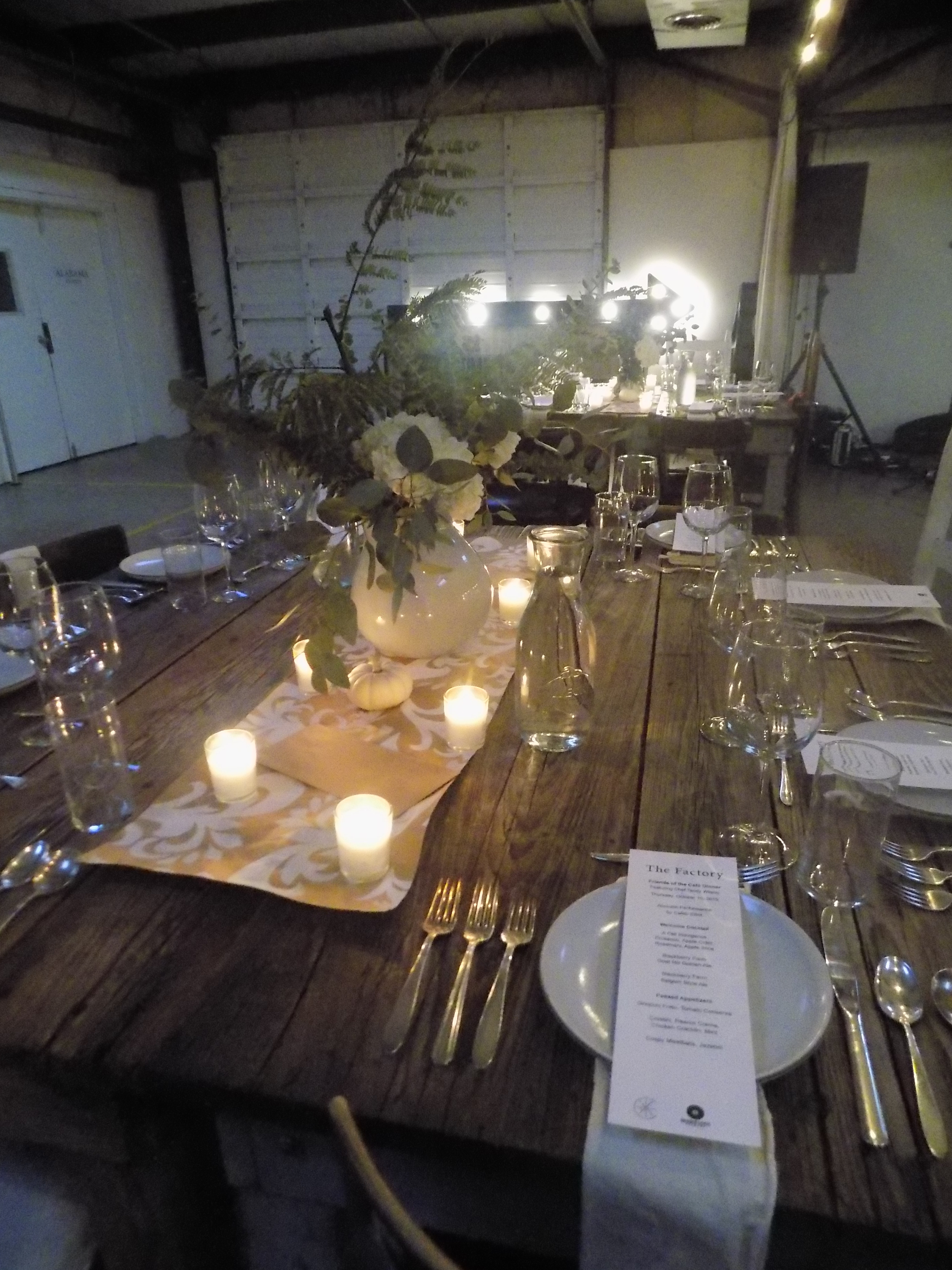
Chef Kumar, who did not appear until after the memorable five-course meal was complete, was the star of the evening. Her dishes were complex but not complicated, beginning with the three passed appetizers that circulated through the café and designer’s show room as the guests assembled. Puffy profiteroles with hot honey and a smoked fish dip with pickled shallot on rye toast were among the appetizers, but I kept leaning in for a bite of the curry leaf polenta with spicy tomato chutney.

When the diners were seated, the diversity of flavor profiles continued to blend and surprise. At my table were Kelly Fields, the James Beard Award-winning Outstanding Pastry Chef of 2019, and her thoughtful sous chef from Willa Jean, a great place I discovered a couple of years ago in New Orleans (www.willajean.com). They were in town to prepare a course for a meal at one of Muscle Shoals’ legendary sound studios on Saturday night of Shindig. It was enlightening to eavesdrop on my tablemates’ expert analyses of each dish as it was presented.

The first seated course was a watermelon and peanut chaat followed by coconut-poached royal red shrimp, creamed corn and tapioca pudding, with Bengali five spice. The third course consisted of a memorable Punjabi grilled summer squash casserole with soft paneer cheese and a fragrant roasted tomato vinaigrette. I think that third dish was my favorite in an evening full of lovely tastes – mainly for the inventive, flavorful, and unexpected use of the summer squash.

The meaty fourth course was a lemongrass summer brisket – big chunks of brisket with fingerling potatoes and pickled green tomatoes in a fresh, steamy, and fragrant broth. Finally, the refreshing dessert course was buttermilk cardamom panna cotta with peaches, olive oil granita, pickled blueberries, meringue, and almonds.

Kumar, a self-taught chef, is also the guitarist for the rock band, Birds of Avalon. I haven’t heard Birds of Avalon yet, but I will attest to Cheetie Kumar’s rock stardom in the kitchen. The meal she presented was thoughtful and imaginative, with diverse and balanced ingredients. It was a meal that will be remembered.

The Friends of the Café dinner series continues to provide an enlightening food education and the introduction to a splendid array of food artists and artisans – both in the kitchen and as fellow guests at the table.

Spahn Ranch | Yasgur’s Farm | Shaggy Dog Stories of 1969

Today, in August 2019, I am older than three of my four grandparents were in summer 1969. My oldest grandfather, Leonard Harbison, was only a year and a half older than I am now.

Back then, of course, they all seemed ancient to me. I keep that in mind as a college professor, surrounded daily by 20-year-olds.

The summer of ’69 is being talked about throughout this, the 50th anniversary. It seems that each week is the golden anniversary of some significant, grand, or unsettling milestone. The Who’s brilliant and pretentious “rock opera” Tommy was released in May 1969 and formed a significant part of the soundtrack of that summer. So did Jimmy Webb’s “Galveston,” recorded by Glen Campbell – which most of us didn’t realize was an anti-war song. The counter-culture biker movie Easy Rider was in theatres, as were John Wayne in True Grit and the X-rated Midnight Cowboy.

The Stonewall uprising occurred in June, signaling the birth of an organized gay rights movement. And Chappaquiddick, an event that forever stained Sen. Ted Kennedy’s reputation, occurred in July. But the first manned moon landing was the most significant event of July, and of the year.


Since I currently live in Huntsville, there has been a certain level of Huntsville-style hoopla in celebration of the first manned moon landing in July 1969. The Saturn V rocket that propelled the Apollo missions was created in Huntsville and there is justifiable pride in the accomplishments of NASA that pervade the community all the time, regardless of the year. What Coach Paul “Bear” Bryant is to Tuscaloosa, the Saturn V is to Huntsville.

Back then, my interest in the myth of the “final frontier” was peripheral at best. It was exciting to watch launches from Cape Kennedy on classroom televisions in the 1960s, and it was exciting to watch the capsules’ safe splash-downs in the Atlantic afterwards. The whole country grieved when the three Apollo 1 astronauts were killed in a fire during a pre-flight launch pad test in 1967.

Two and a half years later, my family was living in Nashville when Neil Armstrong made that first “small step” on the moon in that grainy video transmitted back to Earth. My memory of that moment is vivid still. I remember that when the satellite transmission ended on broadcast television, I walked out into our front yard and looked up at the moon. The fact that two Americans were sitting there, and that another was orbiting to facilitate their return, is still daunting, inspiring, transformational to think about.


August of 1969 is particularly memorable for two tragedies – Hurricane Camille, which devastated the Mississippi Gulf Coast, and the Tate – La Bianca murders perpetrated by the “Manson family” in the hills of Los Angeles. Some say that the gruesome Tate – La Bianca slayings signaled the end of the 1960s, while others make the case that Nixon’s defeat of McGovern in 1972 was the end of the ’60s era. Either way, the Tate – La Bianca case signaled an end to a certain optimistic innocence that characterized large chunks of that decade, despite the war protests and social and political upheaval that fomented throughout those years. August 1969, of course, is also remembered for a slipshod celebration that became an enduring legend – the Woodstock music festival, held on Max Yasgur’s dairy farm in upstate New York.


My first memory of Hurricane Camille is a strange one. My family was traveling from Six Flags in Atlanta to Birmingham and made a rest stop in Anniston late in the night. While we were waiting for Mother, Dad struck up a conversation in the parking lot with another man traveling with his family; they began to talk about the massive hurricane that was then bearing down on the Mississippi coast. Somehow, that conversation conjures a memory of the animated neon Goal Post Bar-B-Q sign, an iconic Anniston fixture depicting a football player kicking a football through a goal post. Our rest stop was down the highway from the barbecue joint and I was watching that sign as the two grown-ups chatted, we waited for my mother, and my brother slept in the back seat.


These distant memories are stimulated by a recent viewing of fanboy Quentin Tarantino’s latest ultra-violent fantasy, Once upon a Time … in Hollywood, set in the summer of 1969. The film focuses on two fictional characters, a fading western star, Rick Dalton (Leonardo DiCaprio), and his stunt man, best friend, and jack-of-all-trades, Cliff Booth (Brad Pitt). A presence throughout the film is the very non-fictional Sharon Tate (Margot Robbie), who, with her husband, director Roman Polanski, rents the house next door to Dalton. Tate, who is 8½ months pregnant at the movie’s end, floats through the proceedings with a serenity and presence that are exhilarating to watch. Another recurring presence throughout the movie is members of Charles Manson’s hippie cult, skulking regularly on the edges.

Tarantino weaves a shaggy dog story with many loose ends and an entertaining jumble of real-life and fictional characters. The movie begins on February 9, 1969 (my 14th birthday), sets up the characters, and jumps, later, to August 9 of the same year. Tarantino assumes that the audience knows its 1969 pop culture history and throws teases and period references in with the imaginative fictionalization. Quick appearances are made by actors playing Steve McQueen, James Stacy, Sam Wanamaker, and other real-life personalities of the era. We briefly catch a bit of a car radio news broadcast announcing the sentencing of Sirhan Sirhan, who assassinated Robert Kennedy in 1968.

In a lovely, carefree interlude, the camera follows Cass Elliott, Michelle Phillips, and Sharon Tate as they hold hands, running through a party at the Playboy mansion, and begin to dance. In another scene, three Manson girls are seen holding hands, smiling like Moonies, singing and skipping down an L.A. sidewalk.

It’s a fascinating and enjoyable movie, made moreso by its frequent dips into a splashy late-60s reality, but always tempered by the very real presence of the darkness that lurks at the Spahn Ranch, the former western movie lot that has been infested by Manson’s followers and hangers-on. In a tense scene, Cliff goes to the Spahn Ranch – a place he knows from past film and television shoots – with a hitchhiker he’s picked up in Hollywood. When he insists on seeing George Spahn, an old friend who is now the blind and aging owner of the ranch, the mood shifts. We worry for the safety of Cliff, and for the foreboding scenarios still to emerge.

I have never warmed up to DiCaprio as an adult actor, but his portrayal of a washed-out, whiny former tv star is effectively irksome and desperate. Brad Pitt, who is aging gracefully, has rarely been as appealingly authentic as he is in his role as Cliff – who might have murdered his wife, but moves through the world with a carefree and amused attitude.

Sharon Tate, who was only 26 when she was murdered, is most remembered now for the last day of her life. In Tarantino’s movie, there is a celebration – through Robbie’s performance – of Tate’s joie de vivre and potential. We follow her as she goes through her day, and discover a complex, upbeat woman far removed from the tragic headlines that have become her legacy. Tarantino’s camera worships Pitt and Robbie in this film, and doesn’t hesitate to linger and marvel at each of them when it has the opportunity.

Obviously, since this is a Tarantino film, there is violence; sometimes, that violence seems gratuitous. Here’s my stance on Tarantino and violence, and I realize there will be those who disagree: To me, Tarantino’s violence is so over-the-top and wild that I find it hard to take seriously. One stifles the urge to laugh at the outrageous excess; the filmmaker does not glorify or even endorse violence, it seems to me, but uses it as a device to celebrate the absurdity all around us to which he seems so drawn.

The Russian playwright Anton Chekhov referred to his plays as “comedy” and many find that hard to wrap their mind around. I think I get it with Chekhov. He explores and revels in the absurdity of our surroundings and everyday lives. I don’t think of Tarantino as “Chekhovian” by any stretch, but I think his prankish and warped world-view enjoys taking his audience to the extremes of a violent society.

For those who think they know how Once upon a Time in Hollywood must inevitably end, and are avoiding it for that reason, I suggest that you see for yourself. Without going into detail, I think the final image of this movie is one of the sweetest images I’ve seen in a movie in years. It’s a moment that portends a whole new trajectory for the end of the ‘60s – an ending that was earned, but, sadly, was never achieved.

New Orleans to Bessemer, 2019

The Bright Star Restaurant’s “Night in New Orleans,” which had its thirtieth incarnation last week, has become a rite of passage for the month of August at the venerable 1907 restaurant in Bessemer, just down I-20/59 from Birmingham. Long billed as “Alabama’s Oldest Restaurant” and the winner of a 2010 James Beard Foundation Award as an “American Classic,” Bright Star has remained a popular dining destination even after the heavy industry that once defined Bessemer has slipped away (www.brightstar.com).

It was my father’s favorite restaurant; at his funeral, one of the ministers quipped in his eulogy that “Grover would sell his lawnmower to eat at the Bright Star.”

“Night in New Orleans” is a three-night event in which a New Orleans chef takes over the Bright Star kitchen and offers selections from a Crescent City restaurant. The late Jamie Shannon of Commander’s Palace and Tory McPhail, current executive chef of Commander’s, are among the notable past chefs who have presided over the event.

This year’s chef, Thomas Robey, recently took over executive chef duties at Tujague’s, the 163-year-old New Orleans staple on Decatur Street on the river side of the French Quarter. Tujague’s is probably most recognizable to New Orleans visitors for the iconic sign over America’s oldest stand-up bar on the corner of Decatur and Madison. The doors are always open and the bar is always crowded with locals and tourists alike (www.tujaguesrestaurant.com).

Chef Robey is no stranger to Birmingham or the Bright Star. He was on Jamie Shannon’s staff for previous “Night in New Orleans” events in the ‘90s and was executive chef of Birmingham’s Veranda on Highlands for several years. He left Veranda for another stint with McPhail at Commander’s before being named executive chef of Tujague’s in summer 2018.

Mother and I arrived on a Saturday evening about twenty minutes before the restaurant opened. A sizable crowd was already waiting in the Bright Star’s large lobby space – a crowd clearly made up mostly of the Bright Star’s dining room’s seasoned veterans. Some chose to sport Mardi Gras beads for the occasion and New Orleans jazz was just audible over the general din as Bright Star hosts began to quickly seat the crowd.

The menu for these events is split into two parts – one features dishes from Bright Star’s regular menu and the other is a sampling of the guest chef’s dishes from his home restaurant. Since my mother has dietary restrictions, the Bright Star part of the menu was her reliable go-to.

I was there, however, for the tastes of New Orleans and focused on the Tujague’s menu, choosing the cheesy char-broiled oysters as my first course. Other first course options were a shrimp and tasso bisque and a watermelon and tomato salad.

The main course offered a skin-on snapper over a corn maque choux, pan-roasted Maple Leaf duck breast, and a grilled pork loin with a mirliton dressing. I, of course, opted for the seafood and the snapper arrived atop a generous and complex maque choux, an elevated succotash-like preparation. Chef Robey’s iteration had a corn and tomato base with finely chopped peppers, green onions, peas, okra, and Creole spices. As I was trying to break down the maque choux ingredients for Mother, Chef Robey strolled past our tableside to explain that the name “maque choux” is probably a French derivation of a Native American name for the dish, which has become an amalgamation of indigenous and Creole techniques.

For the final taste of New Orleans, there was a creamy Grasshopper panna cotta – a nod to the minty signature cocktail invented at Tujague’s in 1918. Garnished with chocolate mints, it was a smooth capper to a rich New Orleans-inspired meal.

Leaving Bright Star’s “Night in New Orleans” in the sultry summer dusk, the urge is strong to take I-59 southbound and travel the quick five hours to experience another night in New Orleans for real.

The Portent of Figs

 I almost passed on the downtown Greene Street Market at Nativity this afternoon (www.greenestreetmarket.com). I’m afraid I’m gathering more at my various farmers markets this summer than I have time to deal with. Birmingham’s Pepper Place on Saturday morning, Latham’s on Tuesdays, and Nativity on Thursday afternoon … occasionally, the Alabama Truck Farmers market on the industrial side of Birmingham, a few others here and there.

At the last minute, though, a brief and gentle rain revived me, and I ventured on out to Nativity to see if inspiration would hit. It always does.

My first stop is always the Humble Heart (www.humbleheartfarms.com) booth to stock up on their various goat cheese blends and to check in with the Spells, the proprietors. A running joke for Paul Spell when he sees me is to say, “Sir, would you like to sample some goat cheese?” as if I haven’t been using his product for years now.

“Goat cheese!?!” I exclaimed today, as if I’d never heard of such a thing.

Some snooty Huntsville woman, who was finishing her transaction, looked over at me and said, with a sniff, “I love goat cheese. You should try it some time.”

I smiled, batted my eyes at her, and placed my order as she cluelessly walked away.

I had given up on locally grown kale here in mid-July but one of the growers from southern Tennessee had several fresh bags of Russian kale just perfect for several applications. I had passed a booth with enticing bags of field peas and vowed to return to buy a couple. When I circled around a minute later, there were no peas to be found.

I said, “Didn’t you have peas here a minute ago?”

“Yes,” came the speedy reply. “And a man just bought me out. But I have more in the cooler … if I’d told him I had more, he might have cleaned me out completely!”

Grabbing what I needed, I moved on. I had plenty of peaches and cantaloupe, so I passed those places by.

I was about to leave when I noticed a few small baskets of figs nestled among more prolific produce at a bustling stand toward the back of the market.

It seems a little early for figs, but the fig yield has been sparse for the past few years and maybe my timing is off. I heard myself sigh figs at precisely the moment a woman behind me did the same.

I moved quickly to the stand with mixed emotions.

First, I associate figs with the end of summer and I’m not nearly ready for that. But, also, I didn’t really grow up with figs; they were not a part of my own family’s eating heritage and I was late to that club. It was while working with a theatre in Montgomery that some of the locals and transient actors began to awaken me to the charm of the fig crop. It was there that figs became another of my harbingers of the stages of the summer fruits.

Strawberries. Peaches. Blackberries and Blueberries. Figs. Apples.

Often, when the figs disappear, so has the summer.

I debated whether I was ready to invite portentous figs into my seasonal kitchen. The woman behind me made her move and so I quickly maneuvered to the front of the line. I pointed to the basket I wanted and said, “Aren’t they early?”

Apparently, they are, but they might also have a longer growing season than in the past several years, so my lament for the end of summer might be delayed for several weeks.

Ghosts of Birmingham

Ensley High School; July 2019

My father, Grover Journey, used to reminisce about when he and a group of boys from his Ensley neighborhood in west Birmingham would regularly ride their bicycles to the Woodlawn section of east Birmingham. He once told me, with a sly smile, that they’d ride over “to fight the Woodlawn boys.” I never knew if he was joking. Either way, I think of what an adventure those days would have been for a group of young boys in the early 1940s.

In my imagination, I see Dad, his three brothers, and some neighborhood boys barreling across the city on their bicycles, navigating the downtown Birmingham grid to 1st Avenue North, crossing the viaduct past Sloss Furnaces in its heyday. Their trek would have taken them past Avondale and onto the main drag of Woodlawn. Avondale and Woodlawn are having a sort of renaissance these days.

Ensley, 2016

I remain hopeful for the future of Ensley and its rusting forest of abandoned steel mills. My father’s boyhood home, in the shadow of the U.S. Steel smokestacks, is one of only two houses still standing on his particular block of Avenue D. Another house on that block was rental property owned by my great-grandfather McCarn; it was demolished just this summer.

Those mental images of the carefree days of my father as a youth give me comfort. It’s always interesting to contemplate the meanderings of the mind and to plot the streams of consciousness that haunt us through each day and the days beyond.


Those memories of Dad on his bike were triggered in a roundabout way when I happened to hear Patti Smith’s version of “Because the Night” from her Easter album over the sound system in a grocery store a few days ago. Although Easter was a stalwart of my late 1970s turntable, I had not heard it, or “Because the Night,” in years – maybe decades. To hear it in the aisles of a grocery store was …  odd.

According to rock lore, Bruce Springsteen, who originally wrote the song, wasn’t making it work for himself and passed it on to Patti Smith’s producer. Smith revised it and recorded it, resulting in her best-known and probably most-played hit. Springsteen now regularly plays it in concert with his original lyrics, and he and Smith share the song-writing credit for what is a great and enduring rock anthem.

I saw Patti Smith live in concert at Brothers Music Hall in Birmingham, a short-lived music venue located on Lakeshore Drive near the place where the Homewood neighborhood slides into the tiny kingdom of Mountain Brook. It was a memorable concert, made even more extraordinary by the fact that I was recovering from a head injury suffered in a bicycle accident the day before.

There was a suggestion that maybe I should pass up on the concert since I was still on medication, but it was Patti Smith and I would not be deterred.

Brothers was an intimate space, with tables set up for maybe 200-250 patrons. In its short existence I saw Elvis Costello, The Police – just on the cusp of super-stardom, and other acts there.

Long after the end of Patti Smith’s show, as audience members were lingering around at the bar, Smith walked out on stage with a push broom and began to sweep the stage. My friend George, a Tuscaloosa record shop owner, and I spotted her and went up on stage to see if we might engage her in conversation. She moved methodically across the stage with an enigmatic smile, occasionally glancing up at the two 20-somethings earnestly trying to get a response (I honestly don’t think that we were being obnoxious). Finally, I stopped in my tracks and said, “You have no intention of talking to us, do you?”

She stopped, too, sort of leaned for a moment against the broom handle, smiled, and shook her head no.

We left her alone, on the darkened stage, quietly finishing her unnecessary task. Just as quietly, she moved into the darkness of the backstage area and was gone.


The building where Brothers Music Hall was located started life as Hollywood Country Club in 1926. It was a grand building with bars and meeting rooms, ballrooms and dining rooms, and a huge pool. A planned golf course for the country club never materialized.

The building went through several incarnations before becoming the location for Brothers Music Hall from 1978 to 1981, where I frequented those concerts as a young adult.

My father remembered going to Hollywood Country Club to dance in the years before he met Mother. His experience with the place was at least three decades prior to mine, but I still felt a synchronicity in the shared experience of space.

The Hollywood Country Club building was demolished by fire in 1984. The site is occupied by a chain hotel.


Bush School; July 2019

“Because the Night” prompted my Hollywood Country Club memory of Dad. A drive past the ruins of his alma mater, Ensley High, which was demolished by fire almost exactly a year ago, and his elementary school, Bush School, now closed but just around the block from the high school, reminded me of those boyhood rides to Woodlawn.

Thus, this tangle of memories and a renewed exploration of Dad’s landscape began.

I’m reminded again of my favorite quote by the painter Willem de Kooning: “Then there is a time in life when you just take a walk,” he said. “And you walk in your own landscape.”

Ensley High School; July 2019

Ode to Summer – 2019

The verb “slather” was coined specifically to describe putting mayonnaise on bread for a tomato sandwich. Linguists and the dictionary may disagree, but that’s my story and I’m sticking to it.

I can never let the Summer Solstice pass without once again expressing my joy at the advent of the season. The Great Gatsby is pulled off the shelf for its annual reading and the bounty of the various farmers markets and highway farm stands becomes increasingly diverse and delectable. The sun rises early and sets well into the evening, giving the heat of the day plenty of time to build in intensity.

The occasional pop-up shower or passing thunderstorm cool things down for a moment, yielding to a sultry steamy aftermath.

The summer tomato sandwich is a seasonal standby once more, its structure changing, based on what other ingredients are available to adorn it. Ripening tomatoes are lined up on the kitchen counter to lend inspiration to another juicy lunch from local farms. It is hard to choose from all of the varieties available; this week, my counter sports more conventional red tomatoes instead of the always tempting heirlooms available to select in cardboard boxes at several of the booths.

A loaf of 10-grain bread from the Mennonite ladies provides two slices to slather with mayonnaise. One slice is topped with several slices of tomato while the other is covered with a layer of basil leaves from the back yard herb garden and crumbles of chipotle pimento cheese from Humble Heart Farms, my favorite purveyor of local goat cheese (www.humbleheartfarms.com). A paper-thin slice of onion tops the basil and cheese. Before the sandwich is assembled, the tomatoes are topped with a sprinkle of sea salt and freshly ground pepper.

Finally, after heating a couple of pats of butter in the iron skillet, the sandwich is pressed and cooked until both sides are golden brown.

I pour a glass of iced tea and sit down for lunch at the plant-filled table in the back room that I use as a library, looking out over the lush green growth of my compact back yard beyond. To be honest, by August that “lush green growth” will be trending brown (if recent summers are an indicator), but my relish of the summer months will not be diminished. Today’s sandwich is a quick and delicious way to celebrate the local tomatoes and to cherish the vibrant first days of the official summer season.

Have a great summer.

Dignity

At a busy intersection in Birmingham, a woman representing the local “restoration ministry” approached the car for a donation. She announced that she was “Sister C____,” a recovering addict, that this church changed her life and that of other addicts, and, as the traffic light changed, she handed me her flyer and told me that I could contribute on the website or by mail, if not in person. The address was on the flyer (www.birminghamrestorationministries.org).

We drove on and I handed the flyer to my mother, commenting that “it takes a lot of courage to stand in the middle of the street and announce that you’re a recovering addict,” to which my mother replied that we should go back and make a contribution.

By the time we made it back around to the intersection, the woman and a woman identified as her “sister” were packing up and calling it a day. My mother rolled down the window, handed her a donation, and said, “See? We didn’t forget you.” Sister C____’s gratitude and blessings seemed real and heartfelt and I was glad we had gone back.

Mother has always had a charitable impulse for the down and out and recovering. Dad served their church in Tuscaloosa as co-chair of the Benevolence Committee for years. He and the committee were generous, but Dad was also alert to any possible scam and careful in the spending of what he considered to be “God’s money.” On occasion, if a client asked for an extra that wasn’t a necessity – and especially if a child was involved – Mother would say “If the fund won’t pay for it, I will!”


When I was directing a production of Samuel Beckett’s Waiting for Godot in the 1980s, I suggested to the actors playing Estragon and Vladimir, the principal characters, that they should think of their characters as homeless. One of the young actors very earnestly announced that he had never seen a homeless person.

“Then you haven’t been looking,” I responded. The other cast members and I began to list the places where he could look and see the homeless that very day as he drove home. We also provided the locations of shelters where he could see people lining up each evening in hopes of securing a cot and a meal.

He returned to rehearsal the next day, shaking his head. “I had no idea.”


Author Chris Arnade has been looking. And what he has seen is chronicled in his new book, Dignity: Seeking Respect in Back Row America, (Sentinel, 2019). Arnade, who has a Ph.D. in Physics from Johns Hopkins and twenty years as a successful Wall Street trader, began to explore neighborhoods he was warned to steer clear of. He began with the Hunts Point community of the Bronx and traveled through America, hanging out with addicts and the homeless, the unemployed and the marginalized, displaced labor union members, immigrants, and people who are generally on the fringes of 21st century America. Arnade labels them as “back row America.”

Not only does he look; he also listens – carefully, and without passing judgment.

Arnade left Wall Street to begin a three-year mission to meet “back row” residents in diverse communities throughout the country. Among the places he visits are Bakersfield, California; Bristol, Tennessee; Buffalo, New York’s “East Side”; Lewiston, Maine; Lexington, Nebraska; Milwaukee, Wisconsin’s “North Side”; the Ozarks; Prestonsburg, Kentucky; Selma, Alabama; Youngstown, Ohio; and places in between.

Along the way, Arnade meets people, lets them talk, and documents what they say. “If I had an obligation to them,” he writes, “it wasn’t to assume what was best for them; rather, it was to listen and try to understand what they valued, what they wanted, and not get in the way.”

The interview style is patient. He waits. He doesn’t lead. In a conversation with a Mexican American woman, he listens as she speaks at length, and with measured prejudice, about members of the Somali community who have immigrated to her small town on the great plains. When she is finished, Arnade writes, “I wait for her to continue.” She does, and her comments illuminate the plight and goals that inspire her, and people like her, to, in her words, “risk their lives in a desert or swimming across a river.” Ultimately, she says, “It is about opportunity.” Ultimately, she says, “I love America.”

Dignity is filled with such testimony and with Arnade’s photographs of people and places he sees along the way. Many of the photos are of the people you might avoid eye contact with in the parking lot, on the sidewalk, in the store aisles. “The walks, the portraits, the stories I heard, the places they took me, became a process of learning in a different kind of way. Not from textbooks, or statistics, or spreadsheets, or Power Point presentations, or classrooms, or speeches, or documentaries – but from people.”

Many of these portraits are taken in each community’s McDonald’s, which becomes a focal point of the travels. At the beginning, in Hunts Point, Arnade goes to the McDonald’s every day “because everyone did.” The fast food place becomes his haunt everywhere he lands. Part of his process is to go to “the busiest McDonald’s in the community …, eventually talking to the morning regulars.” He notes that, in many communities, McDonald’s is one of the few restaurant options, yet “we make fun of them for going there.”

Arnade also finds himself visiting the houses of worship in the places he lands. He begins his travels as an atheist, but he finds himself at a place where he cannot “ignore the value in faith, not as a scientist, not as a person who claimed to want to learn from others.” He observes Bibles in crack houses, Korans in abandoned buildings. He tells of a picture of the Last Supper that a homeless couple carries with them wherever they find themselves – abandoned buildings, sewage-filled basements, under expressways. He writes, “It is the only real possession they own, beyond the Bible.”

My biases, my years steeped in rationality and privilege, was limiting a deeper understanding. That perhaps religion was right, or as right as anything could be. Getting there requires a level of intellectual humility that I am not sure I have.

Still, he observes that “the few success stories told on the streets are of relatives, friends, or spouses who found God, got with the discipline and order of a church, and moved away …Faith is the reality and a source of hope. Science is the distant thing that doesn’t necessarily do much for you.”

Arnade does not cling to religion, but he knows how to testify. He examines the “educational meritocracy” that spawned people like him, and he finds it lacking.

He writes

It is a wholesale rejection that cuts to the core. It isn’t just about them; it is about their friends, family, congregation, union, and all they know.

The educational meritocracy is a well-intentioned system designed to correct massive injustices that enslaved, demeaned, constricted, and ranked people based on the color of their skin, sexuality, and gender. Yet in attempting to correct a nasty and explicit exclusion, we have replaced it with an exclusion that narrowly defines success as all about how much you can learn and then earn.

It is a system that applauds itself for being a meritocracy, allowing anyone to succeed. Implying that those who don’t choose this path, who can’t or don’t pick up and move constantly, who can’t overcome the long odds, are failures and it is their own fault.

Arnade laments the fact that Wall Street, his “old world,” was given whatever it wanted, no matter the damage, and what it wanted was “to lower labor costs no matter how. Mostly that meant shipping U.S. jobs requiring muscle overseas and bringing jobs requiring college here.”

Arnade realizes that the values of the meritocracy are not shared by all.

We didn’t think about changing our definition of success. It didn’t occur to us that what we valued – getting more education and owning more stuff – wasn’t what everyone else wanted.

It isn’t just about money. These entire communities are stigmatized socially and culturally. The feeling of being excluded, of being different, is more than about what things you own; it is also about what you know, what you learn, how you approach issues.

Much of the back row of America … is humiliated. The good jobs they could get straight out of high school … have left. The churches providing them a place in the world have been cast as irrational, backward, and lacking. The communities that provided pride are dying, and into this vacuum have come drugs. Their entire worldview is collapsing, and then they are told this is their own fault: they suck at school and are dumb, not focused enough, not disciplined enough.

We have implemented policies that focus narrowly on one value of meaning: the material. We emphasize GDP and efficiency, those things that we can measure, leaving behind the value of those that are harder to quantify – like community, happiness, friendships, pride, and integration.

Arnade realizes that the schism in this country is not so much a race issue as it is a class issue, and class — the “haves” and the “have-nots” —  is his focus. Arnade’s comments amplify my own concern that we currently have a government that hates, villifies, and exploits the poor and underserved. Neither side of the aisle is exempt. Arnade carefully avoids partisanship throughout his book, but he does observe that the current political climate is rife for the “politics of blame” that so demean us as a nation.

Finally, the book’s title summarizes the theme that Arnade continues to reference. “Most of all,” he writes, “I ended up finding what is often overlooked in stigmatized neighborhoods: dignity.”


This essay quotes liberally from Arnade’s book because I think it’s important that we hear his unfettered voice.

When I started “Professional Southerner” in 2014, I envisioned it as an escape tool, a place to ponder and share those people, places, and things that caught my fancy and gave me insight or delight. At first, that was true. As the years have gone by and I have observed the world around and beyond me, I notice that I am more drawn to reflections that try to make sense of what’s going on. I’m trying to understand a world that seems – in so many ways – to be veering away from the ideals of what our country means and what it should strive to achieve.

Books like Dignity help me to try to put a finger on what’s going on at the end of the second decade of the 21st Century.

It is a powerful and moving document of this pivotal and decisive moment in our time.

Horwitz | Olmsted | Reconstructed

Frederick Law Olmsted reportedly preferred the designations of “park-maker” or “scenery-maker” to the title of “landscape architect” that most often describes him. Yet, he is perhaps the most identifiable landscape architect in the world, based primarily on his work with Calvert Vaux on New York’s Central Park and Brooklyn’s Prospect Park. Other notable Olmsted landscapes include the Biltmore Estate and the U.S. Capitol grounds, among many high-profile commissions.

Because of Central Park, Olmsted’s considerable work and influence on landscape and park creation has been exaggerated to super-natural proportions. It seems that everywhere one travels, one has Frederick Law Olmsted’s designs pointed out. Truth is, they’re usually not.

It’s an understandable mistake. So many communities and public spaces incorporate Olmsted’s technique of creating natural-seeming fluidity to create landscapes that look like they were always there. It is stunning to compare photographs of the rocky and swampy Manhattan terrain that ultimately became Central Park with the well-engineered “natural” environment by Olmsted and Vaux that millions enjoy annually.

Atlanta’s Druid Hills neighborhood is an Olmsted-designed environment; Montgomery’s Cloverdale is not documented as an Olmsted design, although some claim it. Cloverdale is attributed to Joseph Forsyth Johnson. The shared influence is easy to see as both neighborhoods follow very similar principles. Also, Olmsted definitely advised on the landscape design of the Capitol grounds in Montgomery.

Olmsted did not design the campus of Alabama A&M University, north of Huntsville, but the firm founded by his sons, Olmsted Brothers, did documented consultation on that campus into the 1950s as well as designing and advising on numerous other familiar college campuses, public spaces, residential environments, and national parks throughout the country.


These musings on Olmsted are prompted by a recent reading of a new book inspired by Olmsted’s travels in the American South in the decade prior to the Civil War. Spying on the South: An Odyssey across the American Divide (Penguin Press, 2019) documents author journalist Tony Horwitz’s efforts to gauge the politics of the South in the months leading up to the 2016 election while retracing Olmsted’s 1850s Southern journey.

Frederick Law Olmsted spent over a year traveling in the South, writing dispatches for the fledgling New York Times under the pen name of “Yeoman.” Olmsted began his trek as a curious observer but came away as an avid abolitionist and carried those passions throughout and beyond the Civil War that would soon come. Olmsted, whose early career was checkered at best, did not find his calling of landscape design until after his Southern foray. It is suggested, by Horwitz and others, that much of his later landscape design was influenced by what Olmsted observed on his Southern travels and, after the War, he returned to the South throughout his career.

Olmsted was committed to creating democratic public spaces that were accessible to everyone and would encourage the mingling and interactions of all.


As fervently as I love the South, and, as much as I plan to live out the rest of my life here, I am not a fan of most Southern politicians; however, as a student of political science, much entertaining fodder has been supplied by that too despicable breed of the Southern politician. If I ever decide to abandon my homeland, it will be because of its wretched and draconian politics. However, I am determined to stay and continue to work for change and progress from within.

As much as I cherish the spread of Southern foodways and life styles, music, art, and culture to a broader national and world audience, I have never wanted the politics of the South to become “mainstream.” Yet, it seems that Nixon and Reagan’s Republican “Southern Strategy” from decades past has permeated the country beyond the South in the present day and that Southern politics and politicians now sound more and more like politicians throughout the land – from the Executive level to the county commissioner.

I oppose and regret this trend. The last thing I would want to export from my region is its politics.


Tony Horwitz’s always entertaining book purports to explore Southern ideologies and attitudes at a breaking point in American culture, but it is really more of a Southern frolic to explore the (often lunatic) fringe. Horwitz meets many of his subjects in dive bars, so the conversations are animated, loose, and, too often,  predictably cringe-worthy.

Horwitz boards a towboat pushing coal barges along the Ohio, takes a riverboat down the Mississippi, rents a Kia through Louisiana, and rides a mule under the direction of an alleged sadist named “Buck” through the Texas hill country. While on the border in Texas, he frequently crosses the Rio Grande with locals from Eagle Pass, Texas, into Piedras Negras, Mexico.

After a negligible foray into New Orleans, highlighted by Horwitz’s descriptions of a transformative experience in a predominantly black Baptist church and a disappointing visit to Audubon Park, Horwitz and his Australian pal, Andrew Denton, venture deeper into Louisiana bayous, Cajun country, and what Horwitz describes as the “unreconstructed South.” Andrew is of weak stomach and is quickly sidetracked by the local cuisine, which puts a damper on one of the most enticing elements of that part of the country.

Horwitz and Denton alight for a while in Colfax, Louisiana, the site of the bloodiest massacre of freed blacks in the decade after the Civil War. On a tip from a Colfax bartender, Horwitz and Denton attend the “Louisiana Mudfest,” the setting for one of the most vivid and, for me, distasteful episodes of Horwitz’s contemporary narrative. Horwitz, Andrew, and the Kia (“Killed in Action,” quips Andrew) travel into the heart of darkness of the plowed and mud-covered fields of a former plantation waiting to do battle with monster trucks helmed by drunks and rednecks. For me, and for most people I know, the “White Trash Only” sign at the entrance gate would be all that was needed to keep me away. It’s a colorful and entertaining chapter, but hardly representative of the region.

Horwitz spends a major part of his journey of discovery in Texas – which I consider only peripherally Southern – and he devotes about half of his book to adventures in Texas. He seems fascinated by all of the incarnations of Texans that he meets along the way, especially the descendants of Germans. He sees through the forced Chamber of Commerce “weirdness” of Austin and seems to be overwhelmed by Houston’s formidable girth and lack of zoning laws. When I lived in the Houston area, one of the things I actually liked was the lack of rational zoning and the way that one might, for example, find great Mexican food in a cozy restaurant in the middle of what was otherwise a residential neighborhood.

However, as someone who lived on an island off the coast of Texas (Galveston) for two years, my primary impression was that Texans are mighty proud of something, but I’m hard-pressed to tell you what.

Horwitz effectively picks and chooses his examples of the “American Divide” – an idea I find as distasteful as the simple-minded notion of “red” and “blue” states. He masterfully presents a raucous and highly readable trek through a part of the country that is probably more mainstream than he or I would care to admit. Occasionally, he finds flaws in the reasoning of his hero, Olmsted. It’s a book I recommend, but don’t expect it to draw any credible conclusions; it provides a lot to ponder.


I finished Spying on the South on May 26. The next day, I read that Tony Horwitz had died, unexpectedly, at age 60. He will be remembered for his witty and probing examinations in books such as Baghdad without a Map, One for the Road: An Outback Adventure, and Confederates in the Attic. And now, Spying on the South. He will be remembered as a writer who tried to make connections and connect the dots in an increasingly baffling world.

Postscript: Even though Horwitz’s recent book does not venture into Alabama, the dust cover features a photograph of the Webb-Bonds-Bamberg house, an ante-bellum home off Main Street in Greensboro, Alabama. It is familiar to me.

Shotgun

“Magenta on White,” (oil on panel), Jared Small (2019)

I went to the Huntsville Museum of Art (www.hsvmuseum.org) for inspiration this week. That is always an iffy proposition since I tend to find the Huntsville Museum cold and sterile. I visited frequently when I first moved to Huntsville but, over the years, I just stopped out of apathy and frustration.

This week I was on a short break from work and I was at home for a few days and I woke up one morning determined to take a mini-vacation. The main incentive for choosing to spend some time at the Huntsville Museum was an exhibit in conjunction with Alabama’s 2019 bicentennial. “Our Shared Heritage: Alabama Artists from the Collection” is a two-part exhibit featuring Huntsville Museum holdings by artists from Alabama or with an Alabama connection.


“Celebrated Figure” sculptures by Clifton Pearson with 4 William Christenberry photographs on the wall behind.

The first part, which I missed, showcased Alabama artists from 1850 to 1940. The current companion exhibition features Alabama art from 1940 to the present. It’s a nice hit-and-miss exhibit, featuring artists I know and with whom I am familiar. Some of the most significant Alabama artists of the past 75 years are missing, but a number of notable artists are represented. So is the ubiquitous Mr. Nall. Among my personal favorites in the exhibit are a trio of the noble “Celebrated Figure” series by ceramic artist and sculptor Clifton Pearson and four classic photographs by William Christenberry.

As I walked through the bicentennial exhibition, I kept being distracted by the luminescence of oil paintings in a side gallery. It was an exhibit called “Encounters – Jared Small: Southern Moments in Time.” When I was finished with the Alabama exhibit, I ducked into the side gallery to see what that was about (www.davidluskgallery.com/artists/jared.small).

Small is a Memphis-based artist whose work seems to transverse reality with a painterly form of magical realism. At a glance, the paintings seem photorealist, but – upon closer examination – there always seems to be something else going on – color suddenly swooshes across the canvas, ethereal light emanates from an unseen source, flowers float and drip mysteriously.

In one of the narratives that accompanies the exhibit, Small talks about how his flower paintings were inspired by the flowers sent for his father’s funeral. He speaks of observing them closely, of noting the fleeting nature of the flowers that serve as tributes to those who have passed on.

Small’s subjects include portraits, vibrant still lifes, and even more vivid architecture. The architectural paintings were my favorite. In his own way, Small seems to be doing something similar to what Christenberry did – albeit in a different medium. Each artist takes places that are fading into memory and exalts what remains.

This technique is most potent for me in a couple of paintings of shotgun houses in the exhibit. There were other styles of architectural paintings in the show, but the shotgun is a style of Southern vernacular architecture that always speaks to me with its simplicity and functionality of design.

“Pink Roses” (oil and resin on paper), Jared Small (2018)


The standard for s shotgun house is three to four rooms lined up one after the other with no hallways. Typically, the front room is the living area, the central rooms are bedrooms, a bathroom is thrown in there somewhere, and the back room is a kitchen. Most agree that the structures were labelled as “shotgun houses” because you could shoot a shotgun through the front door and the shells would go straight through every room of the house, exiting through the back door. There are other etymologies, but that’s the one I prefer.

These old styles of vernacular architecture were used in the South before air conditioning was common and one of the best things about them was their ability to circulate air throughout the space. Having the front and back doors of a shotgun house open creates a natural cooling airflow throughout the residence. The “dogtrot,” one of my other favorite styles of historic domestic architecture, incorporates an open breezeway down the center of the house with rooms opening off either side of the breezeway. My Grandmother Harbison grew up in a dogtrot house in rural Cullman County; by the time I knew that house, at what was always referred to as the “old homeplace,” the dogtrot had been closed in. However, the idea of the dogtrot breezeway was still in effect whenever the front and back doors were open.

Shotguns seem more common to urban areas and dogtrots are often in rural settings. Both – whether urban or rural – were usually lifted a few feet off the ground, which gives the advantage of added airflow beneath the floors. A few years ago, when I was playing around with home designs and toying with the idea of building my own, I settled on a modified dogtrot with a loft on the public side.

The shotgun style is often considered low-income worker housing, and, indeed, many former factory towns and industrial cities had an abundance of the style. Many of those have gone away over time but the charm and practicality of the style seem to be receiving renewed appreciation.

“Shotgun Houses; Bessemer, Alabama,” Nick Gruenberg

One of my favorite photographs by photographer Nick Gruenberg (www.nickgruenberg.com) is a photo of a row of shotgun houses in Bessemer, a former industrial town a few miles southwest of Birmingham. Each house has been painted a vivid bright rainbow hue; collectively, they create a happy block among the houses of the community.

Shotgun houses are still abundant throughout New Orleans, in an abundance of uses. In the upscale Garden District, the immaculate Seven Sisters houses sit in a pretty row on Coliseum Street. Urban legend has it that the Seven Sisters were built by a father for his seven daughters, but the more prosaic version is that they were built as “spec houses.” Shotgun houses were ideal for urban areas since they were only one-room wide and fit comfortably on a narrow city lot. The “double-barrel shotgun,” even more space-efficient, was two individual shotgun houses that were duplex-joined.

New Orleans’s renowned Brigtsen’s restaurant, Frank and Marna Brigtsen’s Riverbend staple, is housed in a modified shotgun (www.brigtsens.com). Outstanding examples of shotgun houses still serve as residences throughout the French Quarter, Treme, and Marigny neighborhoods.

In my very favorite episode of the HGTV show, “Fixer Upper,” the last remaining shotgun house in Waco was moved to a new lot and turned into a dream home for a young couple. I would move into that house in a minute (except I wouldn’t move to Waco, so there’s that). However, watching that episode on several occasions, I notice that closet or storage space is never shown. That has always struck me as the major flaw in the 19th century shotgun – there never seem to be closets for modern residents.


As I was thinking about this essay, I heard a cut of music called “Sama” by the English ambient/electronic duo ISHQ. The sounds of ISHQ were fluid and dream-like and, since I already had Jared Small’s paintings in mind, seemed the perfect score for his vivid, evocative, and contemplative art.

Go into an art museum – any art museum, even one you don’t particularly like – for inspiration. You never know the unexpected places where it might lead.

“Shotgun House; French Quarter” (2007)

“Shotgun House; French Quarter,” (2007)