Eccentric in Mississippi

In early 1999 I was Managing Director at a not-for-profit professional theatre in Jackson, Mississippi’s historic Belhaven neighborhood. One morning, as I was working at my desk, an intense young man walked in to see me. He introduced himself as Patrick and announced that there were Eames-style mid-20th century chairs in the side alley outside a backstage exit of the theatre and that he wanted them.

I knew the chairs he was referring to. They were molded plastic chairs in the style of American design icons Charles and Ray Eames. Actors and crew used them to gather and smoke backstage during rehearsal and work breaks and performances.

“They’re out there in the elements getting weathered and ruined,” the guy said, “and all they’re being used for is smoke breaks.” He had clearly pre-planned his appeal. He said he would bring metal folding chairs to replace the ones he would like to trade. He explained that he collected mid-century modern chairs and would make sure the alley chairs didn’t get ruined further.

He made sense. Any old chair would serve the purpose that the plastic chairs were serving and here was somebody who would treasure chairs that we were allowing to rust and fade in the alley. Also, that Eames style has been copied and replicated so many times that the fading chairs would have minimal monetary value in their dilapidated condition.

I told Patrick I would need to discuss the matter with the props and scenery staff and that I would give him an answer by the next morning. Later that day, I made the case for the swap to the properties master and technical director and they agreed to the trade. I gave Patrick a call. He arrived soon after to trade weathered cheap metal chairs for weathered cheap plastic ones.

A couple of mornings later my phone rang. It was Patrick. He thanked me again for the chair deal and said, “I’m an artist and I would like to paint you if that’s okay.”

I was flattered. How often does one get asked to sit for a painting? (I’m usually the guy who’s asked to take the picture.)

On the other hand, I really didn’t know Patrick and knew nothing at all about what kind of art he created.

“What would you need from me?” I asked.

“Just let me paint you. I don’t do many portraits and when I do, I prefer to do it in the subject’s environment. So I’d want to come paint you at your house.”

“How many sittings?”

“One.”

“When?”

“How about Monday night after my AA meeting? Around 8.”

I thought about it and said “Sure, okay.” I wasn’t sure I had made a wise decision and decided not to mention the upcoming sitting with anybody until I saw how it all turned out.

On Monday night Patrick arrived at my door with his canvas and supplies. He set up quickly and I asked him what he wanted me to do.

“Just talk to me,” he said cheerfully. “You don’t have to pose or be still or anything. I can see what I need while we’re talking.”

So he began to paint and we chatted. Patrick was very forthcoming and spoke frankly about a lot of things including his travels, his bipolar disorder, and his history with addiction. After about ninety minutes he stopped and announced that he was done.

“Can I look at it?”

“Sure,” said Patrick. “You can keep it. After the paint has had enough time to dry I’ll need to take it back for a few days to apply a protective coating. But it’s yours.”

I thanked him for the painting as he packed and went out into the night. After he left I sat across the room and stared at the painting. That was pretty weird I thought.

A few days later, after I had gotten more comfortable with the new painting, I asked a couple of people who worked in the theatre if they knew of a local artist named Patrick Grogan. They perked up. They did know his work and I got the idea that he was pretty well-respected by the artistically connected people I was talking with.

“He’s kind of a local character but he’s good. I like his work. It’s really different,” said one person who was also a painter.

They wanted to know why I was asking and I finally admitted that Patrick had recently painted my portrait. This information was met with general excitement and enthusiasm.

“How much did he charge?” I was asked.

“Actually, he just sort of gave it to me,” I answered sheepishly.

That caused everybody to buzz and everybody was anxious to come by my place to check out the portrait. I was just relieved that this stranger I had allowed into my house was a known quantity.

Now that I knew that Patrick was known around Jackson, I began to seek out his work and found that most of his art focuses on animals and Native American themes and imagery. It has a distinctly American West vibe … well, American West on peyote.

Friends began to come by to see my portrait and they all were impressed and couldn’t believe that the artist just gave it to me. Soon after, some Patrick Grogan paintings were being displayed in a local designers’ showcase house to benefit some Jackson organization. A couple of colleagues asked if I would arrange a lunch at the show house with Patrick so that they could meet him and see the work on display.

I contacted Patrick and asked if he’d be interested. He said he was always interested in a free meal and we set a luncheon time. On the scheduled date, I bowed out due to some work-related matters and sent my colleagues along to meet Patrick. Since I wasn’t there, what I know about the lunch is second-hand.

I heard that one of my colleagues, after telling Patrick how much she liked his painting of me, proposed to Patrick that she would like to commission him to paint a portrait of her sons.

He declined.

“Of course I’d pay you,” she said, pressing on.

Patrick apparently said something along the lines of “Doesn’t matter. I wanted to paint Edward; I don’t want to paint your kids.” The luncheon quickly came to an end.

Soon after these events, I took another job and left Jackson. Patrick was hard to keep up with but I heard from him infrequently and heard reports about him over the years.

When I met Patrick in Jackson, he was living down the street from the theatre in a 4-plex on Fortification Street. A couple of years later, that building – to the delight of some and the dismay of others – became a large canvas for Patrick to paint on and he covered the facade of the two-story building with trippy and vividly colorful images of many things including religious images, Native Americans, wild animals, totems, birds, and a dachshund to the right of the front door. Like or loathe it, the 4-plex became a Jackson landmark and provoked a lot of discussion.

I’ve heard about various Patrick Grogan exhibits here and there over the years and he apparently has a mural in the food court of a Jackson mall. His work is hard to label but one writer in Jackson referred to him as an “eccentric artist” and I think that works as well as anything. A profile in the Jackson Free Press was simply titled “King Freak.” That works too. www.jacksonfreepress.com/news/2011/jan/05/king-freak.

A few years ago I ran across a terrific little book for young people called Birding for Children www.birdingforkids.com. The book has a text by Art Minton and is beautifully illustrated by Patrick. Browsing through that charming book and looking at Grogan’s body of work it is easy to understand his identification with Walter Anderson, another “eccentric” Mississippi artist. Patrick’s anthropomorphic animals also remind me of the work of Alabama sculptor Frank Fleming.

I have heard and read several conflicting versions of an incident in 2009 when Patrick attended a service at a traditionally white Jackson church wearing blackface makeup and a hoodie to make a point about exclusion in the church (or something). In Patrick’s version, ushers escorted him out of the building during a prayer and roughed him up. In the version of others, Patrick came and went without incident but made a lot of people a tad uncomfortable.

In all fairness to that uncomfortable congregation, I suspect that if Patrick had entered any church service in Jackson — white or black or mixed or whatever — in blackface makeup and a hoodie, the same responses would very likely have occurred.

Patrick has traveled a lot and could probably go to some place like New Orleans or San Francisco, Key West or Austin, and easily blend in with a larger community of “fringe” characters but I like that he chooses to stay around Jackson and be a provocateur. It’s his home, after all, and he has as much right to be there as anybody.

Back in 1999, after the sitting was over and Patrick had given the painting to me, he turned the canvas around for me to see for the first time. “What do you think?” he asked.

“I think I look old and fat.”

He laughed. “I don’t agree but I paint what I see,” he said. “I don’t try to flatter. I guarantee after you live with it for a while you’ll love it.”

And he was right. I love the painting and it has had pride of place in every place I’ve lived ever since.

And I look so young.

100_3255

(NOTE ON THE ARTIST: There is a website, www.patrickgrogan.com, that has not been updated in many years. But it has nice examples of Patrick Grogan’s work, including a photo of the Fortification Street house.)

A Summer Memory

IMG_1784  As the fireflies begin to emerge at dusk this evening, I am reminded of a distant summer Sunday night.

It was the summer before my senior year in college and I was, as always, poor and working part-time jobs to try to pay the bills. My friend Joni invited me over for “afternoon tea” at her house, a small garage apartment in the backyard of a pretty little Tudor in the area we all referred to as the “student ghetto” not far from the Strip and the University campus.

Joni was an art student, a painter. We met through working concerts and events for the University Program Council. I would occasionally visit her in the Woods Hall art studios at Woods Quad, still one of my favorite places on the campus.

IMG_0653

The four-story Woods Hall, a Gothic Revival structure with cast iron galleries along the upper floors, was the first building built on the University of Alabama campus after the campus, including the library, was burned by Croxton’s Army during the Civil War. Only one library book was saved — a copy of the Quran.

The Woods Hall art studios always had a calming effect on me. The rich and pungent smell of oil paints, solvents, and various chemicals had a heady impact as one wandered through the studios looking at finished and unfinished works on easels or at paintings that leaned against the thick walls to dry. The Woods Hall elevator was always covered with the best graffiti on campus

My friend Joni was probably as broke as I was – as we all were in those days, it seemed. But she was known as a good host who threw great parties. Her October masquerade birthday parties were legendary.

Joni’s summer afternoon tea with me was to celebrate a painting she had just completed with inspiration provided by me. One time at my apartment she had spotted a panel of 1950s-era drapes that I always kept close by. These colorful drapes of barkcloth fabric with big tropical looking flowers and flowing shapes are among my very first memories. I remember the barkcloth drapes on the windows in the living room of the first house I can recall from childhood. The room had a red sofa, a green chair, and a table set that included a coffee table, two end tables, and a 2-tiered lamp table that took pride of place in the picture window.

Years later, my mother was getting rid of the old drapes which she hadn’t used in years, I asked if I could have a panel since the pattern was such a primal memory for me. She gave me all of them and I have kept them ever since – although some have been repurposed or given away. Two panels are framed in my current dining room as I write this. I still have two throw pillows covered with the fabric.

Joni saw a panel of the barkcloth draped over hooks in my living room and was immediately taken with it. She said she’d like to use the pattern in a painting. I gave her a spare panel of the drapery for reference.

Now, weeks later, the painting was complete and I arrived for the viewing on a sultry summer late-afternoon, making my way down the driveway to a walkway leading to Joni’s second-floor apartment. The doors and windows were open and strategically placed fans were blowing the thin curtains on each window.

Joni welcomed me and got quickly to the first order of business – the reveal of the new painting. It was resting on a chair in a corner of the room. The finished painting was of Joni’s cat perched on an upholstered side chair. The cat’s eyes were wide open, staring intently at the observer. The long window behind the cat was partially covered by my drapes. A jungle of green was seen through the window. Now that I think about it, Joni’s paintings were often reminiscent of the Naïve French painter Henri Rousseau in their use of color and unbridled primitive appeal.

It was a lovely painting made lovelier by the memories evoked by my favorite draperies. (I spotted that same barkcloth drapery pattern in a John Waters film many years ago.)

After we had admired the painting, Joni said, “Time for tea!” and motioned for me to sit at a small table next to a window overlooking her front yard – which was the back yard of the Tudor. Two places were set with teacups in saucers and paper napkins. Joni brought out a plate of saltine crackers and a store-bought container of pimento cheese with a knife to spread the cheese. From the small refrigerator, she produced an old tin coffee pot and began to pour.

The coffee pot was full of ice and tap water. The icy water was a perfect antidote for a steamy hot day. After pouring, Joni set the pot in the middle of the table. Sugar was offered in case I would prefer “sugar water” but I took mine straight. We refilled our cups from the pot as needed and spread pimento cheese on crackers as the sun set. The sky slowly darkened and the fireflies began to emerge from wherever they had been hiding all day. The cold coffee pot began to sweat and a small slick slowly spread around it on the patterned oilcloth table covering.

Joni and I laughed and talked into the evening; I still remember it as one of the most pleasant “tea” services I ever experienced.

Joni and I graduated around the same time. She left town and I lost touch. I heard she briefly dated a friend of mine but I never saw her again after Tuscaloosa. I’d love to let her know that I still have fond memories of that frugal and elegant Sunday evening.

These are moments brought to mind by fireflies in summer.

On (re)Reading Walker Percy

IMG_1782  One of my assignments during graduate school was to assist the surly and pompous professor who briefly headed up the playwriting and dramaturgy program. He was a Boston native, out of Yale and Carnegie-Mellon, and some kind of Orson Welles scholar. His current assignment was at a Southern university but he made no effort to disguise his contempt for Southerners and the South.

I found him rude and offensive but tolerably amusing and treated him with a level of respect he had not earned. One afternoon we sat in his office discussing scripts that had been submitted to the department’s playwriting program and that conversation veered off onto a number of topics.

“Welles Scholar” leaned back in his chair, eyed me seriously, and said, “I like you, Journey. You’re that rare breed – an intelligent Southerner.”

I seriously eyed him back and said, “Y’know, that may be one of the most insulting things that’s ever been said to me.” I told him I had to get to a seminar and politely excused myself, fuming.

From that moment on, I detested “Welles Scholar” and was delighted to see him leave at the end of that academic year. I’m sure he meant the statement as a compliment to me but the cluelessness, arrogance, and stupidity which informed the comment made me angry and still makes me angry whenever I think about it.

I had not thought of the Welles Scholar story for a number of years but it came back to me this week as I was renewing my acquaintance with the writing of Walker Percy.

The great writer Walker Percy (1916-1990) is legitimately claimed by three states – Alabama, Louisiana, and Mississippi. He was born in Birmingham and lived there until he was 13. After the death of his father, his mother moved the family to Georgia. When she died, he and his brothers were taken in by a bachelor uncle in Greenville, Mississippi. He graduated from the University of North Carolina, earned a medical degree from Columbia, and contracted tuberculosis that lead to a lengthy recovery at a sanitorium in upstate New York. Percy spent the bulk of his adult years in the New Orleans area, eventually settling with his wife, Mary Bernice (“Bunt”), and children across Lake Pontchartrain in Covington, Louisiana.

Percy’s writing is deeply probing and intellectual, mixing Existentialist philosophy and scientific inquiry with Roman Catholic theology and the search for spiritual fulfillment. He deals brilliantly with the South and the complexity of the Southern “character.” He writes with amused suspicion and insight about both the South and other parts of the country but the observations are always filtered through a sense of what it means to be “Southern” in all of its forms.

Percy’s novels often focus on a flawed protagonist who doesn’t quite seem to belong anywhere but continues the quest for meaning and belonging nevertheless. Percy’s books are challenging and they tackle some weighty issues with an underlying wit, compassion, and turn of phrase that make them compelling and entertaining.

Percy’s first published novel, The Moviegoer (1961), is still his most acclaimed. I discovered that book, and Percy, early in my college years and it is still a favorite literary discovery; I find new areas for focus with each reading.

Until this week, I had not read Percy in a while. I ran across an item about him recently and decided it was time to revisit him. Since I had never read his second novel, The Last Gentleman (1966), I pulled it from my bookshelf and started to read. Here’s the odd thing: I began to run across passages that had been obviously underlined by me – they were the sorts of sentences and words that I would have underlined. The book was also full of evidence of previously dog-eared pages.

I still underline passages in books and frequently dog-ear pages. I was never one to write comments in the margins, although I occasionally do that too. This is one of the reasons I will always want to deal with the object of the book; I take pleasure in the tactile physical presence as I do in the words contained therein.

So I was quickly aware that I had already read The Last Gentleman at some point in time. At the beginning I thought Okay, it will start coming back to me as I read on. I read on. It all felt new to me and the last moment of the last page surprised me as if it were brand new. It was an eerie and enjoyable experience. The effect was heightened by the fact that the main character, Will Barrett (usually referred to, ironically, as “the engineer”), suffers from episodes of déjà vu and amnesia. My previously underlined passages were a form of déjà vu for me, the reader, and the fact that I had no memory of the story was my amnesia.

Another odd thing is that the city in which much of the book takes place is clearly based on Birmingham (Walker Percy confirmed as much) and a frequently mentioned landmark in the book is clearly a veiled reference to George Ward’s old “Vestavia” estate on the crest of Shades Mountain that gave Birmingham’s Vestavia Hills suburb its name. (That estate, by the way, is now the location of Vestavia Hills Baptist Church for those readers who know Birmingham geography.) I am surprised that I didn’t remember any of that from my previous reading.

Although I still don’t recall reading the book the first time, I’m sure that I thoroughly enjoyed it that first time just as I thoroughly enjoyed it this week. That certainty is based on the passages I underlined.

Buoyed by my rediscovery of The Last Gentleman, I grabbed The Moviegoer and had the opposite experience of total recall and recognition. It was like revisiting an old friend and I remembered and enjoyed each juicy detail. The Moviegoer is a New Orleans novel and Percy makes no effort to disguise the geography or the names of the actual places. The Moviegoer is the “Ur-text” for all of Percy’s concerns and themes in his novels, essays, and philosophical writings to come.

I wonder if any other writer uses the word “malaise” as often as Percy. The word peppers the text of The Moviegoer. Even so, I think Percy has an ongoing optimism tempered with realism that informs all of his writing. It is much-discussed in Percy scholarship that his early life was dogged by suicide – his grandfather and father committed suicide and he always believed that his mother’s fatal car wreck was a suicide.

The novels I read this week are at least half a century old but I still share the protagonists’ sense of displacement and mistrust in a modern world transitioning to post-modern (post-future? – where are we now?) modes. The changes seem large to the ’60s protagonists – how would the world appear to and discombobulate them half a century later?

The issues that occupy Percy and his characters never go away or find resolution; they just morph as the decades fall into place, one after another. How fortunate we are to have access to timeless writing that deals with these issues so searchingly, so entertainingly, and with such compassion and humor.

That Welles Scholar comment about the rarity of the “intelligent Southerner” came back to me while I was reading Percy, one of the most probingly intelligent of 20th Century American writers — as well as one of the most Southern. I fantasized a face-off between “Welles Scholar” and Percy.

Percy would have eaten him alive.

Food Memory: Vidalia Onion Dip (and a bonus)

IMG_1770   For an onion to be called a “Vidalia” it must be grown in a very specific part of Georgia which includes all or portions of twenty counties. This is mandated by Georgia state law and the USDA. Vidalia onions are now in season and it’s good to stock them when they are available. They are a sweet onion and adapt themselves to a number of uses and recipes.

In the early ‘90s, when I was the resident director at a Birmingham theatre, I worked with an Ole Miss graduate named Catherine. During that time, I often had people up to my apartment on Red Mountain to watch football or play cards and Catherine proved to be a good source of festive party food recipes.

Ole Miss football fans think they invented tailgating. They didn’t; they merely perfected it. And football Saturdays at the Grove on the University of Mississippi campus are legendary, complete with champagne, fine china, and chandeliers. So when a former Ole Miss sorority girl tells you she has a “divine!” recipe to share, attention must be paid. (No really, it must — sorority girls can get pretty loud.)

By far the easiest and most popular of my recipes from Catherine is one for a Vidalia Onion Dip. I only make it when Vidalias are available because no other sweet onion seems to work with this recipe.

When Catherine wrote out this recipe, she was very specific that I had to use exactly what she listed – no substitutions. I tend to tinker with recipes so even though Catherine had laid down the law, I tried the recipe with variations a couple of times. I can tell you from experience that you must stick to this recipe.

So here’s the recipe:

Vidalia Onion Dip

2 Vidalia onions, chopped
 2 cups Hellmann’s mayonnaise
2 cups shredded sharp cheddar cheese

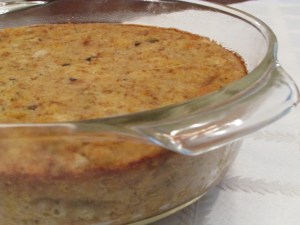
Mix ingredients and bake at 350 degrees for 45 minutes to 1 hour (until bubbly). Let it cool to room temperature and stir before serving.

One time, when Vidalias were not in season, I made the dip with another sweet onion and it was awful. Another time, I substituted another brand of mayonnaise for Hellmann’s and it didn’t work. So this is one of those recipes that you should just follow and never question. Catherine liked to serve the dip with melba rounds but I find that any sturdy, non-assertive bread or cracker works fine and I think it’s very tasty with Triscuits and with toasted French bread. It is also a fine dressing for a sandwich. I spread it on bread for a tomato sandwich recently.

Since I mentioned Ole Miss, I will share Catherine’s version of “Ole Miss Dip.” Ole Miss Dip is ubiquitous and I suspect there are as many variations as there are Ole Miss sorority girls so I will say that this is one version of Ole Miss Dip but it is by no means the definitive version. And it’s easy too.

Ole Miss Cream Cheese Dip

1 lb. hot or mild sausage, cut into small pieces (let me suggest Conecuh sausage from Alabama)
1 can Ro-tel tomatoes and diced green chilies
1 lb. softened cream cheese

Brown and drain the sausage. Add Ro-tel and cream cheese. Serve with tortilla chips.

Eat responsibly and enjoy. As I post this, it is 97 days until the 2015 college football season begins. Just saying …

The Peach Highway and Jimmie’s Peach Stand

One of my earliest essays on “Professional Southerner” was about the peaches of Chilton County, Alabama, and the family-run peach stand of the Harrison family. I made my first “peach run” of the season last week and, in honor of the 2015 peach season, I am going to revisit that 2014 essay.

gedwardjourney's avatarProfessional Southerner

100_1927  I get a little reflective as the Alabama peach season draws to a close. The state of Georgia, of course, has appropriated all of the peach titles and has done an admirable job of marketing its peaches as if they are something special. But a growing number of Southerners have discovered the rich and considerable delights of peaches grown in Chilton County, Alabama. On a May morning in the French Market in New Orleans a few years ago, I was pleased to hear a local shopper ask a vendor if any Chilton County peaches had arrived yet. He replied that he didn’t have any but that the lady a couple of stalls down had just gotten her first delivery of the season that very morning – “and they sure are good this year.” The shopper grinned like a child on Christmas and rushed to buy a basket.

I have…

View original post 677 more words

Food Memory: My Father’s Barbecue

IMG_1760  With Memorial Day weekend comes the traditional kick-off to cooking out and barbecue season. Although it’s always cook-out season in the South, it was a rougher than usual winter and it’s good to know that outdoor activities and barbecue are in full swing.

At some point in the ‘90s, when my job was frequently moving me around the country, I gave away my barbecue grill. Now, two decades later, I still haven’t replaced it.

That was not necessarily the plan. I gave the grill away so I wouldn’t have to move it anymore and I had every intention of replacing and upgrading it when I got settled in a new place. Now, even though I still think about purchasing a new grill (I’m attracted these days to the Big Green Egg) I am in no rush. My standard line is that I can find much better barbecue than I make so why would I want to take the time and trouble to grill my own?

I’m a pretty good cook, it’s true. But I know many people who grill and barbecue better than I. When it comes to barbecue, I prefer to be a connoisseur rather than a master. I once toyed with the idea of pursuing Kansas City BBQ Society judge certification but after exploring the rules I realized I prefer to consume barbecue as an amateur. Over the years, I have found some prize-winning barbecue to be lacking and the barbecue that breaks all of the rules is sometimes among the best.

In other words, I’m not that interested in measuring the smoke ring and analyzing if it “pulls” properly or “falls” off the bone; I’m not interested in quibbling over what’s authentic barbecue and what is just grilled meat. I’m interested in how it tastes and makes me feel.

As I write this, I am still in the afterglow of a quick stop at the original Dreamland location in Jerusalem Heights, Tuscaloosa. Driving away from that storied place, I realized that one of the things I love most about Dreamland is that slight glorious burn from the sauce that lingers in the front of the throat for a good hour or so after the meal is done.

I can give a long and ever-evolving litany of good barbecue joints around the country and I have been to quite a few. But some of the best and most fondly remembered barbecue of my life was cooked in the backyard by my father, Grover Journey.

Dad usually fired up the grill on Memorial Day, Independence Day, and Labor Day. He would start gathering his meat – pork ribs, sausage, and chicken – a couple of days in advance. He was picky about his meat choice. Mother would prepare traditional sides in the kitchen and I often made a huge green salad loaded with chopped vegetables.

My dad, who smoked cigarettes for about 50 years, has COPD – emphysema – now and as his breathing problems got worse he eventually stopped cooking at the barbecues. If the family is together for a warm weather holiday, my brother sometimes serves as pitmaster. Other times, we just buy meat and the sides at a local joint.

But when Dad was younger and healthy, he preferred to do the cooking himself. On the few occasions when I asked him to show me how he did it, he was never particularly forthcoming. I think he grilled his meat by instinct and it would have disturbed his mojo to divulge too much. I get that. I am much more comfortable handling my kitchen and my cooking alone; when I have “help,” things begin to go awry.

One thing I do know: Dad’s technique broke the rules. I read and watch what other pitmasters say and I realize that my father’s way didn’t conform with conventional ‘cue wisdom in many aspects.

Having said that, it always had a phenomenal taste so, in this case, rules be damned.

With the approach of Memorial Day, I recently decided to make another effort to pry loose any of my father’s grilling secrets. I chose to make it part of a recent dinner conversation.

“Dad, what did you use to marinate your meat before you’d barbecue?” I asked innocently.

“I didn’t marinate it,” he said.

“I thought I remembered some kind of pre-soak or marinade you used to do,” I responded.

“No.”

Mother chimed in. “I remember you used to soak it in vinegar.”

He denied it. My mother and I both seem to recall that he would pre-soak the meat in apple cider vinegar but memory is a tricky thing.

This exchange sort of stopped my query cold.

Later that evening, I ventured forth and asked him a little bit more about his technique. I asked him what sauce he used because I remember that he would use store-bought sauce as a base. But in my memory (there’s tricky memory again) he used the bottled sauce as a base only and added his own ingredients to it.

Once again I hit a wall. He told me that he always used Kraft “Original” Barbecue Sauce.

“And what did you add to it?” I asked. I am sure I remember seeing cups of melted butter on the shelf next to the grill, among other things

“Nothing,” he said. “Just Kraft Original.”

“Oh… Okay.” I usually know better than to push on at these moments.

And since I didn’t pursue it, Dad volunteered a good bit of additional information. He said he liked to cook over low heat for several hours. This is the way I remember it, too. He would start early in the day (but did not pull the all-nighters that some pitmasters swear by). The stealthy aroma would waft over the neighborhood until the wait was almost too much to handle and it would seem like the time to sit down and eat would never come.

Dad would sit patiently in a lawn chair, armed with tongs and a spray bottle of water to hit the flames when they flared up. I think the water in the bottle may have been spiked with apple juice but I dared not bring it up in that recent Q and A.

Dad mentioned that he liked to mop some sauce on the meat at the beginning before he put it on the grill. This is one of those areas where many of the “experts” would disagree but I remember it as part of his technique and am a witness that, in my dad’s case, it worked splendidly.

He would continue to mop sauce on throughout the cooking process as he turned the meat over. And he liked to turn the meat a lot (I know, I know – breaking the rules but it worked).

As the various meats were finished, he would pile them on platters, wrap them in aluminum foil, and send them in the house to rest. Huge platters of pork ribs, chicken, and sausages would line the kitchen counter along with Mother’s sides. They always cooked several times more food than was needed for the meal. I counted on it; I liked to be able to carry barbecue leftovers home.

Once, my sister-in-law’s grandparents were visiting from California and joined us for Labor Day barbecue. Spotting the spread, Buster, the grandfather, exclaimed at all of the food. “Do you always eat like this?” he spurted.

“Every single day,” my dad playfully shot back in a dead-pan lie.

All of that sauce slathered on gave the meat a flavorful black char  — the bark. The meat was always moist all the way through and never tasted burned or overdone. Even those who considered themselves wizards at the grill were always impressed by my father’s barbecue.

He broke the rules and did it up right.

I’m pretty sure I’ll never get the low-down on the specifics of his technique.

The Cahaba Lily

IMG_1753 I always forget how spectacular a Cahaba lily is until I come upon a stand of the flowers on a gentle bend in Alabama’s Cahaba River. The Cahaba lily is a rare lily that only grows in a very few spots in Alabama, Georgia, and South Carolina under very specific conditions. There must be swiftly flowing water over rocks. There must be abundant sunlight.

IMG_1752The Cahaba River National Wildlife Refuge near West Blocton, Alabama, is a prime viewing spot for the lilies during their brief growing season from May into June (roughly Mother’s Day to Father’s Day). Each of the fragrant flowers blooms in early evening and only stays for one day. The flowers go through their pollination cycle, dropping seeds into the stream where they become lodged in the rocks and shoals and await their vibrant display a year later.

There are a couple of significant stands of lilies visible from the narrow dirt and gravel road through the wildlife refuge. The water rushes over rocks and through tall grasses and hundreds of stunning white lilies show off their elegant beauty. It never fails to take my breath away.

IMG_1734The Cahaba River is one of the most significant of Alabama’s abundant natural treasures. At almost 200 miles long, it is the longest free-flowing river in the state and provides water for a quarter of Alabama’s population. Its path takes it from St. Clair County, through the suburbs of Birmingham, and into rural Alabama and the Black Belt where it empties into the Alabama River at the ghost town of Cahaba near Selma.

IMG_1742According to the U.S. Fish and Wildlife Service, the Cahaba River is home to 131 fish species – more per mile than any other river in North America. Eighteen of these fish species are found only in the Cahaba River and Mobile River Basin. The refuge is a habitat for at least a dozen threatened or endangered species including migratory birds and bats as well as assorted fish, mussels, snails, insects, and plants.

IMG_1754In addition to being a star in its own right, the Cahaba lily is significant to the area because its beauty and popularity help draw attention to the other aspects of the Cahaba River, its watershed, its significance and dependents. The ever-growing popularity and fan base for the lily help to draw attention to the support groups like the Cahaba River Society (www.cahabariversociety.org) which strive tirelessly to protect this rare and beautiful place.

Beyond all of that, the Cahaba lily in bloom simply belongs on every nature lover’s list of things to see. IMG_1746

Exploring Little River Canyon

IMG_1690 The trip to Little River Canyon from my house involves a drive through profoundly rural areas of northeast Alabama and a few small towns and communities. It feels at times like time travel but it takes less than a couple of hours.

The road passes the Paint Rock Valley before the backwaters of the Tennessee River and Guntersville Lake appear and then the town of Scottsboro. There, the Tennessee River is crossed and the road immediately climbs a steep grade to the top of Sand Mountain, a sprawling sandstone plateau near the southern end of the Appalachians. The myths, mysteries, and culture of Sand Mountain are legend in the rest of Alabama and I’ll admit that even though I have been to various parts of Sand Mountain several times and have been aware of it most of my life it remains a mystery to be unraveled for me.

After driving across Sand Mountain, the road drops again to a valley containing I-59 and the town of Fort Payne. A quick ramble through Fort Payne leads to another steep climb to the top of Lookout Mountain.

Little River in northeast Alabama mostly flows along the top of Lookout Mountain. This feature of the untamed river flowing along the mountain top is one of its most distinguishing characteristics. The canyon starts to form past DeSoto Falls at a wide plummeting Little River Falls and gets deeper, wider, and more steep as it moves down through the mountain.

On a recent mid-May trip, the water level was fairly low but the sound of the rushing rapids could be heard from the west rim even when the lush green canopy made the river invisible far below. The canopy also helped to block the view of houses encroaching on the east rim. IMG_1701

Since I was scoping out hiking trails for future trips, I mostly stayed on the Canyon Rim Drive which is part of the Little River Canyon National Preserve and meanders for eleven miles along the west rim. It passes a number of trailheads and provides a good opportunity to inspect the challenging terrain.

Regular overlooks provide scenic views into and across the canyon. Trails afford steep access to the river and the canyon floor. Grace’s High Falls is visible across the canyon from an outlook on the drive. A dramatic 133-foot plunge during the rainy season, Grace’s High Falls was just a trickle during my recent visit. As the weather gets less humid it will dry up altogether.

Canyon Rim Drive affords quick and easy access to the canyon’s majesty and mystique. A little farther upriver are an informative visitors’ center and DeSoto State Park with additional backcountry trails and accommodations. The National Park Service operates a boardwalk and trails on the east side of Little River Falls which provide access to the river and a close-up view of the falls.

Little River Canyon is wild and feels extremely remote but it is actually centrally located in the region and only a couple of hours or less from Birmingham, Chattanooga, and Atlanta. A quest for this year is to continue to find great outdoor opportunities close to home. The bounty of Little River Canyon and the surrounding area definitely fits with that mission. IMG_1723

Modern Lit: “Mad Men”

“The sea that morning was iridescent and dark. My wife and my sister were swimming … and I saw their uncovered heads, black and gold in the dark water. I saw them come out and I saw that they were naked, unshy, beautiful, and full of grace, and I watched the naked women walk out of the sea.”

Those final lines from John Cheever’s short story “Goodbye, My Brother” are among my favorite closing lines in literature. Cheever, the mid-20th century short story writer and novelist, explores the aspirations, insecurities, and dark underbelly of American suburbia with great depth and insight. He and other writers like John O’Hara,  John Updike, and Richard Yates examine the complexity of “normal” middle class lives in a rapidly evolving society of social pressure and change. They chronicle the American century in a way that will continue to inform future generations of the way we were at one time in history.

The way I feel when I read one of Cheever’s perfect endings is the way I feel at the end of many episodes of Matthew Weiner’s milestone television drama “Mad Men.” Cheever and his masterful way of ending a narrative have been on my mind as I await the airing of the 92nd and final episode of “Mad Men” this weekend. “Mad Men” premiered in 2007 and over seven seasons it has explored the eventful and tumultuous 1960s by focusing on an advertising executive named Don Draper. Don Draper lives in media history annals as one of the great existential antiheroes.

The first season of “Mad Men” is set in 1960 in the months leading up to John Kennedy’s election. It evokes an environment dominated by powerful, reckless, and ambitious New York ad men. Weiner’s obsession with period authenticity is one of the show’s many hallmarks and the period styles, music, and mores are recreated in pristine detail. The current and final season begins in 1969 and moves into 1970 and a new decade.

It has been a brilliant ride and, as a Baby Boomer who was growing up in the 1960s, it gives a sharp perspective from an adult point of view of events that I remember from my developing years. Revisiting the decade in such sharp focus in retrospect just reinforces how essential, frightening, and truly exciting that decade was for those of us who lived it no matter how old we were in the moment.

The narrative does not carry an overt social agenda but it pulls no punches in representing the decade as it was. The environment is dominated by cigarette smoke and liquid lunches. Cocktails and highballs are consumed at the workplace morning, noon, and night. Women are only seen as housewives and secretaries as the series begins and people of color are almost nonexistent in this corporate world. Vietnam is mentioned in passing and then it escalates. These things continue to change as the decade moves forward and the show masterfully explores how the workplace is ultimately unable to avoid and ignore the inevitable seismic changes occurring in the society around it. The media campaigns reflect the changes, uncertainty, and tumult. Like the best modern literature, it does not reveal too much but leaves the audience to find meaning and symbols and to draw its own conclusions.

The series is a gift to the actors involved, giving a skilled ensemble the opportunity to portray rich and vivid characters as they age and grow, evolve, and occasionally disappear or die. Rarely is there a false note and even the more fantastic developments seem inevitable in the world Weiner creates.

Don and Betty Draper’s daughter Sally is almost 6 when the series begins and audiences have the opportunity to watch her grow to a sometimes surly teenager and essential character as the story draws to a close. I have been intrigued by Sally’s story because she is the character who is closest in age to my age at the time of “Mad Men.”

“Mad Men” is always focused on Don Draper, his remarkable and mystery-filled creation story, and his constant search for contentment which never comes. But the Draper story has been constantly juxtaposed with the ascendance of Peggy Olson, the young secretary who becomes an advertising executive, seems to have a preternatural comprehension of Draper, and becomes increasingly hard and ruthless as she maneuvers and schemes her way to the top in a still male-dominated field.

Joan Holloway. Roger and Mona Sterling. Bert Cooper. Sal Romano. Stan Rizzo. And on and on … The memorable characters of “Mad Men” are characters that will stay with me as vividly as my favorite characters of any genre. These are all incredibly flawed and in some cases despicable human beings but I find myself pulling for each to find the path to personal peace and contentment. They feel like friends – annoying at times, but friends nevertheless.

As a lead-up to the final “Mad Men” episode on May 17, AMC has been running a 4-day marathon of every episode ever aired over the show’s seven seasons. I will admit that it has been on my televisions almost nonstop since Wednesday and I have fought the urge to just sit down and wallow in it. Instead, I have been checking in periodically to see where they are in the show’s arc and I will occasionally stop to revisit a favorite scene.

I will be interested to see how Weiner ends it Sunday night. I’m sure the pressure to end it to the devoted and demanding fans’ satisfaction is immense. I’ve heard a number of theories and I have a couple of my own but I feel like it will probably be a surprise and, hopefully, perfect. No pressure, Mr. Weiner.

No matter how “Mad Men’ ends on Sunday, I suddenly have the urge to go back and start rereading Cheever on Monday.

IMG_1724

The Authentic Vision: Brother Joseph’s Ave Maria Grotto

IMG_1617  Authenticity in folk art (“outsider” art, self-taught artists – whatever the current designation of choice may be) is a topic that has long intrigued me. There are any number of phonies – some of them the off-spring of the real thing – who try to cash in on the folk art market. The idea of the authentic artist who creates art from an impulse that comes from within is what I seek in the work of “outsiders.”

IMG_1614Brother Joseph Zoetl (1878-1961), a Bavarian-born monk who spent the bulk of his life at St. Bernard Abbey, a Benedictine monastery in Cullman, Alabama, is an example of that inspired authenticity, I think. Brother Joseph had no training as an artist but created historical and fantasy structures that are a lasting tribute to inspiration and faith. His Ave Maria Grotto (www.avemariagrotto.com) is nestled on the Abbey grounds along with the still active monastery and the St. Bernard Preparatory School which replaced St. Bernard College when it closed in 1979.

IMG_1631Brother Joseph’s impressive installation in the abandoned quarry of the Abbey includes at least 125 structures created out of stone, cement, and discarded items. The centerpiece of the four-acre park is the large Ave Maria Grotto but its focal points are structures – real and fantasy, sectarian and non-sectarian – taken from world culture. The structures span the globe but a large number of them are based on buildings and sites in Rome and Jerusalem. When I was growing up everybody referred to Ave Maria Grotto as “Little Jerusalem.”

IMG_1637I first saw the place as a young boy in the days of “roadside attractions” before the interstate system was ubiquitous. I remembered it fondly as a kitschy place with edifices constructed of concrete and broken glass, broken marble and colorful discarded gaming marbles, costume jewelry and cold cream jars.  IMG_1602 One fanciful monument is topped by green Irish fishing floats. I remembered a miniature Noah’s Ark installation with plastic animals and a fantasy piece called “Hansel and Gretel Visit the Temple of the Fairies” complete with a fierce dragon bound by a chain underneath. A life-size statue of Pope Pius X is just down the hill from a miniature Egyptian-style pyramid. A miniature section of the Great Wall of China hovers close to touching memorials to “St. Bernard Boys” who died in various 20th Century wars in which the United States was involved. There are a 48-star American flag made with marbles, glass, and cement and a replica of the World Peace Church, the Catholic Cathedral at Hiroshima. IMG_1647

All of these things are still there.

Brother Joseph’s first structures were crafted around 1912 and his last, an impressive replica of the Lourdes Basilica, was built in 1958. I remembered the place as a quirky roadside attraction but on a recent visit I was struck by the level of craft and artistry, spirituality, and personal mission represented in the little monk’s life’s work. He was not a world traveler and had only personally viewed a handful of the structures he created – those from his Bavarian home town of Landshut and those on the grounds of the Abbey in Cullman. The rest were composed from photographs, the Bible and other written texts, and his imagination. Brother Joseph started constructing the buildings in his spare time when his job was to shovel coal at the Abbey’s power station. IMG_1627

A few structures have been added to the installation since Brother Joseph died including a life-size bronze statue of Brother Joseph facing his monumental Grotto. After one has toured the installation, a shaded path with the Stations of the Cross leads to the Abbey Cemetery where the monks, including Brother Joseph, are laid to rest. A small stone chapel stands watch over the cemetery. It is a quiet and reflective place, conducive to meditation and contemplation. IMG_1685