A Menu for the End of the Carnival Season

IMG_1134  My attraction to Mardi Gras is directly tied to my attraction to the Gulf Coast. Growing up inland, Mardi Gras always seemed mysterious and somehow “foreign” and like a place I’d rather be. I would see news reports of the activities in New Orleans and Mobile and other celebrations on a smaller scale along the Gulf and they seemed to be in stark contrast to the grey late-winter life around me. I was raised in the Southern Baptist church and we did not observe Ash Wednesday. When I realized the Christian tie-in to the revelry of Mardi Gras and better understood the season that begins on Epiphany and ends precisely at midnight on Shrove Tuesday, that knowledge gave the events of the season even more mystery and appeal.

Age, experience, and knowledge began to de-mystify the events of the carnival season leading up to Mardi Gras and more and more the events began to move farther inland. When I was living and teaching in Indiana in the 90s, I began to throw beads at the end of my Fat Tuesday classes to give myself a sense of connection to my home region. Huntsville, where I live now, had its 2nd annual Mardi Gras parade on Saturday, February 14, but it’s a sad substitute for the real deal on the coast.

I am a bit of a traditionalist and a purist when it comes to the proper way to do things and I bristle a bit at the fact that one can now stand beneath a New Orleans Bourbon Street balcony and be showered with Mardi Gras beads on virtually any night of the year. In my mind, Mardi Gras beads should only be thrown in the season. And then they should be packed away until the following January.

The appeal of tradition and the desire to recapture the mystique of “The Season” on the Gulf Coast of the Deep South is one of the reasons Joe Cain Day, observed in Mobile on the Sunday preceding Fat Tuesday (and the subject of my previous essay), has engaged me.

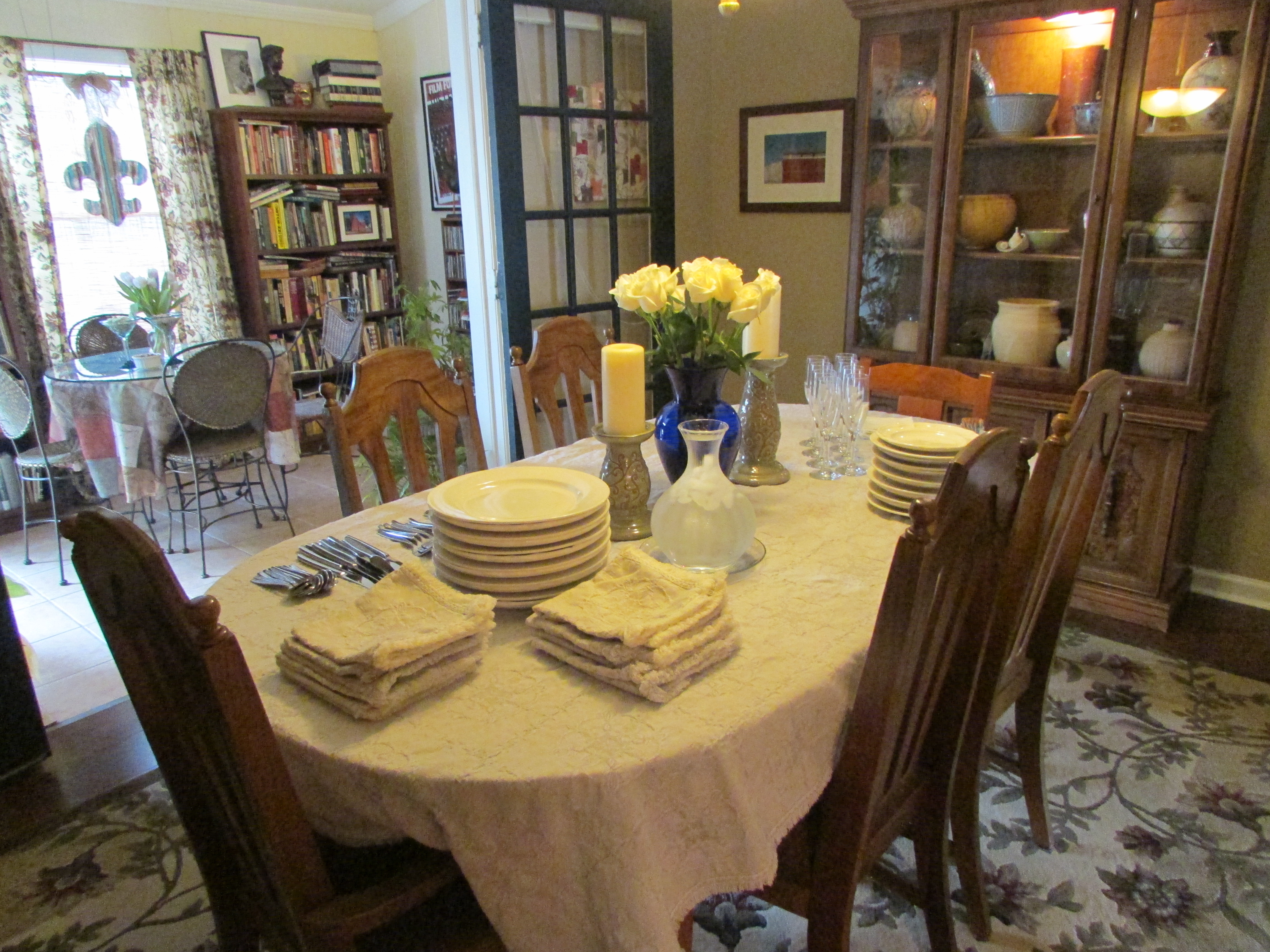
I hosted my first Joe Cain Day celebration this Sunday, February 15, and it brought some levity to a blustery February afternoon in north Alabama as still another cold front – “the weather of northern aggression” I call it – moved into the area. On the invitations I wrote “Masks and mourning attire optional.” My guests, some of them wearing masks and almost all dressed in some form of black in “mourning” for Joe Cain, enjoyed the respite before the cold and icy work week resumed.

IMG_1128One of my favorite images in New Orleans is that of Mardi Gras beads that never came down to earth during parades and got caught in the live oaks along the parade routes. They hang there throughout the year, gradually fading but always a reminder that the season has gone but will always come back again in January. I look for these stray beads on streetcar rides along St. Charles. With that image in mind, I threw beads from my second story bedroom window on the day before the party and let them catch in the cherry tree in my front yard so that my guests would have that image of beads in the trees upon arrival. (Now I will spend the rest of February retrieving Mardi Gras beads from the cherry tree.)

I designed the menu to reflect regional and seasonal tastes and as usual there was much more food than was needed. I made a lot of the food myself. I purchased other things from favorite vendors. Here’s my menu.

A Joe Cain Day Celebration / February 15, 2015

Boiled Peanuts

Cheese Straws

Breads, Toasts, and Crackers for dipping and spreading

Gumbo

Lobster and Shrimp Salad

Alabama Gulf Shrimp w/cocktail and garlic buttermilk sauces

Hot Seafood Dip w/ shrimp and crabmeat

Mardi Gras Chicken

Chocolate Truffles

Moon Pies

King Cake

Bloody Marys, Hurricane Punch and assorted beverages

The gumbo was ordered from Wintzell’s (www.wintzellsoysterhouse.com), a Mobile-based oyster house and restaurant that makes one of my favorite gumbos. The King Cake, a carnival season standard, came from Paul’s Pastry Shop (www.paulspastry.com) in Picayune, Mississippi. My friends G. Todd and Anita brought a couple of other dishes — a crawfish beignet with a savory sauce and crostini topped with shrimp, red pepper jelly, and sweet potato. The chocolates were from the Chocolate Gallery in Huntsville (www.chocolategalleryal.com).

IMG_1133“Mardi Gras Chicken” was a clear favorite of the day. When I was on the Gulf Coast in December, I was toying with the idea of a Joe Cain Day party. I asked my friends, the Brunsons – who are natives of Mobile, for a dish that their mother, Jean Brunson, would have made for Mardi Gras and Joe Cain Day. The response was unanimous – “Mardi Gras Chicken!” – and a recipe was produced. Mrs. Brunson was the caterer for the First Baptist Church of Mobile for many years and had a sizable repertoire. “Mardi Gras Chicken” is really an adaptation of a chicken tetrazinni recipe but Mrs. Brunson always made it around Mardi Gras and her children still refer to it as “Mardi Gras Chicken.”

I made my own revisions to the recipe and my adaptation of Mrs. Brunson’s adaptation is what I’m offering here. It’s a hit.

Mardi Gras Chicken

1¼ lbs. boiled chicken

1 large pkg. rotelli pasta

1 cup green, red, and yellow peppers, diced

1 medium onion, chopped

6 pieces of celery, diced

6 strips of pimento, chopped

2 cans of cream of mushroom soup

¾ cup of sour cream

1 cup of sharp cheddar cheese, finely grated

4 ozs. almonds, minced

Cook rotelli pasta in chicken broth. Since it will be baked in a casserole, it is best to cook it until it is fairly limp. Drain pasta. Add chicken to pasta (chop chicken into fairly large bites). Add peppers, onion, celery, and pimento. Stir in cream of mushroom soup, sour cream, and ½ cup cheese.

Place mixture in large casserole dish and top with ½ cup cheese and minced almonds. Bake at 350 degrees for I hour.

Happy Mardi Gras!

IMG_1146

Joe Cain Day in Mobile


IMG_1124 On Sunday, February 15, I am hosting a pre-Mardi Gras celebration for Joe Cain Day. Joe Cain Day is an event that is unique to Mobile, Alabama. It is always celebrated on the Sunday before Fat Tuesday. I have heard about it for decades but only got really intrigued with its origins and traditions in recent years. The more I learned the more fun it sounded. My little get-together is a way of sharing the tradition with my friends in north Alabama.

Of course, most Alabamians know and proudly assert that Mobile was the site of the first Mardi Gras celebrations in the present-day United States. Mobile was founded in 1703, fifteen years before New Orleans, and had established New World Carnival celebrations under French rule early on. There is still banter back and forth between the two cities about the legitimacy of Mobile’s claim to being the first. And a New Orleans friend once told me, “Well, Mobile may have started it, but New Orleans taught them how it ought to be done.”

There is no controversy, however, over the origins of Joe Cain Day.

Joseph Stillwell Cain (1832-1904) is credited with reviving Mardi Gras in Mobile after the Civil War. It all started in 1866 when he paraded through downtown Mobile in fanciful Native American garb. This act is considered the rebirth of modern Mardi Gras in Mobile.

Joe Cain was a Mobile native and as a teenager was a charter member of the Tea Drinkers Society (TDS), a Mobile mystic society that paraded on New Year’s Eve. Prior to the Civil War, pre-Lenten celebrations in Mobile were customarily tied into New Year’s observances.

When the Civil War began, Joe Cain was a private in the Confederate Army. When his military service was over he lived for a time in New Orleans and participated in New Orleans Mardi Gras observances.

In 1866, when Cain returned to his hometown from New Orleans, he decided to revive Mardi Gras in the city. He and six other members of TDS decorated a charcoal wagon, dressed in Native American garb, and frolicked through the streets of Mobile. Cain led the procession dressed as a fictional Chickasaw chief, “Chief Slackabamarinico,” and declared an end to Mobile’s suffering and the return of pre-Lenten carnival celebrations.

Joe Cain’s actions had an impact and led to the city officially moving the culmination of carnival festivities from the New Year’s season to traditional Fat Tuesday. Cain was a founding member of the mystic society called Order of Myths. Order of Myths adopted the emblem of Folly chasing Death around a broken column. This is assumed to be symbolic of the Civil War, a Lost Cause for the rebel South.

Cain remained active in Mardi Gras. Later in life, he and his wife moved from Mobile to the fishing village of Bayou La Batre, Alabama. Cain died in 1904 and was buried near Bayou La Batre. After Cain’s death, Mobile’s Mardi Gras remained popular but exclusive. The mystic societies had closed memberships. Most of the citizens of the city could only participate as onlookers.

In 1966, Julian Lee Rayford, a local author, set out to honor Joe Cain and open Mardi Gras participation to more people. Cain and his wife’s bodies were moved from Bayou La Batre to Mobile’s Church Street Cemetery. Cain’s interment was accompanied by a Mardi Gras parade, jazz band, and mourners. His tombstone has a jester’s image and reads “Here Lies Old Joe Cain, the Heart and Soul of Mardi Gras in Mobile.”

The popularity of Cain’s reburial inspired the creation of “Joe Cain Day,” observed on the Sunday before Fat Tuesday. The Joe Cain Day Parade, also known as “The People’s Parade” because anyone may participate (although it eventually became so big that the number of participants had to be capped), is led by a person chosen to dress as Chief Slackabamarinico. The parade concludes at Church Street Cemetery where revelers dance atop Cain’s grave.

Throughout the day, a mystic society of mourning-clad women known as “Joe Cain’s Merry Widows” wail over the loss of their beloved Joe Cain and declare “He loved me best!” The Merry Widows wail at the grave, toast the deceased from the front porch of his house on Augusta Street, and ride in a place of honor in the Parade. In 2003, another all-woman mystic society, “Mistresses of Joe Cain,” appeared. The Mistresses are also veiled, but dress all in scarlet and proclaim that “Of course he loved us best!” They parade alongside the vehicle carrying the Widows in the Parade, taunting them along the route and creating a general caterwaul.

Rumor has it that still another all-woman mystic society might be in the works that will be Joe Cain’s “ladies of the evening” – or some more earthy variation. In any case, Joe Cain Day in Mobile is a great representation of the silliness and release of the Mardi Gras season.

(The image is of the cherry tree in my front yard, bedecked with beads for Joe Cain and Mardi Gras.)

The Bright Star


     100_2314  Bessemer, AL It seems that every family has a restaurant where it convenes for special events and commemorations – the place where the family goes to celebrate graduations, birthdays, and anniversaries, and to gather after funerals and hospital visits and other more somber occasions. For my family, that restaurant in the Birmingham area is The Bright Star west of the city in Bessemer. The Bright Star, Alabama’s oldest restaurant, opened in 1907 and has been family-owned ever since. The Bright Star was awarded as an “America’s Classic” by the James Beard Foundation in 2010.

Mine is a family of strong, vocal, and often divergent opinions on pretty much everything, including food. The Bright Star is one of the places that is in every family member’s “comfort zone.” In addition to being a safe choice, it also has a good and diverse menu with offerings for every taste. I always look forward to eating at The Bright Star, whether it is a quick lunch or a leisurely evening meal.

Frank Stitt triggered Birmingham’s ascent on the national culinary map with the opening of Highlands Bar and Grill in the 1980s. But the culinary history of the Birmingham area is full of the stories of Greek families and immigrants who opened restaurants. Many of their descendants are still restaurateurs into the 21st century. The Bright Star is the anchor of that Greek-influenced dining tradition in Birmingham with off-shoots that range from fine dining establishments to fish markets, barbecue joints, and hot dog stands.

The Bright Star was started by Tom Bonduris and has been continuously owned by Bonduris and Koikos family members ever since. Jimmy and Nick Koikos, sons of long-time owners Bill and Tasia Koikos, are the current faces of the restaurant, along with a large and long-serving support staff. Much of my recent planning with the restaurant has been coordinated through the invaluable  and gracious help of Jimmy and Nick’s niece, Stacey Craig, and maître d’ Marlon Tanksley. The restaurant always bustles and the place is full of regulars as well as people who are traveling through or have made the effort to come to Bessemer just to check it out.

The Bright Star has grown over the years in its current building in the middle of downtown Bessemer. The vibe of The Bright Star reminds some of New Orleans’ Galatoire’s. (It is a lesser known fact that the first Galatoire’s was in downtown Birmingham before Jean Galatoire ended up in New Orleans and opened his iconic Bourbon Street bistro.) The Bright Star menu that features seafood and steaks in the evenings serves a classic Southern “meat and three” lunch menu each day. The shredded cabbage with the signature slaw dressing is a staple, as is a superior bread pudding and an array of fine pies. The Bright Star serves one of my favorite gumbos. Tipping its hat to the New Orleans influences on the menu, The Bright Star does an annual “Taste of New Orleans” event in August that usually features the executive chef of New Orleans’ Commander’s Palace.

Fresh seafood is delivered daily and Alabama Cattlemen’s Association has named Bright Star’s beef the best steak in Alabama. The large foyer entrance to the restaurant is full of memorabilia including awards, national magazine and newspaper articles, and archival photographs of the many celebrities and dignitaries who have enjoyed a meal at The Bright Star. One finds photos of Sandra Bullock and her father dining there among an array of celebrities and sports figures from earlier times.

The main dining room is flanked with highly varnished pastoral murals painted by an itinerant German painter in 1915. A century of varnishing and cigarette smoke creates a warm glow from the murals and the combination of the murals and the high wooden booth backs creates an intimate and cozy feeling in the large room, even as the aisles are full of servers and patrons coming and going.

Far in the back of the main dining room is the enclosed booth that was Alabama Coach Paul “Bear” Bryant’s favorite booth. For a recent birthday dinner, my mother reserved the Bryant booth and I dined there for the first time with a large portrait of “the Coach” looking down from the west wall.

When The Bright Star turned 100 in 2007, a book, A Centennial Celebration of The Bright Star Restaurant, was released. The book, a project by nieces of Jim and Nick Koikos with assistance from Niki Sepsas, is a compilation of history, memories, recipes, and photographs of the restaurant. IMG_1119

Bessemer, a vibrant industrial town in the early 20th Century, lost much of its industry in the 1970s and has suffered economic downturns and redefinition. Through it all The Bright Star has endured. I was in the restaurant this past weekend and am convinced that The Bright Star will be serving good meals to happy patrons for generations to come.

Note: The top image is a detail from Scott Smith’s assemblage, “Ensley” (2010), featuring the menu listing for The Bright Star’s “famous snapper almondine.” “Ensley” was a commission celebrating my parents’ marriage. Each pin represents a place they have lived during the marriage. Images of Ensley, the Birmingham neighborhood where they met, and other aspects of their marriage are represented, including images from The Bright Star menu.

“I Love You, Alice B. Toklas”

IMG_1114   I bought my first Gertrude Stein book, The Autobiography of Alice B. Toklas, at the late great Smith and Hardwick Bookstore on 20th Street in downtown Birmingham in the ‘70s when I was an undergraduate at Alabama. Smith and Hardwick was one of those amazing bookstores with an outstanding jumble of books on two levels in seeming disarray. It was owned by the Praytor sisters – Virginia and Anna – and by Anna Praytor alone when Virginia died in 1974.

If you were looking for a particular title in the store and couldn’t figure out where it might be in the dusty stacks, one of the Misses Praytor always seemed to know exactly where it was located. Here’s what great locally-owned bookstores were like back then: I was in school in Tuscaloosa and if there was a book I needed I would telephone Miss Anna Praytor in Birmingham. She would mail the book the same day and enclose a handwritten bill and thank you.

The Autobiography of Alice B. Toklas (1933) was Stein’s own autobiography told in the voice of Toklas, her long-time companion, secretary, cook, confidante, hostess, and handler. Alice B. Toklas (1877-1967) and Gertrude Stein (1874-1946) met on Toklas’s first day in Paris in 1907 and were never apart until Stein’s death thirty-nine years later. The Autobiography of Alice B. Toklas was a huge hit and led to Stein and Toklas’s triumphant first tour of the U.S. that spanned seven months in 1934 and 1935. Stein captured the experience of the American tour and other events in a 1937 book titled Everybody’s Autobiography. Whatever else Gertrude Stein may have been, she was never modest.

Over the years I have been fascinated with Gertrude Stein and have directed and adapted her plays, delivered papers about her oeuvre and influence, and conducted acting workshops based on the enigmatic short ditties she referred to as “plays.”

And the more I have learned about Stein, the more interested I have become in Toklas and her quirky and ongoing influence. Eugene Walter knew Toklas (of course) in Paris in the ‘50s and “adored [her] because she had this little moustache, and I swear she waxed it.” He says that upon meeting her “Right away you could see cat and monkey” (his two favorite creatures). “She had a logical mind, but she also had the gift of the parenthesis.”

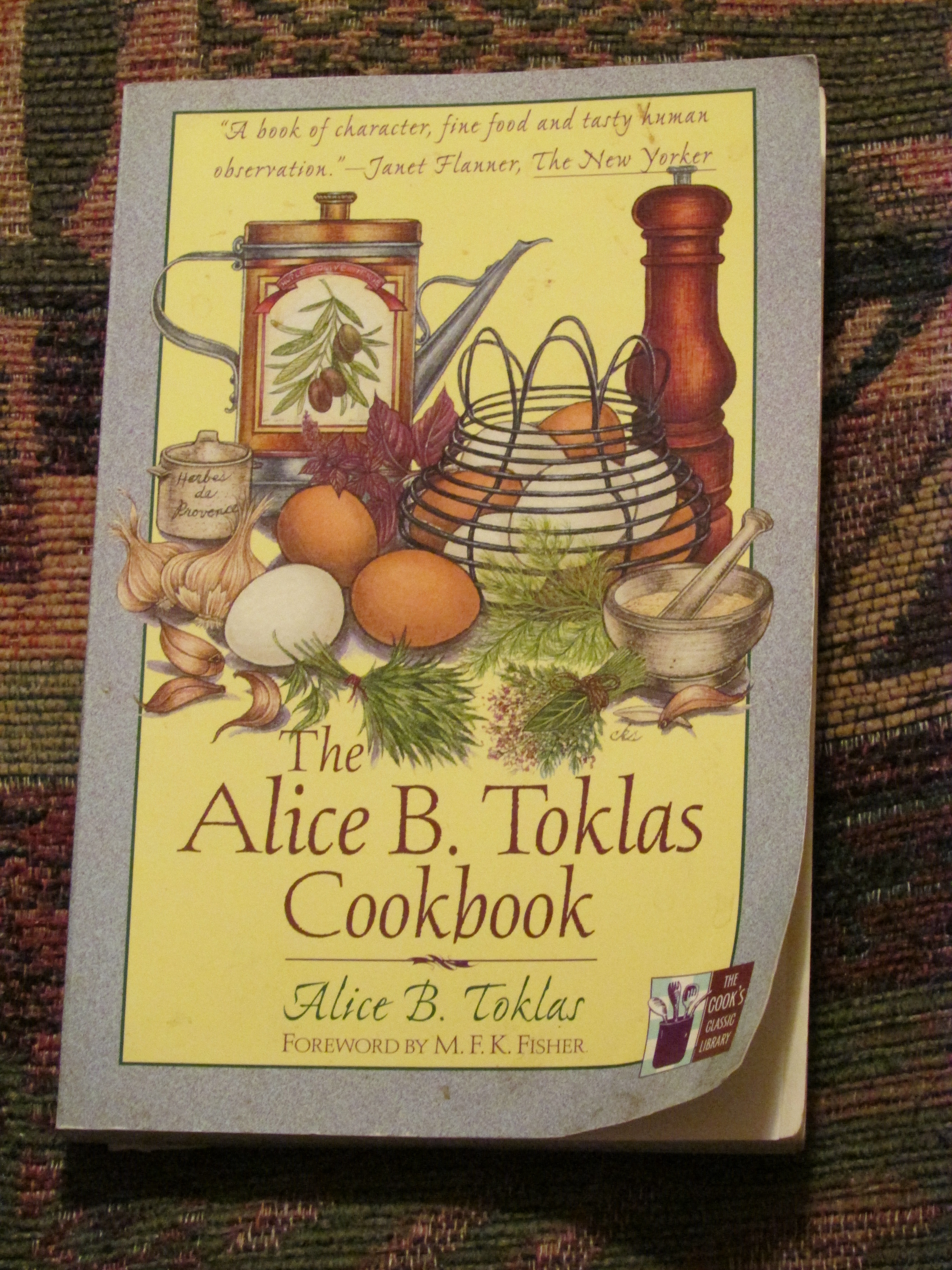
Walter and Toklas exchanged cooking ideas and recipes and it was The Alice B. Toklas Cookbook (1954) that brought Toklas a surge of attention after Stein’s death. The Cookbook is really a fascinating memoir with recipes presented in a witty, earnest, and distinctive voice. In a chapter entitled “Murder in the Kitchen,” Toklas discusses the unpleasant tasks of preparing live animals for the kitchen: “The first victim was a lively carp brought to the kitchen in a covered basket … So quickly to the murder and have it over with.”

As Toklas assesses and deals with the fish she observes:

The carp was dead, killed, assassinated, murdered in the first, second, and third degree. Limp, I fell into a chair, with my hands still unwashed ready for a cigarette, lighted it, and waited for the police to come and take me into custody. After a second cigarette my courage returned and I went to prepare poor Mr Carp for the table.

Later in the same chapter Toklas describes her preparation of “Six white pigeons to be smothered, to be plucked, to be cleaned and all this to be accomplished before Gertrude Stein returned for she didn’t like to see work being done.”

In addition to being very readable, educational, and entertaining, the Cookbook continues to inspire into the 21st Century. A brief passage in Toklas’s chapter entitled “Servants in France” about the hiring of an Indo-Chinese cook named Trac inspired the creation of a beautiful and award-winning 2003 novel, The Book of Salt, by Monique Truong. Truong’s seductive and meditative book explores a fictional Vietnamese cook, Binh, who comes into the Stein-Toklas household.

No doubt the part of the Cookbook which caused the most stir is a recipe for “Haschich Fudge” in a section of the book called “Recipes from Friends.” The marijuana brownie recipe “which anyone could whip up on a rainy day” was given to Toklas by Brion Gysin and is described as “an entertaining refreshment for a Ladies’ Bridge Club or a chapter meeting of the DAR.” The chapter of recipes from friends was inserted to fill the book out and Toklas might have been clueless about what she was presenting with the fudge recipe. Even so, the American publishers left the recipe out of the first American edition but it was included in others and became notorious and sort of a code, especially when the hippie movement of the 1960s took hold.

That recipe is the reason that a fairly insipid and badly dated 1968 Peter Sellers comedy directed by Hy Averback is called I Love You, Alice B. Toklas! Sellers plays “Harold Fine,” a strait-laced attorney who falls in with a group of very stereotypical hippies and is especially enamored of one particular hippie, Nancy, played by Leigh Taylor-Young. Nancy, of course, bakes Alice’s brownie recipe that fuels much of the frolic. The title song, penned by Elmer Bernstein (who was no hippie) and performed by Harpers Bizarre, has the refrain “I love you, Alice B. Toklas / And so does Gertrude Stein.” Other lyrics evoke “Coriander baby elephants singing ‘Silent Night’/ Sweet cinnamon and nutmeg Che Guevara.” (The ladies would be so proud.)

Sly references to Toklas’s fudge recipe had a way of sneaking in to pop culture. In a 1969 episode of the sitcom “Bewitched,” Samantha’s mother Endora is offered a cookie. Endora asks if it’s from an Alice B. Toklas recipe. When she’s told it’s not, Endora says, “… I’ll pass.”

My favorite recipe from the cookbook is “Oeufs Francis Picabia” from the chapter titled “Dishes for Artists.” Here it is:

Break 8 eggs into a bowl and mix them well with a fork, add salt but no pepper. Pour them into a saucepan – yes, a saucepan, no, not a frying pan. Put the saucepan over a very, very low flame, keep turning them with a fork while very slowly adding in very small quantities ½ lb. butter – not a speck less, rather more if you can bring yourself to it. It should take ½ hour to prepare this dish. The eggs of course are not scrambled but with the butter, no substitute admitted, produce a suave consistency that perhaps only gourmets will appreciate.

I am no gourmet, and this recipe is too rich to serve a lot, but I have prepared it and can attest to the fact that it is delicious.

In 1963, needing money, Alice B. Toklas finally got around to writing her own autobiography. It is called What Is Remembered. Even though she outlived Gertrude Stein by over two decades, she chose to end her own life’s story with the death of Gertrude Stein.

Discovering Eugene Walter

IMG_1111 During graduate school I briefly worked a part-time job as a reader for a press clipping service. This is another of those occupations that is now totally obsolete but I love to read and enjoyed the job. It’s clearly a great job for a liberal arts guy. The staff of readers would have our favorite newspapers and would try to make sure that the favorites were in our stack of papers to be read. I had personal picks among the large dailies and there were a few of the small-town weeklies that I tried to grab because of a particularly charming or quirky local columnist or point of vew.

“The Boulevardier” was the title of a column written by Eugene Walter and published in Azalea City News and Review, an alternative weekly newspaper in Mobile at the time. My first reaction was Who is this guy and why haven’t I heard of him before if he’s been all of the places and done all the things he claims?

The more I read, however, the more fascinated I became with the scope of knowledge and experience of a true, uncompromising, unpretentious, and erudite Renaissance man. Too late, I began to track down the biographical details of Eugene Walter (1921-1998) and realized that even if the majority of his claims were tall tales and fabrications, he still lived a more eventful and meaningful life than most everybody else.

“I don’t drive a car, I don’t wear blue jeans, and I don’t go to football games,” said Eugene Walter, but here are just a few of the things that he did do:

  1. Worked with the Civilian Conservation Corps as a highway sign painter.
  2. Served as an army cryptographer in World War II.
  3. With collaborators, staged some of the first “Happenings” in the garden of New York’s Museum of Modern Art.
  4. Worked on a Paris-based multilingual international literary journal, Botteghe Oscure. He later relocated to Rome as the journal’s editor.
  5. Published a short story in the first Paris Review for which he served as a founding and contributing editor.
  6. Published his first novel, The Untidy Pilgrim, while living in Paris. It won the Lippincott Prize for best first novel.
  7. Published his first volume of poetry, Monkey Poems, during the Paris years.
  8. While in Rome, acted and worked as an assistant and translator for master Italian filmmaker Federico Fellini. He appeared in Fellini’s masterpiece and in many other films for Fellini and other directors including Blake Edwards and Lina Wertmuller.
  9. Wrote the lyrics for Nino Rota’s signature song “What Is a Youth?” for Franco Zeffirelli’s Romeo and Juliet. This theme song for the very popular film was an international hit.
  10. Wrote the best-selling classic American Cooking: Southern Style (1971) for the Time-Life Foods of the World cookbook series.

He was born and grew up in Mobile, served the military in the Arctic Circle, lived in New York City in the 1940s, lived in Paris in the 1950s, lived in Rome throughout the 1960s into the 1970s, and moved back to his beloved but changed Mobile for a number of social and productive years from the late-1970s until his death. “Sooner or later Southerners all come home, not to die, but to eat gumbo,” he said. As he lived and traveled around the world, he always carried a Thom McAn shoebox full of Alabama red clay with him and stored it under his bed – “So I always slept on Alabama soil.”

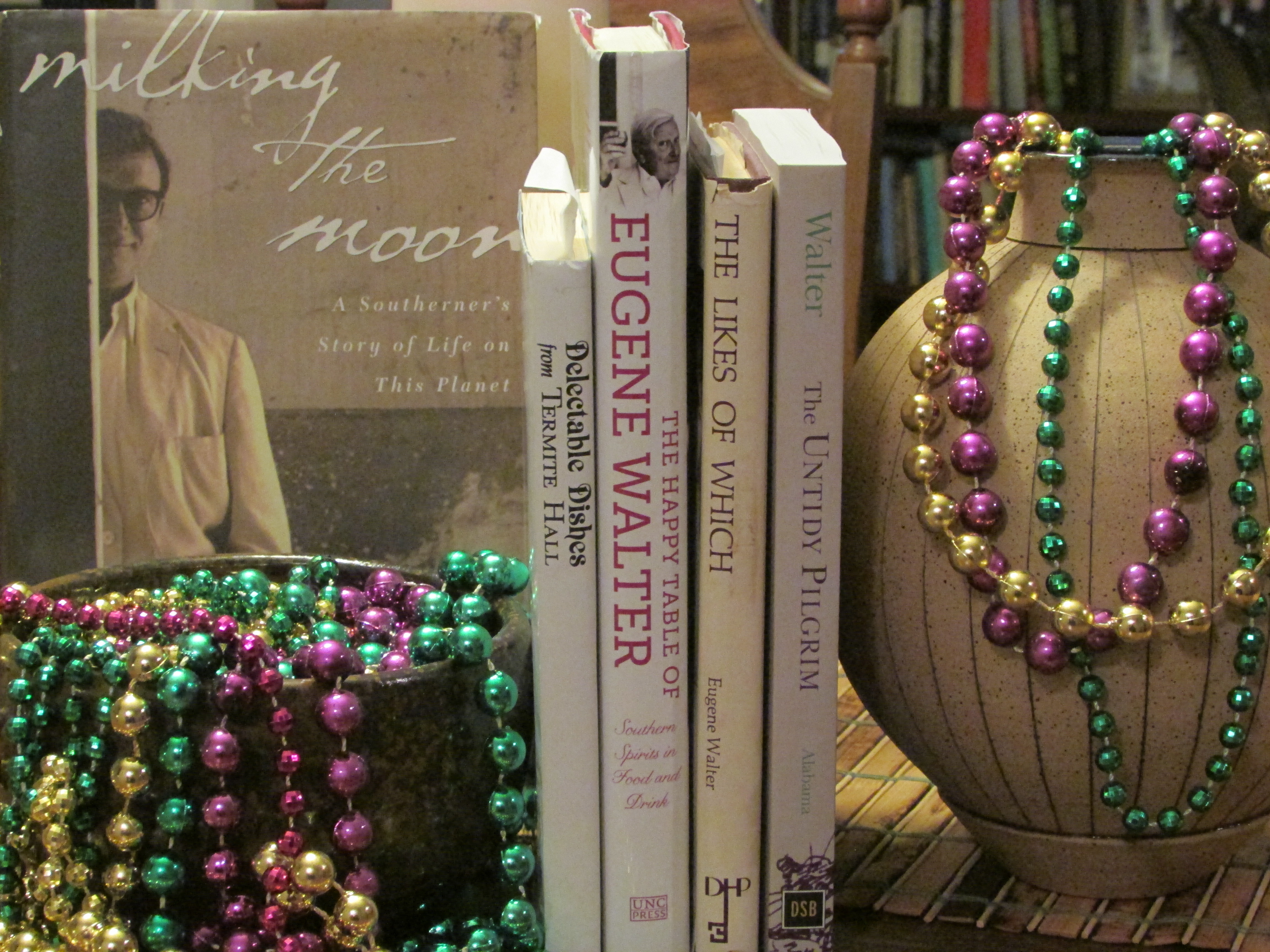
American Cooking: Southern Style is out-of-print, very precious, and somewhat hard to find in a good affordable copy. If you’re interested in food, grab it when you find it. Walter did other food-related books in his lifetime including Delectable Dishes from Termite Hall: Rare and Unusual Recipes (1982); and Hints and Pinches (1991). Posthumously, in 2011, The Happy Table of Eugene Walter: Southern Spirits in Food and Drink was published. The Happy Table was compiled from an unpublished manuscript and other recipes and food writing from Walter and focuses on “Southern Beverages and a Grand Selection of Southern Dishes Employing Spiritous Flavorings.”

His books on food are full of wonderfully vivid recipes and unvarnished opinions. “Baby turnip roots just boiled to a point, not mushy, dressed with butter, cream, salt and a generous flecker of nutmeg, are the sign of a highly civilized household.”

In The Happy Table … Walter writes, “For a real feast, you must have two kinds of meat and two kinds of bread, and there must always be more than enough food to serve the number of guests.” (My grandmother would add that one of the reasons for this abundance is to “be sure there is something on the table that everybody likes” and I still follow her mandate.)

His advice to cooks is simple and timely: “seek fresh, avoid chemicals, keep a light hand, rise to the occasion, try what you don’t know, have fun … and good eating, you-all!”

Don’t get him started on ready-ground pepper (or do, it’s very entertaining): “Never use the dead dust sold as ready-ground pepper. … dead dust is only dead dust. Many restaurants which pretend to be first class, and with prices which corroborate their pretensions, do not have pepper mills … either take your own pepper mill with you, or smash an ashtray when the waiter says they don’t have one.” As random and serendipitous as Walter’s pronouncements may sound, his food-related books are meticulously researched and the scope of his knowledge and historical grasp is constantly impressive.

Writer Pat Conroy, a personal friend of Walter, devotes a whole chapter to him in The Pat Conroy Cookbook (2004). Conroy writes that while he lived in Rome, shortly after Walter had returned to Mobile, “I met more Italians who were in love with the whole state of Alabama just because Eugene Walter had sprung so fully formed and elegant from that Deep South state. Many Italians were fully prepared to like me because they knew my native state of Georgia was contiguous to the one that had produced the incomparable Eugene Walter.”

In 2001, Milking the Moon: A Southerner’s Story of Life on This Planet was published. It is the life story of Walter in his own inimitable words as he told it to Katherine Clark in a series of recorded conversations near the end of his life. Be warned that once you pick it up, it is hard to put it down. He begins, “You may think you don’t know me but you have probably seen me on late-night television playing either an outlaw or a hanging judge… If you’ve ever seen Fellini’s 8 ½, I’m the tacky American journalist who keeps pestering Marcello Mastroianni with obnoxious questions. And if you haven’t seen , you need to: it’s one of the great films of this century.”

I re-watched not long ago and particularly watched for Eugene Walter’s appearances. He’s one of those performers who glows on the screen – not so much for his acting ability as for his sheer joy in acting. He smiles broadly, his eyes are shining and shifting with mischievous glee, and he is totally present every moment he’s in a scene. I couldn’t help thinking about the similar impact Tim Blake Nelson’s performance as Delmar had for me in the Coen Brothers’ O Brother, Where Art Thou? In each case, the glee of the actor in the performance is memorable and contagious.

Reading Walter’s work, one constantly has the urge to call somebody and quote a passage. But that’s a risky exercise since once you get started, you can’t stop. Almost every word on the page is quotable.

Eugene Walter knew everybody. The 23-page “Cast of Characters” at the end of Milking the Moon reads like a Who’s Who of important and famous people of the 20th Century. He threw dinner parties for whomever happened to be of interest to him wherever he happened to live. He claimed to have three pubic hairs which were gifted to him by actress Tallulah Bankhead in her dressing room after her performance in The Skin of Our Teeth at a Broadway theatre during his early sojourn in New York (but then, who didn’t have such a treasure from Tallulah at that time?).

I was familiar with Walter’s short stories but I recently read that first novel, The Untidy Pilgrim, for the first time. It is the story of a young man from central Alabama who comes to Mobile – “south of the salt line” – to work in a bank and study law. “Down in Mobile they’re all crazy,” the novel begins, “because the Gulf Coast is the kingdom of monkeys, the land of clowns, ghosts, and musicians, and Mobile is sweet lunacy’s county seat.”

Of course the stable and well-intentioned young man (who is never named) is quickly caught up in the intrigues and pleasures of his new surroundings and his Mobile friends and relatives. He is introduced to the colorful characters, artists, and underside of Mobile and encouraged to play hooky from his 8-5 grind. He samples the indiscreet pleasures around him and is taken into the fold by his more cavalier south Alabama relatives and Miss Nonie Fifield – “Fiffy” – from whom he rents a room.

As with all of Walter’s writing, I found the novel compelling and terrifically entertaining. And I was pleasantly surprised when the ending of the book was a somewhat conventional one – which was not at all what I expected given what I know about Eugene Walter. The book plays around with the reader’s expectations, dips its toes in the unexpected and bizarre, and then catches the reader off-guard by concluding in a sweet and almost conventional way. That unpredictable predictability left me smiling and satisfied at the end.

Eugene Walter spent much of his life in poverty, had a limited formal education, and died practically destitute, but happy. “I haven’t been smashed by the educational system, the financial system, the political system,” he said. He lived his life on his own terms and with style. When he died, a jazz funeral procession took him through the streets of Mobile for burial at Church Street Cemetery. The cemetery had been closed for a century but the city gave special permission for his interment.

Over the years, I have talked to a few people who met Eugene and each one seems simultaneously entranced, intrigued, befuddled, and half in love with the guy. He was what one might call an eccentric in every sense but his charm was evident to all kinds of people. “When I was growing up in Mobile,” he said, “there was no such thing as an eccentric, because individuality was permitted.”

I wish I had known to meet him.

Robert Altman’s Nashville

IMG_1109  My directing students are currently engaged in a project in which they are analyzing five favorite films. It is a way to develop critical and analytical skills and to find their own directorial “voice.”

In discussions with the students, I realized that my all-time favorite movie, Nashville, directed by Robert Altman, turns forty this year. I fell in love with the movie the first time I saw it at the Bama Theatre in downtown Tuscaloosa and by the end of the first week of its Tuscaloosa run I had already watched it four times. I kept saying to friends “Have you seen Nashville yet?” and when they had not I made them drop whatever they were doing and it was off to the Bama to catch the next screening.

I was a little obsessed.

I was 20 when Nashville was released in 1975. That was sort of an annus mirabilis for American movies. The Academy Award nominees for Best Picture that year were Stanley Kubrick’s Barry Lyndon; Dog Day Afternoon; Jaws; Nashville; and One Flew over the Cuckoo’s Nest (the winner). It was also the year of Fellini’s Amarcord; The Day of the Locust; The Man Who Would Be King; Shampoo; Three Days of the Condor; and one of my guilty pleasures, Ken Russell’s Tommy (that amazing music by the Who; those saturated over-the-top images by Ken Russell, a madman – Ann-Margret rolling around in those baked beans!).

Nashville is an examination of American culture and politics set in the country music capital. Altman weaves together the stories of 24 characters that converge in Nashville over five days. A presidential candidate, never seen but often heard as his campaign van roams the streets of the city blaring his inane populist rhetoric, provides the context that finally brings all of the characters together at a political rally. The film employs Altman’s trademark techniques of overlapping dialogue and an ensemble of colorful and vivid characters that ultimately merge in a sobering and insightful commentary on American society in the second half of the twentieth century. This is my favorite film from probably my favorite movie director.

Altman’s oeuvre includes Gosford Park, M*A*S*H, McCabe and Mrs. Miller, The Player, and Short Cuts among many others over a long career. They weren’t all great but Altman is one of those directors whose weaker works are more interesting to watch than many other directors’ strongest work. I was in Tuscaloosa when Alabama’s student programming film division did an “Altman Week” in 1979. The week of Altman films culminated in a visit to the campus by the director along with a screening of his latest film, A Perfect Couple. I got to interview him for a journal published at the time by the College of Arts and Sciences. It was a great week.

Prior to its release, Nashville was famously previewed by New Yorker film critic Pauline Kael, the best in the business and the most provocative writer to ever cover the movies. She wrote a breathless and over-the-top rave of the film that caused some people to love it and others to hate it before they had even seen it. Kael, a brilliant writer, was a divisive critic – you either loved her or loathed her – and if she was enthusiastic about a movie, she did not hold back. The same was true of movies that did not meet her standards. I read her reviews ravenously and did not always agree with her but on the subject of Nashville and its greatness we shared common ground.

I own a well-worn copy of the Nashville script by Joan Tewkesbury, developed from cast improvisations and her journals of “Music City,” but I have watched the movie so many times that the script is hardly necessary. It’s a brilliant patchwork of intersecting lives with poignancy and sadness but also with abundant humor that never ceases to amuse me.

The memorable cast includes a number of people making their film debuts. The Nashville cast almost seemed like family to me and for decades I would follow the career path of actors just because I had first noticed them in Nashville.

I have watched the movie many times and find myself anticipating my favorite lines and moments; many of them continue to make me laugh.

“She can’t even comb her hair,” Connie White (Karen Black) snarls about Julie Christie (playing herself in a cameo) when she is told that Christie is a “famous movie star.”

Ned Beatty’s delivery of the line “I think I’ll just boil me an egg” as Delbert Reese still cracks me up as does the scene in which Winifred – aka “Albuquerque” – played by the brilliant Barbara Harris, tries to explain the industrial revolution to her grumpy husband by talking about “those flyswatters with the red dot.”

There was a widespread misconception and rumor that Southerners hated the movie. I know people who didn’t care about the movie as much as I did, but I wasn’t aware of any particular backlash against it. There was resentment in the country music community around Nashville about the broad strokes with which some of the country singers were presented; Loretta Lynn reportedly was offended by the Barbara Jean character – perhaps because her story hit a little too close to Lynn’s personal narrative.

Altman suggested that the country music establishment was offended that he used original music instead of music by Nashville songwriters. Many of the actors wrote and performed their own songs and they are sometimes good-natured spins on popular country music themes. Still, I find the music to be clever and fun and cherish some of the most absurd lyrics. Actor Keith Carradine’s soulful ballad “I’m Easy” won the Academy Award for best song that year (the only Academy Award the movie received). Country personalities of the time are seen in cameos in the Grand Ole Opry scenes and there is a lovely moment when legendary country fiddler Vassar Clements is featured in striking close-up.

It is an oversimplification to say that Altman uses Nashville as a metaphor and microcosm for America in the 1970s, while Watergate is winding down and while the lessons of the ‘60s are sinking in. But that is exactly how the movie works. For Baby Boomers like me who grew up in the Cold War and with the social upheavals of the ’60s, with a regular diet of political assassinations, race riots, and the Vietnam War, Nashville – with its paranoia, cynicism, and, finally, its senseless violence, seems par for the course. It celebrates the American spirit and illuminates the American lie. Connie White purrs to a couple of young boys at the Opry, “I want you to study real hard because just remember anyone of you can grow up to be the president.” This, less than a year removed from Nixon’s resignation, inspires a single clueless audience member to clap, joylessly.

The climactic violent act of Nashville is senseless and meaningless and it is a fitting denouement to the decade we Baby Boomers, our parents, and grandparents had just endured. In her introduction to the published script, screenwriter Tewkesbury says, “… whatever you think about the film is right, even if you think the film is wrong.”


Alabama Barbecue and the “White Sauce” Anomaly

100_1583   It is often written that there is no indigenous “Alabama-style” of barbecue and it seems that circumstance may be a key to our abundance of options. Opinions about barbecue in Alabama – indeed, throughout the South – are as strong as those about football, religion, or politics. Everybody has a favorite place and favorite style and it is often based on tradition and habit as much as quality and taste.

I don’t put much stock into website rankings, but a 2014 online study by “Estately Blog,” using five statistical criteria for all fifty states, ranked Alabama as the most “Barbecue-Crazed State in America.” Among the criteria in which Alabama ranked highest are the overall percentage of restaurants devoted to barbecue (1st — 8.27% of all restaurants in the state are barbecue places according to this report) and number of barbecue restaurants per capita (3rd). I have seen previous reports that ranked Alabama as 1st in that “per capita” category also.

With such an abundance to choose from, I long ago stopped taking the time to grill out or barbecue since there are so many better options from which to choose.

A few days ago, I saw another online article with the title “Are These the Most Iconic Restaurants in Every State?” I try to avoid those articles because it’s inevitable that they’ll annoy me; that’s the reason they’re there. But it was about food and I had to take a look. Before I opened the webpage I began to imagine the possibilities and the various ways to define “iconic” and wondered what might be the selection for Alabama. Candidates that immediately came to mind were Highlands Bar and Grill, the fine dining restaurant in Birmingham’s Five Points South; The Bright Star, the Bessemer institution for over a century; and Dreamland, the superior barbecue joint in Tuscaloosa.

The website’s choice, alas, was Big Bob Gibson Bar-B-Que (www.bigbobgibson.com) in Decatur. Congratulations to them for their designation but this is one of those selections where personal taste has to speak up. (“They’re not even the best barbecue in Decatur,” said a friend who is a longtime resident of Decatur.) I was aware of Big Bob Gibson’s and know they are a force on the competition circuit. I even like their food fine. But it seems that their “iconic” status is based on something this Alabamian was unaware of until he moved to the Tennessee Valley of north Alabama: white sauce slathered on barbecue (chicken, usually). This is not a béchamel but a mayonnaise-based sauce for barbecued meat.

White sauce is a staple for most barbecue places in this part of north Alabama. I was unaware of its existence until I moved to the area over twelve years ago. I tried it out – more than once and at more than one place – and I don’t like it. I like all of the ingredients – mayonnaise, vinegar, pepper, occasionally horseradish – but I declared the combination “nasty” the first time I tried it and have not waivered on subsequent attempts. I know people who love it and they are entitled to their taste. It’s not for me. I have met people who claim that they ship it by the case to people who want it and can’t get it in other parts of the country. Feel free to give them my share. Please.

To add insult to injury – and I think this was fueled by the Food Network – the sauce is now commonly being referred to as “Alabama sauce.” I first heard this appelation on the Food Network and have now encountered it in other national media including PBS. This rankles me a bit. I could live with it being called “Decatur Sauce” or “Tennessee Valley Sauce” or “North Alabama Sauce.” Jim ‘n Nick’s, a Birmingham stalwart, refers to it as “Morgan Co. White Sauce.” I’m good with that. But I find that white barbecue sauce is an anomaly outside north Alabama. And my vote is for it to stay that way.

Since the website listings of “iconic” eateries chose to represent Alabama with barbecue, I began to brainstorm my favorite Alabama restaurants for barbecue. The first names that came to mind were places around Birmingham and the part of Alabama that is most familiar to me. I have eaten Bob Sykes Bar-B-Q (www.bobsykes.com) most of my life. Its location in Bessemer, just outside Birmingham, is always busy and the product is consistent. It’s a good sauce and the pulled pork is my favorite. Jim ‘n Nick’s Community Bar-B-Q (www.jimnnicks.com) is a Birmingham-based brand that has only been around since 1985 (short-lived by barbecue standards) but has quickly become iconic with its support of community, locally grown ingredients, and far-reaching philanthropy backed up by truly high quality product. There are now Jim ‘n Nick’s in a number of states and the corporate and quality policies are consistent throughout the franchise. Corporate policy forbids freezers at Jim ‘n Nick’s.

For me, and for many Alabamians who grew up away from the pull of Big Bob’s white sauce, the barbecue mecca for Alabama is still Tuscaloosa County. There is some difference of opinion on who tops the Tuscaloosa ‘cue culture but it’s a happy dilemma since the debate focuses on two long-time joints – Dreamland and Archibald’s.

The original Dreamland (www.dreamlandbbq.com) was opened by “Big John” Bishop in 1958, the year Bear Bryant came to coach at Alabama. It is located in the community of Jerusalem Heights in southeast Tuscaloosa fairly near US Hwy. 82 and I-59/20. Turn onto Jug Factory Road, drive the curvy road to the top of the hill, and take a right to Dreamland. Follow your nose if you get turned around and you will sometimes know the place by the happiest parking lot dogs to be found.

Dreamland has franchised and can be found in other locations but Jerusalem Heights, the “OG,” is the end of the barbecue rainbow for me. The original place used to serve only ribs and white bread (“No Fries, No Slaw, Don’t Ask” said a sign over the register at one time) and that is enough. It’s a cinderblock temple with noisy screen doors. “Alabama” is a Native American word meaning “Here We Rest” and that is the phrase that comes to mind whenever I am in Mr. Bishop’s original Jerusalem Heights establishment. The ribs are available as a sandwich, a plate, or a slab, and the sauce is amazing with sweet undertones beneath a bold vinegary bite.

While I would have to vote for Dreamland as the best and most iconic barbecue in the state, cross the river from Tuscaloosa into Northport and there is amazing and even more rustic competition from Archibald’s. The late writer Barry Hannah introduced me to Archibald’s in the late ’70s. It is basically a shed surrounding a pit with a few seats on the inside and a few picnic tables around the small parking lot. The menu is minimal but the quality is splendid, and the sauce is more mustardy. Archibald’s is a little bit off the beaten path and I haven’t eaten there nearly as often as I’ve eaten at Dreamland but I’d venture to guess that if I had been introduced to Archibald’s first, it might be my favorite. As it is, it’s almost a toss-up between Dreamland and Archibald’s for me.

And there’s not a drop of white sauce to be found at either place.

A Menu for the New Year

IMG_1101  A couple of decades ago, when I stopped actively celebrating New Year’s Eve, I started cooking a big meal for New Year’s Day and use New Year’s Eve to prep the food.

It’s always a simple menu using the Southern good luck staples that we always had for New Year’s Day growing up – pork, greens, and black-eyed peas. If that’s your basic menu, cornbread is a given. Over time, I realized that such a healthy and hearty meal should be shared and began to invite friends and family over for the meal to celebrate the beginning of a new year.

In recent years it has become “a thing” and my menu constantly evolves while the basics remain the same. Since many of the same people attend regularly, I constantly make notes and look for ways to add new touches and tastes. In 2014, for example, I served baked grits from the recipe used at Frank Stitt’s Highlands Bar and Grill in Birmingham as a base over which to ladle the black-eyed peas. It was a delicious riff on traditional ingredients.

Around Thanksgiving of 2014 I was talking with a new colleague and friend and holiday plans came up. I asked her if she would be around for New Year’s Day and told her that if she was, she was invited to my house for lunch. She said she would like to come and I told her that it would be nothing fancy, “just the New Year’s staples.”

“Herring?” she asked.

That caught me off-guard. “Well, no, actually,” I said. “I meant pork, black-eyed peas, and turnip greens.”

The conversation ended soon after but I was intrigued and started researching and found that herring is a New Year’s good luck food in Germany, Scandinavia, and some eastern European locations. I resolved then and there to add herring in some form to my New Year’s lunch menu this year.

IMG_1100

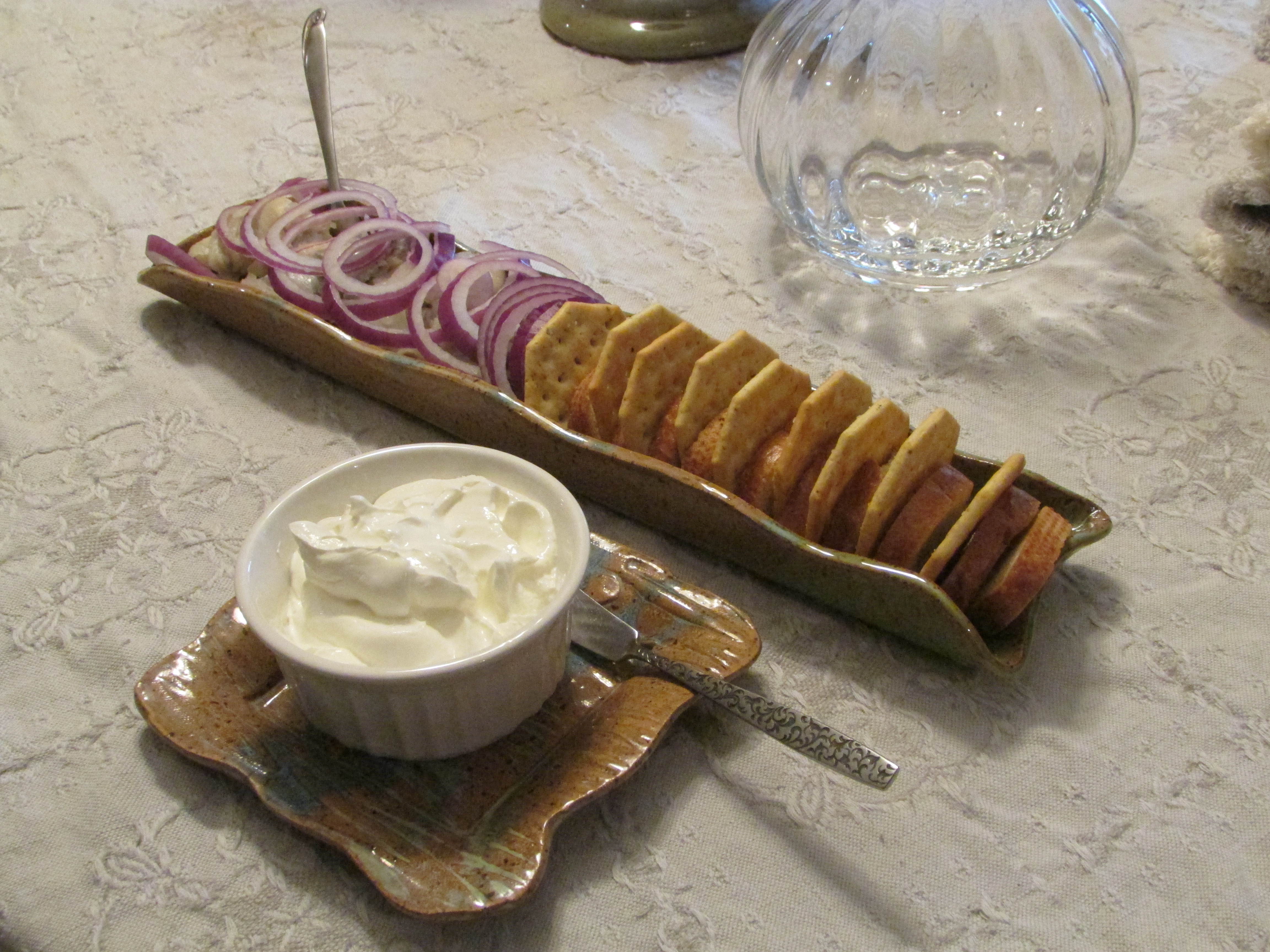
I decided to serve a herring appetizer. As guests arrived on New Year’s Day, in addition to various pralines, hard candies, and pecans, there was a serving dish with herring in white wine sauce with red onion slivers scattered around. Toasts and crackers were laid out on which to layer the herring. Sour cream was available at the side as a spread for the fish. It was a very tasty and popular appetizer. It may become a new tradition for the meal at my house.

After all the guests arrived and toasts were made, the lunch main menu was pretty standard for Southern homes on New Year’s Day:

Pork Roast with dry rub of coffee, brown sugar, seasoned salt, and orange zest
Seasoned Black-Eyed Peas
Seasoned Mixed Greens
Ambrosia
Cornbread

The seasoning for the greens and peas included hog jowl. The ambrosia is adapted from a simple ambrosia from chef Scott Peacock. His elegant classic includes only orange, coconut, sugar, and sherry. Mine uses satsumas from south Alabama for the citrus and adds pecan pieces and cherry slices.

The pork roast dry rub is worth sharing. I had jotted down a recipe from somewhere for a meat dry rub using coffee, granulated sugar, and seasoned salt. I experimented with it until I came up with the one I used on New Year’s Day. All of my guests left the lunch with a jar of this rub and it’s one you can easily make.

Dry Rub for Meat
1 part ground coffee (I used Community Coffee)
1 part brown sugar
1 part seasoned salt
1/2 part orange zest

Put all ingredients into a jar. Seal the lid and shake to mix thoroughly. Rub the meat with a good olive oil and then generously rub the meat with the dry rub.

We were ten at table – seven adults and three young people aged 11 and younger. For dessert, each guest was served a single madeleine and reminded of how Proust’s madeleine was a trigger for memory in Remembrance of Things Past. Whatever…

The adults enjoyed the madeleines and the kids scarfed them down; I doubt that anyone was too concerned about Proust.

It was a lovely meal and a lovely afternoon. A soft rain began as the guests began to leave. As the last guest departed, we had a quick “post-mortem” of the event. “The afternoon was full of laughter,” she said. “That’s what I needed — an afternoon filled with laughter.”

May 2015 be filled with happy laughter.

A Poem for New Year’s Day


Sometime in the ’90s I decided that trying to have fun and frivolity in a crowd of intoxicated people on New Year’s Eve was a fool’s errand. Instead, I stay home on New Year’s Eve and invite friends over for a hearty lunch of Southern good luck staples on New Year’s Day. The menu changes, but it always involves pork, greens, black-eyed peas, cornbread, and an ambrosia.

On New Year’s Day of 2014, instead of a traditional toast, I decided to launch the meal with a favorite poem by American poet Richard Tillinghast, who is from Memphis but has lived in Ireland for many years. I think “Table” is a fitting way to launch a new year full of hope and possibilities. For New Year’s Day 2015, I want to share it with you. May your table be full and steady. Happy New Year.


Table
by Richard Tillinghast      from the Turkish of Edip Cansever

for Julia

A man filled with the gladness of living
Put his keys on the table.
Put flowers in a copper bowl there.
He put his eggs and milk on the table.
He put there the light that came in through the window,
Sound of a bicycle, sound of a spinning wheel.
The softness of bread and weather he put there.
On the table the man put
Things that happened in his mind.
What he wanted to do in life,
He put that there.
Those he loved, those he didn’t love,
The man put them on the table too.
Three times three make nine:
The man put nine on the table.
He was next to the window next to the sky;
He reached out and placed on the table endlessness.
So many days he had wanted to drink a beer!
He put on the table the pouring of that beer.
He placed there his sleep and his wakefulness:
His hunger and his fullness he placed there.

Now that’s what I call a table!
It didn’t complain at all about the load.
It wobbled once or twice, then stood firm.
The man kept piling things on.

“Table” by Richard Tillinghast, from Selected Poems by Richard Tillinghast; Dublin: The Dedalus Press. 2009. Reprinted with permission of the publisher (www.dedaluspress.com).


Hiking Red Mountain

     IMG_1085  Birmingham. Every Baby Boomer growing up in Birmingham was taught in elementary school that Birmingham is the only place in the world where iron ore, coal, and limestone – the three essential raw materials used to manufacture steel – can be found in such close proximity. Every local schoolboy of that generation knew that Birmingham was not in existence during the Civil War and that this unique confluence of natural resources had led to its founding as the first major industrial center of the post-war South in 1871.

The steel industry was still what drove Birmingham when I was a boy and both of my grandfathers worked in Birmingham factories – one at U.S. Steel and one at Butler Manufacturing.

I remember standing on the observation deck at Vulcan, Birmingham’s “Iron Man” statue overlooking the city, and watching with awe as the night sky turned bright orange as molten iron was poured at steel manufacturing locations in the western section, in north Birmingham, and at the Sloss Furnaces just east of downtown. For a young boy, the sight of such robust heavy industry was thrilling.

Vulcan now overlooks a city in which heavy industry is less prominent than healthcare and finance; Sloss Furnaces closed down in 1970 and was designated as a National Historical Landmark in 1981. The remains of the structures of U.S. Steel’s Ensley works loom over what is now a desolate landscape. I still look for ruins and remnants of the once vibrant industrial landscape as I drive around the area.

In 2007, as a result of the efforts of Freshwater Land Trust and dedicated citizens, ownership of 1200 acres of U.S. Steel-owned land on Birmingham’s Red Mountain was transferred and development began on Red Mountain Park (www.redmountainpark.org), an urban greenspace which now comprises over 1500 acres and twelve miles of trails. There are also an adventure area, zip lines, an 80-foot repelling tower, a dog park, and overlooks in the current development of the eastern Phase 1 of the park. At the overlooks, the hiker is afforded views of the city which have been unavailable for half a century. The Phase 2 western development, scheduled for completion in 2016, will include more trails and features. IMG_0520

Red Mountain Park has become my favorite place to hike. The layout of the trails enables one to do a quick and easy hike or a more rigorous and challenging one, such as the Ike Maston Trail, or to mix and match. The land, once active with railroad and mining activity from the 1860s to 1962, has reverted now to mostly wilderness.

IMG_1087

A large appeal for me, though, is in the ruins of the industrial sites like mine entrances and shaft mines that pepper the site. One is walking in the woods and then there are the tightly secured masonry entrances to Ishkooda #13 or #14 mines, or the Redding Shaft Mine farther west. Encountering these ruins, it isn’t difficult to imagine the bustle of activity which once occurred in what is now such a serene and natural environment. One walks just a few feet away from these sites and is again immersed in total wilderness. It is as if the ruins are ghosts that appeared and then are gone.  They are.IMG_0516

I try to hike Red Mountain Park whenever I am in Birmingham for more than a day or two. It is a potent symbol of urban progress and commitment to the environment built on the relics of the progress of an earlier era.  IMG_1098