“Oh, Masha, Masha, Masha …!”

IMG_0843    One of my favorite opening lines in all of dramatic literature comes from Masha in Chekhov’s The Seagull. At the beginning of that play, Medvedenko asks Masha why she always wears black. “I am in mourning for my life,” she says. I was thrilled recently when I stopped by a neighborhood shop on my way home from work. I was wearing a black shirt and black trousers and the shopowner, a friend, asked me why I was dressed all in black. It was the perfect opening for a literary quote and I grabbed it.

I am a man with strong opinions on many things and many of those opinions were formed relatively early in life. I was fortunate to have a high school English teacher who was not intimidated by the Russian master Anton Chekhov and I remember loving Chekhov’s The Three Sisters the first time I studied it in a high school lit class. It was then that I decided that Chekhov was my favorite playwright and he is still my favorite playwright to this day. I must admit that Sam Shepard is a close second. And I will direct a Chekhov or Shepard play at any opportunity.

Chekhov referred to his plays as “comedy.” That fact still baffles many people familiar with the work. It never baffled me. As a Southerner, I have always felt a kinship with the playwright’s sly and droll sense of humor.

Chekhov’s plays examine the idiosyncrasies and foibles of the human condition and he seems on occasion to wince patiently and lovingly. This is what we mortals are, Chekhov seems to assert, as ludicrous as we may be. Chekhov was trained as a physician and examines his characters fairly and humanely but with clinical detachment.

Chekhov’s down-to-earth sense of humor reminds me of my favorite quote from William James: “Common sense and a sense of humor are the same thing, moving at different speeds. A sense of humor is just common sense, dancing.”

I once congratulated a friend on her performance in Chekhov’s final play, The Cherry Orchard. “Oh please,” she snapped. “I hated that performance and I hate that play. He’s so damn depressing!” I realized that her cluelessness about the play and the character may have been what contributed to her excellent and amusing performance as a headstrong woman who couldn’t see the forest for the (cherry) trees.

I have had the opportunity to direct Chekhov plays a couple of times, to act in a couple, and to see many productions over the years. When I directed The Seagull, I played up the abundant humor of the piece. Audience members thanked me for it afterward. An actor friend who drove a hundred miles to see the production grabbed me at intermission and said, “Thank God. Finally a performance of The Seagull where an audience is actually laughing at the funny parts!” (one of my favorite reviews ever).

As the various characters struggle through their various issues – loveless marriages, aging and decay, lack of talent, greed and ruthless ambition, fickle lovers, loss – they often make bad choices and those bad choices are often accompanied by overwrought and over the top overreactions. We smile to ourselves and I think we recognize ourselves in much of what transpires on stage.

I have dealt with The Seagull in many stages in life. When I was a college student, I thought it was the perfect play for college students as it examined our need to define ourselves, set our goals, and perhaps overreach beyond our capabilities. Now that I’m older, the play speaks directly to me on a profoundly different level but with the same intensity. And much of the journey of the play is still very touching and funny.

Konstantin, one of the major characters, does commit suicide in the end. Oh well, there’s that…

Chekhov’s characters are often in turmoil and despair. He does not make fun of them, but he does handle them gingerly and allows an attentive audience to smile at their overwrought reactions to situations that might often be easily remedied with a little common sense and effort. Often it seems his characters are frozen in inaction and ennui simply because they can’t stop talking about their despair. One thinks Just go to Moscow and stop whining about it after listening to the title siblings of The Three Sisters long for Moscow for four acts. To me, that’s funny.

Anton Chekhov died in 1904 at the age of 44. He died of tuberculosis but almost until the end he was writing letters assuring his correspondents that he was well on the road to recovery. Chekhov was a doctor; he knew better. At the end, a doctor who was attending Chekhov ordered a bottle of fine champagne with three glasses. He poured full glasses of champagne for Chekhov, Olga – Chekhov’s wife, and himself. According to Olga, Chekhov finished his glass, smiled, and said, “It’s a long time since I drank champagne.” Then he rolled over in his bed and quietly died.

(The image is Mandy Erbes and Joseph C. Wilson as Masha and Dorn in The Seagull, directed by Edward Journey, at Longwood College in Farmville, Virginia, in September 1993.)


Christenberry: Bearing Witness

IMG_0838  I have had a couple of opportunities to hear artist William Christenberry speak and on each occasion he recounted how his mother worried that, based on his work, people would think that Alabama was just some “rusted out, worn down, bullet-ridden place.”

Christenberry’s work focuses on memories of a fading South and his photographs capture buildings and landscapes in decay. He often photographs the same places year after year and documents how places evolve or disappear or ultimately break down completely.

One such sequence, the “Palmist Building” series begun in 1961, is among Christenberry’s iconic images. The earliest photographs of the building show an abandoned and dilapidated wooden structure. A sign advertising a palmist has been placed upside down in a broken window as protection from the weather. Subsequent images over years show the progression of the building’s decay amidst growing vegetation. In the later images, the building is completely gone, and trees, vegetation, wire fencing, and a utility pole stand beside a lonely road. Similar photographic series include “Church, Sprott, Alabama,” “Green Warehouse,” and “Coleman Café.”

I have never shared Mrs. Christenberry’s concern about her son’s work, but she addresses a basic misunderstanding of the South by people who don’t really know the place. By capturing fade and decay, Christenberry is preserving images of a South that is disappearing … has largely disappeared. His predilection for finding and recording old buildings, abandoned places, overgrown landscapes – a predilection I share and which makes Christenberry’s work special to me – is driven by a need to bear witness rather than by nostalgia. Christenberry focuses on rural landscapes but the impulse seems to me to be the same as my attraction to rust and industrial decay found in urban environments. Some misinterpret these images as representations of what the South is today but Christenberry captures and honors them as a rapidly disappearing landscape.

William Christenberry was born in 1936 in Tuscaloosa and left Alabama in 1961 to live and work in New York, Memphis, and finally Washington, D.C. where he has lived and taught at the Corcoran since 1968. Still, his preferred landscape for his art focuses on the environs of Alabama’s “Black Belt,” an area of rich black soil that cuts through the center of the state, where both sets of his grandparents resided. Hale County, “ground zero” for Christenberry’s art, was also the location for James Agee and Walker Evans’s iconic Depression-era book, Let Us Now Praise Famous Men, a hypnotic and microscopic examination of the lives of three Alabama tenant farm families.

Occasionally, as I drive around the Black Belt in west Alabama, I will accidentally stumble across a place that Christenberry has photographed. I am startled at the discovery, stunned at the recognition, and often feel like I have witnessed some elusive ancient treasure.

Christenberry’s art encompasses painting and drawing, sculpture, and assemblage but he is primarily known for his photography. It was photographer Walker Evans himself who became a sort of mentor to Christenberry when they met in New York in the early 1960s after Christenberry finished his M.F.A. at Alabama. Evans steered Christenberry along the path of a concentration on photography after viewing snapshots Christenberry had made with a cheap Brownie camera as studies for expressionist paintings.

Often, in his sculptures, Christenberry takes the same buildings he has photographed and does three-dimensional reproductions of them, often resting on an authentic bed of Alabama red clay in a shallow box. Over time, these more realistic depictions have given way to solid white “dream buildings” and ghostly structures drawn from memory and iconographic imagery – ladders, gourds, signs, structures on stilts. Christenberry’s evocative art never tells the viewer what to think; he presents it and allows one to ponder and meditate on it, to explore the implications.

There are many books of Christenberry’s art available. These would be of interest to the uninitiated as well as those who already know the artist’s work. A couple of my favorites are Trudy Wilner Stack’s Christenberry Reconstruction: The Art of William Christenberry (1996) and William Christenberry (2006) with thoughtful essays by Walter Hopps, Andy Grundberg, and Howard N. Fox.

My articles about William Christenberry and Walker Evans with several multimedia links may be found at http://www.encyclopediaofalabama.org.

Sustainability and Soul

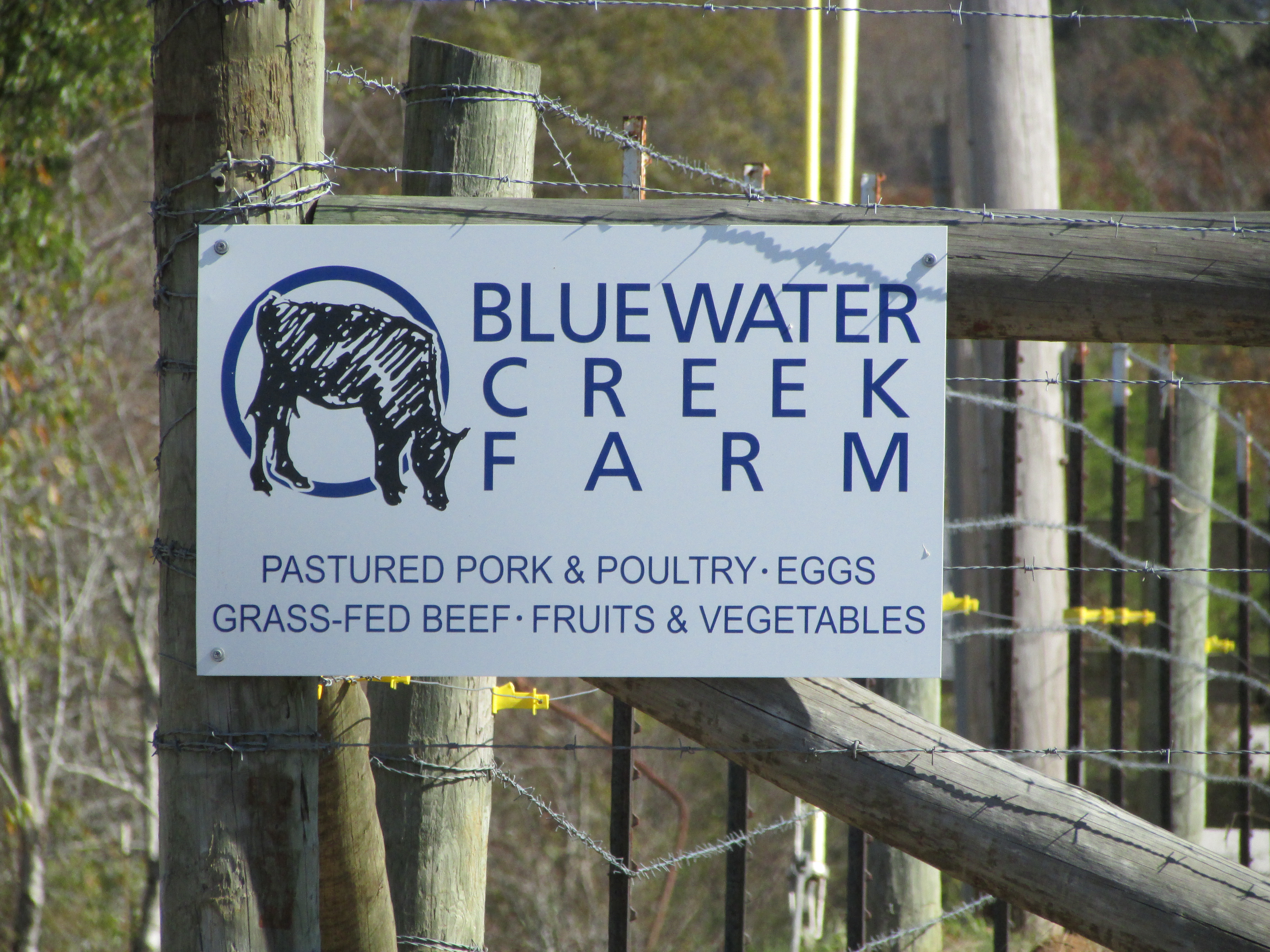
IMG_0837 Bluewater Creek Farm (www.bluewatercreekfarm.com) is a family-owned sustainable farm near Killen, Alabama, in the Shoals area of the far northwest corner of Alabama. It is run by Liz and Collins Davis in partnership with Liz’s parents, Donna and Doug Woodford. Today I drove over there for the first time to check out today’s farm stand and to join a tour of the farm led by Liz. The more time I spend in the Shoals lately the more I’m convinced that it may be the center of the universe.

I was unaware of Bluewater Creek Farm until August when I was in the Shoals — in Florence — for my second “Friends of the Café” event  at the Alabama Chanin Factory. We were lucky enough to sit across the table from Donna and Doug who enthusiastically told about their family and granddaughter Abby. They were thrilled that Liz, Collins, and Abby had recently returned from northern California to start Bluewater Creek Farm. Collins had run farms in California and other places and now they are back in Alabama.

Doug, who is a physician and advocate of holistic nutrition, spoke passionately about his and Liz’s work in nutritional therapy, and Doug and Donna enthusiastically shared news of the activities on the farm as well as pictures of Abby. Doug also had impressive pictures of chickens and bulls from the farm.

What impressed me most was the passion and commitment with which this couple discussed the work they and their family are doing.

I was happy to see Donna and Doug at the next “Friends of the Café” event in October, and this time Liz and Collins were there too. I contacted Liz to get on the farm’s mailing list and that led to the trip today. Bluewater Creek Farm’s stated mission is “to produce nutrient dense, clean food in a sustainable way… this means using farming practices that work with nature. This in turn shows respect for the living beings in our care, and makes a positive impact on our local environment.”

IMG_0808

This family makes a convincing case for their philosophy and seeing the labor-intense way in which they practice what they preach drives home the benefits and sanity of their cause. I, like most Americans, have only fairly recently become educated to the benefits of the “slow food,” “No Farms, No Food,” and “Eat Fresh, Eat Local” movements. It is this rising consciousness and education of the general public which has led to the emergence of great local farmers’ markets in virtually every community, to locally owned restaurants serving locally grown foods, to an understanding of why these issues increasingly matter, and to more sustainable farms like Bluewater Creek.

Previous generations knew this first-hand. Most Americans of the 21st century are learning it anew. Availability nurtures advocacy.

Liz’s tour included the planting beds, still full of lush greens and root vegetables on the first day of November (after the first truly cold night of the season); a visit with the farm’s heritage pigs, including a bunch of tiny piglets; cattle in the pasture, including the grass-fed, heat tolerant South Poll breed; and a bunch of happy grass-fed chickens, joined by a lone turkey (it’s close to Thanksgiving; I didn’t have the heart to ask).

IMG_0803

When the tour was over, I continued down the path to Bluewater Creek. I never lived on a farm and have spent minimal amounts of my life in the country and around farms. Yet I find, especially lately, that being alone out in nature gives me a peace and sense of ease that I don’t get in any other environment. It has become my best and most reliable form of release.

IMG_0832

On the walk back from the creek to the Barn, I met Liz on the road. We had a nice chat about future plans for the farm. “I’m not trying to preach organic farming,” she said. “I just want to show people what we’re doing and they can decide for themselves.”

Before leaving Bluewater Creek Farm I stopped by the Barn, a converted horse barn now used for events and classes, to visit for a minute with Donna. This was the location of the farm stand with the farm’s various products being sold. I bought some meat, peppers, beets, and beet greens to supplement what I had already gotten at my local farmers’ market a couple of days ago. I also got some honey that had been jarred today. I was too late for eggs. They had just sold out.

That’s okay. I’ll be back. IMG_0836


Red State Blues

I am a liberal in a conservative state that I love. I accept that; in fact, I embrace it since I know that change comes from within. The whole “red state/blue state” labeling has irritated me since Tim Russert made it a household phrase in the 2000 election cycle. I think that labeling system oversimplifies and stereotypes the complex and diverse populations of each state. Those smug and cutesy “I am a blue dot in a red state” car decals nauseate me.

But I am constantly being reminded that I am in a supposedly solid red state. In next week’s midterm elections, the Alabama Democrats did not even bother to field a candidate for some key races. I will not cast a vote in those particular races. The Alabama Democrats are presenting a “Democratic” candidate who was recently a Republican (and before that he was a Democrat) for governor. I will not cast a vote in that race either. I don’t vote for Republicans – never have and likely never will, but I can’t in good conscience vote for certain “Democrats” that I can’t trust. The current Alabama Democratic gubernatorial candidate calls to mind “Shorty” Price, a man who was a perennial (and perennially defeated) Alabama candidate back in the 1950s through 1970s. If there’s an election, this guy will be in it.

I still hear people who pompously declare that they “vote for the candidate, not the party.” That sounds like a noble position and I used to pay lip service to that notion. But now I think the candidate has made a conscious decision which party to affiliate with and if the affiliation is with a party that consistently stands for things that I disagree with or abhor then I have to question the integrity and wisdom of the choice.

Some candidates switch parties for political expediency; that’s certainly not somebody I want to support. If politicians switch parties because that is the only way they think they can get elected in their state or district, then I have to question their convictions and fitness for elective office to begin with. Politics is a game to career politicians, but I can’t forget that their actions or lack thereof affect real people.

Political advertising in Alabama is as troublesome as it is throughout the nation as the candidates strive to divide us rather than unite us and keep fighting moot battles for political gain. In Alabama, local ads and politicians seem to be competing to see who can use the word “conservative” most often. I personally have strong “family values” but I’m not sure that the “family values” extolled by the local candidates are in keeping with my personal definition of the term.

My conservative mother surprised me in the spring during primary season when she said, “It must be frustrating to be a liberal in Alabama. It must feel like nobody wants your vote.” That’s true. I’ve developed a thick skin. I’ve gotten used to local Democrats who feel they have to brandish a firearm to get elected.

When it was announced earlier this year that Birmingham is a finalist for the 2016 Democratic National Convention, I was impressed with what a smart choice that could be for the party. It would show a confidence and aggressiveness that the Democratic Party seems to be lacking of late – sort of like when the Southern Baptists decided to have their national conference in Salt Lake City a few years back. True enough, Alabama generally goes Republican in presidential elections, but Birmingham is a Democratic city and the statement the DNC would be making in choosing Birmingham would be one of the more progressive and intelligent moves that party has made in a while. I don’t expect it to happen because, truth be told, I’m not too thrilled with the Democrats these days either.

In the meantime, I will continue to be amused and confounded by political advertising and politicians and I will continue to vote my conscience and values. To steal (liberally and loosely) from Faulkner, I shall continue to endure until the day I once again prevail.

The Chukker Nation

59343_10151206185029021_891945282_n  A girl I sort of dated in college told me that she thought I looked like “the love child of Mick Jagger and Jackson Browne.” This was the ‘70s. She was delusional; I was young and flattered.

I had forgotten the comment (really, I had!) until somebody forwarded this photo to me from Facebook. It was taken (as far as I can figure since I remember the shirt) by photographer John Earl sometime in the very early ‘80s. I am the skinny guy in the down right corner with a lot of attitude. The photo made me gasp since I had forgotten myself as that skinny, that young, and with that hairstyle. But then the Mick and Jackson love child statement came to mind. Or is that guy in that picture maybe “Zoolander-esque”? Or Zoolander-esque-ish?

The picture was taken in the Chukker, a Tuscaloosa fixture for 47 years from 1956 to Halloween 2003. It was a bar. It was a dive. And it was one of the great and legendary watering holes in the world (friends have reported seeing Chukker tee-shirts in Paris). I was born in 1955 so I was a minute older than the Chukker. But here’s the deal: My parents opened a typewriter business on 22nd Avenue in downtown Tuscaloosa in 1957 and their shop was around the corner from the Chukker, new at the time but already a dive. Back then, the Chukker was a lunch spot – a grill if you will – in the daytime and reverted to its bar status at night.

I know my parents would probably rather not admit to this, but I remember going to the Chukker as a young child to pick up coffee in the morning and sandwiches at noontime for Mother and Dad. So my personal memories of the Chukker go back to about 1958. It was a different time and toddlers could freely roam Tuscaloosa city streets. I was – I’ll admit it – too much of a spoiled brat to go to day care back then and my accommodating parents made a sort of nursery/playroom for me in the back of their business.

I had the run of the streets in many ways since the shopowners in the area knew me and would look out for me. My parents still have a small bookcase that I decided I needed back then. I spotted it and my 4-year-old self told Mr. McGraw at the furniture store to put it on my parents’ account. He did. I am pretty sure that my mother’s cedar chest still has a drawing of little me that was drawn by an itinerant artist who set up shop for a while in the Chukker in the ‘50s. And I vividly remember ringing the bell at the Salvation Army booth during the Tuscaloosa JayCee’s Christmas parade with my stuffed Coca-Cola Santa under my arm, making a haul for charity. As a toddler in Tuscaloosa I was a “street kid” in the purest (and most innocent) sense of the term

When the family moved back to Tuscaloosa in 1972, the Chukker was still there. And it was still there when I was an undergraduate in college. It was only after I finished college (the first time) and I was still living in Tuscaloosa that I went with friends back to the Chukker. Back then, it was much like I remembered it, but it was a full-fledged bar and its reputation seemed to change biannually. It was reputed to be, at various times, an “artists’ bar,” a “biker bar,” a “blues bar,” a “bohemian bar,” a “gay bar,” a “lesbian bar,” an “old hippy bar,” a “punk rock bar,” a “redneck bar,” a “writers’ bar” … I could go on.

What it was, though, was an inclusive community that happened to be a bar. One always felt looked after at the Chukker. One always found someone one wanted to talk to and get to know.

My friend Bill and I were at the Chukker when I heard that John Lennon had been killed. That was no small feat since the bar had no phone at that time. I directed my first, and unexpectedly successful, production of Gertrude Stein plays at the Chukker. Bruce Hopper, the owner at that time, asked me if I wanted to do a show in the bar’s performance space. I told him that I did but I couldn’t guarantee an audience for the avant garde plays of Gertrude Stein. He said “do it” and we sold out nightly.

A film student shot a short film of my friend Deb and me walking in a circle in the Chukker courtyard on the day that Andy Warhol died. We walked round and round and talked about Andy and Andy’s death. I never saw the finished product but someone told me, many years later, that they saw it at a screening somewhere. “You’re the guy walking in circles in that Warhol film.” Yes, I guess I am.

My friend Clay would spend hours, it seemed, glued to the Chukker’s Galaga machine. My Galaga attempts were generally over in under a minute. Clay and I played a lot of pool at the Chukker also. My pool skills were unpredictable at best; I chose to refer to them as “Zen-like.” Clay was one of the few people who had the patience to play pool with me; I even won a game on occasion.

An ersatz and quirky art collection was housed at the Chukker – mostly the work of artists who hung out at the place during their Tuscaloosa sojourn. Some was hanging on the walls and some was painted directly on the walls. “The Sistine Chukker,” Tom Bradford’s Michelangelo homage on the bar’s ceiling, was the most legendary piece of the Chukker collection. For many years, I would welcome newcomers to Tuscaloosa with a postcard of the Sistine Chukker.

The great Tuscaloosa-based Celtic group Henri’s Notions was practically the house band at the Chukker for a while. Forecast, The Indigo Girls, The Replacements, Johnny Shines, Richard Thompson, and Sun Ra all played the Chukker, as did any number of local bands trying to be R.E.M. during that band’s heyday. In fact, I took a long time to warm up to R.E.M. because of the English department “R.E.M. wannabe” bands that sprang up in Tuscaloosa at the time. The real R.E.M. itself adjourned to the Chukker after a concert on the University campus, bringing a substantial number of the concert-goers with them, when Michael Stipe announced to the audience that that’s where they were going after the show. I invited Billy Joel to the Chukker after one of his Tuscaloosa concerts; he declined. Jimi Hendrix may or may not have played there and Keith Richards may or may not have played pool there. Abbie Hoffman DID have a beer there because I was there when he did it. There was always a “Chukker Nation Reunion” on the Saturday between Christmas and New Years’s Day.

“Quarter beer night” on Mondays was a longstanding tradition. One could go on the roof of the building next to the place (the building, in fact, where the furniture store where I bought those bookshelves used to be) and watch the cars converge from every direction at 9:00 p.m. on Monday (remember that convergence scene in Field of Dreams?) and watch most of the same cars leave again at 10 when the hour of 25 cent beer was over.

I had not been at the Chukker for many years when I heard it was closing its doors on Halloween 2003. In fact, the closing was reported on CNN. It was ultimately the victim of a Tuscaloosa downtown renewal. There’s a park where the Chukker and my parents’ typewriter shop used to be, and a fountain nearby. It’s a nice enough place, but a little bittersweet if you remember what used to be.

I went down on Halloween 2003 to be a witness. So did many other people. I didn’t stay long that night, and I was disappointed that I arrived just as Henri’s Notions finished their final Chukker set, but the place was packed; it seemed that every time the door opened that night, it contained a face that I had not seen in ages. Truly, people flew from across the country to be present at the Chukker’s closing night. I visited with the guys from Henri’s Notions, Sandra and Michael, Fred and Jennifer, and other people I knew. I didn’t stay long; I didn’t even have a beer. But I was there.

And then I was not there anymore. It was all I could do not to turn around for one last look as I walked out of the Chukker door for the final time. But I didn’t. I just kept walking.

Community and Kentuck

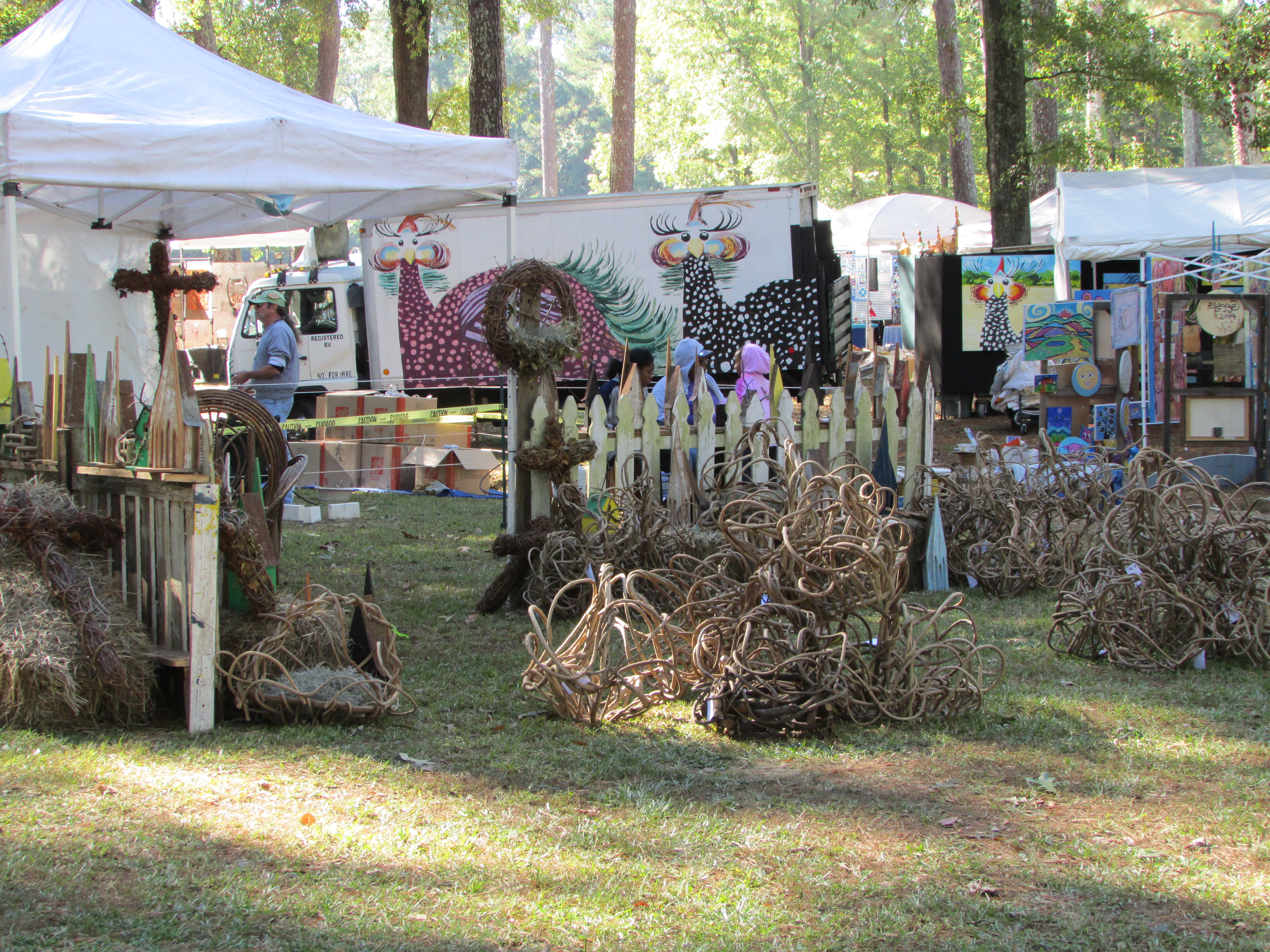
IMG_0775   I never know what will catch my eye at the Kentuck Festival of the Arts in Northport, Alabama, right across the Black Warrior River from Tuscaloosa. It is always held on the third weekend in October (www.kentuck.org).

This weekend, October 18-19, was the 41st running of the Kentuck Festival. I began attending when the Festival was in its toddler stage, around #2 or #3. I’m not sure which one because, like turnip greens, Kentuck now seems ubiquitous in my life. Journalist and Columbia University professor Claudia Dreifus writes that Alabama is a “hotspot” for visual and musical art and that “Kentuck is an incubator, a nursery, a home.”

The festival started on a small local scale in 1971 and has grown in size and reputation ever since, frequently and nationally being touted as among the finest of its kind. Folk, self-taught, and visionary artists have always been the backbone of the Kentuck Festival but it includes a diverse and impressive array of visual artists from the South, throughout the United States, and beyond. The festival takes place in a wooded area of a park not far from Northport’s downtown but the Kentuck organization operates year-round with resident artists, studios, galleries, and workshops spread along Main Street and throughout the city.

Everything builds to the festival. Artists, dealers, patrons, and sightseers converge from all over the country to purchase, mingle, look at art, and meet the artists. Demonstrations, musical performances, storytellers, and food areas round out the sensory overload of the event. I counted more than 250 artist exhibitors in booths spread among towering trees. An added bonus was when I stumbled upon an art installation in an environment adjacent to the Festival grounds. Meredith Randall Knight’s M.F.A. exhibition, “The Marrow of It,” features nebulous concrete abstractions nestled within and interacting with a natural environment just steps from the festival.

IMG_0786

The sense of community is palpable and is one of the factors that always brings me back. Kentuck gives me an opportunity to visit with friends – many of whom I only see annually at Kentuck and some of whom I have known since I was an undergraduate at Alabama in the ‘70s. I can check out new directions in their art, find out how the art circuit has been this year, and catch up on the family.

Among those friends I count on seeing are Lou and Daniel Livingston. It’s always good to see Daniel’s bold works in clay, bright and shiny and delicate. Tim Weber, whose work I’ve followed and collected since he was in residence at Kentuck, is constantly creating new forms in his clay work as well as revisiting and fine tuning forms that he has been doing throughout his career. Close by Daniel Livingston’s area are Andrew and Etta McCall and their lovely little church structures and bird houses and free-form baskets.

T.R. Reid keeps creating whimsical and original whirligigs while his partner, Jeanie Holland, displays her colorful mixed media wares one booth over.

Folk pottery legend Jerry Brown has his face jugs on display among the exhibitors and the Miller family from Miller’s Pottery in Brent, Alabama, throws pieces as patrons look on. The Millers have roots going back to the early days of Alabama potteries.

Amos Paul Kennedy, whose letterpress shop used to be based in Alabama locations, has now relocated to Detroit, Michigan, but still sets up a press at Kentuck to produce his array of colorful and clever posters

I have pieces by all of the aforementioned artists in my home and living with their art is made even more special by knowing and interacting with the artists. Most of my pieces were purchased directly from the maker.

Charlie Lucas, the “Tin Man” and a legend in his own right, seems always to be hard at work on new sculptures in the rusting metal enclosure that houses his work at the festival. Steve Shepard’s outspoken and brightly colored paintings, often sprinkled with his unharnessed opinions on politics and other issues, are as entertaining as the animated conversations with the artist himself.

A new Kentuck discovery this year was Clay Bush, who makes amazing bags, wallets, backpacks, satchels, and other designs from repurposed automobile seatbelts. The structure of his designs is flawless and the execution is masterful

My main purchase this year was a copper and steel balanced wind vane by Allan Kress of the Alabama Forge Council. The finely wrought copper feather moves wistfully, dancing delicately with the breeze. I never know what will catch my eye at Kentuck and I never know, until I’m there, what I’ll be bringing home. For one weekend in October, a community of artists in Northport, Alabama, supplies positive and creative energy that will sustain and inspire me in the days to come.

IMG_0800

Food Memory: Turnip Green Soup

IMG_0769  When I was growing up I didn’t think much about turnip greens because they were ubiquitous. They’d be served at home regularly, most restaurants had them on the menu, and any “meat and three” joint or cafeteria would serve them. As long as there was a bottle of pepper sauce – hot peppers in vinegar – on the table to sprinkle over them I was good.

Turnip greens were one of the many Southern staples that I didn’t much think about or miss until I began to travel and lived in places where they were hard to get or completely unavailable. That’s when I began to pay more attention to them. I began to grab them fresh when I could find them. I questioned older Southern cooks about how to prepare them.

I also began to experiment with collard greens which were generally less served in my own native environs. I enjoy cooking collard and turnip greens together; turnip greens have a bit more of a bite and the collard greens pull that down a notch. I even began to play around with the actual turnips, which were rarely served on Southern menus. I occasionally make a creamed turnip puree which is good to spread on bread or use as a dipping sauce with a plate of crudités.

Several years ago my mother, knowing my appreciation of greens prepared well, mailed to me a recipe for “turnip green soup” that she had cut out of the newspaper. I have a rule that I never tamper with a recipe until I have prepared it as written at least once. After that, I can start playing around.

I thought the “turnip green soup” would be a recipe that I messed with because it used frozen turnip greens and some canned ingredients. I would make it their way and then see how I might improve it with fresh ingredients. But here’s what happened: It was so delicious as written that I wasn’t sure I wanted to mess around with it.

I did tamper with it a bit though, and have made substitutions when I was missing an ingredient in the pantry. When fall weather and football season roll around, it’s a great quick meal to prepare. I cook a large batch of it in a cast iron dutch oven, transfer it to containers in the refrigerator, and eat on it for a few days. You must have cornbread with it and I sometimes just make a cake of cornbread but I prefer to make corn sticks as the accompaniment so that I can just dip the corn stick in the soup.

I often serve turnip green soup as a starter course to my New Year’s Day luncheon. A few years ago, when my sister-in-law ran her first half marathon in Huntsville, I prepared a pot of it for lunch after the run and found that it was the perfect post-run comfort food. Friends from Ohio have transferred it up North and I hear it “has legs” along Lake Erie.

I am teaching a Saturday morning class this fall and there are hours of college football to watch when I get home from class. When I left class around 11:00 this Saturday morning, I ran by the store to pick up some ingredients, came home, made a batch of turnip green soup and corn sticks, and had a hearty meal before my main game aired at 2:30.

Here’s the recipe for turnip green soup as I usually make it. It is a forgiving recipe, open to substitutions or deletions depending on taste. It can easily be a vegetarian dish if one is so inclined.

TURNIP GREEN SOUP

2 packages (about 24 ounces) frozen turnip greens with diced turnips

1 package Knorr vegetable mix (from the soup section)

1 can (about 15 ounces) northern beans

1 can (about 15 ounces) navy beans

1 small onion, chopped

5 cups chicken broth

1 pound smoked sausage, sliced thin (I use Conecuh smoked sausage from south Alabama)

1 teaspoon hot sauce (I use more)

1 teaspoon garlic powder

Salt and pepper to taste

Tony Chachere’s Original Creole Seasoning to taste

Combine all ingredients in a soup pot. Bring to a boil. Reduce heat to a simmer. Cook until sausage is done. Serve with corn bread, corn muffins, or corn sticks.

Food Memory: Cheese Straws

IMG_0760 In every community in the South – church, club, work, neighborhood – there seems to be the one lady who is famous for her cheese straws. Neither of my grandmothers made cheese straws, nor does my mother. But I have always known about them and associated them with significant occasions – parties, weddings, wakes – and in every Southern community it seemed that there was always a lady – always a woman – who was celebrated for her cheese straws.

When I worked at Alabama Shakespeare Festival, that lady was Mrs. Betty Campbell, a theatre supporter and erstwhile ASF board member.

A member of that theatre company knew that he had truly arrived and been accepted into the fold when Mrs. Betty Campbell graced him with a tightly wrapped little package of cheese straws tucked into his box at the theatre. After I had been at the theatre for about a year, I was delighted to find a package of Mrs. Betty Campbell’s cheese straws placed neatly in the center of my desk when I returned from lunch one afternoon. The golden baked morsels lived up to their reputation and were worth the wait. And they were consumed quickly.

But that was the only time Mrs. Betty Campbell ever honored me with cheese straws. I waited patiently, but a second offering never materialized. This nagged me for a while and then, one Sunday morning in the New York Times magazine, I ran across an article, “Eat the Rich Stuff,” by Julia Reed, a Mississippi native. In the piece she remembers tastes of her own childhood and how they inform her adult Christmases. The article is wonderful but the real revelation is the fact that at the end of the article Reed shares her favorite holiday recipes, including one for cheese straws.

I read the recipe carefully and realized I can do that. Why I thought have I spent my life at the mercy of old ladies with cookie presses to get my cheese straw fix when all I have to do is buy some basic ingredients and a cookie press (whatever that is) and I can have my own fresh homemade cheese straws whenever I get the urge?

I went shopping for a cookie press at a local kitchen supply place, but first I had to figure out what it was. I approached a customer who sort of looked like she might be a Junior Leaguer. She would know. “Excuse me,” I said, “where might I find a cookie press?”

She eyed me. “You’re going to make cheese straws, aren’t you?” she said.

“I plan to try.”

She took me straight to a shelf of cookie presses and pointed out her favorite, an Italian model. She wished me luck and went on her way. I left the store with a sparkling new cookie press and a resolve to become the first man, to my knowledge, to make cheese straws.

The first batch turned out well. I began to add my own touches to the recipe, share the results with family and friends, and get accustomed to the process. One of the first things I learned was that all of those old ladies were strong. It was a workout of the wrist and arms to squeeze those straws out of the tiny opening of the cookie press and onto a baking sheet.

The first true test of my cheese straw mastery came on a visit to Greensboro, Alabama, a small town in Hale County. I went down for a quick visit to see my friend Randall and decided to take a bag of freshly baked cheese straws to him and his mother. When I presented them, both were surprised that I had baked them. Some friends – Greensboro ladies that I had known over the years – had been invited over for afternoon tea.

When we were seated, Randall set out a plate of my cheese straws. I tensed a little, knowing that I was among a group of Southern cooks who knew their way around cheese straws.

“These are delicious. Where did you get them?”

“Eddie made them,” Randall said. I was among people who had known me so long that I was still “Eddie” to them.

There were looks of disbelief and then astonishment.

Finally, someone said, “Well, they’re delicious and it’s obvious you used real butter. That’s essential.”

I assured them that real butter had indeed been used and then found myself comparing cheese straw recipes with the ladies. I was happy I had passed the ultimate test of the cheese straws and was validated in the belief that I could serve and present cheese straws with confidence.

Later, I remember thinking Is this what my life has become? Sitting around comparing cheese straw recipes with a bunch of ladies older than my mother?

Oh well. I can think of worse fates.

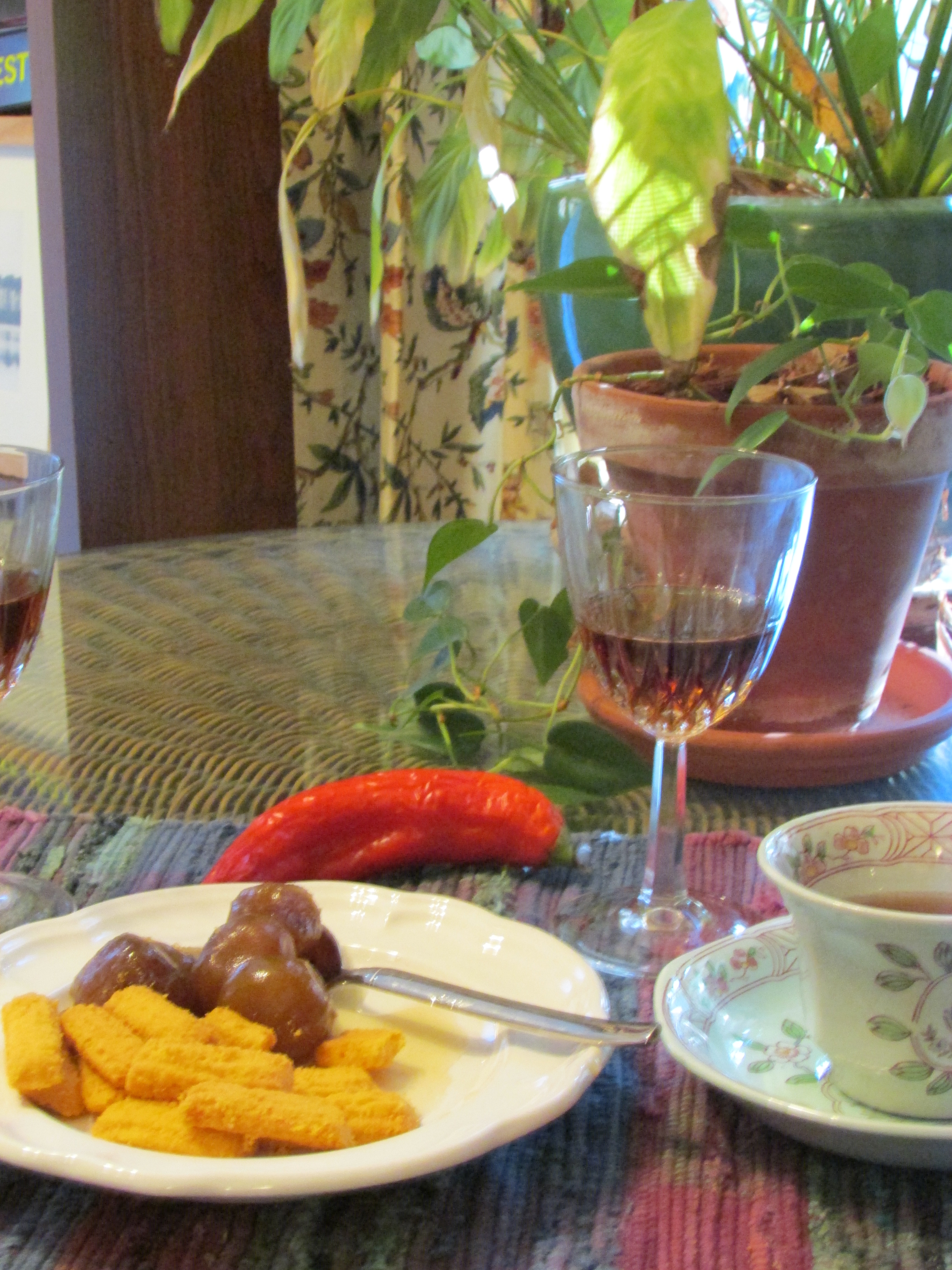
I continue to bake cheese straws for special people and special occasions and continue to enjoy the surprised gasps when I reveal that these straws were made by a man. I haven’t baked any in almost a year but when the temperatures begin to drop and the air gets crisp the urge to buy some fine cheddar and make up a batch begins to twitch. This time of year a few cheese straws with fresh figs (or fig preserves), a glass of sherry, or a cup of warm tea hit the spot.

Here’s my recipe. It is adapted from the recipe in Julia Reed’s 2001 New York Times piece which was in turn adapted from a cookbook called Southern Sideboards Cookbook by Winifred Cheney. Over time, I have made my own revisions, and that is what I’m sharing with you.

CHEESE STRAWS

1 stick (8 tablespoons) of softened unsalted butter

8 ounces finely grated extra-sharp cheddar cheese (I like to mix white and yellow cheddar)

½ teaspoon salt

1 teaspoon cayenne pepper (I like my straws hot)

1½ cups plus 1 tablespoon sifted flour

  1. Preheat oven to 350 degrees. Mix the butter with the cheese and seasonings in a large bowl. Add the flour and knead into a smooth dough.
  2. Pack the dough in batches in a cookie press and press through the round-ridged opening onto an ungreased cookie sheet to form “straws.” 2½-3 inches are good, but I just squeeze until it seems long enough or stops on its own.
  3. Bake until golden and crisp, usually about 12 minutes in my oven. Remove from the cookie sheet with a metal spatula, cool, and store in an airtight container.

The straws break easily but that doesn’t affect the taste, does it? Also, depending on temperature and humidity, I sometimes sprinkle a little water on the dough in the press so that it comes out more easily.

Oh yeah – if you make these and people love them, mention my name.

On Being the New Kid

100_3255  A writer friend once challenged me to write my autobiography in 700 words. I’ll always rise to a writing challenge. I began by listing the different cities and towns where I had lived in a lifetime. I have lived in a total of 14 separate cities and towns. That list took up the first 29 words. Then I recounted how many separate moves I had made from one city or town to another – there were 24 of those. For example, I moved back to Birmingham from other places at least five different times. This list does not include the times I moved from place to place within the same city. During my time in Tuscaloosa in the 70s and 80s –finishing high school, going to college, etc. – I moved at least eight times that I can recall.

I sent the 700 words to my friend. He sent a chastising email back, chiding me for a “cop-out.” He felt I had dealt with superficial things as a way of avoiding writing about myself.

I stood my ground. I feel that the moves are a large part of what defines me. I was born in a military hospital but my father was discharged from the Army when I was six weeks old so I am not a military brat. However, Dad’s work transferred us a lot and I ended up attending ten different schools from grades 1-12. That gave me a lot of experience in being the “new kid.”

In a recent post for “Professional Southerner,” I realized how many times I use the word “community.” In fact, I even used that word in the title of that essay. One of the impacts of being the new kid is that you are always looking for your community – the place where you fit in and belong. And when you move around as much as I did, once you think you may have found it, it is taken away and you have to start over again, build up your shell, and carry on. A miracle of the whole experience is that, despite the moves, I always managed to keep my grades up. That was tough.

I have a deformity of my left hand. It is relatively minor but it is there nevertheless. I am missing a little finger and my middle and ring fingers were fused together at birth. The fingers were surgically separated when I was very young but they are still noticeably misshapen to an observant eye. Some people never even notice and others spot it immediately. I am very good at not drawing unnecessary attention to the issue; I’ve had a lifetime of practice.

If you are no longer the new kid, classmates get used to the irregularity and don’t even think about it. If you are constantly the new kid, classmates are constantly discovering, staring, and whispering for the first time. Over time, I developed an aggressive way of dealing with the stares and comments. “I see you’re looking at my hand,” I would say boldly. “Let me show you what’s wrong with it.” Then I’d whip out the hand, explain the defect, and carry on. Some seemed uncomfortable or put off by my candor but most, I think, were grateful to have the mystery solved. I realize that my aggressive response was a defense that I built up to cover my discomfort at always being newly discovered.

I am shy. I am able to cover it pretty well and my current college students chortle in disbelief when I say it, but it’s true. Walking up to a group of total strangers and inserting myself into their consciousness is not something with which I am comfortable. Over the years, when I plead shyness, someone inevitably says, “Well, you’ve moved around so much. Surely you’ve conquered it by now.” I haven’t conquered it, but I have a lifetime of experience that helps me to build up defenses that hide it better, I guess.

As a boy, there was often an impulse to redefine myself when I moved. I would analyze what had worked and what had not worked so well at the old place and try to adjust accordingly for the new place. I’d change my “style,” my attitude, and sometimes my clothes and hair, and take it for a test drive. Probably the redefinition worked most quickly and successfully at my favorite of all of the schools I attended – Shades Valley High in metro Birmingham (in its original location between Homewood and Mountain Brook for those who remember). I immediately felt at home and like I fit. I first seriously pursued theatre at Valley, took my first real curtain call at Valley, and had a close and diverse circle of friends — none of whom, incidentally, I am still in contact with. That’s a collateral effect of constantly moving: One tends to lose touch.

I only attended Shades Valley for four months and we moved again. At the new schools in Jackson, Mississippi – I had to attend two schools because one did not offer all of the classes I was taking at Valley – I auditioned for shows but, as the “new kid,” nobody knew who I was and I was never cast. So I started to redefine again.

Jackson in 1971 was where I first encountered the unfortunate policy of busing to achieve racial integration in the schools. Regardless of your political point of view about what was right or wrong about busing as a solution to a real problem that needed to be fixed, it was incredibly uncomfortable for those of us who actually participated in it. My parents offered to send me to a private school in Jackson but I felt that if you weren’t part of the alleged solution, you were part of the problem and I felt some sort of 16-year-old’s drive to be a part of the solution, no matter how inconvenient and painful it was.

Lunch is always the very worst time of day for the new kid. All of the affiliations are established already and you have to step carefully to avoid stepping on toes or putting yourself in an even more awkward situation. I remember on a first day at lunch in Nashville in 1968 a girl plopped down and informed me that I was “new.” I told her she was right. She asked me where I was from and I told her Birmingham. “Oh,” she said, “a southerner … how do you like living up north now?” I patiently informed her that I wasn’t “up north” but in Nashville.

On the first day at lunch in Jackson in 1971, another girl plopped down across the table from me. Again, I was informed that I was “new.” I introduced myself. She did likewise and asked where I was from. “Birmingham,” I said. “Oh,” she sneered, “another Yankee.” I assured her that I was not a Yankee but from Birmingham, Alabama, and she asked me a few uncomfortable questions about my politics (I was 16, mind you), and then informed me that “nowadays” everybody who wasn’t from Mississippi was a “Yankee.” I did make friends at the schools in Jackson but that girl wasn’t one of them.

Eventually, Dad took a job in Tuscaloosa and we were there for the last part of my junior year and my entire senior year in high school. I found friends, fit in, became an editor of Tuscaloosa High School’s literary magazine, and went through all of the activities one associates with a high school senior’s year. Still, I went through senior year as one of the “new kids” and never quite felt like I was totally a part of the picture in the way that my classmates, most of whom had gone through school together, might be. The yearbook came out and my name was misspelled. It was just a typo and those things happen but it felt a little bit like a repercussion of being perpetually the “new kid.”

My brother is twelve years younger than me and the family had pretty much settled in Tuscaloosa by the time he entered school and I went to college. It’s interesting to observe how we had the same wonderful parents but such different childhoods. On a couple of occasions over the past few years, Mother has felt the need to apologize to me for all of the moves and upheaval of my growing up years.

I appreciate that she has said it, but I don’t feel anybody is owed an apology for this. Yes, it was difficult at times, but I’m sure it made me tougher, more flexible, more tolerant, and more of a survivor when the pressure starts to build.

We all do what we must do. I don’t know for sure how much my growing up years contributed to my decision to pursue a career in theatre. I have noticed, though, that many actors have a transient or “military brat” childhood. Whatever the reasons, I worked in professional theatre after graduate school and, in doing so, I extended the vagabond lifestyle for another couple of decades.

Now I have lived in the same place with the same job for twelve years. But I still get mighty restless.

(The image is an untitled portrait by Patrick Grogan, 1999),

Community and Fatback

IMG_0753 Last night was another memorable evening at the Alabama Chanin Factory (www.alabama.chanin.com) in Florence, Alabama. Natalie Chanin and her tireless staff hosted another “Friends of the Café” dinner event featuring executive chef Drew Robinson and Nicholas Pihakis of Birmingham-based Jim ’N Nick’s Bar-B-Q (www.jimnnicks.com). The October 10 event was the fourth and final “Friends of the Café” dinner for 2014. I am already looking forward to the 2015 schedule.

My friend Cindy Edwards and I were lucky enough to attend three of the four 2014 dinners. The previous two were fundraisers for Southern Foodways Alliance (www.southernfoodways.org), of which I am a “dues paying” member. Last night’s event benefits “The Fatback Collective Fund.” The Fatback Collective is an impressive array of “chefs, writers, and pig cookers” who are supporting a philosophy of sustainable and humanely raised pork, local ingredients, support of community, and sharing of knowledge. They fundraise for many compatible causes and provide assistance in their communities when tragedy strikes. For example, Fatback Collective recently sponsored a series of successful fundraisers for a South Carolina pitmaster who lost his pit to fire in 2013.

Last night’s meal was a juxtaposition of all of the elements that contribute to the Fatback philosophy. During the cocktail hour, featuring a “Donkey’s Daddy” cocktail, mushroom tamales were served to each table. That was followed by a four course meal featuring local ingredients including produce from the Jones Valley Teaching Farm (www.jonesvalleyteachingfarm.org) in downtown Birmingham, Gulf shrimp, Fatback Pig Project porchetta, and guinea hens from White Oak Pastures in Georgia (www.whiteoakpastures.com). Each course featured beer pairings from Birmingham’s Good People Brewing Company (www.goodpeoplebrewing.com).

Chanin is accomplishing her goal of supporting and sustaining her community in many ways and these dinners are just a part of that big and impressive picture. As a result of these events, a community of like-minded individuals is finding each other – sharing thoughts and energy.

Last night it was a pleasure to once again visit with Donna and Doug Woodford of Bluewater Creek Farm  (www.bluewatercreekfarm.com). Bluewater Creek Farm is a family-owned sustainable farm in the Shoals area of northwest Alabama. Doug was proudly showing off pictures of a very handsome rooster and of a recent acquisition, a South Poll Grass Cattle bull. I learned that South Poll is an Alabama-based cattle breed that is bred to thrive on a grass-based diet and to tolerate the heat of the Southern summer (www.southpoll.com). I was also pleased to learn that Bluewater Creek’s most recent batch of chickens recently started laying.

Nancy Campbell and Charles Day, friends from Tuscaloosa, were also back at the dinner last night. We met at the July dinner and have remained in contact ever since. They shared news of a recent visit to a saltwater shrimp farm in Greene County, Alabama – 150 miles inland from the Gulf of Mexico. This was exciting news to me. Charles has also begun to cultivate domestic culinary mushrooms. The spores are shipped to him and it was fascinating and tempting to learn about the process. It also gave me a nifty idea for my food-minded nephew’s 11th birthday present.

A number of websites are referenced in this post. I hope that readers will be inspired to check out one or more of them and participate as their interests and means dictate. They are all causes that mean something to me and deserve our support and commitment.

An amazing and innovative meal. Camaraderie with a community of people with shared interests and values. New knowledge and understanding. The “Friends of the Café” dinners in Florence have quickly become an essential ingredient in the process of strengthening a commitment to culture, community, and the values that will help change our world and move us steadily forward.