A Brief Memory of Marian Seldes

The great stage actor Marian Seldes died this week at the age of 86.

Seldes may not be a household name outside of the world of theatre, but she was very well-known as a stage actress with many successes on Broadway and beyond.

I never saw Ms. Seldes’s legendary New York stage appearances but I mentioned her over the years in acting classes as an actor who seemed most ideally suited to live stage performance. Her mere presence was a powerful dramatic statement. Seldes was tall and stately with a handsome angular face that was easy to read from a distance; these are perfect tools for a stage actor but sometimes too large for the screen (although she did appear on television and in a number of films).

Some of my students remembered that Seldes made a brief appearance as Big’s mother in an episode of “Sex and the City.” But it is her appearances in numerous stage plays by Edward Albee, Samuel Beckett, and Tennessee Williams, as well as productions of Equus, Deathtrap, Painting Churches, Richard III, etc., that cement her place in American theatre history in a career that spanned seven decades..

Although I missed her many New York performances, I was fortunate enough to see Marian Seldes in a live performance I will never forget. In November 2008, when I was presenting a paper at a Thornton Wilder conference at The College of New Jersey, a Friday afternoon session was an intimate readers’ theatre presentation of work by and about Wilder. Narrated by Tappan Wilder, Thornton Wilder’s nephew, the other performers were Marian Seldes, playwright Edward Albee, and poet Sandy McClatchy.

When I took my seat in the campus concert hall, Ms. Seldes was sitting quietly behind a grand piano at the back of the stage, carefully studying her script. Her concentration and presence were mesmerizing. When the performance began, it was electric to watch the interaction of Seldes and Albee, two legends who had carved parts of their legends in collaborations with each other. Each would have been 80 at the time.

It was a one-time performance and the small but rapt audience knew we were watching something special.

Playwright Sam Shepard once said that the thing he likes about theatre is that “it goes out into the air and disappears.” That November 2008 Wilder performance was a perfect illustration of that ephemeral quality of theatre.

And of a notable lifetime.

Coke and Peanuts

IMG_0749 Back when I subscribed to Oxford American magazine, I would regularly threaten (to myself) to cancel my subscription if I saw one more picture of a snake handler in their pages. Snake handlers and alligators were a little too common as OA’s attempt to capture “Southern-ness” occasionally tilted a little too far toward surreal Southern Gothic.

So it is with some trepidation that I feel a need to address the very Southern taste for salted peanuts in Coca-Cola as a snack. This is something I remember from early childhood. We would take a bottle of Coke and a sleeve of salted peanuts. Take a couple of good swigs of the Coke to make room for the peanuts and then slowly pour the peanuts into the narrow top of the Coke bottle. The combination of the sugary Coca-Cola with the salty peanuts is really good. Trust me on this, but don’t ask me to explain why.

I had relegated peanuts in Coca-Cola to a distant childhood memory until this summer when Coach Jimbo Fisher of Florida State dumped some peanuts in his Coca-Cola during ACC media days. The non-Southern press in attendance was flabbergasted and felt the need to address this odd behavior in multiple columns which then led to a deluge of online responses, contradictions, and opinions. We Southerners who grew up with peanuts in Coke as a normal treat were a little bemused by the brouhaha. While I suspect that this tradition is more familiar to Baby Boomers and their parents than to younger generations, I asked a recent class of college-age students how many of them had heard of or had peanuts in Coca-Cola and was surprised at how many hands went up. A few of them opted for RC Cola instead of Coke. I can accept that.

The resurgence of peanuts in Coca-Cola as a topic of conversation in the 21st century surprised me as much as the emergence of one of my guilty pleasure road treats – fried pork rinds – as a healthier junk food choice (no carbs, high protein, low-fat and a high percentage of the same healthy unsaturated fats as olive oil – go figure).

There is a long tradition of Coke in recipes. “Atlanta Brisket” – brisket glazed with cola – has been around for a while and “America’s Test Kitchen” did a version of it fairly recently. “Coca-Cola Cake” is a mainstay of Southern cookbooks and I have seen a Coca-Cola cake with a peanut glaze inspired by the classic peanuts in Coke tradition.

Bartenders are constantly upgrading the football Saturday stalwart bourbon and Coke into more sophisticated renderings such as the “Reengineered Bourbon and Coke Cocktail” recently featured in Garden and Gun magazine. Even more to the point, I recently heard that a place in Birmingham has a cocktail called the “Tallulah” which is made of Coca-Cola, peanut syrup, and Jack Daniel’s. An investigation is in order.

North Carolina chef Vivian Howard, in an episode of her PBS show “A Chef’s Life,” explored the North Carolina tradition of putting peanuts in Pepsi. I have a lot of respect for Chef Howard and she is a wonderful chef, but this will not do. Howard’s Pepsi and peanuts exploration did, however, lead to what looked like a great recipe of Pepsi-glazed pork belly with country ham braised peanuts. I bet it would be even better with a Coke glaze.

After teaching a Saturday class in Huntsville this past weekend, I hopped in the car to drive to Birmingham for a quick visit. Stopping for gas outside Decatur, I spotted an 8 oz. Coke in a glass bottle in the drinks case. I grabbed it and a sleeve of Golden Flake salted peanuts and headed to the car. I downed a few gulps of the Coke, emptied the peanuts into the bottle, and headed south on I-65 listening to the radio and the pre-game shows leading up to the Alabama-Ole Miss game. It has been at least forty years since I indulged in peanuts in Coca-Cola. I was transported back to football Saturdays growing up and “The Bear Bryant Show” on television each Sunday after game days. Coca-Cola and Golden Flake potato chips sponsored the show (“’Great pair’, says The Bear”).

It was an exhilarating drive.

Tracking Down Mrs. Roosevelt

IMG_0746 A couple of weeks ago I spent fourteen fascinating hours watching Ken Burns’s newest documentary, “The Roosevelts: An Intimate History.” I have had a fondness for Franklin and Eleanor Roosevelt since I heard my grandmother talk about them when I was growing up.

It is easy to forget after so many years how important FDR’s Great Depression recovery policies were to the country as a whole and particularly to the part of north Alabama and the Tennessee River Valley where I currently live. At the time the Tennessee Valley Authority was inaugurated as part of Roosevelt’s New Deal, the improvements in the infrastructure for north Alabama led to the development and progress of the decades to come. TVA’s Wilson Dam changed the Shoals area immeasurably. I am convinced that Huntsville’s considerable growth and the development of its substantial technology, space, and defense industries can be traced directly back to the technological advances spawned by the Roosevelt administration of the 1930s. I am also convinced that some of the local politicians who run campaigns railing against “big government” and “government interference” would not have been born if not for the government assistance and programs that came to the aid of so many millions during the Roosevelt New Deal era.

Tennessee Valley Authority (TVA). Works Progress Administration (WPA). Civilian Conservation Corps (CCC). Federal Housing Authority (FHA). Social Security Administration (SSA). The alphabet soup of programs initiated by the FDR administration is large and impressive. Some of them still exist today. Most towns, wherever you travel in the country, still utilize the legacy of the New Deal in extant public spaces, buildings, tourist sites, roads and highways, dams and factories. The WPA art works, photographs, performing arts, and literature were created by many people — some of whom would move on to become among the brightest lights of twentieth century American arts.

When Roosevelt took office in 1933, about 90% of urban Americans had electricity compared to roughly 10% of rural Americans. The Rural Electrification Administration (REA) was created to rectify that situation and by 1942 the number had risen to 50%. Ten years later, close to 100% of Americans in rural areas had electricity.

My grandmother often talked about listening to Roosevelt’s “Fireside Chats” by her radio (after the REA had supplied electricity to her family’s rural Cullman County residence). My mother still has recollections of my Grandmother Harbison pulling her chair right up to the radio to listen to the coverage of FDR’s funeral in 1945. She sat listening all day.

During a recent conversation about the Burns documentary, Mother mentioned how she had always enjoyed reading Eleanor Roosevelt’s daily syndicated newspaper column, “My Day,” which ran from the time Mrs. Roosevelt was First Lady in 1936 to her death in 1962. “I wish I had saved those in a scrapbook or something,” she said. “Wouldn’t it be nice to look back at them now?”

My quest had begun.

Fuelled by the documentary, I searched for a book compilation of the columns. What I found was My Day by Eleanor Roosevelt: The Best of Eleanor Roosevelt’s Acclaimed Newspaper Columns 1936-1962, edited by David Emblidge (New York: MJF Books, 2001). I ordered it and will soon give it to my mother, but I am reading it first and having a grand time of it. Mrs. Roosevelt’s written communication skills are as clear, blunt, and articulate as her husband’s much-lauded oral communication skills and she tackles a staggering array of issues with taste, tact, and progressive common sense. There are also warm personal insights about holiday outings with the family, gardening, fashion(!), and the amazing array of 20th century personalities she knew — from her uncle Theodore Roosevelt to John F. Kennedy, from Helen Keller to Autherine Lucy, Shirley Temple to Nikita Krushchev, Winston Churchill to Humphrey Bogart, … you get the idea.

I have a tattered and fraying tee-shirt with FDR’s image that I usually just wear for yard work. One afternoon I wore it to one of the local farmers’ markets and a vendor at one of the produce stands called me over. “My parents loved FDR,” she said. “My dad always said he saved us from sure ruin.”

“My Day” and Ken Burns’s striking new documentary provide human and first-hand insights into some of the most important events of the twentieth century. We all need to remember and learn.

My Granddaddy’s Yard

IMG_0729 I was a latecomer to home ownership. After grad school, I embarked on a career in professional theatre that took me all over the place and often involved series of short-term contracts. So I spent most of my adult life in apartments, condos, and hotel rooms.

When I finally settled for academia, tenure, and the illusion of security, I realized that it might be time to grow up and own a house. My real estate agent and I spent a few months looking and after many houses, none of which quite felt right, my patient realtor said, “I want to show you some townhouses.”

“I’m not looking for a townhouse,” I responded. “Too much like the apartments I’ve been living in since I was 19.”

She showed me townhouses anyway and I realized I was in my comfort zone and that a townhouse was probably the way to go: Not too big; not too small – and not much yard, but enough to pursue my attraction to gardening on a small manageable scale. I quickly brought in a landscaper to get my tiny front yard in shape.

Then I began to eye my back yard.

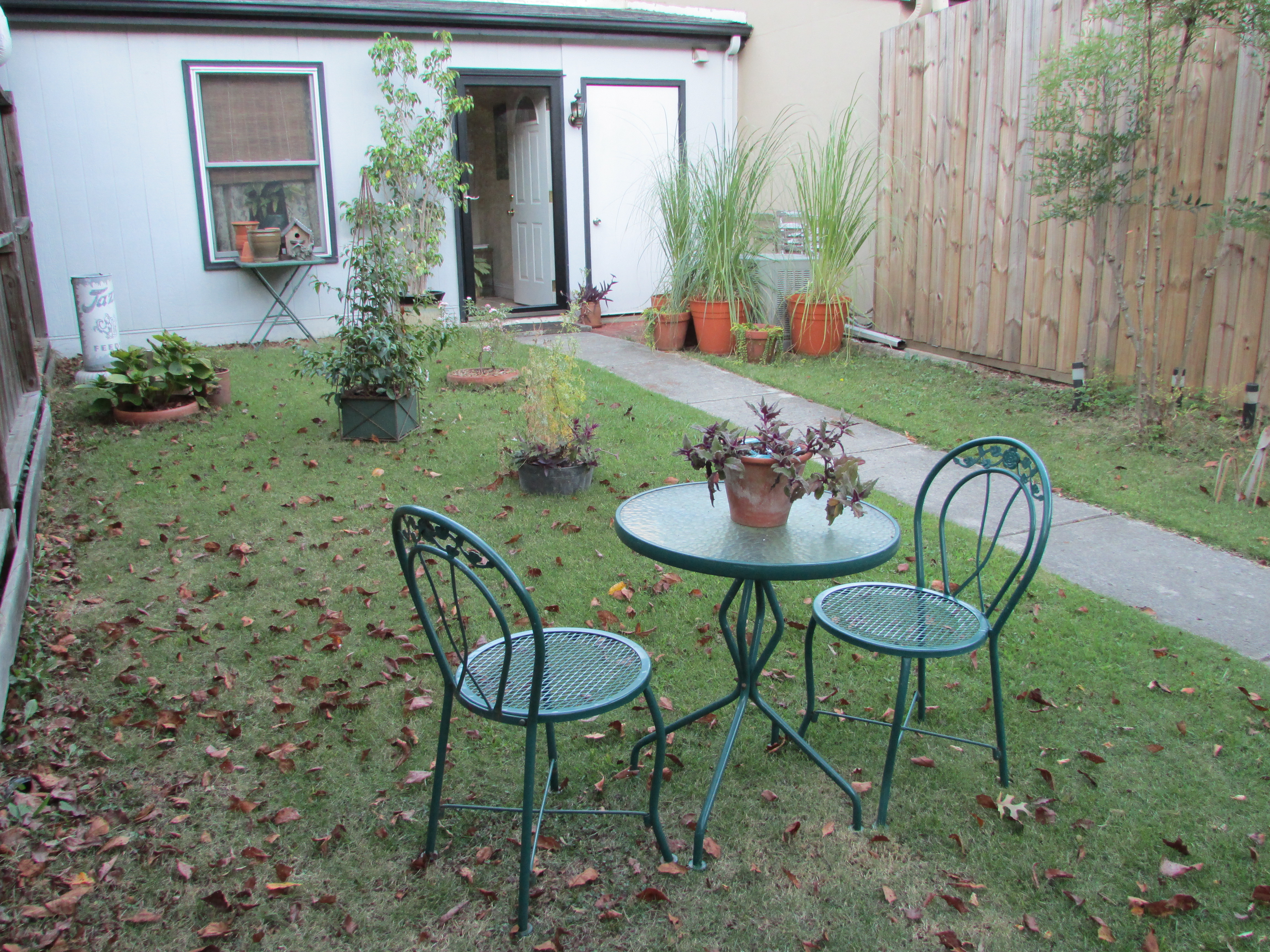
It is a long narrow yard with a privacy fence in three parts (since it is a shared fence on two sides, it doesn’t quite match). A towering Rose of Sharon anchors the northwest corner and spindly nandinas are grouped in the middle of the southern fence. All were untended and overgrown when I moved in and I discovered how easily they were improved by radical pruning.

The plan has always been to do a complete landscape redo in that back yard and I have sat at the bistro table in the yard and mused over plans many times over the past several summers. All of my planning revolves around eventually creating the sort of freestyle, eclectic, and semi-wild “hidden garden” that one finds throughout New Orleans, particularly in the French Quarter. A book, Gardens of New Orleans: Exquisite Excess by Jeannette Hardy and Lake Douglas, with photographs by Richard Sexton (Chronicle Books, 2001), serves as a major inspiration. My plans constantly evolve and change. While I work on my to-do list, I add things to the yard randomly, eventually settle on where to put something in the ground, add architectural finds, and move pots around to experiment with ideas.

I still plan to do a major overhaul of the yard but I realize that the yard has gradually begun to take on some of the characteristics of the New Orleans spaces I admire. The real surprise, though, is that it reminds me of my Granddaddy Harbison’s yard in Fairfield Highlands west of Birmingham.

My grandfather, Leonard Harbison, had a sure green thumb and a love of the outdoors. (My green thumb didn’t grow until I was well into my 30s.) Granddaddy grew up in Cullman County but lived most of his adult life in and around Birmingham. Even so, and even in densely populated urban neighborhoods, he could always find a wooded area to take a nature walk, stick in hand and often with a dog or cat or grandson in tow. His yard was always the prettiest in the neighborhood with a seemingly random mix of blooming plants, vines, pots, and small garden plots growing tomatoes or peppers or other edibles. He worked hard to achieve yards that looked effortless.

In my small backyard, there is a small wild rosebush that grew from a cutting from the rosebush that once belonged to my Harbison grandparents and is now in my parents’ back yard. After all of these decades, a part of Granddaddy’s rosebush flourishes in my little yard. Nearby is a Jazz Feeds chicken feeder that I picked up at an antique shop. Jazz was a brand of farm feed that has disappeared but I remember it well from when I was growing up. My grandfather always had Jazz feed on hand for the hounds he continued to run into his later years. When I saw the feeder with the Jazz name and the logo of a rooster playing a saxophone, I knew I would buy it then and figure out where to put it later.

When my grandfather died in 1997 I was working in Texas. After much deliberation and tampering with my schedule and finances, I realized that it would be best not to go back to Alabama for the funeral. On the day of the funeral, I took a late lunch at 2:00 – the time the funeral was scheduled to begin – and wandered around a local nursery and bought plants. It seemed like the right thing to do on that particular day. All of the plants would have done well in Granddaddy’s yard.


Mastery and Marginalia: The Art of Scott Smith

IMG_0734 I bought the first piece of art by Scott Smith that I ever saw. That statement is significant because I look at lots of art; however, I only buy a work of art when I find some connection that makes me long to possess it. I only buy art, in other words, that speaks to me in some way.

Scott Smith’s art speaks to me.

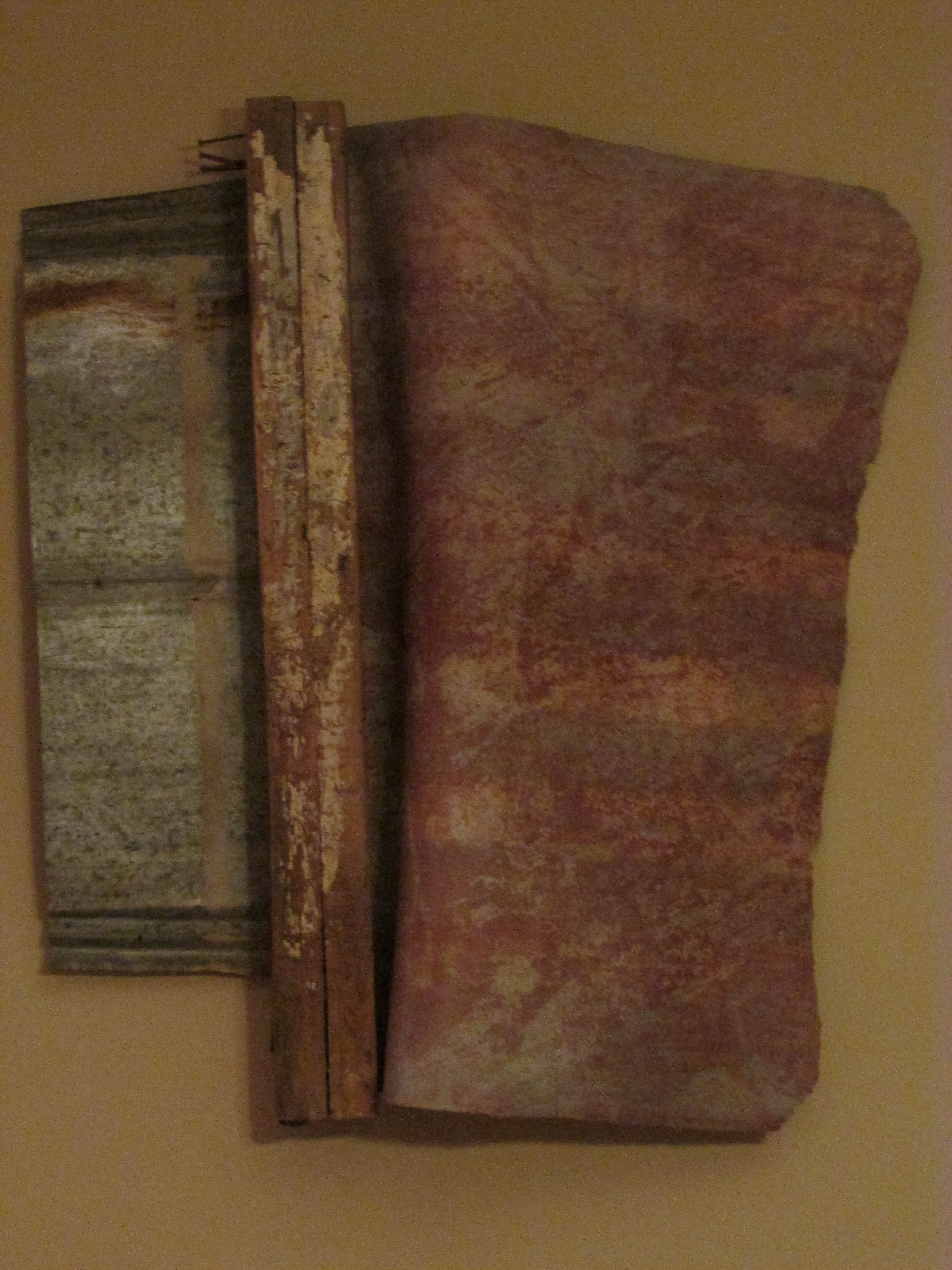
That first work that I acquired is called “Butterfly Wall” (pictured above). Like much of Scott’s art, “Butterfly Wall” combines found objects with prints on paper. A grizzled cracking piece of sturdy 4×4 with four rusty nails congregated near one end anchors the piece. On one side of the 4×4 is a slice of barely rusted tin with ridged edges top and bottom. On the other side of the 4×4 Scott has attached one of his stunning signature prints: in this case the metallic greys and dingy rust red inks blend and interact on paper that gracefully curves (I now know that the curving paper in “Butterfly Wall” is an anomaly in Smith’s work). “Butterfly Wall” has gravity and presence and looks as if it should be very heavy but it is really very light. I am sure he did not intend the print as a trompe l’oeil but everyone who sees “Butterfly Wall” for the first time walks over and touches the graceful curve and is surprised to discover that the print is, well, a print.

I knew Scott before I saw that first piece that I had to buy. I knew that Scott was a master printmaker and a mixed media artist and from our conversations I knew that we shared an affinity for some of the same types of art and artists. As Scott and I became friends I was pleased to learn that he has worked with some of those same artists we both admired.

And now that I have had the opportunity to observe much more of Scott’s output first-hand over the past decade I feel that his is a singular vision. Many artists work with found objects; many artists make prints; many artists incorporate assemblage into their work. And Scott Smith has some things in common with many artists. But his vision seems unique to me. I haven’t seen another artist’s work that is quite like this.

Scott is from the rust belt of Ohio and his fascination with industrial detritus is a fascination I share from growing up in Birmingham when it was still an iron and steel center. His concern with relics and castaways from the past never becomes sentimental or nostalgic. He recognizes the beauty in the margins and presents it at face value.

It’s not just the industrial castoffs Scott is drawn to, however. Scott’s art embraces the decay and fading grandeur of rural as well as urban landscapes. This is part of the reason, I suspect, that his output takes on a local and regional flavor regardless of where he happens to find himself. In the years that Scott and his wife, Michelle, have lived in northern Alabama he has rescued castaway barn materials, architectural elements, and other found objects and incorporated them into his work and allowed them to inform and influence his prints. Scott takes the objects at hand, filters them through his sensibility, and makes them of a specific time and place but still transcendent. He’s hard to peg and that is another reason I find his work so appealing.

“Aggressive,” “robust,” “masculine,” and “earthy” are adjectives I have applied to Scott’s work at different times. So I was a little skeptical a few years ago when Scott told me he was going to have a show at a small gallery in the idyllic Florida coastal community of Seaside. I am a somewhat grudging admirer of Seaside, Florida, and would be inclined to describe the town as “pastel,” “refined,” and “precious.” None of those are adjectives I would ever apply to Scott Smith’s work and I wasn’t sure how it would be received there.

I traveled to Florida with Scott, Michelle, and their daughter, Cecilia, for the Seaside gallery opening and was surprised and delighted to find that not only did Scott’s art “play” in that environment, it was embraced by it and embraced it in return. The work took on a whole new and unexpected presence in Seaside. Neither the environment nor the art was compromised. Instead, each responded with a fresh vibrancy and timbre.

That is the true mark of an artist and his art, isn’t it? Doesn’t it start with something personal and specific and of the moment and transform into something universal and transcendent? In Scott Smith’s work, the mastery and the marginalia fuse.

(See more of Scott Smith’s art at http://www.scottsmithfineart.com.)

Weeding Organic Cotton

IMG_0724 In 2012 I received an email from Billy Reid’s organization with an interesting proposition. It seemed that Natalie Chanin and Billy Reid, both fashion designers based in Florence, Alabama, were experimenting with growing organic cotton in a small field near Trinity, a town between Decatur and the Shoals area of Alabama. The email asked for volunteers to come out to the field to help weed – no small task when you’re growing organic.

Natalie Chanin’s Florence-based label, Alabama Chanin, features handmade garments made with American-grown organic cotton. The problem is, there is no organic cotton grown in Alabama that she can use and she has to source her cotton from some place in Texas. The purpose of the Trinity experiment was to see what kind of luck they’d have growing their organic cotton locally. A September 5, 2014, edition of The New York Times “T” magazine blog chronicles the Alabama Chanin cotton harvest.

Back in 2012 I heeded the call out of curiosity and because it isn’t every day that one is invited to weed in a fashion designer’s organic cotton field.

I drove to Trinity one sunny Saturday morning and the only other person in the field that morning was Lisa Lentz; she and her husband had lent the project the seven acres to plant the cotton. I didn’t have too much time to spend in the field that morning but I weeded hard while I was there and learned more details about the project from Lisa. I had worked in a cotton field once before; when I was a young boy, on a visit to Cullman County, Alabama, with my mother and grandmother, my Cullman County cousins got a kick out of putting their skinny city cousin in the field for a while with a sack over his shoulder. I wasn’t very useful out in the field that morning but I remember it was rough on the hands and hard work to remove the cotton and place it in the sack.

It was equally challenging to pull weeds in Trinity in 2012 but I drove away with a sense of accomplishment, sore knees, and a curiosity about how the experiment would work out. There were subsequent appeals a few weeks after my morning of weeding for volunteers to pick the cotton ready for harvest. I had conflicts that kept me from going back out but was glad I had a connection to the project. A friend, when I told him I had spent a morning weeding organic cotton, smirked a little and asked how organic cotton clothes would feel any different from any other cotton clothing. I was surprised he asked that since he is very environmentally conscious and fuels one of his vehicles with recycled cooking oil. I explained that it wasn’t so much the feel of the cotton but the toxic chemicals that were not going into the earth and the water supply that mattered.

In July of this year, I was at the Alabama Chanin Factory for a Friends of the Café event and asked Natalie Chanin about the status of the Trinity organic cotton project. She told me the finished cotton was in the factory being turned into tee-shirts. When the tee-shirts went on sale a couple of weeks ago, I had to grab one. It may be the most expensive tee-shirt I’ve ever owned, but I definitely feel I had a hand – and knees – in the effort. And, back to my friend’s comment about what difference organic cotton makes: It’s likely all psychological – but it is probably the most comfortable tee-shirt I’ve ever put on my body.

Waning Days of Summer

IMG_0726  When you live alone you develop routines and rituals. At least that has been my experience. I don’t know when I started the ritual of reading F. Scott Fitzgerald’s The Great Gatsby on the first day of summer, but I know exactly why.

On page 11 of The Great Gatsby, during a dinner party fraught with marital mystery and tension, Daisy Buchanan says, “I always watch for the longest day in the year and then miss it.” Her friend Jordan Baker replies, “We ought to plan something,” and yawns.

I didn’t yawn. Like Daisy, I often watched for the longest day of the year – the first day of summer – and then forgot it until it was past. On my third or fourth reading of The Great Gatsby, that passage resonated with me and, following Jordan’s bored advice, I made a plan: I always read The Great Gatsby on the longest day of the year. I can’t remember exactly when I started that ritual – probably in the late ‘70s – but it continues to this day. And I have never missed the longest day of the year since.

William Faulkner is my favorite writer (good Southern boy that I am) but I think Fitzgerald’s The Great Gatsby is the most perfect American novel. It’s a short read; I can knock it out in about three hours. But it is so compactly and intricately structured that I never tire of it even though I have now read it upward of forty times. I always discover something new or respond to something I never responded to in previous readings. I first read the novel in high school and, unlike many young readers, I loved it immediately. I studied it again in college and then found myself drawn to it periodically after those initial readings. And then I developed my summer ritual.

I love summer. I love the heat and the sweatiness and the long days and the outdoor activities. In my part of the South, many people seem to relish complaining about the heat and humidity of summer but I cherish it. I’d rather be too hot than too cold any day. So not only does The Great Gatsby represent my literary tastes, it has also come to represent my favorite time of the year.

The reason I am talking about the beginning of summer at the end of summer is because I am winding down the summer of 2014 with a book that is about The Great Gatsby and that I am thoroughly savoring. Literary critic Maureen Corrigan has authored a new book, So We Read On: How The Great Gatsby Came to Be and Why It Endures, that is an extended meditation and exploration of Fitzgerald’s masterpiece. It amuses me that Corrigan’s book exploring The Great Gatsby is twice as long as the novel itself. It turns out that Corrigan may be an even bigger fan of the book than I am although she admits to not liking it in high school. I heard Corrigan tell an interviewer that she has read Gatsby at least fifty times and I knew I had to check her book out.

It was worth it. And reading it now, three months past the first day of summer, is giving me a nice way of transitioning to ever shorter days and ever dropping temperatures. I must admit that the only thing that bothers me on that first day of summer in June is the knowledge that the second day of summer will be a bit shorter, and the next shorter still as we take the plunge to the shortest day of the year in December.

The Great Gatsby itself takes place over a summer season. In the first pages the narrator, Nick Carraway, comments that “life was beginning over again in the summer.” Toward the end, he mentions that “there was an autumn flavor in the air” on the day that Gatsby is killed.

Maureen Corrigan, in So We Read On, has provided this reader with the perfect way to ease into the fall.

“So we beat on, boats against the current, …” Thanks, F. Scott. And thanks, Ms. Corrigan.


The Peach Highway and Jimmie’s Peach Stand

100_1927  I get a little reflective as the Alabama peach season draws to a close. The state of Georgia, of course, has appropriated all of the peach titles and has done an admirable job of marketing its peaches as if they are something special. But a growing number of Southerners have discovered the rich and considerable delights of peaches grown in Chilton County, Alabama. On a May morning in the French Market in New Orleans a few years ago, I was pleased to hear a local shopper ask a vendor if any Chilton County peaches had arrived yet. He replied that he didn’t have any but that the lady a couple of stalls down had just gotten her first delivery of the season that very morning – “and they sure are good this year.” The shopper grinned like a child on Christmas and rushed to buy a basket.

I have long been a fan of Chilton County peaches but it was only when I moved back to Alabama in 1999 that I became something of a snob about them. The local crop is becoming better known and any traveler on I-65 between Birmingham and Montgomery is bombarded by the billboards promoting the tourist-driven peach shops at exits around Clanton. The biggest billboard of all for Chilton County peaches is the giant peach water tower at exit 212 in Clanton. The giant peach water tower in Gaffney, South Carolina, is older and bigger but each makes its point with kitschy panache.

To truly get a feel for Chilton County peaches, however, you must wander off the interstate and experience the numerous peach stands along Highway 82. When I lived in Montgomery from 1999 to 2002 I frequently traveled U.S. Highway 82 on the way to Tuscaloosa, where my parents lived at the time. Outside Montgomery, traveling northwest on 82, after going past the Robert Trent Jones Golf Trail resort and subdivisions in the town of Prattville, the highway turns aggressively two-lane and rural through Autauga, Chilton, and Bibb counties on the way to Tuscaloosa.

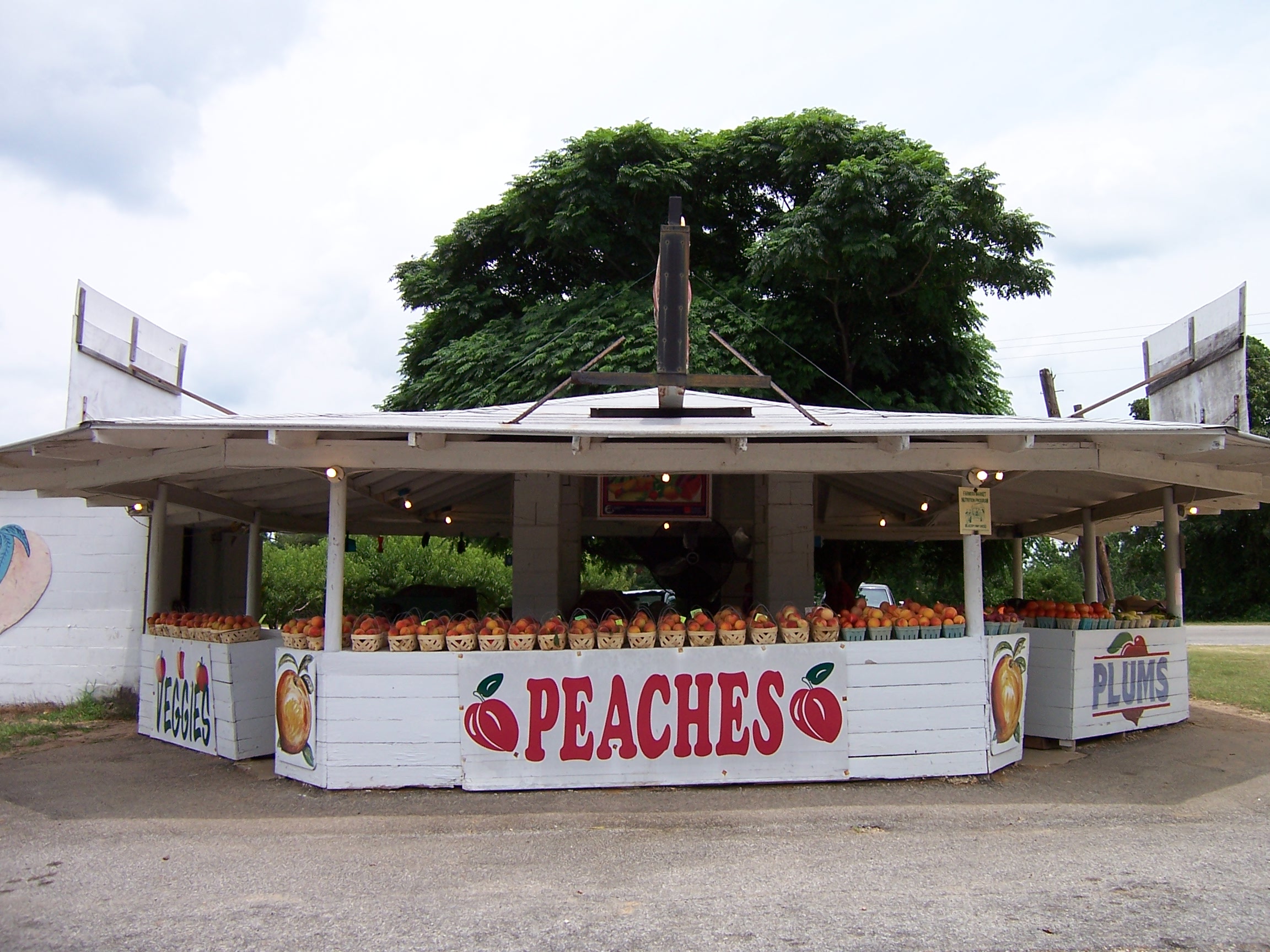
As soon as you pass into Chilton County, from either direction, the roadside stands begin to appear. Some vendors come and go and others have been there for years. Sometime around Mother’s Day the stands, which have stood vacant during the cooler months, put up their freshly painted signs and the first succulent peaches of the year make their debut, lined up in full farm baskets and beckoning to all travelers. It is almost impossible not to stop. That moment – when I catch sight of my first peach stand of the season open for business with that sensual peach color and aroma – has become one of the defining moments of the growing season. My heart soars; I have been known to shout.

After sampling most of the stands, one has become my clear favorite – not just for consistent quality but for sheer “ambience,” if that word applies for a humble fruit stand on a lonely stretch of rural highway (and I think it’s the perfect word). Jimmie’s is my hands-down favorite peach stand in Chilton County.

Jimmie’s is located at a fork at the top of a hill where County Road 15 feeds into Highway 82. It’s a simple open wooden structure with display space on two sides facing each road. Baskets of peaches are lined up across the shelves facing Highway 82 and whatever other produce is in season is usually displayed on the other side.

Jimmie’s, which is a family-run stand, only sells peaches that they grow. To drive the point home, one of their peach orchards stands next to the stand and the truck regularly pulls in with peaches and other produce from orchards and parts of the farm farther down the road. A few years ago I asked Mrs. Harrison if they had any okra in yet and was told that they had sold out of okra that morning but if I could wait a few minutes they were out in the garden getting some more now. A few minutes later the truck pulled up and Mrs. Harrison told them to unload the okra first since “that’s what this man is waiting for.”

I now live in north Alabama, but my parents are in Birmingham and I manage to drive the seventy-something miles from Birmingham down to Jimmie’s every two weeks during the season. Usually I buy a basket for myself and fill additional orders from friends throughout Alabama. The car smells amazing on the trip back after the “peach run.”

If you happen to get to Jimmie’s after hours, and if anything was left when they closed up for the night, there’s an honor box so you can buy what you need, leave the money in the box, and be on your way. Honor boxes. You don’t see them much anymore but every time I encounter one it strikes me as one of the most civilized and hopeful things left in the world.

“The Professional Southerner” — and why

IMG_3349I think I was living in Indiana the first time I was referred to as a “professional southerner.” As I recall, it was around 1994 and I was frustrated because I had been unable to find okra in the produce sections of the local grocers. Someone innocently asked why I ate okra and my shock made me launch into a monologue of the virtues of okra and all the ways in which it could be consumed. But my favorite way was breaded and fried in the particular way my Grandmother Harbison had always made it and I had been craving fried okra around that time of that Indiana summer.

This led to questions about other ways in which okra could be consumed (I told them pickled okra was my favorite Bloody Mary garnish), other foods I like, and other queries about Southern foodways. Someone in the group mumbled, “I never realized you were such a professional Southerner,” and we all laughed but over the years, as I lived and traveled in other parts of the country, I became aware that I was often the go-to guy for issues dealing with the South and what it means to be Southern.

Having said that, I am a proud Southerner but very few people would classify me as a “typical” Southern male with all of the misconceptions and stereotypes that label evokes. But I realized, after traveling and working in different places – and to my surprise, really – that not only was the South my home, but that it was the place I best understood and the place where I felt most comfortable. It was the place I wanted to come back to. My politics, for one thing, are not typical of the South, but they are also not as atypical as some might suppose and I resent the whole “Blue State / Red State” way of thinking because it gives such a divisive idea of what is really happening in our country.

Not long ago, my friend Cindy and I attended a “Piggy Bank” dinner at the Factory of Alabama-based fashion designer Natalie Chanin in Florence, Alabama. The event was to honor Southern food and to benefit Southern Foodways Alliance. The chef for the evening was Vivian Howard who owns and runs Chef and the Farmer, a farm to table fine dining restaurant in Kinston, North Carolina, with her husband Ben Knight. Between the entrée and the dessert, Shonna Tucker, an Alabama-born musician who has recently moved to Florence after many years on the road, sang her striking and original songs. The dinner guests were a wide range of people who shared an amazing communal meal and one of the most convivial and relaxed evenings I have enjoyed in a long time. At the end of the evening, all of the diners stood and sang “You Are My Sunshine” to Vivian Howard, led by Natalie Chanin, one of the most innovative and conscious fashion designers working today.

That night, walking from the Factory to the car, I commented to my friend that “This is one of those nights when I can’t imagine living anyplace else but Alabama.” And I decided that I – who have always detested the idea of blogs and the label of “blogger” – would make an effort to record and share some of the things that make my South so special to me. Plus, I have been told that I “think loudly.” Maybe, by writing this online journal, my loud thoughts will become more specific and defined.