Tag Archives: Alabama

Fairhope + Point Clear: Part 2, Old Favorites

Hesitant to leave the tranquil environment of the French Quarter Chateau in downtown Fairhope, it was time to move on to the next stop – the Grand Hotel, a few miles down the bay in Point Clear. But there were a few hours to fill prior to check-in and I started at the Warehouse, an eatery I wasn’t aware of until Allison’s enthusiastic recommendation. It’s a big room, crowded and friendly, with a big menu, serving breakfast all day and lunch. I ordered a memorable shrimp and grits, with Conecuh sausage added, that I wanted to reorder as soon as I finished my first serving. It became a new “must-go” on my already crowded list of essential Eastern Shore dining rooms (Warehouse Bakery & Donuts).

Warehouse, Fairhope

There was an urge to stay and sample more of the Warehouse menus, but I had promised myself a drive around Baldwin County before returning to the already familiar Grand. Silverhill is a small town a few miles out of Fairhope; I have enjoyed the short drive to Silverhill past pecan orchards and farmland in the past and pegged it as a good place to start. When I arrived at the main intersection in Silverhill, a woman was standing on a park bench doing what looked like modern interpretive dance. Perhaps it was modern dance – or maybe it was a very Westernized and dramatic version of tai chi. Whatever it was, it was a momentary distraction on a slow chilly morning and the woman looked content.

Moving past Silverhill, I realized that I have not been to the southernmost point of Baldwin County at the Gulf of Mexico in about fourteen years and headed south through towns I have passed through and occasionally stopped at throughout my life. Crossing into Gulf Shores, I headed east toward Gulf State Park and parked near the beach. The deserted beach was a pleasant place for a brief, bracing walk.

After a drive past the dunes, trails, and waterways of the park, it was time to head back toward Fairhope and Point Clear. The back roads took me to Bon Secour, Magnolia Springs, and Weeks Bay – places I have lingered before and will linger again. Along the way, I saw a couple of satsuma trees so loaded with the fruit that the branches were sagging to the ground. It was a good reminder that I had not yet stopped for a bag of satsumas at my regular place, Harrison Farms on Highway 98 (not to be confused with Harrison Fruit Farm in Chilton County – my peach source).
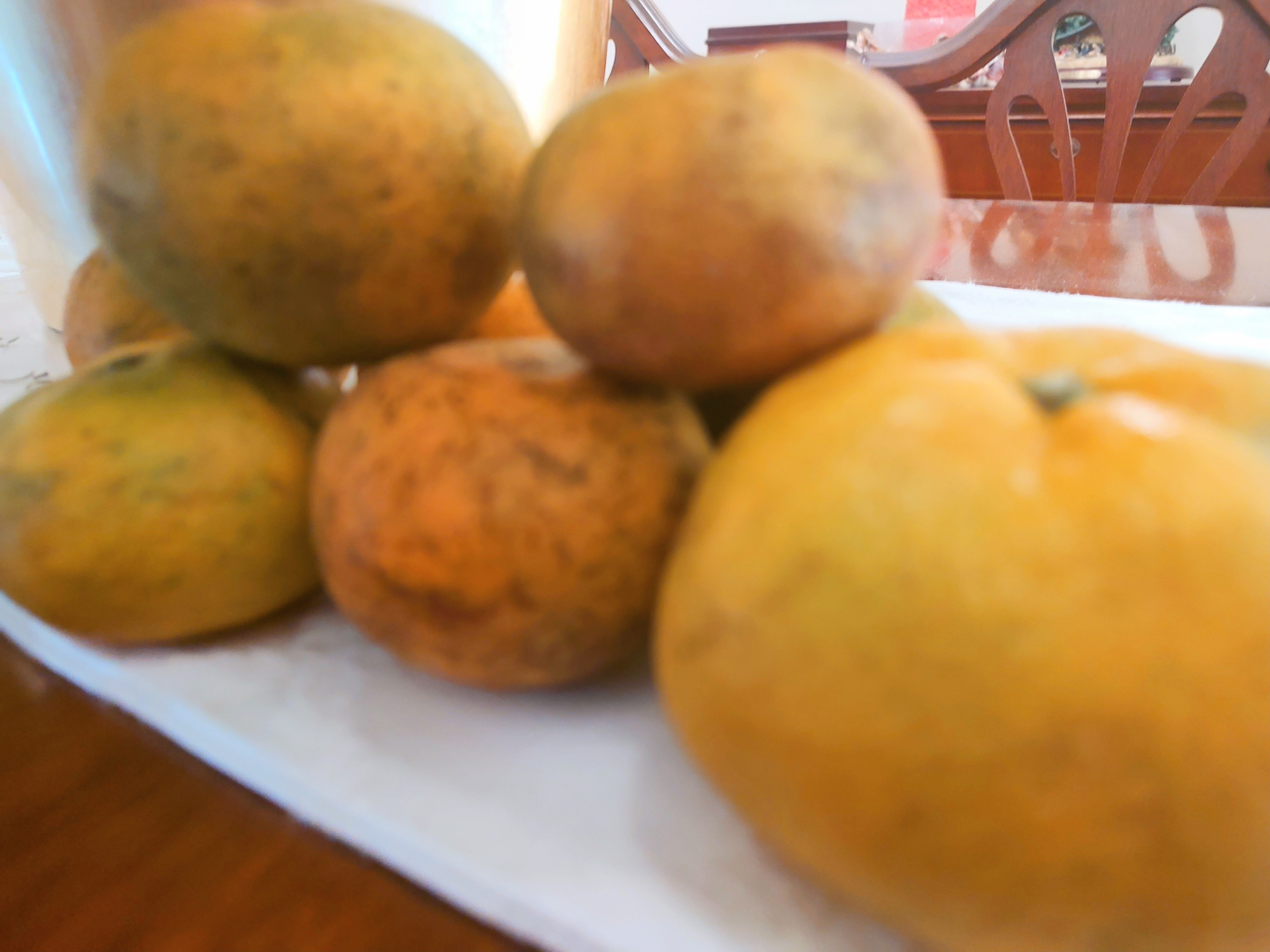
As usual, the Harrisons had the truck parked on the highway with the big SATSUMAS NOW! sign and bags of fruit lining the truck bed. It is on the honor system so I picked my sack of fruit, put money in the box, and went on my way. Because of unusually warm temperatures, the outside was greener than usual, but the fruit inside was as orange, juicy, and tasty as always. Down the road, a stop at B&B Pecan Company and then it was on to the Grand.

As I get older, I am more and more a creature of ritual and tradition. In my first days in Fairhope, I intentionally steered clear of Point Clear where the Grand Hotel Spa and Resort is located. I did not want to spoil the moment of arrival at the Grand’s gates. Finally, satsumas and pecans in tow, it was time to check in. Normally, when I make my December trip to the Grand, it is very quiet. On this arrival, the place was packed as people took in the Christmas decorations on the grounds, the gingerbread village in the lobby, and all the things the Grand has to offer for the holidays. My peace and quiet came when I got to my preferred room (I have been staying in the same room for years) and caught the last color of the recent sunset off to the west from my balcony.

I dressed for a dinner reservation at Southern Roots, the Grand’s more formal dining room. When I got there, there was a course of Murder Point oysters calling my name. My preferences from a year ago had been noted by the attentive manager, Susan Margaretha; this is one of many reasons that I must stay at the Grand every December. When I ordered the grouper dish, the server explained that the sauce had changed from when I had the dish a year ago and that she suspected I would like the change; she was right.

After a sumptuous meal at Southern Roots and a walk through the lagoon gardens back to my room, I sat for a while on the balcony, read for a while in the room, and went to sleep early. This Mobile Bay trip had been designated for pure rest and relaxation. My balconies got a workout.

The next morning was my annual morning massage at the Grand spa with Claudia. She and I tried to figure out how many years this December ritual – a morning warm stone massage with Claudia – has been going on. We settled on fifteen years, at least. I look forward to it all year.

I usually linger in the spa’s Quiet Room after the massage, but this year I had an inspiration. After my eager consumption of Murder Points over the past few years – and singing their praises to anyone who might listen – I should go to the source since it was only about an hour away. So, I scuttled my plan for a quiet day of reading at the Grand, ate the West Indies Salad I had taken out from Southern Roots the night before (perfect lunch after a massage), set the GPS for Murder Point Oysters in Bayou La Batre, and headed across the causeway toward Mobile.

Over the years I have travelled through Bayou La Batre a couple of times; I have heard of it most of my life, mainly because of the annual Blessing of the Fleet every spring. As a traveler at the Grand reminded me, it was also the home of Bubba Gump Shrimp. When I reached the fishing village about an hour before sunset, the Murder Point Oysters shop was the target. Set just off the bayou, the store is full of oyster and seafood-themed products and you can buy oysters on the half-shell – even just a single one – for a fresh taste. Click this: Murder Point Oyster Company. Now, if that doesn’t inspire you to go out and eat a dozen oysters, I guess you’re not an oyster lover (not that there’s anything wrong with that).

I had hoped to go in search of those oyster beds. Whenever I am dining out at a seafood place, I request Murder Points. It is not just that they are an Alabama family-grown product, but they are quite simply the best-tasting oysters I have ever had – buttery and clean, with a nice pop of salt at the end. But it was getting late in the Bayou and time to head back to Point Clear. The oyster beds will still be there next time.
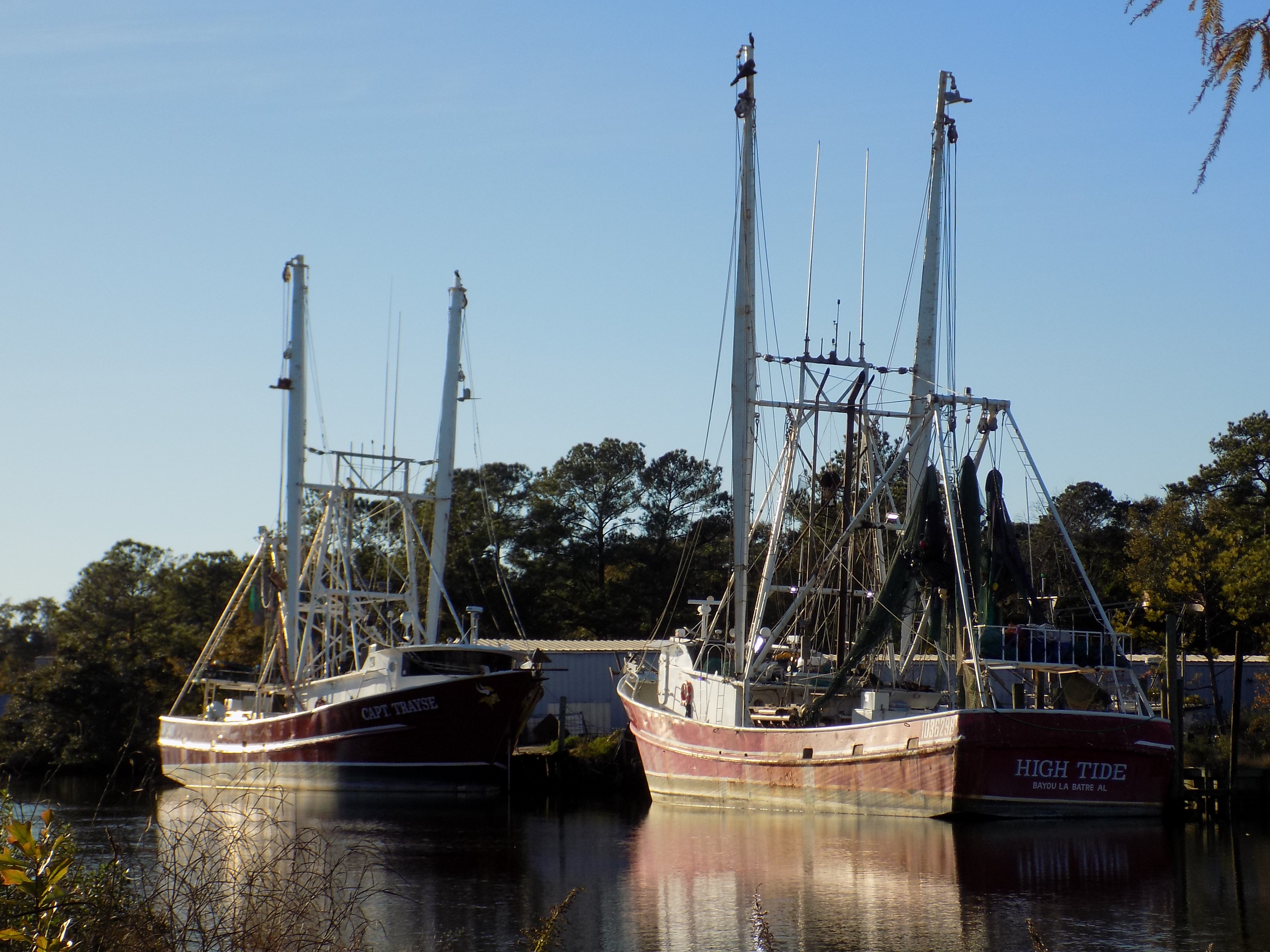
Bayou La Batre

Back at Point Clear and a mile down the road from the Grand, the Wash House has been a special place for a great dinner since I began this annual pilgrimage. I usually save it for the final night of the trip and have had memorable Wash House meals with friends many times over the years. There were no Murder Point oysters, but a silky she-crab soup was a delicious starter to a final dinner of this edition of my December respite.

Early enough the next morning – after a good sleep and coffee on the balcony, watching groundskeepers at the lagoon, guests heading over for breakfast, and children feeding ducks made it hard to leave. But leave I did, with festive thoughts of another restful getaway to the coast and ready to brave the busy highway north.

A refreshing trip to Mobile Bay. I highly recommend it – even, and maybe especially — in December. 

Fairhope + Point Clear: Part One, New Angles

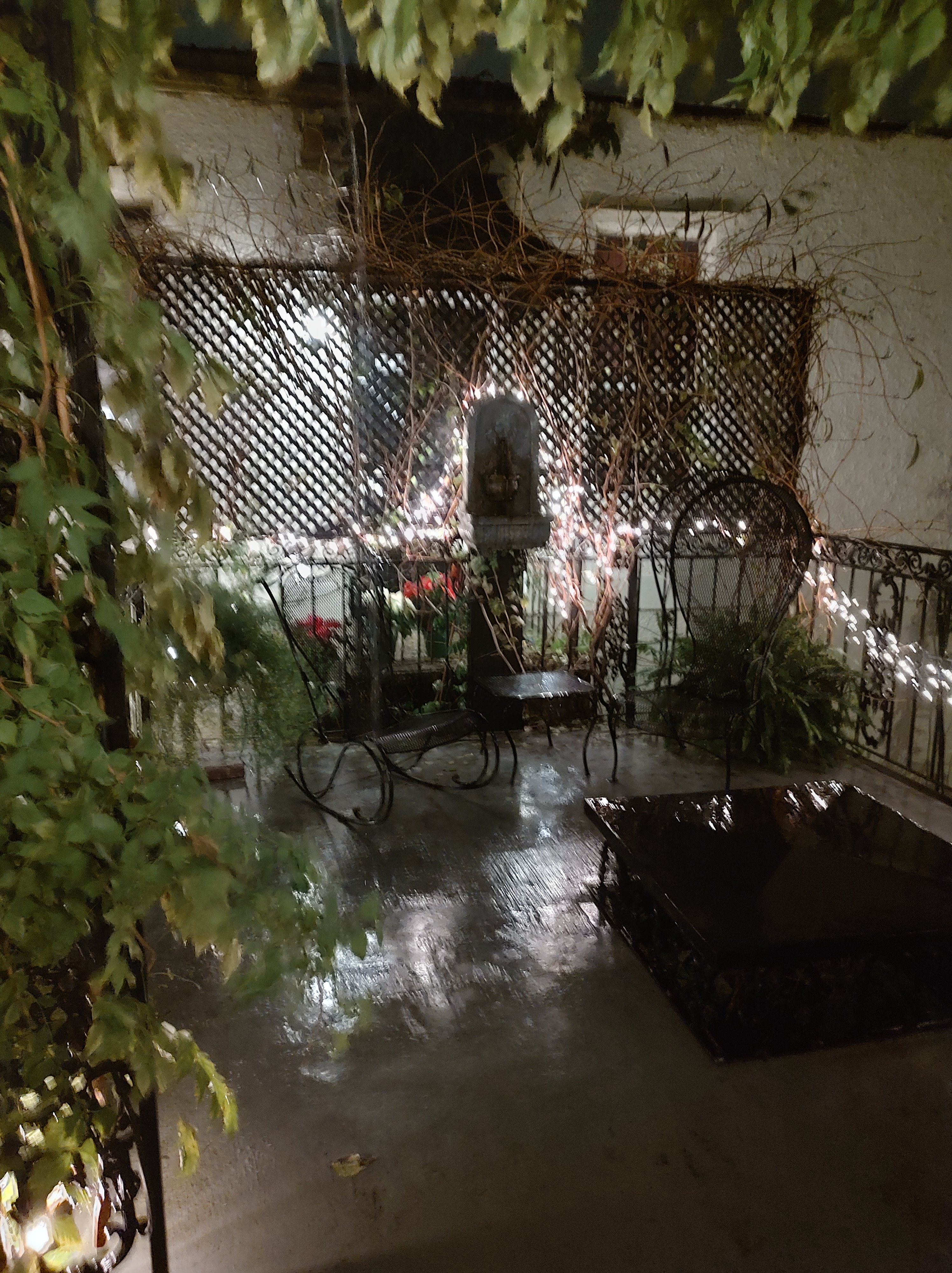
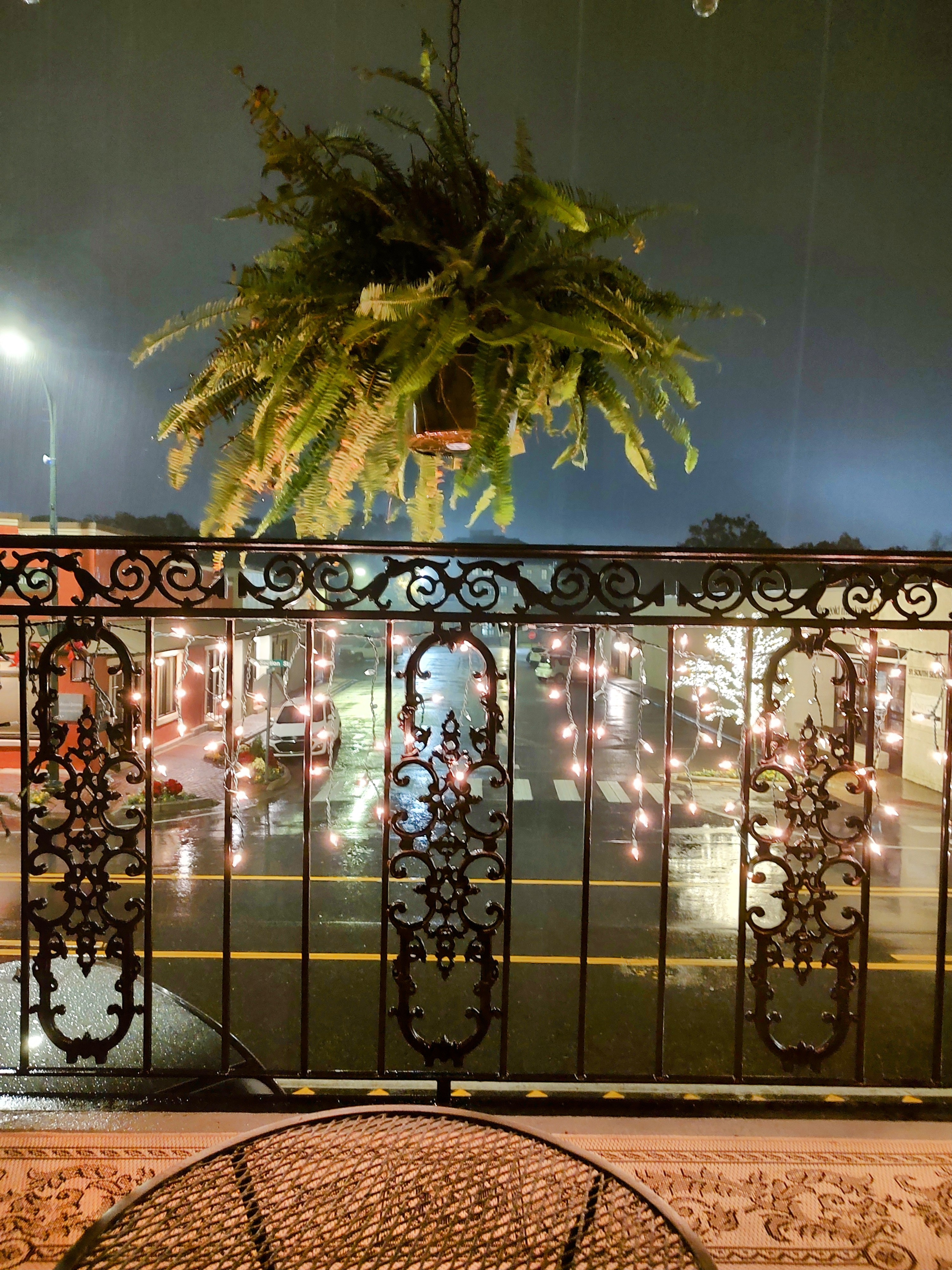
My annual December respite to Mobile Bay got off to an amazing start as I stayed at a new place above downtown Fairhope’s French Quarter alley of quaint shops and a popular eatery. The French Quarter Chateau is a spacious one-bedroom apartment with a huge balcony overlooking the French Quarter and one of Fairhope’s main streets. The balcony wraps around two sides of the apartment and, due to Fairhope’s mild climate, is comfortable throughout the year. There are multiple places to sit outside and, depending on your selection, you can sit and watch the foot and motor traffic on Section Street or watch people come and go at the French Quarter or both from my favorite nook beside a trickling fountain amid wisteria vines.

The chateau became an instant special place; for me, it is made even more special by its location – in the middle of a bustling small town at Christmas time – and its peace and solitude. The host, Allison, has furnished and equipped the place to charming perfection and I am content just to stay there and read, or people watch, or occasionally doze off. You, too, can be content there: French Quarter Chateau in Lovely Downtown Fairhope – Apartments for Rent in Fairhope, Alabama, United States – Airbnb.

The location makes it possible to park the car and walk to whatever is needed. Greer’s, a local market, is just across the street; as soon as I arrived, I crossed the street for basics for the refrigerator before dashing down the street for a dinner reservation.

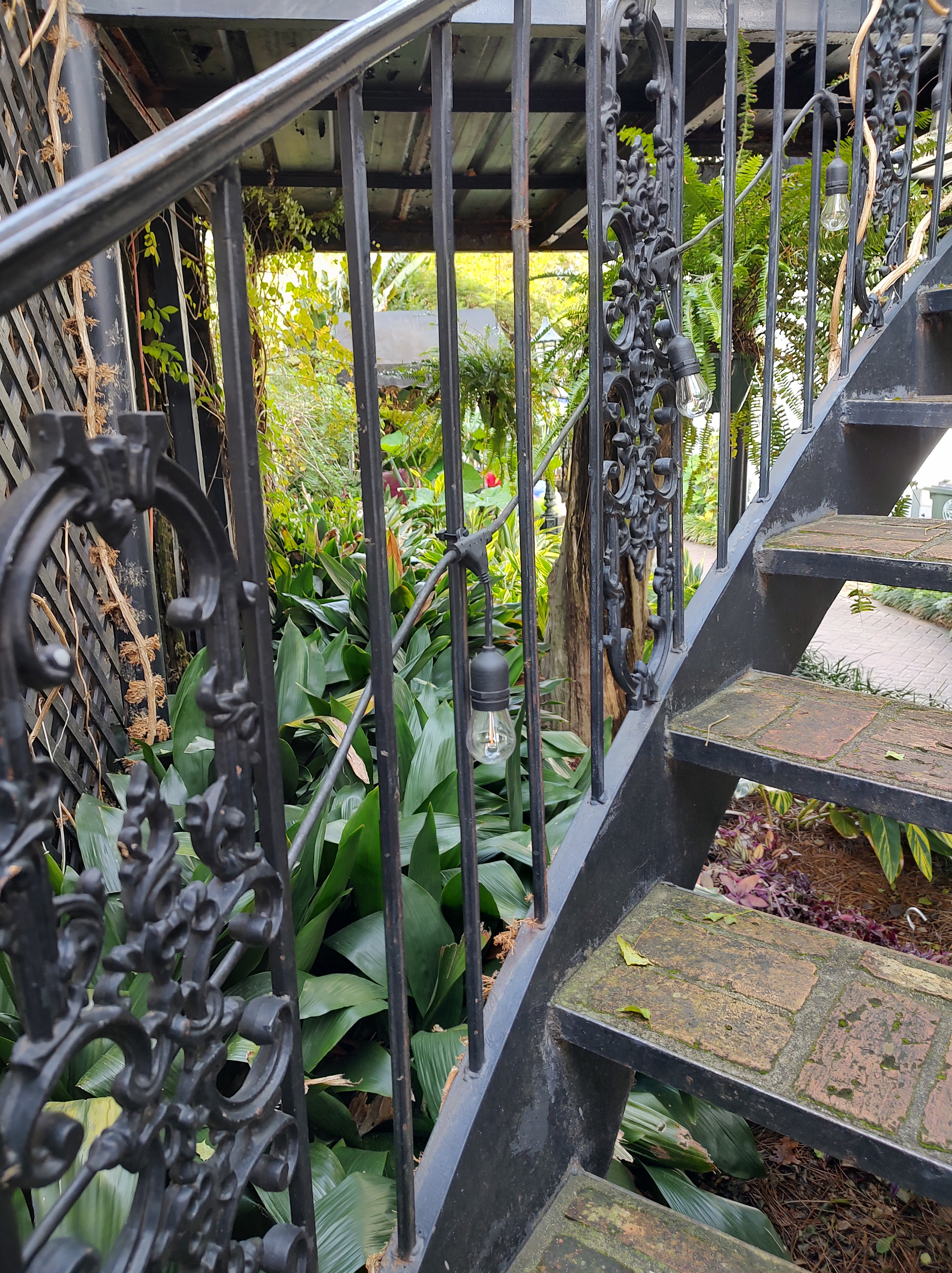
In the morning, after coffee in the apartment, I walk down the spiral staircase through lush greenery for more coffee and beignets at Panini Pete’s in the French Quarter courtyard, beside the fountain among the specialty shops. It was raining, but plastic enclosures shielded the outdoor tables from the soft December trickle.

“Marble,” one of the French Quarter cats, stood outside the kitchen door begging for treats. “Are you waiting for some turkey?” asked a server. “Let’s see what I can find.” Marble patiently took a seat at a nearby table and waited for the treats that another server soon sprinkled in a corner of the patio, eating quietly as other morning diners gathered and rain trailed down clear plastic. Finally, brushing the dusting of powdered sugar off my shirt and pants, I head back up to the apartment, stopping to give Miss Fancy, the dowager of the French Quarter cats, a rub on the head and chin (no stomach rubs, please). Do not mistake Fancy for homeless and take her back to Birmingham as some “well-meaning” tourists did not long ago (it made the news).

As the rain stopped, I headed back down the stairs and casually browsed some of the shops, picking up some Christmas presents along the way. My first stop in downtown Fairhope (after Greer’s) is usually Page and Palette, a bookstore and community gathering place since 1968, with a coffee shop, Latte Da, and Book Cellar bar attached. Just down De La Mare Avenue from Page and Palette is Happy Olive, a go-to place for specialty olive oils and vinegars. Other shops a block over along Fairhope Avenue yield other pleasures and gift ideas.

The pull of the chateau balcony is strong, however, and I spend the bulk of the afternoon out there – reading, finishing a book review, napping. I rouse myself long enough to go out for my first plate of raw oysters of the trip at Sunset Pointe. Of course, it’s Murder Point oysters from across the Bay near Bayou La Batre, a storied fishing village.

With the oyster urge satisfied for a while, it’s back to the apartment. It is my long-time habit to read Truman Capote’s “A Christmas Memory” sometime during the holiday season, usually somewhere near Alabama’s Eastern Shore. After running across a newspaper article about the filming of the 1966 television version of the short story, I decided to watch the television “special” – my first exposure to the story when I was a boy. It is a wondrous thing. Filmed in Alabama, starring Geraldine Page as “Sook,” directed by Frank Perry, and narrated by Capote himself – the very definition of “bittersweet.” You can watch the full film here: Truman Capote’s A Christmas Memory (1966 Emmy Winner) – DVD Color.

One of my favorite casual dining spots in downtown Fairhope was Dragonfly foodbar. I read earlier in the year that Dragonfly had left its downtown location for a spot farther south. Wandering around before the rains moved in on my last full day at the apartment, I happened to pass the old location and was pleased to see that it is now occupied by one of my favorite places up the highway in Daphne. Market by the Bay has just moved into the Dragonfly location and I was pleased to have the opportunity to have one of their unbeatable shrimp po’boys.

That night, I enjoyed dinner at Dragonfly with friends Allison and Richard. Doug Kerr’s creative menu, heavy on tacos and bowls, was as enticing as ever in the expansive and noisy new digs. By the time Allison and Richard dropped me off at the apartment, the rain was getting harder. The rest of the evening was spent on the balcony watching the rain. Distant lightning was visible from the Gulf. Sounds of people chattering and laughing as they left the Book Cellar and hopped puddles to their cars mixed with the sounds of the rain.

It was hard to leave the balcony and go to bed. But tomorrow is moving day and I need to pack and leave my downtown oasis for the bay views of the Grand Hotel down at Point Clear.

Mobile and Havana: Sisters across the Gulf

Serendipity happens. As I was traipsing around south Mobile County, Alabama Writers’ Forum posted my latest book review of Mobile and Havana: Sisters across the Gulf. For anyone interested in Mobile, there are so many recent books being written about the area. And this one includes a huge helping of history and architecture and the compelling history of Havana.

Here’s a link to that review:

Mobile and Havana

The Birds of Autumn

Through an unusually hot and deplorable November amid drought conditions, the activity of the birds at the backyard feeders has provided respite. Trees and plants seem confused and bees, wasps, flies, and mosquitoes are taking advantage of the extended warmth, but butterflies have recently been spotted in the lantana that still bloomed in the raised bed until this week. Every time Lulu, the dog, goes out, a mosquito comes in.

The bird population seems to have thinned out but they still frequent the feeders. Cardinal sightings are more likely in early morning and dusk and the mourning doves still come in groups but they don’t hang out on the fence quite as much. I always leave the hummingbird feeders out longer than necessary; I always think there may be a stray after the rest have left. In fact, the last hummingbird we saw this year was quite late and seemed more frantic than usual to get fed and get gone around the time a hurricane was churning down in the Gulf.

A murder of crows converge on occasion. Lulu loves to dash out the door to chase them away. On first chase, the crows usually just fly up into a nearby pine to wait her out. If we go back out and I clap my hands and she barks, black crows can be seen scattering off in all directions, caw-fussing as they go. Once, I banged some pot lids and Lulu joined in with her happy dance, hopping up and down on her front legs. Neighbors were pleased with the commotion, no doubt.

A frost is forecast for sometime next week. Maybe some rain. I dread cold weather, but the earth sorely needs it. The plants will save up some energy, the leaves that haven’t decided yet will turn. I have tried to let the last grass mowing wait for the leaves to fall but it’s past time to mow the grass and the leaves can just take their time. The bugs will go away. The birds that stay will stay. The birds that go away will go.

______________________________

I didn’t realize it until recently, but I have found some peace in watching birds as long as I can remember. Even when they are acting up, they bring me peace. The grace and freedom they seem to represent may be part of the attraction. My grandparents had glass bird figurines on the mantel, in the china cabinet, and around the house, one of which lingers on my mother’s mantel. I have been looking at those cardinals all my life.  Mother also has a cabinet full of hummingbird-related items – plates, figurines, ornaments. My one and only piece of Howard Finster art is a white crane sculpture covered with his scribbled preaching. “My entire life is a sacrifice for you,” he writes.

Margaret Renkl’s book, The Comfort of Crows: A Backyard Year, is a beautiful book of essays published last year. Renkl knows how to watch and appreciate birds and savor the nature all around us if we just pay attention. A big edition of Audubon’s The Birds of America sits on the coffee table in my living room. I visit it often when I am at home. In admiration for Mr. Audubon’s work, I contribute to the Audubon Society. I support the society’s mission, but I’m not really interested in becoming a “birder.” I can identify the birds that I need to identify by their obvious characteristics, but I don’t identify the ubiquitous small greyish birds that are delightful and plentiful and look too much alike to my untrained eye. I misidentified a nesting bird in this space a year or two ago and got my hands slapped by a reader. So I appreciate them, but I keep their (perhaps mistaken) identity to myself. An organized bird-watching expedition sounds as deadly dull to me as the wine aficionado who can’t enjoy the glass without extemporizing ad nauseum on its qualities (or lack of). It’s kind of like a round of golf; I’m bored with the game but I enjoy the walk in nature.

Rarely am I aware when a bird has died. They come and go and I like to assume that the returnees are the same birds I watched last year and years before. I guess that’s the reason I think Alison Krauss and Gillian Welch’s version of the old hymn “I’ll Fly Away” would be a good selection for my funeral, if I have one.

‘tis the season for pensive posts, I guess. This is what’s on my mind this morning. So savor your birds. Enjoy their songs. Feed them and protect them to the extent possible. Make it a good fall. Despite …

Mobile, Alabama’s Antebellum Image

Historian Mike Bunn’s This Southern Metropolis examines the antebellum history and character of Mobile, Alabama, through the eyes of its myriad visitors.  It’s an intriguing dive into a unique Southern city. I reviewed it for Alabama Writers’ Forum.

This Southern Metropolis

Sidewalking 2024

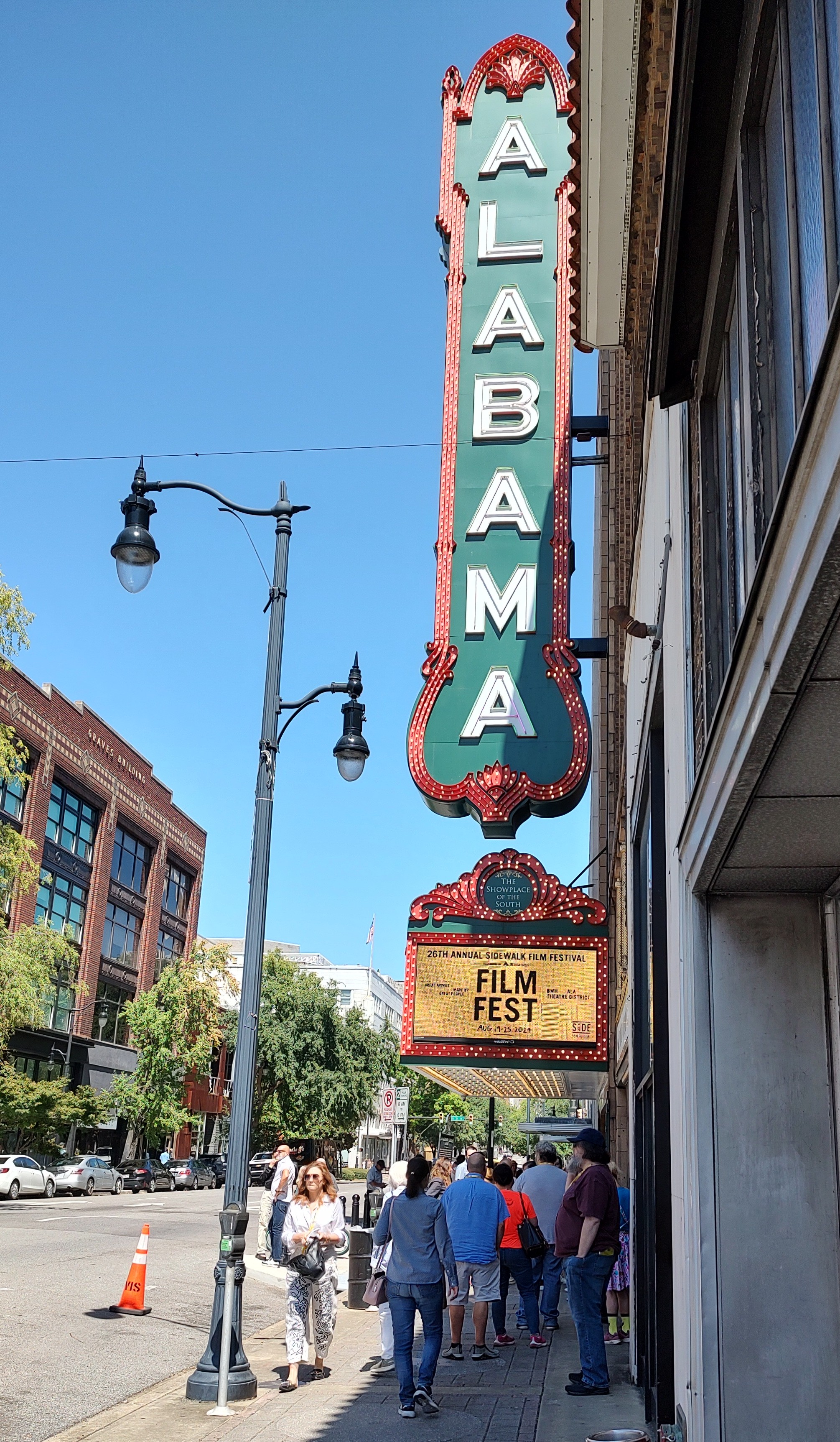
Each year, on the final August weekend before the start of college football season, Birmingham’s Sidewalk Film Festival fills the north side of downtown with screenings, workshops, panels, and events focused on what’s happening in the world of independent filmmaking. Sidewalk has garnered many designations from film media over the years, including nonspecific adjectives like “coolest” and “fabulous.” It was also, more specifically, designated as one of the “Great Film Festivals for First-Time MovieMakers.” I’ve been present for the majority of the twenty-six iterations of Sidewalk and am delighted and proud that it became what it has become. Sidewalk Film Center + Cinema, in the basement of the Pizitz building, houses two cinemas showing movies year-round in intimate state-of-the art theaters that have become my favorite places to catch a movie in the city. The Festival even went on in 2020, at the height of the pandemic, in a drive-in theatre format at an outlet mall just outside the city. “Cool,” right?

It is my habit to book a room at the Elyton Hotel, on the southern edge of the festival, at the proverbial “Heaviest Corner on Earth,” ditch the car, and walk and walk … and walk among ten downtown venues showing about 250 titles from morning to late-night. A filmmaker friend who showed his film at Sidewalk years ago quipped that “now I understand why they call it ‘Sidewalk’.”

The 26th Annual Sidewalk opened at the Alabama Theatre on Friday night with Exhibiting Forgiveness, the debut film by visual artist Titus Kaphar starring Alabama native Andre Holland.

Easing in to a full day of movie watching on Saturday, I decided to watch “Saturday Morning Cartoons” at the Sidewalk Cinemas where sugary cereals and milk, coffee, cold pizza, Bloody Marys, and mimosas were on hand. Cleansed by cartoons and breakfast food, I walked over to the next block to catch a live organ performance by Nathan Avakian at the Alabama Theatre, Birmingham’s 1927 vintage “Showplace of the South.” Avakian provided accompaniment for a classic Harold Lloyd short and several three-minute contemporary films from the International Youth Silent Film Festival (IYSFF), all of which were directed by talented youth between the ages of thirteen and twenty.

Refreshed and awake, it was time to dive into the real business of the day and start watching movies. I am not keeping up with cinema like I used to so my selections were based largely on instinct. I am relieved to say that my instincts were good. My first full-length screening, Family Portrait (2023) at Sidewalk Cinema, was my best choice, but more about that later.

At the Birmingham Museum of Art, Chaperone (2024), directed by Zoe Eisenberg, features a compelling, sometimes painful, performance by Mitzi Akaha as an almost-thirty slacker who, despite pressures to accept responsibility, is content in her life until she accidentally gets romantically involved with a much younger guy.

Rushing back down to the Lyric Theatre, the night was closed out with My Name Is Alfred Hitchcock (2022), a high-concept documentary caper by Mark Cousins. The film is narrated in a voice, purported to be Hitchcock’s, about the various elements of Hitch’s filmography. It’s an entertaining ruse and a relaxing opportunity to revisit snippets of Hitchcock’s films and reexamine his mastery of suspense.

Sunday morning was the time for Sleep (South Korea, 2024), directed by Jason Yu. Yu’s suspenseful film, about a young couple suddenly beset with sleepwalking that quickly becomes a nightmare, is a deftly handled debut by Yu with strong and affecting performances by Jung Yu-mi and Lee Sun-kyun as the besieged couple.

My Sunday schedule is often heavy with documentaries and Resynator, directed by Alison Tavel, explores Tavel’s search for information about a father she never knew. Her father, Don Tavel, invented a synthesizer in the 1970s. In discovering the history of the Resynator synthesizer, Alison also forges a connection with her father.

Turning to more locally-focused fare – which is a Sidewalk standard, A Symphony Celebration: The Blind Boys of Alabama with Dr. Henry Panion III (2024), directed by Michael Edwards and Henry Panion, played at the recently-renovated Carver Theatre. My fandom of the Blind Boys took hold in the ‘80s when I was fortunate enough to attend The Gospel at Colonus, Lee Breuer and Bob Telson’s brilliant stage adaptation of the ancient Greek play, Oedipus at Colonus by Sophocles. The production featured Morgan Freeman as the Messenger and the Blind Boys of Alabama, collectively, as Oedipus. A Symphony Celebration chronicles a Birmingham performance by the Blind Boys with full orchestra and chorus. A centerpiece of the performance is the Blind Boys’ signature rendition of “Amazing Grace” to the tune of “House of the Rising Sun,” a controversial choice that has become the Blind Boys’ most enduring hit.

The Almost Lost Story of Tuxedo Junction (2024), directed by Katie Rogers, is about a spot in the Ensley neighborhood of west Birmingham that is both mythologized and forgotten. My dad grew up on Avenue D in Ensley and I have known the humble building that stands at what was once a streetcar junction for as long as I can remember. Also, I cannot help tapping my toes whenever I hear the Erskine Hawkins-composed jazz standard, “Tuxedo Junction,” a piece inspired by that now-neglected place. It was heartening to see the large crowd that filled the Carver to watch the documentary; maybe more people remember than we realize.

_________________________________

Now, if I’m lucky, I will see at least one movie each year at Sidewalk that I won’t forget. Most of what I saw in this 2024 edition was of fine quality and merit. However, the film that I can’t stop pondering is Family Portrait (2023), directed by Lucy Kerr.

A large family is gathered at an idyllic riverside home on a warm summery day. It is the appointed day to take the annual family photo for the Christmas card before the gathered begin to disperse. The news of the mysterious death of a distant relative begins to spread through the house. The family matriarch, who meticulously plans the annual card, walks away and seems to disappear. As the rest of the family goes blithely through their carefree day, daughter Katy (Deragh Campbell) becomes increasingly anxious – to take the picture, to find her mother. The mood of this quiet film becomes increasingly frantic, desperate, foreboding.

Family Portrait is a beautiful film – beautiful cinematography by Lidia Nikonova, beautifully edited by Karlis Bergs, brilliant sound design by Nikolay Antonov and Andrew Siedenburg. In a dreamlike prologue, the family aimlessly gathers at the river and the camera follows first one and then another, moving carefully back and forth and among the family members. Santa Claus hats are being handed out on a bright warm day; a man is given a hat, places it on a passing child’s head, and, when the child discards it, the man reluctantly picks it up and walks toward the others as the camera glides to another point of interest. Sound begins to bleed in, subconsciously at first – faint childish chatter, adult banter, nature sounds … and then the opening titles appear.

Exposition is casual and dialogue overlaps. We learn that the family are Texan. Katy is not married to her Polish partner, Oleg (Chris Galust); he has been designated the photographer for the portrait since he’s not “family.” A relative’s iconic World War II photograph was appropriated for Vietnam War propaganda of some sort. There is a brief sequence in which Katy and Oleg read an excerpt from a Barbara Bush memoir they have pulled from a shelf (I recognized the book cover from my mother’s bookshelves). A couple of hired workers go about their business inside and outside the house. Something is amiss and the specter of Covid is clearly looming here, but has not yet become a conscious issue for the family. A lyrical underwater swim late in the movie raises many questions as Katy emerges, soaking wet, and walks back toward the house. A slice of life story becomes surreal, off-balance. It seems that nobody remembers that Katy and Oleg are late for a ride to the airport.

Movies like Family Portrait are the reason I go to film festivals.

William C. Gorgas of Alabama

William Crawford Gorgas’s impressive career included his battles against yellow fever around the globe in the early twentieth century. He receives much of the credit for eliminating yellow fever in the Panama Canal zone and his family left a lasting legacy at my alma mater, the University of Alabama. His contributions to medical science are now largely forgotten, but military medical historian Carol R. Byerly’s new book, Mosquito Warrior, seeks to clarify the record. I reviewed the book for Alabama Writers’ Forum recently.

Mosquito Warrior


Peaches!

Anybody who knows me or reads this journal knows that I’m a peach nerd. Fresh peaches are one of the ways I gauge my seasons. Jimmie’s Harrison Fruit Farm stand on Highway 82 in Chilton County is my mecca at this time of year. In a good season, Jimmie’s opens around Mother’s Day and is able to sell peaches from their orchards into late-July or August. Years ago, in the year of one particularly productive harvest, I was able to buy a basket of Jimmie’s peaches on Labor Day.

At my peachy peak, I would drive down to Jimmie’s every couple of weeks in season. Starting with the pandemic, my “peach runs” were somewhat curtailed and my last trip down was in 2021. Since then, Jimmie Harrison, the patriarch of the farm, passed away. The farm continues on and Jimmie’s wife and family continue to oversee the charming seasonal stand at a peaceful rural intersection.

I hoped to get down to Jimmie’s last year. We had a severe late freeze in Alabama and, checking the farm’s website, I saw that they had lost most of their peach crop. By the time I might be able to manage a trip down, Jimmie’s had already closed for the season.

So it was pleasing to check the website recently, see that Jimmie’s is open, and read the prediction that they should be open into August. In anticipation of a fresh peach cobbler, my mother couldn’t wait for me to make the first peach run of the year. I was easy to persuade since the drive along the rural roads of Chilton County is one of my favorite and most relaxing day trips.

Most people, when they think of Chilton County peaches, think of the tourist-oriented peach places off the exits of I-65. I prefer the adventure of getting off the interstate and driving past the family farms and peach orchards, appreciating the bounty all around. In my mind, the off-road peaches are the best.

When we arrived at Jimmie’s this week, Mrs. Harrison was taking a brief break under the shade tree behind the stand. The shelves were lined with fresh baskets of just-picked peaches and other produce. My mom had felt like riding with me and, upon seeing the peaches, her order began to get bigger. Finally, we left with enough peaches to share with neighbors, make a cobbler, and have plenty for ourselves. And a watermelon.

A long-awaited trip to Jimmie’s is a reminder of the simple delights the warm season brings. I hope to go down there several times while the peach season thrives.

Woke

The hyacinths in my mother’s flower garden woke last week. The crocuses have almost finished their blooming for the year. The harbingers of daffodils and tulips are beginning to break through and will be fully woke soon.

I added a label to my LinkedIn profile last week. Along with “Essayist | Editor | Retired Educator” I have added “Woke Liberal.” There are state-wide elections here in Alabama, along with the scary presidential election cycle we’re enduring in the United States. As I watch the ads for state-wide elections, it seems that the Republicans are out to extinguish “woke” liberals, etc. so I seem to be in their NRA-loving sights. As they scramble to establish their bona fides with the previous insurrectionist U.S. president, I shudder.

One ad for a candidate for chief justice of the state Supreme Court brags that “If you like Trump’s judges, you’ll love” him. I say Thanks for the warning. Another, by a candidate for a spot on the state school board, features the voice of an apoplectic woman having the vapors because her son came home from school with a Black Lives Matter book. A candidate for reelection to the state’s Public Service Commission makes a thinly-veiled promise to continue her tradition of letting the big utility lobbies have their way with her, including photos of “woke” Hollywood celebrities to, I guess, make her point. Still another says that “Republicans can trust” her; apparently, the rest of us cannot.

Some of these candidates will be elected and their bigotry makes me want to be even more “woke” than I already am. Since the label “woke” began to break into the mainstream as a common adjective for progressively-minded people, I haven’t always been able to fully play along. On occasion, presented with a challenging new idea, I have been known to quip that “I’m not sure that I’m that ‘woke’ yet.” (For example, I am not woke enough to turn down pork barbecue.) Yet, as books get targeted, immigrants get dehumanized, women’s control over their own bodies is increasingly threatened, education is tyrannized, health care is ridiculed, “diversity, equity, and inclusion” is not considered a worthy goal, and Capitol insurrectionists are called “hostages” and “patriots,” I am leaning more than ever to the increasingly saner “woke” points of view.

For a group of politicians that claim to be for “less government,” these politicians seem determined to interfere with our private lives and most personal decisions.

No matter how much we love Alabama, it is our legacy to be regularly embarrassed on the national stage by our elected politicians. The recent atrocity put to paper by the current duly elected chief justice of our Supreme Court is jaw-dropping, even by our standards. Who votes for these people? I’m not aware of many people who do vote for them, but those candidates seem to get elected, anyway. I guess I don’t get around much anymore.

And then there’s Sen. Katie Britt.

____________________________________________________________

When I named this journal “Professional Southerner” a decade ago, it was intended as a riff on a gibe I received while living in the Midwest in the ‘90s. There, I seemed to be the go-to person for all things Southern. Somebody referred to me as “our professional Southerner.” Those gibers were the ones who breathlessly reported that, as a Southerner, I had to see the new movie Forrest Gump – that I would love it. I did see it; to their dismay, I didn’t love it that much.

I read a book recently that referred to the keepers of the “Lost Cause” mythology as “professional southerners.” Hopefully, anyone who knows me or reads what I have to say knows that I am not an advocate for the “Lost Cause” version of the Civil War. A while ago, I read a quote from Alabama writer Rick Bragg saying, “I never wanted to be a professional Southerner … but at the same time, I’ve never been more proud to be anything but a Southern writer.” I, too, never intend to be a spokesperson for my region – it is too diverse for anyone to take that mantle. But I like to express my views and experiences. And I’m Southern.

Truth be told, “Professional Southerner” was supposed to be an escape from the stressors of everyday life, but events – both personal, social, and political – have made it necessary to speak up on occasion and this current election cycle makes it more urgent than usual to take a stand.

In the meantime, I watch the birds in the backyard feeders, prepare the hummingbird feeders for their impending return, and tend the garden. And I vote. Even if the options are slim pickings, I look for the less threatening, non-Republican choice.

“Woke” is akin to springtime – opening oneself to the clear light of day, to new ideas, to new challenges, to new solutions. “Woke” = Not Asleep at the Wheel.

Tolstoy Park

 I have long suspected that readers often find the right book at just the right time. I was aware of The Poet of Tolstoy Park (Ballantine Books, 2005) by Sonny Brewer from the time of its publication and just never got around to reading it. I finally read it recently and found it the perfect read at this stage of life. I might not have appreciated it quite as much back in 2005.

The Poet of Tolstoy Park is a contemplative and philosophical novel. In the mid-1920s, a man named Henry Stuart, living in Idaho, learns that he has a short time to live. His doctor tells him that he suffers from an advanced state of non-contagious tuberculosis, suggesting that his final days might be easier if he moves to a more hospitable climate. After considering a move to California, Stuart hears about the utopian single-tax colony of Fairhope, Alabama, divests himself of most of his possessions – including his shoes, and moves sight unseen to ten acres in Montrose, a small community just up the road from Fairhope. His two sons and best friend, left behind in Idaho, think he’s crazy.

Stuart, dying, in his mid-sixties, and alone, embarks on a stoic existence and finds the Fairhope community to be kind and willing to assist. His ten acres have no house, only a barn in disrepair, and Stuart and his new-found Fairhope friend, Peter Stedman, create a suitable room in a corner of the barn. Stuart, inspired by the abodes of Native Americans and the nests of birds, plans to build a small round hut – a masonry dome, really – as his final home. The novel painstakingly describes Stuart’s method of building his house – he insists on doing it alone – as he pours concrete blocks and scavenges bricks from a ruin on the bay.

Brewer’s narrative excels in the quiet moments and the details of a life in nature. His descriptions of Henry Stuart’s methodical thought and process in the construction of his hurricane-proof abode make for reflection and calm, as do the minute details of Stuart’s life. The narrative is deliberate, but I found myself eager to keep reading – to see what would come next. The very decent people that Stuart meets and befriends along the way are finely and distinctly drawn; I hope they are based on real people, each one.

A former seminarian who eschews organized churchgoing, Stuart follows the philosophy of Henry George, who was an influence on many in the early twentieth century, including the founders of Fairhope and the great Russian author Leo Tolstoy. Stuart is an acolyte of the writings of Tolstoy, especially his nonfiction essays, and names his Montrose home “Tolstoy Park” in his honor.

Henry Stuart’s aim is to keep his terminal illness a secret from the Fairhope community, but secrets are hard to keep in a small tight-knit town – especially if the subject is a disheveled, unshaven, barefoot newcomer in his sixties. When Stuart admits to his friend Peter that “I am supposed to die,” Peter’s response is “Well, hell, I reckon so! Me, too.” Henry Stuart has chosen his place and way of dying and living and local gossip makes him withdraw into increased solitude to complete his tasks with minimal intrusion.

Suffice it to say, Mr. Stuart does not die on the doctor’s schedule.

As we used to say in third grade book reports, “If you want to know more, you’ll have to read the book.” I hope you will; it’s a very good one, with valuable lessons for living.

__________________________________________________

Henry Stuart was a real person and the basics of Sonny Brewer’s fictional narrative are essentially true. During his time in Fairhope, the retired professor became a fixture in the area, occasionally giving talks to the community – barefoot and sharing his far-reaching interests and philosophies. He welcomed visitors to his “hermit house” over the years; his guest book had well over a thousand signatures. The great civil liberties attorney Clarence Darrow, a regular visitor to Fairhope, reportedly signed the book half a dozen times.

Present-day visitors are still able to sign a guest book in the house that Henry built. The house is still there. It is listed on the National Register of Historic Places now, and is surrounded by a parking lot in a nondescript office complex off a busy highway. The rest of Stuart’s ten acres have been developed, but the hut at Tolstoy Park is always open to visitors. Author Sonny Brewer leased the space from the current owner of the property and did repairs. He stayed there while he was writing part of the novel.

It is a strangely efficient round house, fourteen feet in diameter, with an ancient tree standing beside it still, and with no corners to gather clutter. The house is built slightly into the ground and there are a door and six windows. Two skylights are at the top of the dome. The furnishings are simple, with places for writing, reading, and contemplation. There’s a wood stove. To save space, Henry Stuart hung his bed off the ground and used a ladder to crawl up and in. Today, there are mementoes of the original owner scattered about.

It is still a quiet, calm, and spiritual place, despite the encroachment of the growing community around it. When you visit, stand in the middle of the room and hum, or sing, or just say Hallelujah, to take advantage of the sublime acoustics. Take a moment to honor Henry Stuart, and to thank Sonny Brewer for bringing him and his story to a larger audience.