Tag Archives: Alabama literature

Review: Deep Water, Dark Horizons by Suzanne Hudson

Occasionally, while reading Suzanne Hudson’s collection Deep Water, Dark Horizons, I felt like I might be eavesdropping on some kinfolks — y’know, those kinfolks you don’t necessarily like to claim. The collection commemorates Hudson’s 2025 Truman Capote Prize and you can read my review for Alabama Writers’ Forum here:

Deep Water, Dark Horizons

A Book Review with an Unexpected Connection

During the years that I have reviewed books for Alabama Writers’ Forum, I occasionally run across a mention of somebody I know, especially in those books with Alabama roots. I was recently asked to review Accidental Activist: Changing the World One Small Step at a Time (Livingston Press, 2024). Accidental Activist is the memoir by Alabama-born progressive activist Mary Allen Jolley, who passed away in 2023. Jolley, who worked for years in Washington, D.C., was instrumental in programs and legislation that were beneficial nationally and to Alabama.

Early in the memoir, Jolley mentions an early teaching position at Cold Springs School in Cullman County. My mother attended Cold Springs School and I realized she might have been a student there when Mary Allen was a teacher. I asked, “Do you happen to recall a teacher at Cold Springs named Mary Allen?”

Mother’s face brightened. “Mary Allen was one of my favorite teachers!” she responded and began to recount memories of Mary Allen and classmates at the time.

The Cold Springs experience is a very small part of Jolley’s memoir, but knowing that Mary Allen of Sumter County was known and remembered fondly by my mom gave the story and the life a more vivid resonance.

Whether or not you have a personal connection to Mary Allen Jolley, her story is an inspiring one, recounting a remarkable life. Here’s my review:

Accidental Activist

New Books and Reviews – Poetry and Biography

Alabama Writers’ Forum has just posted my two latest reviews. Circulation is poet Ken Autrey’s exploration of larger truths beyond familiar surfaces.

Circulation

Odyssey of a Wandering Mind is Jennifer Horne’s biography of Sara Mayfield, a twentieth century writer who overcame significant personal challenges to live a “fully felt and deeply experienced” life.

Odyssey of a Wandering Mind

Tolstoy Park

 I have long suspected that readers often find the right book at just the right time. I was aware of The Poet of Tolstoy Park (Ballantine Books, 2005) by Sonny Brewer from the time of its publication and just never got around to reading it. I finally read it recently and found it the perfect read at this stage of life. I might not have appreciated it quite as much back in 2005.

The Poet of Tolstoy Park is a contemplative and philosophical novel. In the mid-1920s, a man named Henry Stuart, living in Idaho, learns that he has a short time to live. His doctor tells him that he suffers from an advanced state of non-contagious tuberculosis, suggesting that his final days might be easier if he moves to a more hospitable climate. After considering a move to California, Stuart hears about the utopian single-tax colony of Fairhope, Alabama, divests himself of most of his possessions – including his shoes, and moves sight unseen to ten acres in Montrose, a small community just up the road from Fairhope. His two sons and best friend, left behind in Idaho, think he’s crazy.

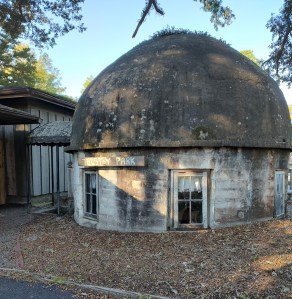
Stuart, dying, in his mid-sixties, and alone, embarks on a stoic existence and finds the Fairhope community to be kind and willing to assist. His ten acres have no house, only a barn in disrepair, and Stuart and his new-found Fairhope friend, Peter Stedman, create a suitable room in a corner of the barn. Stuart, inspired by the abodes of Native Americans and the nests of birds, plans to build a small round hut – a masonry dome, really – as his final home. The novel painstakingly describes Stuart’s method of building his house – he insists on doing it alone – as he pours concrete blocks and scavenges bricks from a ruin on the bay.

Brewer’s narrative excels in the quiet moments and the details of a life in nature. His descriptions of Henry Stuart’s methodical thought and process in the construction of his hurricane-proof abode make for reflection and calm, as do the minute details of Stuart’s life. The narrative is deliberate, but I found myself eager to keep reading – to see what would come next. The very decent people that Stuart meets and befriends along the way are finely and distinctly drawn; I hope they are based on real people, each one.

A former seminarian who eschews organized churchgoing, Stuart follows the philosophy of Henry George, who was an influence on many in the early twentieth century, including the founders of Fairhope and the great Russian author Leo Tolstoy. Stuart is an acolyte of the writings of Tolstoy, especially his nonfiction essays, and names his Montrose home “Tolstoy Park” in his honor.

Henry Stuart’s aim is to keep his terminal illness a secret from the Fairhope community, but secrets are hard to keep in a small tight-knit town – especially if the subject is a disheveled, unshaven, barefoot newcomer in his sixties. When Stuart admits to his friend Peter that “I am supposed to die,” Peter’s response is “Well, hell, I reckon so! Me, too.” Henry Stuart has chosen his place and way of dying and living and local gossip makes him withdraw into increased solitude to complete his tasks with minimal intrusion.

Suffice it to say, Mr. Stuart does not die on the doctor’s schedule.

As we used to say in third grade book reports, “If you want to know more, you’ll have to read the book.” I hope you will; it’s a very good one, with valuable lessons for living.

__________________________________________________

Henry Stuart was a real person and the basics of Sonny Brewer’s fictional narrative are essentially true. During his time in Fairhope, the retired professor became a fixture in the area, occasionally giving talks to the community – barefoot and sharing his far-reaching interests and philosophies. He welcomed visitors to his “hermit house” over the years; his guest book had well over a thousand signatures. The great civil liberties attorney Clarence Darrow, a regular visitor to Fairhope, reportedly signed the book half a dozen times.

Present-day visitors are still able to sign a guest book in the house that Henry built. The house is still there. It is listed on the National Register of Historic Places now, and is surrounded by a parking lot in a nondescript office complex off a busy highway. The rest of Stuart’s ten acres have been developed, but the hut at Tolstoy Park is always open to visitors. Author Sonny Brewer leased the space from the current owner of the property and did repairs. He stayed there while he was writing part of the novel.

It is a strangely efficient round house, fourteen feet in diameter, with an ancient tree standing beside it still, and with no corners to gather clutter. The house is built slightly into the ground and there are a door and six windows. Two skylights are at the top of the dome. The furnishings are simple, with places for writing, reading, and contemplation. There’s a wood stove. To save space, Henry Stuart hung his bed off the ground and used a ladder to crawl up and in. Today, there are mementoes of the original owner scattered about.

It is still a quiet, calm, and spiritual place, despite the encroachment of the growing community around it. When you visit, stand in the middle of the room and hum, or sing, or just say Hallelujah, to take advantage of the sublime acoustics. Take a moment to honor Henry Stuart, and to thank Sonny Brewer for bringing him and his story to a larger audience.

Fresh Books

Alabama Writers’ Forum has just published a new crop of reviews. I review Ayana Mathis’s new novel, The Unsettled, and a packed collection of short stories, The Best of the Shortest, that grew out of the legendary “literary slugfest” Southern Writers Reading in Fairhope, Alabama. And while you’re there, enjoy Susie Paul’s lively review of Jacqueline Allen Trimble’s How to Survive the Apocalypse, a new book of poetry. Check them out here:

Reviews

On Reading Jim Murphy’s “Versions of May”

Perhaps my favorite poem by Norman Dubie, the poet who died in the winter of this year, is “Pastoral,” a quietly startling poem about a woman nursing her baby as her father is shot to death. “…all the snow is red, the horse’s / Blood is white,” Dubie writes, before he gets to a memorably haunting final line: “Terror is / The vigil of astonishment.”

My synapses started firing while I read Jim Murphy’s new book of poetry, Versions of May (Negative Capability Press, 2023), and came across the poem “Letter to Westerberg” with the words about the “damaged and distorted / record that you left like blood on snow.” Soon after, in the poem “Terra Nova,” Murphy writes of “nothing known for sure / except the sweet terror of horizons.”

The ability of words to stoke evocative connections is a powerful thing and the fact that the words “blood,” “snow,” and “terror” sent me back to a much-admired poem from the 1970s illustrates the power of the written word, and poetry especially, to transform and stimulate. Dubie and Murphy share wide-ranging ken and conjure familiarity from the obscure.

Versions of May grabbed me from the first poem, “Grave as Blackberries” – an invocation, of sorts, calling forth joy and Miles Davis. Murphy writes poetry of subtext, in which larger truths and histories often lurk beneath the façade – poetry pentimento, in a way. Conversely, an expansive vision might give way to an intensely personal insight at the turn of a phrase.

In “Southern Holi,” a poem about the Hindu “Festival of Colors” in India, “filaments of the distant past” become “lost in the compact present.” Vestiges of that past abruptly halt the adults; the children frolic on, “not a worry in the world.” Murphy’s poems cover a world of topics with frequent shout-outs to jazz, blues, and rock musicians.  Chet Baker, The Beatles, Blind Willie Johnson, Hall and Oates, Jane’s Addiction, Jim Morrison, Lou Reed, Nina Simone, and others make cameos in these pages. In “Phone Call to Morrison,” he writes, “I’m trying to reach you on a black phone / in the hall, hung by its neck until dead.”

Murphy’s poems address joy and beauty, friends and family and bliss, but often with a keen sense of the darkness that lies beneath. These poems are set throughout the United States as well as in far-reaching locations in Mexico, India, and Vietnam. Section 2, a series of 13-line poems, considers topics that begin with a breath and continue to the death of a parent. “At last, you had become the chords,” he writes for his mother.

These are robust and vital poems – each with something to be pondered and savored. As Murphy writes “In Defense of Chet Baker”:

“You hear that? Someone / somewhere is singing.”

“Celebrate Books”

It was my honor to attend and report on the 2023 Alabama Writers Hall of Fame induction ceremony. The literary arts in Alabama are thriving, thanks in part to these fine writers. Read my article from the Alabama Writers’ Forum website.

The Gathering: Alabama Writers Hall of Fame Induction Ceremony, March 10, 2023

Book Review: It Falls Gently All Around

Alabama Writers’ Forum has just posted my review of Ramona Reeves’s award-winning collection of short fiction, It Falls Gently All Around. The book was just published by the University of Pittsburgh Press. Read the review here:

https://www.writersforum.org/news_and_reviews/review_archives.html/article/2022/10/07/it-falls-gently-all-around-and-other-stories

New Book Reviews for Alabama Writers’ Forum

My latest reviews about two sharply contrasting books have just been posted on Alabama Writers’ Forum. Deep South Dynasty by Kari Frederickson is a fascinating history of an influential Alabama family, the Bankheads. Barry Marks’s new poetry, My Father Should Die in Winter, examines grief and hope. Check them out at https://www.writersforum.org/news_and_reviews/