Tag Archives: Alabama sports

3rd Avenue West

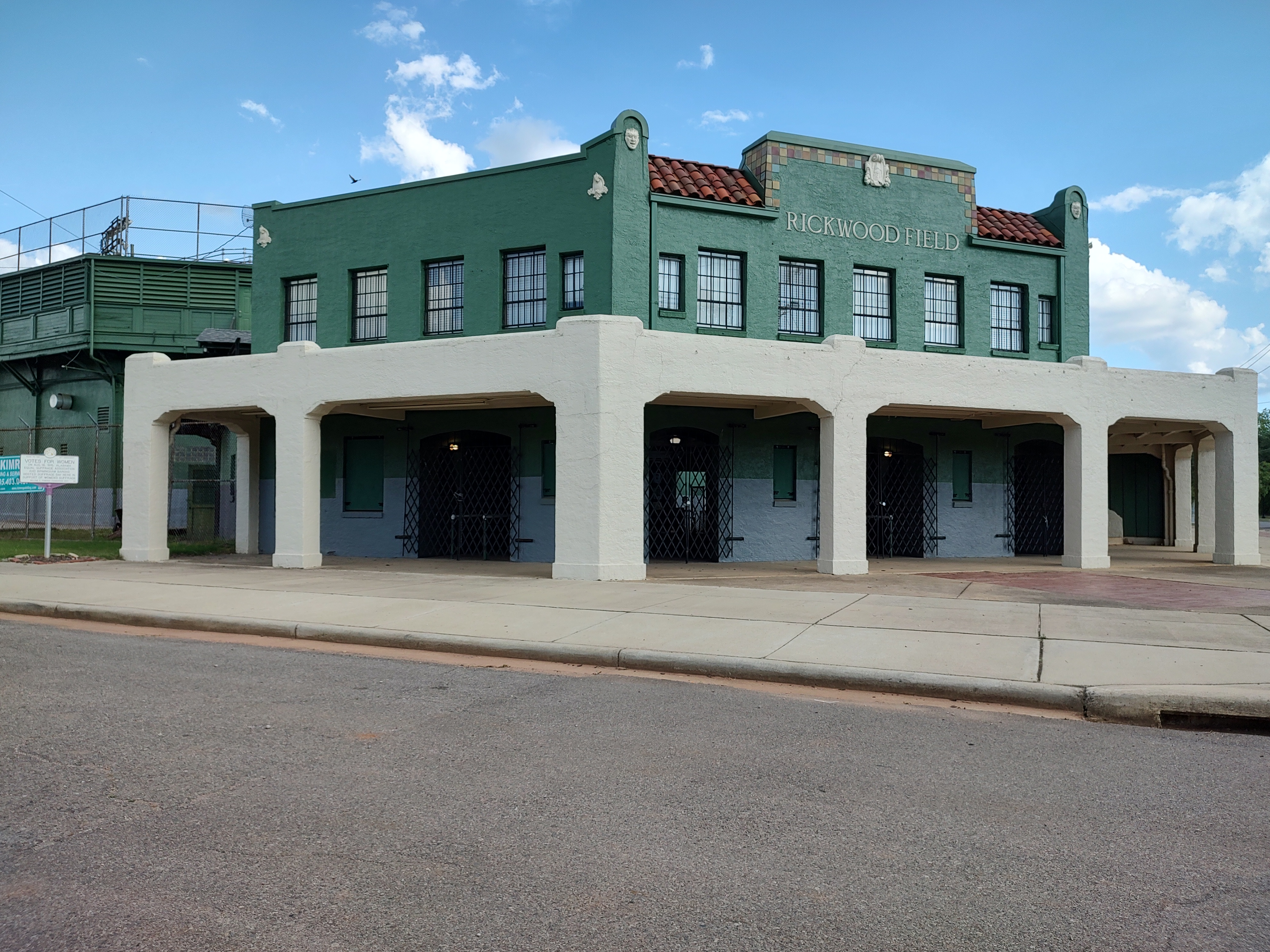
Rickwood Field; Birmingham

When Chicago’s Comiskey Park was demolished in 1991, Birmingham’s Rickwood Field, built in 1910, became the oldest professional baseball park in the United States (www.rickwood.com). The history of the storied baseball field in what is now a less-traveled section of Birmingham’s West End will be revealed to a wider audience on June 20, 2024, when Rickwood hosts Major League Baseball’s nationally televised tribute to the Negro Leagues with a regular season game between the San Francisco Giants and the St. Louis Cardinals. Birmingham native and Hall of Famer Willie Mays, who began his professional baseball career as a Birmingham Black Baron in 1948, will be the honoree.

In the years of segregation, the Birmingham Black Barons shared Rickwood with the Birmingham Barons. Even for those who are not big baseball fans, lists of the ballplayers who played at Rickwood – either as members of the local teams or with exhibitions or traveling teams – is impressive to the point of being daunting. In addition to Willie Mays, there are Hank Aaron, Vida Blue, Ty Cobb, Piper Davis, Dizzy Dean, Joe DiMaggio, Lou Gehrig, “Shoeless Joe” Jackson, Mickey Mantle, Stan Musial, Satchell Paige, Jackie Robinson, Babe Ruth, Honus Wagner, and so many more. When Birmingham native Charlie O. Finley owned the Oakland A’s, his 1967 minor league Birmingham A’s roster boasted Dave Duncan, Rollie Fingers, Reggie Jackson, Tony LaRussa, and Joe Rudi.

The Birmingham Barons’ current home is Regions Field in downtown but they play a throwback game at Rickwood every season. Rickwood is listed on the National Register of Historic Places. A very active Friends of Rickwood organization has worked for decades to nurture and refurbish the baseball park, which remains a facility for a local college and Birmingham city schools. Major League Baseball has chipped in with upgrades over the past year, since the Negro Leagues salute was announced. Sneak peeks indicate that the changes and upgrades have not diminished the essential character of the proud structure or its infield. I can still imagine my dad as a teenager riding his bicycle from Ensley to Rickwood to sell concessions in the stands. From Rickwood Field, one can see 3rd Avenue West.

__________________________________

When I was a kid, Birmingham was still a center of heavy industry and factory-life was going strong in areas like the U.S. Steel works in Fairfield and Ensley and other industrial sites. Because of shift work, the commercial areas of these places were twenty-four-hour districts.

To a young boy, the bustle and energy of western Birmingham was exciting. I had grandparents in Ensley and Fairfield Highlands and lived in the Green Acres community from second to eighth grade; much of my growing up years was spent in those areas.

In those days before the interstate, 3rd Avenue West was the central thoroughfare of west Birmingham. Going east on 3rd Avenue West, it became 3rd Avenue North and went downtown into the theatre district. Going west, it became Bessemer Super Highway. Bessemer Super Highway was originally modelled on the German autobahn and was destined to be the first controlled-access highway in the United States. Funding dried up in the Depression, but the four-lane with wide medians was still impressive for its time.

I particularly remember a row of motels including a Wigwam Village Motor Court, a chain featuring teepee-shaped cabins around a central teepee main building. My parents bowled at the Holiday Bowl and Alabama’s first Holiday Inn was along that stretch.

Occasionally, we would hear about a “gas war” up on the highway. Gas stations would start competing for the lowest prices and cars would line up to take advantage as long as it lasted. I can remember gas getting as low as ten cents a gallon before a filling station owner blinked and gas prices began to make their way back up to the average price of 31 cents a gallon.

5 Points West Shopping City was a sprawling shopping center with a large variety of shopping options. My mother has particularly fond memories of New Williams and Parisian department stores at the site. A Parisian saleslady would lay aside boys’ clothes that she thought Mother might like to consider for me.

Across from the shopping center was the Alabama State Fairgrounds. In those days it was a real fall state fair with agricultural exhibitions, a grandstand, and a large midway with carnival rides. Kiddieland Park was the small amusement park on the southwest corner of the fairgrounds. Fair Park Drive-In Theatre was at the other end and the Birmingham International Raceway occupied the grandstand area. The Birmingham Crossplex, an athletic facility, occupies the space now.

There were other favorites along 3rd Avenue like El Charro, a Mexican restaurant in a time before there were Mexican restaurants and fast-food joints everywhere. Spinning Wheel was a local chain of ice cream drive-ins. It was close by Lowe’s Skating Rink, a popular spot where my parents had dated. Carnaggio’s had traditional Italian. A unique dining choice where my family was regular was Porter’s Cafeteria, a meat and three on a balcony overlooking a drugstore.

Those places always felt special to me.

________________________________

Memory gets burnished with time. And, as time erases remnants, younger generations who were not first-hand witnesses are strained to give credibility to those memories. That’s true of many areas in Birmingham’s West End. Much of the news from 3rd Avenue West is negative these days, but there are still places of pride and plenty of good memories in the western part of town. Rickwood Field’s upcoming moment in the spotlight should help to revive memories of that area’s importance to local history. Perhaps, also, it might inspire further positive development.
The Houndstooth Trigger

Fried Green Tomatoes (www.eatfgt.com), a comfort food place in the Birmingham suburb of Hoover, is an offshoot of the Irondale Café across town, which was the inspiration for the Whistle Stop Café in Fannie Flagg’s popular novel, Fried Green Tomatoes at the Whistle Stop Café. The food at Fried Green Tomatoes is mostly seasonal and locally sourced. It offers dine-in and take-out, has a friendly staff and a casual vibe, and has been a great place to have close-by during the pandemic.

It’s popular with the after-church crowd on Sundays and I was standing in a long line waiting to order take-out on a recent Sunday afternoon. I was masked and trying to stay socially distanced, standing against a wall near the door and leaving enough room to let people pass. There was plenty of room to cross in front of me; even so, a woman got up in my face, rudely saying “Excuse me!” I tried to press myself even tighter against the wall. Moving on, she shrieked “War Eagle!” twice to the couple next in line to me, looking back and snarling at me the whole way out (she wasn’t masked, so I could see the snarl). The two fellas with her followed suit (“Excuse me! War Eagle!”)

These are crazy times indeed.

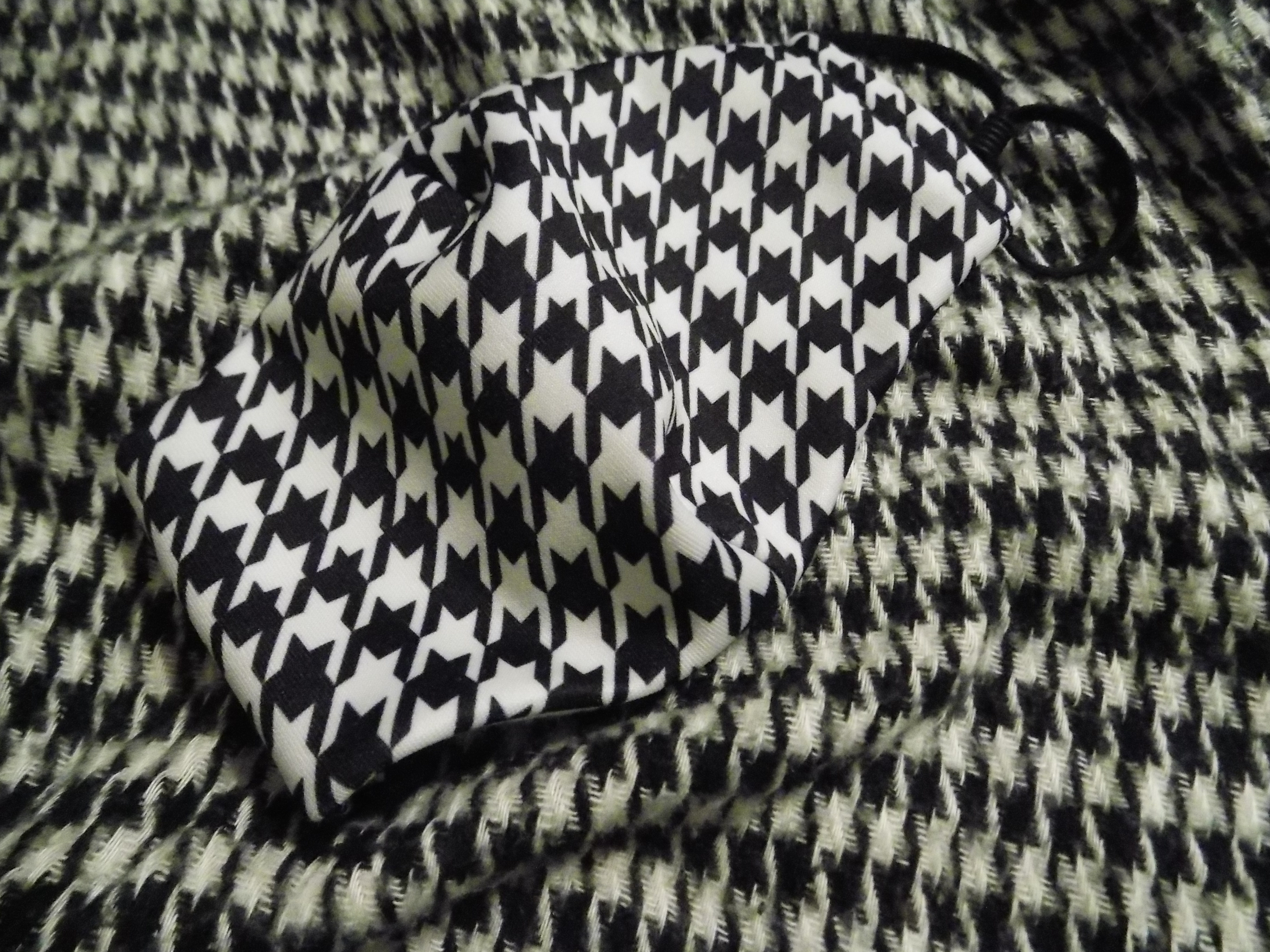
When they were out the door, I glanced at the couple next to me and saw that the man was wearing an Auburn shirt. I was wearing a houndstooth mask. It all became clear. I had just been figuratively slimed by an Auburn fan. My mask must have been a trigger for the woman’s unpleasant outburst. We’re all on edge these days, I guess.


In 1995, I bought a houndstooth scarf at Lazarus department store in Evansville, Indiana, on a wet and cold day. This purchase was years before houndstooth had become so associated with the attire of my alma mater, the University of Alabama. I liked the scarf, didn’t associate it with the University at the time, and still wear it sometimes when it’s cold enough. I was amused a few years later when the University began to exploit the design. I was a student at Alabama during the “Bear” Bryant era and he didn’t always wear houndstooth hats; there are plenty of images of him wearing checkerboard and plaid patterns, too. Still, if you’re going to adopt a fashion statement for sports iconography, houndstooth is a pretty stylish way to go.

Around the time, in the early 2000s, when Alabama football fans began to flaunt houndstooth, I would get a “Roll Tide” any time I wore the scarf. Since I don’t really mind an exchange of “Roll Tide,” I respond appropriately and move on, not bothering to explain that the scarf was never about football for me. I will admit, however, that the houndstooth face mask was a conscious choice.

I take great and justifiable pride in Alabama’s football legacy and I am aware that on occasion some of our fans step over the line. I have not forgotten the idiot who poisoned the live oaks at Auburn’s Toomer’s Corner (live oaks that were already being slowly killed, unfortunately, by the Auburn tradition of toilet papering them whenever Auburn won a game – and power-washing them to get the paper out the next day). And I am embarrassed by the fact that Alabama sorority rushees’ TikTok posts went viral during the recent Fall Rush. I have long considered Alabama’s greek system of fraternities and sororities to be the biggest blemish on the University’s reputation.

I am reminded of an incident in Pasadena in 2010 when Alabama won its first national championship of the Saban era. On the day of the Rose Bowl, an Alabama fan, who had probably partied too much early in the day, took to an intersection to scream “Roll Tide” to all who passed. A demure Alabama fan left her seat at a sidewalk café and rested her hand on his shoulder. “Honey,” she said, “you need to settle down. We don’t do that sort of thing out in the middle of the street. Save that for the Rose Bowl tonight.”


Which brings me back to my “War Eagle” woman at Fried Green Tomatoes. I am irritated by that huge chip Auburn people seem to have on their shoulders about Alabama’s football dominance. Frankly, I don’t pay much attention to Auburn football until Iron Bowl week – the week of the annual showdown between the intrastate rivals. Beyond that, Auburn football, for me, is like a gnat – an occasional annoyance, but no big deal. I am quick to point out Auburn’s good veterinary medicine and architecture programs, but the football team and its succession of milquetoast coaches don’t occupy much of my attention. Even on the occasions when Auburn beats Alabama on Thanksgiving weekend, the sting is gone by Monday morning.


Auburn won its second national football championship in school history in 2010. Their first was in 1957. Based on that average, they might have their next national championship around 2063.

I’m pretty sure I can take a pass on that. Roll Tide.

Legion Field

dscn0633 The massive steel girders and beams of Birmingham’s Legion Field have thrilled me since I was a kid growing up in the city.  “The Old Gray Lady” is 90-years-old and, even though her best days are likely behind her, she maintains a majesty and charm. Another proud old sports arena, Rickwood Field, sits a short drive from Legion Field and is the oldest remaining professional baseball field in the country. Rickwood opened in 1910 and the first Legion Field game was played in 1927.

When I was in college, the University of Alabama’s significant games and major rivalries were played at Legion Field. In those days, Denny Stadium on campus in Tuscaloosa was a perfect little 60,000 seat bowl and half of the home games were played there while the other half went up the highway to Birmingham. This is years before Bryant-Denny became the 101,000+ seat behemoth that it is today and before big-time college football had become so “corporate.” dscn0624

Coach Paul “Bear” Bryant was the coach then and, depending on which national polls you’re counting, my freshman year was the year of Alabama’s ninth national championship and Bryant’s fourth of six. The most enduring memory of my years attending Alabama games at Legion Field is the image of Bear Bryant, hat always in place (despite the legend, it wasn’t always a houndstooth hat), leaning casually against the goal post and watching the team warm-up. One time, when Alabama offered Bryant a significant boost in salary (which would be paltry by today’s standards), he commented that it would be unseemly for the football coach to make more than the college president. Times have changed.

In those pre-ESPN days of a finite number of television channels and networks, the weekly choice of televised college football games was limited and it was always a treat when Alabama football was nationally televised – usually on ABC and usually with the great sports broadcaster Keith Jackson calling the game (“Whoa, Nellie!” and “Hold the phone!” Jackson would say at particularly exciting moments).

In 1981 Bryant broke the record of the most wins by any college football coach up to that time. Keith Jackson was in the booth. The opponent was Auburn and the game was played in Legion Field. The final score was 28-17. At halftime, Bryant growled to interviewer Verne Lundquist that his players were acting “like they’re afraid they’ll hurt somebody’s feelings or something.”

During those years the upper deck was in place on the east side of the stadium and the capacity of the stadium was around 70,000 with more expansions to come. For many years the words “Football Capital of the South” were displayed inside Legion Field and for most of those years that was true. At its peak, Legion Field could hold over 83,000. When a structural review in 2004 determined that the upper deck was not up to code, the city removed the deck and the stadium now seats about 71,000.

With the increased capacity of Bryant-Denny in Tuscaloosa, the University of Alabama began to schedule more home games away from Legion Field. The annual “Iron Bowl” between Alabama and Auburn was always played at Legion Field from 1948 to 1988. Tickets were split evenly between the schools and they alternated the “home team” each year. After Auburn moved the game to Auburn in their “home team” years, Alabama would continue to play the game in Birmingham in their “home” years until the end of the century. The Birmingham location is the reason that the game is called the “Iron Bowl” in the first place. And the game is still and forever the “Iron Bowl’ even though it will probably never be played in Birmingham again.

The last time I lived in Birmingham, I could see Legion Field across town from my apartment on Red Mountain. When an Alabama game was televised I would host watch parties at my place; if the game was at Legion Field and something went wrong I was known to go out on the balcony and yell toward the stadium (a couple of times, maybe more …).

In the heyday of big stadium concerts, Legion Field hosted acts like the Rolling Stones, U2, and Pink Floyd. The last time I saw the Stones live was at Legion Field for the 1989 “Steel Wheels” tour. dscn0625

Among the monumental architecture at the entrance to Legion Field, which was named to honor the American Legion, are two reclining lions and, at the base of the two flag poles, American bald eagles. A later monument, centered between the flag poles, memorializes Bear Bryant. A quote from Reagan at the time of Bryant’s death is engraved beneath Bryant’s bust on one side and Bryant’s own words about what it takes to be a “winner” are on another.  On the façade of the stadium these days are the words “Built by Legends.” dscn0628

The Iron Bowl is gone but Legion Field still hosts annual games like the “Magic City Classic” between Alabama A&M and Alabama State. The Classic has been played in Birmingham for seventy years. The Birmingham Bowl is the latest and longest lasting in a series of post-season bowl games played in the stadium. The first two SEC championship games were at Legion Field. The stadium has been the site for high school football and major soccer events and was home to local football teams of the several short-lived efforts to challenge the NFL (WFL, USFL, XFL, etc.).

Legion Field will once again be the home field for the resuscitated University of Alabama at Birmingham Blazers football team in fall 2017. For those of us who remember the Old Gray Lady’s glory years, it’s somewhat sad to see the mostly empty stands for UAB games.

Legion Field was already in its fifth decade when the Houston Astrodome opened and was declared the “Eighth Wonder of the World” in 1965. These days, the Astrodome is virtually obsolete — empty and avoiding the wrecking ball – but Legion Field soldiers on.

Long may she live. Roll Tide. dscn0635