Tag Archives: Birmingham

On (re)Reading Walker Percy

IMG_1782  One of my assignments during graduate school was to assist the surly and pompous professor who briefly headed up the playwriting and dramaturgy program. He was a Boston native, out of Yale and Carnegie-Mellon, and some kind of Orson Welles scholar. His current assignment was at a Southern university but he made no effort to disguise his contempt for Southerners and the South.

I found him rude and offensive but tolerably amusing and treated him with a level of respect he had not earned. One afternoon we sat in his office discussing scripts that had been submitted to the department’s playwriting program and that conversation veered off onto a number of topics.

“Welles Scholar” leaned back in his chair, eyed me seriously, and said, “I like you, Journey. You’re that rare breed – an intelligent Southerner.”

I seriously eyed him back and said, “Y’know, that may be one of the most insulting things that’s ever been said to me.” I told him I had to get to a seminar and politely excused myself, fuming.

From that moment on, I detested “Welles Scholar” and was delighted to see him leave at the end of that academic year. I’m sure he meant the statement as a compliment to me but the cluelessness, arrogance, and stupidity which informed the comment made me angry and still makes me angry whenever I think about it.

I had not thought of the Welles Scholar story for a number of years but it came back to me this week as I was renewing my acquaintance with the writing of Walker Percy.

The great writer Walker Percy (1916-1990) is legitimately claimed by three states – Alabama, Louisiana, and Mississippi. He was born in Birmingham and lived there until he was 13. After the death of his father, his mother moved the family to Georgia. When she died, he and his brothers were taken in by a bachelor uncle in Greenville, Mississippi. He graduated from the University of North Carolina, earned a medical degree from Columbia, and contracted tuberculosis that lead to a lengthy recovery at a sanitorium in upstate New York. Percy spent the bulk of his adult years in the New Orleans area, eventually settling with his wife, Mary Bernice (“Bunt”), and children across Lake Pontchartrain in Covington, Louisiana.

Percy’s writing is deeply probing and intellectual, mixing Existentialist philosophy and scientific inquiry with Roman Catholic theology and the search for spiritual fulfillment. He deals brilliantly with the South and the complexity of the Southern “character.” He writes with amused suspicion and insight about both the South and other parts of the country but the observations are always filtered through a sense of what it means to be “Southern” in all of its forms.

Percy’s novels often focus on a flawed protagonist who doesn’t quite seem to belong anywhere but continues the quest for meaning and belonging nevertheless. Percy’s books are challenging and they tackle some weighty issues with an underlying wit, compassion, and turn of phrase that make them compelling and entertaining.

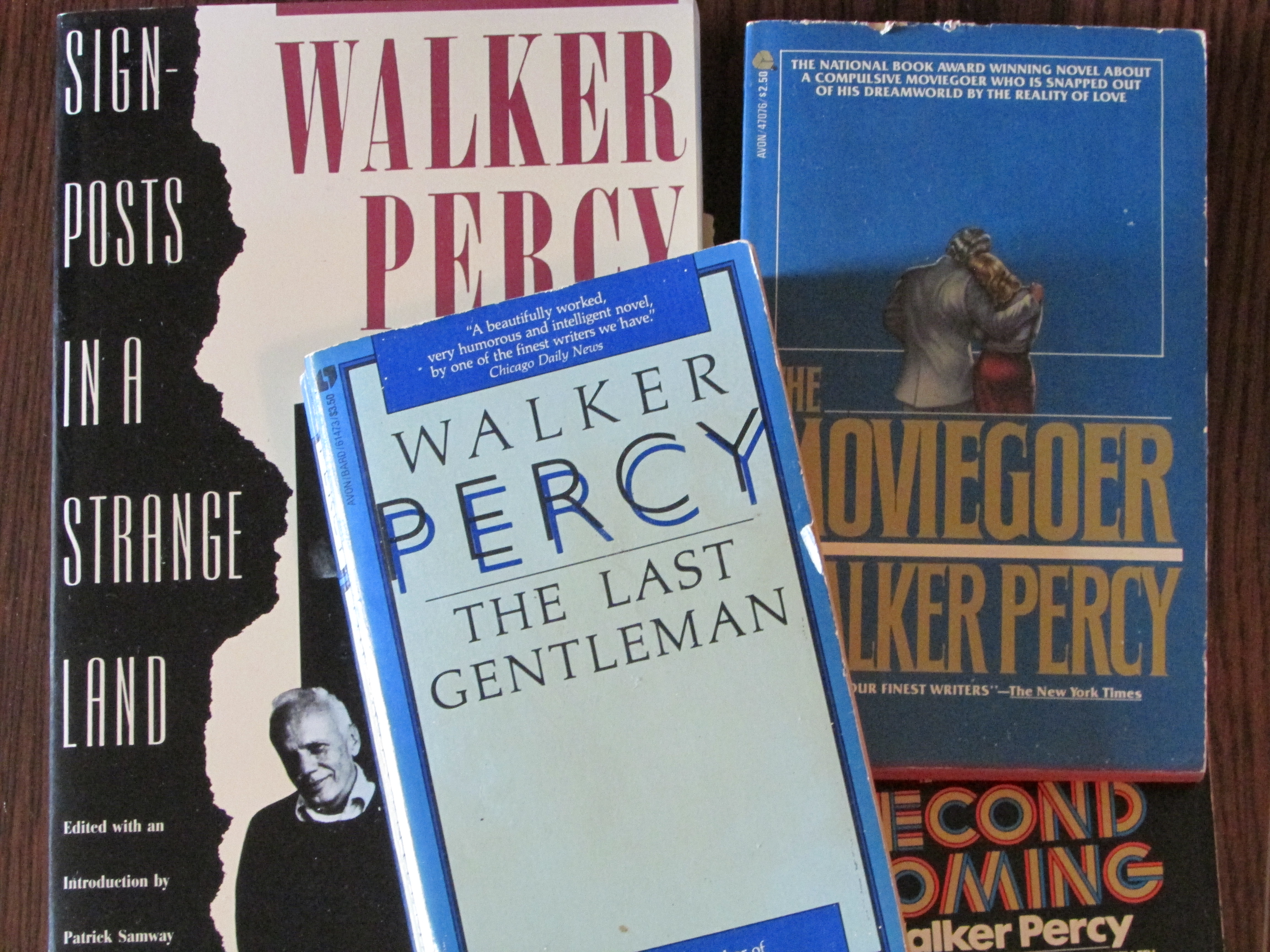
Percy’s first published novel, The Moviegoer (1961), is still his most acclaimed. I discovered that book, and Percy, early in my college years and it is still a favorite literary discovery; I find new areas for focus with each reading.

Until this week, I had not read Percy in a while. I ran across an item about him recently and decided it was time to revisit him. Since I had never read his second novel, The Last Gentleman (1966), I pulled it from my bookshelf and started to read. Here’s the odd thing: I began to run across passages that had been obviously underlined by me – they were the sorts of sentences and words that I would have underlined. The book was also full of evidence of previously dog-eared pages.

I still underline passages in books and frequently dog-ear pages. I was never one to write comments in the margins, although I occasionally do that too. This is one of the reasons I will always want to deal with the object of the book; I take pleasure in the tactile physical presence as I do in the words contained therein.

So I was quickly aware that I had already read The Last Gentleman at some point in time. At the beginning I thought Okay, it will start coming back to me as I read on. I read on. It all felt new to me and the last moment of the last page surprised me as if it were brand new. It was an eerie and enjoyable experience. The effect was heightened by the fact that the main character, Will Barrett (usually referred to, ironically, as “the engineer”), suffers from episodes of déjà vu and amnesia. My previously underlined passages were a form of déjà vu for me, the reader, and the fact that I had no memory of the story was my amnesia.

Another odd thing is that the city in which much of the book takes place is clearly based on Birmingham (Walker Percy confirmed as much) and a frequently mentioned landmark in the book is clearly a veiled reference to George Ward’s old “Vestavia” estate on the crest of Shades Mountain that gave Birmingham’s Vestavia Hills suburb its name. (That estate, by the way, is now the location of Vestavia Hills Baptist Church for those readers who know Birmingham geography.) I am surprised that I didn’t remember any of that from my previous reading.

Although I still don’t recall reading the book the first time, I’m sure that I thoroughly enjoyed it that first time just as I thoroughly enjoyed it this week. That certainty is based on the passages I underlined.

Buoyed by my rediscovery of The Last Gentleman, I grabbed The Moviegoer and had the opposite experience of total recall and recognition. It was like revisiting an old friend and I remembered and enjoyed each juicy detail. The Moviegoer is a New Orleans novel and Percy makes no effort to disguise the geography or the names of the actual places. The Moviegoer is the “Ur-text” for all of Percy’s concerns and themes in his novels, essays, and philosophical writings to come.

I wonder if any other writer uses the word “malaise” as often as Percy. The word peppers the text of The Moviegoer. Even so, I think Percy has an ongoing optimism tempered with realism that informs all of his writing. It is much-discussed in Percy scholarship that his early life was dogged by suicide – his grandfather and father committed suicide and he always believed that his mother’s fatal car wreck was a suicide.

The novels I read this week are at least half a century old but I still share the protagonists’ sense of displacement and mistrust in a modern world transitioning to post-modern (post-future? – where are we now?) modes. The changes seem large to the ’60s protagonists – how would the world appear to and discombobulate them half a century later?

The issues that occupy Percy and his characters never go away or find resolution; they just morph as the decades fall into place, one after another. How fortunate we are to have access to timeless writing that deals with these issues so searchingly, so entertainingly, and with such compassion and humor.

That Welles Scholar comment about the rarity of the “intelligent Southerner” came back to me while I was reading Percy, one of the most probingly intelligent of 20th Century American writers — as well as one of the most Southern. I fantasized a face-off between “Welles Scholar” and Percy.

Percy would have eaten him alive.

“Complex Vision” and a Medical Visionary

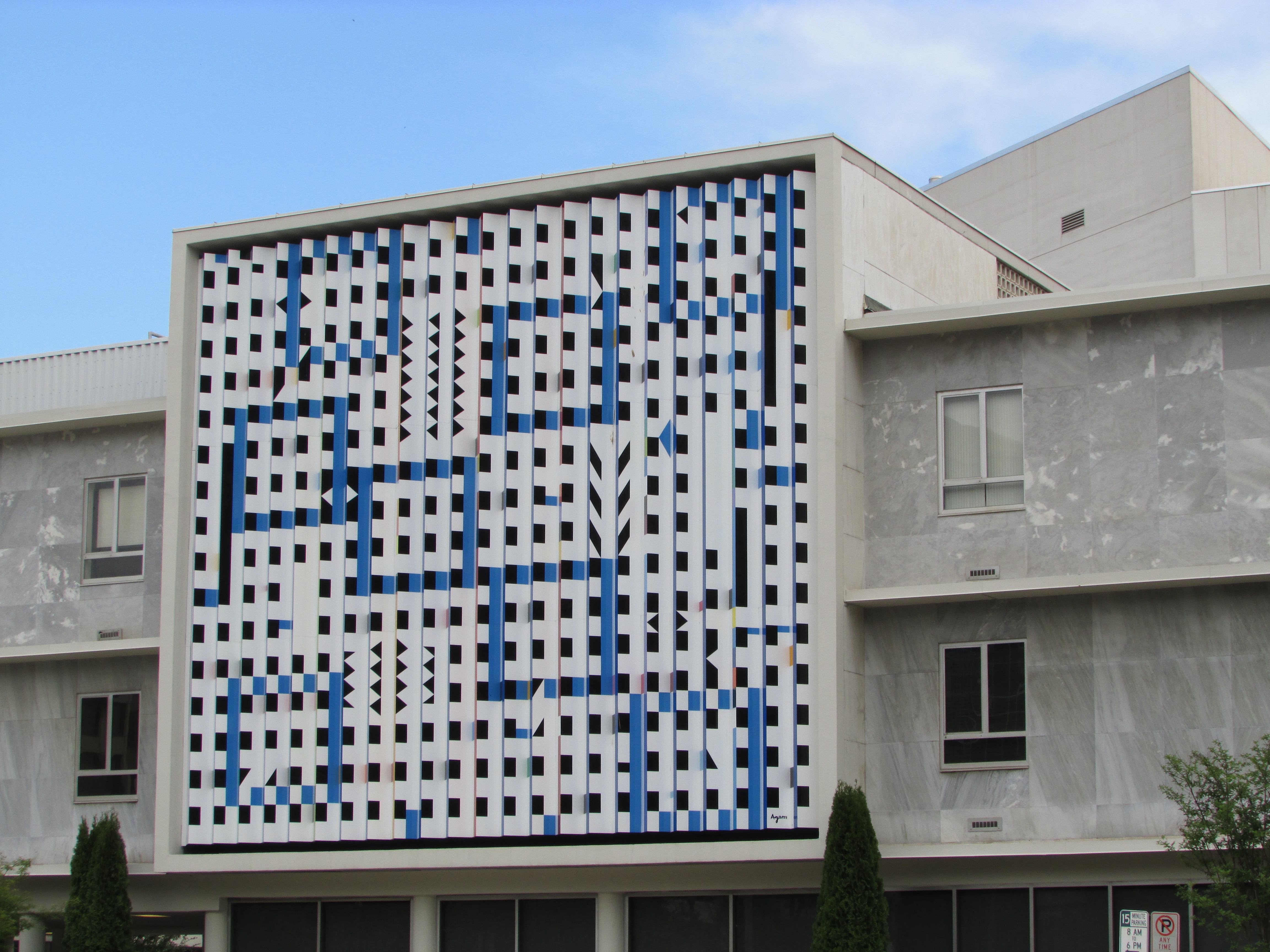
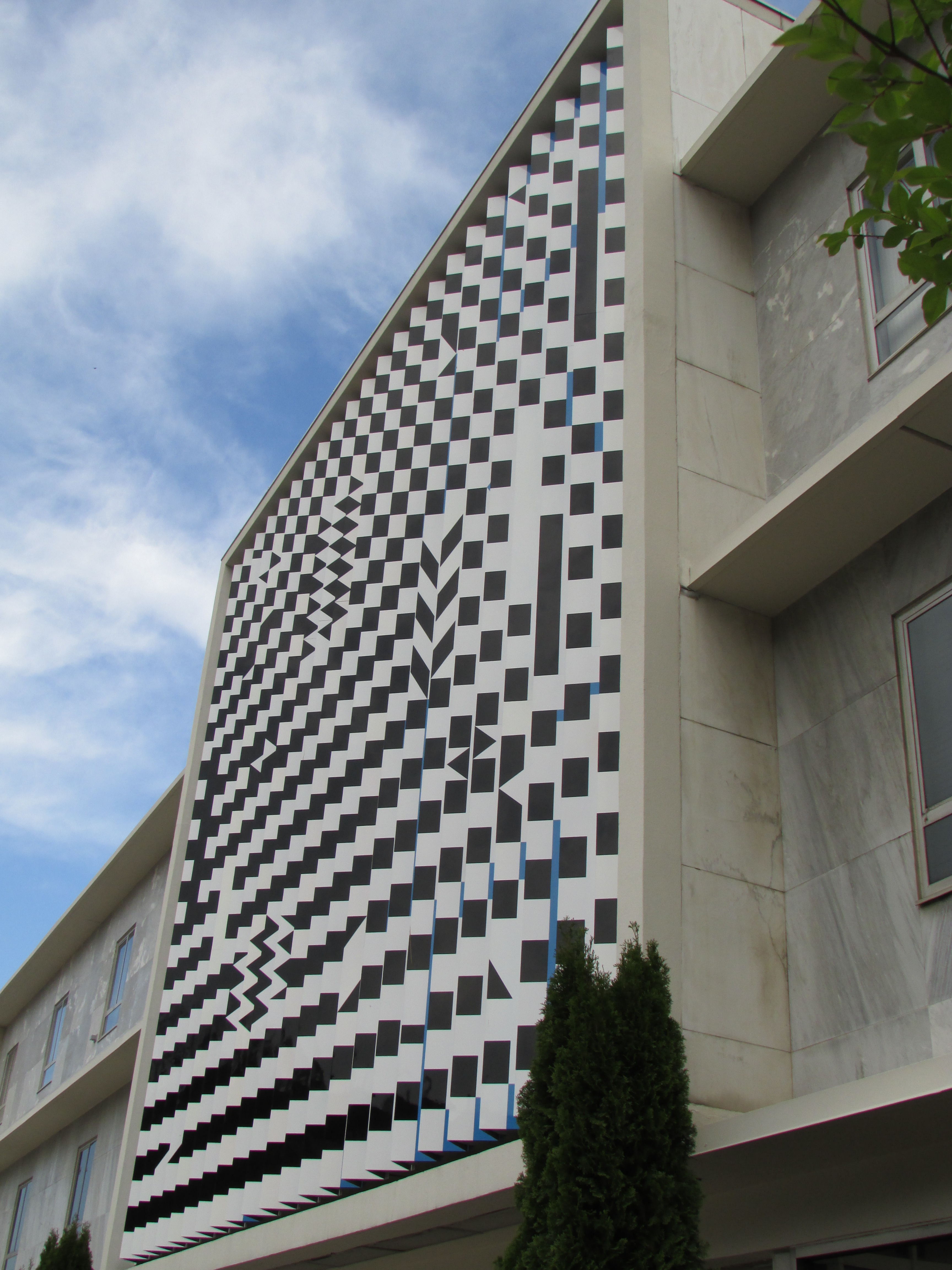
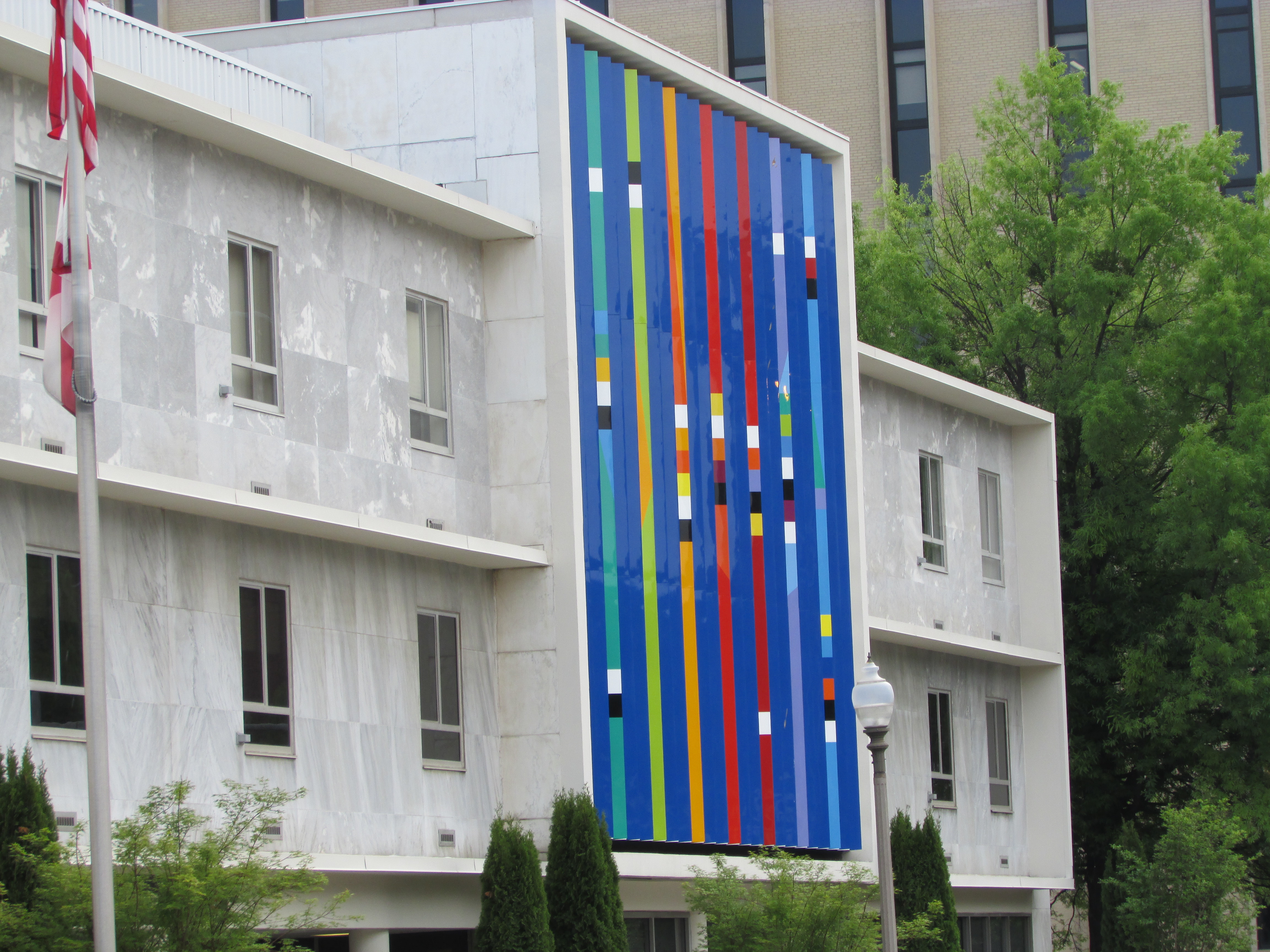
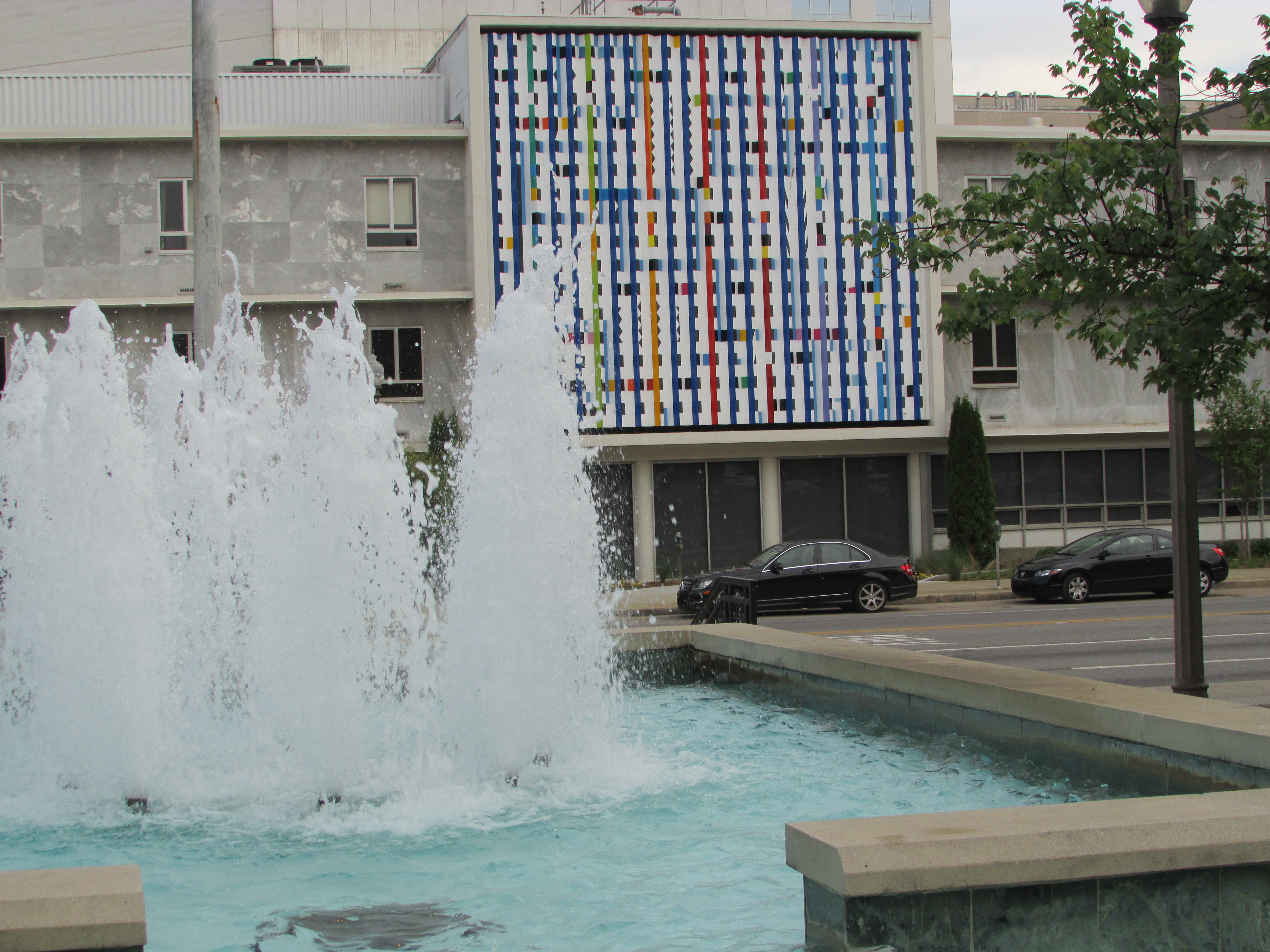
IMG_1541  After a year of restoration under the artist’s supervision in Florida, Yaakov Agam’s “Complex Vision” is back at home on the University Boulevard façade of the Callahan Eye Hospital in Birmingham. The Israeli artist’s 30’x30’ kinetic mural, commissioned by Dr. Alston Callahan (1911-2005), the ophthalmology pioneer and founder of the Eye Foundation Hospital (www.uabmedicine.org/locations/uab-callahan-eye-hospital) that now bears his name, has been a striking landmark in Birmingham’s sprawling medical center since the 1970s. IMG_1545

My mother has a strong bond with the Eye Foundation and a visceral affection for Agam’s mural. After being misdiagnosed for a problem with her left eye by another doctor in another town, her malignant melanoma was diagnosed by Dr. Callahan at the Eye Foundation in 1986. Immediate surgery led to loss of the eye but the cancer was removed and there has been no recurrence. She is now cancer-free for over twenty-nine years.

The Callahan Eye Hospital and its patients seem to become like family. My mother’s ongoing relationship with the hospital and members of its staff is powerful. She is now the patient of “Dr. Mike” Callahan, Alston Callahan’s son, and maintains friendships with employees whose time with the hospital dates back to her 1986 life-saving and life-changing surgery. IMG_1559

Dr. Callahan seems to have envisioned the Agam sculpture as a gift for his patients. He imagined the patient who arrived at the Eye Foundation with impaired vision being able to leave to appreciate the full color and beauty of the mural. Symbolically, from one perspective the mural is black and white; as one moves past it, it reveals itself in its full array of vivid panels of primary colors and patterns.

IMG_1550

I know that Mother wants to view it each time she visits the hospital and she likes to drive by it whenever she’s downtown. She missed it over the past year and is delighted at its return. The mural was spectacular as it was but the renovation has clarified, brightened, and reinforced its vibrant splendor. IMG_1553

Dr. Alston Callahan’s lasting influence extends far beyond the Eye Foundation Hospital and the many patients he served. He and his wife, Eivor Holst Callahan, left an impressive legacy as philanthropists and art collectors. Much of their extensive Asian art collection was bequeathed to the Birmingham Museum of Art. The museum’s Indian and Southeast Asian gallery,  a meditative room with a window looking across to Linn Park and the skyline beyond, is named the Eivor and Alston Callahan Gallery in their honor. The museum also has an annual Eivor and Alston Callahan Lecture series focusing on Asian art.

In addition to all of that, Dr. Callahan was a seasoned world traveler who went on expeditions to both the North and South Poles. Those adventures, in addition to the Eye Foundation, are commemorated on his gravestone.

The Callahan’s home atop Red Mountain overlooked Birmingham with a direct view across the road to Vulcan, Birmingham’s iconic iron man statue. I once lived in an apartment around the curve from Vulcan and that house and was a fan of the architecture before I ever knew who lived there. The Moshe Safdie-designed house was a modernist vision of dramatic mystery and unexpected angles. It was the kind of house that made one wonder what treasures were to be found inside. It went on the market after Dr. Callahan’s death (his wife preceded him in death in 2002). Unfortunately, the new owners razed the Callahan house and built another more traditional big house in its place. It’s a perfectly fine house, I guess. But now it’s just another big house on the mountain. The Callahan house was one that was destined to live in the memory. IMG_1562

The loss of the Callahan house, however, does not diminish the impressive legacy of Dr. Callahan. That legacy lives on in Birmingham and beyond in the Eye Foundation; the Callahan Eye Hospital; the International Retinal Research Foundation; the art his family collected and shared; the BMA’s Callahan Gallery and Asian lecture series; and the thousands of doctors and patients who are touched directly or indirectly by his influence. Given his impact on my family, Mother’s Day seems to be a perfect time to honor him.

The magnificently restored Agam mural is perhaps the most visible and accessible piece of that legacy. And now it’s back where it belongs. IMG_1557

Highlands Bar and Grill

IMG_1509  My first extended post-Katrina visit to New Orleans in 2007 coincided with the New Orleans Wine and Food Experience. Held in May, that event showcases local restaurants and is a draw for food and wine aficionados from many places. I met a couple who were restaurateurs from Napa and the husband’s work required him to travel all over the world. When I mentioned that I was from Birmingham, he said, “You know, Birmingham is a great food city. Not many people know that.”

I already knew but it was nice to hear it from somebody from the west coast.

Growing up in Birmingham, there was good dining to be had and there was always an abundance of Greek-owned eateries from hot dog stands to white tablecloth establishments. The place has long been a mecca for classic southern “meat and three” places and the quality and variety of barbecue and barbecue styles in the area is an embarrassment of riches.

But when Frank Stitt opened Highlands Bar and Grill (www.highlandsbarandgrill.com) in Five Points South in 1982, the bar for Birmingham dining was significantly raised. A few years later Stitt opened Bottega and Bottega Café (www.bottegarestaurant.com) a few blocks away on Highland Avenue and then Chez Fonfon (www.fonfonbham.com), a more casual bistro, next door to Highlands.

Add to that a preponderance of good eats from other chefs, many of whom worked for Stitt before striking out on their own. There are always a new attitude and a new swagger creating a great and unpretentious urban destination for dining at every level and taste. In the Five Points South area near Highlands, I am partial to Ocean (www.oceanbirmingham.com) and Hot and Hot Fish Club (www.hotandhotfishclub.com) but every time I go to Birmingham lately it seems that a “must visit” new dining option has opened somewhere in the city. I am falling way behind on keeping up and checking them out.

Highlands, however, is still the flagship. It is pricey and elegant and provides an unmistakable sense of occasion when one enters the door. However, it is never snooty nor pretentious, it features the best locally grown and fresh ingredients, and a meal at Highlands is always an opportunity to relax and breathe. Frank Stitt and his wife, Pardis, create gracious and memorable dining experiences for their guests.

The wait staff is knowledgeable, efficient, and playful. I like to eat seafood from the Gulf when I am at Highlands; for my taste, Highlands prepares fish better than anybody. But everything on the menu pleases. We celebrated my mother’s milestone birthday at Highlands last summer and she declared her steak that night to be “the best steak I’ve ever eaten.” The menu is seasonal and changes often but Highlands baked grits, a signature dish, is always on the menu.

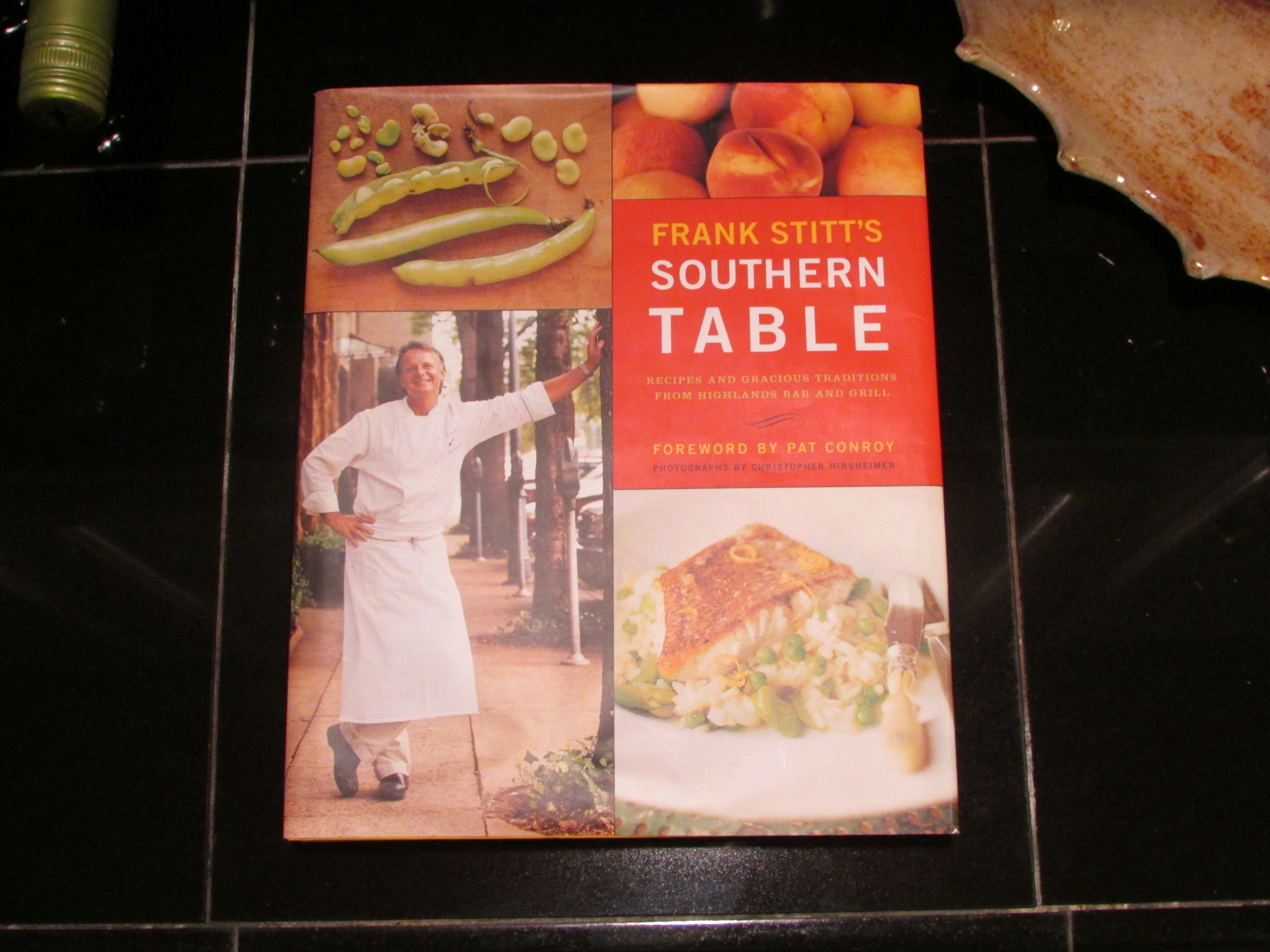
Two of my most often thumbed through cookbooks are by Frank Stitt. The first, an instant classic, is Frank Stitt’s Southern Table. It was followed by Frank Stitt’s Bottega Favorita. In each, the reader and cook find a delicious assortment of unique takes on food preparation and presentation culled from Stitt’s extensive experience. Stitt is a native of Cullman, Alabama, who attended college at Tufts and Berkeley, apprenticed and cooked in France and the Caribbean, and ultimately opened his restaurants less than an hour from where he was born.

Highlands Bar and Grill and Frank Stitt are on my mind this week because the 25th presentation of the James Beard Awards (JBAs) for restaurants and chefs will be held in Chicago on Monday, May 4, 2015. Highlands Bar and Grill is one of the five finalists for Outstanding Restaurant for the seventh year in a row. The other four finalists this year are in New York.

I have been paying attention to the JBAs (www.jamesbeard.org) for many years and have paid particularly close attention since Stitt and Highlands have been regular contenders. Stitt was inducted into the JBA Who’s Who of Food and Beverage in 2011 and was named Best Chef – Southeast in 2001. I find that very often the winner for Outstanding Restaurant is a top five finalist several times before it wins so every year I tune in to see if this year is Highlands’ “turn.” I feel good about lucky 7.

A confession: I will be watching the James Beard Awards on Monday night. They are streamed every year on livestream.com and I am just enough of a food nerd to watch a couple of hours of restaurant awards. I want to be a witness when Highlands gets its much deserved honor. It will be an honor for the whole city. On the down side, it may make it even harder to get a reservation at Highlands Bar and Grill.

Mother and Truman at Highlands in June 2014

(The photograph is of my mother, Jean Journey, and my nephew, Truman, outside Highlands in June 2014.)


“I Love You, Alice B. Toklas”

IMG_1114   I bought my first Gertrude Stein book, The Autobiography of Alice B. Toklas, at the late great Smith and Hardwick Bookstore on 20th Street in downtown Birmingham in the ‘70s when I was an undergraduate at Alabama. Smith and Hardwick was one of those amazing bookstores with an outstanding jumble of books on two levels in seeming disarray. It was owned by the Praytor sisters – Virginia and Anna – and by Anna Praytor alone when Virginia died in 1974.

If you were looking for a particular title in the store and couldn’t figure out where it might be in the dusty stacks, one of the Misses Praytor always seemed to know exactly where it was located. Here’s what great locally-owned bookstores were like back then: I was in school in Tuscaloosa and if there was a book I needed I would telephone Miss Anna Praytor in Birmingham. She would mail the book the same day and enclose a handwritten bill and thank you.

The Autobiography of Alice B. Toklas (1933) was Stein’s own autobiography told in the voice of Toklas, her long-time companion, secretary, cook, confidante, hostess, and handler. Alice B. Toklas (1877-1967) and Gertrude Stein (1874-1946) met on Toklas’s first day in Paris in 1907 and were never apart until Stein’s death thirty-nine years later. The Autobiography of Alice B. Toklas was a huge hit and led to Stein and Toklas’s triumphant first tour of the U.S. that spanned seven months in 1934 and 1935. Stein captured the experience of the American tour and other events in a 1937 book titled Everybody’s Autobiography. Whatever else Gertrude Stein may have been, she was never modest.

Over the years I have been fascinated with Gertrude Stein and have directed and adapted her plays, delivered papers about her oeuvre and influence, and conducted acting workshops based on the enigmatic short ditties she referred to as “plays.”

And the more I have learned about Stein, the more interested I have become in Toklas and her quirky and ongoing influence. Eugene Walter knew Toklas (of course) in Paris in the ‘50s and “adored [her] because she had this little moustache, and I swear she waxed it.” He says that upon meeting her “Right away you could see cat and monkey” (his two favorite creatures). “She had a logical mind, but she also had the gift of the parenthesis.”

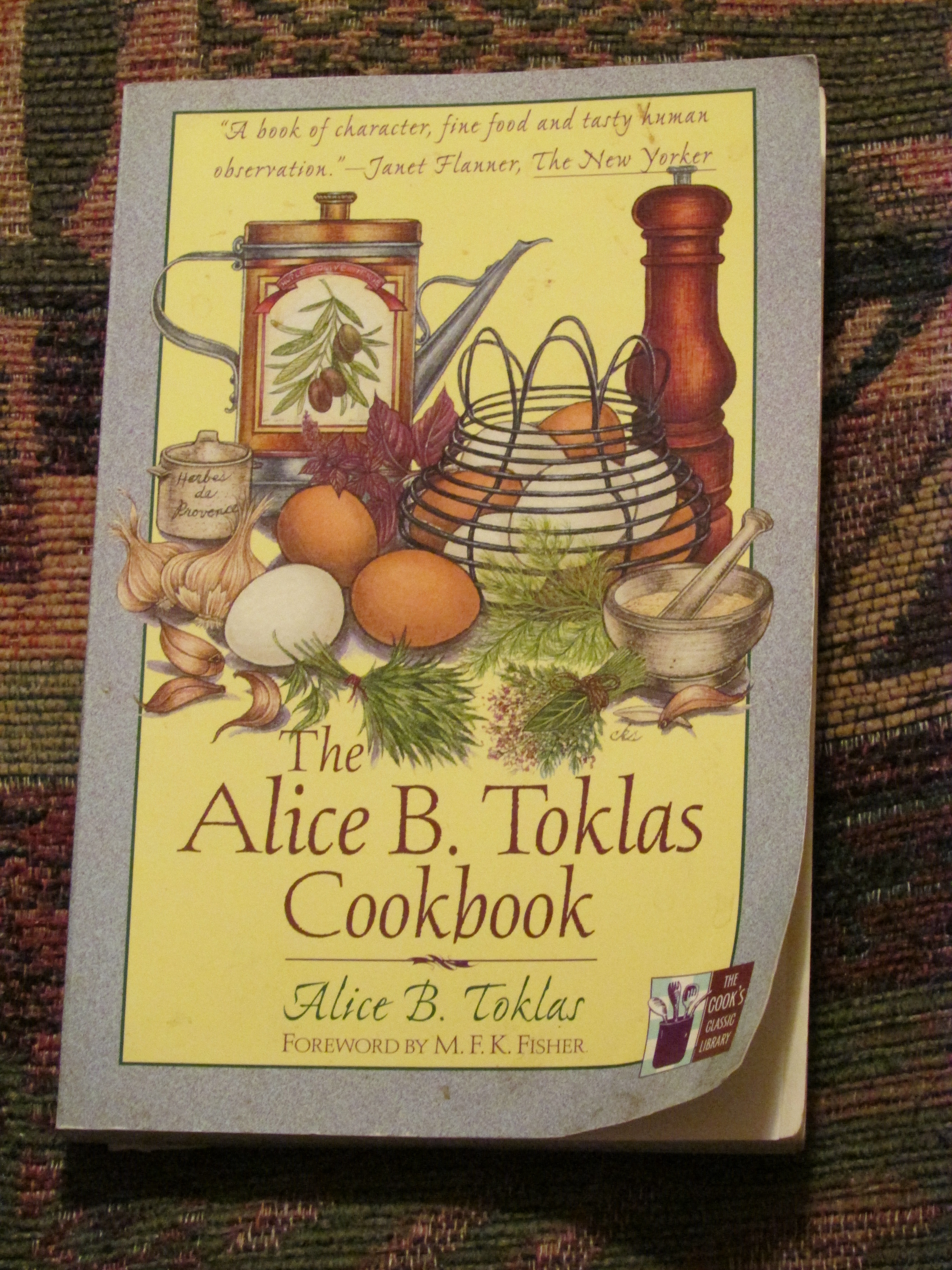
Walter and Toklas exchanged cooking ideas and recipes and it was The Alice B. Toklas Cookbook (1954) that brought Toklas a surge of attention after Stein’s death. The Cookbook is really a fascinating memoir with recipes presented in a witty, earnest, and distinctive voice. In a chapter entitled “Murder in the Kitchen,” Toklas discusses the unpleasant tasks of preparing live animals for the kitchen: “The first victim was a lively carp brought to the kitchen in a covered basket … So quickly to the murder and have it over with.”

As Toklas assesses and deals with the fish she observes:

The carp was dead, killed, assassinated, murdered in the first, second, and third degree. Limp, I fell into a chair, with my hands still unwashed ready for a cigarette, lighted it, and waited for the police to come and take me into custody. After a second cigarette my courage returned and I went to prepare poor Mr Carp for the table.

Later in the same chapter Toklas describes her preparation of “Six white pigeons to be smothered, to be plucked, to be cleaned and all this to be accomplished before Gertrude Stein returned for she didn’t like to see work being done.”

In addition to being very readable, educational, and entertaining, the Cookbook continues to inspire into the 21st Century. A brief passage in Toklas’s chapter entitled “Servants in France” about the hiring of an Indo-Chinese cook named Trac inspired the creation of a beautiful and award-winning 2003 novel, The Book of Salt, by Monique Truong. Truong’s seductive and meditative book explores a fictional Vietnamese cook, Binh, who comes into the Stein-Toklas household.

No doubt the part of the Cookbook which caused the most stir is a recipe for “Haschich Fudge” in a section of the book called “Recipes from Friends.” The marijuana brownie recipe “which anyone could whip up on a rainy day” was given to Toklas by Brion Gysin and is described as “an entertaining refreshment for a Ladies’ Bridge Club or a chapter meeting of the DAR.” The chapter of recipes from friends was inserted to fill the book out and Toklas might have been clueless about what she was presenting with the fudge recipe. Even so, the American publishers left the recipe out of the first American edition but it was included in others and became notorious and sort of a code, especially when the hippie movement of the 1960s took hold.

That recipe is the reason that a fairly insipid and badly dated 1968 Peter Sellers comedy directed by Hy Averback is called I Love You, Alice B. Toklas! Sellers plays “Harold Fine,” a strait-laced attorney who falls in with a group of very stereotypical hippies and is especially enamored of one particular hippie, Nancy, played by Leigh Taylor-Young. Nancy, of course, bakes Alice’s brownie recipe that fuels much of the frolic. The title song, penned by Elmer Bernstein (who was no hippie) and performed by Harpers Bizarre, has the refrain “I love you, Alice B. Toklas / And so does Gertrude Stein.” Other lyrics evoke “Coriander baby elephants singing ‘Silent Night’/ Sweet cinnamon and nutmeg Che Guevara.” (The ladies would be so proud.)

Sly references to Toklas’s fudge recipe had a way of sneaking in to pop culture. In a 1969 episode of the sitcom “Bewitched,” Samantha’s mother Endora is offered a cookie. Endora asks if it’s from an Alice B. Toklas recipe. When she’s told it’s not, Endora says, “… I’ll pass.”

My favorite recipe from the cookbook is “Oeufs Francis Picabia” from the chapter titled “Dishes for Artists.” Here it is:

Break 8 eggs into a bowl and mix them well with a fork, add salt but no pepper. Pour them into a saucepan – yes, a saucepan, no, not a frying pan. Put the saucepan over a very, very low flame, keep turning them with a fork while very slowly adding in very small quantities ½ lb. butter – not a speck less, rather more if you can bring yourself to it. It should take ½ hour to prepare this dish. The eggs of course are not scrambled but with the butter, no substitute admitted, produce a suave consistency that perhaps only gourmets will appreciate.

I am no gourmet, and this recipe is too rich to serve a lot, but I have prepared it and can attest to the fact that it is delicious.

In 1963, needing money, Alice B. Toklas finally got around to writing her own autobiography. It is called What Is Remembered. Even though she outlived Gertrude Stein by over two decades, she chose to end her own life’s story with the death of Gertrude Stein.

Hiking Red Mountain

     IMG_1085  Birmingham. Every Baby Boomer growing up in Birmingham was taught in elementary school that Birmingham is the only place in the world where iron ore, coal, and limestone – the three essential raw materials used to manufacture steel – can be found in such close proximity. Every local schoolboy of that generation knew that Birmingham was not in existence during the Civil War and that this unique confluence of natural resources had led to its founding as the first major industrial center of the post-war South in 1871.

The steel industry was still what drove Birmingham when I was a boy and both of my grandfathers worked in Birmingham factories – one at U.S. Steel and one at Butler Manufacturing.

I remember standing on the observation deck at Vulcan, Birmingham’s “Iron Man” statue overlooking the city, and watching with awe as the night sky turned bright orange as molten iron was poured at steel manufacturing locations in the western section, in north Birmingham, and at the Sloss Furnaces just east of downtown. For a young boy, the sight of such robust heavy industry was thrilling.

Vulcan now overlooks a city in which heavy industry is less prominent than healthcare and finance; Sloss Furnaces closed down in 1970 and was designated as a National Historical Landmark in 1981. The remains of the structures of U.S. Steel’s Ensley works loom over what is now a desolate landscape. I still look for ruins and remnants of the once vibrant industrial landscape as I drive around the area.

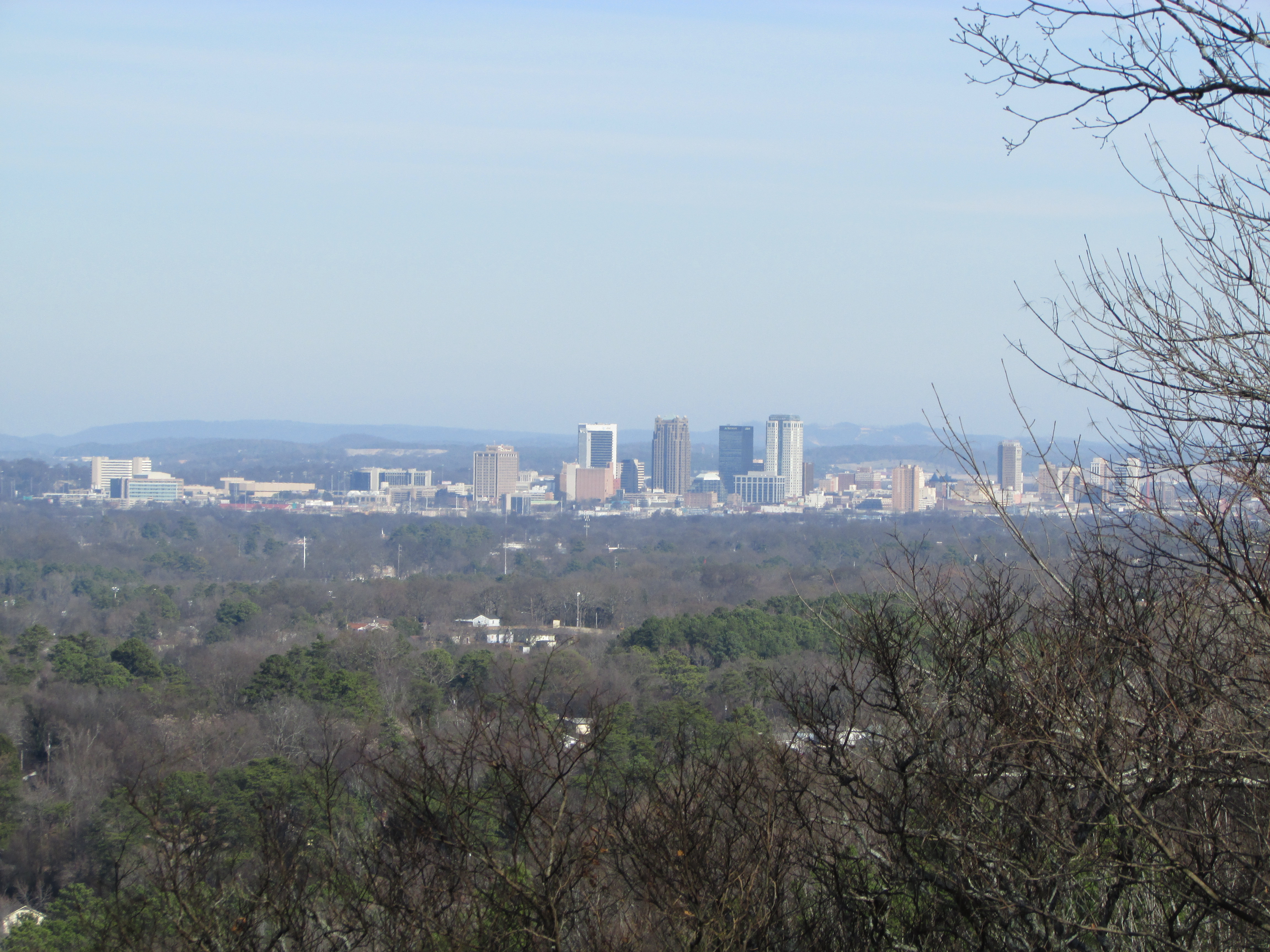
In 2007, as a result of the efforts of Freshwater Land Trust and dedicated citizens, ownership of 1200 acres of U.S. Steel-owned land on Birmingham’s Red Mountain was transferred and development began on Red Mountain Park (www.redmountainpark.org), an urban greenspace which now comprises over 1500 acres and twelve miles of trails. There are also an adventure area, zip lines, an 80-foot repelling tower, a dog park, and overlooks in the current development of the eastern Phase 1 of the park. At the overlooks, the hiker is afforded views of the city which have been unavailable for half a century. The Phase 2 western development, scheduled for completion in 2016, will include more trails and features. IMG_0520

Red Mountain Park has become my favorite place to hike. The layout of the trails enables one to do a quick and easy hike or a more rigorous and challenging one, such as the Ike Maston Trail, or to mix and match. The land, once active with railroad and mining activity from the 1860s to 1962, has reverted now to mostly wilderness.

IMG_1087

A large appeal for me, though, is in the ruins of the industrial sites like mine entrances and shaft mines that pepper the site. One is walking in the woods and then there are the tightly secured masonry entrances to Ishkooda #13 or #14 mines, or the Redding Shaft Mine farther west. Encountering these ruins, it isn’t difficult to imagine the bustle of activity which once occurred in what is now such a serene and natural environment. One walks just a few feet away from these sites and is again immersed in total wilderness. It is as if the ruins are ghosts that appeared and then are gone.  They are.IMG_0516

I try to hike Red Mountain Park whenever I am in Birmingham for more than a day or two. It is a potent symbol of urban progress and commitment to the environment built on the relics of the progress of an earlier era.  IMG_1098

Red State Blues

I am a liberal in a conservative state that I love. I accept that; in fact, I embrace it since I know that change comes from within. The whole “red state/blue state” labeling has irritated me since Tim Russert made it a household phrase in the 2000 election cycle. I think that labeling system oversimplifies and stereotypes the complex and diverse populations of each state. Those smug and cutesy “I am a blue dot in a red state” car decals nauseate me.

But I am constantly being reminded that I am in a supposedly solid red state. In next week’s midterm elections, the Alabama Democrats did not even bother to field a candidate for some key races. I will not cast a vote in those particular races. The Alabama Democrats are presenting a “Democratic” candidate who was recently a Republican (and before that he was a Democrat) for governor. I will not cast a vote in that race either. I don’t vote for Republicans – never have and likely never will, but I can’t in good conscience vote for certain “Democrats” that I can’t trust. The current Alabama Democratic gubernatorial candidate calls to mind “Shorty” Price, a man who was a perennial (and perennially defeated) Alabama candidate back in the 1950s through 1970s. If there’s an election, this guy will be in it.

I still hear people who pompously declare that they “vote for the candidate, not the party.” That sounds like a noble position and I used to pay lip service to that notion. But now I think the candidate has made a conscious decision which party to affiliate with and if the affiliation is with a party that consistently stands for things that I disagree with or abhor then I have to question the integrity and wisdom of the choice.

Some candidates switch parties for political expediency; that’s certainly not somebody I want to support. If politicians switch parties because that is the only way they think they can get elected in their state or district, then I have to question their convictions and fitness for elective office to begin with. Politics is a game to career politicians, but I can’t forget that their actions or lack thereof affect real people.

Political advertising in Alabama is as troublesome as it is throughout the nation as the candidates strive to divide us rather than unite us and keep fighting moot battles for political gain. In Alabama, local ads and politicians seem to be competing to see who can use the word “conservative” most often. I personally have strong “family values” but I’m not sure that the “family values” extolled by the local candidates are in keeping with my personal definition of the term.

My conservative mother surprised me in the spring during primary season when she said, “It must be frustrating to be a liberal in Alabama. It must feel like nobody wants your vote.” That’s true. I’ve developed a thick skin. I’ve gotten used to local Democrats who feel they have to brandish a firearm to get elected.

When it was announced earlier this year that Birmingham is a finalist for the 2016 Democratic National Convention, I was impressed with what a smart choice that could be for the party. It would show a confidence and aggressiveness that the Democratic Party seems to be lacking of late – sort of like when the Southern Baptists decided to have their national conference in Salt Lake City a few years back. True enough, Alabama generally goes Republican in presidential elections, but Birmingham is a Democratic city and the statement the DNC would be making in choosing Birmingham would be one of the more progressive and intelligent moves that party has made in a while. I don’t expect it to happen because, truth be told, I’m not too thrilled with the Democrats these days either.

In the meantime, I will continue to be amused and confounded by political advertising and politicians and I will continue to vote my conscience and values. To steal (liberally and loosely) from Faulkner, I shall continue to endure until the day I once again prevail.