Tag Archives: Bob Dylan

Long, Last, Barry

After a night out with friends in 1979, I returned to my apartment on Caplewood, a pleasant winding residential street at the end of the Strip, down the road from the University of Alabama. As I put the key in the lock, my neighbor Mike walked out on the porch. “Barry was here earlier,” he said.

“Yeah?”

“Yeah. I kinda had to run him off.”

“What was he doing?”

“Actually, he was trying to break into your apartment.”

“Really … did he happen to say why?”

“He said he was a writer and he needed inspiration and that you had a record album he needed to listen to tonight, right now. He was pretty adamant.”

“And …”

“I told him it looked like you weren’t home and he needed to leave, that I couldn’t let him break in.”

“How’d he take it?”

“He was annoyed and argued a little, but he left. Do you know what he was looking for?”

“I do.”

The next day, I grabbed Planet Waves from my record stack and walked a couple of doors down to Barry’s studio in the backyard of a neighbor’s house.

He was in.

“Here’s the album you were looking for last night,” I said. “Take it. Keep it. You can have it, and please don’t come knocking at my door anymore. And don’t ever try to break into my house again. Please.”

___________________________________________

Barry Hannah, the novelist that Truman Capote called “the maddest writer in the USA” and whom Alfred Kazin praised as “a writer of violent honesty and power” was my neighbor in Tuscaloosa in 1979. His studio was two doors down and his house was farther down on the curve that pointed Caplewood back toward the university.

When I heard that Hannah was coming to the University of Alabama to teach creative writing, I grabbed his first novel, Geronimo Rex, and was transfixed by the vibrant energy and muscle of the words on the page. He always wrote like nobody else with a style that was impossible to emulate – for anyone foolhardy enough to try.

I started hearing “Barry stories” from my writer friends as soon as Barry hit town, but I didn’t meet him until his hugely acclaimed volume of short stories, Airships, was released and I got a copy signed at Another Roadside Attraction, a bookstore on the Strip. He asked my name, proclaimed it a “great name,” and inscribed the book to me with a comment about my name.

I later loaned that signed copy of Airships to a friend and he never returned it. I asked him about it and he denied that he borrowed it, but I know he did. I always remember people who borrow and steal my books. (I’m talking about you, Jim.) After I started hanging out with Barry, he signed another copy of Airships, but the inscription was less personal.

After I moved into the apartment down the street from Barry’s house, we began to run into each other more often. He’d occasionally show up at my door and I was occasionally invited down to his house or studio.

One night late, a friend and I were sitting in Barry’s living room and Frampton Comes Alive! was on the turntable. When “Do You Feel Like We Do?” came on and the signature talk box guitar solo kicked in, Barry picked up his trumpet and began to blow, trying to match the talk box sound. It was a bizarre moment in time, but Barry’s effort was so earnest that we weren’t sure how to react. Once it was over, I think I offered a noncommittal wow.

_______________________________________________

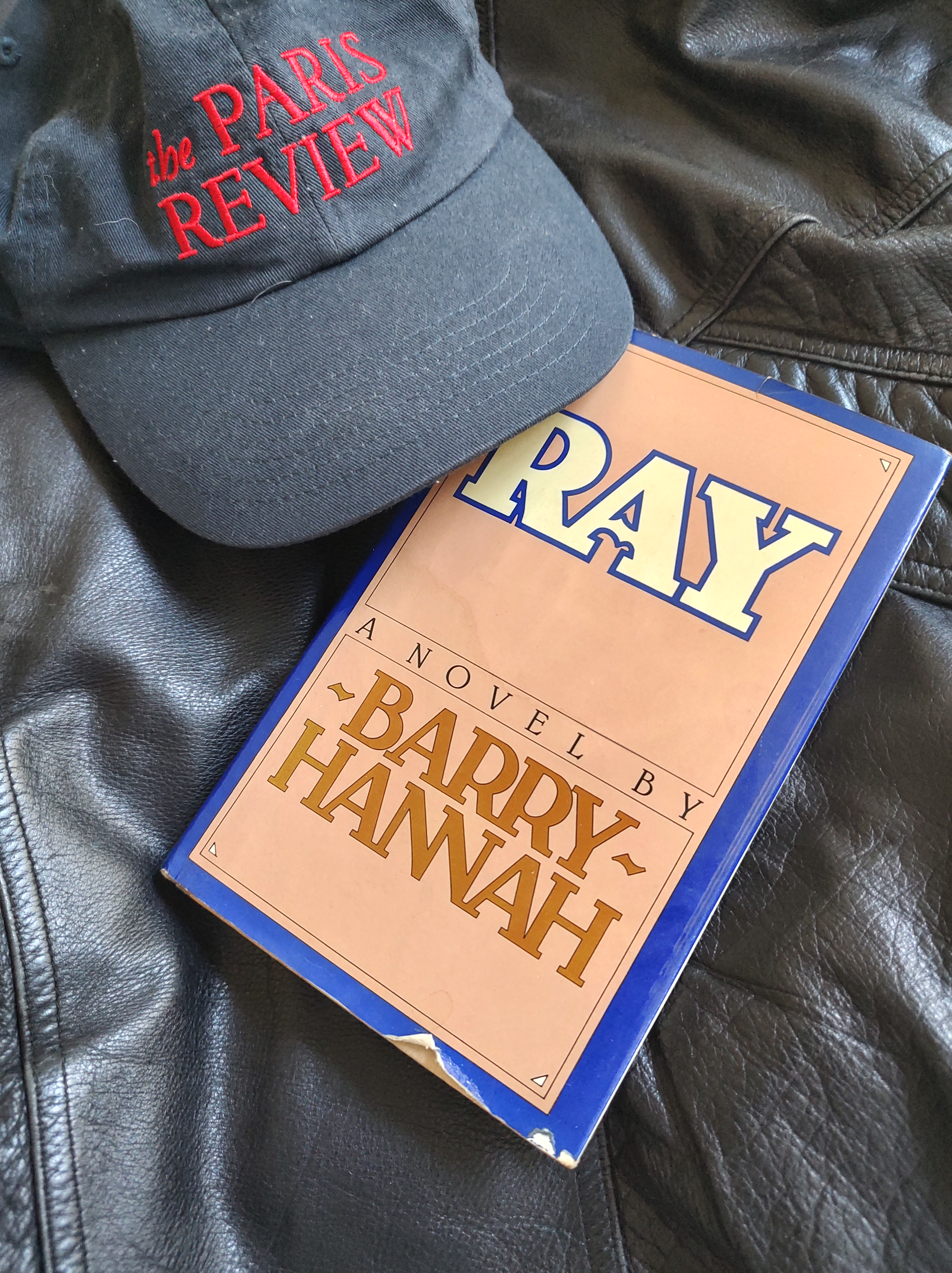
But my most bizarre “Barry story” begins on another late night at Barry’s house. Barry suddenly turned to me and said, “The Paris Review wants to publish an interview with me. I’ve told them I will only do it if I can choose the interviewer. Edward, do you want to do my Paris Review interview?”

Remember, this was forty-four years ago and I was trying to keep up with Barry, so some details are fuzzy. I have no clue if Paris Review was trying to do a Barry Hannah interview in 1979, and I was skeptical that I would be considered to write it, but it was a promising adventure and I didn’t hesitate to go along.

I was even more skeptical when Barry said we would do the interview the next morning at the studio, but I called in to take the day off, gathered a cassette recorder and blank tapes, and showed up at the studio at the appointed time. I was pretty sure I wasn’t prepared to do a proper Paris Review interview.

Barry, drink in hand, was waiting for me when I got to the studio. We chatted for a while until I finally asked if we could start the interview. Barry insisted that I needed something to drink and poured a glass full of something rancid that he referred to as white wine. It had a strong chemical smell and something unsavory was floating on the bottom. I thanked him, put the glass to the side, and started the recorder.

I wasn’t really prepared for a writer interview with twelve hours’ notice, so I asked him about his childhood in Mississippi, his family, other Mississippi writers and influences, autobiographical elements in his stories, teaching creative writing. I rambled and so did he. His responses were tangential and he kept coming back to a poem he had just written, called “Certain Feelings.” “I have certain feelings about this room / I have certain feelings about doom …” and on like that. I was pretty sure we weren’t having a Paris Review-level interview. I wasn’t sure if Barry was putting me on, making a fool of me, or was just that far gone. I wasn’t sure how I should respond to the bad poetry of “Certain Feelings.”

After a very long time, Barry looked at my wine glass. “Why didn’t you drink the wine?” he asked. I told him that I thought the wine had turned, or something. He grabbed the glass and shrieked in horror and said he gave me the “wrong glass.”

The interview basically was over when he said, “Let’s go get a drink.” I agreed and Barry picked up the phone, called Lee’s Tomb, a downtown bar and music venue at a former loading dock, and ordered four cocktails to go. We climbed into Barry’s MG convertible and drove the few blocks to Lee’s Tomb, where a bartender stood on the side of the road with a tray and four cocktails. Barry tipped the bartender, told him to put it on his tab, and roared off, announcing that we were going for some barbecue.

As we crossed the river into Northport, Barry announced that he wanted to go get his kids and drove to a neighborhood. He stopped at the end of the drive where his ex-wife lived and told me his kids were inside and he wanted them to go get barbecue with us.

“She’ll get mad if I go to the door,” he said. “You’ll have to go. Tell her you’re a writer for The Paris Review, interviewing me, and that we want to take my kids for barbecue.”

As I got out of the car, he said, “Use a French accent.” After all these years, I blush to admit that I took his suggestion.

I walked up the long drive to the front door and rang the bell. It opened immediately; she was waiting for me. “Bonjour, madame,” I said in the worst attempt to have a French accent ever. “I am in town to interview Barry Hannah for The Paris Review. He would like to take his children out for barbecue and I would like to meet his children.”

She scowled at me, at the MG, and at me again. It was a practiced scowl that I’m sure she had been called upon to use frequently with Barry’s “associates.”

“Go home,” she said, and closed the door.

I took the long walk back to the MG. “She said we should go home – no kids today.”

Barry looked back at the house for a long time. Finally, he took a long breath and said, “Let’s kill her.” I’m sure he didn’t mean it.

“Let’s go get some barbecue,” I said. And we pulled away and went to Archibald’s. The meat was good, but the wind was taken out of the day and we ate and went back to the studio on Caplewood, stopping again for curb service at Lee’s Tomb on the way. Barry said we’d have to finish the “interview” some other time and that was the last time the Paris Review interview was mentioned.

________________________________________________

But Barry and I kept hanging out for a while. Occasionally he would summon me down to the studio to hear something he was writing. One night, very late, he knocked on my door, woke me up, and said he wanted me to look at something he’d just written. I dressed and went down to the studio, he made a drink, and I read a few paragraphs about Judy Moody, a charismatic young woman who had recently made a run for mayor of Tuscaloosa and lost in a close runoff. Barry describes her as “a true person waiting to talk to you and comfort you.”

On another night, he saw my lights on and dropped by. I was listening to Planet Waves, the first album collaboration between Bob Dylan and The Band. The Last Waltz documentary was recently released and I was going though a major The Band phase.  Barry wanted to listen to Planet Waves over and over. I have no idea which song was so important to him but the next night he was breaking into my house for the album.

That led to the incident that opened this essay.

__________________________________________

I mostly avoided Barry after that. Occasionally, we’d see each other out and about and nod in passing. Sometimes, I’d hear the trumpet being played on the balcony down the street, its often shrill notes breaking the peace of Caplewood. One weekend, a group from a party I was hosting decided it would be fun to roll Barry’s yard. I didn’t find out until after the fact and worried that there might be a confrontation. The next day, I walked down to see Barry’s yard and trees covered in toilet paper; the following day, it was gone. Nothing ever came of it.

Barry was never very happy in Tuscaloosa and his legendary drinking contributed to a preponderance of local “Barry stories.” I heard the famous story about him pointing a gun at a student in a fiction writing workshop and every version was a little different. I even heard the story from the grad student that the gun was allegedly pointed at; according to him, the story was true. Barry’s version was much more sanitized – something about using the gun to illustrate the various parts of a short story. No matter whose version you heard, though, Barry brought a gun to a creative writing class.

I moved away from Caplewood later in ’79 and saw Barry out and about less and less. I bought Ray as soon as it came out in 1980. In Ray, Barry writes about sex and violence and frequently uses the n-word with what we used to call “reckless abandon.”

_______________________________________________

There was a terrible movie called Walking Tall that came out in the early ‘70s. The head of a local movie chain gave his personal endorsement of that movie in radio ads. “Walking Tall is rated R for violence, not sex,” he said. “So bring the whole family.”

You can’t make that up. It was the ‘70s.

_____________________________________________

When I read Ray, I realized that the rambling stream of consciousness is partially a surreal recap of Barry’s experiences during the writing of that short novel. I realized that some of his rambles during the “interview” were a test run for passages that wound up in the book. That passage about Judy Moody is there – section XVIII, as is the “Certain Feelings” poem that he recited to me off and on throughout the interview day (XIV). In the novel, a student recites “Certain Feelings” to Ray and Ray slugs him. I finally knew how I was supposed to respond to that poem.

I haven’t told my “Barry story” very often. Partially, I was embarrassed by the out-of-control aspect of the whole series of episodes, especially the French accent episode at his ex-wife’s house. His name would come up in conversation now and then and I would sometimes mention that I had known him briefly in Tuscaloosa. During a conversation with members of an Atlanta-based New Wave band, Swimming Pool Qs, a band member cited Barry Hannah as an influence in their music and I mentioned that I had hung out with him at one time. My cred immediately rose with the band.

I ran across those Paris Review interview cassettes as I was packing for a move sometime in the ‘90s, listened to a few minutes, was mortified, and tossed them. If they had been found, they would have been an embarrassment to Barry and me. Sorry. I couldn’t let them exist.

______________________________________________

After Barry left Tuscaloosa, he worked with filmmaker Robert Altman for a while, and then he went to Oxford, Mississippi, to teach at Ole Miss. I heard stories about his drinking in the first years there and then I heard he got sober. I would run into people who had been in Oxford and knew Barry and it was the tale of two Barrys. Some stories were from the heavy drinking phase and others were from the sober phase. Overall, Oxford seems to have been the right place for him to land. I’m sure he had plenty of barbecue with his kids there.

I thought about trying to get back in touch, but never did. Eventually, Barry had a series of health problems and reported seeing Jesus in his hospital room.

The Paris Review ran Lacey Galbraith’s interview with Barry Hannah in Winter 2004, twenty-five years after our trial run. I re-read it not long ago and it’s a great interview. Look it up in the archives – “ Barry Hannah, The Art of Fiction no. 184.”

Long, Last, Happy was a posthumous collection of short stories published not long after Barry died in 2010. He’s buried in the same Oxford cemetery as Faulkner and some of his friends slapped one of those I’D RATHER BE READING AIRSHIPS stickers on Faulkner’s grave shortly afterward. I bought a copy of Long, Last, Happy at Faulkner House Books on a trip to New Orleans with my brother in 2011. Late that night, back at the hotel, I started randomly reading the stories – many of which I already knew from Airships and other collections – while my brother tried to sleep on the other side of the room. I giggled heartily way into the early morning.

When the proprietor of the bookstore had seen what I was buying, she said, “A good Southern boy.” Did she mean me for reading it? Or Barry for writing it? I think she meant both.

Another 5th of July

When I was taking a shower the other morning, Bob Dylan’s “My Back Pages” started playing in my head. You know, the one with the refrain that goes “Ah, but I was so much older then / I’m younger than that now.” (Actually, it was the Byrds’ version of that Dylan song that was playing in my head.) I can’t remember the last time I actually heard that song so it’s strange that it started playing in my head in the shower on a Saturday. I’ve been thinking about it since, though. Many consider the lyric to be a turning point and Dylan’s rejection of sorts of the more strident protest lyrics of his early career.

Pondering “My Back Pages” made me recall Billy Joel’s “Angry Young Man,” a lyric that I once identified with. The title character martyrs himself “With his foot in his mouth and his heart in his hand,” and “he’s fair and he’s true and he’s boring as hell.” The song’s narrator confesses that “I once believed in causes too, / I had my pointless point of view, /
And life went on no matter who was wrong or right.”

In Lanford Wilson’s play Fifth of July, June Talley – a former ‘60s activist, tells her daughter, “You’ve no idea the country we almost made for you. The fact that I think it’s all a crock now does not take away from what we almost achieved.”

Be warned, I need to vent now.

I’m not sure why these thoughts (and songs, and lines) are coming into my head, but I have a hunch: With all of the news about gun violence, a frightening activist conservative Supreme Court wreaking havoc with gun control, the environment, and women’s rights, and the general divisiveness in the country, I wonder what I can do about it and previous history tells me not much. Of course, I can vote, but we are now plagued with a generation of Alabama Republican politicians that would make George Wallace look progressive and I am finally acknowledging – after decades of preaching to students that their vote does count, that my vote in Alabama no longer counts for much. The Republican women running for Alabama state office feel the need to show themselves with firearms in their commercials and to demonstrate regrettable misinterpretation of the second amendment. The concept of separation of church and state is equally misinterpreted by those same people; they don’t seem to realize that its intent was to protect their religious freedom. Even though a known January 6 insurrectionist was defeated in his bid for the Republican nomination for the U.S. Senate from Alabama, the chirpy, gun-totin’ woman who defeated him managed to seem even worse.

I love Alabama and my family’s roots run deep here. I realize that my politics don’t align with the conservative majority, but I also know a lot of Alabamians whose politics align with my old-fashioned liberalism. What irks me is the way these politicians talk is if they represent all Alabamians; for the record, they don’t represent me. Even more galling, perhaps, is the fact that national progressive and liberal politicians seem to write off Alabama as hopeless to their politics and ability to gain votes. I feel overlooked and ignored from both sides of the spectrum.

I watch the protests on television and usually think bless their hearts. I’m with them in spirit, but I’m not sure I have much confidence in what they’re accomplishing other than looking a little silly with their rote chants and their predictable signs. I’ve seen it all before and, beyond the Civil Rights era, I’m not sure it’s still effective. Maybe it makes the protesters feel better at the end of the day; I certainly understand the desperation that drives them there.

I notice that we Baby Boomers seem to catch the blame for all of the evils in the world today, especially in snarky online posts, and especially among Generation Z types. But I have a different take. The three Supreme Court justices appointed by the previous occupant of the Oval Office, all of whom lied or misled during their confirmation hearings, are all post-Baby Boom (one of them, born in 1965, is on the cusp, actually). My theory is that the current regression of American culture is being fueled by the legacy of Ronald Reagan, who was idolized by many of that post-Baby Boom generation and whose political tenure was the beginning of all the things that so many of us are lamenting right now.

I have always taken comfort in the aspirational phrase “in Order to form a more perfect Union” in the preamble to the U.S. Constitution. It always seemed to mean we’re not perfect yet, but this is what we’re working toward. Throughout my lifetime, progress has been made – slowly but surely – toward that ideal. Today, though, it feels a little like we’re going backward and the conservative unbalance in the Supreme Court is going to plague us for a long while.

As I composed these thoughts, word came across that a seventh victim of the mass shooting at the Highland Park, Illinois, 4th of July parade, has died. Three people were gunned down a few weeks ago at a potluck supper at an Episcopal church just a few miles from my house in Birmingham. There are reports that the white supremacy domestic terrorist group, Patriot Front, is making its presence known in Birmingham on the eve of the opening of the 2022 World Games.

I may have to hit the streets in protest yet.

What Is Remembered | Look Away

I saw Joan Baez don a grey Confederate soldier’s cap, probably picked up at some local tourist stand, to sing Robbie Robertson and The Band’s “The Night They Drove Old Dixie Down” at a pop-up concert in Mobile. It was April 1976 and the event was one of the two Mobile performances of Bob Dylan’s legendary “Rolling Thunder Revue.”

I skipped a final exam to be there.

The song is poor fictional Virginia farmer Virgil Caine’s lament about his plight at the end of the Civil War. The song, written by a Canadian musician, was not perceived as “racist” at the time. But I doubt that Baez could comfortably perform the song in a cheap Confederate soldier’s cap in 2020; I would have a difficult time applauding it now – with all of the baggage it has come to contain. Even so, it is an undeniably great song and Baez gave an indisputably great performance.

At a time when we are trying to become an anti-racist society, we are challenged to become more conscious of race than at any time in my existence. I learned early on that it is rude to label people based on their race and ethnicity or gender or religion or sexual orientation. Now it is demanded.

White Southerners have often been accused of “living in the past.” I’m afraid we’ve reached a time when the entire nation is living in the past and we’re too paralyzed to move forward.


I taught at an HBCU (Historically Black College / University) for the last eighteen years of my career before retiring in May. On occasion, a student would find out I was from Birmingham (mostly – my family moved around a lot) and ask me what part of town. I would answer that we lived in “Green Acres” during my elementary school years and those familiar with the city would jaw-drop and say, “Journey, you’re from the hood!”

Green Acres was not called “the hood” in the ‘60s when I lived there, but times and places change. If I wanted to really blow my students’ minds, I would mention that my dad graduated from Ensley High School.

During those years, Green Acres was an all-white school. It was almost a decade after Brown v. Board and Birmingham city schools were still in the process of integrating. The city had operated its schools on the principle of neighborhood accessibility and, while there were communities of color close to Green Acres, the nearest were in the county – not the city – school system. More diverse parts of the city – especially closer to the city center – were more quickly integrated, but the regrettable “white flight” to the suburbs was gaining steam.

In the interesting time in which we are living, I find myself looking back on my early years in the still much-segregated South. I may have been in the city that Martin Luther King, Jr. declared the “most segregated city in America” in 1963, but, even then, I found the claim somewhat dubious; it was what one might expect from an Atlantan.

I was never oblivious to the struggles going on in my city and around the country. George Wallace was our governor and Bull Connor was wielding his power in Birmingham and forging sores the city has not yet been fully able to erase.

I was in elementary school when the 16th Street Baptist Church was bombed by Klansmen. That was the same year that Wallace was grandstanding in the schoolhouse door at the University of Alabama to symbolically block the entrance to Black students. It was the time of the Selma marches; the third effort made it beyond the Edmund Pettus Bridge and captured the imagination of the world when it reached the Alabama Capitol steps.

I was not “raised” by a Black woman, as some of my friends claim they were, but Black people were ubiquitous wherever I went in the city. Neighborhoods were still considered segregated, but if you walked through the opening in the shrubbery in my Grandparents’ Harbison Fairfield Highlands back yard, you were in a Black community. My grandfather and I would take his dogs for walks through that neighborhood where he seemed to be on a mutual first-name basis with all of the people we met.

My Grandparents’ Journey house was in the shadow of U.S. Steel’s Ensley Works. Their neighborhood was considered segregated, but directly across the street from them were blocks of houses entirely occupied by Black people. The idea of segregation on that street was more of a ludicrous technicality than a reality. Also, my Grandfather Journey was less “neighborly” than Granddaddy Harbison.

Kiddieland was a small amusement park in one corner of the old state fairgrounds in Five Points West. I remember one Saturday at Kiddieland, I got to the coveted first row of the modest  roller coaster. Mother and Dad were sitting the ride out so I had the seat to myself until the ride operator put an African American kid about my age in the seat next to me. I looked over and smiled and said “hey” before the ride took off. My seatmate remained silent until we were about to climb the first rise; then he looked over at me and said, “You soda cracker!” Ruined my ride.

On many days, when I was still pre-school age, Mother and Grandmother Harbison took me shopping. On one of those days, at Goldstein & Cohen, a department store in downtown Ensley, Mother was trying on dresses while I was waiting and hanging out in the women’s department. I got thirsty and took a drink from a water fountain. A sales clerk quickly moved in and scolded me; I had apparently drunk from the “wrong” fountain. My mother, hearing the kerfuffle, rushed out, still buttoning her dress, grabbed my arm, informed the sales clerk that she would decide when her child needed discipline, and took me out.


In those years, my father’s office was in downtown Birmingham, at 20 S. 20th Street. He worked for a national company that manufactured and sold printing equipment. As I quickly learned, everybody – on whichever extreme of the political spectrum – needed printing presses to get their messages out. Dad’s territory included churches and schools, department stores and groceries, political and activist organizations, newspapers, and government offices.

I remember one time driving in the car with Mother to Dad’s office. On a downtown street, we were met with a Civil Rights protest coming toward us from the next block. Mother muttered “March,deftly maneuvered the car down the next block, and we arrived at 20 S. 20th Street without delay.

In the summer months, when school was out, Mother and I would occasionally accompany Dad around central Alabama as he made his calls. I especially remember one trip when Mother was not along – either because she was pregnant with my brother or because she was home with the baby.

Dad’s calls took us to his usual clients – small town printers, newspapers, and churches, schools, colleges, etc. In Sumter County, he called on a print shop housed on a farm. It was a Black-run operation and Dad probably told me its name, but all I remember now is that he referred to it as some sort of “separatist organization.”

Years later, I learned that the earliest incarnations of the Black Panther Party were in Alabama in 1965 with Stokely Carmichael’s leadership of the Lowndes County Freedom Organization. I still try to connect the possible dots between that and my Dad’s clients in Sumter County.

The main reason that summer day with my dad stands out is for his final sales call of the day. After leaving Sumter County in late afternoon, we went through Tuscaloosa on the way back to Birmingham. There, in early evening, Dad made one last business call on a business called Imperial Press in a tight two-story building on the main street of downtown Tuscaloosa.

As we pulled into the parking place, Dad said, “It’s called Imperial Press; it’s a front for the Klan.”

Not only was it a front, but we entered the place to be greeted by Bobby Shelton, the “Grand Wizard” (what a silly organization; what pathetic, silly titles and costumes).

I couldn’t wait to get away, but I sat patiently in Shelton’s office while my dad conducted his business, just as he had done at every organization we visited during the course of that day. I looked at framed signed photographs inscribed to their “friend Bobby” by prominent politicians of the time.

Dad was a salesman and all of these diverse characters were his clients. As we drove back to Birmingham, I expressed my pre-teen repugnance and embarrassment at meeting the Klan. Dad asked me how I felt about the Sumter County “separatists” (I still wish I could remember the name of the group) and I told him they seemed “nicer.” “Did they seem ‘nicer’,” he asked rhetorically, “because they were a different race and you didn’t feel embarrassed by them?”

My dad was no Atticus Finch, but he was a good man who often gave me perspectives that I have clung to for life.


In 1973, I was a freshman at Alabama when I watched Gov. Wallace crown Terry Points as the first African American Homecoming Queen at the University. Soon after, Sylvester Jones, my classmate at Birmingham’s Shades Valley High, was elected the first African American Vice President of Alabama’s SGA. In my senior year, Cleophus Thomas, a friend from the University’s Program Council, was elected UA’s first African American SGA President. (I had run against Cleo, a sorority girl, and an umbrella-pilfering frat boy on the platform of abolishing SGA, a principle I still believe in.)

In 1988, shortly after midnight on a June night, the 25th anniversary of Wallace’s Stand in the Schoolhouse Door, my friend Clay and I climbed to the balcony of Foster Auditorium to commemorate the anniversary. It’s odd that none of these events seemed to have happened in as quick succession as they did. It all felt like distant history from June 1963.


Decades later, in a classroom at the HBCU, a student asks me once again where I’m “from.”

“Birmingham,” I answer for the umpteenth time.

Her eyes squint and her mouth wrinkles into a sneer. “You’re not really from Birmingham.”

I start to respond, but realize that she has decided the only way to legitimately be from Birmingham is to be Black and from Birmingham.

A student who knows me leans to her and says, “His dad graduated from Ensley. He’s really from Birmingham.”

I decide to let the whole exchange hang there. But it still bothers me: I’m not sure I truly belong anywhere.


Diane McWhorter, a writer from the privileged Birmingham suburb of Mountain Brook, wrote a Pulitzer Prize-winning book, Carry Me Home, in 2001. Her journalistic research and documentation about the Birmingham campaign of the Civil Rights movement are impressive. McWhorter makes the mistake, however, of putting herself and her lily-white upbringing into the narrative by weaving in a shaggy dog story about her father’s conjectural involvement in the 16th Street Baptist Church bombing (almost certainly a fictional conjecture).

McWhorter leveraged her book into a career of sorts, commenting on race relations in the South whenever someone wants her point of view. She presents herself in Carry Me Home as an ingenuous Mountain Brook girl, somehow oblivious to what’s going on just a few miles over the mountain from her house.

McWhorter is only a few years older than me.

When I read her book, I kept thinking, if you were growing up there and then, How could you not know?