Tag Archives: food

Food Memory: Mother’s Fresh Apple Cake


IMG_1122  Last night friends invited me over for dinner. As we ate Lake Erie perch, we talked about food – where holiday meals would be eaten, travel plans, restaurant favorites, and New Year’s meals and itineraries.

Food and food memory are key to everybody’s holiday traditions and powerful seasonal associations come from foods around the holidays.

Jean Harbison Journey, my mother, would be the first to tell you that she never cared to be known for her cooking. As a young woman getting married and starting a family in the ‘50s, she – like most women of her generation – was looking for convenience and ways to juggle feeding a family with her busy schedule of work, volunteering, and other activities. She was heavily engaged in P.T.A., church, and community.

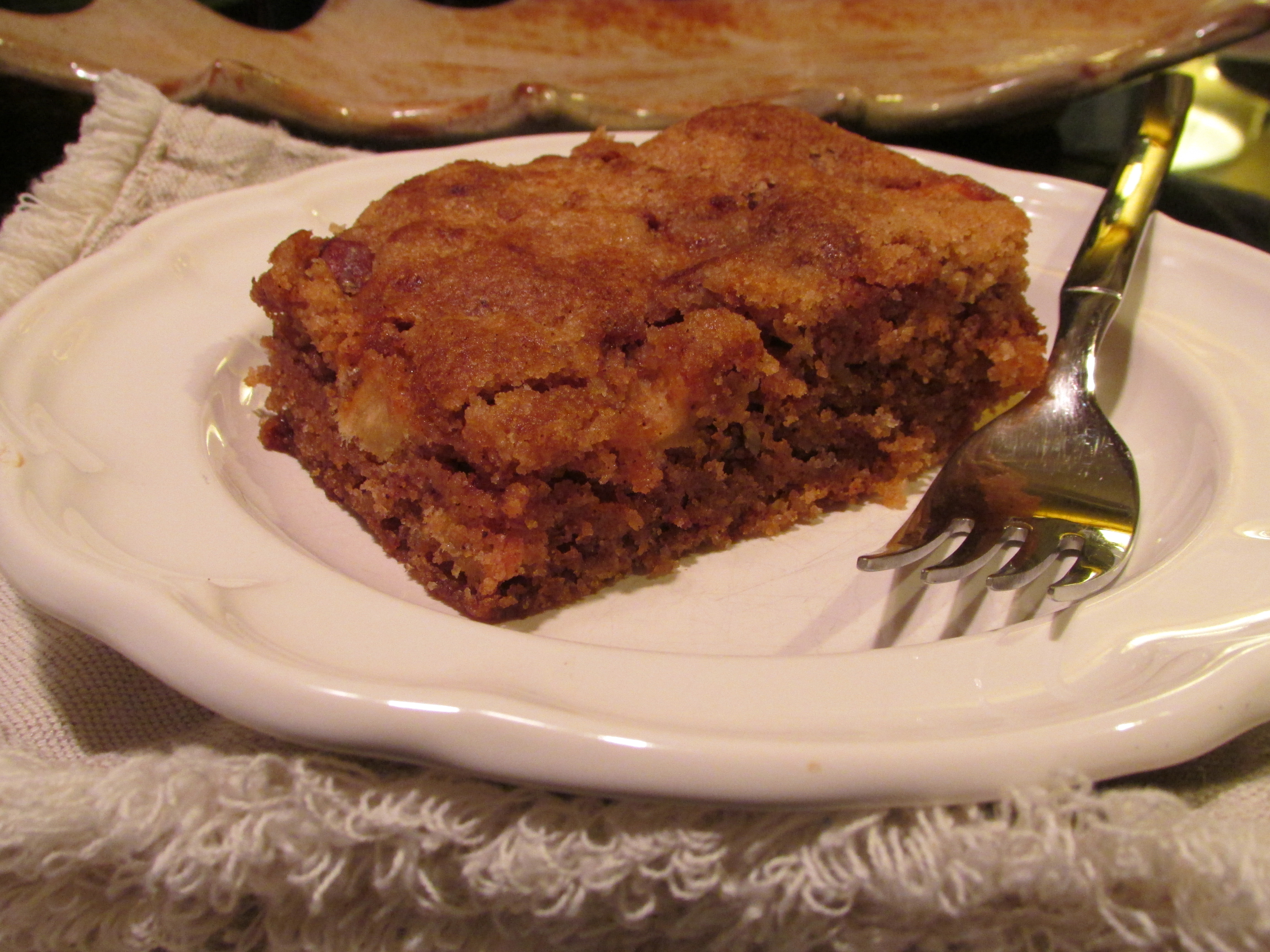
Even so, she got meals on the table and there were always favorite meals and special treats that she made. None of her dishes, however, got and gets as much attention as her fresh apple cake. There are many fresh apple cakes out there but Mother’s has to be among the finest I’ve ever tasted – okay, it’s by far the best. She gets just the right combination of firmness and moisture and once somebody has sampled Mother’s cake, they always want more.

The process is a collaboration between Mother and Dad with him chopping the apples and stirring the mixture to Mother’s satisfaction. In years past, I would come to town for Christmas only to find my parents busy in the kitchen with almost a factory line in motion of putting together and baking cakes for the family meals and as Christmas presents for friends. The whole house smells like Christmas on these occasions. Sometimes I would chauffeur as Mother delivered cakes on Christmas Eve.

Oftentimes, people brazenly asked Mother to bring one of her fresh apple cakes. This applied even to doctors’ offices. Mother would have an appointment scheduled and would get a call from the office asking if she might be bringing an apple cake along. She always tried to comply.

Mother and Dad have slowed down and aren’t able to make the volume of fresh apple cakes they used to make but the cake still makes appearances on holidays, birthdays, and special occasions. She occasionally still takes one to the offices of favorite doctors and their staffs when she feels like it.

I have tried to make Mother’s recipe exactly once. The right flavor was there but the texture and form were a mess and I haven’t dared try again, although Mother gave me several pointers about what I might do differently next time. I gather that I should spray my cake pan with Baker’s Joy baking spray and have noted that on my copy of the recipe (if I ever get the courage to try it again). I also suspect that I overworked the batter and should have let it rest longer. I gave the recipe to a friend years ago and she said it took her four tries to get it tasting like Mother’s.

When my brother anchored a television news program, Mother was invited on to demonstrate how to make her fresh apple cake. She performed like someone who had been in front of the camera all her life and was told later that it was one of the most requested recipes at the station.

It is a perfect cake for dessert at any meal and is always a favorite for breakfast. Mother is a teetotaler and I would never dare do it, but I suspect that this would be a great cake to drizzle with a bourbon-based sauce.

As Christmas quickly approaches, I’m sharing Mother’s recipe with my highest recommendation. I’ll tell you up front that even if you follow the recipe to the letter, I doubt that it will match hers. But it will still be delicious and memorable.

Jean Journey’s Fresh Apple Cake

 2 1/2 cups plain flour

 2 cups sugar

1 teaspoon baking soda

2 teaspoons baking powder

1 teaspoon salt

1 cup chopped pecans

1 cup oil

2 eggs

1 teaspoon vanilla flavoring

3 cups apples, chopped (Mother usually uses tart apples)

  1. Combine and mix all dry ingredients.
  2. Add oil, eggs, and vanilla.
  3. Mix well by hand.
  4. Add chopped apples.
  5. Mix well. If dough is stiff, let it stand for a while and mix again.
  6. Pour mixture into a tube pan.
  7. Bake in a pre-heated oven at 350 degrees for 50-60 minutes.


Food Memory: Kushmagudi


IMG_0881     As the cold weather holidays roll in, I look forward to family food traditions. Going into Thanksgiving week and celebrations in Birmingham with my family, food memory kicks in bigtime.

There is a dish called “kushmagudi” (this is my own spelling; there is no official spelling) which is always on the Journey family tables at Thanksgiving and Christmas. It is simple Southern food and its name (and my phonetic spelling) has no precedence that I can find.

My brother wrote a lovely essay about this dish a couple of years ago but since I haven’t been able to retrieve it, I will reintroduce the basics to “Professional Southerner” readers.

My grandmother Eula Harbison used to make kushmagudi and I always assumed that it was a known thing, like salt on watermelon, pepper on cantaloupe, and celery sticks served with turkey. As long as I can remember, kushmagudi was on the holiday table so I would mention it casually and be surprised at the blank stares I received. As I lived and traveled around the country, I realized that nobody outside my immediate family seems to have a clue what “kushmagudi” is.

Many might know some variation of the dish, I think, but not by that name.

Kushmagudi is nothing more than a tasty mixture of crumbled cornbread with the potlikker of turnip greens. I say “nothing more” but I am convinced that one needs a cook’s instinct to pull off the right mix. I have always heard stories about Grandmother feeding the masses of her family and crowds from church at short notice in the ‘30s and ‘40s and having family move into her family home between jobs and houses, during travel, etc. Based on what I know, I realize that Grandmother’s kushmagudi may have been invented as Depression food and a way to make the food in the rural house and garden go farther.

Based on what I know, I am sure that the word “kushmagudi” is Grandmother’s own coinage to name a dish she already knew but reinvented for her immediate and extended families. I have talked with Southerners who know a variation of potlikker and greens but, so far, none outside my own family have referred to it as “kushmagudi.”

After Grandmother died in December 1995, I was asked if I would make the kushmagudi for Christmas. I will admit that I was daunted. I had eaten it all of my life but I had never thought about it.

I relaxed and thought about the dish. I realized that it is a basic and instinctual recipe and that if one understands its components one should be able to make it in a satisfactory manner.

Here’s my basic recipe for my grandmother’s kushmagudi:

Eula McCarn Harbison’s Kushmagudi

  1. Make 1-2 cakes of cornbread or use leftover cornbread if you have it (remember that sugar is never acceptable in cornbread).
  2. Boil up a pot of turnip greens with your favorite spices and seasonings.
  3. Bring the greens to a boil and simmer on low for at least a half hour.
  4. In a large mixing bowl, crumble 1-1½ of the cakes of cornbread.
  5. Ladle the potlikker of the greens over the crumbled cornbread in the mixing bowl and mix to your preferred consistency and taste.
  6. Let the mixture meld for a while, keep it warm, and serve it.

I like to mix some collard greens with my turnip greens to vary the flavor of the potlikker a bit. Grandmother tended to use less spices in her greens than I do; she used salt and pepper. I like to add a little pepper sauce, sage, bacon fat, garlic powder, thyme, and other seasonings to the greens before I strain them into the cornbread. I also might add a small dash of sugar to the greens (but never to the cornbread). I also like to mix more of the actual greens into the mix. Grandmother generally just used the potlikker and served the seasoned turnip greens as a separate side dish.

This is truly a recipe that may be adapted to your and your family’s preference.

A bowl of kushmagudi with a glass of buttermilk is a perfect meal on a chilly night in late fall or winter.

Even though kushmagudi is cornbread-based, it is different enough that my family serves it alongside Mother’s traditional cornbread dressing. I think one must sprinkle pepper sauce over a good kushmagudi at table. This is a dish that is always on my family’s table at Thanksgiving and Christmas and is often a side at my New Year’s Day luncheon.

If you have a variation of this dish, or a variant name, I would love to hear from you. If you’ve never tried it, you ought to. It’s easy and tasty.

Happy Thanksgiving.

Sustainability and Soul

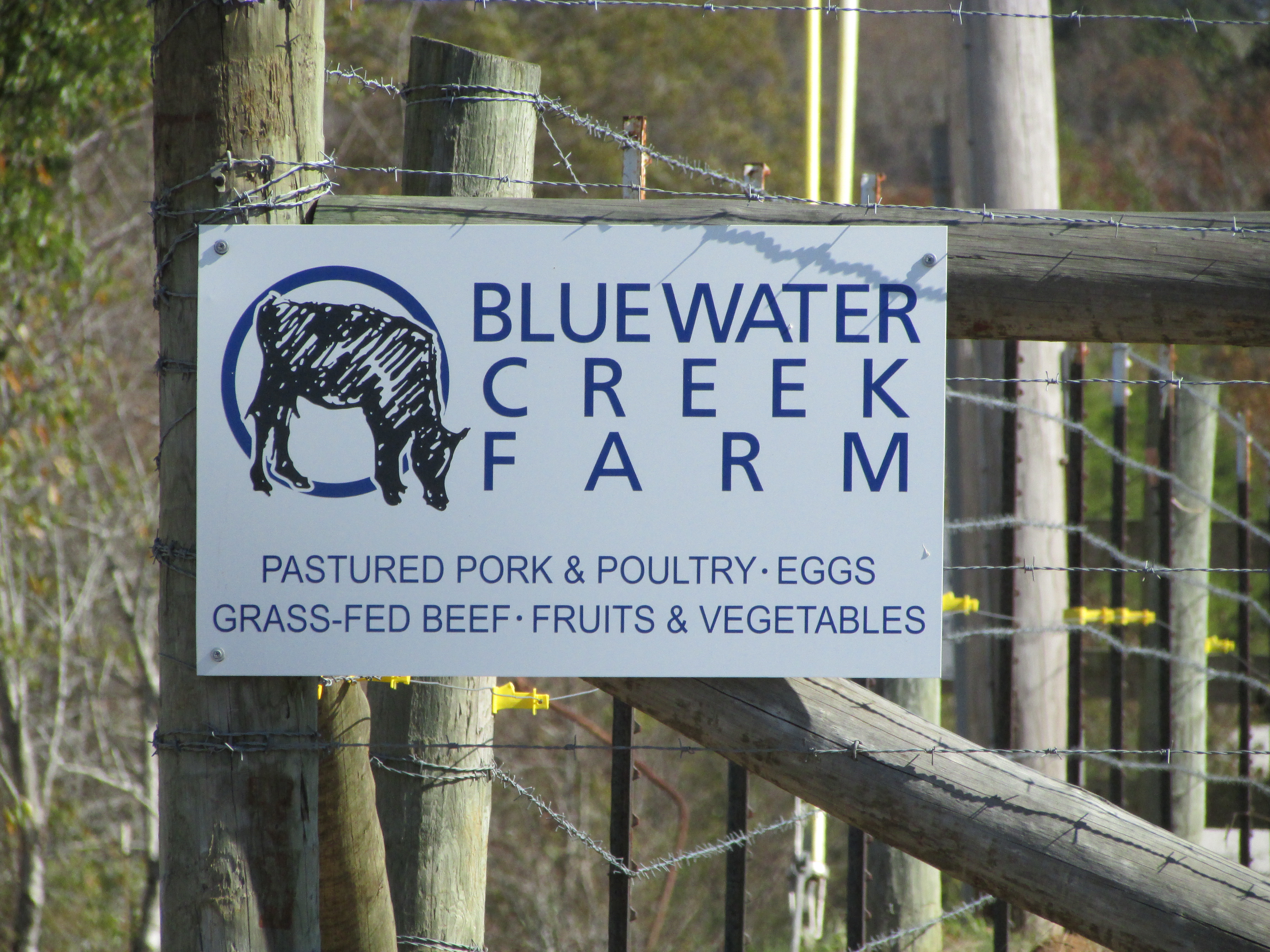
IMG_0837 Bluewater Creek Farm (www.bluewatercreekfarm.com) is a family-owned sustainable farm near Killen, Alabama, in the Shoals area of the far northwest corner of Alabama. It is run by Liz and Collins Davis in partnership with Liz’s parents, Donna and Doug Woodford. Today I drove over there for the first time to check out today’s farm stand and to join a tour of the farm led by Liz. The more time I spend in the Shoals lately the more I’m convinced that it may be the center of the universe.

I was unaware of Bluewater Creek Farm until August when I was in the Shoals — in Florence — for my second “Friends of the Café” event  at the Alabama Chanin Factory. We were lucky enough to sit across the table from Donna and Doug who enthusiastically told about their family and granddaughter Abby. They were thrilled that Liz, Collins, and Abby had recently returned from northern California to start Bluewater Creek Farm. Collins had run farms in California and other places and now they are back in Alabama.

Doug, who is a physician and advocate of holistic nutrition, spoke passionately about his and Liz’s work in nutritional therapy, and Doug and Donna enthusiastically shared news of the activities on the farm as well as pictures of Abby. Doug also had impressive pictures of chickens and bulls from the farm.

What impressed me most was the passion and commitment with which this couple discussed the work they and their family are doing.

I was happy to see Donna and Doug at the next “Friends of the Café” event in October, and this time Liz and Collins were there too. I contacted Liz to get on the farm’s mailing list and that led to the trip today. Bluewater Creek Farm’s stated mission is “to produce nutrient dense, clean food in a sustainable way… this means using farming practices that work with nature. This in turn shows respect for the living beings in our care, and makes a positive impact on our local environment.”

IMG_0808

This family makes a convincing case for their philosophy and seeing the labor-intense way in which they practice what they preach drives home the benefits and sanity of their cause. I, like most Americans, have only fairly recently become educated to the benefits of the “slow food,” “No Farms, No Food,” and “Eat Fresh, Eat Local” movements. It is this rising consciousness and education of the general public which has led to the emergence of great local farmers’ markets in virtually every community, to locally owned restaurants serving locally grown foods, to an understanding of why these issues increasingly matter, and to more sustainable farms like Bluewater Creek.

Previous generations knew this first-hand. Most Americans of the 21st century are learning it anew. Availability nurtures advocacy.

Liz’s tour included the planting beds, still full of lush greens and root vegetables on the first day of November (after the first truly cold night of the season); a visit with the farm’s heritage pigs, including a bunch of tiny piglets; cattle in the pasture, including the grass-fed, heat tolerant South Poll breed; and a bunch of happy grass-fed chickens, joined by a lone turkey (it’s close to Thanksgiving; I didn’t have the heart to ask).

IMG_0803

When the tour was over, I continued down the path to Bluewater Creek. I never lived on a farm and have spent minimal amounts of my life in the country and around farms. Yet I find, especially lately, that being alone out in nature gives me a peace and sense of ease that I don’t get in any other environment. It has become my best and most reliable form of release.

IMG_0832

On the walk back from the creek to the Barn, I met Liz on the road. We had a nice chat about future plans for the farm. “I’m not trying to preach organic farming,” she said. “I just want to show people what we’re doing and they can decide for themselves.”

Before leaving Bluewater Creek Farm I stopped by the Barn, a converted horse barn now used for events and classes, to visit for a minute with Donna. This was the location of the farm stand with the farm’s various products being sold. I bought some meat, peppers, beets, and beet greens to supplement what I had already gotten at my local farmers’ market a couple of days ago. I also got some honey that had been jarred today. I was too late for eggs. They had just sold out.

That’s okay. I’ll be back. IMG_0836


Food Memory: Turnip Green Soup

IMG_0769  When I was growing up I didn’t think much about turnip greens because they were ubiquitous. They’d be served at home regularly, most restaurants had them on the menu, and any “meat and three” joint or cafeteria would serve them. As long as there was a bottle of pepper sauce – hot peppers in vinegar – on the table to sprinkle over them I was good.

Turnip greens were one of the many Southern staples that I didn’t much think about or miss until I began to travel and lived in places where they were hard to get or completely unavailable. That’s when I began to pay more attention to them. I began to grab them fresh when I could find them. I questioned older Southern cooks about how to prepare them.

I also began to experiment with collard greens which were generally less served in my own native environs. I enjoy cooking collard and turnip greens together; turnip greens have a bit more of a bite and the collard greens pull that down a notch. I even began to play around with the actual turnips, which were rarely served on Southern menus. I occasionally make a creamed turnip puree which is good to spread on bread or use as a dipping sauce with a plate of crudités.

Several years ago my mother, knowing my appreciation of greens prepared well, mailed to me a recipe for “turnip green soup” that she had cut out of the newspaper. I have a rule that I never tamper with a recipe until I have prepared it as written at least once. After that, I can start playing around.

I thought the “turnip green soup” would be a recipe that I messed with because it used frozen turnip greens and some canned ingredients. I would make it their way and then see how I might improve it with fresh ingredients. But here’s what happened: It was so delicious as written that I wasn’t sure I wanted to mess around with it.

I did tamper with it a bit though, and have made substitutions when I was missing an ingredient in the pantry. When fall weather and football season roll around, it’s a great quick meal to prepare. I cook a large batch of it in a cast iron dutch oven, transfer it to containers in the refrigerator, and eat on it for a few days. You must have cornbread with it and I sometimes just make a cake of cornbread but I prefer to make corn sticks as the accompaniment so that I can just dip the corn stick in the soup.

I often serve turnip green soup as a starter course to my New Year’s Day luncheon. A few years ago, when my sister-in-law ran her first half marathon in Huntsville, I prepared a pot of it for lunch after the run and found that it was the perfect post-run comfort food. Friends from Ohio have transferred it up North and I hear it “has legs” along Lake Erie.

I am teaching a Saturday morning class this fall and there are hours of college football to watch when I get home from class. When I left class around 11:00 this Saturday morning, I ran by the store to pick up some ingredients, came home, made a batch of turnip green soup and corn sticks, and had a hearty meal before my main game aired at 2:30.

Here’s the recipe for turnip green soup as I usually make it. It is a forgiving recipe, open to substitutions or deletions depending on taste. It can easily be a vegetarian dish if one is so inclined.

TURNIP GREEN SOUP

2 packages (about 24 ounces) frozen turnip greens with diced turnips

1 package Knorr vegetable mix (from the soup section)

1 can (about 15 ounces) northern beans

1 can (about 15 ounces) navy beans

1 small onion, chopped

5 cups chicken broth

1 pound smoked sausage, sliced thin (I use Conecuh smoked sausage from south Alabama)

1 teaspoon hot sauce (I use more)

1 teaspoon garlic powder

Salt and pepper to taste

Tony Chachere’s Original Creole Seasoning to taste

Combine all ingredients in a soup pot. Bring to a boil. Reduce heat to a simmer. Cook until sausage is done. Serve with corn bread, corn muffins, or corn sticks.

Food Memory: Cheese Straws

IMG_0760 In every community in the South – church, club, work, neighborhood – there seems to be the one lady who is famous for her cheese straws. Neither of my grandmothers made cheese straws, nor does my mother. But I have always known about them and associated them with significant occasions – parties, weddings, wakes – and in every Southern community it seemed that there was always a lady – always a woman – who was celebrated for her cheese straws.

When I worked at Alabama Shakespeare Festival, that lady was Mrs. Betty Campbell, a theatre supporter and erstwhile ASF board member.

A member of that theatre company knew that he had truly arrived and been accepted into the fold when Mrs. Betty Campbell graced him with a tightly wrapped little package of cheese straws tucked into his box at the theatre. After I had been at the theatre for about a year, I was delighted to find a package of Mrs. Betty Campbell’s cheese straws placed neatly in the center of my desk when I returned from lunch one afternoon. The golden baked morsels lived up to their reputation and were worth the wait. And they were consumed quickly.

But that was the only time Mrs. Betty Campbell ever honored me with cheese straws. I waited patiently, but a second offering never materialized. This nagged me for a while and then, one Sunday morning in the New York Times magazine, I ran across an article, “Eat the Rich Stuff,” by Julia Reed, a Mississippi native. In the piece she remembers tastes of her own childhood and how they inform her adult Christmases. The article is wonderful but the real revelation is the fact that at the end of the article Reed shares her favorite holiday recipes, including one for cheese straws.

I read the recipe carefully and realized I can do that. Why I thought have I spent my life at the mercy of old ladies with cookie presses to get my cheese straw fix when all I have to do is buy some basic ingredients and a cookie press (whatever that is) and I can have my own fresh homemade cheese straws whenever I get the urge?

I went shopping for a cookie press at a local kitchen supply place, but first I had to figure out what it was. I approached a customer who sort of looked like she might be a Junior Leaguer. She would know. “Excuse me,” I said, “where might I find a cookie press?”

She eyed me. “You’re going to make cheese straws, aren’t you?” she said.

“I plan to try.”

She took me straight to a shelf of cookie presses and pointed out her favorite, an Italian model. She wished me luck and went on her way. I left the store with a sparkling new cookie press and a resolve to become the first man, to my knowledge, to make cheese straws.

The first batch turned out well. I began to add my own touches to the recipe, share the results with family and friends, and get accustomed to the process. One of the first things I learned was that all of those old ladies were strong. It was a workout of the wrist and arms to squeeze those straws out of the tiny opening of the cookie press and onto a baking sheet.

The first true test of my cheese straw mastery came on a visit to Greensboro, Alabama, a small town in Hale County. I went down for a quick visit to see my friend Randall and decided to take a bag of freshly baked cheese straws to him and his mother. When I presented them, both were surprised that I had baked them. Some friends – Greensboro ladies that I had known over the years – had been invited over for afternoon tea.

When we were seated, Randall set out a plate of my cheese straws. I tensed a little, knowing that I was among a group of Southern cooks who knew their way around cheese straws.

“These are delicious. Where did you get them?”

“Eddie made them,” Randall said. I was among people who had known me so long that I was still “Eddie” to them.

There were looks of disbelief and then astonishment.

Finally, someone said, “Well, they’re delicious and it’s obvious you used real butter. That’s essential.”

I assured them that real butter had indeed been used and then found myself comparing cheese straw recipes with the ladies. I was happy I had passed the ultimate test of the cheese straws and was validated in the belief that I could serve and present cheese straws with confidence.

Later, I remember thinking Is this what my life has become? Sitting around comparing cheese straw recipes with a bunch of ladies older than my mother?

Oh well. I can think of worse fates.

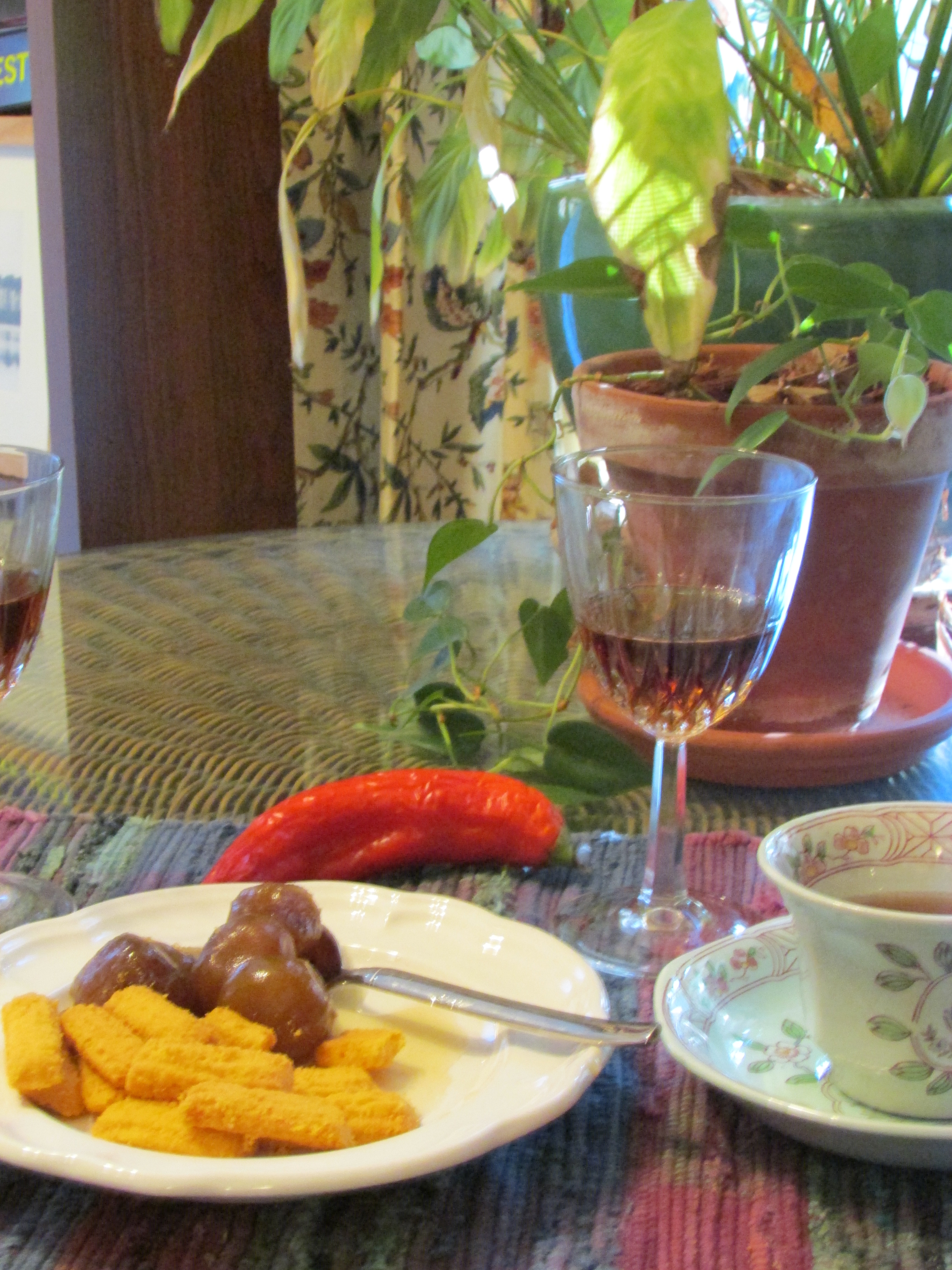
I continue to bake cheese straws for special people and special occasions and continue to enjoy the surprised gasps when I reveal that these straws were made by a man. I haven’t baked any in almost a year but when the temperatures begin to drop and the air gets crisp the urge to buy some fine cheddar and make up a batch begins to twitch. This time of year a few cheese straws with fresh figs (or fig preserves), a glass of sherry, or a cup of warm tea hit the spot.

Here’s my recipe. It is adapted from the recipe in Julia Reed’s 2001 New York Times piece which was in turn adapted from a cookbook called Southern Sideboards Cookbook by Winifred Cheney. Over time, I have made my own revisions, and that is what I’m sharing with you.

CHEESE STRAWS

1 stick (8 tablespoons) of softened unsalted butter

8 ounces finely grated extra-sharp cheddar cheese (I like to mix white and yellow cheddar)

½ teaspoon salt

1 teaspoon cayenne pepper (I like my straws hot)

1½ cups plus 1 tablespoon sifted flour

  1. Preheat oven to 350 degrees. Mix the butter with the cheese and seasonings in a large bowl. Add the flour and knead into a smooth dough.
  2. Pack the dough in batches in a cookie press and press through the round-ridged opening onto an ungreased cookie sheet to form “straws.” 2½-3 inches are good, but I just squeeze until it seems long enough or stops on its own.
  3. Bake until golden and crisp, usually about 12 minutes in my oven. Remove from the cookie sheet with a metal spatula, cool, and store in an airtight container.

The straws break easily but that doesn’t affect the taste, does it? Also, depending on temperature and humidity, I sometimes sprinkle a little water on the dough in the press so that it comes out more easily.

Oh yeah – if you make these and people love them, mention my name.

Community and Fatback

IMG_0753 Last night was another memorable evening at the Alabama Chanin Factory (www.alabama.chanin.com) in Florence, Alabama. Natalie Chanin and her tireless staff hosted another “Friends of the Café” dinner event featuring executive chef Drew Robinson and Nicholas Pihakis of Birmingham-based Jim ’N Nick’s Bar-B-Q (www.jimnnicks.com). The October 10 event was the fourth and final “Friends of the Café” dinner for 2014. I am already looking forward to the 2015 schedule.

My friend Cindy Edwards and I were lucky enough to attend three of the four 2014 dinners. The previous two were fundraisers for Southern Foodways Alliance (www.southernfoodways.org), of which I am a “dues paying” member. Last night’s event benefits “The Fatback Collective Fund.” The Fatback Collective is an impressive array of “chefs, writers, and pig cookers” who are supporting a philosophy of sustainable and humanely raised pork, local ingredients, support of community, and sharing of knowledge. They fundraise for many compatible causes and provide assistance in their communities when tragedy strikes. For example, Fatback Collective recently sponsored a series of successful fundraisers for a South Carolina pitmaster who lost his pit to fire in 2013.

Last night’s meal was a juxtaposition of all of the elements that contribute to the Fatback philosophy. During the cocktail hour, featuring a “Donkey’s Daddy” cocktail, mushroom tamales were served to each table. That was followed by a four course meal featuring local ingredients including produce from the Jones Valley Teaching Farm (www.jonesvalleyteachingfarm.org) in downtown Birmingham, Gulf shrimp, Fatback Pig Project porchetta, and guinea hens from White Oak Pastures in Georgia (www.whiteoakpastures.com). Each course featured beer pairings from Birmingham’s Good People Brewing Company (www.goodpeoplebrewing.com).

Chanin is accomplishing her goal of supporting and sustaining her community in many ways and these dinners are just a part of that big and impressive picture. As a result of these events, a community of like-minded individuals is finding each other – sharing thoughts and energy.

Last night it was a pleasure to once again visit with Donna and Doug Woodford of Bluewater Creek Farm  (www.bluewatercreekfarm.com). Bluewater Creek Farm is a family-owned sustainable farm in the Shoals area of northwest Alabama. Doug was proudly showing off pictures of a very handsome rooster and of a recent acquisition, a South Poll Grass Cattle bull. I learned that South Poll is an Alabama-based cattle breed that is bred to thrive on a grass-based diet and to tolerate the heat of the Southern summer (www.southpoll.com). I was also pleased to learn that Bluewater Creek’s most recent batch of chickens recently started laying.

Nancy Campbell and Charles Day, friends from Tuscaloosa, were also back at the dinner last night. We met at the July dinner and have remained in contact ever since. They shared news of a recent visit to a saltwater shrimp farm in Greene County, Alabama – 150 miles inland from the Gulf of Mexico. This was exciting news to me. Charles has also begun to cultivate domestic culinary mushrooms. The spores are shipped to him and it was fascinating and tempting to learn about the process. It also gave me a nifty idea for my food-minded nephew’s 11th birthday present.

A number of websites are referenced in this post. I hope that readers will be inspired to check out one or more of them and participate as their interests and means dictate. They are all causes that mean something to me and deserve our support and commitment.

An amazing and innovative meal. Camaraderie with a community of people with shared interests and values. New knowledge and understanding. The “Friends of the Café” dinners in Florence have quickly become an essential ingredient in the process of strengthening a commitment to culture, community, and the values that will help change our world and move us steadily forward.

Coke and Peanuts

IMG_0749 Back when I subscribed to Oxford American magazine, I would regularly threaten (to myself) to cancel my subscription if I saw one more picture of a snake handler in their pages. Snake handlers and alligators were a little too common as OA’s attempt to capture “Southern-ness” occasionally tilted a little too far toward surreal Southern Gothic.

So it is with some trepidation that I feel a need to address the very Southern taste for salted peanuts in Coca-Cola as a snack. This is something I remember from early childhood. We would take a bottle of Coke and a sleeve of salted peanuts. Take a couple of good swigs of the Coke to make room for the peanuts and then slowly pour the peanuts into the narrow top of the Coke bottle. The combination of the sugary Coca-Cola with the salty peanuts is really good. Trust me on this, but don’t ask me to explain why.

I had relegated peanuts in Coca-Cola to a distant childhood memory until this summer when Coach Jimbo Fisher of Florida State dumped some peanuts in his Coca-Cola during ACC media days. The non-Southern press in attendance was flabbergasted and felt the need to address this odd behavior in multiple columns which then led to a deluge of online responses, contradictions, and opinions. We Southerners who grew up with peanuts in Coke as a normal treat were a little bemused by the brouhaha. While I suspect that this tradition is more familiar to Baby Boomers and their parents than to younger generations, I asked a recent class of college-age students how many of them had heard of or had peanuts in Coca-Cola and was surprised at how many hands went up. A few of them opted for RC Cola instead of Coke. I can accept that.

The resurgence of peanuts in Coca-Cola as a topic of conversation in the 21st century surprised me as much as the emergence of one of my guilty pleasure road treats – fried pork rinds – as a healthier junk food choice (no carbs, high protein, low-fat and a high percentage of the same healthy unsaturated fats as olive oil – go figure).

There is a long tradition of Coke in recipes. “Atlanta Brisket” – brisket glazed with cola – has been around for a while and “America’s Test Kitchen” did a version of it fairly recently. “Coca-Cola Cake” is a mainstay of Southern cookbooks and I have seen a Coca-Cola cake with a peanut glaze inspired by the classic peanuts in Coke tradition.

Bartenders are constantly upgrading the football Saturday stalwart bourbon and Coke into more sophisticated renderings such as the “Reengineered Bourbon and Coke Cocktail” recently featured in Garden and Gun magazine. Even more to the point, I recently heard that a place in Birmingham has a cocktail called the “Tallulah” which is made of Coca-Cola, peanut syrup, and Jack Daniel’s. An investigation is in order.

North Carolina chef Vivian Howard, in an episode of her PBS show “A Chef’s Life,” explored the North Carolina tradition of putting peanuts in Pepsi. I have a lot of respect for Chef Howard and she is a wonderful chef, but this will not do. Howard’s Pepsi and peanuts exploration did, however, lead to what looked like a great recipe of Pepsi-glazed pork belly with country ham braised peanuts. I bet it would be even better with a Coke glaze.

After teaching a Saturday class in Huntsville this past weekend, I hopped in the car to drive to Birmingham for a quick visit. Stopping for gas outside Decatur, I spotted an 8 oz. Coke in a glass bottle in the drinks case. I grabbed it and a sleeve of Golden Flake salted peanuts and headed to the car. I downed a few gulps of the Coke, emptied the peanuts into the bottle, and headed south on I-65 listening to the radio and the pre-game shows leading up to the Alabama-Ole Miss game. It has been at least forty years since I indulged in peanuts in Coca-Cola. I was transported back to football Saturdays growing up and “The Bear Bryant Show” on television each Sunday after game days. Coca-Cola and Golden Flake potato chips sponsored the show (“’Great pair’, says The Bear”).

It was an exhilarating drive.

“The Professional Southerner” — and why

IMG_3349I think I was living in Indiana the first time I was referred to as a “professional southerner.” As I recall, it was around 1994 and I was frustrated because I had been unable to find okra in the produce sections of the local grocers. Someone innocently asked why I ate okra and my shock made me launch into a monologue of the virtues of okra and all the ways in which it could be consumed. But my favorite way was breaded and fried in the particular way my Grandmother Harbison had always made it and I had been craving fried okra around that time of that Indiana summer.

This led to questions about other ways in which okra could be consumed (I told them pickled okra was my favorite Bloody Mary garnish), other foods I like, and other queries about Southern foodways. Someone in the group mumbled, “I never realized you were such a professional Southerner,” and we all laughed but over the years, as I lived and traveled in other parts of the country, I became aware that I was often the go-to guy for issues dealing with the South and what it means to be Southern.

Having said that, I am a proud Southerner but very few people would classify me as a “typical” Southern male with all of the misconceptions and stereotypes that label evokes. But I realized, after traveling and working in different places – and to my surprise, really – that not only was the South my home, but that it was the place I best understood and the place where I felt most comfortable. It was the place I wanted to come back to. My politics, for one thing, are not typical of the South, but they are also not as atypical as some might suppose and I resent the whole “Blue State / Red State” way of thinking because it gives such a divisive idea of what is really happening in our country.

Not long ago, my friend Cindy and I attended a “Piggy Bank” dinner at the Factory of Alabama-based fashion designer Natalie Chanin in Florence, Alabama. The event was to honor Southern food and to benefit Southern Foodways Alliance. The chef for the evening was Vivian Howard who owns and runs Chef and the Farmer, a farm to table fine dining restaurant in Kinston, North Carolina, with her husband Ben Knight. Between the entrée and the dessert, Shonna Tucker, an Alabama-born musician who has recently moved to Florence after many years on the road, sang her striking and original songs. The dinner guests were a wide range of people who shared an amazing communal meal and one of the most convivial and relaxed evenings I have enjoyed in a long time. At the end of the evening, all of the diners stood and sang “You Are My Sunshine” to Vivian Howard, led by Natalie Chanin, one of the most innovative and conscious fashion designers working today.

That night, walking from the Factory to the car, I commented to my friend that “This is one of those nights when I can’t imagine living anyplace else but Alabama.” And I decided that I – who have always detested the idea of blogs and the label of “blogger” – would make an effort to record and share some of the things that make my South so special to me. Plus, I have been told that I “think loudly.” Maybe, by writing this online journal, my loud thoughts will become more specific and defined.