
 Sometime around the turn of the century, I was at my parents’ house over the 4th of July holiday. I had travelled in from wherever I was living at the time. They had friends – a pair of married young attorneys – who lived in the neighborhood. My contact with this couple was minimal, but my parents spoke highly of them.
The wife called my mother to invite her and Dad over for dinner on the night of the 4th. Mother told her that I was in town and asked if I could come along. She said I could (what else could she say?) and, even though I didn’t really want to, I tagged along. After all, I was sort of invited and felt it would be rude not to go.
When we got there, there were the couple’s two daughters and some other guests, including one person I knew in a roundabout way. When it was time to gather for dinner, the hosts said “Let’s see where we can put Edward” and made a bit of a show of pulling in a small table and setting it at the end of the dining table with a smaller chair to match. It occurred to me at the time that they might have saved room by just pulling an extra chair up to the big table.
Memory is a strange thing and I have wondered how much of this I might have exaggerated in my head, but the description I have seems pretty accurate. Let me add that I was not a kid; I was in my forties at the time so the whole situation was embarrassing and uncomfortable. I wasn’t sure how I might have offended these people – I barely knew them – but they made it clear that there was no place at their table for me.
When the meal was over, I helped move my little table out of the way, thanked the hosts, pled a headache, and walked back to my parents’ house. I was happy that we had Dad’s barbecue for lunch so the day was not a total disappointment.
And now, I confess that I can hold a grudge.
____________________
A couple of decades later, in the summer of 2020 during the pandemic, a friend emailed me “Have you seen this yet?” with a New York Times article attached. The article’s title was “A White Gatekeeper of Southern Food Faces Calls to Resign.” In it, journalist Kim Severson explores a move by a cadre of members of Southern Foodways Alliance, of which I was a contributing member, to oust the SFA’s founding director, John T. Edge. Reading the article, I do not exaggerate when I say I got physically ill.
The main complaint seemed to be that Edge is a white man at the head of an organization that explores the range of what constitutes the food of the American South in all its complexity and constant transformation. People that I only knew about because of John T. Edge and SFA were making weird and sometimes unhinged accusations.
An Indian American chef who had been part of SFA’s “Brown in the South” outreach to give broader exposure to Indian foods and foodways in the American South, groused that she was “a prop in what felt like a dog-and-pony show.” I grimaced when I read that because I had recently eaten this woman’s cooking, vowing to give Indian cuisine – which I had never really warmed up to (it’s a texture thing) – another go, mainly because of the advocacy of SFA.
Another person, who had spoken at an SFA symposium, felt demeaned that she had spoken behind a lectern “created to look like a stove.” I used to attend SFA symposia and there was often a clever touch decorating the lectern and the podium on which it stood. I find no insult or sexism in stove imagery at a food symposium.
Ronni Lundy, an Appalachian food writer and founding member of SFA, seemed to be a prime mover in calls for Edge’s resignation. Her charges seemed to be based on allegations of sexism. I have no apparent right to comment on that since I am a white male. I can only say that from my privileged position, it seemed like Edge’s writings and recommendations appeared to spotlight as many, if not more, women and minorities. I would never have known who Ronni Lundy is if not for John T. Edge, nor would I have bought her cookbook. It was hurtful to read spiteful comments about a man I liked and respected from those who would have probably never been known to me without him. If he was the “gatekeeper,” the gates always seemed open wide.
And that is where my anger comes in. I became a supporter of Southern Foodways Alliance because it set a place at a large and welcoming table for all of us. John T. Edge, as the primary face and spokesperson for the organization, introduced us, through his stewardship as well as his books and writing for other publications, to a more complete, diverse, and equitable understanding of what it means to be Southern – and what it means to eat for connection as well as sustenance. His show, “True South,” for ESPN and the SEC Network, travels the region and shows us the contrasts and connections ever-present in our food places and food habits. I discovered foods and sought out restaurants I might never have known about because of John T. and SFA. There were more places at more tables than I realized.
I have had the good fortune to be present at table and have conversations with John T. Edge over the years, to the point that I consider him a friend. I am always impressed with his graciousness, his humor, his warm and open demeanor, and his prodigious memory. The first time we met in person, at a dinner in the Shoals, he recalled an essay I had submitted to Gravy, the SFA quarterly, about a family peach farm in Chilton County, Alabama. (The essay was rejected, but John T. suggested places I ought to submit it.)
So, when that New York Times article came out, I emailed John T. to extend good wishes and commiserate. His response was gracious, grounded, and reasonable – no anger or bitterness came through – and I felt better after I heard from him. Some of my own anger went away as I decided to sit tight and see what happened next.
Over time, John T. and the University of Mississippi (which houses SFA) came to an agreement and John T. moved on from his SFA leadership – a move that he had been planning, actually, prior to the New York Times article.
In my subsequent message to SFA, canceling my membership and asking to be removed from all their mailing lists, I wrote that it was clear that there was no longer a place at their table for me.
I confess that I can hold a grudge.
____________________
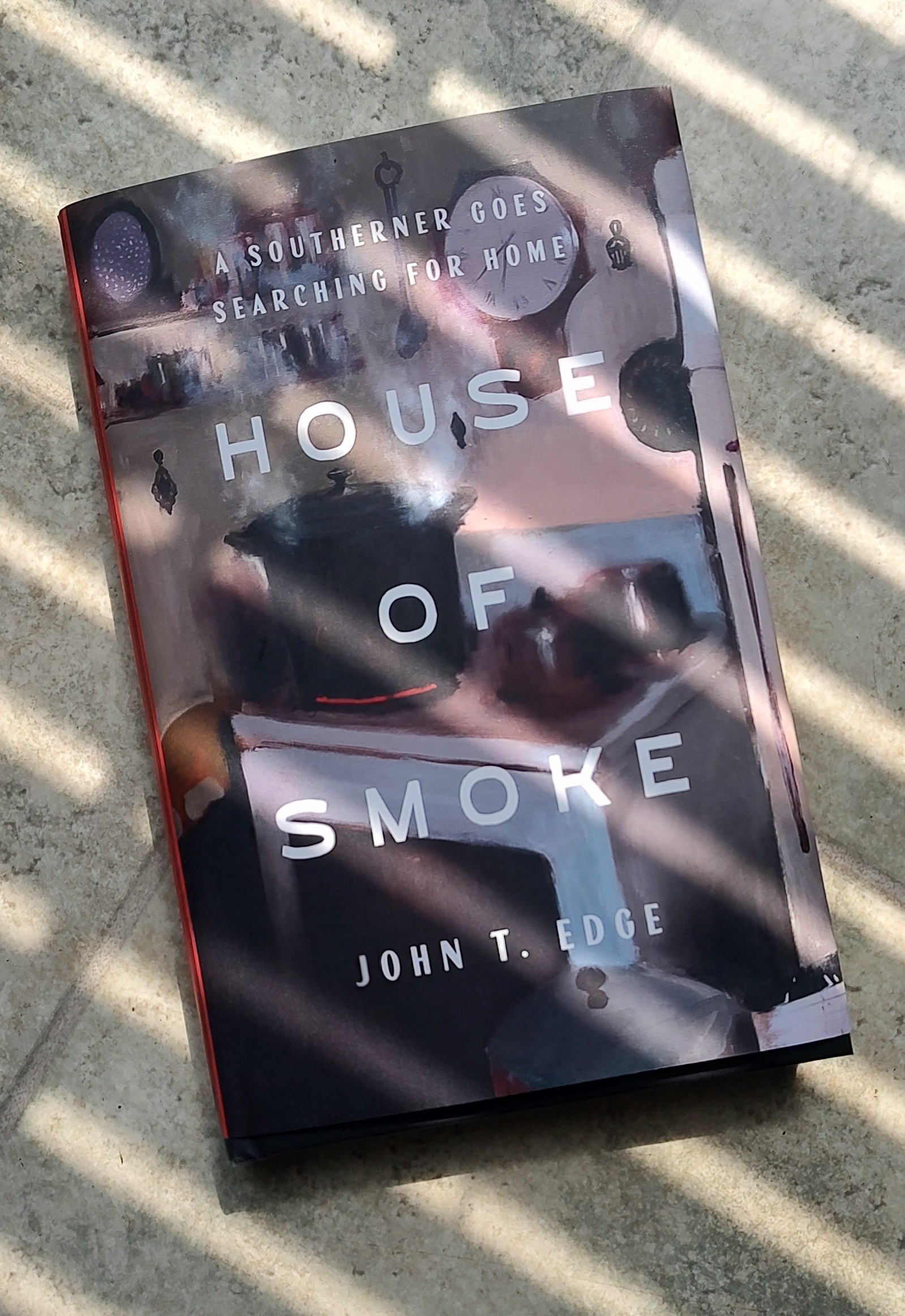
John T. Edge has just released his memoir, House of Smoke: A Southerner Goes Searching for Home (Crown Publishing). It is an unrestrained examination of himself, his family, and the places and events that have brought him to this point in his life. It is occasionally surprising and shocking – it turns out John T. has a knack for keeping things close to the vest.
House of Smoke is gracious, open-minded, and self-examining as it traces a life from a historic, crumbling antebellum house to the Animal House life of a University of Georgia frat to stints in the corporate world, to academic life at Oxford and Ole Miss and the actualization of a life’s calling. It is warm, forgiving, and humane. Despite distractions, I was able to read and savor the book in the course of a day. The book’s reach is wide as Edge considers family, foodways, class, race, betrayal, forgiveness, and what it means to be of the South. It’s a lovely and honest book that I highly recommend.
In House of Smoke, John T. writes soberly, fairly, and bluntly about his severance from Southern Foodways Alliance. He discusses the support he received and the ways in which he, his wife Blair Hobbs, and their son adapted to the change. When writing about ceremonial ways in which he and Blair memorialized the break, I smiled and gave out a silent cheer when I read “In our backyard firepit, I burned a cookbook by Ronni Lundy.” That pleased me.
I confess that I can still hold a grudge.
 Professional Southerner