
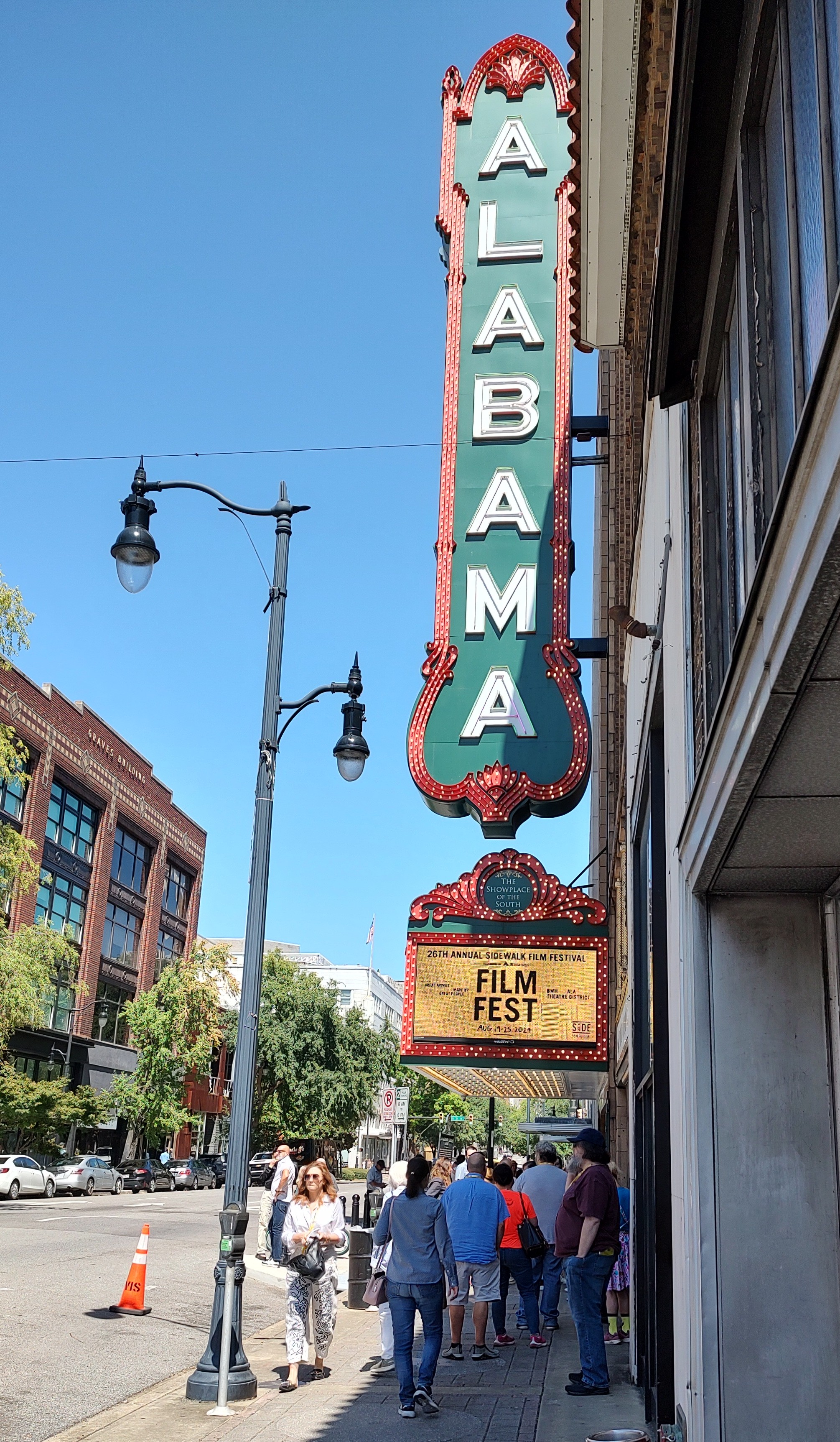
 Each year, on the final August weekend before the start of college football season, Birmingham’s Sidewalk Film Festival fills the north side of downtown with screenings, workshops, panels, and events focused on what’s happening in the world of independent filmmaking. Sidewalk has garnered many designations from film media over the years, including nonspecific adjectives like “coolest” and “fabulous.” It was also, more specifically, designated as one of the “Great Film Festivals for First-Time MovieMakers.” I’ve been present for the majority of the twenty-six iterations of Sidewalk and am delighted and proud that it became what it has become. Sidewalk Film Center + Cinema, in the basement of the Pizitz building, houses two cinemas showing movies year-round in intimate state-of-the art theaters that have become my favorite places to catch a movie in the city. The Festival even went on in 2020, at the height of the pandemic, in a drive-in theatre format at an outlet mall just outside the city. “Cool,” right?
It is my habit to book a room at the Elyton Hotel, on the southern edge of the festival, at the proverbial “Heaviest Corner on Earth,” ditch the car, and walk and walk … and walk among ten downtown venues showing about 250 titles from morning to late-night. A filmmaker friend who showed his film at Sidewalk years ago quipped that “now I understand why they call it ‘Sidewalk’.”
The 26th Annual Sidewalk opened at the Alabama Theatre on Friday night with Exhibiting Forgiveness, the debut film by visual artist Titus Kaphar starring Alabama native Andre Holland.
Easing in to a full day of movie watching on Saturday, I decided to watch “Saturday Morning Cartoons” at the Sidewalk Cinemas where sugary cereals and milk, coffee, cold pizza, Bloody Marys, and mimosas were on hand. Cleansed by cartoons and breakfast food, I walked over to the next block to catch a live organ performance by Nathan Avakian at the Alabama Theatre, Birmingham’s 1927 vintage “Showplace of the South.” Avakian provided accompaniment for a classic Harold Lloyd short and several three-minute contemporary films from the International Youth Silent Film Festival (IYSFF), all of which were directed by talented youth between the ages of thirteen and twenty.
Refreshed and awake, it was time to dive into the real business of the day and start watching movies. I am not keeping up with cinema like I used to so my selections were based largely on instinct. I am relieved to say that my instincts were good. My first full-length screening, Family Portrait (2023) at Sidewalk Cinema, was my best choice, but more about that later.
At the Birmingham Museum of Art, Chaperone (2024), directed by Zoe Eisenberg, features a compelling, sometimes painful, performance by Mitzi Akaha as an almost-thirty slacker who, despite pressures to accept responsibility, is content in her life until she accidentally gets romantically involved with a much younger guy.
Rushing back down to the Lyric Theatre, the night was closed out with My Name Is Alfred Hitchcock (2022), a high-concept documentary caper by Mark Cousins. The film is narrated in a voice, purported to be Hitchcock’s, about the various elements of Hitch’s filmography. It’s an entertaining ruse and a relaxing opportunity to revisit snippets of Hitchcock’s films and reexamine his mastery of suspense.
Sunday morning was the time for Sleep (South Korea, 2024), directed by Jason Yu. Yu’s suspenseful film, about a young couple suddenly beset with sleepwalking that quickly becomes a nightmare, is a deftly handled debut by Yu with strong and affecting performances by Jung Yu-mi and Lee Sun-kyun as the besieged couple.
My Sunday schedule is often heavy with documentaries and Resynator, directed by Alison Tavel, explores Tavel’s search for information about a father she never knew. Her father, Don Tavel, invented a synthesizer in the 1970s. In discovering the history of the Resynator synthesizer, Alison also forges a connection with her father.
Turning to more locally-focused fare – which is a Sidewalk standard, A Symphony Celebration: The Blind Boys of Alabama with Dr. Henry Panion III (2024), directed by Michael Edwards and Henry Panion, played at the recently-renovated Carver Theatre. My fandom of the Blind Boys took hold in the ‘80s when I was fortunate enough to attend The Gospel at Colonus, Lee Breuer and Bob Telson’s brilliant stage adaptation of the ancient Greek play, Oedipus at Colonus by Sophocles. The production featured Morgan Freeman as the Messenger and the Blind Boys of Alabama, collectively, as Oedipus. A Symphony Celebration chronicles a Birmingham performance by the Blind Boys with full orchestra and chorus. A centerpiece of the performance is the Blind Boys’ signature rendition of “Amazing Grace” to the tune of “House of the Rising Sun,” a controversial choice that has become the Blind Boys’ most enduring hit.
The Almost Lost Story of Tuxedo Junction (2024), directed by Katie Rogers, is about a spot in the Ensley neighborhood of west Birmingham that is both mythologized and forgotten. My dad grew up on Avenue D in Ensley and I have known the humble building that stands at what was once a streetcar junction for as long as I can remember. Also, I cannot help tapping my toes whenever I hear the Erskine Hawkins-composed jazz standard, “Tuxedo Junction,” a piece inspired by that now-neglected place. It was heartening to see the large crowd that filled the Carver to watch the documentary; maybe more people remember than we realize.
_________________________________
Now, if I’m lucky, I will see at least one movie each year at Sidewalk that I won’t forget. Most of what I saw in this 2024 edition was of fine quality and merit. However, the film that I can’t stop pondering is Family Portrait (2023), directed by Lucy Kerr.
A large family is gathered at an idyllic riverside home on a warm summery day. It is the appointed day to take the annual family photo for the Christmas card before the gathered begin to disperse. The news of the mysterious death of a distant relative begins to spread through the house. The family matriarch, who meticulously plans the annual card, walks away and seems to disappear. As the rest of the family goes blithely through their carefree day, daughter Katy (Deragh Campbell) becomes increasingly anxious – to take the picture, to find her mother. The mood of this quiet film becomes increasingly frantic, desperate, foreboding.
Family Portrait is a beautiful film – beautiful cinematography by Lidia Nikonova, beautifully edited by Karlis Bergs, brilliant sound design by Nikolay Antonov and Andrew Siedenburg. In a dreamlike prologue, the family aimlessly gathers at the river and the camera follows first one and then another, moving carefully back and forth and among the family members. Santa Claus hats are being handed out on a bright warm day; a man is given a hat, places it on a passing child’s head, and, when the child discards it, the man reluctantly picks it up and walks toward the others as the camera glides to another point of interest. Sound begins to bleed in, subconsciously at first – faint childish chatter, adult banter, nature sounds … and then the opening titles appear.
Exposition is casual and dialogue overlaps. We learn that the family are Texan. Katy is not married to her Polish partner, Oleg (Chris Galust); he has been designated the photographer for the portrait since he’s not “family.” A relative’s iconic World War II photograph was appropriated for Vietnam War propaganda of some sort. There is a brief sequence in which Katy and Oleg read an excerpt from a Barbara Bush memoir they have pulled from a shelf (I recognized the book cover from my mother’s bookshelves). A couple of hired workers go about their business inside and outside the house. Something is amiss and the specter of Covid is clearly looming here, but has not yet become a conscious issue for the family. A lyrical underwater swim late in the movie raises many questions as Katy emerges, soaking wet, and walks back toward the house. A slice of life story becomes surreal, off-balance. It seems that nobody remembers that Katy and Oleg are late for a ride to the airport.
Movies like Family Portrait are the reason I go to film festivals.
 Professional Southerner