Tag Archives: Natalie Chanin

Makers and Others at the Alabama Chanin Factory

IMG_1991 I live in a high tech town full of engineers, IT, military, and rocket scientists. That is all well and good for them and they speak of the place as a mecca but I am a liberal arts guy from Birmingham who has lived and traveled all over the country working in the performing arts. I have lived in Huntsville for thirteen years now and have a difficult time finding my niche in that community.

So I was fortunate indeed to be able to travel over to Florence again to attend the most recent Friends of the Café dinner at the Alabama Chanin Factory on Saturday, October 24. This is a trying and stressful time for my family with my father in the hospital; my mother, bless her, knew I had reservations for the dinner and insisted that I travel up for the night. IMG_1993

I have attended several of these Alabama Chanin (www.alabamachanin.com) events over the past sixteen months. Natalie Chanin is doing great things to spark community from her design business based in the Shoals and she and her phenomenal staff always create a lovely and memorable evening of food and camaraderie. In addition to Chanin’s amazing hand-sewn fashion designs and clothing, the Factory store features books, pottery, art, and other products, most of them crafted by various makers from the South and beyond. The aesthetic of the place is flawless and I am always restored and inspired when I leave the Factory. When I attend the Alabama Chanin dinners I feel like I have found a place where I “belong.”
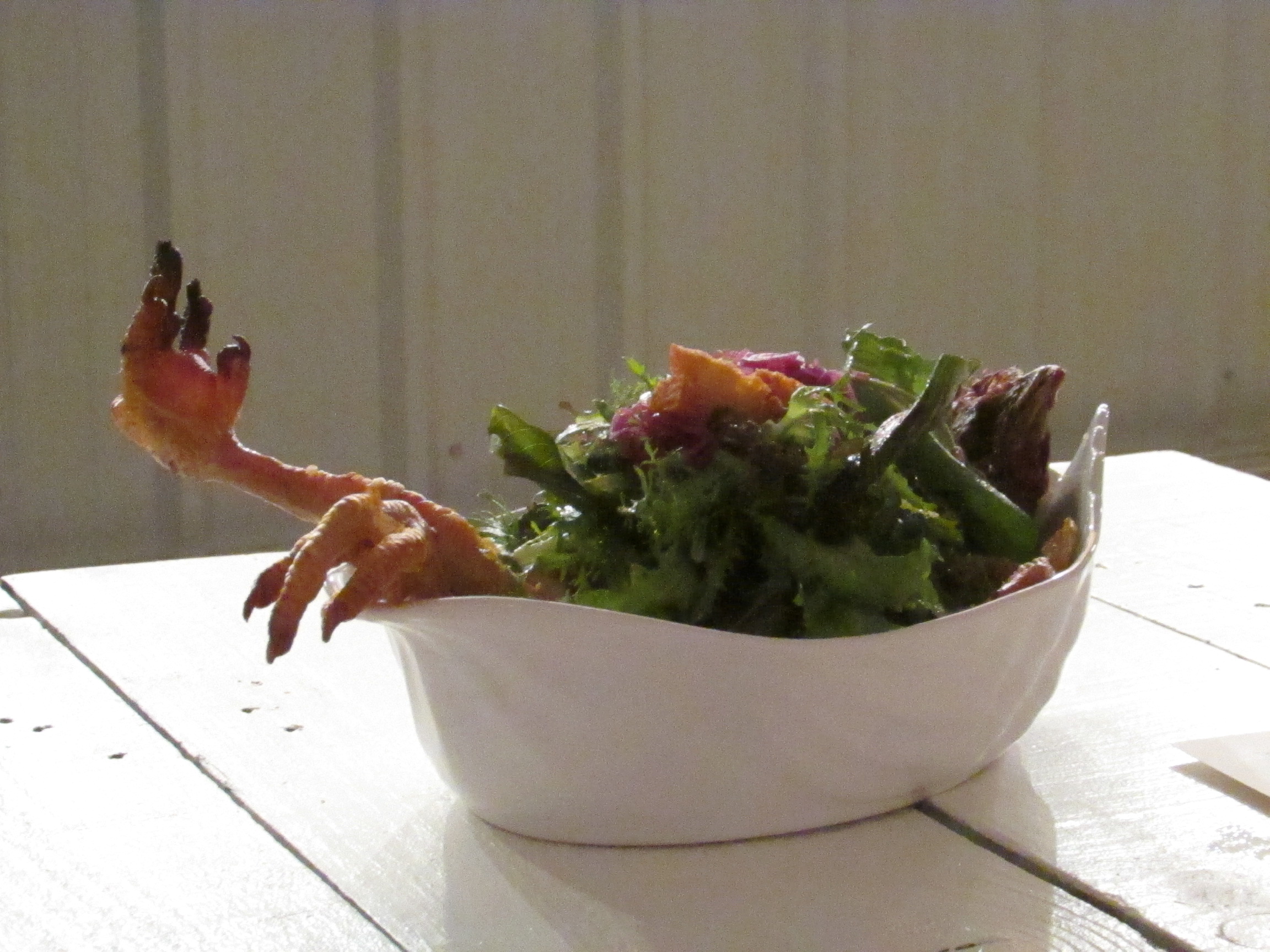
IMG_1995Chef Anne Stiles Quatrano of Bacchanalia (www.starprovisions.com) and other Atlanta food destinations was the guest chef for the evening. After cocktails and an assortment of passed hors d’oeuvres, diners sat down to a four course meal with wine pairings starting with a Georgia white shrimp cocktail. The second course was served family-style and featured a whole roasted Green Circle chicken in a large vessel with bitter greens and roasted chicken jus vinaigrette.

A simple and elegant cheese course featured Grayson cheese with hazelnuts and crispy honeycomb presented on a circle of fine wood. Finally, the dessert course was canales with a rich coffee cream and Revelator coffee (www.revelatorcoffee.com).IMG_1999

“Southern Makers,” an Alabama collective of artists and artisans (www.southernmakers.com), was a sponsor of the event and guests received a “Maker Box” of Alabama-made products introduced by Garlan Gudger of Cullman’s Southern Accents Architectural Antiques (www.sa1969.com). Oxford American magazine (www.oxfordamerican.org), another sponsor, is now partnering with Southern Makers to expand the collective to include artisans, artists, and makers from throughout the South. Lee Sentell of the Alabama Tourism Department took the opportunity to discuss the upcoming “Year of Alabama Makers” during which makers throughout the state will be featured in tourism publicity and events.

Finally, Chef Quatrano brought and signed copies of her gorgeous cookbook Summerland: Recipes for Celebrating with Southern Hospitality. This is one of the prettiest cookbooks I have seen with a long and varied collection of recipes and commentary.

During the comments throughout the evening, someone mentioned that even though people travel from faraway destinations to see Alabama Chanin’s operation and to have the Factory experience, many Alabamians have not yet heard about her business, what she does, and her wide-spread  influence. The word is getting out, however, and with the continued efforts of Alabama Chanin, Southern Makers, Oxford American, Alabama Tourism, and many other makers and supporters throughout the state more people will be aware of the hidden treasures to be found and nurtured throughout Alabama and the region.

A night at the Factory in Florence always gives me hope.

IMG_1997

Weeding Organic Cotton

IMG_0724 In 2012 I received an email from Billy Reid’s organization with an interesting proposition. It seemed that Natalie Chanin and Billy Reid, both fashion designers based in Florence, Alabama, were experimenting with growing organic cotton in a small field near Trinity, a town between Decatur and the Shoals area of Alabama. The email asked for volunteers to come out to the field to help weed – no small task when you’re growing organic.

Natalie Chanin’s Florence-based label, Alabama Chanin, features handmade garments made with American-grown organic cotton. The problem is, there is no organic cotton grown in Alabama that she can use and she has to source her cotton from some place in Texas. The purpose of the Trinity experiment was to see what kind of luck they’d have growing their organic cotton locally. A September 5, 2014, edition of The New York Times “T” magazine blog chronicles the Alabama Chanin cotton harvest.

Back in 2012 I heeded the call out of curiosity and because it isn’t every day that one is invited to weed in a fashion designer’s organic cotton field.

I drove to Trinity one sunny Saturday morning and the only other person in the field that morning was Lisa Lentz; she and her husband had lent the project the seven acres to plant the cotton. I didn’t have too much time to spend in the field that morning but I weeded hard while I was there and learned more details about the project from Lisa. I had worked in a cotton field once before; when I was a young boy, on a visit to Cullman County, Alabama, with my mother and grandmother, my Cullman County cousins got a kick out of putting their skinny city cousin in the field for a while with a sack over his shoulder. I wasn’t very useful out in the field that morning but I remember it was rough on the hands and hard work to remove the cotton and place it in the sack.

It was equally challenging to pull weeds in Trinity in 2012 but I drove away with a sense of accomplishment, sore knees, and a curiosity about how the experiment would work out. There were subsequent appeals a few weeks after my morning of weeding for volunteers to pick the cotton ready for harvest. I had conflicts that kept me from going back out but was glad I had a connection to the project. A friend, when I told him I had spent a morning weeding organic cotton, smirked a little and asked how organic cotton clothes would feel any different from any other cotton clothing. I was surprised he asked that since he is very environmentally conscious and fuels one of his vehicles with recycled cooking oil. I explained that it wasn’t so much the feel of the cotton but the toxic chemicals that were not going into the earth and the water supply that mattered.

In July of this year, I was at the Alabama Chanin Factory for a Friends of the Café event and asked Natalie Chanin about the status of the Trinity organic cotton project. She told me the finished cotton was in the factory being turned into tee-shirts. When the tee-shirts went on sale a couple of weeks ago, I had to grab one. It may be the most expensive tee-shirt I’ve ever owned, but I definitely feel I had a hand – and knees – in the effort. And, back to my friend’s comment about what difference organic cotton makes: It’s likely all psychological – but it is probably the most comfortable tee-shirt I’ve ever put on my body.

“The Professional Southerner” — and why

IMG_3349I think I was living in Indiana the first time I was referred to as a “professional southerner.” As I recall, it was around 1994 and I was frustrated because I had been unable to find okra in the produce sections of the local grocers. Someone innocently asked why I ate okra and my shock made me launch into a monologue of the virtues of okra and all the ways in which it could be consumed. But my favorite way was breaded and fried in the particular way my Grandmother Harbison had always made it and I had been craving fried okra around that time of that Indiana summer.

This led to questions about other ways in which okra could be consumed (I told them pickled okra was my favorite Bloody Mary garnish), other foods I like, and other queries about Southern foodways. Someone in the group mumbled, “I never realized you were such a professional Southerner,” and we all laughed but over the years, as I lived and traveled in other parts of the country, I became aware that I was often the go-to guy for issues dealing with the South and what it means to be Southern.

Having said that, I am a proud Southerner but very few people would classify me as a “typical” Southern male with all of the misconceptions and stereotypes that label evokes. But I realized, after traveling and working in different places – and to my surprise, really – that not only was the South my home, but that it was the place I best understood and the place where I felt most comfortable. It was the place I wanted to come back to. My politics, for one thing, are not typical of the South, but they are also not as atypical as some might suppose and I resent the whole “Blue State / Red State” way of thinking because it gives such a divisive idea of what is really happening in our country.

Not long ago, my friend Cindy and I attended a “Piggy Bank” dinner at the Factory of Alabama-based fashion designer Natalie Chanin in Florence, Alabama. The event was to honor Southern food and to benefit Southern Foodways Alliance. The chef for the evening was Vivian Howard who owns and runs Chef and the Farmer, a farm to table fine dining restaurant in Kinston, North Carolina, with her husband Ben Knight. Between the entrée and the dessert, Shonna Tucker, an Alabama-born musician who has recently moved to Florence after many years on the road, sang her striking and original songs. The dinner guests were a wide range of people who shared an amazing communal meal and one of the most convivial and relaxed evenings I have enjoyed in a long time. At the end of the evening, all of the diners stood and sang “You Are My Sunshine” to Vivian Howard, led by Natalie Chanin, one of the most innovative and conscious fashion designers working today.

That night, walking from the Factory to the car, I commented to my friend that “This is one of those nights when I can’t imagine living anyplace else but Alabama.” And I decided that I – who have always detested the idea of blogs and the label of “blogger” – would make an effort to record and share some of the things that make my South so special to me. Plus, I have been told that I “think loudly.” Maybe, by writing this online journal, my loud thoughts will become more specific and defined.