Tag Archives: Southern literature

A Place at the Table: John T. Edge and House of Smoke

Sometime around the turn of the century, I was at my parents’ house over the 4th of July holiday. I had travelled in from wherever I was living at the time. They had friends – a pair of married young attorneys – who lived in the neighborhood. My contact with this couple was minimal, but my parents spoke highly of them.

The wife called my mother to invite her and Dad over for dinner on the night of the 4th. Mother told her that I was in town and asked if I could come along. She said I could (what else could she say?) and, even though I didn’t really want to, I tagged along. After all, I was sort of invited and felt it would be rude not to go.

When we got there, there were the couple’s two daughters and some other guests, including one person I knew in a roundabout way. When it was time to gather for dinner, the hosts said “Let’s see where we can put Edward” and made a bit of a show of pulling in a small table and setting it at the end of the dining table with a smaller chair to match. It occurred to me at the time that they might have saved room by just pulling an extra chair up to the big table.

Memory is a strange thing and I have wondered how much of this I might have exaggerated in my head, but the description I have seems pretty accurate. Let me add that I was not a kid; I was in my forties at the time so the whole situation was embarrassing and uncomfortable. I wasn’t sure how I might have offended these people – I barely knew them – but they made it clear that there was no place at their table for me.

When the meal was over, I helped move my little table out of the way, thanked the hosts, pled a headache, and walked back to my parents’ house. I was happy that we had Dad’s barbecue for lunch so the day was not a total disappointment.

And now, I confess that I can hold a grudge.

____________________

A couple of decades later, in the summer of 2020 during the pandemic, a friend emailed me “Have you seen this yet?” with a New York Times article attached. The article’s title was “A White Gatekeeper of Southern Food Faces Calls to Resign.” In it, journalist Kim Severson explores a move by a cadre of members of Southern Foodways Alliance, of which I was a contributing member, to oust the SFA’s founding director, John T. Edge. Reading the article, I do not exaggerate when I say I got physically ill.

The main complaint seemed to be that Edge is a white man at the head of an organization that explores the range of what constitutes the food of the American South in all its complexity and constant transformation. People that I only knew about because of John T. Edge and SFA were making weird and sometimes unhinged accusations.

An Indian American chef who had been part of SFA’s “Brown in the South” outreach to give broader exposure to Indian foods and foodways in the American South, groused that she was “a prop in what felt like a dog-and-pony show.” I grimaced when I read that because I had recently eaten this woman’s cooking, vowing to give Indian cuisine – which I had never really warmed up to (it’s a texture thing) – another go, mainly because of the advocacy of SFA.

Another person, who had spoken at an SFA symposium, felt demeaned that she had spoken behind a lectern “created to look like a stove.” I used to attend SFA symposia and there was often a clever touch decorating the lectern and the podium on which it stood. I find no insult or sexism in stove imagery at a food symposium.

Ronni Lundy, an Appalachian food writer and founding member of SFA, seemed to be a prime mover in calls for Edge’s resignation. Her charges seemed to be based on allegations of sexism. I have no apparent right to comment on that since I am a white male. I can only say that from my privileged position, it seemed like Edge’s writings and recommendations appeared to spotlight as many, if not more, women and minorities. I would never have known who Ronni Lundy is if not for John T. Edge, nor would I have bought her cookbook. It was hurtful to read spiteful comments about a man I liked and respected from those who would have probably never been known to me without him. If he was the “gatekeeper,” the gates always seemed open wide.

And that is where my anger comes in. I became a supporter of Southern Foodways Alliance because it set a place at a large and welcoming table for all of us. John T. Edge, as the primary face and spokesperson for the organization, introduced us, through his stewardship as well as his books and writing for other publications, to a more complete, diverse, and equitable understanding of what it means to be Southern – and what it means to eat for connection as well as sustenance. His show, “True South,” for ESPN and the SEC Network, travels the region and shows us the contrasts and connections ever-present in our food places and food habits. I discovered foods and sought out restaurants I might never have known about because of John T. and SFA. There were more places at more tables than I realized.

I have had the good fortune to be present at table and have conversations with John T. Edge over the years, to the point that I consider him a friend. I am always impressed with his graciousness, his humor, his warm and open demeanor, and his prodigious memory. The first time we met in person, at a dinner in the Shoals, he recalled an essay I had submitted to Gravy, the SFA quarterly, about a family peach farm in Chilton County, Alabama. (The essay was rejected, but John T. suggested places I ought to submit it.)

So, when that New York Times article came out, I emailed John T. to extend good wishes and commiserate. His response was gracious, grounded, and reasonable – no anger or bitterness came through – and I felt better after I heard from him. Some of my own anger went away as I decided to sit tight and see what happened next.

Over time, John T. and the University of Mississippi (which houses SFA) came to an agreement and John T. moved on from his SFA leadership – a move that he had been planning, actually, prior to the New York Times article.

In my subsequent message to SFA, canceling my membership and asking to be removed from all their mailing lists, I wrote that it was clear that there was no longer a place at their table for me.

I confess that I can hold a grudge.

____________________

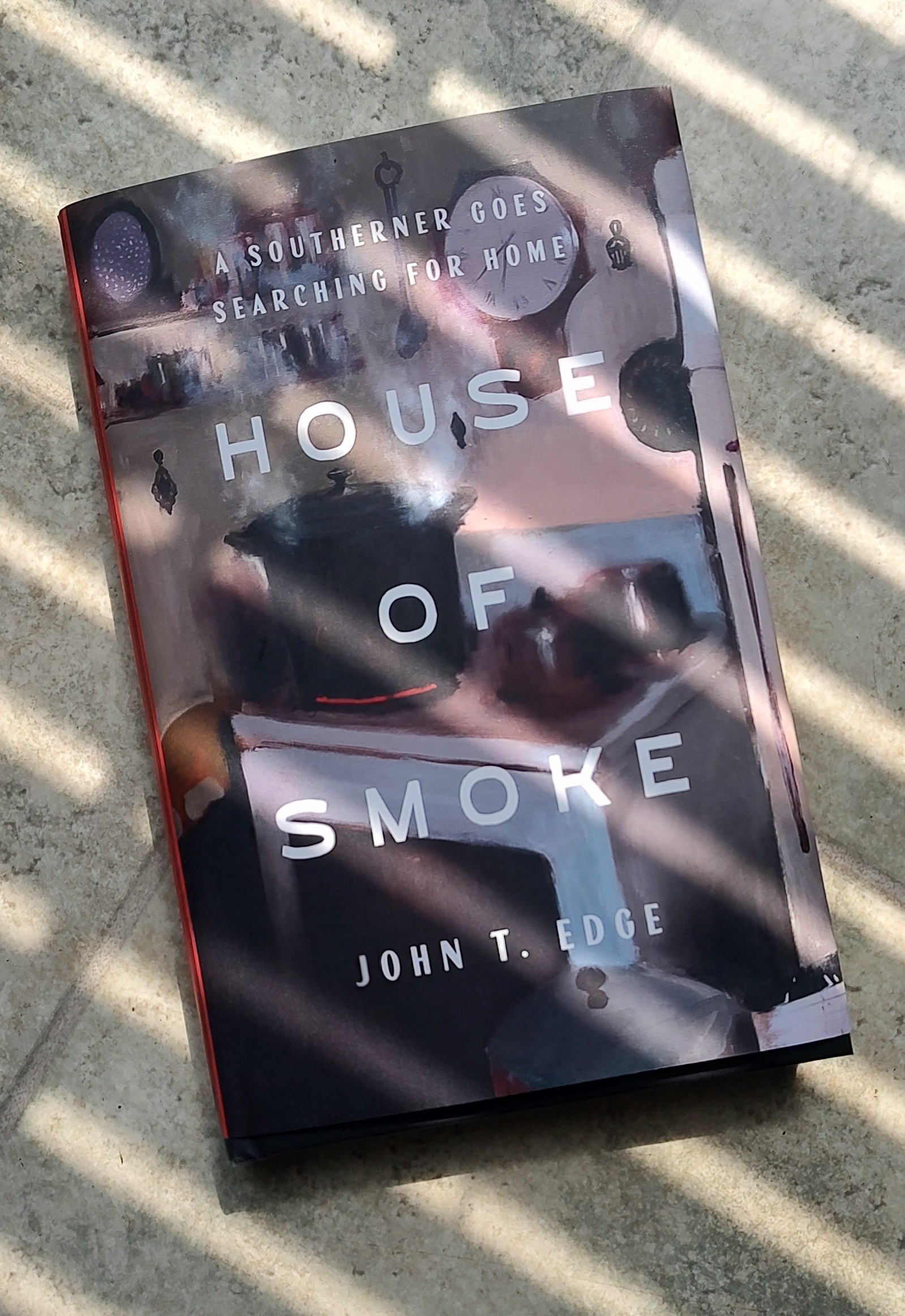
John T. Edge has just released his memoir, House of Smoke: A Southerner Goes Searching for Home (Crown Publishing). It is an unrestrained examination of himself, his family, and the places and events that have brought him to this point in his life. It is occasionally surprising and shocking – it turns out John T. has a knack for keeping things close to the vest.

House of Smoke is gracious, open-minded, and self-examining as it traces a life from a historic, crumbling antebellum house to the Animal House life of a University of Georgia frat to stints in the corporate world, to academic life at Oxford and Ole Miss and the actualization of a life’s calling. It is warm, forgiving, and humane. Despite distractions, I was able to read and savor the book in the course of a day. The book’s reach is wide as Edge considers family, foodways, class, race, betrayal, forgiveness, and what it means to be of the South. It’s a lovely and honest book that I highly recommend.

In House of Smoke, John T. writes soberly, fairly, and bluntly about his severance from Southern Foodways Alliance. He discusses the support he received and the ways in which he, his wife Blair Hobbs, and their son adapted to the change. When writing about ceremonial ways in which he and Blair memorialized the break, I smiled and gave out a silent cheer when I read “In our backyard firepit, I burned a cookbook by Ronni Lundy.” That pleased me.

I confess that I can still hold a grudge.

There Is Happiness: Fiction by Brad Watson

The astonishing fiction of Brad Watson (1955-2020) is available in a new collection, There Is Happiness: New and Selected Stories, an enduring record of a fearless writer whose work should be treasured.

It was my pleasure to review There Is Happiness for Alabama Writers’ Forum. Read the full review here:

There Is Happiness

A History of Saints, the Debut Novel by Julyan Davis

 A History of Saints (Shadelandhouse Modern Press, 2021), the debut novel by Julyan Davis, is a modern comedy of manners set during the Great Recession in the eccentric environs of Asheville, North Carolina (blundering “toward a theme park version of itself”). Funny and surprising, the novel brings together a truly bizarre cast of characters – including two feral chihuahuas – and explores, as the subtitle declares, “dog handling, courtly love, gardening and cooking, sexual fluidity, belly dancing, poetry, loss, and addiction.” That list barely scrapes the surface of the explorations that also include a missing chifforobe, a stolen shopping cart, a samurai sword, and “misguided sugar babies.”

The first sentence sets the antic pace: “At the next light Frank struck an individual dressed as a mattress.” Frank is Frank Reed, around whom the book mostly revolves. In an effort to save his grand old home, “Carolina Court,” Frank Reed rents out rooms and assembles a mismatched and colorful group of tenants. The mattress turns out to be one of those tenants, Angus Saxe-Pardee (sometimes known as “Angus Sex Party”), an erstwhile Scotsman.

Angus, in an effort to be of service – or to be in charge, takes it upon himself to run a classified ad to try to rent out Frank’s remaining space. “LIVE GONE WITH THE WIND FOR ONLY $400 A MONTH” reads part of the ad. Eventually the all-male household is joined by two women – Andromeda, a young woman seeking refuge from an affair that has ended badly, and Lida, an enigmatic traveling nurse. The complications and hilarity that ensue are full of surprises and laugh-out-loud banter.

A History of Saints is Davis’s first novel, but his writing is skilled and assured. A native of England, known primarily as a painter of the American South, his art frequently has a narrative flair, especially his touring large-scale painting installation based on Appalachian murder ballads and his “Demopolis” paintings inspired by an Alabama colony of French settlers. That French “Vine and Olive Colony” inspired Davis’s first forays into the South, which he has been painting consistently since the 1980s. The wry humor of A History of Saints is not unprecedented in Davis’s oeuvre; scattered through his work are wistful paintings of period-costumed monkeys and, my favorite, the stages of the moon represented by Moon Pies.

While reading A History of Saints, I was reminded at times of The Untidy Pilgrim, the first novel by Southern renaissance man Eugene Walter, in 1954. Davis’s writing is reminiscent of Walter’s in its devil-may-care whimsy and its unbridled joie de vivre in the complex and occasionally zany weaving of a narrative. Yet, there are poignant moments of insight such as Frank’s realization that it is “the objects we cherish that make a home — the paintings and keepsakes — not the walls around us or the roof above us.”  A History of Saints is the work of an artist who is already a skilled storyteller, who has taken those skills to another medium with a novel that provides a welcome respite in challenging times. (https://julyandavis.com)

New Reviews of Southern Fiction

To all of the kind people who responded to my most recent post about missing books (“Page by Page, Measuring a Life”) — Thank You! The books have been found, but I was so moved by the concern and generosity of many.

Here are links to my most recent reviews for Alabama Writers’ Forum:

https://www.writersforum.org/news_and_reviews/review_archives.html/article/2021/10/13/this-ditch-walking-love

https://www.writersforum.org/news_and_reviews/review_archives.html/article/2021/10/13/fugitives-of-the-heart

Miss Jane’s Solitary Life

dscn0555 When Brad Watson’s remarkable short story collection The Last Days of the Dog Men first appeared, I kept gifting it to readers I know. Read it, Read it, Read it I would say and let me know if it’s as good as I think it is. Those who followed my exhortation tended to agree with me. Finally somebody said to me “I love it, but you gave me this same book last year.” I told her to keep it and pass it on and I gave her another book to replace it.

I have known great dogs all of my life and no writer has ever captured a dog’s essence in quite the way that Watson does in that compulsively readable and often brilliant first short story collection.

Watson followed up Last Days … with the fine novel The Heaven of Mercury and then Aliens in the Prime of Their Lives, a second short story collection full of mystique and wonder. Now his second novel, Miss Jane, is on the shelves. It is a book of painstaking empathy and precision inspired in part by the true story of one of Watson’s great-aunts.

The title character, Jane Chisholm, is born before her organs are fully developed and has a genital birth defect which obliterates the demarcation between her reproductive, bowel, and urinary functions. This does not sound like a promising premise for a fascinating and distinctive novel but in Brad Watson’s skilled hands Jane overcomes the odds and her handicaps to live a full and courageous life and that singular life is the book’s clear focus.

Watson tells the story in a straightforward and fluid way, avoiding maudlin sentimentality, and exploring the life of Jane while skillfully rendering the few people in her orbit in a rural area near the fictional town of Mercury, Mississippi (which has much in common with Watson’s home town of Meridian).

Jane’s parents, Ida and Sylvester, are stoic and grim, accepting their troubles as their due and finding ways to blame themselves for both Jane’s careless conception and her physical challenges. The married couple has long drifted away from each other and each tries to find ways to find peace and calm in their existence. Jane’s older sister, Grace, is anything but graceful as she schemes and connives to remove herself from her parents’ farm and move to town.

Most interesting of all Jane’s acquaintances is Dr. Eldred Thompson, the country doctor who makes a special effort to cultivate and educate Jane from the moment of her birth. The frank and honest relationship between the woman and her doctor makes a striking centerpiece for a unique and brave novel.

Watson’s ability to provide much detail in a sparse and efficient matter is a hallmark of his work and he is at his peak in Miss Jane. He weaves his story seamlessly and compellingly and a life passes before the reader without interruption. Jane is a toddler and suddenly five years have passed and she’s going to school; Jane is an adolescent and suddenly she is working with her sister as a young woman in Mercury. Jane becomes an old woman.

Without dwelling on Jane’s challenges, Watson shows a girl – later a woman – who finds ways to control her incontinence and mostly successfully keep it from interfering with her functioning in the world around her. He presents a vivid character forced by biology and culture to live a solitary life but shows that it can be a satisfying and fulfilling one, and one perhaps more successful than the flawed conventional lives of those she encounters.

Jane comes to an early realization that child-bearing and a “normal” sex life are beyond her capabilities and comes to a calm and healthy acceptance of the facts of life as they apply to her circumstances. Even so, a beautiful young man, Elijah, falls for her and she for him and Jane immediately begins to calculate how far she can allow the teenage romance to progress. Jane and Elijah’s delicate and bittersweet relationship is acutely explored until the time when the doctor and Jane’s family decide it is in the best interest of both to put a stop to it. It’s interesting that this same theme of the world making decisions about the sensual life of one with disabilities is also explored in Jeannie Thompson’s The Myth of Water, a series of poems about the life of Helen Keller. Well-meaning “normal” people are not always aware of the spiritual harm they might inflict by looking out for the perceived “best interests” of others.

I knew Brad Watson casually when we were both students at Alabama. He was known as a serious and skilled writer even then and his composure and bearing always seemed to take him above the muck and petty politics that occasionally mar the creative graduate school experience. Writer Barry Hannah was teaching at Alabama at the time Brad Watson was there and when Watson’s work began to be published Hannah’s great quote was “Only the Irish geniuses wrote like this.”

It is always an especially exciting time when one can open a crisp new book by Brad Watson. With Miss Jane he has created a character that will endure and inspire.  Read it, Read it, Read it …

On (re)Reading Walker Percy

IMG_1782  One of my assignments during graduate school was to assist the surly and pompous professor who briefly headed up the playwriting and dramaturgy program. He was a Boston native, out of Yale and Carnegie-Mellon, and some kind of Orson Welles scholar. His current assignment was at a Southern university but he made no effort to disguise his contempt for Southerners and the South.

I found him rude and offensive but tolerably amusing and treated him with a level of respect he had not earned. One afternoon we sat in his office discussing scripts that had been submitted to the department’s playwriting program and that conversation veered off onto a number of topics.

“Welles Scholar” leaned back in his chair, eyed me seriously, and said, “I like you, Journey. You’re that rare breed – an intelligent Southerner.”

I seriously eyed him back and said, “Y’know, that may be one of the most insulting things that’s ever been said to me.” I told him I had to get to a seminar and politely excused myself, fuming.

From that moment on, I detested “Welles Scholar” and was delighted to see him leave at the end of that academic year. I’m sure he meant the statement as a compliment to me but the cluelessness, arrogance, and stupidity which informed the comment made me angry and still makes me angry whenever I think about it.

I had not thought of the Welles Scholar story for a number of years but it came back to me this week as I was renewing my acquaintance with the writing of Walker Percy.

The great writer Walker Percy (1916-1990) is legitimately claimed by three states – Alabama, Louisiana, and Mississippi. He was born in Birmingham and lived there until he was 13. After the death of his father, his mother moved the family to Georgia. When she died, he and his brothers were taken in by a bachelor uncle in Greenville, Mississippi. He graduated from the University of North Carolina, earned a medical degree from Columbia, and contracted tuberculosis that lead to a lengthy recovery at a sanitorium in upstate New York. Percy spent the bulk of his adult years in the New Orleans area, eventually settling with his wife, Mary Bernice (“Bunt”), and children across Lake Pontchartrain in Covington, Louisiana.

Percy’s writing is deeply probing and intellectual, mixing Existentialist philosophy and scientific inquiry with Roman Catholic theology and the search for spiritual fulfillment. He deals brilliantly with the South and the complexity of the Southern “character.” He writes with amused suspicion and insight about both the South and other parts of the country but the observations are always filtered through a sense of what it means to be “Southern” in all of its forms.

Percy’s novels often focus on a flawed protagonist who doesn’t quite seem to belong anywhere but continues the quest for meaning and belonging nevertheless. Percy’s books are challenging and they tackle some weighty issues with an underlying wit, compassion, and turn of phrase that make them compelling and entertaining.

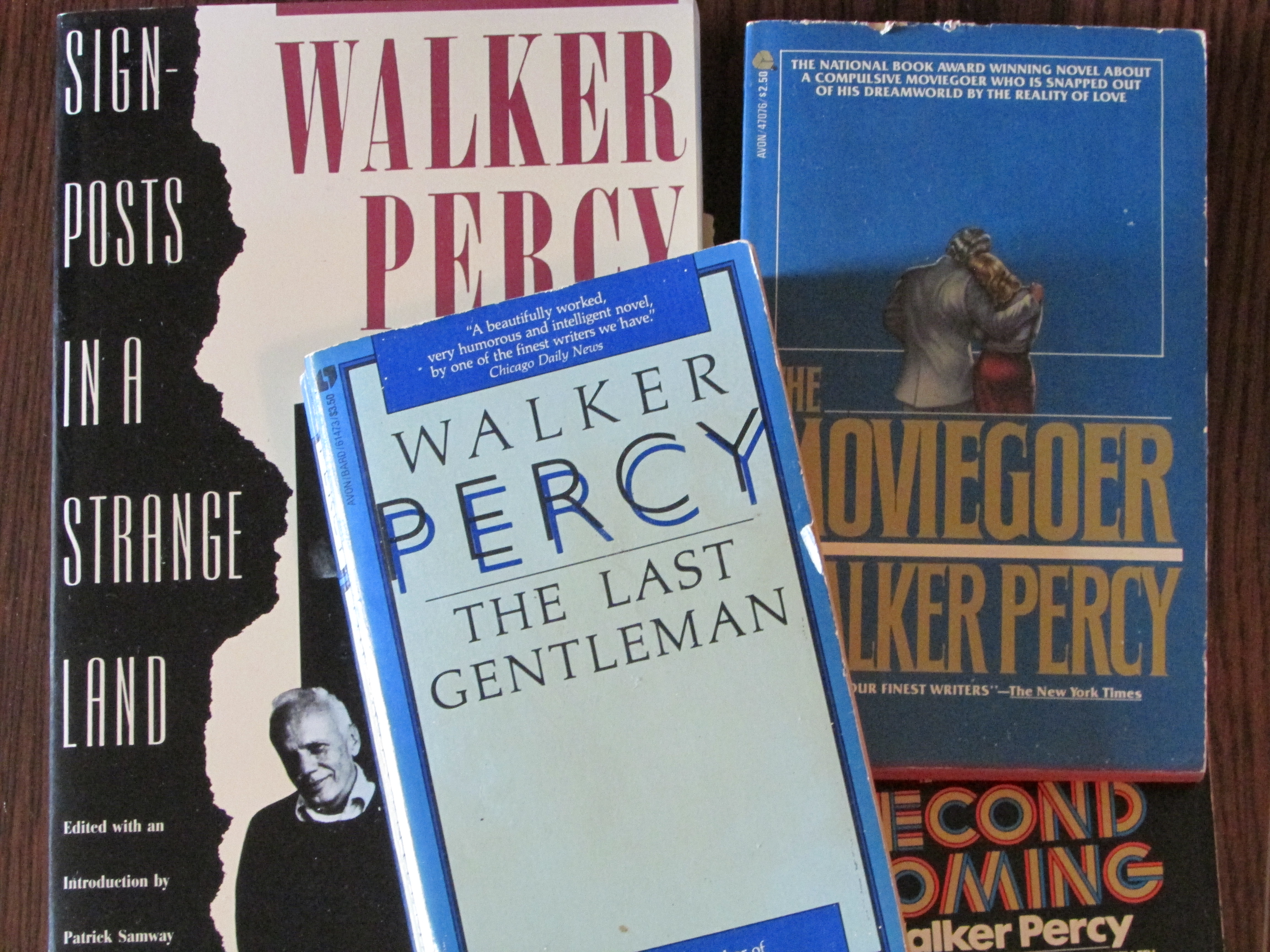
Percy’s first published novel, The Moviegoer (1961), is still his most acclaimed. I discovered that book, and Percy, early in my college years and it is still a favorite literary discovery; I find new areas for focus with each reading.

Until this week, I had not read Percy in a while. I ran across an item about him recently and decided it was time to revisit him. Since I had never read his second novel, The Last Gentleman (1966), I pulled it from my bookshelf and started to read. Here’s the odd thing: I began to run across passages that had been obviously underlined by me – they were the sorts of sentences and words that I would have underlined. The book was also full of evidence of previously dog-eared pages.

I still underline passages in books and frequently dog-ear pages. I was never one to write comments in the margins, although I occasionally do that too. This is one of the reasons I will always want to deal with the object of the book; I take pleasure in the tactile physical presence as I do in the words contained therein.

So I was quickly aware that I had already read The Last Gentleman at some point in time. At the beginning I thought Okay, it will start coming back to me as I read on. I read on. It all felt new to me and the last moment of the last page surprised me as if it were brand new. It was an eerie and enjoyable experience. The effect was heightened by the fact that the main character, Will Barrett (usually referred to, ironically, as “the engineer”), suffers from episodes of déjà vu and amnesia. My previously underlined passages were a form of déjà vu for me, the reader, and the fact that I had no memory of the story was my amnesia.

Another odd thing is that the city in which much of the book takes place is clearly based on Birmingham (Walker Percy confirmed as much) and a frequently mentioned landmark in the book is clearly a veiled reference to George Ward’s old “Vestavia” estate on the crest of Shades Mountain that gave Birmingham’s Vestavia Hills suburb its name. (That estate, by the way, is now the location of Vestavia Hills Baptist Church for those readers who know Birmingham geography.) I am surprised that I didn’t remember any of that from my previous reading.

Although I still don’t recall reading the book the first time, I’m sure that I thoroughly enjoyed it that first time just as I thoroughly enjoyed it this week. That certainty is based on the passages I underlined.

Buoyed by my rediscovery of The Last Gentleman, I grabbed The Moviegoer and had the opposite experience of total recall and recognition. It was like revisiting an old friend and I remembered and enjoyed each juicy detail. The Moviegoer is a New Orleans novel and Percy makes no effort to disguise the geography or the names of the actual places. The Moviegoer is the “Ur-text” for all of Percy’s concerns and themes in his novels, essays, and philosophical writings to come.

I wonder if any other writer uses the word “malaise” as often as Percy. The word peppers the text of The Moviegoer. Even so, I think Percy has an ongoing optimism tempered with realism that informs all of his writing. It is much-discussed in Percy scholarship that his early life was dogged by suicide – his grandfather and father committed suicide and he always believed that his mother’s fatal car wreck was a suicide.

The novels I read this week are at least half a century old but I still share the protagonists’ sense of displacement and mistrust in a modern world transitioning to post-modern (post-future? – where are we now?) modes. The changes seem large to the ’60s protagonists – how would the world appear to and discombobulate them half a century later?

The issues that occupy Percy and his characters never go away or find resolution; they just morph as the decades fall into place, one after another. How fortunate we are to have access to timeless writing that deals with these issues so searchingly, so entertainingly, and with such compassion and humor.

That Welles Scholar comment about the rarity of the “intelligent Southerner” came back to me while I was reading Percy, one of the most probingly intelligent of 20th Century American writers — as well as one of the most Southern. I fantasized a face-off between “Welles Scholar” and Percy.

Percy would have eaten him alive.