Tag Archives: the south

Discovering Eugene Walter

IMG_1111 During graduate school I briefly worked a part-time job as a reader for a press clipping service. This is another of those occupations that is now totally obsolete but I love to read and enjoyed the job. It’s clearly a great job for a liberal arts guy. The staff of readers would have our favorite newspapers and would try to make sure that the favorites were in our stack of papers to be read. I had personal picks among the large dailies and there were a few of the small-town weeklies that I tried to grab because of a particularly charming or quirky local columnist or point of vew.

“The Boulevardier” was the title of a column written by Eugene Walter and published in Azalea City News and Review, an alternative weekly newspaper in Mobile at the time. My first reaction was Who is this guy and why haven’t I heard of him before if he’s been all of the places and done all the things he claims?

The more I read, however, the more fascinated I became with the scope of knowledge and experience of a true, uncompromising, unpretentious, and erudite Renaissance man. Too late, I began to track down the biographical details of Eugene Walter (1921-1998) and realized that even if the majority of his claims were tall tales and fabrications, he still lived a more eventful and meaningful life than most everybody else.

“I don’t drive a car, I don’t wear blue jeans, and I don’t go to football games,” said Eugene Walter, but here are just a few of the things that he did do:

  1. Worked with the Civilian Conservation Corps as a highway sign painter.
  2. Served as an army cryptographer in World War II.
  3. With collaborators, staged some of the first “Happenings” in the garden of New York’s Museum of Modern Art.
  4. Worked on a Paris-based multilingual international literary journal, Botteghe Oscure. He later relocated to Rome as the journal’s editor.
  5. Published a short story in the first Paris Review for which he served as a founding and contributing editor.
  6. Published his first novel, The Untidy Pilgrim, while living in Paris. It won the Lippincott Prize for best first novel.
  7. Published his first volume of poetry, Monkey Poems, during the Paris years.
  8. While in Rome, acted and worked as an assistant and translator for master Italian filmmaker Federico Fellini. He appeared in Fellini’s masterpiece and in many other films for Fellini and other directors including Blake Edwards and Lina Wertmuller.
  9. Wrote the lyrics for Nino Rota’s signature song “What Is a Youth?” for Franco Zeffirelli’s Romeo and Juliet. This theme song for the very popular film was an international hit.
  10. Wrote the best-selling classic American Cooking: Southern Style (1971) for the Time-Life Foods of the World cookbook series.

He was born and grew up in Mobile, served the military in the Arctic Circle, lived in New York City in the 1940s, lived in Paris in the 1950s, lived in Rome throughout the 1960s into the 1970s, and moved back to his beloved but changed Mobile for a number of social and productive years from the late-1970s until his death. “Sooner or later Southerners all come home, not to die, but to eat gumbo,” he said. As he lived and traveled around the world, he always carried a Thom McAn shoebox full of Alabama red clay with him and stored it under his bed – “So I always slept on Alabama soil.”

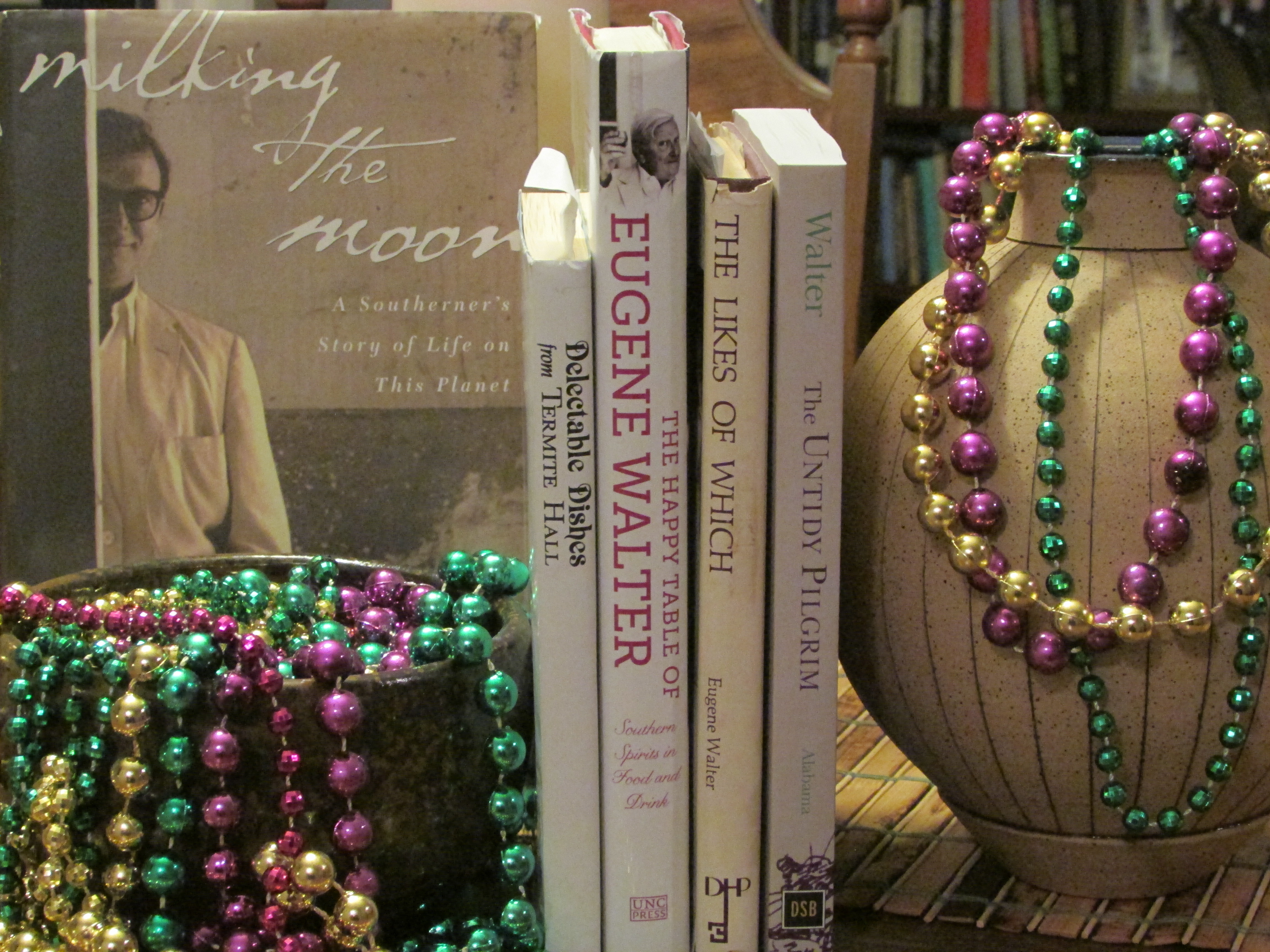
American Cooking: Southern Style is out-of-print, very precious, and somewhat hard to find in a good affordable copy. If you’re interested in food, grab it when you find it. Walter did other food-related books in his lifetime including Delectable Dishes from Termite Hall: Rare and Unusual Recipes (1982); and Hints and Pinches (1991). Posthumously, in 2011, The Happy Table of Eugene Walter: Southern Spirits in Food and Drink was published. The Happy Table was compiled from an unpublished manuscript and other recipes and food writing from Walter and focuses on “Southern Beverages and a Grand Selection of Southern Dishes Employing Spiritous Flavorings.”

His books on food are full of wonderfully vivid recipes and unvarnished opinions. “Baby turnip roots just boiled to a point, not mushy, dressed with butter, cream, salt and a generous flecker of nutmeg, are the sign of a highly civilized household.”

In The Happy Table … Walter writes, “For a real feast, you must have two kinds of meat and two kinds of bread, and there must always be more than enough food to serve the number of guests.” (My grandmother would add that one of the reasons for this abundance is to “be sure there is something on the table that everybody likes” and I still follow her mandate.)

His advice to cooks is simple and timely: “seek fresh, avoid chemicals, keep a light hand, rise to the occasion, try what you don’t know, have fun … and good eating, you-all!”

Don’t get him started on ready-ground pepper (or do, it’s very entertaining): “Never use the dead dust sold as ready-ground pepper. … dead dust is only dead dust. Many restaurants which pretend to be first class, and with prices which corroborate their pretensions, do not have pepper mills … either take your own pepper mill with you, or smash an ashtray when the waiter says they don’t have one.” As random and serendipitous as Walter’s pronouncements may sound, his food-related books are meticulously researched and the scope of his knowledge and historical grasp is constantly impressive.

Writer Pat Conroy, a personal friend of Walter, devotes a whole chapter to him in The Pat Conroy Cookbook (2004). Conroy writes that while he lived in Rome, shortly after Walter had returned to Mobile, “I met more Italians who were in love with the whole state of Alabama just because Eugene Walter had sprung so fully formed and elegant from that Deep South state. Many Italians were fully prepared to like me because they knew my native state of Georgia was contiguous to the one that had produced the incomparable Eugene Walter.”

In 2001, Milking the Moon: A Southerner’s Story of Life on This Planet was published. It is the life story of Walter in his own inimitable words as he told it to Katherine Clark in a series of recorded conversations near the end of his life. Be warned that once you pick it up, it is hard to put it down. He begins, “You may think you don’t know me but you have probably seen me on late-night television playing either an outlaw or a hanging judge… If you’ve ever seen Fellini’s 8 ½, I’m the tacky American journalist who keeps pestering Marcello Mastroianni with obnoxious questions. And if you haven’t seen , you need to: it’s one of the great films of this century.”

I re-watched not long ago and particularly watched for Eugene Walter’s appearances. He’s one of those performers who glows on the screen – not so much for his acting ability as for his sheer joy in acting. He smiles broadly, his eyes are shining and shifting with mischievous glee, and he is totally present every moment he’s in a scene. I couldn’t help thinking about the similar impact Tim Blake Nelson’s performance as Delmar had for me in the Coen Brothers’ O Brother, Where Art Thou? In each case, the glee of the actor in the performance is memorable and contagious.

Reading Walter’s work, one constantly has the urge to call somebody and quote a passage. But that’s a risky exercise since once you get started, you can’t stop. Almost every word on the page is quotable.

Eugene Walter knew everybody. The 23-page “Cast of Characters” at the end of Milking the Moon reads like a Who’s Who of important and famous people of the 20th Century. He threw dinner parties for whomever happened to be of interest to him wherever he happened to live. He claimed to have three pubic hairs which were gifted to him by actress Tallulah Bankhead in her dressing room after her performance in The Skin of Our Teeth at a Broadway theatre during his early sojourn in New York (but then, who didn’t have such a treasure from Tallulah at that time?).

I was familiar with Walter’s short stories but I recently read that first novel, The Untidy Pilgrim, for the first time. It is the story of a young man from central Alabama who comes to Mobile – “south of the salt line” – to work in a bank and study law. “Down in Mobile they’re all crazy,” the novel begins, “because the Gulf Coast is the kingdom of monkeys, the land of clowns, ghosts, and musicians, and Mobile is sweet lunacy’s county seat.”

Of course the stable and well-intentioned young man (who is never named) is quickly caught up in the intrigues and pleasures of his new surroundings and his Mobile friends and relatives. He is introduced to the colorful characters, artists, and underside of Mobile and encouraged to play hooky from his 8-5 grind. He samples the indiscreet pleasures around him and is taken into the fold by his more cavalier south Alabama relatives and Miss Nonie Fifield – “Fiffy” – from whom he rents a room.

As with all of Walter’s writing, I found the novel compelling and terrifically entertaining. And I was pleasantly surprised when the ending of the book was a somewhat conventional one – which was not at all what I expected given what I know about Eugene Walter. The book plays around with the reader’s expectations, dips its toes in the unexpected and bizarre, and then catches the reader off-guard by concluding in a sweet and almost conventional way. That unpredictable predictability left me smiling and satisfied at the end.

Eugene Walter spent much of his life in poverty, had a limited formal education, and died practically destitute, but happy. “I haven’t been smashed by the educational system, the financial system, the political system,” he said. He lived his life on his own terms and with style. When he died, a jazz funeral procession took him through the streets of Mobile for burial at Church Street Cemetery. The cemetery had been closed for a century but the city gave special permission for his interment.

Over the years, I have talked to a few people who met Eugene and each one seems simultaneously entranced, intrigued, befuddled, and half in love with the guy. He was what one might call an eccentric in every sense but his charm was evident to all kinds of people. “When I was growing up in Mobile,” he said, “there was no such thing as an eccentric, because individuality was permitted.”

I wish I had known to meet him.

Alabama Barbecue and the “White Sauce” Anomaly

100_1583   It is often written that there is no indigenous “Alabama-style” of barbecue and it seems that circumstance may be a key to our abundance of options. Opinions about barbecue in Alabama – indeed, throughout the South – are as strong as those about football, religion, or politics. Everybody has a favorite place and favorite style and it is often based on tradition and habit as much as quality and taste.

I don’t put much stock into website rankings, but a 2014 online study by “Estately Blog,” using five statistical criteria for all fifty states, ranked Alabama as the most “Barbecue-Crazed State in America.” Among the criteria in which Alabama ranked highest are the overall percentage of restaurants devoted to barbecue (1st — 8.27% of all restaurants in the state are barbecue places according to this report) and number of barbecue restaurants per capita (3rd). I have seen previous reports that ranked Alabama as 1st in that “per capita” category also.

With such an abundance to choose from, I long ago stopped taking the time to grill out or barbecue since there are so many better options from which to choose.

A few days ago, I saw another online article with the title “Are These the Most Iconic Restaurants in Every State?” I try to avoid those articles because it’s inevitable that they’ll annoy me; that’s the reason they’re there. But it was about food and I had to take a look. Before I opened the webpage I began to imagine the possibilities and the various ways to define “iconic” and wondered what might be the selection for Alabama. Candidates that immediately came to mind were Highlands Bar and Grill, the fine dining restaurant in Birmingham’s Five Points South; The Bright Star, the Bessemer institution for over a century; and Dreamland, the superior barbecue joint in Tuscaloosa.

The website’s choice, alas, was Big Bob Gibson Bar-B-Que (www.bigbobgibson.com) in Decatur. Congratulations to them for their designation but this is one of those selections where personal taste has to speak up. (“They’re not even the best barbecue in Decatur,” said a friend who is a longtime resident of Decatur.) I was aware of Big Bob Gibson’s and know they are a force on the competition circuit. I even like their food fine. But it seems that their “iconic” status is based on something this Alabamian was unaware of until he moved to the Tennessee Valley of north Alabama: white sauce slathered on barbecue (chicken, usually). This is not a béchamel but a mayonnaise-based sauce for barbecued meat.

White sauce is a staple for most barbecue places in this part of north Alabama. I was unaware of its existence until I moved to the area over twelve years ago. I tried it out – more than once and at more than one place – and I don’t like it. I like all of the ingredients – mayonnaise, vinegar, pepper, occasionally horseradish – but I declared the combination “nasty” the first time I tried it and have not waivered on subsequent attempts. I know people who love it and they are entitled to their taste. It’s not for me. I have met people who claim that they ship it by the case to people who want it and can’t get it in other parts of the country. Feel free to give them my share. Please.

To add insult to injury – and I think this was fueled by the Food Network – the sauce is now commonly being referred to as “Alabama sauce.” I first heard this appelation on the Food Network and have now encountered it in other national media including PBS. This rankles me a bit. I could live with it being called “Decatur Sauce” or “Tennessee Valley Sauce” or “North Alabama Sauce.” Jim ‘n Nick’s, a Birmingham stalwart, refers to it as “Morgan Co. White Sauce.” I’m good with that. But I find that white barbecue sauce is an anomaly outside north Alabama. And my vote is for it to stay that way.

Since the website listings of “iconic” eateries chose to represent Alabama with barbecue, I began to brainstorm my favorite Alabama restaurants for barbecue. The first names that came to mind were places around Birmingham and the part of Alabama that is most familiar to me. I have eaten Bob Sykes Bar-B-Q (www.bobsykes.com) most of my life. Its location in Bessemer, just outside Birmingham, is always busy and the product is consistent. It’s a good sauce and the pulled pork is my favorite. Jim ‘n Nick’s Community Bar-B-Q (www.jimnnicks.com) is a Birmingham-based brand that has only been around since 1985 (short-lived by barbecue standards) but has quickly become iconic with its support of community, locally grown ingredients, and far-reaching philanthropy backed up by truly high quality product. There are now Jim ‘n Nick’s in a number of states and the corporate and quality policies are consistent throughout the franchise. Corporate policy forbids freezers at Jim ‘n Nick’s.

For me, and for many Alabamians who grew up away from the pull of Big Bob’s white sauce, the barbecue mecca for Alabama is still Tuscaloosa County. There is some difference of opinion on who tops the Tuscaloosa ‘cue culture but it’s a happy dilemma since the debate focuses on two long-time joints – Dreamland and Archibald’s.

The original Dreamland (www.dreamlandbbq.com) was opened by “Big John” Bishop in 1958, the year Bear Bryant came to coach at Alabama. It is located in the community of Jerusalem Heights in southeast Tuscaloosa fairly near US Hwy. 82 and I-59/20. Turn onto Jug Factory Road, drive the curvy road to the top of the hill, and take a right to Dreamland. Follow your nose if you get turned around and you will sometimes know the place by the happiest parking lot dogs to be found.

Dreamland has franchised and can be found in other locations but Jerusalem Heights, the “OG,” is the end of the barbecue rainbow for me. The original place used to serve only ribs and white bread (“No Fries, No Slaw, Don’t Ask” said a sign over the register at one time) and that is enough. It’s a cinderblock temple with noisy screen doors. “Alabama” is a Native American word meaning “Here We Rest” and that is the phrase that comes to mind whenever I am in Mr. Bishop’s original Jerusalem Heights establishment. The ribs are available as a sandwich, a plate, or a slab, and the sauce is amazing with sweet undertones beneath a bold vinegary bite.

While I would have to vote for Dreamland as the best and most iconic barbecue in the state, cross the river from Tuscaloosa into Northport and there is amazing and even more rustic competition from Archibald’s. The late writer Barry Hannah introduced me to Archibald’s in the late ’70s. It is basically a shed surrounding a pit with a few seats on the inside and a few picnic tables around the small parking lot. The menu is minimal but the quality is splendid, and the sauce is more mustardy. Archibald’s is a little bit off the beaten path and I haven’t eaten there nearly as often as I’ve eaten at Dreamland but I’d venture to guess that if I had been introduced to Archibald’s first, it might be my favorite. As it is, it’s almost a toss-up between Dreamland and Archibald’s for me.

And there’s not a drop of white sauce to be found at either place.

A Menu for the New Year

IMG_1101  A couple of decades ago, when I stopped actively celebrating New Year’s Eve, I started cooking a big meal for New Year’s Day and use New Year’s Eve to prep the food.

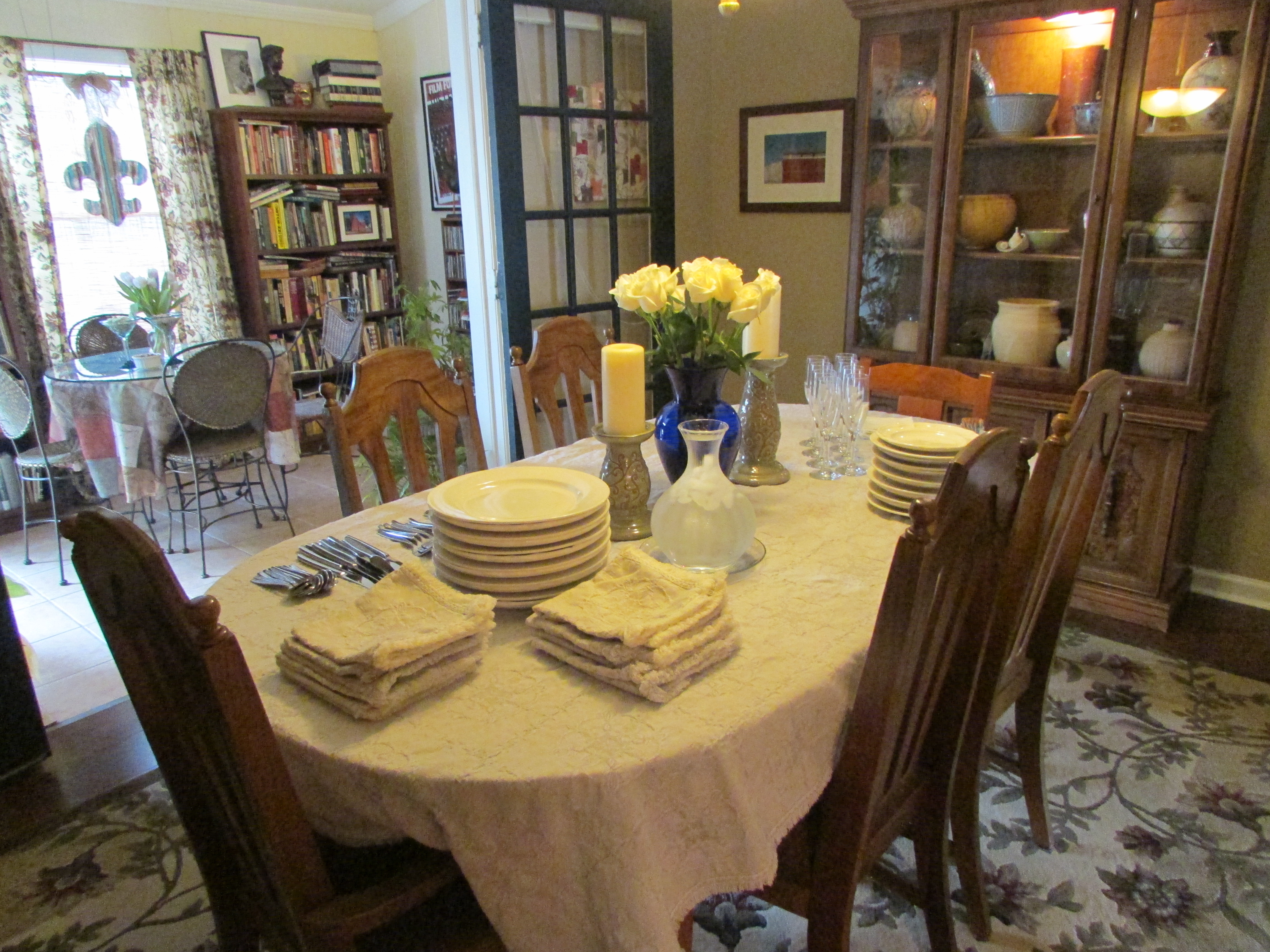
It’s always a simple menu using the Southern good luck staples that we always had for New Year’s Day growing up – pork, greens, and black-eyed peas. If that’s your basic menu, cornbread is a given. Over time, I realized that such a healthy and hearty meal should be shared and began to invite friends and family over for the meal to celebrate the beginning of a new year.

In recent years it has become “a thing” and my menu constantly evolves while the basics remain the same. Since many of the same people attend regularly, I constantly make notes and look for ways to add new touches and tastes. In 2014, for example, I served baked grits from the recipe used at Frank Stitt’s Highlands Bar and Grill in Birmingham as a base over which to ladle the black-eyed peas. It was a delicious riff on traditional ingredients.

Around Thanksgiving of 2014 I was talking with a new colleague and friend and holiday plans came up. I asked her if she would be around for New Year’s Day and told her that if she was, she was invited to my house for lunch. She said she would like to come and I told her that it would be nothing fancy, “just the New Year’s staples.”

“Herring?” she asked.

That caught me off-guard. “Well, no, actually,” I said. “I meant pork, black-eyed peas, and turnip greens.”

The conversation ended soon after but I was intrigued and started researching and found that herring is a New Year’s good luck food in Germany, Scandinavia, and some eastern European locations. I resolved then and there to add herring in some form to my New Year’s lunch menu this year.

IMG_1100

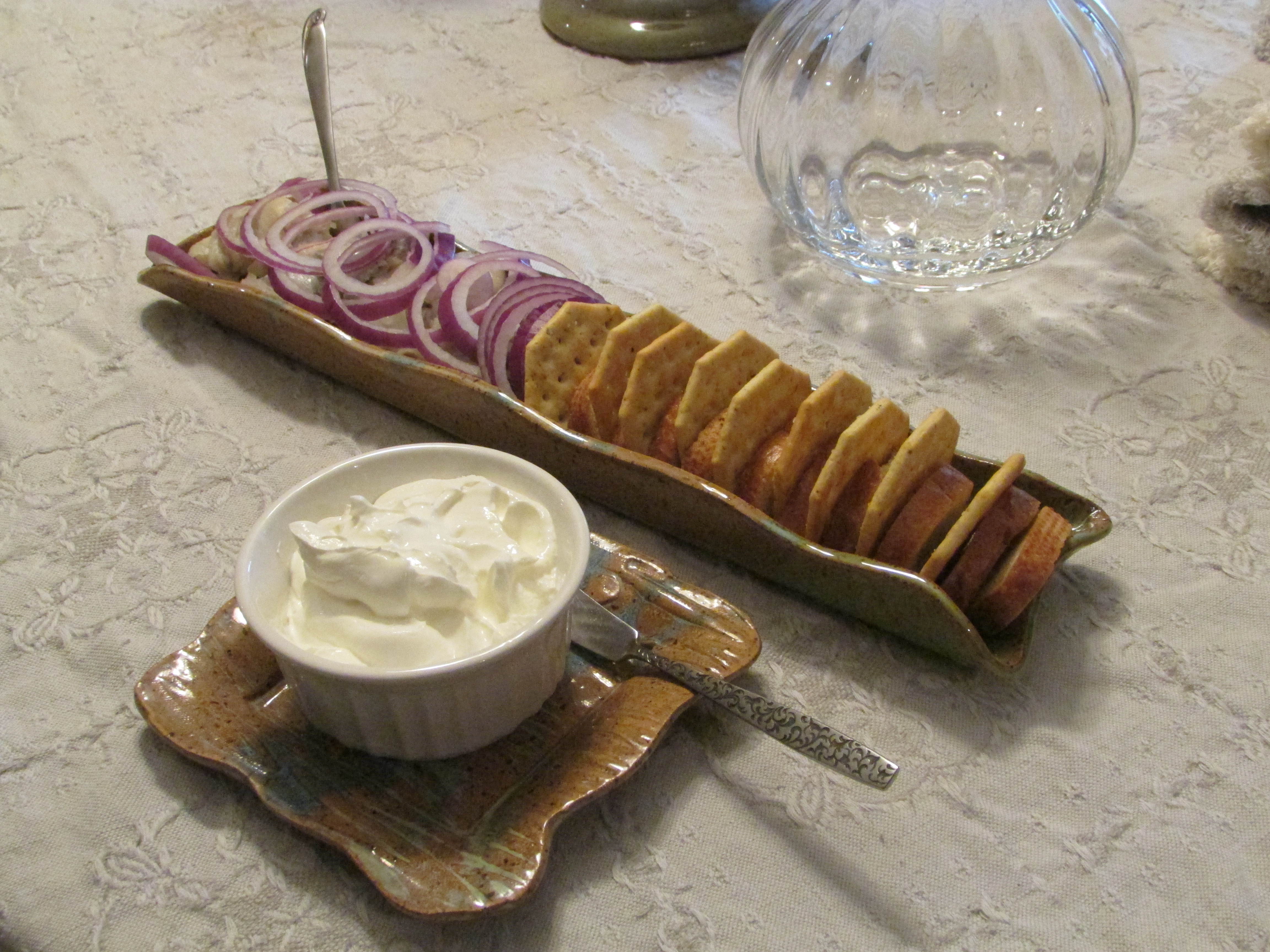
I decided to serve a herring appetizer. As guests arrived on New Year’s Day, in addition to various pralines, hard candies, and pecans, there was a serving dish with herring in white wine sauce with red onion slivers scattered around. Toasts and crackers were laid out on which to layer the herring. Sour cream was available at the side as a spread for the fish. It was a very tasty and popular appetizer. It may become a new tradition for the meal at my house.

After all the guests arrived and toasts were made, the lunch main menu was pretty standard for Southern homes on New Year’s Day:

Pork Roast with dry rub of coffee, brown sugar, seasoned salt, and orange zest
Seasoned Black-Eyed Peas
Seasoned Mixed Greens
Ambrosia
Cornbread

The seasoning for the greens and peas included hog jowl. The ambrosia is adapted from a simple ambrosia from chef Scott Peacock. His elegant classic includes only orange, coconut, sugar, and sherry. Mine uses satsumas from south Alabama for the citrus and adds pecan pieces and cherry slices.

The pork roast dry rub is worth sharing. I had jotted down a recipe from somewhere for a meat dry rub using coffee, granulated sugar, and seasoned salt. I experimented with it until I came up with the one I used on New Year’s Day. All of my guests left the lunch with a jar of this rub and it’s one you can easily make.

Dry Rub for Meat
1 part ground coffee (I used Community Coffee)
1 part brown sugar
1 part seasoned salt
1/2 part orange zest

Put all ingredients into a jar. Seal the lid and shake to mix thoroughly. Rub the meat with a good olive oil and then generously rub the meat with the dry rub.

We were ten at table – seven adults and three young people aged 11 and younger. For dessert, each guest was served a single madeleine and reminded of how Proust’s madeleine was a trigger for memory in Remembrance of Things Past. Whatever…

The adults enjoyed the madeleines and the kids scarfed them down; I doubt that anyone was too concerned about Proust.

It was a lovely meal and a lovely afternoon. A soft rain began as the guests began to leave. As the last guest departed, we had a quick “post-mortem” of the event. “The afternoon was full of laughter,” she said. “That’s what I needed — an afternoon filled with laughter.”

May 2015 be filled with happy laughter.

Hiking Red Mountain

     IMG_1085  Birmingham. Every Baby Boomer growing up in Birmingham was taught in elementary school that Birmingham is the only place in the world where iron ore, coal, and limestone – the three essential raw materials used to manufacture steel – can be found in such close proximity. Every local schoolboy of that generation knew that Birmingham was not in existence during the Civil War and that this unique confluence of natural resources had led to its founding as the first major industrial center of the post-war South in 1871.

The steel industry was still what drove Birmingham when I was a boy and both of my grandfathers worked in Birmingham factories – one at U.S. Steel and one at Butler Manufacturing.

I remember standing on the observation deck at Vulcan, Birmingham’s “Iron Man” statue overlooking the city, and watching with awe as the night sky turned bright orange as molten iron was poured at steel manufacturing locations in the western section, in north Birmingham, and at the Sloss Furnaces just east of downtown. For a young boy, the sight of such robust heavy industry was thrilling.

Vulcan now overlooks a city in which heavy industry is less prominent than healthcare and finance; Sloss Furnaces closed down in 1970 and was designated as a National Historical Landmark in 1981. The remains of the structures of U.S. Steel’s Ensley works loom over what is now a desolate landscape. I still look for ruins and remnants of the once vibrant industrial landscape as I drive around the area.

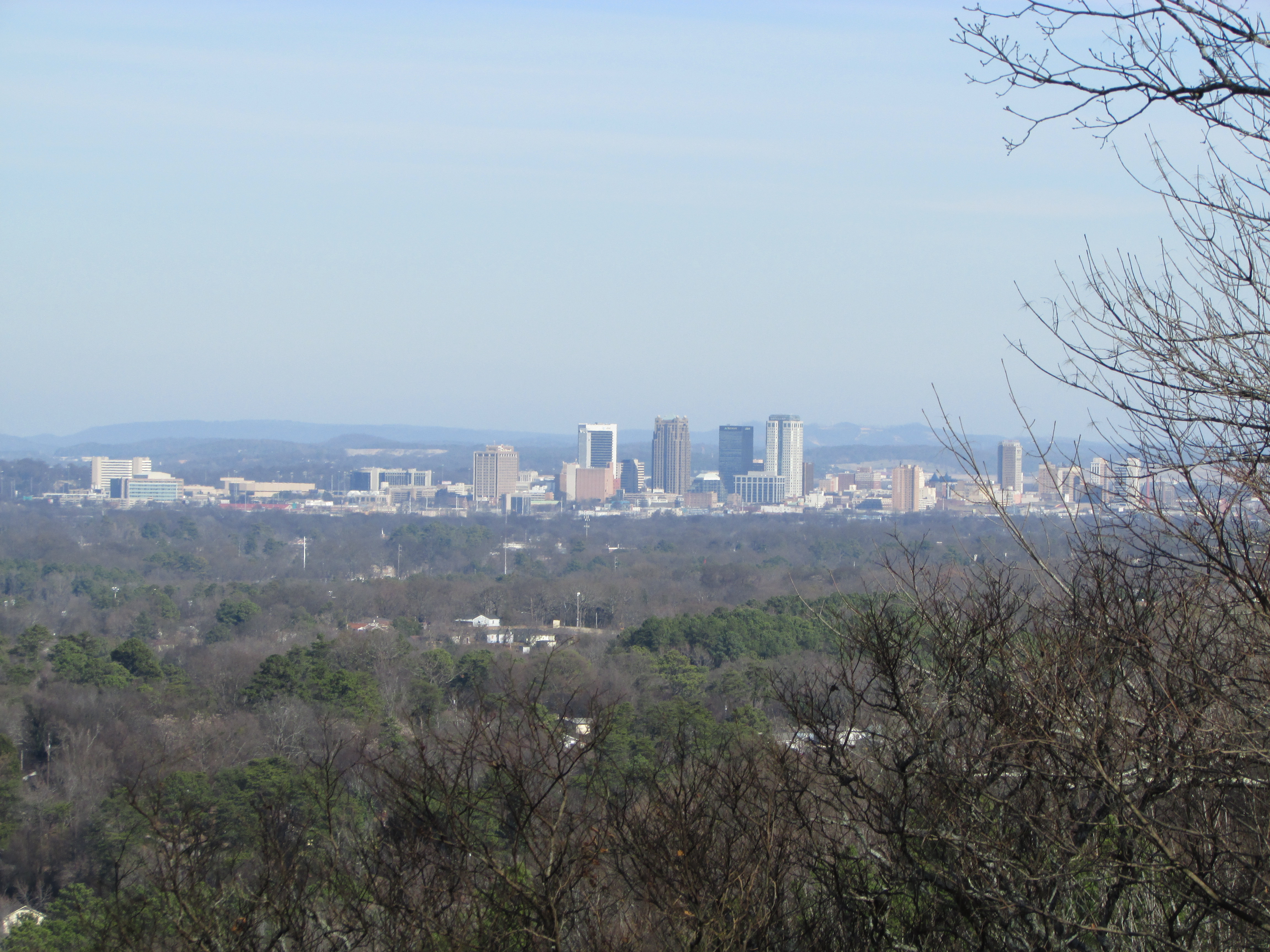
In 2007, as a result of the efforts of Freshwater Land Trust and dedicated citizens, ownership of 1200 acres of U.S. Steel-owned land on Birmingham’s Red Mountain was transferred and development began on Red Mountain Park (www.redmountainpark.org), an urban greenspace which now comprises over 1500 acres and twelve miles of trails. There are also an adventure area, zip lines, an 80-foot repelling tower, a dog park, and overlooks in the current development of the eastern Phase 1 of the park. At the overlooks, the hiker is afforded views of the city which have been unavailable for half a century. The Phase 2 western development, scheduled for completion in 2016, will include more trails and features. IMG_0520

Red Mountain Park has become my favorite place to hike. The layout of the trails enables one to do a quick and easy hike or a more rigorous and challenging one, such as the Ike Maston Trail, or to mix and match. The land, once active with railroad and mining activity from the 1860s to 1962, has reverted now to mostly wilderness.

IMG_1087

A large appeal for me, though, is in the ruins of the industrial sites like mine entrances and shaft mines that pepper the site. One is walking in the woods and then there are the tightly secured masonry entrances to Ishkooda #13 or #14 mines, or the Redding Shaft Mine farther west. Encountering these ruins, it isn’t difficult to imagine the bustle of activity which once occurred in what is now such a serene and natural environment. One walks just a few feet away from these sites and is again immersed in total wilderness. It is as if the ruins are ghosts that appeared and then are gone.  They are.IMG_0516

I try to hike Red Mountain Park whenever I am in Birmingham for more than a day or two. It is a potent symbol of urban progress and commitment to the environment built on the relics of the progress of an earlier era.  IMG_1098

Photographing Churches

IMG_1059    O! How I love time spent south of the salt line in December! We were all doubtful that I’d be able to see my friends Deb and Jeana Brunson in Fairhope this year but they arrived in town on Thursday, my last day at The Grand, from Las Cruces, New Mexico, and Tallahassee, Florida, respectively.

We gathered for afternoon tea at The Grand with Deb and Jeana, their brother Richard and his wife, Allison, and Allison and Richard’s dapper youngest son, William, who insisted on wearing a tie for tea at The Grand. I helped him tie the tie and commented that with his blue blazer, button-down shirt and tie, and khakis, he looked like an Alabama frat boy headed to a game. All of the Brunsons had a Christmas concert to attend but Deb, Jeana, Allison, Richard, and I met later for a memorable meal at Dragonfly Foodbar in downtown Fairhope.

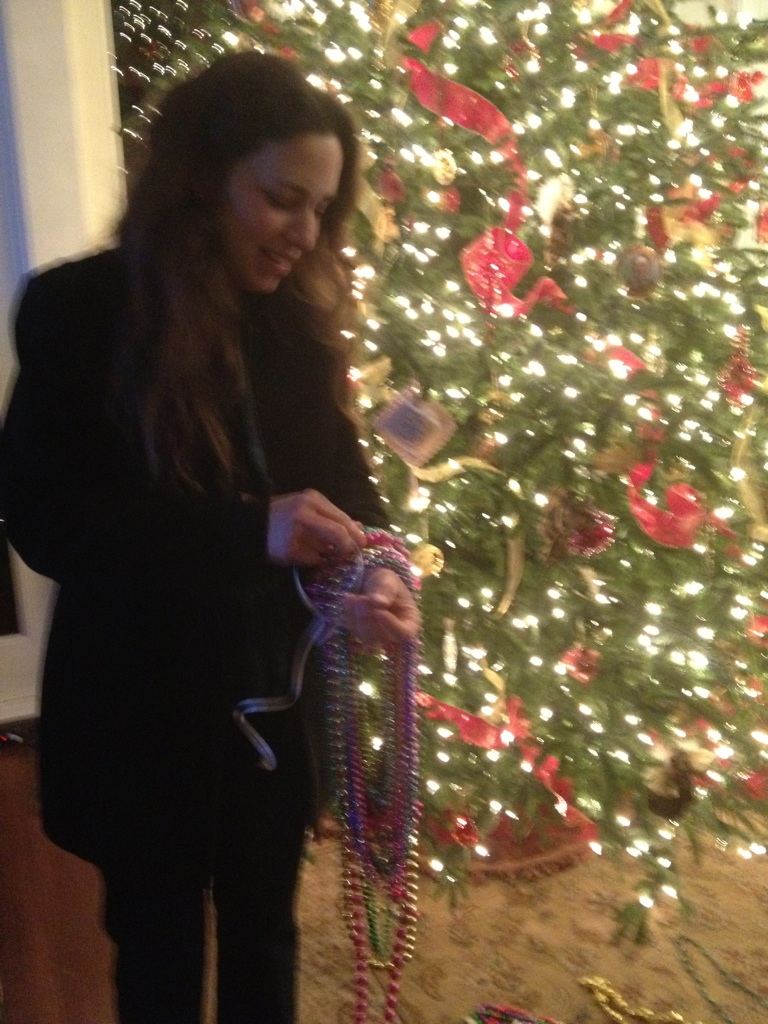
During dinner, I mentioned that I was out of Mardi Gras beads and Allison and Richard insisted that I stop by their house and get some of their stash. Later, at their beautiful home on Mobile Bay, Allison and Richard not only brought out a load of shiny beads from storage, but they also insisted on untangling them, separating them by size, and tying each bundle together before they loaded them into a huge box which should fulfill my Mardi Gras bead needs for a while. Allison Brunson sorting Mardi Gras beads  Richard Brunson sorting Mardi Gras beads

It is a true friend, I realize, who will sort and tie your Mardi Gras beads.

As I headed north from Point Clear on Friday, I realized that it was December 19 and I had not photographed any churches for my 2015 Christmas card. Realizing that there was still plenty of time and that there were a couple of back-up buildings I might use in north Alabama, I decided to keep my eyes open for any Christmas card-worthy churches along the drive home. In an earlier post for this journal, I recount my criteria for my annual Christmas card designs. I look for buildings that are often vernacular, were photographed in the month of December, and are always honest.

IMG_1011

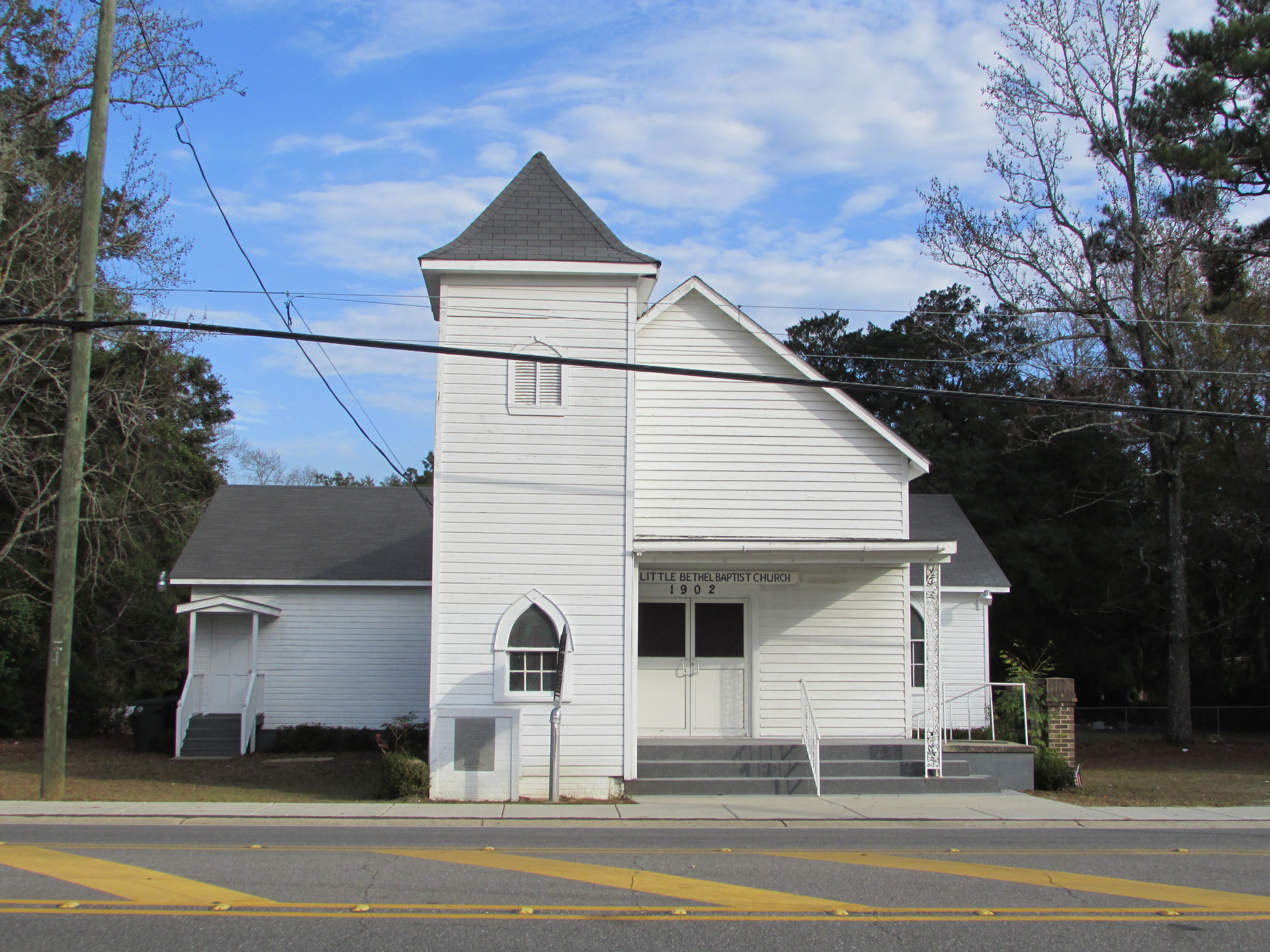
On this most recent trip, I had already taken photographs of Little Bethel Baptist Church in Daphne. Traveling along Alabama SR 225 in rural Baldwin County, I decided to check out St. John’s, a small yellow Catholic chapel that I had passed many times before but never photographed. As I pulled away from St. John’s, I noticed a small white building through the trees. I pulled off the road again and discovered what looks like a former schoolhouse that is now designated as “James E. Cook Memorial Presbyterian Chapel.” It is a charming little church I had never before noticed.

IMG_1021  IMG_1024

A few hours later, approaching Montgomery, I remembered the small town of Lowndesboro off U.S. Highway 80 between Selma and Montgomery. Highway 80 from Selma to Montgomery has been designated by the National Park Service as the “Selma to Montgomery National Voting Rights Trail,” a national scenic byway. Turning off 80 onto CR 29 into Lowndesboro, one travels through an impressive and well-maintained collection of antebellum architecture compressed into a very brief stretch of road. I have been to the town several times now, but it is always a shock to see such pristine examples of domestic and non-secular architecture in such a compact little community (population 140).

A particular oddity among the roadside attractions of Lowndesboro is the C.M.E. church, erected around 1830. Instead of a traditional steeple, the building is topped by a structure which was the original dome of the first Alabama state capitol in Cahaba. It was moved to Lowndesboro and mounted on the church when the original capitol building in Cahaba was demolished. IMG_1042

IMG_1035St. Paul’s Episcopal is a stately and dignified structure. Lowndesboro Baptist has intricate Carpenter Gothic detailing in the wooden columns on its portico. Lowndesboro Presbyterian (pictured at the front of this post) has simple Doric columns. IMG_1047

The only one of the impressive old churches that did not make the cut was Lowndesboro United Methodist. The main structure is very handsome but I couldn’t get past the steeple, which just couldn’t quite live up to the building’s base. Alabama-native writer Eugene Walter, who was quoted in an earlier post, referred to such steeples as “little-prick.” I now regret not taking a picture of the building, since it was a lovely church (other than that unfortunate steeple) and I likely won’t be back in Lowndesboro for a while.

Lowndesboro was a treasure trove in my search for picturesque churches. After roaming the street and photographing for about an hour, I drove away with the certainty that I have now found my Christmas card image for 2015. The challenge will be choosing just one out of many.

A playwright friend recently sent a note from Los Angeles and said “it isn’t Christmas at our house until your church arrives!” It is because of such kind words from many friends and correspondents that I take particular pride and effort in my December sojourn to photograph churches and other images of the season throughout Alabama.

Merry Christmas.IMG_1055

Postcard from The Grand

     IMG_0938  Point Clear, AL. People have been coming to a hotel at this spot for rest and rejuvenation since the 1830s. For me, a visit to The Grand Hotel in Point Clear, Alabama, (www.Mariott.com/Point-Clear) has become an annual December event. I occasionally get down here at warmer times of the year but the pre-Christmas visit is my constant.

IMG_0948


The Grand Hotel is located on the Eastern Shore of Mobile Bay, a short distance south of the town of Fairhope, at a point where the bay broadens as it gets closer to the Gulf of Mexico. The various buildings overlook the Bay and out toward the Gulf on one side and a peaceful lagoon surrounded by ancient, Spanish moss-dripping live oaks and walking paths on the other. The grounds are expansive and beautifully landscaped with paths along the bay. Pathways open to the public radiate beyond the resort and one is welcome to stroll past the private sides of bay-front Point Clear homes and get a sense of local living.

In the warm months the place bustles. A huge swimming pool is full of sun-worshippers and all kinds of outdoor activities – biking, kayaking, croquet, beach bonfires, etc. – are available throughout the grounds.

Now, in December, it is more quiet and less crowded and I have found that this trip is a perfect and much-needed way to shake off my job after a demanding semester and to brace for the holidays with family and friends.

IMG_0941

As might be expected from such a place, there is a feel of tradition. Hurricane Katrina did massive damage to the Alabama coast in 2005 and the hotel was closed for over a year while renovations occurred. When I returned in December 2006 after the renovation, I was relieved to see that the restoration had taken pains to restore the look and feel of the place prior to the storm.

The site has history and tradition and it manages to retain the feel without overwhelming one with the past. Every afternoon there is a small military procession through the grounds ending at a Civil War-era cannon. After the hotel’s military history is recounted – it served as a military hospital during the Civil War, was fired upon during the Battle of Mobile Bay, and the grounds include a Confederate cemetery containing the remains of many casualties of the Battle of Vicksburg (which happened 250 miles away) – the cannon is fired and can be heard throughout the area.

While the cannon fires outside, an afternoon tea is held around the grand fireplace every afternoon at 4:00. There is a blazing fire and a huge Christmas tree this time of year.

IMG_0927

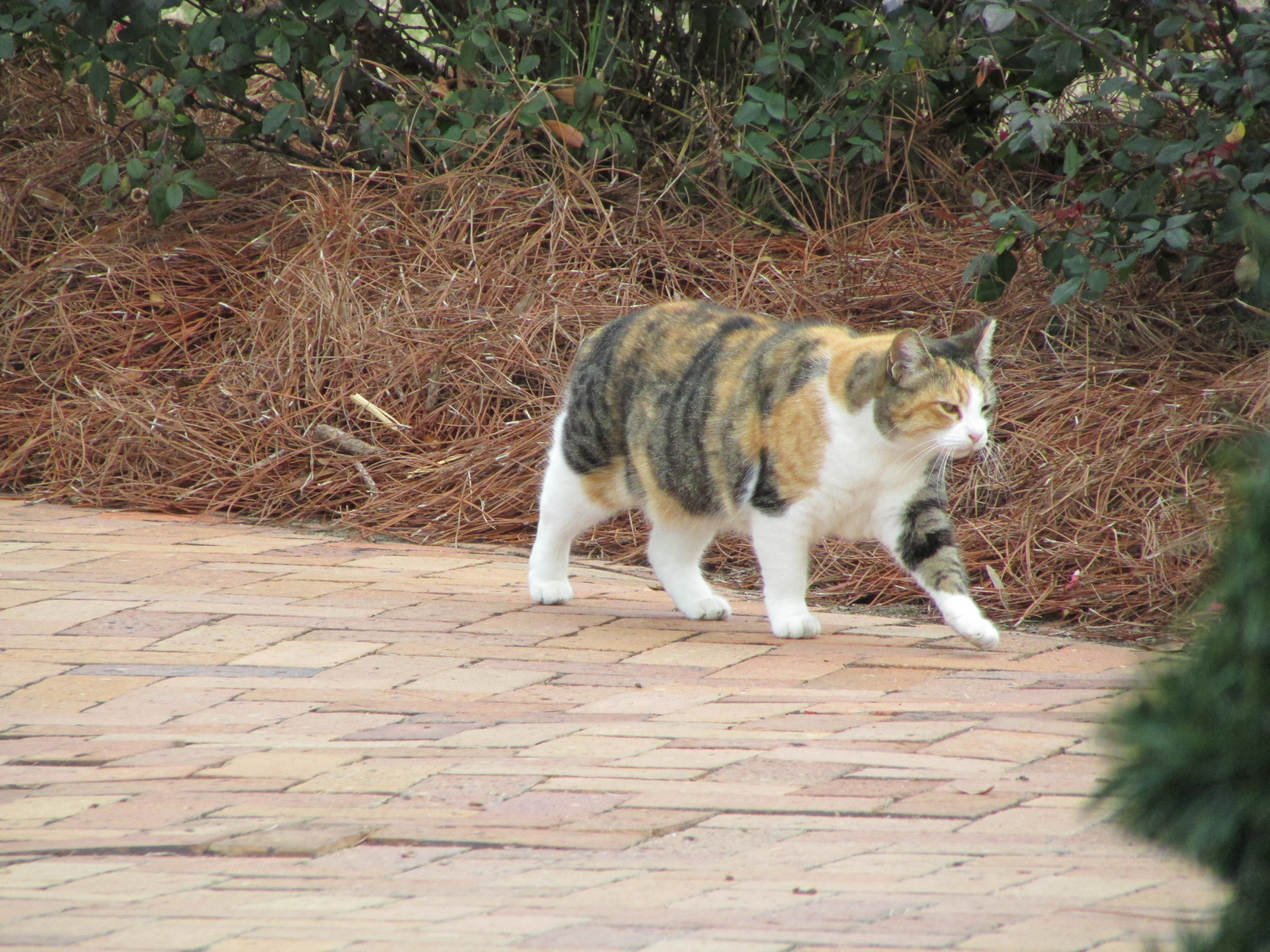
Outside Bucky’s Birdcage Lounge, also located in the main building, is a sunset bell that is rung thirty minutes before sunset each day. It is a reminder to move toward the lounge and toward the Bay-front to observe and celebrate what is almost always a spectacular sunset. “Bucky” Miller was a beloved employee of the Grand for 61 years and a life-sized statue of Bucky stands outside his namesake lounge, his hand extended in greeting. Bucky’s cats still roam the grounds – or by now maybe Bucky’s cats’ descendants. I was greeted by one of Bucky’s cats as I went into the main building for check-in yesterday.

IMG_0933    IMG_0925

I have heard about the Grand my whole life but I didn’t start coming down for regular visits until over a decade ago in the early 2000s. Several years ago an acquaintance who used to come to the Grand for decades remarked, when I told him I was about to come down, “I hear the Grand isn’t so ‘grand’ anymore.” (Isn’t there always that guy?) Things change and the events of the past may not be happening with the velocity they once had, but my Grand experience is always peaceful and invigorating and exactly as grand as I want it to be. The fact that I always splurge and treat myself to a massage at the hotel’s highly-rated spa makes my experience that much more grand.

In the earlier years of the Grand’s history, it was owned by individuals and families. It is now a Marriott resort owned by Retirement Systems of Alabama, part of Alabama’s much lauded Robert Trent Jones Golf Trail (the property includes Lakewood Country Club). The staff is international and far-flung in origin but there are many locals who work here too and there are faces and names that are familiar to me trip after trip. It may all be an act, but I will say that the employees at the Grand always seem happy and they make every guest feel special and welcome. It’s a wonderful place for families and couples but I am usually here as a single and feel totally at home and comfortable as such.

IMG_0959

I was already in my 40s when my recurring “Grand experience” began. I know people who started coming here with their families when they were very young. There are always happy children and young people at play when I make my visits. However, I have always felt that I started coming at just the right time for me – at a time when I was looking for stability and peace of mind in my life. I worry that if I had started my annual treks even a decade earlier I might have found the place a little staid and slow.

I have a long list of places I still want to visit in this world, but, for me, if I want to relax and regroup, coming back to a place I know and a place where I feel like I can just sit on the balcony and while the day away with a good book is the ticket to a perfect vacation (New Orleans is another of those places for me). After staying in buildings all over the resort, I now have and always request my favorite room in the Spa building. IMG_0911


So, the Grand it is and the Grand it will be for this December and, I hope, many Decembers to come.

IMG_0939


“… a brief meditation …” : Why I Mail Christmas Cards

IMG_0444   My Christmas cards went in the mail on December 1. I started designing my own Christmas cards over a decade ago and it has become something many of my correspondents seem to appreciate. And expect.

I looked forward to receiving and looking at Christmas cards when I was a child and many of the people who sent cards to my parents every year were people I never met but felt I knew from the stories my mother would share about them each December when the card arrived. Genevieve O’Brien in Chicago, Christine Allen in Georgia, and Doris and Bill Fuller in Fort Worth are among the annual cards we received without fail from people I never met. When I was grown and out on my own, I would send Christmas cards as often as I could but sometimes work schedules or finances would make it prohibitive.

From a very young age I had set opinions about Christmas greetings and Christmas décor. For example, I am a Southerner and never quite understood why so many Southerners would buy into the Madison Avenue version of Christmas and send out pristine snow scenes and winter scenes depicting images that were not part of my reality of the season growing up in Alabama. I have traveled and worked all over the country and I have had white Christmases a few times. But the Christmases of most of my life have been bracing Alabama Christmases with a chill in the air and no snow. Actually, I’m not a fan of snow and have never once dreamed of a white Christmas.

A number of years ago I decided to design my own Christmas cards and feature photographs that represented December in the South. I developed rules: 1) The photograph had to be taken during the month of December and 2) the photograph had to be taken somewhere in Alabama. Those are the only hard and fast rules but over time most of the photographs have been of old country churches I have discovered around the state. A couple of times the image has been landscapes around Mobile Bay where I try to spend some time each December.

The only exception was in 2005, the year of Hurricane Katrina. I didn’t design the card that year; instead, I purchased museum holiday cards with a detail from a still life of a bountiful holiday table which somehow reminded me of good times on the Gulf and in New Orleans.

I developed rituals: I try to get my card to the printer around October 1 each year. I start signing and addressing the cards by November 1. On December 1, my cards are in the mail. Over time the mailing list has gotten quite large. Most of the people on my list don’t send cards anymore. For me, however, it’s a way of keeping in touch with old friends and acquaintances all over the world. Some of them are people I may never see again but I like to keep a connection. I’ve moved around a lot in my life and the Christmas card list is something that keeps me in touch and grounded.

Most people who know about or receive my Christmas cards are grateful and look forward to them each year. Someone might ask if I’ve picked next year’s image yet or they’ll send me a new mailing address to ensure that they won’t miss this year’s card.

But occasionally someone will grouse “I don’t know why you do it. Who has the time? It’s so expensive. And so much trouble.” Here’s my response: If you don’t want to do it, don’t do it. I do it because it gives me pleasure. I look forward to it. I want to do it.

With each card I sign and with each address I write on an envelope, it’s a brief meditation on that recipient.

When I first moved to Huntsville, there was a lady, Grace Clark, who lived in my apartment complex. We didn’t see each other often, but whenever we did we’d have a very pleasant conversation. I added her to my Christmas card list. She never mentioned my cards but when I moved from that apartment to my house I kept sending Christmas cards to Mrs. Clark. A couple of years ago, when Christmas was past, I received a note from a woman I didn’t know. She was Mrs. Clark’s daughter telling me that her mother had recently passed away. She told me that when she was going through her mother’s papers, she found a stack of my Christmas cards. Mrs. Clark had saved each one over the years.

If you don’t have time to send Christmas cards, I totally understand. I’m busy too. I have no time for Facebook and Twitter. We each choose what we have time to do.

This year’s image, by the way, is St. Luke’s Church (c. 1850), a cedar church in Cahaba. Cahaba is a ghost town and state park now, but it was Alabama’s first state capital from 1820-1826.

Happy Holidays.IMG_0456


Food Memory: Kushmagudi


IMG_0881     As the cold weather holidays roll in, I look forward to family food traditions. Going into Thanksgiving week and celebrations in Birmingham with my family, food memory kicks in bigtime.

There is a dish called “kushmagudi” (this is my own spelling; there is no official spelling) which is always on the Journey family tables at Thanksgiving and Christmas. It is simple Southern food and its name (and my phonetic spelling) has no precedence that I can find.

My brother wrote a lovely essay about this dish a couple of years ago but since I haven’t been able to retrieve it, I will reintroduce the basics to “Professional Southerner” readers.

My grandmother Eula Harbison used to make kushmagudi and I always assumed that it was a known thing, like salt on watermelon, pepper on cantaloupe, and celery sticks served with turkey. As long as I can remember, kushmagudi was on the holiday table so I would mention it casually and be surprised at the blank stares I received. As I lived and traveled around the country, I realized that nobody outside my immediate family seems to have a clue what “kushmagudi” is.

Many might know some variation of the dish, I think, but not by that name.

Kushmagudi is nothing more than a tasty mixture of crumbled cornbread with the potlikker of turnip greens. I say “nothing more” but I am convinced that one needs a cook’s instinct to pull off the right mix. I have always heard stories about Grandmother feeding the masses of her family and crowds from church at short notice in the ‘30s and ‘40s and having family move into her family home between jobs and houses, during travel, etc. Based on what I know, I realize that Grandmother’s kushmagudi may have been invented as Depression food and a way to make the food in the rural house and garden go farther.

Based on what I know, I am sure that the word “kushmagudi” is Grandmother’s own coinage to name a dish she already knew but reinvented for her immediate and extended families. I have talked with Southerners who know a variation of potlikker and greens but, so far, none outside my own family have referred to it as “kushmagudi.”

After Grandmother died in December 1995, I was asked if I would make the kushmagudi for Christmas. I will admit that I was daunted. I had eaten it all of my life but I had never thought about it.

I relaxed and thought about the dish. I realized that it is a basic and instinctual recipe and that if one understands its components one should be able to make it in a satisfactory manner.

Here’s my basic recipe for my grandmother’s kushmagudi:

Eula McCarn Harbison’s Kushmagudi

  1. Make 1-2 cakes of cornbread or use leftover cornbread if you have it (remember that sugar is never acceptable in cornbread).
  2. Boil up a pot of turnip greens with your favorite spices and seasonings.
  3. Bring the greens to a boil and simmer on low for at least a half hour.
  4. In a large mixing bowl, crumble 1-1½ of the cakes of cornbread.
  5. Ladle the potlikker of the greens over the crumbled cornbread in the mixing bowl and mix to your preferred consistency and taste.
  6. Let the mixture meld for a while, keep it warm, and serve it.

I like to mix some collard greens with my turnip greens to vary the flavor of the potlikker a bit. Grandmother tended to use less spices in her greens than I do; she used salt and pepper. I like to add a little pepper sauce, sage, bacon fat, garlic powder, thyme, and other seasonings to the greens before I strain them into the cornbread. I also might add a small dash of sugar to the greens (but never to the cornbread). I also like to mix more of the actual greens into the mix. Grandmother generally just used the potlikker and served the seasoned turnip greens as a separate side dish.

This is truly a recipe that may be adapted to your and your family’s preference.

A bowl of kushmagudi with a glass of buttermilk is a perfect meal on a chilly night in late fall or winter.

Even though kushmagudi is cornbread-based, it is different enough that my family serves it alongside Mother’s traditional cornbread dressing. I think one must sprinkle pepper sauce over a good kushmagudi at table. This is a dish that is always on my family’s table at Thanksgiving and Christmas and is often a side at my New Year’s Day luncheon.

If you have a variation of this dish, or a variant name, I would love to hear from you. If you’ve never tried it, you ought to. It’s easy and tasty.

Happy Thanksgiving.

My Grandmother’s Quilt

IMG_0861   In the popular imagination, there has long been a romanticized picture of quilting as “quilting bees” in which ladies gathered, gossiped, and used their genteel skills to create colorful quilts. Folk art aficionados and museums have elevated quilts made for everyday use into works of art and the market for vintage quilts has gone through the roof in recent decades.

Quilts are works of art but lost on many are the practical utilitarian reasons for quilts to exist in the first place. As beautiful and artful as quilts may be, they were used to keep us warm and most of the people – mostly women – who created them were creating them as part of their job to feed and clothe and look to the comfort of their families. As beautiful as many quilts are and as much pride as is shown in the careful and intricate construction of quilts, their exhibition and appeal to collectors was far from the motivation for the quilter. More likely the motivation was along the lines of Will it keep the family warm at night? and Will it hold up? and Will I be embarrassed for the neighbor ladies to see it hanging on my clothesline?

As a child, I was fascinated with the quilts that would come out of the chiffarobes and cedar chests and closets when the nights started to become cool in the fall. The intricate patterns and pieces of fabric told a tale of the maker and her family. As I became older, my mother would occasionally offer me quilts that she had from her or Dad’s families. I have never turned down the gift of a quilt and now have a small but precious collection.

I am always curious about the provenance of the family quilts I receive but, because of the nature of the pieces and their creation, the information is often sketchy. These quilts, after all, were not made to be passed down as heirlooms. They were made to cover people and beds and serve a purpose. I have quilt tops that never got quilted and at least one quilt attributed to Snow Patton Journey, one of my paternal great-grandmothers.

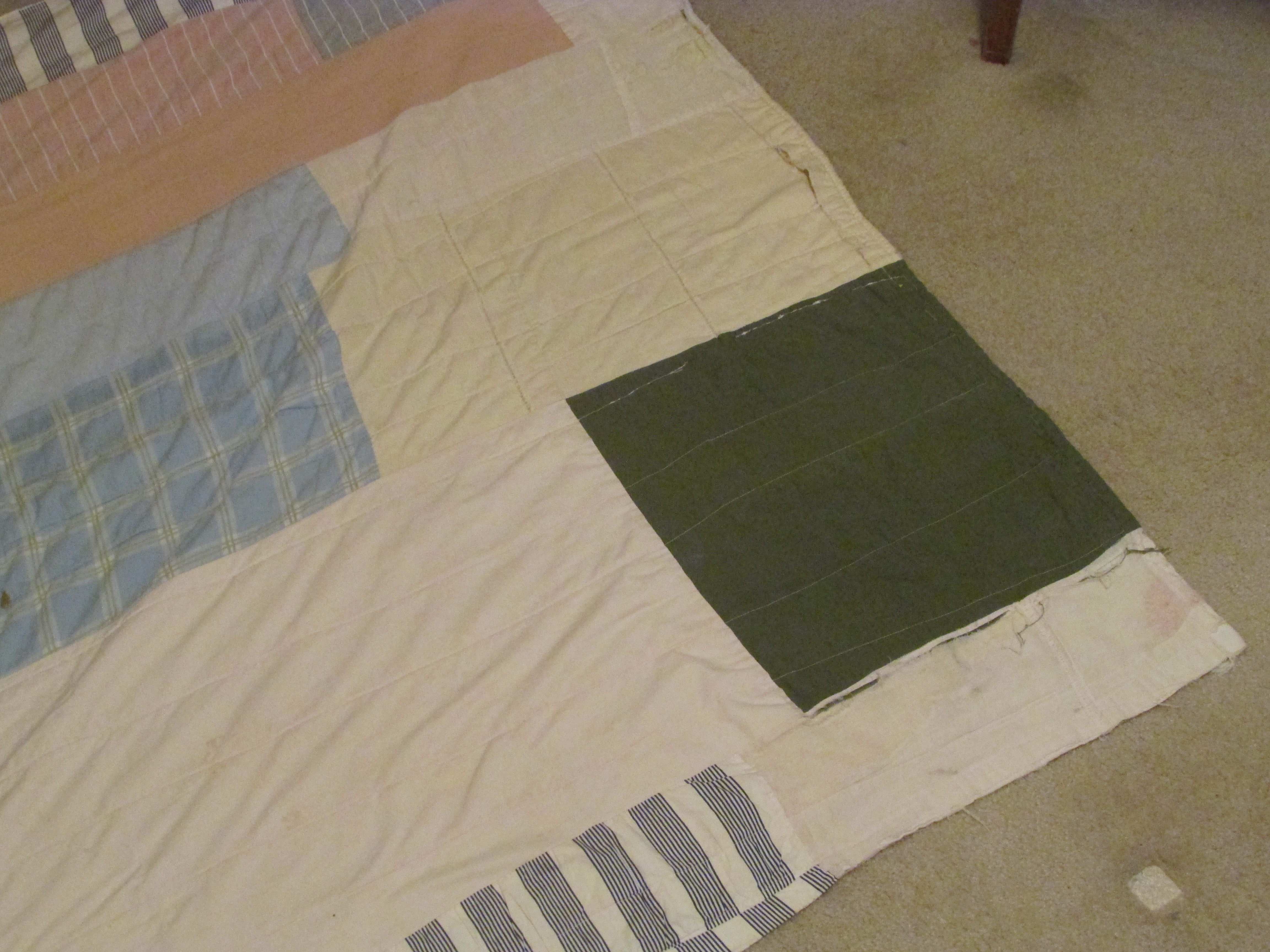
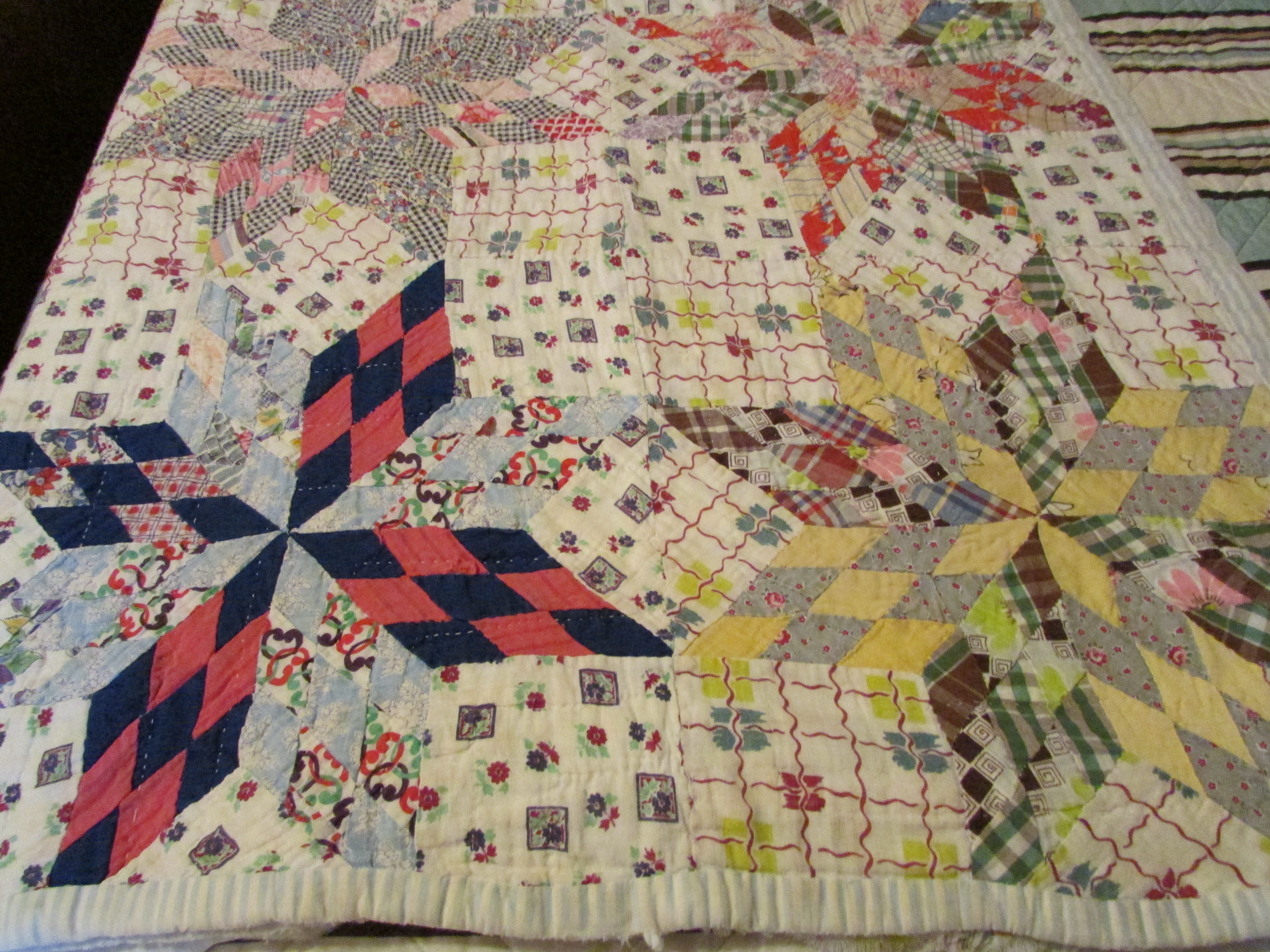
Most of the quilts I have, however, were made by Eula McCarn Harbison (1909-1995), my maternal grandmother. All but one of Grandmother Harbison’s quilts are traditionally patterned –star and snowflake forms are popular – and delicately and masterfully structured. There is one exception and that quilt is on my bed as I write this and has been on my bed every cold season for years. This exception is one that my mother gave to me with the disclaimer that “your grandmother would be horrified if she thought anybody would see this one.”

I hope Grandmother Harbison is not horrified when I say that this is my favorite quilt and I am proud to show it to others. It is clearly a “crazy quilt,” with unmatched and large pieces of fabric and no patterning. In examining it, my guess is that it was put together very quickly (perhaps in advance of an approaching cold spell?). It is also the heaviest and warmest quilt I have ever encountered. I don’t much like cold weather but one of the few pleasures of “the weather of northern aggression” is knowing that I will be sleeping under this amazing quilt for a while. My mother can’t remember when this quilt was made but I am guessing the 1940s before Mother’s family relocated to Birmingham after World War II. Mother says that’s a good guess since she doesn’t recall Grandmother quilting after the move to Birmingham.

IMG_0857

As an artist and as a lover of art, my tastes often run toward the modernist and minimalist and Grandmother Harbison’s quilt fits in both categories in its abstract and random collection of fabrics and in its asymmetrical and challenging composition. There is a large square of solid olive fabric placed near one of the corners that always reminds me of the blocks of color or text found in some Asian prints. This would not have been something my grandmother necessarily knew about but the artistic impulse and prescience intrigues me. Grandmother always said that every room should have a touch of red somewhere and I always thought Well, she and Diana Vreeland have that in common! 

One of Grandmother’s “nicer” more traditional quilts lives on the foot of the bed in my guest room but it’s the thick and crazy one that will cover me tonight and for many nights to come.

IMG_0870

(All quilts shown are by Eula McCarn Harbison.)


Christenberry: Bearing Witness

IMG_0838  I have had a couple of opportunities to hear artist William Christenberry speak and on each occasion he recounted how his mother worried that, based on his work, people would think that Alabama was just some “rusted out, worn down, bullet-ridden place.”

Christenberry’s work focuses on memories of a fading South and his photographs capture buildings and landscapes in decay. He often photographs the same places year after year and documents how places evolve or disappear or ultimately break down completely.

One such sequence, the “Palmist Building” series begun in 1961, is among Christenberry’s iconic images. The earliest photographs of the building show an abandoned and dilapidated wooden structure. A sign advertising a palmist has been placed upside down in a broken window as protection from the weather. Subsequent images over years show the progression of the building’s decay amidst growing vegetation. In the later images, the building is completely gone, and trees, vegetation, wire fencing, and a utility pole stand beside a lonely road. Similar photographic series include “Church, Sprott, Alabama,” “Green Warehouse,” and “Coleman Café.”

I have never shared Mrs. Christenberry’s concern about her son’s work, but she addresses a basic misunderstanding of the South by people who don’t really know the place. By capturing fade and decay, Christenberry is preserving images of a South that is disappearing … has largely disappeared. His predilection for finding and recording old buildings, abandoned places, overgrown landscapes – a predilection I share and which makes Christenberry’s work special to me – is driven by a need to bear witness rather than by nostalgia. Christenberry focuses on rural landscapes but the impulse seems to me to be the same as my attraction to rust and industrial decay found in urban environments. Some misinterpret these images as representations of what the South is today but Christenberry captures and honors them as a rapidly disappearing landscape.

William Christenberry was born in 1936 in Tuscaloosa and left Alabama in 1961 to live and work in New York, Memphis, and finally Washington, D.C. where he has lived and taught at the Corcoran since 1968. Still, his preferred landscape for his art focuses on the environs of Alabama’s “Black Belt,” an area of rich black soil that cuts through the center of the state, where both sets of his grandparents resided. Hale County, “ground zero” for Christenberry’s art, was also the location for James Agee and Walker Evans’s iconic Depression-era book, Let Us Now Praise Famous Men, a hypnotic and microscopic examination of the lives of three Alabama tenant farm families.

Occasionally, as I drive around the Black Belt in west Alabama, I will accidentally stumble across a place that Christenberry has photographed. I am startled at the discovery, stunned at the recognition, and often feel like I have witnessed some elusive ancient treasure.

Christenberry’s art encompasses painting and drawing, sculpture, and assemblage but he is primarily known for his photography. It was photographer Walker Evans himself who became a sort of mentor to Christenberry when they met in New York in the early 1960s after Christenberry finished his M.F.A. at Alabama. Evans steered Christenberry along the path of a concentration on photography after viewing snapshots Christenberry had made with a cheap Brownie camera as studies for expressionist paintings.

Often, in his sculptures, Christenberry takes the same buildings he has photographed and does three-dimensional reproductions of them, often resting on an authentic bed of Alabama red clay in a shallow box. Over time, these more realistic depictions have given way to solid white “dream buildings” and ghostly structures drawn from memory and iconographic imagery – ladders, gourds, signs, structures on stilts. Christenberry’s evocative art never tells the viewer what to think; he presents it and allows one to ponder and meditate on it, to explore the implications.

There are many books of Christenberry’s art available. These would be of interest to the uninitiated as well as those who already know the artist’s work. A couple of my favorites are Trudy Wilner Stack’s Christenberry Reconstruction: The Art of William Christenberry (1996) and William Christenberry (2006) with thoughtful essays by Walter Hopps, Andy Grundberg, and Howard N. Fox.

My articles about William Christenberry and Walker Evans with several multimedia links may be found at http://www.encyclopediaofalabama.org.