Tag Archives: the south

Sustainability and Soul

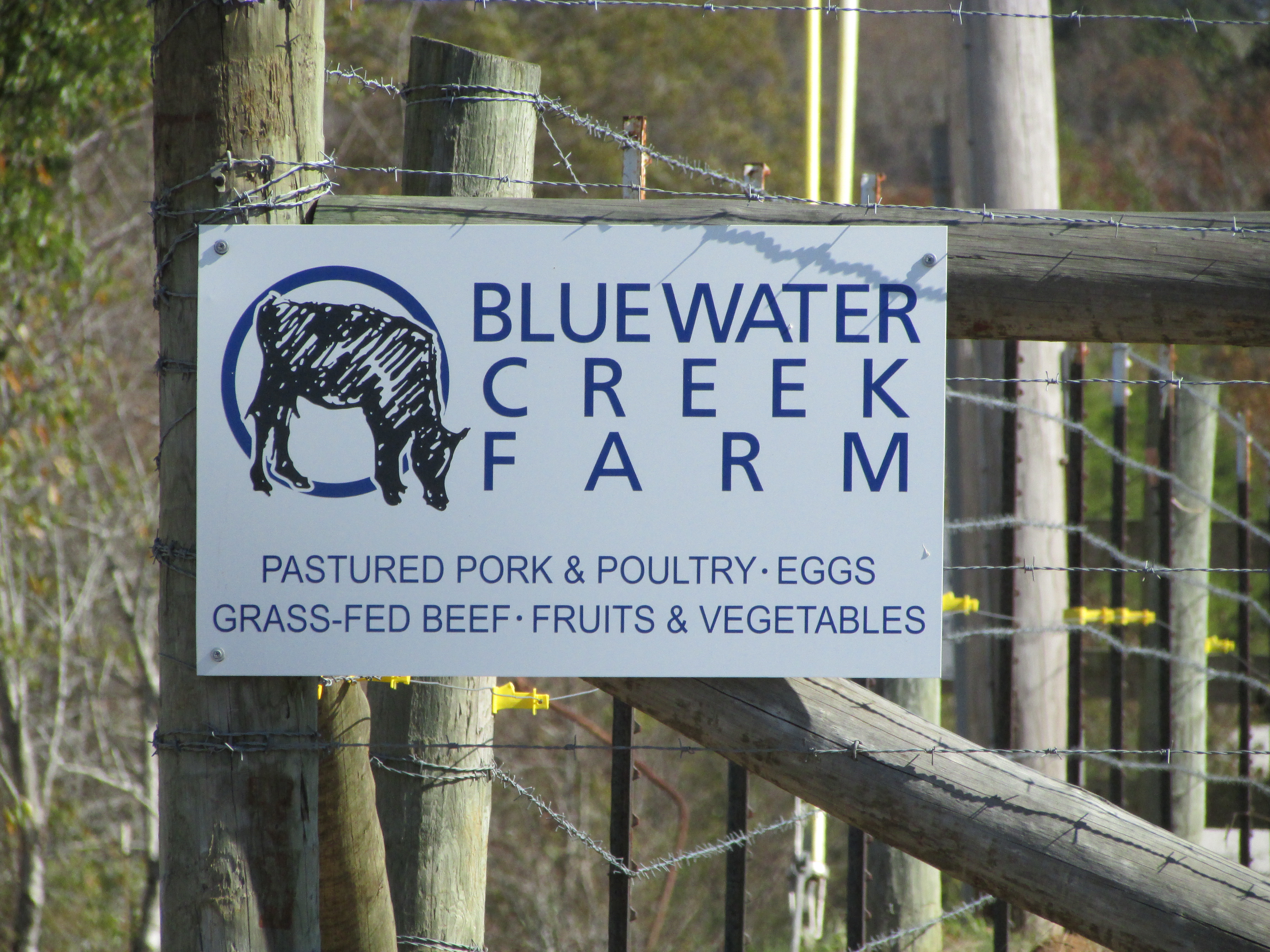
IMG_0837 Bluewater Creek Farm (www.bluewatercreekfarm.com) is a family-owned sustainable farm near Killen, Alabama, in the Shoals area of the far northwest corner of Alabama. It is run by Liz and Collins Davis in partnership with Liz’s parents, Donna and Doug Woodford. Today I drove over there for the first time to check out today’s farm stand and to join a tour of the farm led by Liz. The more time I spend in the Shoals lately the more I’m convinced that it may be the center of the universe.

I was unaware of Bluewater Creek Farm until August when I was in the Shoals — in Florence — for my second “Friends of the Café” event  at the Alabama Chanin Factory. We were lucky enough to sit across the table from Donna and Doug who enthusiastically told about their family and granddaughter Abby. They were thrilled that Liz, Collins, and Abby had recently returned from northern California to start Bluewater Creek Farm. Collins had run farms in California and other places and now they are back in Alabama.

Doug, who is a physician and advocate of holistic nutrition, spoke passionately about his and Liz’s work in nutritional therapy, and Doug and Donna enthusiastically shared news of the activities on the farm as well as pictures of Abby. Doug also had impressive pictures of chickens and bulls from the farm.

What impressed me most was the passion and commitment with which this couple discussed the work they and their family are doing.

I was happy to see Donna and Doug at the next “Friends of the Café” event in October, and this time Liz and Collins were there too. I contacted Liz to get on the farm’s mailing list and that led to the trip today. Bluewater Creek Farm’s stated mission is “to produce nutrient dense, clean food in a sustainable way… this means using farming practices that work with nature. This in turn shows respect for the living beings in our care, and makes a positive impact on our local environment.”

IMG_0808

This family makes a convincing case for their philosophy and seeing the labor-intense way in which they practice what they preach drives home the benefits and sanity of their cause. I, like most Americans, have only fairly recently become educated to the benefits of the “slow food,” “No Farms, No Food,” and “Eat Fresh, Eat Local” movements. It is this rising consciousness and education of the general public which has led to the emergence of great local farmers’ markets in virtually every community, to locally owned restaurants serving locally grown foods, to an understanding of why these issues increasingly matter, and to more sustainable farms like Bluewater Creek.

Previous generations knew this first-hand. Most Americans of the 21st century are learning it anew. Availability nurtures advocacy.

Liz’s tour included the planting beds, still full of lush greens and root vegetables on the first day of November (after the first truly cold night of the season); a visit with the farm’s heritage pigs, including a bunch of tiny piglets; cattle in the pasture, including the grass-fed, heat tolerant South Poll breed; and a bunch of happy grass-fed chickens, joined by a lone turkey (it’s close to Thanksgiving; I didn’t have the heart to ask).

IMG_0803

When the tour was over, I continued down the path to Bluewater Creek. I never lived on a farm and have spent minimal amounts of my life in the country and around farms. Yet I find, especially lately, that being alone out in nature gives me a peace and sense of ease that I don’t get in any other environment. It has become my best and most reliable form of release.

IMG_0832

On the walk back from the creek to the Barn, I met Liz on the road. We had a nice chat about future plans for the farm. “I’m not trying to preach organic farming,” she said. “I just want to show people what we’re doing and they can decide for themselves.”

Before leaving Bluewater Creek Farm I stopped by the Barn, a converted horse barn now used for events and classes, to visit for a minute with Donna. This was the location of the farm stand with the farm’s various products being sold. I bought some meat, peppers, beets, and beet greens to supplement what I had already gotten at my local farmers’ market a couple of days ago. I also got some honey that had been jarred today. I was too late for eggs. They had just sold out.

That’s okay. I’ll be back. IMG_0836


The Chukker Nation

59343_10151206185029021_891945282_n  A girl I sort of dated in college told me that she thought I looked like “the love child of Mick Jagger and Jackson Browne.” This was the ‘70s. She was delusional; I was young and flattered.

I had forgotten the comment (really, I had!) until somebody forwarded this photo to me from Facebook. It was taken (as far as I can figure since I remember the shirt) by photographer John Earl sometime in the very early ‘80s. I am the skinny guy in the down right corner with a lot of attitude. The photo made me gasp since I had forgotten myself as that skinny, that young, and with that hairstyle. But then the Mick and Jackson love child statement came to mind. Or is that guy in that picture maybe “Zoolander-esque”? Or Zoolander-esque-ish?

The picture was taken in the Chukker, a Tuscaloosa fixture for 47 years from 1956 to Halloween 2003. It was a bar. It was a dive. And it was one of the great and legendary watering holes in the world (friends have reported seeing Chukker tee-shirts in Paris). I was born in 1955 so I was a minute older than the Chukker. But here’s the deal: My parents opened a typewriter business on 22nd Avenue in downtown Tuscaloosa in 1957 and their shop was around the corner from the Chukker, new at the time but already a dive. Back then, the Chukker was a lunch spot – a grill if you will – in the daytime and reverted to its bar status at night.

I know my parents would probably rather not admit to this, but I remember going to the Chukker as a young child to pick up coffee in the morning and sandwiches at noontime for Mother and Dad. So my personal memories of the Chukker go back to about 1958. It was a different time and toddlers could freely roam Tuscaloosa city streets. I was – I’ll admit it – too much of a spoiled brat to go to day care back then and my accommodating parents made a sort of nursery/playroom for me in the back of their business.

I had the run of the streets in many ways since the shopowners in the area knew me and would look out for me. My parents still have a small bookcase that I decided I needed back then. I spotted it and my 4-year-old self told Mr. McGraw at the furniture store to put it on my parents’ account. He did. I am pretty sure that my mother’s cedar chest still has a drawing of little me that was drawn by an itinerant artist who set up shop for a while in the Chukker in the ‘50s. And I vividly remember ringing the bell at the Salvation Army booth during the Tuscaloosa JayCee’s Christmas parade with my stuffed Coca-Cola Santa under my arm, making a haul for charity. As a toddler in Tuscaloosa I was a “street kid” in the purest (and most innocent) sense of the term

When the family moved back to Tuscaloosa in 1972, the Chukker was still there. And it was still there when I was an undergraduate in college. It was only after I finished college (the first time) and I was still living in Tuscaloosa that I went with friends back to the Chukker. Back then, it was much like I remembered it, but it was a full-fledged bar and its reputation seemed to change biannually. It was reputed to be, at various times, an “artists’ bar,” a “biker bar,” a “blues bar,” a “bohemian bar,” a “gay bar,” a “lesbian bar,” an “old hippy bar,” a “punk rock bar,” a “redneck bar,” a “writers’ bar” … I could go on.

What it was, though, was an inclusive community that happened to be a bar. One always felt looked after at the Chukker. One always found someone one wanted to talk to and get to know.

My friend Bill and I were at the Chukker when I heard that John Lennon had been killed. That was no small feat since the bar had no phone at that time. I directed my first, and unexpectedly successful, production of Gertrude Stein plays at the Chukker. Bruce Hopper, the owner at that time, asked me if I wanted to do a show in the bar’s performance space. I told him that I did but I couldn’t guarantee an audience for the avant garde plays of Gertrude Stein. He said “do it” and we sold out nightly.

A film student shot a short film of my friend Deb and me walking in a circle in the Chukker courtyard on the day that Andy Warhol died. We walked round and round and talked about Andy and Andy’s death. I never saw the finished product but someone told me, many years later, that they saw it at a screening somewhere. “You’re the guy walking in circles in that Warhol film.” Yes, I guess I am.

My friend Clay would spend hours, it seemed, glued to the Chukker’s Galaga machine. My Galaga attempts were generally over in under a minute. Clay and I played a lot of pool at the Chukker also. My pool skills were unpredictable at best; I chose to refer to them as “Zen-like.” Clay was one of the few people who had the patience to play pool with me; I even won a game on occasion.

An ersatz and quirky art collection was housed at the Chukker – mostly the work of artists who hung out at the place during their Tuscaloosa sojourn. Some was hanging on the walls and some was painted directly on the walls. “The Sistine Chukker,” Tom Bradford’s Michelangelo homage on the bar’s ceiling, was the most legendary piece of the Chukker collection. For many years, I would welcome newcomers to Tuscaloosa with a postcard of the Sistine Chukker.

The great Tuscaloosa-based Celtic group Henri’s Notions was practically the house band at the Chukker for a while. Forecast, The Indigo Girls, The Replacements, Johnny Shines, Richard Thompson, and Sun Ra all played the Chukker, as did any number of local bands trying to be R.E.M. during that band’s heyday. In fact, I took a long time to warm up to R.E.M. because of the English department “R.E.M. wannabe” bands that sprang up in Tuscaloosa at the time. The real R.E.M. itself adjourned to the Chukker after a concert on the University campus, bringing a substantial number of the concert-goers with them, when Michael Stipe announced to the audience that that’s where they were going after the show. I invited Billy Joel to the Chukker after one of his Tuscaloosa concerts; he declined. Jimi Hendrix may or may not have played there and Keith Richards may or may not have played pool there. Abbie Hoffman DID have a beer there because I was there when he did it. There was always a “Chukker Nation Reunion” on the Saturday between Christmas and New Years’s Day.

“Quarter beer night” on Mondays was a longstanding tradition. One could go on the roof of the building next to the place (the building, in fact, where the furniture store where I bought those bookshelves used to be) and watch the cars converge from every direction at 9:00 p.m. on Monday (remember that convergence scene in Field of Dreams?) and watch most of the same cars leave again at 10 when the hour of 25 cent beer was over.

I had not been at the Chukker for many years when I heard it was closing its doors on Halloween 2003. In fact, the closing was reported on CNN. It was ultimately the victim of a Tuscaloosa downtown renewal. There’s a park where the Chukker and my parents’ typewriter shop used to be, and a fountain nearby. It’s a nice enough place, but a little bittersweet if you remember what used to be.

I went down on Halloween 2003 to be a witness. So did many other people. I didn’t stay long that night, and I was disappointed that I arrived just as Henri’s Notions finished their final Chukker set, but the place was packed; it seemed that every time the door opened that night, it contained a face that I had not seen in ages. Truly, people flew from across the country to be present at the Chukker’s closing night. I visited with the guys from Henri’s Notions, Sandra and Michael, Fred and Jennifer, and other people I knew. I didn’t stay long; I didn’t even have a beer. But I was there.

And then I was not there anymore. It was all I could do not to turn around for one last look as I walked out of the Chukker door for the final time. But I didn’t. I just kept walking.

“The Professional Southerner” — and why

IMG_3349I think I was living in Indiana the first time I was referred to as a “professional southerner.” As I recall, it was around 1994 and I was frustrated because I had been unable to find okra in the produce sections of the local grocers. Someone innocently asked why I ate okra and my shock made me launch into a monologue of the virtues of okra and all the ways in which it could be consumed. But my favorite way was breaded and fried in the particular way my Grandmother Harbison had always made it and I had been craving fried okra around that time of that Indiana summer.

This led to questions about other ways in which okra could be consumed (I told them pickled okra was my favorite Bloody Mary garnish), other foods I like, and other queries about Southern foodways. Someone in the group mumbled, “I never realized you were such a professional Southerner,” and we all laughed but over the years, as I lived and traveled in other parts of the country, I became aware that I was often the go-to guy for issues dealing with the South and what it means to be Southern.

Having said that, I am a proud Southerner but very few people would classify me as a “typical” Southern male with all of the misconceptions and stereotypes that label evokes. But I realized, after traveling and working in different places – and to my surprise, really – that not only was the South my home, but that it was the place I best understood and the place where I felt most comfortable. It was the place I wanted to come back to. My politics, for one thing, are not typical of the South, but they are also not as atypical as some might suppose and I resent the whole “Blue State / Red State” way of thinking because it gives such a divisive idea of what is really happening in our country.

Not long ago, my friend Cindy and I attended a “Piggy Bank” dinner at the Factory of Alabama-based fashion designer Natalie Chanin in Florence, Alabama. The event was to honor Southern food and to benefit Southern Foodways Alliance. The chef for the evening was Vivian Howard who owns and runs Chef and the Farmer, a farm to table fine dining restaurant in Kinston, North Carolina, with her husband Ben Knight. Between the entrée and the dessert, Shonna Tucker, an Alabama-born musician who has recently moved to Florence after many years on the road, sang her striking and original songs. The dinner guests were a wide range of people who shared an amazing communal meal and one of the most convivial and relaxed evenings I have enjoyed in a long time. At the end of the evening, all of the diners stood and sang “You Are My Sunshine” to Vivian Howard, led by Natalie Chanin, one of the most innovative and conscious fashion designers working today.

That night, walking from the Factory to the car, I commented to my friend that “This is one of those nights when I can’t imagine living anyplace else but Alabama.” And I decided that I – who have always detested the idea of blogs and the label of “blogger” – would make an effort to record and share some of the things that make my South so special to me. Plus, I have been told that I “think loudly.” Maybe, by writing this online journal, my loud thoughts will become more specific and defined.