Tag Archives: Zelda Fitzgerald

Notes on a Century of Gatsby

The university where I taught was hosting a mini-symposium about F. Scott Fitzgerald’s The Great Gatsby in conjunction with the local library and the National Endowment for the Arts. I was the moderator and had gathered the participants for a planning session before the event. At some point in the conversation, I casually stated that I thought the Twenties would have been an exciting time to be alive.

There was a moment, and then one of the professors muttered, “As long as you were white.” Another chimed in, “… and a man.”

I was chastened and kept my mouth shut. However, some of my favorite writers were publishing in the 1920s – William Faulkner, T.S. Eliot, Gertrude Stein, etc. George Gershwin was composing. The Harlem Renaissance highlighted the talents of Hughes and Hurston and so many others. The New Yorker magazine was founded, and modern art was bursting forth. Speaking strictly for myself, I still think it would have been an inspiring time to be alive (if only one could maneuver a way to exit prior to the Great Depression).

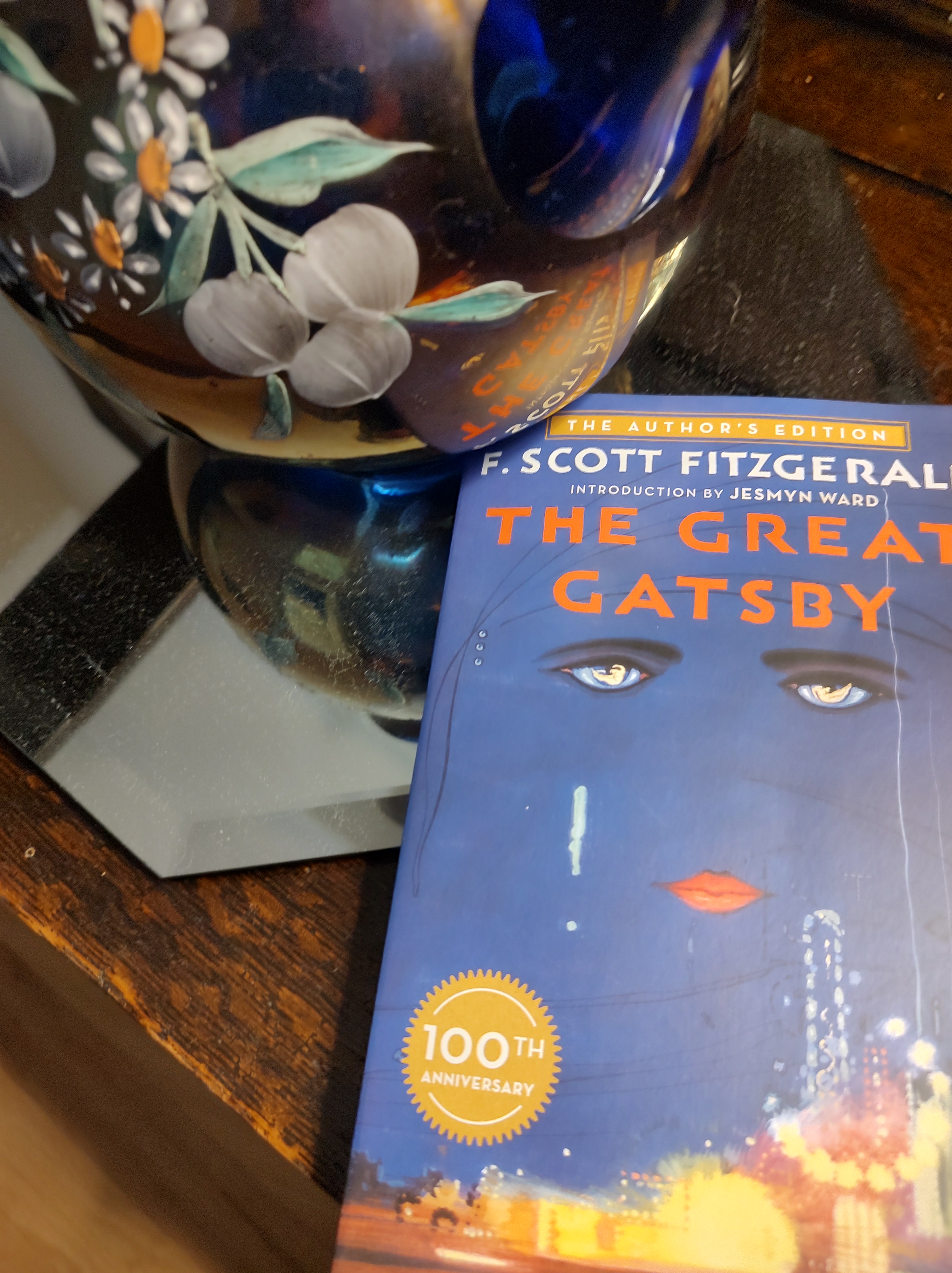
And in 1925, F. Scott Fitzgerald’s The Great Gatsby was published. I try to stop myself from writing about my ritual of reading F. Scott Fitzgerald’s The Great Gatsby on every Summer Solstice. But since much commotion heralded the centennial of that enduring novel in April of this year, I need to address my ritual once more. It began in high school when we were assigned Gatsby in an American lit class. I think that’s a good age to read the book for the first time – a time when adult thoughts are edging out the preoccupations of childhood and adolescence, when many are just getting an inkling of what romantic love might be all about. Cynicism hasn’t yet taken hold.

In the book, Daisy muses that she always looks forward to the longest day of the year and then forgets it when it comes. “We ought to plan something,” her friend Jordan dreamily says. For some reason – mainly because I always looked for the longest day of the year and then forgot about it until it was past – I thought I should plan to read The Great Gatsby on the longest day of the year.

And so I did. I am prone to such plans and then letting them slide away, but I have stuck to the reading Gatsby thing. By my calculations – I might have missed a year somewhere along the way – I have read Gatsby annually, and on the same day, for over half of the hundred years since its publication.

Over the years, it never gets old; there’s always a new moment or turn of phrase to discover. I look forward to the Summer Solstice just because I know I will be revisiting the Eggs of Long Island. As I grow older, Gatsby grows in meaning and grace. Over time, my waning tolerance for the arrogance and wealth of Tom and Daisy Buchanan has decreased and James Gatz of North Dakota has begun to look increasingly foolish and naïve in his quixotic quest. I understand how careless Jordan Baker could inspire a fleeting adolescent crush in any number of grown men. (When Tom is in the middle of one of his racist rants, Jordan breezily shuts him down with “We’re all white here.”)  I feel sorry for the Wilsons – Myrtle and George – and think that we all have known marriages like theirs, one way or the other. And now, when I read the book, I think They’re all so young.

But of all of them, it is Nick Carraway, the narrator, whose voice I most enjoy visiting once a year. I sort of trust him when he says he is one of the “few honest people that I have ever known,” although anyone who would say that about himself is already suspect (it’s kind of like declaring yourself a “stable genius”).

____________________

I underline passages in books, although I have always done it sparingly, like a standing ovation. Each time I read Gatsby I linger over lines and passages I underlined in past summers. Sometimes it makes perfect sense; other times, I think Why did that catch my attention? Occasionally, it takes me right to a certain place in my life and I know what prompted those words to grab me at that specific time. At one point in the book, Nick realizes that it is his thirtieth birthday and the “portentous, menacing road of a new decade. … the promise of a decade of loneliness, a thinning list of single men to know, a thinning briefcase of enthusiasm, thinning hair.” I can tell you exactly when I underlined that passage. I have gone through several paperbacks of The Great Gatsby since my ritual began. I keep them even after they fall apart and are replaced. One remaining copy was damaged after it was thrown up into the air to avoid an incoming wave on a beach somewhere. It avoided the surge, but not the saltwater.

____________________

On those first readings of The Great Gatsby, I was not aware of Fitzgerald’s Alabama connections. Zelda Sayre was a new name to me. It was only after Fitzgerald’s daughter, Scottie, came to speak to my sophomore lit class, that I began to realize the significance of Alabama in the Fitzgerald biography. It was while he was stationed in Montgomery that Scott and Zelda met. Later, in 1931 and 1932, when they briefly rented a house in Montgomery’s Cloverdale neighborhood, Zelda worked on her novel, Save Me the Waltz, and Scott wrote part of Tender Is the Night. Their daughter, Scottie Fitzgerald Lanahan, moved to Alabama around the time she spoke to my class. She became active in social advocacy and politics in Alabama later in life, partially to atone for some of the Jim Crow legislation of her prominent politician grandfather, and spent her final years in her mother’s hometown.

Anyone familiar with Fitzgerald’s story will recognize the influence of Zelda on Scott’s writing, and especially in his creation of Daisy Buchanan in Gatsby. Zelda famously said, “Mr. Fitzgerald — I believe that is how he spells his name — seems to believe that plagiarism begins at home.”

____________________

One of Andy Kaufman’s most frustrating stunts was when he decided to read The Great Gatsby to an audience. He would start reading in a sonorous voice and he would not stop. Audiences would catcall and scream for him to stop and he would taunt them, threatening that if they did not quieten down, he would stop reading. They would persist, but he would not stop. Eventually, after his reading had taken the audience beyond the breaking point, he told them if they did not stop, he would have to play the recording he brought. As the audience pleads for him to play the recording, he finally puts down the book and cues up the record – a recording of Andy Kaufman reading The Great Gatsby.

It’s a brilliant piece and, in its building tension and absurdity, there is an underlying truth. The Great Gatsby is so beautifully written, the words are so crisp and precise, that I always want to read passages aloud just to hear the words. Kaufman picked up on that urge and his madcap stunt shows just how outrageous and cloyingly precious it is to force people to listen.

Kaufman’s stunt aside, the theatre ensemble called Elevator Repair Service won massive acclaim and made its reputation with a production called Gatz in which The Great Gatsby is performed, word for word, from start to finish. Set in a drab office, a bored office worker pulls out a copy of Gatsby and begins to read it aloud. The other workers begin to recite the text – in its entirety – and play the various characters, all in their office setting. The performance lasted eight hours including two short breaks, an intermission, and a dinner break. It was a hit and has been toured and revived by Elevator Repair Service several times since its 1999 premiere. It probably sounds like torture to many — as torturous as that Kaufman bit  — but, given the opportunity, I would happily sit through Gatz.

_____________________

There is one passage in Gatsby that I always ponder; it never ceases to intrigue me and is one of many moments that feeds my deep affection for the story. It comes at the end of Chapter VI after Gatsby opens up to Nick about his Daisy obsession. Nick notes that despite Gatsby’s

… appalling sentimentality, I was reminded of something – an elusive rhythm, a fragment of lost words, that I had heard somewhere a long time ago. For a moment a phrase tried to take shape in my mouth and my lips parted like a dumb man’s … But they made no sound, and what I had almost remembered was uncommunicable forever.

That moment passes; it’s not referenced again. No other writer has so effectively captured that moment of something “on the tip of the tongue” that is almost there and disappears, never to return. I am not sure that any other writer has tried.

Gatherings – Part 2: Montgomery … and some birds

Saturday – Montgomery

Court Square Fountain, Montgomery

My main purpose for going to Montgomery is to see a matinee at Alabama Shakespeare Festival, but I get there in plenty of time to hang out in Blount Cultural Park, the 175-acre sprawling English-style park that is home to Alabama Shakespeare Festival and the Montgomery Museum of Fine Arts.

I lived in Montgomery for three years when I worked at Alabama Shakespeare Festival and my apartment was on property that adjoined the Park. On days when I didn’t need to use my car, I could walk from my front door to my office in less than five minutes. A jasmine-covered arch marked the entrance to the parkland from my apartment complex and the moment of entering the park never got old. It’s still a special moment when the winding road through the park rounds a curve and you get your first view of the theatre across the lake.

New York Office (1962); Edward Hopper

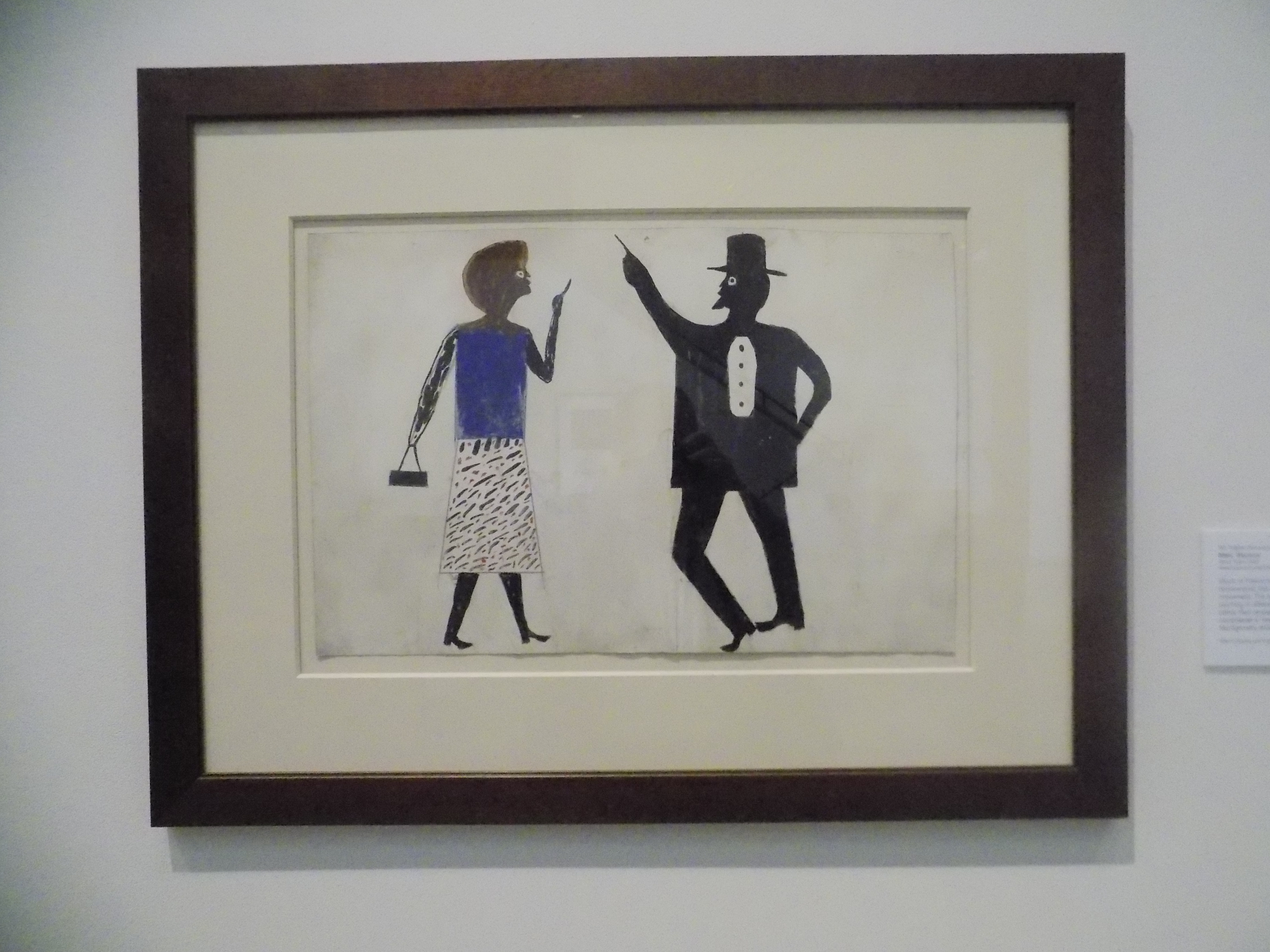
Man, Woman; Bill Traylor

I have time to head to the museum and its eclectic collection of treasures. When I worked at ASF, the museum was a favorite place to go for a relaxing lunch or a quick break. The museum is larger now, and there is a significant sculpture garden. The collection is a somewhat quirky combination of American art of the 18th-21st centuries with a strong dose of vernacular art. One of my favorite Edward Hopper works, New York Office, is there, along with works by Montgomery artist Bill Traylor. Born into slavery, Traylor started making art works in 1939 when he was in his eighties and completed around 1500 works for ten years until his death in 1949.

Sunset Landscape (1899); Charles Warren Eaton

Sunset Landscape by Charles Warren Eaton reminded me of Hwy. 82 and I am always drawn to Christenberry’s Providence Church sculpture. I also like to pay homage to Zelda Sayre Fitzgerald, an artist, Montgomery native, and F. Scott’s wife, whose artwork is usually on view. It was missing on this trip, waiting to be re-hung for an upcoming exhibition. I always asked friends visiting Montgomery, “What other museum can you visit to see paintings by Zelda Fitzgerald?”

Providence Church (1976); William Christenberry


I could have lingered longer at the museum but it was time to take the short drive across the park to the theatre and the real purpose for being back in Montgomery. In the museum parking lot, I heard the cheerful song of a mockingbird. Moving toward the sound, I found the soloist perched in a tree; as I moved closer, the bird paid me no mind, just joyful in the day.

I’ve lost track of how many years it has been since I was last at Alabama Shakespeare Festival to see a show, but it still felt familiar. When I was there, it was still a classically-based, Shakespeare-heavy theatre. There was a true repertory season that extended well into the summer, a brilliant resident company of actors, and a thriving graduate acting program affiliated with the University of Alabama. I had friends from near and far who would travel to Montgomery annually to spend a weekend seeing up to six plays in rep. I’m not sure we truly valued what we had back then. Over the years, Shakespeare titles are less abundant and the season is greatly reduced, but we’re fortunate it’s still there.

Alabama Shakespeare Festival

From the parking lot, I have to duck in to the Shakespeare Garden before going to the box office to pick up the ticket. The Shakespeare Garden is next to the theatre – a bucolic place with an intimate amphitheatre, featuring plants mentioned in the writing of Shakespeare. I would often take a respite in the garden during my time at ASF. A large statue of Puck is tucked away at the top of terraced levels for seating.

Outside the box office, a lone duck has decided to swim around a small fountain. People take out their cameras to photograph him. Occasionally, he steps up to the edge and quacks at bystanders. This is my place! he seems to say.

I stop for a moment to watch the audience assemble – another gathering. When I lived in this neighborhood, I would often come to the park an hour or so before a performance to watch the cars begin to arrive and the people eagerly go through the doors of the theatre. Like the night before in Tuscaloosa, this gathering takes on a new resonance.

Wandering through the lavish lobby, I catch site of the open door of the Patron’s Room at the far end. It is almost time for ASF’s resident dramaturg Susan Willis to give a fifteen-minute talk about the play we are about to see. The room is full. It’s good to see that Dr. Willis is still giving the talks. She was already there when I came to the theatre years ago; I’ve learned a lot from those talks over the years.

Pre-show is over and, ultimately, the play’s the thing … And today’s play is The Tempest, Shakespeare’s final and farewell play (although Dr. Willis would fine tune and clarify that statement a bit).

I have seen several productions of this play in various places over the years, and have seen at least three different versions at Alabama Shakespeare Festival. I am mainly here today because the actor Greta Lambert has announced her retirement from the theatre and is wrapping it up by playing the role of Prospero in The Tempest. Greta has been with ASF since its premiere production of A Midsummer Night’s Dream in Montgomery in 1985; she played Titania.

Over the years, Greta has gifted audiences with some of the most memorable performances of my life. She’s played most of the major Shakespeare women, along with Blanche DuBois, Hedda Gabler, Eliza Doolittle, Candida, The Glass Menagerie’s Amanda, and so many others. Coming full circle, she was Miranda to Philip Pleasants’s Prospero in a 1986 production of The Tempest.

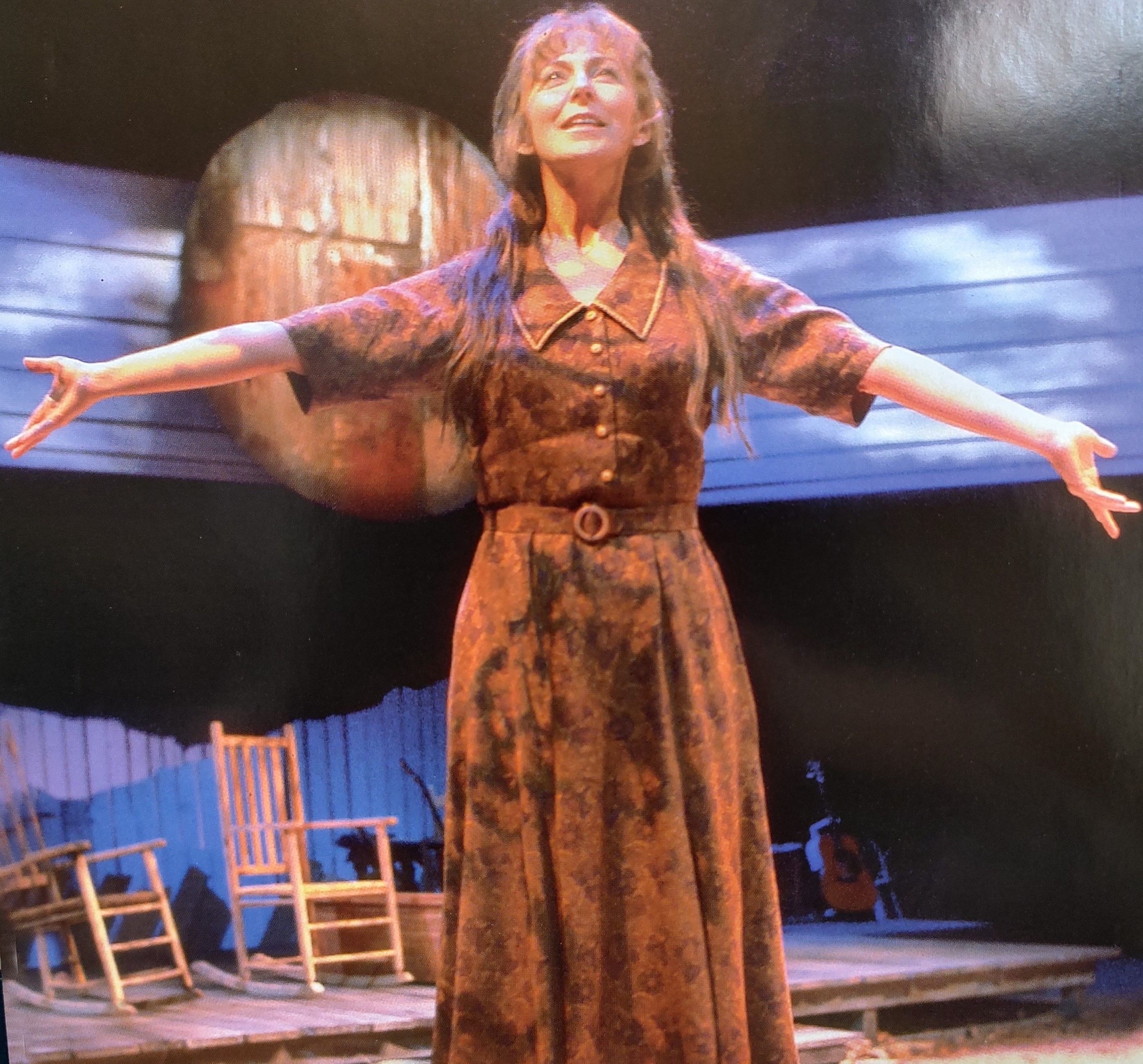
Greta Lambert in Fair and Tender Ladies (2000)

But my most cherished role played by Greta Lambert was her performance as Ivy Rowe in Fair and Tender Ladies, a musical adaptation of the Lee Smith novel. In it, Ivy Rowe ages from a young girl to an old woman. The production Greta starred in was directed by Susan Willis. I had the good fortune to manage a tour of the show in the fall of 2000 and it was a thrill to watch audience’s response each performance. I had toured with shows in the past, but Fair and Tender Ladies is the one I never tired of.

Greta Lambert’s interpretation of Prospero was, of course, wonderful. She establishes an immediate connection with the audience and her presence on stage, even in scenes where she is just an observer, is mesmerizing. It always has been.

In Fair and Tender Ladies, after the audience has watched Ivy Rowe’s life unfold on the stage, there is the moment when the elderly Ivy Rowe slowly walks off the stage for the final time. On tour, I tried to never miss that moment and, after dozens of viewings, was always moved by it along with the audience seeing it for the first time. In The Tempest, Prospero’s final speeches took on another level of resonance in Greta’s delivery. Our revels now are ended …We are such stuff as dreams are made on …release me from my bands with the help of your good hands … Greta has announced her retirement from ASF, but not, necessarily, from the stage, so we may have future opportunities to see her act. But these moments seemed to signal the end of an era. I shall always remember them.

It’s hard to leave the theatre and I vow to come back more often. I linger in the park for a bit and finally leave, taking a drive through the grounds before turning toward town.

_____________________

I was honestly not thrilled to move to Montgomery in 1999. I loved the theatre and mostly enjoyed my job there, but the city itself, despite its historical significance, had never seemed to have much to offer. By the time I moved away, in 2002, I had grown to appreciate the place more. Now, though, after a couple of decades of more progressive leadership, the city is enjoying a revival of sorts and what used to be a dead downtown, where I am going to spend the night, is teeming with activity when I pull in to the Renaissance Montgomery Hotel, my address for the night.

My room is across from the city’s Riverfront Park and historic Union Station along the Alabama River and I am eager to go for a walk and see what the city has to offer these days. I’ve stopped in town a few times for a quick meal or to check out Equal Justice Initiative’s Legacy Museum and the National Memorial for Peace and Justice, but this will be my first time to explore on foot since I lived here.

Blues music greets me when I start my walk and the statue of Hank Williams has been moved from its previous location to a more prominent site on Commerce Street. Lots of tourists wander the streets, lots of dining spots and bars are open, and I realize what a difference has occurred since the city began to embrace its Civil Rights legacy and has become a prime location for Civil Rights tourism.

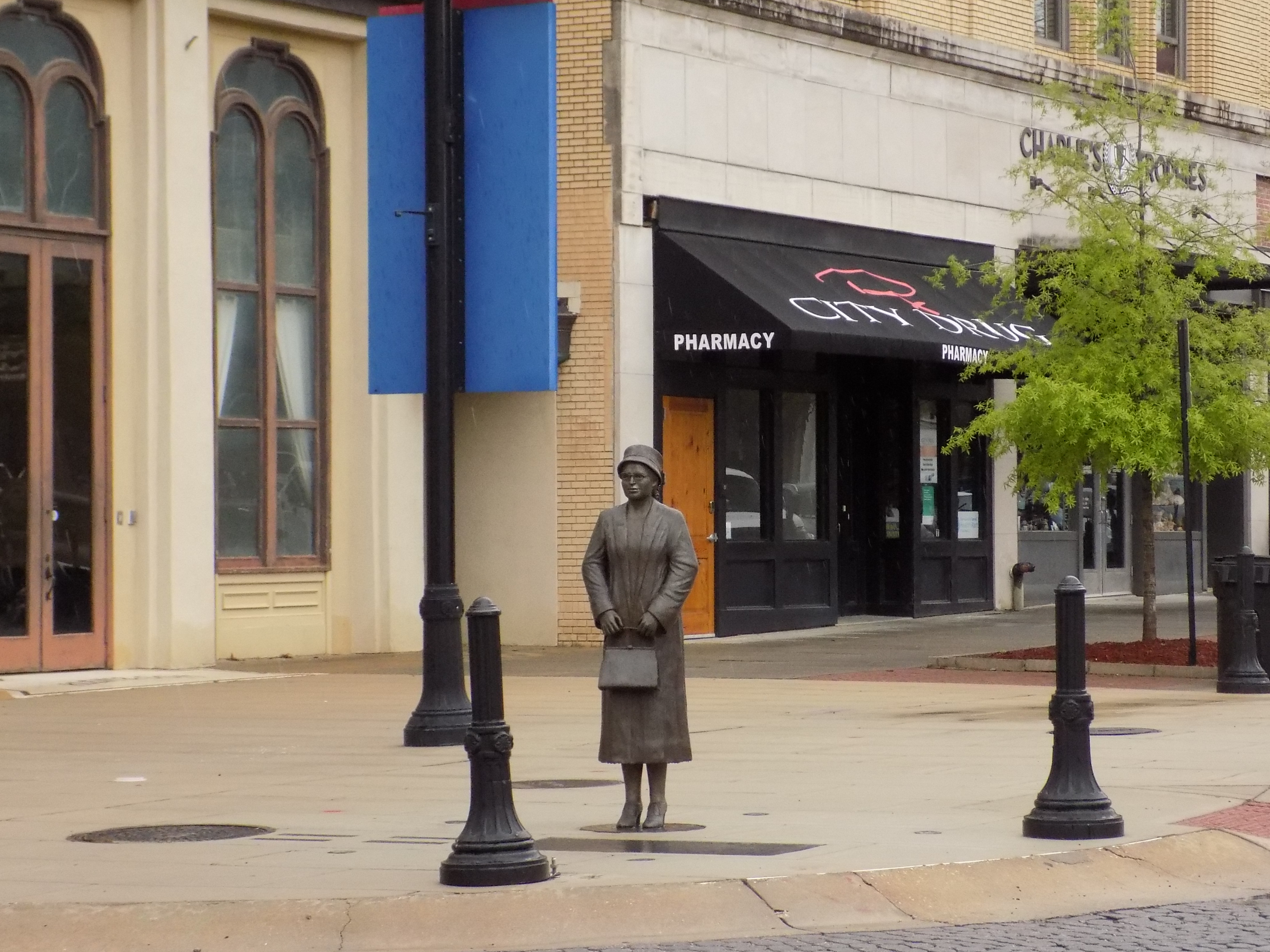
The fountain at Court Square, at the bottom of Dexter Avenue, now has “Black Lives Matter” painted on the sidewalk around its base and a quiet statue of Rosa Parks waits patiently across the street. The state capitol building is at the top of Dexter, while Dexter Avenue Baptist Church, where Martin Luther King, Jr. was the pastor in 1955 during the bus boycott,  is just down to the right of the first capitol of the Confederacy. Montgomery has a complex and colorful history, to say the least, and this current embrace of the past somehow makes the city feel more forward-looking.

I’m liking Montgomery more and more. A memorable and imaginative dinner at Central Restaurant, a locally-owned and locally-sourced restaurant helmed by executive chef Jason McGarry on Coosa Street, is the appropriate topper for a pretty terrific day. A woman I met at the Hall of Fame dinner in Tuscaloosa gave it a glowing recommendation; she didn’t know that I already had a reservation. Her recommendation was spot-on and I’m glad that I sought this gem out.

There are lots of gems to discover in Montgomery these days, it seems. I head home the next morning determined to return for more. And determined to squeeze in more roadtrips.

Rosa Parks; Montgomery