 After a night out with friends in 1979, I returned to my apartment on Caplewood, a pleasant winding residential street at the end of the Strip, down the road from the University of Alabama. As I put the key in the lock, my neighbor Mike walked out on the porch. “Barry was here earlier,” he said.
“Yeah?”
“Yeah. I kinda had to run him off.”
“What was he doing?”
“Actually, he was trying to break into your apartment.”
“Really … did he happen to say why?”
“He said he was a writer and he needed inspiration and that you had a record album he needed to listen to tonight, right now. He was pretty adamant.”
“And …”
“I told him it looked like you weren’t home and he needed to leave, that I couldn’t let him break in.”
“How’d he take it?”
“He was annoyed and argued a little, but he left. Do you know what he was looking for?”
“I do.”
The next day, I grabbed Planet Waves from my record stack and walked a couple of doors down to Barry’s studio in the backyard of a neighbor’s house.
He was in.
“Here’s the album you were looking for last night,” I said. “Take it. Keep it. You can have it, and please don’t come knocking at my door anymore. And don’t ever try to break into my house again. Please.”
___________________________________________
Barry Hannah, the novelist that Truman Capote called “the maddest writer in the USA” and whom Alfred Kazin praised as “a writer of violent honesty and power” was my neighbor in Tuscaloosa in 1979. His studio was two doors down and his house was farther down on the curve that pointed Caplewood back toward the university.
When I heard that Hannah was coming to the University of Alabama to teach creative writing, I grabbed his first novel, Geronimo Rex, and was transfixed by the vibrant energy and muscle of the words on the page. He always wrote like nobody else with a style that was impossible to emulate – for anyone foolhardy enough to try.
I started hearing “Barry stories” from my writer friends as soon as Barry hit town, but I didn’t meet him until his hugely acclaimed volume of short stories, Airships, was released and I got a copy signed at Another Roadside Attraction, a bookstore on the Strip. He asked my name, proclaimed it a “great name,” and inscribed the book to me with a comment about my name.
I later loaned that signed copy of Airships to a friend and he never returned it. I asked him about it and he denied that he borrowed it, but I know he did. I always remember people who borrow and steal my books. (I’m talking about you, Jim.) After I started hanging out with Barry, he signed another copy of Airships, but the inscription was less personal.
After I moved into the apartment down the street from Barry’s house, we began to run into each other more often. He’d occasionally show up at my door and I was occasionally invited down to his house or studio.
One night late, a friend and I were sitting in Barry’s living room and Frampton Comes Alive! was on the turntable. When “Do You Feel Like We Do?” came on and the signature talk box guitar solo kicked in, Barry picked up his trumpet and began to blow, trying to match the talk box sound. It was a bizarre moment in time, but Barry’s effort was so earnest that we weren’t sure how to react. Once it was over, I think I offered a noncommittal wow.
_______________________________________________
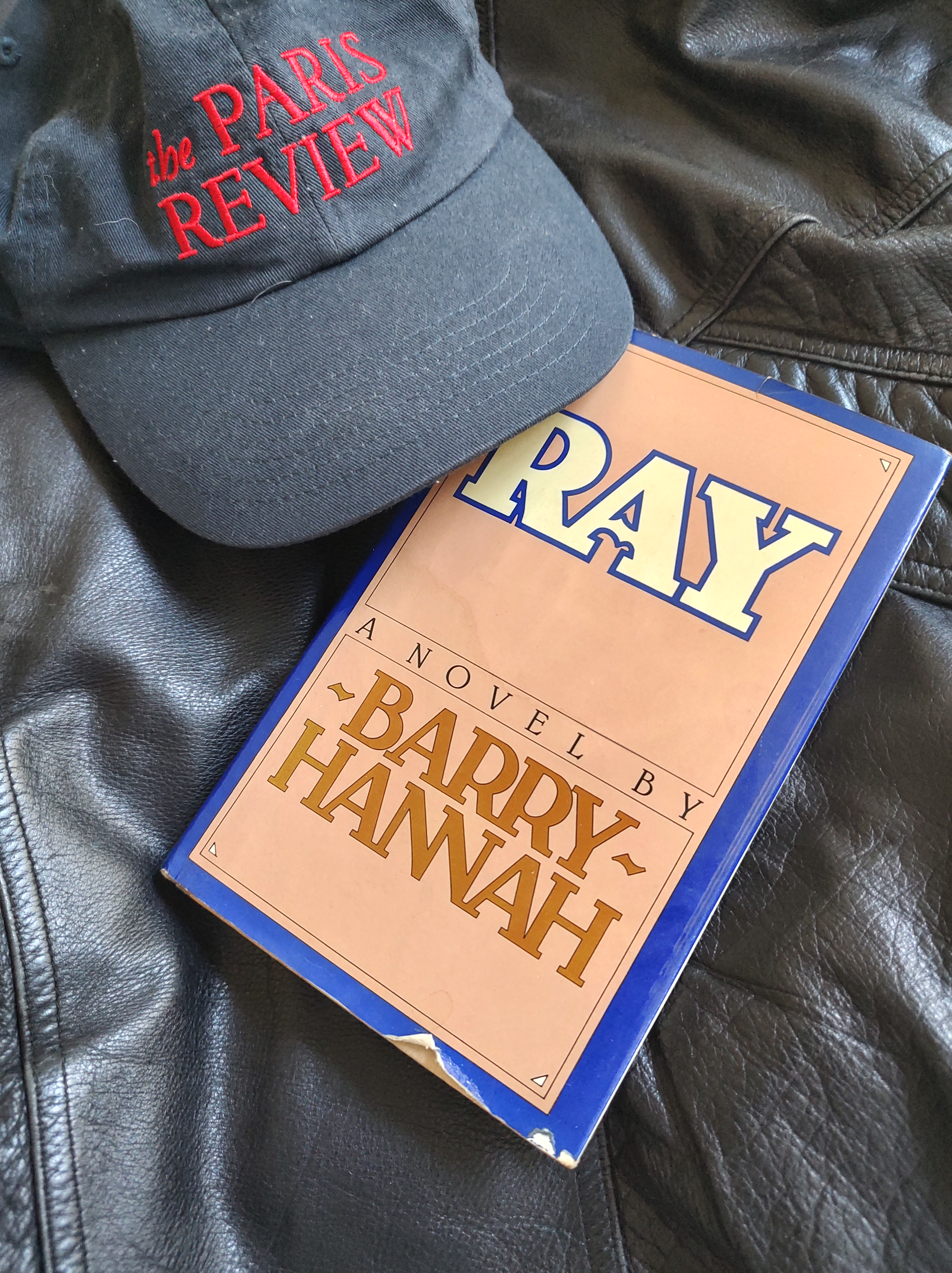
But my most bizarre “Barry story” begins on another late night at Barry’s house. Barry suddenly turned to me and said, “The Paris Review wants to publish an interview with me. I’ve told them I will only do it if I can choose the interviewer. Edward, do you want to do my Paris Review interview?”
Remember, this was forty-four years ago and I was trying to keep up with Barry, so some details are fuzzy. I have no clue if Paris Review was trying to do a Barry Hannah interview in 1979, and I was skeptical that I would be considered to write it, but it was a promising adventure and I didn’t hesitate to go along.
I was even more skeptical when Barry said we would do the interview the next morning at the studio, but I called in to take the day off, gathered a cassette recorder and blank tapes, and showed up at the studio at the appointed time. I was pretty sure I wasn’t prepared to do a proper Paris Review interview.
Barry, drink in hand, was waiting for me when I got to the studio. We chatted for a while until I finally asked if we could start the interview. Barry insisted that I needed something to drink and poured a glass full of something rancid that he referred to as white wine. It had a strong chemical smell and something unsavory was floating on the bottom. I thanked him, put the glass to the side, and started the recorder.
I wasn’t really prepared for a writer interview with twelve hours’ notice, so I asked him about his childhood in Mississippi, his family, other Mississippi writers and influences, autobiographical elements in his stories, teaching creative writing. I rambled and so did he. His responses were tangential and he kept coming back to a poem he had just written, called “Certain Feelings.” “I have certain feelings about this room / I have certain feelings about doom …” and on like that. I was pretty sure we weren’t having a Paris Review-level interview. I wasn’t sure if Barry was putting me on, making a fool of me, or was just that far gone. I wasn’t sure how I should respond to the bad poetry of “Certain Feelings.”
After a very long time, Barry looked at my wine glass. “Why didn’t you drink the wine?” he asked. I told him that I thought the wine had turned, or something. He grabbed the glass and shrieked in horror and said he gave me the “wrong glass.”
The interview basically was over when he said, “Let’s go get a drink.” I agreed and Barry picked up the phone, called Lee’s Tomb, a downtown bar and music venue at a former loading dock, and ordered four cocktails to go. We climbed into Barry’s MG convertible and drove the few blocks to Lee’s Tomb, where a bartender stood on the side of the road with a tray and four cocktails. Barry tipped the bartender, told him to put it on his tab, and roared off, announcing that we were going for some barbecue.
As we crossed the river into Northport, Barry announced that he wanted to go get his kids and drove to a neighborhood. He stopped at the end of the drive where his ex-wife lived and told me his kids were inside and he wanted them to go get barbecue with us.
“She’ll get mad if I go to the door,” he said. “You’ll have to go. Tell her you’re a writer for The Paris Review, interviewing me, and that we want to take my kids for barbecue.”
As I got out of the car, he said, “Use a French accent.” After all these years, I blush to admit that I took his suggestion.
I walked up the long drive to the front door and rang the bell. It opened immediately; she was waiting for me. “Bonjour, madame,” I said in the worst attempt to have a French accent ever. “I am in town to interview Barry Hannah for The Paris Review. He would like to take his children out for barbecue and I would like to meet his children.”
She scowled at me, at the MG, and at me again. It was a practiced scowl that I’m sure she had been called upon to use frequently with Barry’s “associates.”
“Go home,” she said, and closed the door.
I took the long walk back to the MG. “She said we should go home – no kids today.”
Barry looked back at the house for a long time. Finally, he took a long breath and said, “Let’s kill her.” I’m sure he didn’t mean it.
“Let’s go get some barbecue,” I said. And we pulled away and went to Archibald’s. The meat was good, but the wind was taken out of the day and we ate and went back to the studio on Caplewood, stopping again for curb service at Lee’s Tomb on the way. Barry said we’d have to finish the “interview” some other time and that was the last time the Paris Review interview was mentioned.
________________________________________________
But Barry and I kept hanging out for a while. Occasionally he would summon me down to the studio to hear something he was writing. One night, very late, he knocked on my door, woke me up, and said he wanted me to look at something he’d just written. I dressed and went down to the studio, he made a drink, and I read a few paragraphs about Judy Moody, a charismatic young woman who had recently made a run for mayor of Tuscaloosa and lost in a close runoff. Barry describes her as “a true person waiting to talk to you and comfort you.”
On another night, he saw my lights on and dropped by. I was listening to Planet Waves, the first album collaboration between Bob Dylan and The Band. The Last Waltz documentary was recently released and I was going though a major The Band phase. Barry wanted to listen to Planet Waves over and over. I have no idea which song was so important to him but the next night he was breaking into my house for the album.
That led to the incident that opened this essay.
__________________________________________
I mostly avoided Barry after that. Occasionally, we’d see each other out and about and nod in passing. Sometimes, I’d hear the trumpet being played on the balcony down the street, its often shrill notes breaking the peace of Caplewood. One weekend, a group from a party I was hosting decided it would be fun to roll Barry’s yard. I didn’t find out until after the fact and worried that there might be a confrontation. The next day, I walked down to see Barry’s yard and trees covered in toilet paper; the following day, it was gone. Nothing ever came of it.
Barry was never very happy in Tuscaloosa and his legendary drinking contributed to a preponderance of local “Barry stories.” I heard the famous story about him pointing a gun at a student in a fiction writing workshop and every version was a little different. I even heard the story from the grad student that the gun was allegedly pointed at; according to him, the story was true. Barry’s version was much more sanitized – something about using the gun to illustrate the various parts of a short story. No matter whose version you heard, though, Barry brought a gun to a creative writing class.
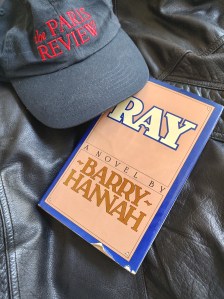
I moved away from Caplewood later in ’79 and saw Barry out and about less and less. I bought Ray as soon as it came out in 1980. In Ray, Barry writes about sex and violence and frequently uses the n-word with what we used to call “reckless abandon.”
_______________________________________________
There was a terrible movie called Walking Tall that came out in the early ‘70s. The head of a local movie chain gave his personal endorsement of that movie in radio ads. “Walking Tall is rated R for violence, not sex,” he said. “So bring the whole family.”
You can’t make that up. It was the ‘70s.
_____________________________________________
When I read Ray, I realized that the rambling stream of consciousness is partially a surreal recap of Barry’s experiences during the writing of that short novel. I realized that some of his rambles during the “interview” were a test run for passages that wound up in the book. That passage about Judy Moody is there – section XVIII, as is the “Certain Feelings” poem that he recited to me off and on throughout the interview day (XIV). In the novel, a student recites “Certain Feelings” to Ray and Ray slugs him. I finally knew how I was supposed to respond to that poem.
I haven’t told my “Barry story” very often. Partially, I was embarrassed by the out-of-control aspect of the whole series of episodes, especially the French accent episode at his ex-wife’s house. His name would come up in conversation now and then and I would sometimes mention that I had known him briefly in Tuscaloosa. During a conversation with members of an Atlanta-based New Wave band, Swimming Pool Qs, a band member cited Barry Hannah as an influence in their music and I mentioned that I had hung out with him at one time. My cred immediately rose with the band.
I ran across those Paris Review interview cassettes as I was packing for a move sometime in the ‘90s, listened to a few minutes, was mortified, and tossed them. If they had been found, they would have been an embarrassment to Barry and me. Sorry. I couldn’t let them exist.
______________________________________________
After Barry left Tuscaloosa, he worked with filmmaker Robert Altman for a while, and then he went to Oxford, Mississippi, to teach at Ole Miss. I heard stories about his drinking in the first years there and then I heard he got sober. I would run into people who had been in Oxford and knew Barry and it was the tale of two Barrys. Some stories were from the heavy drinking phase and others were from the sober phase. Overall, Oxford seems to have been the right place for him to land. I’m sure he had plenty of barbecue with his kids there.
I thought about trying to get back in touch, but never did. Eventually, Barry had a series of health problems and reported seeing Jesus in his hospital room.
The Paris Review ran Lacey Galbraith’s interview with Barry Hannah in Winter 2004, twenty-five years after our trial run. I re-read it not long ago and it’s a great interview. Look it up in the archives – “ Barry Hannah, The Art of Fiction no. 184.”
Long, Last, Happy was a posthumous collection of short stories published not long after Barry died in 2010. He’s buried in the same Oxford cemetery as Faulkner and some of his friends slapped one of those I’D RATHER BE READING AIRSHIPS stickers on Faulkner’s grave shortly afterward. I bought a copy of Long, Last, Happy at Faulkner House Books on a trip to New Orleans with my brother in 2011. Late that night, back at the hotel, I started randomly reading the stories – many of which I already knew from Airships and other collections – while my brother tried to sleep on the other side of the room. I giggled heartily way into the early morning.
When the proprietor of the bookstore had seen what I was buying, she said, “A good Southern boy.” Did she mean me for reading it? Or Barry for writing it? I think she meant both.


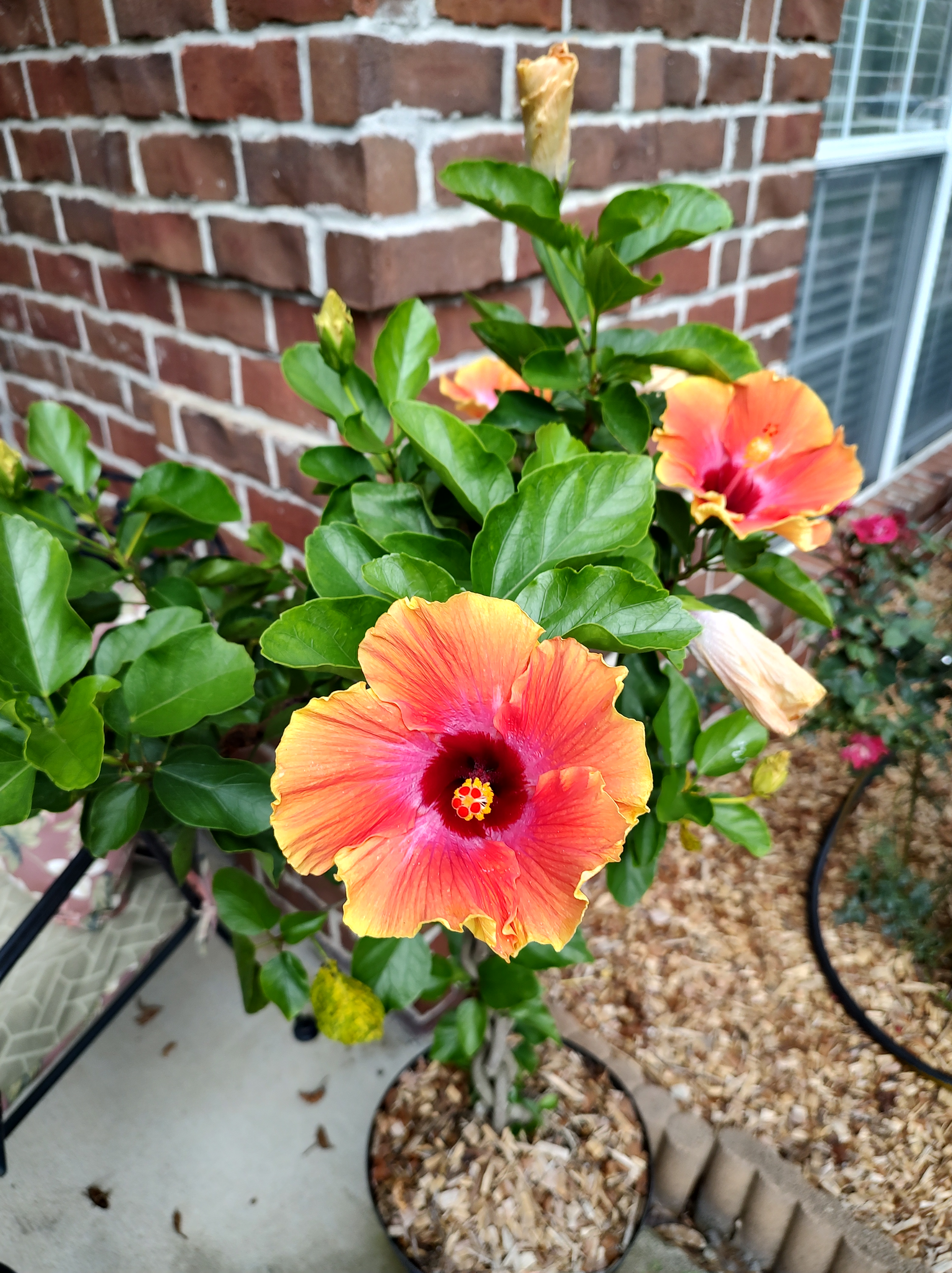 On the porch, a yellow begonia holds court in a hanging container, with lysimachia flowing toward the ground. The large blooms of a braided mandevilla in a unique coral and golden hue are a favorite of my mom’s, but the blooms drop after one day, leaving the plant leafy without flowers on occasion. It shields an always trustworthy heuchera which was joined this year by a lacy volunteer that was just too charming to eliminate. The lacy foliage will wither away in late-fall, but the heuchera, if it acts according to habit, will still be flourishing next year.
 As you come into the entry space, a ruellia – commonly called a “wild petunia” and known for an invasive nature – stands confined in a container, grounded by impatiens and lysimachia. Its delicate morning blooms fall off daily, to be replaced by new blooms the next morning. The roses in a bed next to the house have seen better days, but they are hanging in there. Bees, butterflies, and the occasional hummingbird show up and regular rainfall and diligent watering are keeping everything happy so far in the stifling July heat.
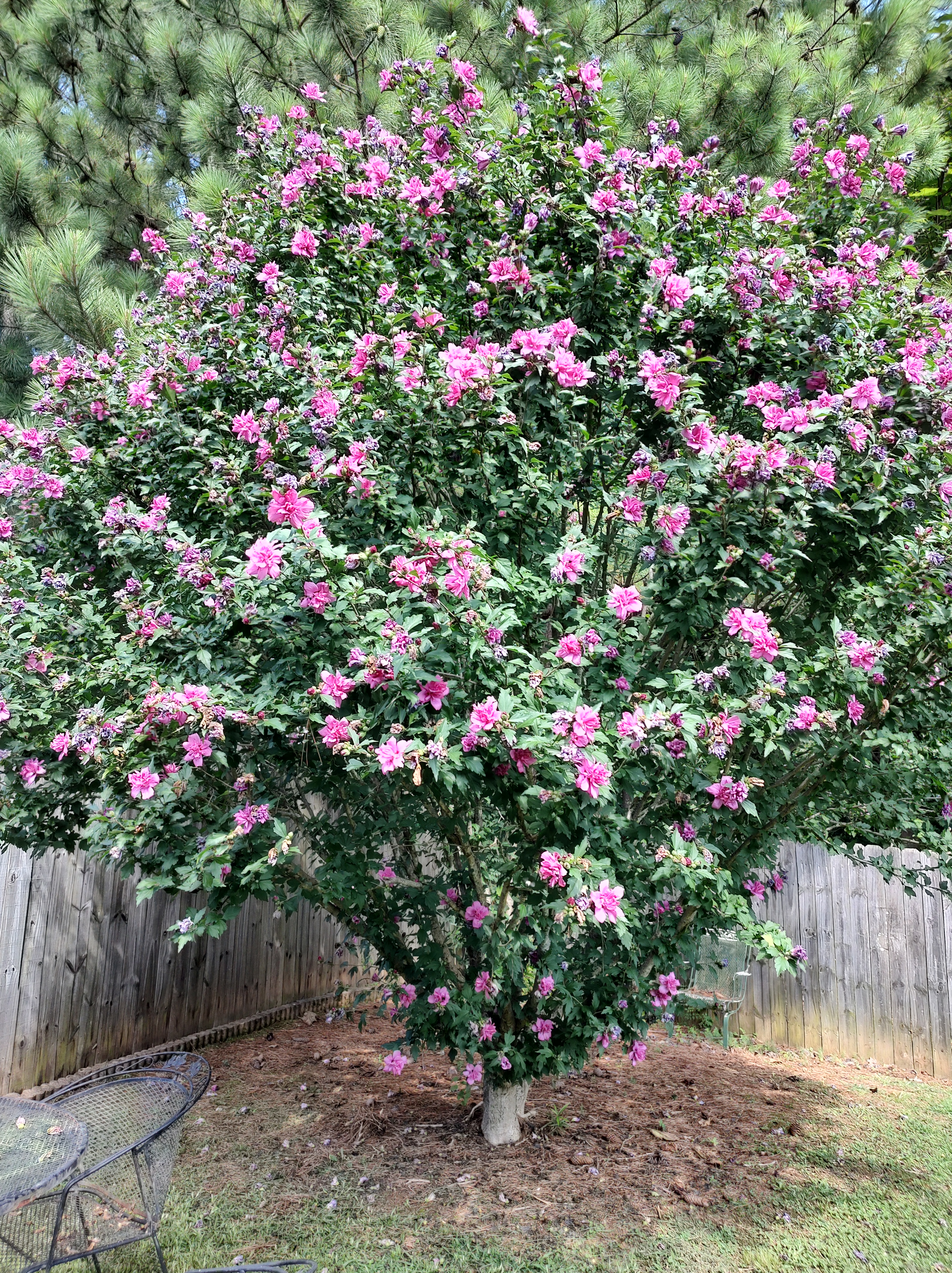 But here’s the kicker: There’s a Rose of Sharon in my parent’s backyard that grew from a sprout and is probably in excess of twelve feet now. It’s covered with fuchsia blooms and – at any given time – hundreds of bees. I know Rose of Sharon is a common name used for a number of plants – this one is a hibiscus – but I like the tradition and antiquity of the appellation and plan to use it until the plant police come knocking. Bees have always loved this specimen, but this year seems to be a banner year for its bee population from early morning to sunset. There is a constant low buzz from the tree when we wander into the yard.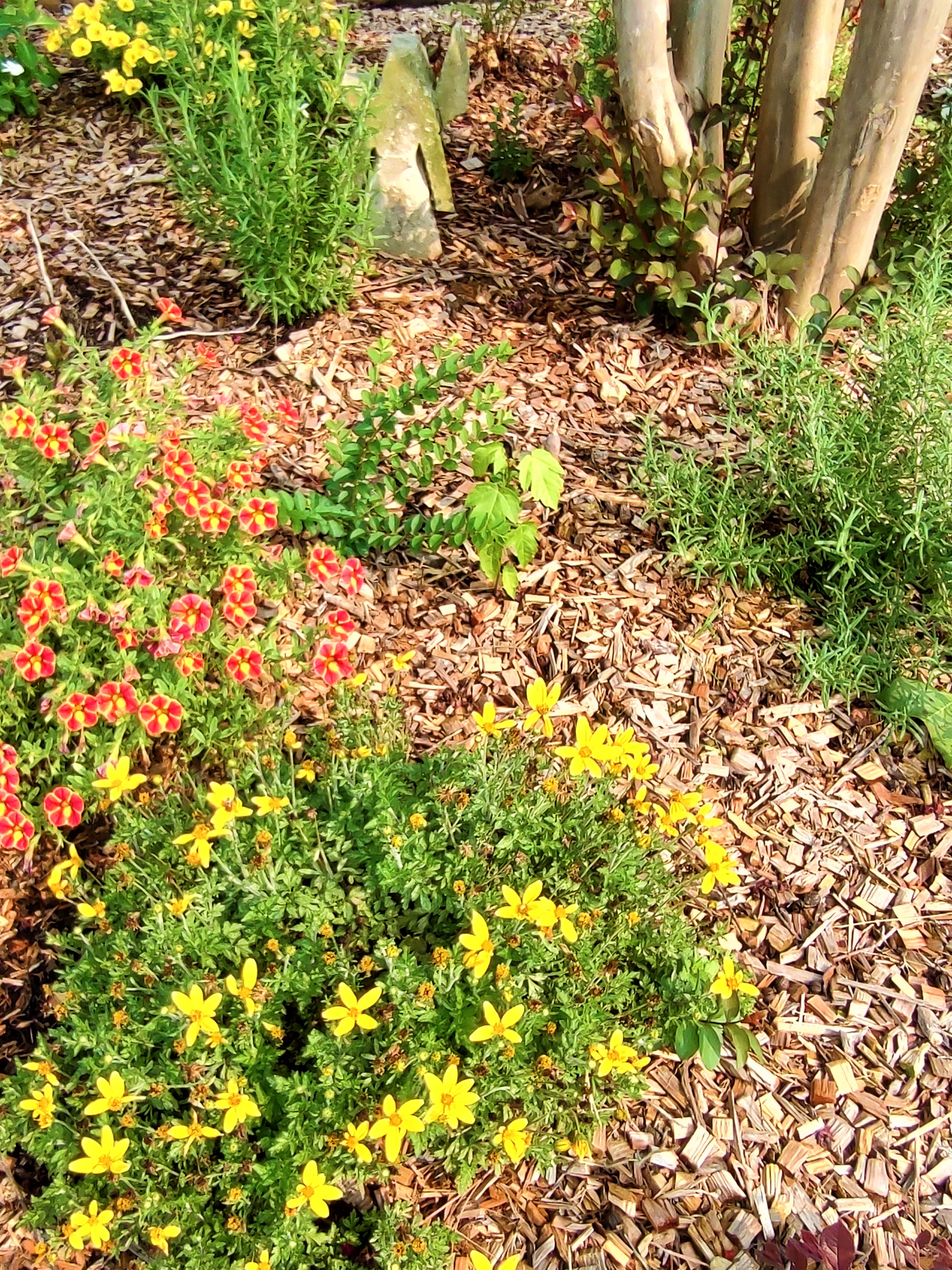
 Professional Southerner