
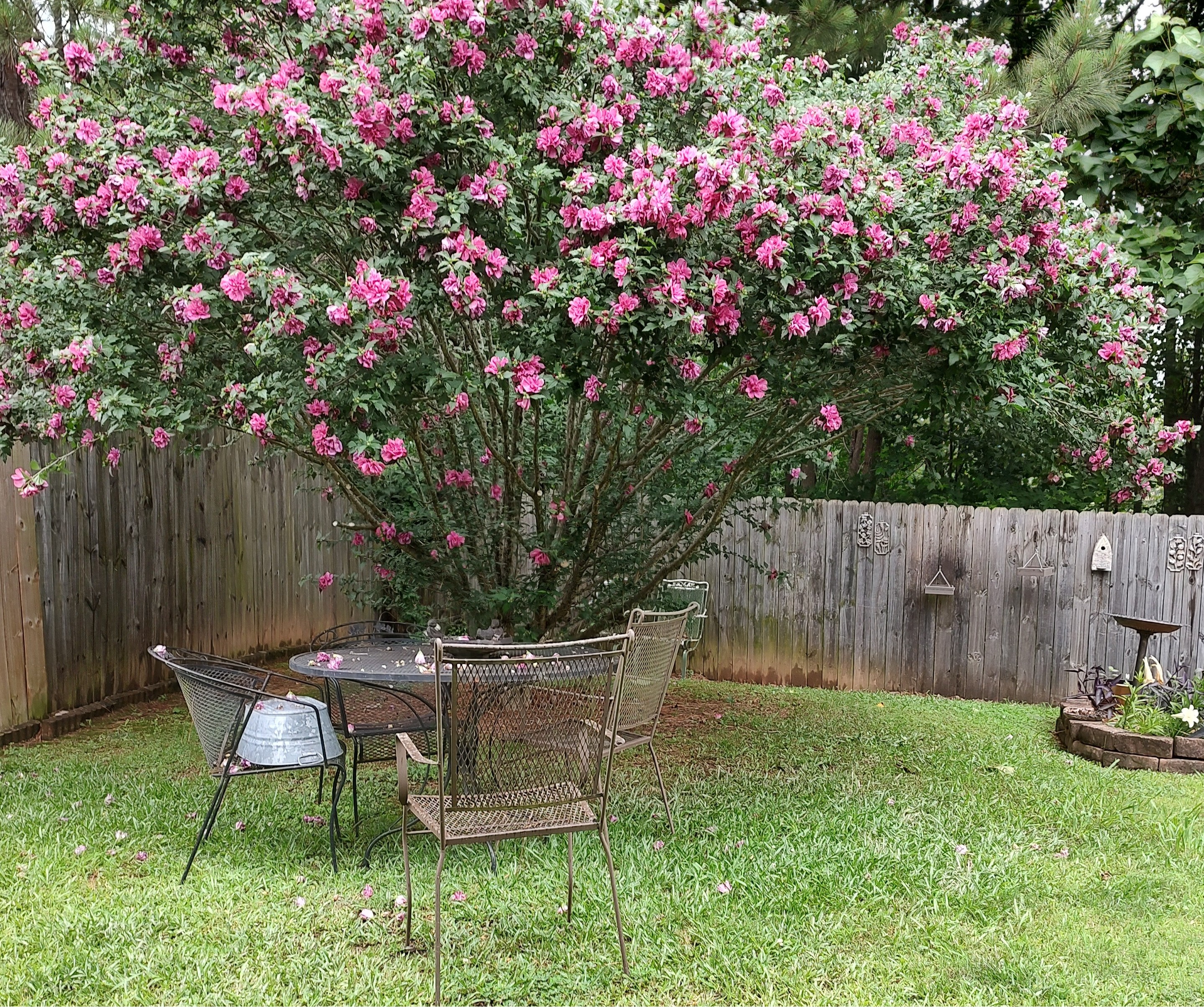
 I take mental refuge in watching nature, even just the plot of land where I spend the bulk of my time these days – halfway up the western slope of Shades Mountain, just below Bluff Park, eight miles from my own house which is mostly fending for itself in terms of outdoor maintenance. I’m grateful for the HOA to keep the grass cut on my own home front.
At different points in the year, certain flora gets my attention. This week, it has been the rose of Sharon tree that has drawn the bulk of my notice. It started as a twig soon after my parents moved to this house almost sixteen years ago. Mom asked her friend Margaret, at Brown’s Nursery in Tuscaloosa, for a suggestion of a flowering plant to place in a backyard location; the twig was her response. Margaret didn’t tell her what it was.
Back in Birmingham, Mom told Dad she’d like it planted in a place where it would be visible from the street – if it ever grew that tall. He chose a spot visible from the front gate and from the back door and the large window in the breakfast nook. Before too long, it grew tall and spread wide and the fuchsia flowers, which began to burst forth a couple of weeks ago, are visible from the street and fill the windows in that door and nook with magnificence. It’s hard not to smile when the blinds are opened in the morning and that abundance hits.
I didn’t limb up the rose of Sharon last year and the last time Joseph, the man who keeps my mother’s lawn mown, was here, he had a hard time getting under and around the tree, its branches hanging low due to the weight of hundreds of blooms and buds and recent heavy rains. He asked if he should prune or did I want to handle it. I enjoy pruning and the rose of Sharon had been on my to-do list since late-winter.
The next day, I worked my way around the tree, pruning the obstacles to passage and trying to retain the tree’s natural integrity, while preserving as many low buds as possible. The results are pleasing, I think.
Rose of Sharon is the common hibiscus (Hibiscus syriacus), also known as “althea.” I have always preferred to call hibiscus “rose of Sharon” due to its evocative literary use in the Old Testament, especially in Song of Solomon, and its Christian adaptation as a symbol for beauty, grace, and love. John Steinbeck memorably creates the character named Rose of Sharon Joad (“Rosasharn”) in The Grapes of Wrath and the plant is referenced in other literature.
But I do not always view the backyard tree with such lofty significance. It has become a spectacular harbinger of the summer. From the moment in early spring when the tree begins to leaf and the buds begin to pop forth, the anticipation of that first flower mounts until, one sunny morning, a flower appears. From that point, more flowers arrive – quickly, vividly, profusely – and the tree itself buzzes with the sound of bees busily at work. Most years, a nest is tucked away in the upper branches. Always, the perching of birds, especially the cardinals, adds a bold splash of color to the already gaudy mix.
I had thought this essay might lead to a life lesson. Perhaps not. Just this: Spring has sprung and summer awaits. Savor the moment.
 Professional Southerner
Thanks for this essay and for the picture of your lovely tree. I noticed our rose of Sharon yesterday, blooming her heart out since the beautiful but damaged black gum next to her has been removed. You remind me to appreciate her abundant blossoms.
LikeLike