Author Archives: gedwardjourney

Unknown's avatar

About gedwardjourney

Edward Journey is a writer, theatre artist, and retired university professor. "Professional Southerner" is an online journal focusing on topics -- Southern and other -- that stoke Edward's interests. Edward may be reached at likatrip@yahoo.com.

Fall Risk

It’s December and I went down to Fairhope and Baldwin County for my annual getaway. There were new restaurants to discover, old favorites to visit, a perfect massage treatment with Claudia at the Grand Hotel, an Advent service at the Anglican church at Point Clear, drives along the bay and past orchards of satsumas and pecans, interactions with writer friends, and general rest, reading, and relaxation. The weather took a gloomy turn so a planned visit to write about the oyster beds at Murder Point on the Gulf of Mexico will have to wait for another year.

On the second full day, at lunch after the massage, I got a phone call that my mother had a medical incident the previous night. She was resting and recovering in the hospital and I was assured that there was no need to cut my trip short – that she was well cared for where she was. After that call, it was a juggling game of should I stay or should I go. I decided to spend the night and decide the next morning.

The next morning, after church, I decided to have lunch and decide. After lunch, I decided that since I only had another day left in my trip, I might as well stay unless something happened that would require me to head back to Birmingham. You see how this is going to go.

So, on that last full day of indecision, I stumbled, twisted my ankle, and had to be helped up to my room. Since I couldn’t put weight on my left foot, the ever-gracious security staff at the hotel brought a wheelchair up and carried me to the ER of the local hospital. That’s how the last day of the getaway I look forward to all year turned into a seven-hour stint in the ER.

I am no stranger to hospitals in the past decade; stoicism is the key whenever you find yourself in one. Everybody at the ER at Thomas Hospital was great, even though it was a day-long affair. Unfortunately, it wasn’t my first time there; I took a fall at the pool about fifteen years ago and was witness to Thomas’s brand of medical hospitality. I am not clumsy (he said, after the fall) and those two tumbles fifteen years apart are the only falls I’ve taken during that time.

Which brings me to the reckoning of the wristbands. When I was admitted to the ER, I was given three wristbands. The first was my identification, with name and birthdate. The second red band was for an allergy alert. I had a reaction to penicillin as a young boy and have been told to avoid penicillin. (If you must have a drug allergy, penicillin is the way to go; there are so many things you can take instead.) The third wristband, yellow, said “FALL RISK.”

Sitting for hours, trying not to stare at the other suffering people all around, one seeks out distractions. At some point, I decided to study my wristbands. The name and birth date checked out. It was the parenthetical that drew focus. “(70-year-old man)” it said. It didn’t seem quite real, but there it was. ALLERGY was something I am used to and that one got a passing glance. Then there was FALL RISK. There I lingered. “(70-year-old man).” “FALL RISK.”

FALL RISK was there, obviously, because I was in the ER as the result of a fall. But the idea of being described as a fall risk suddenly made me feel very old. The people in the Thomas waiting room that I had thought of as “the old ones,” on their walkers and crutches and in their wheelchairs, were suddenly my peers. As I departed hours later in a wheelchair with an orthopedic boot and a new set of crutches, I joked to the nurse that over time I would morph my awkward stumble into a skiing accident.

_______________________________________________

I have tried to model my attitude toward getting older on humorist Garrison Keillor, who is in his eighties now and shares his essays online at “Garrison Keillor and Friends.” Keillor (perhaps too often) begins his contemporary essays by stating that “I’m an old man.” But he celebrates the fact that he can leave behind concerns that he had when he was younger and cherishes little things that he once didn’t attend to. His is a fresh, frank, sometimes repetitive and self-indulgent, take on life and the events of the day. I try to keep it in mind as I spend hours on end with my mom at her rehab facility, observing her fellow clients. I refer to the experience as my “Ghost of Christmas Yet to Come” – a specter I hope to somehow avoid.

________________________________________________

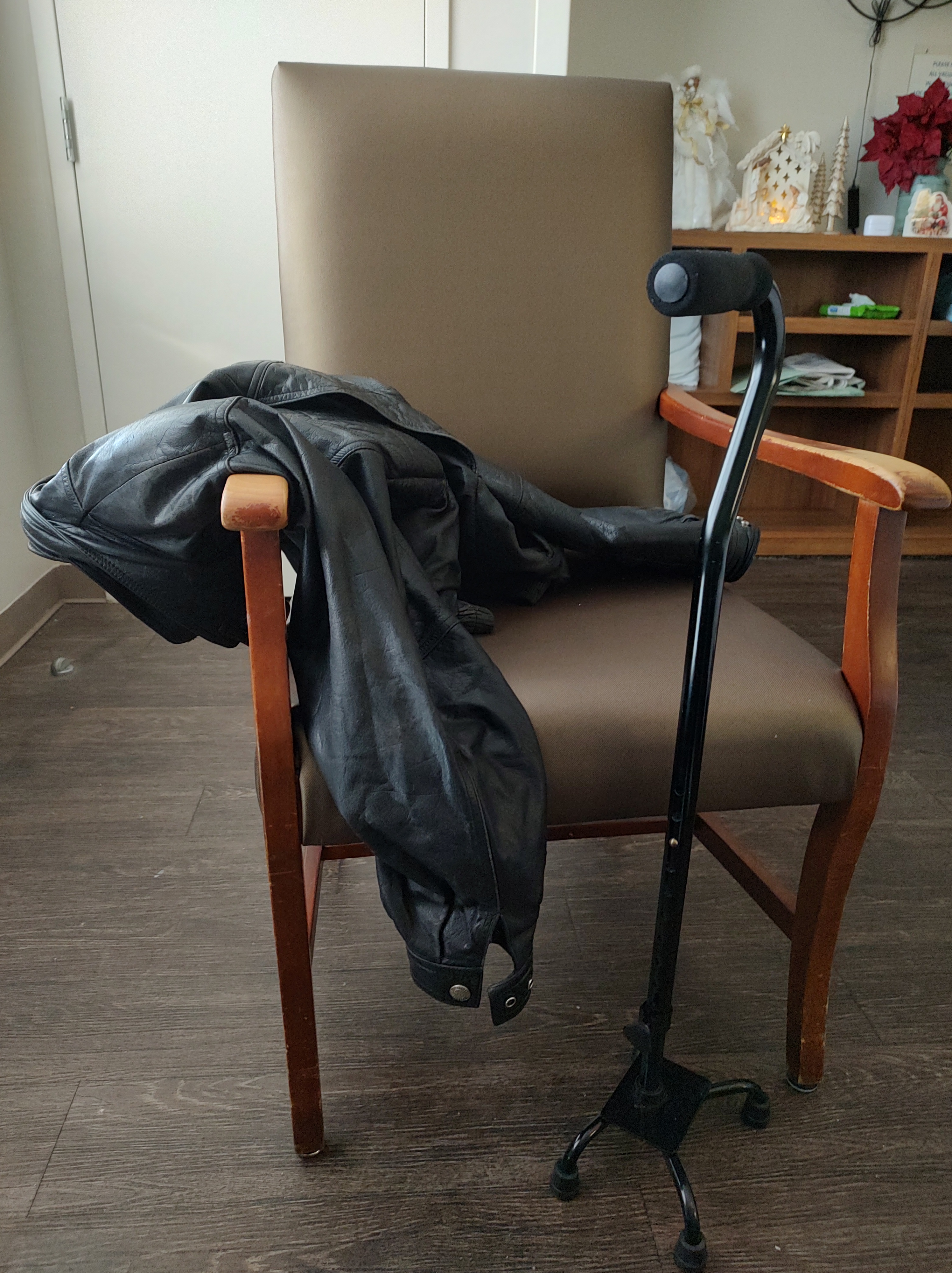
I realize that it’s a form of bigotry to say that I have respect for the aging process and old people while resisting the inevitability of becoming one myself. And while I do not try to hide my aging, I feel a need to defy aging stereotypes. Sometimes, validation comes at unexpected moments. Last night, after a 50+ hour session of sitting up with my mother at her rehab facility, I ducked out to the grocery store to pick up some things. The weather here has turned cold and I was wearing my most vintage item of clothing – a black leather jacket that I picked up in Indiana in 1994. As I was paying, the teenager who was bagging my groceries said, “Man, that jacket is dope.” When I realized that he wasn’t being ironic, I thanked him. “How old is that jacket?” he asked.

“A lot older than you,” I replied. “Over thirty years.”

To which he replied, “I want to have a jacket like that one day.”

As I left the store, I felt a little less tired. The limp from that skiing injury was somehow less pronounced.

Jacket | Cane | Hospital


Book Review: Grey Wolfe LaJoie’s “Little Ones”

Occasionally a book comes across my review desk that takes me totally by surprise. Little Ones by Grey Wolfe LaJoie is one of those books. I was happy to review it for Alabama Writers’ Forum. You can read it here:

Little Ones – Alabama Writers’ Forum

Fall, Again

For years, whenever I open my mother’s refrigerator, one quote stands out among the reminders of doctor appointments, handyman numbers, Bible verses, and proverbs hung on the door (including the occasional Bible verse from Proverbs). It’s a quote from George Washington Carver that says, “How far you go in life depends on your being tender with the young, compassionate with the aged, sympathetic with the striving, and tolerant of the weak and the strong – because someday you will have been all of these.” Recently, I ran across another Carver quote that stuck with me as I took a walk around the neighborhood. He said, “I love to think of nature as an unlimited broadcasting system, through which God speaks to us every hour, if we will only tune in.” Here in the middle of the Deep South, Fall does not provide a grandiose display like it does in New England. Nature saves Southern grandiosity for the Spring. And the weather is so unpredictable that who really knows what to expect from day to day? A couple of weeks ago, there was a taste of Winter to come and the same people who had been griping about the heat for months instantly cursed the cold. Now, we’re flirting with record highs and unseasonably mild nighttime lows and even the birds and the bugs seem a bit confused about where to go and what to do. On a recent walk, wasps seemed to be swarming and flies seemed to be waiting to dash inside any opened door. A day later, they had hastily retreated, only to reappear again with equal haste later in the week.

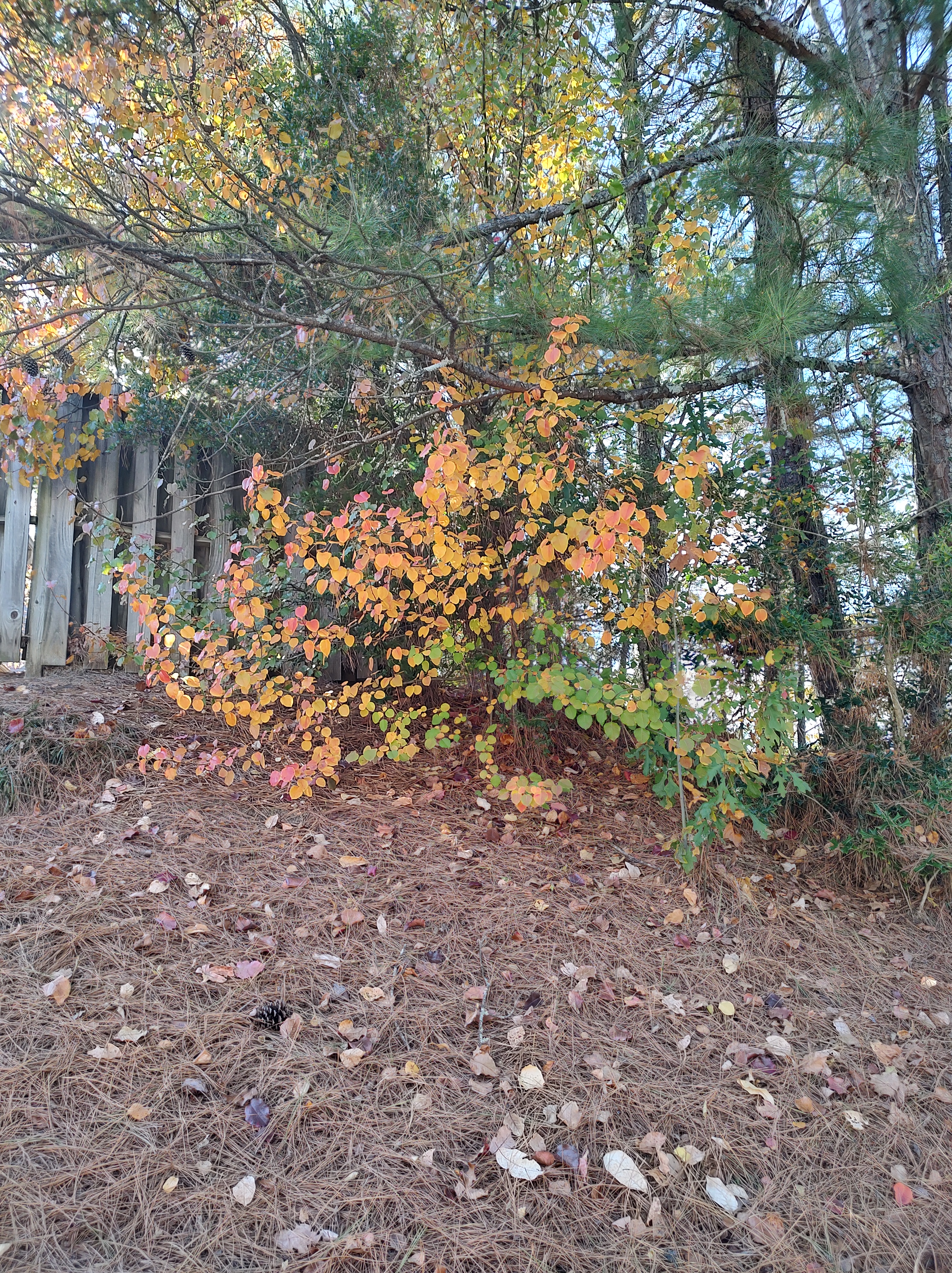
On today’s walk, with a pleasant breeze, leaves – both falling and fallen – came into focus. The neighborhood is dominated by longleaf pines and the trees on the mountain tend to blend into rusty tones of gold and bronze this time of year. Out the back and down the mountain, gold and burgundy are visible beyond the fences. But it was the images in miniature that pulled my attention. There were thick displays on the branches and others, in crumbling piles, on the sidewalk, in the grass, as Fall’s detritus creates fleeting seasonal abstractions. As nature’s broadcasts stimulated Carver’s scientific mind, the beauty of its moments provide a welcome distraction from the tedium and drama of the day-to-day.

It’s Fall, again. Leaves are falling, Thanksgiving is pending, and Christmas decor is being rushed in the neighborhoods. My less scientific mind ponders if there might be a law of physics to explain how the days can last forever while the years pass in a flash.

Book Review: “The Old Breed” by W. Henry Sledge

In W. Henry Sledge’s new book, The Old Breed … The Complete Story Revealed, he provides a sequel, of sorts, to With the Old Breed, the influential World War II classic by his father, Eugene Sledge. “Henry Sledge, who was raised in a house full of mementos of the war, was a son who asked questions, listened, and remembered. His personal narrative throughout the book gives perspective on how the war impacted his father for the rest of his life.” My review is available at Alabama Writers’ Forum.

The Old Breed…The Complete Story Revealed

Tallulah

Not long after Lulu died in September, my mother got anxious to get another dog for “company.” The fact that I am staying with her full-time now doesn’t seem to count.

A neighbor took it upon himself to find Mom a dog and started forwarding regular posts of dogs needing to be rehomed. Most of them were no-go. Too young. Too old. Too male. Too big. Finally, Luna popped up. She was advertised as a three-year-old chihuahua, affectionate and calm. Her family was letting her go because their two youngest children didn’t know how to play with a dog. I texted that my mother might be interested and showed my mom the photo and description. Mom was interested and the phone rang soon after.

The woman said that they loved Luna and hated to let her go. They had gotten her from another lady who decided she didn’t need a dog. Luna had been with them for seven months and “we’d love to keep her …” She sang Luna’s praises and said we could come meet her that day if we wanted to. She lived about an hour away. I asked Mom if she wanted to meet the dog and she said yes without hesitation. I was pretty sure we’d be bringing a dog back later.

After an hour-long drive, we met the woman and Luna at a city park. Mom stayed in the car as she petted Luna’s head and I asked what I hoped were the right questions about food, house training, shots. The woman wasn’t sure about many things. Finally, I took a deep breath and asked if the dog had been spayed. Not sure, but she thought she’d had a litter of puppies at some point. I was sure the dog hadn’t been spayed. I looked at Mother. “Mom, she probably hasn’t been spayed.” The response was immediate – “We’ll get her spayed.”

I already knew the answer to my next question. “Do you want to take her?”

“Yes. I like her.”

Luna rode with us back to Mother’s house and was a perfect, well-behaved passenger with no signs of anxiety. I called the vet, told them Mom had adopted a new dog and we needed to get her checked out. Told them she likely needed to be spayed. Made an appointment for Saturday morning. Luna seemed to adjust to the house quickly but was hesitant to go outside without me. As she explored, I noticed that she was spotting blood. I tried to check her underside but she wasn’t having it. Finally, I let Mom know what I was seeing.. “She seems to be bleeding a bit. Do you think she’s in heat?”

Mom assured me that she was not and that I should take her to the vet the next day. Early the next morning, after cleaning up little bloody spots on the floor, I called the clinic and asked if they might work her in that day. I explained the problem and the receptionist said, “She’s in season. See you Saturday.” They’re calling it “in-season” now.

Thus began my training to be a canine gynecologist. I found out about the four phases of female dog heat and saw that Luna was in the first phase. I bought a wrap to keep the bleeding in check but Luna was having none of it. In the meantime, Mom, whose first response to the news had been “What have I done?” was becoming attached to her new buddy. “What have I done?” became “Poor thing, she can’t help it.”

The name, however, was a problem. Lulu had been “Luna” before Mother changed it. And now she had another Luna. She has some sort of aversion to that name and vowed she’d get used to it this time, but it kept causing her trouble. She wanted to say “Lulu” or “Lula” or anything but “Luna.” Finally, she decided to rename the dog but agreed that a new name should not be too far removed from the one Luna had been used to for three years.

Inspiration hit. Not long ago, I reviewed a book about the Bankhead political family of Alabama. An offspring of that family was Tallulah Bankhead, an acclaimed and colorful actor of the early twentieth century stage. Tallulah was prone to outrageous and unfettered behavior and, in a movie magazine interview, she lamented how long she had been without a man. “I need a man!” she moaned. Her Aunt Marie, back in Alabama, wrote a letter to her niece, scolding her for her outbursts and accusing her of the “yapping of a hot canine …”

“I have a solution,” I said. “You have a hot canine – name her Tallulah and call her ‘Lula’. She’ll have a name you’re more comfortable with and I’ll have a story.”

So “Lula” it is. The vet declared her healthy, gave her shots, and will schedule surgery after her current situation has passed. I am learning first-hand about the second stage of heat as I follow Lula around with a damp rag to wipe up the tiny bloody spots. The female’s tail takes on a snaky life of its own. Based on my canine gyno training, this is her way of signaling that she, in Tallulah’s words, “needs a man.”  And, as the Persian proverb says, “This too shall pass.”

Tallulah


The Land of Strict Embargoes

If Alabama had to choose a secular saint, I suspect it would be Harper Lee (1926-2016), the author of To Kill a Mockingbird. She only published the one novel, and a few other things along the way. So, it came as a bit of a surprise when HarperCollins announced the upcoming publication of a selection of Lee’s previously published and “newly discovered” writing under the title, The Land of Sweet Forever. And that’s about all we know.

I explore the upcoming book, and posthumous publications in general, in an essay for First Draft, the quarterly publication of Alabama Writers’ Forum. Read it here:

Land of Strict Embargoes

Civility

The switch on the bedside lamp stopped working a few days ago. It seemed like a simple enough repair and even I, who have never been a handyman, thought I could fix it. I took the lamp to the kitchen table and took it apart. I knew what was wrong – something in the switch would not catch – but after messing with the workings for a bit, I decided I needed a professional and reassembled the lamp.

I had noticed a sign in the neighborhood hardware store window that said “Professional Lamp Repair” so I put the lamp in the car and decided to check that out the next time I was in the neighborhood. That morning, after a doctor’s appointment, I swung by the hardware store and asked if they still did lamp repairs (the sign wasn’t in the window). They did, and I went back to the car to retrieve the lamp. The clerk took my name and phone number and told me the lamp repair guy might be in later that day and, if not, he’d be in on Thursday. They’d call when my lamp was ready.

A couple of hours later, the phone rang and the guy on the phone told me my lamp was ready. I happened to be running errands in the area and told him I would be by within the next half hour.

“You need to stop by the bank on the way,” he said. “It’s gonna cost you $1.61.”

I laughed and told him I’d see him soon.

Twenty minutes later, I walked into the store and a couple of guys were standing behind the counter. I told them my name and the guy who had repaired the lamp turned and took it off the shelf while I took out my wallet.

The repairman said, “$1.61.”

I had a five in the wallet. “Here, take five,” I said, “for your trouble.” I gave the five to the guy at the register who took the bill and opened the register.

“It was no trouble,” the repairman said, “and it only costs $1.61.” Meanwhile, the other guy was standing there, holding my five-dollar bill. The repairman turned to him and said, “Give him his change.”

I insisted but he countered that I only owed $1.61 so I relented, took my change and the lamp, thanked him, and headed for the door. A simple act had earned this customer’s loyalty.

_______________________________________

A moment of civility. It made my day. And I felt better the rest of the day because of it. I keep thinking about why I was so impacted by such a small but decent and honest gesture. Then I started thinking about the world around us and how rare a decent, honest, and civil gesture has become in a world driven by hate, greed, and division – when the sorriest role models are those who are supposed to be in charge.

It’s time to set a new standard. Practice civility. Seek it out. Vote for it. And find out what a difference a simple gesture can make.

A Place at the Table: John T. Edge and House of Smoke

Sometime around the turn of the century, I was at my parents’ house over the 4th of July holiday. I had travelled in from wherever I was living at the time. They had friends – a pair of married young attorneys – who lived in the neighborhood. My contact with this couple was minimal, but my parents spoke highly of them.

The wife called my mother to invite her and Dad over for dinner on the night of the 4th. Mother told her that I was in town and asked if I could come along. She said I could (what else could she say?) and, even though I didn’t really want to, I tagged along. After all, I was sort of invited and felt it would be rude not to go.

When we got there, there were the couple’s two daughters and some other guests, including one person I knew in a roundabout way. When it was time to gather for dinner, the hosts said “Let’s see where we can put Edward” and made a bit of a show of pulling in a small table and setting it at the end of the dining table with a smaller chair to match. It occurred to me at the time that they might have saved room by just pulling an extra chair up to the big table.

Memory is a strange thing and I have wondered how much of this I might have exaggerated in my head, but the description I have seems pretty accurate. Let me add that I was not a kid; I was in my forties at the time so the whole situation was embarrassing and uncomfortable. I wasn’t sure how I might have offended these people – I barely knew them – but they made it clear that there was no place at their table for me.

When the meal was over, I helped move my little table out of the way, thanked the hosts, pled a headache, and walked back to my parents’ house. I was happy that we had Dad’s barbecue for lunch so the day was not a total disappointment.

And now, I confess that I can hold a grudge.

____________________

A couple of decades later, in the summer of 2020 during the pandemic, a friend emailed me “Have you seen this yet?” with a New York Times article attached. The article’s title was “A White Gatekeeper of Southern Food Faces Calls to Resign.” In it, journalist Kim Severson explores a move by a cadre of members of Southern Foodways Alliance, of which I was a contributing member, to oust the SFA’s founding director, John T. Edge. Reading the article, I do not exaggerate when I say I got physically ill.

The main complaint seemed to be that Edge is a white man at the head of an organization that explores the range of what constitutes the food of the American South in all its complexity and constant transformation. People that I only knew about because of John T. Edge and SFA were making weird and sometimes unhinged accusations.

An Indian American chef who had been part of SFA’s “Brown in the South” outreach to give broader exposure to Indian foods and foodways in the American South, groused that she was “a prop in what felt like a dog-and-pony show.” I grimaced when I read that because I had recently eaten this woman’s cooking, vowing to give Indian cuisine – which I had never really warmed up to (it’s a texture thing) – another go, mainly because of the advocacy of SFA.

Another person, who had spoken at an SFA symposium, felt demeaned that she had spoken behind a lectern “created to look like a stove.” I used to attend SFA symposia and there was often a clever touch decorating the lectern and the podium on which it stood. I find no insult or sexism in stove imagery at a food symposium.

Ronni Lundy, an Appalachian food writer and founding member of SFA, seemed to be a prime mover in calls for Edge’s resignation. Her charges seemed to be based on allegations of sexism. I have no apparent right to comment on that since I am a white male. I can only say that from my privileged position, it seemed like Edge’s writings and recommendations appeared to spotlight as many, if not more, women and minorities. I would never have known who Ronni Lundy is if not for John T. Edge, nor would I have bought her cookbook. It was hurtful to read spiteful comments about a man I liked and respected from those who would have probably never been known to me without him. If he was the “gatekeeper,” the gates always seemed open wide.

And that is where my anger comes in. I became a supporter of Southern Foodways Alliance because it set a place at a large and welcoming table for all of us. John T. Edge, as the primary face and spokesperson for the organization, introduced us, through his stewardship as well as his books and writing for other publications, to a more complete, diverse, and equitable understanding of what it means to be Southern – and what it means to eat for connection as well as sustenance. His show, “True South,” for ESPN and the SEC Network, travels the region and shows us the contrasts and connections ever-present in our food places and food habits. I discovered foods and sought out restaurants I might never have known about because of John T. and SFA. There were more places at more tables than I realized.

I have had the good fortune to be present at table and have conversations with John T. Edge over the years, to the point that I consider him a friend. I am always impressed with his graciousness, his humor, his warm and open demeanor, and his prodigious memory. The first time we met in person, at a dinner in the Shoals, he recalled an essay I had submitted to Gravy, the SFA quarterly, about a family peach farm in Chilton County, Alabama. (The essay was rejected, but John T. suggested places I ought to submit it.)

So, when that New York Times article came out, I emailed John T. to extend good wishes and commiserate. His response was gracious, grounded, and reasonable – no anger or bitterness came through – and I felt better after I heard from him. Some of my own anger went away as I decided to sit tight and see what happened next.

Over time, John T. and the University of Mississippi (which houses SFA) came to an agreement and John T. moved on from his SFA leadership – a move that he had been planning, actually, prior to the New York Times article.

In my subsequent message to SFA, canceling my membership and asking to be removed from all their mailing lists, I wrote that it was clear that there was no longer a place at their table for me.

I confess that I can hold a grudge.

____________________

John T. Edge has just released his memoir, House of Smoke: A Southerner Goes Searching for Home (Crown Publishing). It is an unrestrained examination of himself, his family, and the places and events that have brought him to this point in his life. It is occasionally surprising and shocking – it turns out John T. has a knack for keeping things close to the vest.

House of Smoke is gracious, open-minded, and self-examining as it traces a life from a historic, crumbling antebellum house to the Animal House life of a University of Georgia frat to stints in the corporate world, to academic life at Oxford and Ole Miss and the actualization of a life’s calling. It is warm, forgiving, and humane. Despite distractions, I was able to read and savor the book in the course of a day. The book’s reach is wide as Edge considers family, foodways, class, race, betrayal, forgiveness, and what it means to be of the South. It’s a lovely and honest book that I highly recommend.

In House of Smoke, John T. writes soberly, fairly, and bluntly about his severance from Southern Foodways Alliance. He discusses the support he received and the ways in which he, his wife Blair Hobbs, and their son adapted to the change. When writing about ceremonial ways in which he and Blair memorialized the break, I smiled and gave out a silent cheer when I read “In our backyard firepit, I burned a cookbook by Ronni Lundy.” That pleased me.

I confess that I can still hold a grudge.

Lulu

  Lulu longed to talk more than any dog I’ve ever known. She watched carefully and would look me in the eyes and make this low guttural sound. I realized she was trying to talk. It reminded me of when I was a kid and tried to imitate foreign accents. I didn’t know the words, but I would talk gibberish and strive to get the sound right.

Over time, when Lulu needed to talk, I would just sit and have a chat with her. She’d make her sounds and I would respond. She tilted her head to the side and listened and when I stopped, she’d make her sounds again. It was usually a very serious discussion. When she was satisfied, she’d lean over and lick my hand or jump down and lick a toe if I was barefoot, wag her tail, and move on to the next thing.

Lulu was my mother’s dog, but I have been with her almost nonstop for the past three and a half years – and frequently for five years before that. We had to let her go Wednesday night. Her vet, who assured us her practice didn’t do this service for other patients, brought her home. Mother held her for a while and then I held her, sitting in her favorite chair with her favorite stuffed toys and people she loved and who loved her around – Mom, me, and the vet, who had come to love her, too.  I talked to Lulu through two final injections about the squirrels she’d chase, the crows she’d run away from the bird feeders, and what a good girl she was. And she was.

She had her eyes focused on me and they did not close when she went on to the next thing. It was peaceful. It was horrible.

She was a happy, active chihuahua until ten days before she died. One morning, she had an accident in the house and when I was cleaning it up I saw that it was mostly blood. She went to the vet who tested her, said it was treatable, and began treatment. A few days later, Lulu was recovering nicely. On the morning of the day we were going to bring her home, she had a stroke. They say strokes in dogs are rare but that some make a full or at least partial recovery. We got a couple of promising daily reports and then Lulu began to decline. By Wednesday, the vet decided it was time. And it was.

Chihuahuas get a bad rap and I used to be guilty. I worked with a director once, a short guy with a bad attitude who yapped constantly. I nicknamed him “Chihuahua.” I regret that and apologize to the entire Chihuahua community. Lulu would yap when she got excited, usually when she was happy about something, but most of the time she was quiet. Once, Mother almost fell and a visiting neighbor jumped up to help her; Lulu misunderstood what was happening and made a mad and excitable dash for the neighbor. I appreciated that Lulu was coming to the aid of her person but the neighbor, a cat lady, never returned. And I will never disparage another chihuahua – the three that my parents have had – Pepe, Clover, and Lulu – were fine, smart, and noble creatures.

If Lulu heard lightning, or if it rained hard, she would wander around the house until she found a haven, usually in a closet or bedroom. She never sat and ate a meal. She would nibble delicately throughout the day. If she was going out or for a walk, she would grab a few bites of kibble in her mouth, delicately place them on the floor, and eat them one by one. She had a keen sense of smell and would roam the backyard, following the scent of creatures who had wandered through – a rabbit, a raccoon, an opossum, a runaway ferret one time, a tortoise, the neighborhood cat who taunted her from the fence post. She knew there was a chipmunk who lived under the storage shed in the backyard and never went out without sniffing at the place where the chipmunk burrowed under. On walks, she would stop and sniff anything with a scent. The jasmine at a mailbox down the street was a particular favorite.

She was a bit of a snob with other dogs, especially other small ones, but she developed the occasional crush on big dogs that lived in the neighborhood. She had raised a litter of puppies not long before she came to live with Mother. We always suspected that she missed her puppies, especially the one they called “P.J.” that had stayed with her until she was given to Mom. One day, on a neighborhood walk, she spotted a chihuahua puppy in a yard and pulled on her leash until I took her over. She gently nuzzled and licked that puppy for several minutes. I had a hard time getting her to leave it. I suspect she was remembering her own lost pups.

Lulu hated me at first. She would have nothing to do with me. In her mind, she thought I was the person who took her away from her people and puppy. She wouldn’t let me near and would bark fiercely if I approached. Somewhere along the way, she decided I was okay, and we were close from then on. She was an intuitive girl. If voices were raised, even if it wasn’t in anger, she would quietly leave the room and seek shelter in a cozy corner; I suspected that might have been a holdover from her previous owners. When I was down or upset, she seemed to always know and would climb up and lay her head in my lap and stroke my hand with her paw.

She’s gone now and Mom is already talking about getting another dog. I’d prefer to give it a break for a while, but it’s her house. Lulu came to think of it as Lulu’s house.

And it was.

Lulu and the Tortoise

Notes under the August Sky

I learned something this week that I never imagined before. What is referred to as “ground clutter” in weather radar is often, this time of year, showing migrating birds at night. I wasn’t sure I heard correctly so I looked it up. I found several reports from all over that attributed the radar images to millions of migrating birds flying toward the Gulf of Mexico in the dark of night. In fact, I learned that the other ground clutter can be filtered out to give an accurate view of the birds. A few nights ago, the night sky was filled. Further research found evidence of mass early-season avian immigration throughout the eastern United States. For me, it was one of those who knew? moments.

No matter how I try, the Spring plantings that I took such pride in “look like August” after the harsh heat of July and August. Plants that once bloomed prolifically look a little spare, the petunias (which I never really cared for to begin with) are faded and leggy. Even the Peggy Martin “Katrina” rose looked like it might die a few days ago; it’s springing fresh leaves again and might still manage a fall bloom. The lantana soldiers on but didn’t flower quite as much in the hottest heat; that’s okay, since I like the citrusy fragrance of lantana leaves even more than the flowers. I still have a hard time believing that lantana is an invasive species elsewhere. The hibiscus, a slow starter, seems to flourish in the heat.

The three pottings on the front porch don’t miss a beat unless I miss a watering. The sweet potato vines are swallowing that corner. I planned to prune it back but my mom likes it “as is” so I leave it alone. The volunteer caladium in one of those pots enhances the sweet potato vine and begonia sharing space. I used to explain that it was a happy accident but now I just smile and thank passersby for the compliment. I probably couldn’t repeat that accidental planting next year if I tried.

After much pruning, weeding, and sweet talk, the ageless wild rose in the backyard, taken from a cutting of my grandfather’s “mother” plant years ago, looked grim but  pushed out a couple of blooms recently and looks like it might live to bloom another year. Another cutting from that mother plant flourished in the backyard of my house in north Alabama. When I sold the house to move back to Birmingham, I left a note for the incoming residents explaining the long history of that rose in hopes that they would keep it there and alive, but I doubt they did.

We’re going through a faux fall for a few days here. The temperatures are unseasonably moderate and humidity is down. These portents of fall are a break from brutal heat, but I’m already regretting the shorter days.

The quality of the “light in August” into September has long fascinated me. I don’t remember which came first – my notice of the August sunlight or my reading of the Faulkner novel that gave it a name. It’s a clear sky, often adorned by what I call “biblical clouds” – the fluffy pure white piles of cloud sitting majestically in the vivid sky. I started calling them “biblical clouds” because they remind me of the skies in the illustrations of Renaissance paintings that always seemed to be in those large family Bibles that were once sold door-to-door. The light, the shadows, the breeze all work together to create an otherworldly feel. It’s not there all the time, but when it happens, it stops me in my tracks and often creates magnificent sunsets.

Remember in elementary school when we would stick balls of cotton on a skyscape to represent clouds? Looking at these clouds, I’ve figured out why I never got my desired effect — why it just looked like a cotton ball plopped down on a piece of paper. Now, if I were back in elementary school, I think I’d  shred the cotton ball a little and carefully spread it across the sky …  Yeah, that would work.

Today’s Sunset from Shades Mountain