Author Archives: gedwardjourney

Unknown's avatar

About gedwardjourney

Edward Journey is a writer, theatre artist, and retired university professor. "Professional Southerner" is an online journal focusing on topics -- Southern and other -- that stoke Edward's interests. Edward may be reached at likatrip@yahoo.com.

Homage to Sam

“There are times when I can’t help thinking about the past. I know the present is the place to be. It’s always been the place to be. I know I’ve been recommended by very wise people to stay in the present as much as possible, but the past sometimes presents itself. The past doesn’t come as a whole. It always comes in parts.

In fact it comes apart…”

When Sam Shepard died in July 2017, I wrote about what a strong influence his writing has been for me through the years. His final work, Spy of the First Person (Penguin Random House, 2017), is an undeniably autobiographical work of “fiction” written by Sam Shepard in his final year as he suffered from ALS.

The book is a labor of community and love. When Shepard began the book, he could still write. As his motor skills weakened, his children and sisters devised ways to help him keep the work going – recording devices, transcription, dictation. Shepard’s long-time friend and erstwhile collaborator Patti Smith assisted the writer in editing the book into final shape. Shepard’s involvement in the book continued until his death; he even chose the haunting cover photograph for the publication – a Graciela Iturbide photograph of a weathered man looking up at birds flying overhead.

When Shepard died, his children took the book to fruition and publication. The triumphant result is a book that reminds us what a masterful writer Shepard is and how masterful he remained until the end. In a touching twist, the book is dedicated to the writer by his children.

The book’s first-person narration is a duality of the observer and the observed. An unnamed man watches a sick man on a screened porch across the street, musing on the man’s situation and the events he can make out through the screen. The sick man, aware of being watched, becomes alternately paranoid and reflective as his memory travels far into his past – and childhood and youthful experiences become juxtaposed with visits to medical clinics.

The narrative consciousness of nature around us is strong and vivid, with detailed descriptions of landscapes and wildlife – particularly birds. One is reminded of playwright Shepard’s skill with monologues and all of the memorable moments he gave his characters in raw and mind-bending dramas spanning decades.

The narrative flow between the two voices is fluid and we lose track of which speaker’s voice we are reading. That is fitting as it becomes clear that the narrative voices are almost certainly of the same man, pondering his sickness and observing his physical degradation with a still sharp brain.

Spy of the First Person culminates with a celebratory dinner at a Mexican restaurant teeming with “a lot of noise and a lot more tequila.” The sick man is surrounded by his children, his sisters, and friends. In these final pages the man reveals the names of the people around him – Jesse and Walker – his sons; his daughter, Hannah; Roxanne and Sandy – his sisters. The names are the same as Sam Shepard’s children and sisters.

As the group leaves the festive restaurant, the man says, “The thing I remember most is being more or less helpless and the strength of my sons. A man pushed by his sons in a wheelchair from a crowded restaurant to a street with nobody on it. A man sitting on shaggy wool with a Navajo blanket across his knees.”

Sam Shepard the man is gone but Sam Shepard the artist lives on in a body of work that had majesty and resonance to the very end.

Photo of Sam Shepard by Grant Delin

Red Beans Road Show

When I was first visiting New Orleans on a regular basis, Buster Holmes restaurant on the corner of Burgundy and Orleans was still in operation serving distinctive New Orleans food at amazingly reasonable prices. It was a no-frills place with a jukebox and a diverse clientele. It was well-known for catering to New Orleans musicians and was famous for its simple and excellent food.

Buster’s was best known for red beans and rice, that hearty New Orleans kitchen stalwart that was the traditional meal for Mondays – “wash day” for many households. Cooks could put on a big pot of red beans, let it simmer, go about their other chores, and have a good nutritious meal to eat on throughout the rest of the day.

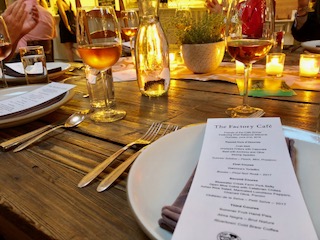
Buster’s came to mind recently as I traveled with my friend Madeleine – who has been known as “Bunny” her entire life – to Florence for my first dinner of 2018 at the Alabama Chanin Factory (www.alabamachanin.com). The January dinner was a special Factory add-on and was not part of the Factory’s “Friends of the Café” series which will kick off its fourth season of dinners by award-winning chefs in April.

New Orleans-based writer, photographer, and raconteur Pableaux Johnson has been presenting the “Red Beans Road Show” for a few years now in a variety of locales. The event hearkens back to Johnson’s childhood memories of meals around his grandmother’s large round kitchen table. When that same table came into his possession, he felt a need to “feed the table” with informal Monday night red beans and rice dinners. Subsequently, epicurious.com recently named Pableaux Johnson to its list of “100 Greatest Home Cooks of All Time.” That “of All Time” phrase is pretty heady stuff (www.pableaux.com).

The ensuing “Red Beans Road Show” project is a series of traveling pop-up dinners inspired by meals around Johnson’s grandmother’s table and Pableaux’s desire to share Louisiana culture (www.redbeansroadshow.com).

It’s a simple premise. A local host provides the venue, the starters, and the dessert, and Johnson provides the heart of the meal – red beans and rice with skillet cornbread. Diners eat family-style around a table and lively conversation and new friendships accrue.

The Alabama Chanin Factory, helmed by Natalie Chanin with the Factory kitchen run by chef Ray Nichols, is the perfect setting for the concept; the precedent set by the “Friends of the Café” series makes it comfortable and familiar.

Bunny and I were greeted by Natalie Chanin when we arrived on a rainy Thursday night with a brutal cold front moving in. The crowd was mingling and exploring the racks of the Alabama Chanin showroom as appetizers were circulated. Pableaux Johnson’s photographs of Mardi Gras Indians were displayed on Factory walls and provided additional visual stimulation to the perfectly curated Factory space. We were a little late and I only got to the deviled eggs but I caught sight of other starters across the room.

Pableaux Johnson provided an animated introduction and explanation of the evening to the guests before we moved on to our seats at the many tables set up in the space. Once seated, huge bowls of rice appeared followed by bowls full of red beans. The assembled began to fill our bowls as plates of cornbread arrived to complete the serving.

Over the years I have realized that there are as many opinions about what constitutes the proper red beans and rice as there are people who eat it. Pableaux Johnson’s recipe for “Monday Night Red Beans” hits all of the high points and is a superior palate pleaser. Briefly, his version uses Louisiana-sourced Camellia brand red beans, andouille sausage, Tony Cachere’s Creole Seasoning, and Crystal Hot Sauce, along with the expected herbs, vegetables, and seasoning. It’s a pretty basic red bean recipe – no extreme frills or flourishes or experimentation – and it’s delicious.

The cornbread was a source of some culinary controversy as Johnson warned the gathering in advance that his cornbread contains a small amount of sugar. Those are fightin’ words in some quarters (including in my family) but the cornbread was very tasty nevertheless and a good complement to the savory dish. In Pableaux’s defense (if he needs one), the bit of sugar is part of his family’s cornbread recipe and that’s good enough justification for me. In fact, after a brief conversation with Pableaux in which I let him know that my mother is a bit of a cornbread snob, he brought over a couple of slices of the cornbread for me to take to Birmingham for her inspection.

Between the red beans course and the dessert, Pableaux discussed the Mardi Gras Indian portraits which lined two walls of the dining area. The Mardi Gras Indians have a rich and literally colorful history and tradition that is uniquely New Orleans and Pableaux’s respect for their craft and folkways is evident in his art and in his rendering of their story. It was satisfying to see the intricate details of the Indians’ painstakingly rendered and hand-sewn regalia sharing space with the meticulously crafted and hand-sewn garments of the Alabama Chanin showroom.

Chef Ray Nichols’s kitchen provided the dessert, a beautiful banana pudding that provided the ideal tasty end to a relaxing and rejuvenating evening at the Factory. As the guests departed, there was a washtub full of bags of Camellia red beans. Each guest received a bag of beans and a copy of Pableaux’s “Monday Night Red Beans” recipe.

Exchanging goodbyes with Natalie Chanin, we noted how nice it was to have an event such as the Red Beans Road Show so near the end of the holiday season (and, also, to kick off the Carnival season commencing on the Gulf Coast). I’m hoping there will be other such events at the Factory to signal the start of years and Mardi Gras seasons to come.

Bunny and I made our way home through a winter mist and fog and, by the time we got home, work and school were cancelled for the next day due to inclement weather. I’m happy the hard freeze waited until the Florence version of the Red Beans Road Show had reached its successful end. 

Cathedral

The Cathedral of Saint Paul, Birmingham

In Raymond Carver’s glorious short story, “Cathedral,” a regular guy, stoned and semi-drunk, tries to communicate the actuality of a cathedral to a blind man – a houseguest who is practically a stranger to him. The task is pursued with the seeing man holding a ballpoint pen to paper and the blind man following the movement of the hand and the verticality of the movement.

“You got it, bub. I can tell. You didn’t think you could,” says the blind man. By story’s end, the seeing man is the one who has been enlightened about the majesty and meaning of cathedral architecture.

My ongoing project of photographing old churches is inspired by an interest in ecclesiastical architecture and architecture in general. I am often drawn to the quaint and forgotten small churches found on remote byways but church architecture of all types is interesting to me.

I am a fan of modern architecture but too many modern church structures are bland, utilitarian, and boring, it seems, with no architectural distinction whatsoever; I have seen charming buildings demolished to make way for eyesores, usually alongside major highways.

Cathedral Church of the Advent, Birmingham

Fortunately, there are still distinctive old church buildings in the northside city center of downtown Birmingham with congregations founded within a year or two of the 1871 founding of the city.

The Cathedral Church of the Advent, an 1883 Gothic sandstone structure, stands on 20th Street across from the Harbert Tower (www.adventbirmingham.org). When I worked in downtown Birmingham in the ‘90s, I would often take a lunchtime break in the peaceful Advent church garden to read and reflect. A block away, on the other side of the Harbert building, is the First United Methodist Church’s brooding Romanesque structure built in 1891 (www.firstchurchbham.com).

Cathedral Church of the Advent garden, Birmingham

It is noteworthy that the architecture of the 1989 post-modern Harbert office tower – formally known as the Regions-Harbert Plaza – acknowledges its proximity to Cathedral Church of the Advent and First Methodist in its building materials and architectural set-backs and flourishes.

A few blocks northwest of First Methodist (now known as First Church Birmingham) is downtown’s most famous church, 16th Street Baptist – site of the horrific 1963 bombing that killed four young girls and galvanized the Civil Rights Movement (www.16thstreetbaptist.org). The building, completed in 1911, is a distinguished Byzantine-Romanesque structure that anchors Birmingham’s Civil Rights National Monument.

Built in 1888, the Victorian Gothic First Presbyterian Church (www.fpcbham.org), east of 20th Street, is only a block over from the Cathedral of Saint Paul (www.stpaulsbhm.org), a Neo-Gothic building completed in 1893, whose brick masonry is so reminiscent of many of the downtown structures from Birmingham’s early decades.

Cathedral of Saint Paul, Birmingham

On a recent Saturday morning a couple of days before Christmas, I went into the Cathedral. A couple of parishioners were in the sanctuary preparing for mass. The majestic impact of the soaring room was heightened by the Moller pipe organ that was at that time filling the building with bright and vibrant sacred music of the season.

Outside, the day was overcast, but the stained glass windows shone brightly as the sun occasionally burst through grey December clouds. I sat in a pew toward the back and listened to the music for a while, savoring the solitude and peace of the room and the history it encompassed. Then it was time to travel out into the busy streets and continue with holiday preparations.

Cathedral of Saint Paul, Birmingham

May 2018 bring good news. Look for and savor the beauty that surrounds you. Happy New Year.

Notes from the Point – 2017

Point Clear, Alabama. The long etymology of the word “vacation” seems to suggest that it’s more about what you’re leaving behind than where you’re going.

That works for me.

I have been making an annual pre-Christmas getaway to the Grand Hotel in Point Clear, Alabama, just down the eastern shore of Mobile Bay from Fairhope, for about fifteen years (www.marriottgrand.com). There is a time on the trip down from north Alabama when I forget that I have a job and that is one of the rewards, for me, of any sort of vacation time.

The first time I came to the Grand there was a rare hard freeze and it was miserable outside during my short stay. Even so, I wandered the resort grounds, explored the public walkway that runs between the bay-front houses and the water, ate some great meals in area restaurants, and decided that a December tradition had instantly begun.

Most Decembers the weather is milder; occasionally it’s tee-shirt and shorts weather. This time it’s somewhere in between – slightly chilly with a warm front threatening to bring some rain before my visit is over.

The drive down seemed better than usual; traffic was just right and my spirits were heightened by the results of the recent special election for an Alabama U.S. Senate seat. For a change, Alabama voters came through; I will be embarrassed again by Alabama politicians and Alabama voters – and soon, probably – but for the holidays I am going to cherish and savor the current hopeful moment. Everything looked brighter and more beautiful on the drive down. I always love my home state, but this week it looks brighter than usual. Maybe it’s my imagination, but people seemed friendlier.

Near the end of the drive, at a traffic light in Fairhope on a Friday afternoon, two women shoppers burst into spontaneous dance to the holiday pop music piped in from a street speaker. When they got their signal to walk, they beamed brightly and continued to dance across the street, doubling over with laughter as they reached the sidewalk.

It’s easy to forget that the 2017 hurricane season was brutal but I was reminded as I drove down Scenic 98 and saw that every pier along the waterfront was damaged by Hurricane Nate, including a public pier that I have photographed many times.


The Grand itself is undergoing a massive (non-hurricane-related) property-wide renovation and upon arrival I passed barricaded construction sites. The main building is completely closed. Upon check-in I was told that my usual room on the top floor of the Spa Building was not available. After some searching and discussion, a manager determined that it was available and, if I’m not mistaken, I am the first guest in that room post-renovation.

After staying all over the Grand property in my first years coming here, I honed in on my favorite room and I have vowed to stick with it. It is on the top floor of the tallest building and faces out over the lagoon and property. From the balcony, one can view the property with the bonus feature that one can also see over the live oaks and across the wide part of the Bay past Gulf Shores to the open gulf. Looking to the west, one can see across the pool to Mobile Bay just before it widens significantly at the place that gives Point Clear its name.

The footprint of my favorite room is the same but the re-model has made it seem more spacious, more luxurious, and much more contemporary. It is perfectly curated with less furniture – but what is there is more practical. In my king room, the reclining sofa against one wall with a movable tabletop is a welcome addition and one I spent hours using for rest as well as more productive activities.

The room still includes the ubiquitous Nall print – common, it seems, to all properties that are part of the Robert Trent Jones Golf Trail, but the new selection is less dense and more easily lived with.

Since the main building is closed, the Jubilee Poolside Grill in the pool pavilion has been tasked with all of the dining service for the property. The dining staff is doing a really good job with limited kitchen and dining space and I ate well there – from gumbo on arrival to a plate of peel-and-eat Gulf shrimp for my final dinner there.

After my first night’s sleep, I had an appointment for a warm stone massage at the Grand Spa at 9:00 a.m. The Spa, too, is undergoing massive renovation like the rest of the property but the attendant, J.C., who has been taking care of me since my first spa visit, and my favorite massage therapist, Claudia, are still on hand to make me feel as welcome and pampered as ever. I am not a man who indulges in many luxuries but the annual warm stone massage has become an essential part of my December holiday and I will feel no guilt for that particular indulgence.


As I drive back to the hotel after a dinner at Camellia Café (www.camelliacafe.com) in downtown Fairhope at 9-something on a Saturday night, I see a figure walking hurriedly along the sidewalk on Scenic 98. As I get closer, I realize it is Jesus in full white robe, blue under-garment, sandals, and a flowing mane. He clearly has a purpose, looking straight ahead with a determined stride. I’m not sure why Jesus would be walking quickly down Scenic 98 on a Saturday night nine days before Christmas, but the image sticks with me.

I’m sure it wasn’t really Jesus, but he definitely had something. I probably should’ve taken a picture but He didn’t look like he wanted to be disturbed.

The next morning I attended an Anglican Advent service at St. Francis at the Point (www.stfrancisatthepoint.org), a stunning modern white church building full of rich wood tones and light streaming through towering clear glass windows. The windows are decorated with magnolia leaves and white candles and a towering Christmas tree fills the arched window of the church façade. The tiny old chapel at the corner of this same church property was my Christmas card image a few years back.


I always return from Baldwin County with bags of satsumas – the efficient little citrus fruit that thrives along Mobile Bay. I heard several rumors that there was a smaller than usual satsuma crop this year and that I might not be able to find any.

The search for satsumas took me on a drizzly drive over to Silverhill, a Baldwin County town founded as a settlement by Scandinavians in the 1890s. Silverhill was a charming place – new to me – but there were no satsumas to be found.


That night, I had a rude encounter with political reality as I dined at the Wash House (www.washhouserestaurant.com), my favorite Point Clear restaurant. A loud and bitter Republican, unfortunately within earshot, was spouting excuses for his candidate’s recent loss in the Senate election. Inevitably his vitriol settled on the various accusers in the various current political and celebrity sexual misconduct scandals.

“I’m sorry they decided they didn’t have fun forty years later,” he snorted. “I’ll bet they enjoyed it back then!” He then felt the need to recount to his relatively silent male dining companion the women who could come forward to accuse himself of previous encounters; he seemed to believe there were quite a few. “I’d tell them they seemed to enjoy it at the time …” he bragged, and more.

Unfortunately, I had no volume control, but I felt privy to a new strategy of excuses for sexual misconduct. Nevertheless, my Wash House meal was still excellent, despite the abrasive live vocal soundtrack interfering with the more pleasant holiday music.


On my final full day on the bay, I visited with my friend Richard to deliver cheese straws to him and his family at their inviting home overlooking Mobile Bay. I mentioned my satsuma search and he pointed me to an orange tree full of fruit on the edge of his property, near the house of his recently deceased aunt-in-law, Bessie Montgomery – doyenne of Fairhope’s popular French Quarter shopping district. He filled me a bag of Bessie’s oranges for the road.

Thus armed, I headed over to B&B Pecan Co. on the main highway. Just before I got to B&B, a sign proclaiming “SATSUMAS Now” beckoned me to a truck bed with bags of fresh satsumas and an honor box with instructions for paying. Finally…

So our Christmas ambrosia will again be graced with Baldwin County citrus and pecans. 

After a lunch of a wild ostrich burger at Locals (www.localsburger.com), a new downtown Fairhope eatery, I headed back to the Grand and a final walk along the grounds and the Bay before a cloudy, foggy sunset. My walk coincided with the Resort’s daily military history lesson and firing of the Civil War cannon. On this particular afternoon, a boat full of rowdy boys emerged from the fog to observe the cannon firing and to play, loudly, the national anthem at the conclusion of the observance.

My final night at the Point was quiet, foggy, and peaceful. I safely harbored on the sofa, catching up on reading, with a streaming soundtrack from the “Peace, Be Still” channel on the Hearts of Space website playing in the background.

It was a good night of rest with a wet day of driving to follow, buoyed by pleasant memories of another blissful respite at Point Clear.

Merry Christmas. Peace on Earth. 

“… a brief meditation …” – Take 3

Church (c. 1871); Maplesville, Alabama; December 2016

 Here, again, is an updated version of an essay, “Why I Mail Christmas Cards,” from December 2014. Each year, I am asked about my Christmas card project so here’s another take:

My Christmas cards went in the mail on December 1. I started designing my own Christmas cards in 2004 and it has become something many of my correspondents seem to appreciate. And now expect.

I looked forward to receiving and looking at Christmas cards when I was a child and many of the people who sent cards to my parents every year were people I never met but felt I knew from the stories my mother would share about them each December when the card arrived. Genevieve O’Brien in Chicago, Christine Allen in Georgia, and Doris and Bill Fuller in Fort Worth are among the annual cards we received without fail from people I never met. When I was grown and out on my own, I would send Christmas cards as often as I could but sometimes work schedules or finances would make it prohibitive.

From a very young age I had set opinions about Christmas greetings and Christmas décor. For example, I am a Southerner and never quite understood why so many Southerners would buy into the Madison Avenue version of Christmas and send out pristine snow scenes and winter scenes depicting images that were not part of my reality of the season growing up in Alabama. I have traveled and worked all over the country and I have had white Christmases a few times. But the Christmases of most of my life have been bracing Alabama Christmases with a chill in the air and no snow. Actually, I’m not a fan of snow and have never once dreamed of a white Christmas.

When I decided to design my own Christmas cards I wanted to feature photographs that represented December in the South. I developed rules: 1) The photograph had to be taken during the month of December and 2) the photograph had to be taken somewhere in Alabama. Those are the only hard and fast rules but over time most of the photographs have been of old country churches I have discovered around the state. A couple of times the image has been landscapes around Mobile Bay where I try to spend some time each December. The project began shortly after 9/11 and every card since then has included the phrase “Peace on Earth.”

The only exception was in 2005, the year of Hurricane Katrina. I didn’t design the card that year; instead, I purchased museum holiday cards with a detail from a still life of a bountiful holiday table which somehow reminded me of good times on the Gulf and in New Orleans.

I developed rituals: I try to get my card to the printer around October 1 each year. I start signing and addressing the cards by November 1. On December 1, my cards are in the mail. Over time the mailing list has gotten quite large. Most of the people on my list don’t send cards anymore. For me, however, it’s a way of keeping in touch with old friends and acquaintances all over the world. Some of them are people I may never see again but I like to keep a connection. I’ve moved around a lot in my life and the Christmas card list is something that keeps me in touch and grounded.

Most people who know about or receive my Christmas cards are grateful and look forward to them each year. Someone might ask if I’ve picked next year’s image yet or they’ll send me a new mailing address to ensure that they won’t miss this year’s card.

But occasionally someone will grouse “I don’t know why you do it. Who has the time? It’s so expensive. And so much trouble.” Here’s my response: If you don’t want to do it, don’t do it. I do it because it gives me pleasure. I look forward to it. I want to do it.

With each card I sign and with each address I write on an envelope, it’s a brief meditation on that recipient.

When I first moved to Huntsville, there was a lady, Grace Clark, who lived in my apartment complex. We didn’t see each other often, but whenever we did we’d have a very pleasant conversation. I added her to my Christmas card list. She never mentioned my cards but when I moved from that apartment to my house I kept sending Christmas cards to Mrs. Clark. A couple of years ago, when Christmas was past, I received a note from a woman I didn’t know. She was Mrs. Clark’s daughter telling me that her mother had recently passed away. She told me that when she was going through her mother’s papers, she found a stack of my Christmas cards. Mrs. Clark had saved each one over the years.

If you don’t have time to send Christmas cards, I totally understand. I’m busy too. I have no time for Facebook and Twitter. We each choose what we have time to do.

The 2017 image, by the way, is a church in Maplesville, Chilton County, Alabama, that was built around 1871, the year that Birmingham was founded. It sits serenely beside a railroad track, down the street from the town’s old train depot

I have realized that the frequent choice of little white country churches for the annual mailing almost makes it seem like I’m sending the same card every year. I’m toying with the idea of some changes for next year’s Christmas card. Stay tuned …

and Happy Holidays. 

Third Space

Entrance to Third Space, Birmingham Museum of Art

The last thing I care to do on the day between Thanksgiving and the Iron Bowl is shop. Instead, I try to find some free time to do something relaxing and just for myself.

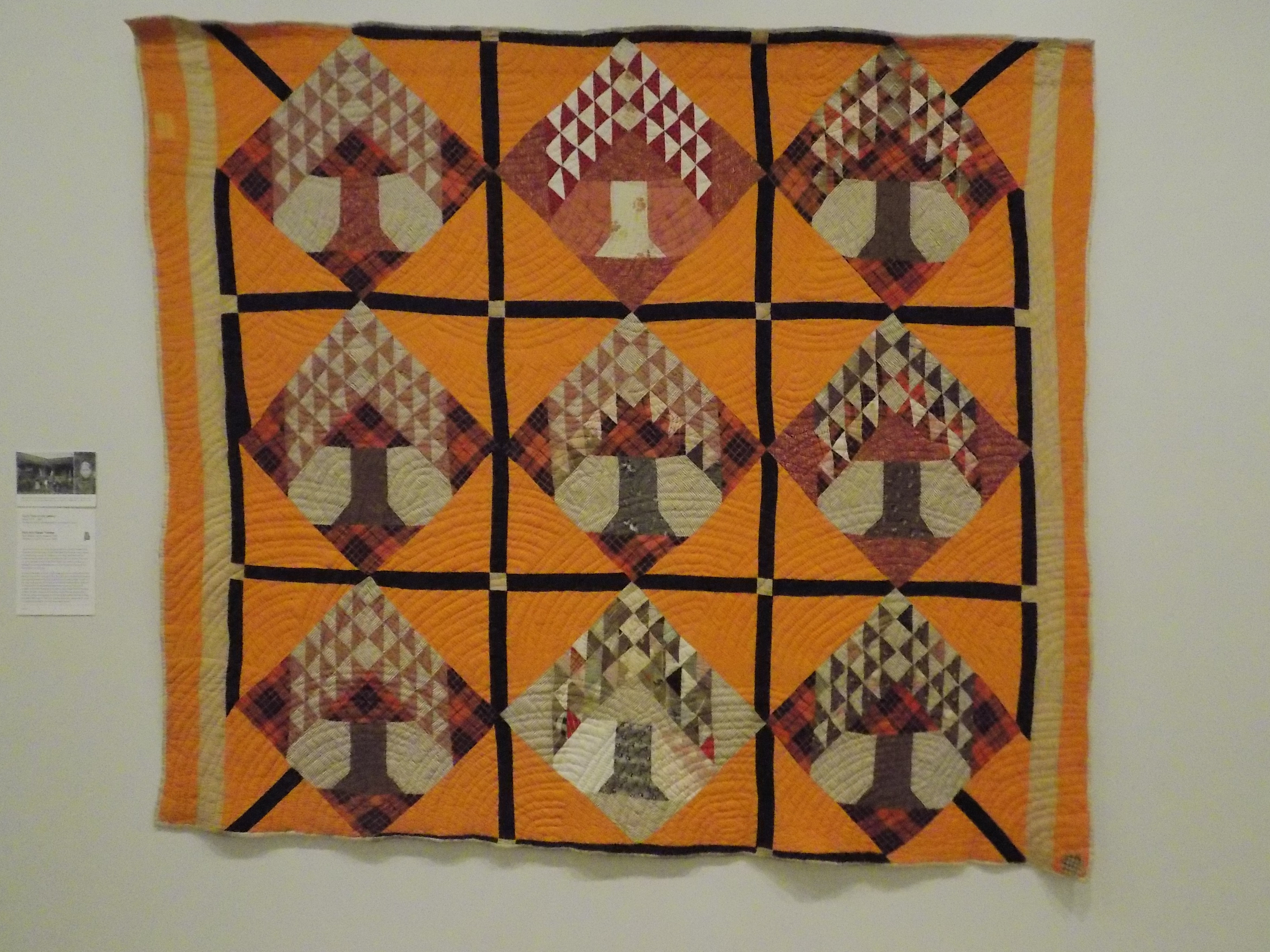
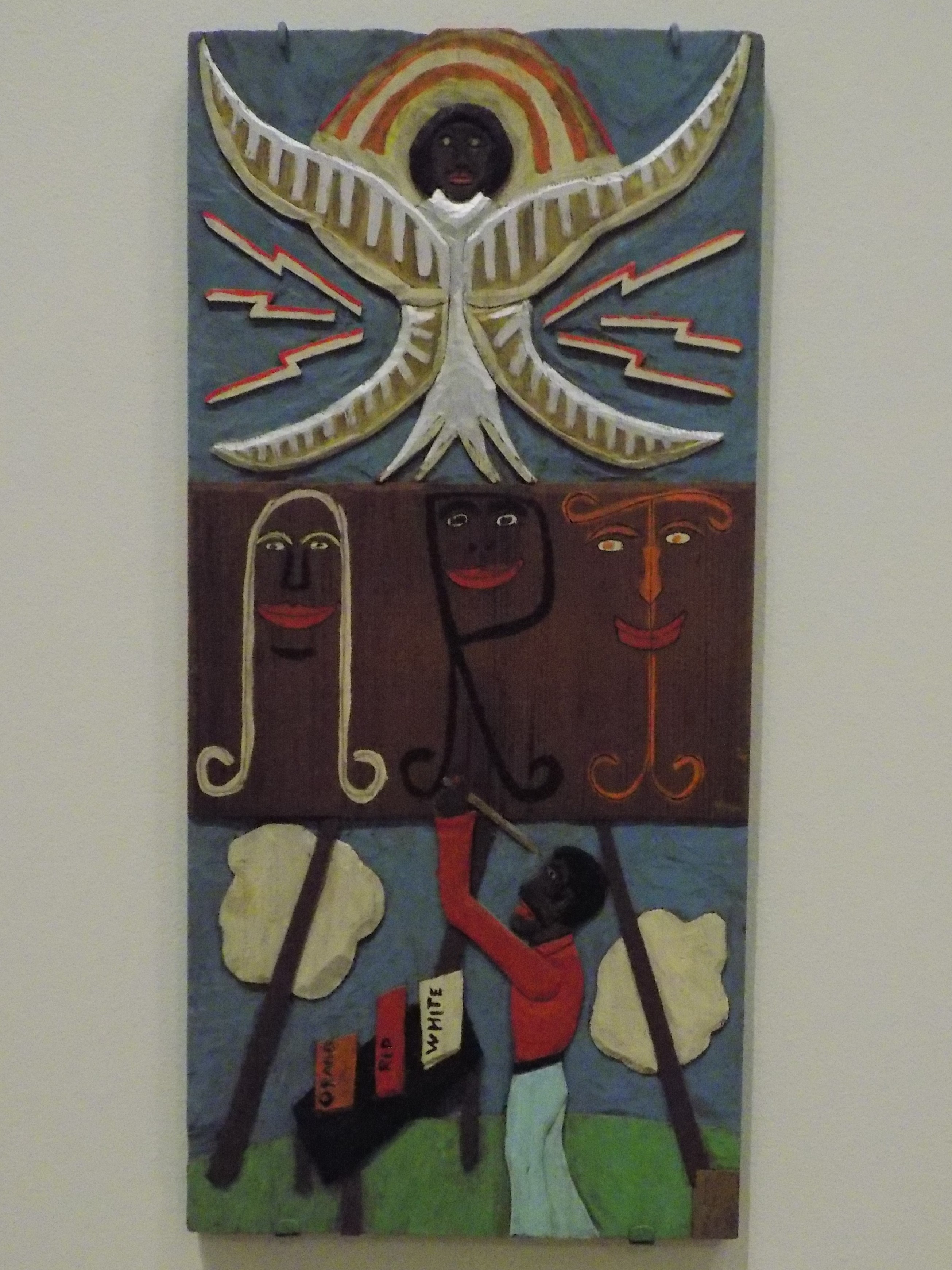
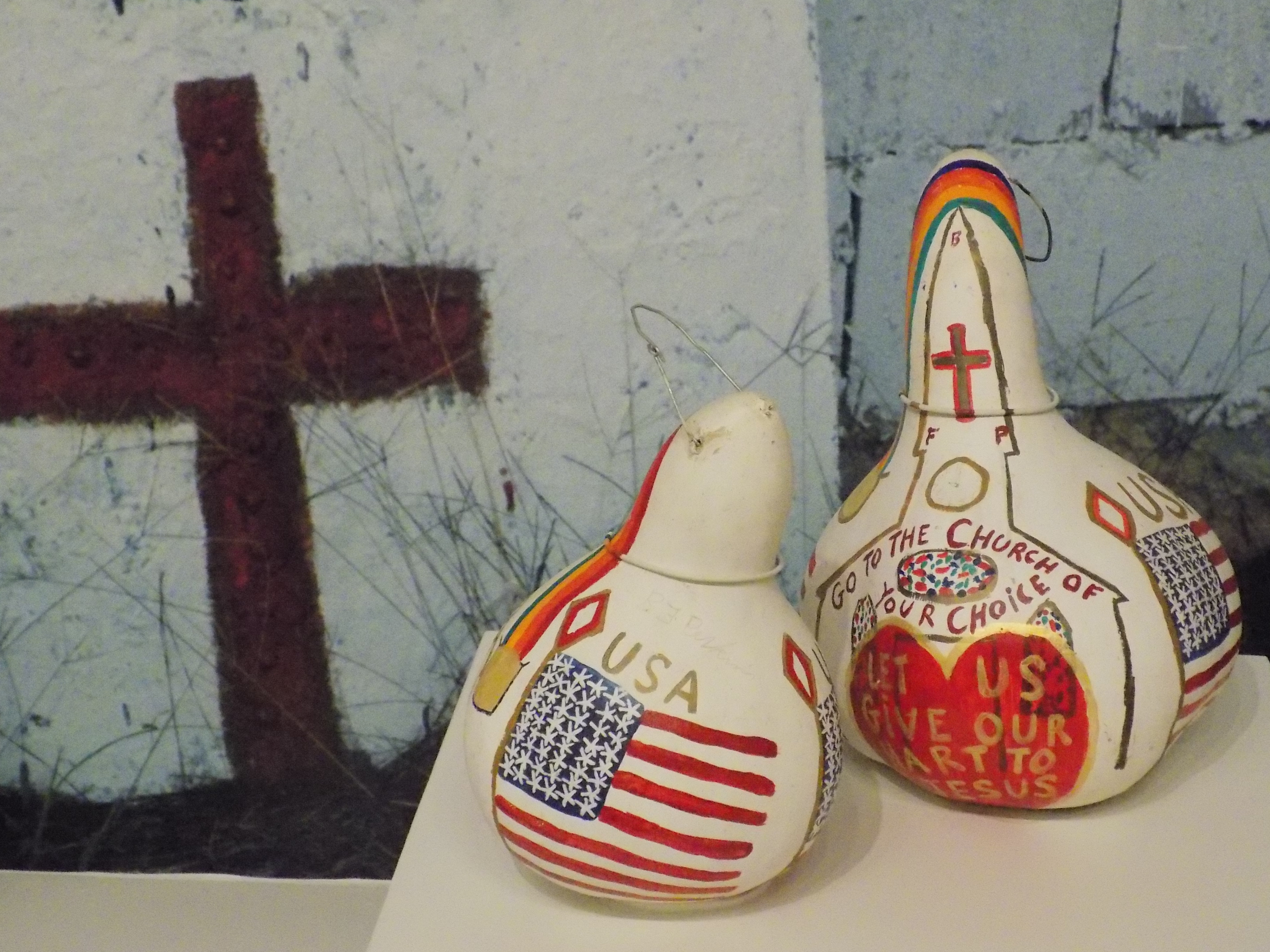
This Thanksgiving weekend I found time to go to the Birmingham Museum of Art (www.artsbma.org) to catch an exhibition I’ve been wanting to see since it opened in January. “Third Space: Shifting Conversations about Contemporary Art” will be up until January 2019. It incorporates a number of contemporary pieces from the Museum’s permanent collection and explores correlations between diverse media, artists, and themes.

Birmingham Museum of Art regulars are already familiar with some of the featured Alabama artists like William Christenberry, Thornton Dial, Lonnie Holley, Kerry James Marshall, and Moses Tolliver. They are all represented in “Third Space.” The exhibit also gives the opportunity to view lesser-seen pieces, monumental pieces, and video installations by international artists that are rarely viewed.

“Big Fish Eat All the Little Fish” by Thornton Dial

The exhibit is organized into groupings with labels like “migration / diaspora / exile”; “gaze / agency / representation”; “spirit / nature / landscape”; “traditions / histories / memory.” Those categories, peppered with contemporary art buzzwords, prepare the viewer for the dominant themes of victimization and resentment which are so prevalent in much current contemporary art.

There are exciting images throughout the venue and around each corner is something to please and/or challenge the senses. Out of the corner of my eye I thought I spotted one of Jim Dine’s Pinocchios but moving closer it was a sculpture by Cuban artist Esterio Segura. In “La historia se muerda la cola (History Bites Its Tail),” Pinocchio’s nose, which grows when he lies, has grown into a rope that binds him. Not only did I ponder the symbolism of the nose in the Segura piece but it lead me to consider why Dine is also drawn to the character and has presented him in so many ways.

“La historia se muerda la cola” by Esterio Segura with “Old Salem: A Family of Strangers (Series One)” by Fred Wilson and “Making the Bed” by David Salle (far right)

I have a quote from art critic Cay Sophie Rabinowitz on my office wall; I regularly discuss it in my directing classes. She wrote, “When agency is replaced by agenda, the intelligence and poetry of art often get sacrificed.” I found myself thinking about that quote during my time at the Third Space exhibit. “Third Space” is a challenging exhibit, raising questions and issues at every juncture. However, the artists’ agenda in the approximately hundred works on view usually does not take precedence over the provocative agency of the artists’ accomplishments. I was often drawn to a work’s skillful execution before being drawn into the artist’s more powerful and subtle intent. At times, I had no clue to the intent.

For example, Laylah Ali’s “President” is a puzzling collection of small sketchy drawings of each U.S. president pre-Obama. Exhibition notes say the artist gave no instruction for how the portraits should be ordered so the curator has arranged them from president with most hair to president with least. A few of the presidents are being gazed at (taunted?) by little orange heads. There was no apparent rhyme or reason as to why Ali chose the presidents she did for these puzzling cartoon additions. Still, I kept looking.

“among the weeds, plants, and peacock feathers” by Ebony G. Patterson

One of the prettiest pieces is also abruptly disturbing. “among the weeds, plants, and peacock feathers” by Ebony G. Patterson compels with its sparkles and bangles until one notices the shoes in the tapestry and realizes they are attached to a human body.

Probably the most aesthetically pleasing painting for me was David Salle’s “Making the Bed,” a striking work on canvas in which an armada hovers over a shadowy reclining figure. A blood red streak of paint connects the two images.

“Gravity’s Rainbow” by Odili Donald Odita as seen from inside “2x’s” by Rural Studio

One of the galleries in the exhibit is grounded by a large piece built by Rural Studio architect/artisans. “2x’s” (two bys) is an aggregation of boards that would be used in building one of Rural Studio’s “20K Home” projects. The assemblage has built-in seating areas and provides a unique and personal perspective to the work that surrounds it. When the Third Space exhibition closes in 2019, the boards of “2x’s” will return to the Black Belt to be used in a new 20K Home.

On most visits to the Birmingham Museum, I head first to the modern galleries where I have favorites I like to revisit. It’s good to have “Third Space” available for another year with some of those familiar pieces and others with which I have just established an acquaintance.

View of “Third Space” at Birmingham Museum of Art with “Soundsuit” by Nick Cave in the foreground

Harbingers

While I was in Birmingham on the weekend before Thanksgiving, the inevitable November storm passed through. It had been a pleasant warm day but after dark a thunderstorm blew up accompanied by a strong wind; the leaves – many of which had barely turned – began to swirl around and cover the back yard. By the next morning, sunny skies were flirting with freezing temperatures and the back yard was a wind-blown mess.

Mother’s house is on a slope of Shades Mountain with a back yard ending at a steep bluff that looks down onto the Oxmoor Valley. The Oxmoor Furnaces – the first blast furnaces in this area – used to stand in that valley more than a century ago. Now it’s a valley of industrial buildings, residential areas, and golf courses. At the end of the day after the storm, when it was almost dark at Mother’s house, I peered over the fence into the valley below where the setting sun was still making a final brilliant show across the valley before nightfall.

I am a hot weather guy but that first rush of cold air in Alabama, which always makes a dramatic entrance, is full of energy. It is usually a harbinger of the holiday season, usually happening just a few days before Thanksgiving.

Of course, temperatures were back in the 70s by the beginning of the week. Cold snaps rarely last long here. But that sudden chill gives a new urgency to the impending holiday season and I went ahead and made the reservation for my annual December trip to Point Clear on Mobile Bay. The resort is undergoing extensive renovations so it will be an adventure to see what is finished and what is still underway. I already know that the spa will be a work in progress but was still able to book a massage with Claudia, an amazing massage therapist who has been treating me every December for over a decade now.

As much as I like Thanksgiving, it is also the preamble to a hectic time at work. When I return to classes on Monday, there is only a week of classes left and for some of my students that becomes a week of excuses about late or missing assignments leading to final exam week and fall graduation. Graduation always brings its own challenges as we often go up to the last minute before we know for sure that all of our majors who plan to graduate have fulfilled the requirements to do so.

That push to the end of the semester and graduation makes a Christmas break even more welcome and necessary. The news of the nation and of the world is chilling, foreboding, and depressing but the holidays provide a welcome – if temporary – distraction. They make the long nights and cooler temperatures more bearable and provide a bit of a breather in the midst of work and personal stress and concerns. The promise of new beginnings and the fervent hope for a better year ahead lend an extra sparkle to the season of lights.

May your Thanksgiving be stress-free.

Harvest and Rejuvenation

The cotton fields – which are still abundant between Decatur and Florence, Alabama – were peaking and startlingly beautiful with their fluffy and practical white yield as my friend  Anne and I made our way to the Alabama Chanin factory and the last dinner of the 2017 season (www.alabamachanin.com).

It was in this in-between area, around the community of Trinity, that I was one of many volunteers that helped out for a morning or a day with Alabama Chanin and Billy Reid’s 2012 experiment in growing organic cotton in north Alabama. With the industrialization and outsourcing of cotton harvesting, working the field was a “back to the roots” experience which helped me to recognize and honor the hard work of my own relatives who worked the cotton fields and harvests of their own Alabama farms in the first half of the twentieth century.

Inventive souls are finding new uses for local cotton these days, including downtown Birmingham’s Redmont Distillery which features an “Alabama Cotton Gin,” a spirit which is “distilled through Alabama cotton” and infused with other local product (www.redmontdistilling.com).

The most recent Alabama Chanin dinner was a celebration of the fall harvest, helmed by Ray Nichols, the new in-house chef for the Café at the Factory, who comes with an already impressive resume and who, before joining Alabama Chanin, was at Odette, a charming dining spot in downtown Florence. It was a rich season of Friends of the Café meals starting with Chef Scott Peacock re-emerging for an Easter season event and moving forward with the return of Chef Ashley Christensen for her second meal of the series. In August, in conjunction with the Billy Reid Shindig, Chef Asha Gomez presented a meal combining her American Southern experiences with her roots in southern India.

Chef Nichols’s dinner was a sold-out mix of locals, regulars, and new faces. Our friend Carol from Chicago showed up accompanied by a charming Chicago friend. We met guests from Hawaii and Colorado and a yoga master from Gray Bear Lodge in nearby Hohenwald, Tennessee. I have written before that there are times when the former tee-shirt factory in the industrial section of Florence seems like the center of the universe; chance meetings and serendipity abound.

Young Chef Nichols impressively held his own with his predecessors with a hearty dinner featuring the harvest of the region along with a couple of tasty imports, like Conway Cup oysters from Prince Edward Island. The mildly briny oyster was topped with a Harvest Roots kimchi from Mentone, a scenic village on Lookout Mountain in northeast Alabama. The oysters on the half shell were pass-arounds at the start of the evening along with deviled eggs topped with a Harvest Roots curtido.

The pre-dinner beverage was served in a brown sugar-rimmed glass partially filled with cider from Florence’s Singin’ River Brewery. The cider was cut with Prosecco and the drink was finished with a splash of Sangria. 

When the guests were seated and the preliminary introductions were completed, platters of smoked chicken wings, pickled vegetables, and toasts topped with Bonnie Blue goat cheese were served family-style. The chicken was coated with a white sauce (this is, after all, north Alabama), and the goat cheese was from Waynesboro, Tennessee, just off the Natchez Trace.

A harvest salad with an abundance of greens and local harvest from area farms was served next with a burnt honey–sweet potato dressing. The main course featured Bear Creek pork served two ways. A large and tasty pork rib was presented alongside a ham steak. Both were accompanied by farro verde, turnips, and muscadine.

The dessert lived up to its preamble. A crumbly sweet potato cake and a creamy semolina pudding were garnished with cashews and citrus. 

Ray Nichols’s debut for an Alabama Chanin factory special dinner was a triumph with every bite, heralding a bright new presence in the Factory kitchen that will maintain and enhance an already impressive standard.

The yoga master asked me at some point during the evening if I spent my time going from one amazing dining experience to another. I wish … but no, I do not. Such evenings are few and far between in my schedule and each is anticipated with pleasure. I feel rejuvenated and ready to face the day to day challenges when I have the opportunity to eat an amazing meal in a singular place in the company of delightful people.

The Vine and Olive Colony

Demopolis, Alabama – the “City of the People” – was founded in 1817 at the confluence of the Tombigbee and Black Warrior rivers by French Bonapartist exiles and other French who had fled the Haitian slave rebellion of 1791-1803.

The founding Frenchmen’s original charter was to create a “Vine and Olive Colony,” growing olive trees and grapes for wine-making. They were misinformed that the Canebrake region around what is now Demopolis was suitable for those crops. The vine and olive experiment was short-lived and most of the French settlers moved on to other locations. The few who remained assimilated into the area’s plantation and agricultural economy and Demopolis, despite its shaky beginnings, went on to be a flourishing center of the Black Belt in the nineteenth century.

The story of Alabama’s vine and olive colony of French expatriates had “legs” and was reimagined and enhanced, becoming an integral part of Alabama lore and mythology. The Vine and Olive Colony of Demopolis has been recounted in numerous ways in fiction and was even a climactic plot point of the John Wayne film, The Fighting Kentuckian (1949).

When I first met the artist Julyan Davis (www.julyandavis.com) in the 1980s, he was a recent art school graduate from England who had come to Alabama to learn more about the Vine and Olive colony. He had read about it in books from his novelist father’s library, particularly the fictionalized version found in Carl Carmer’s 1934 “creative non-fiction” novel, Stars Fell on Alabama.

Although Julyan is a painter, he is also a skilled writer whose earliest interest in the Vine and Olive Colony was literary; he travelled to Demopolis with plans to write about it and its unique and romanticized history.

I met Julyan at a New Year’s Eve party in Tuscaloosa that I attended with one of my good friends, Madeleine, whom Julyan later married. Julyan’s travels are far-flung but he more or less settled in the American South over the past three decades and much of his painting focuses on Southern landscapes, overlooked architecture, and abandoned interiors. As a painter, his interests often complement the interests of photographer and Alabama native William Christenberry, whose life-long work in photography, painting, sculpture, and assemblage chronicles a vanishing and overlooked South and southern landscape.

Like Christenberry, Julyan explores the beauty in the decay of the forgotten detritus. He paints proud buildings in disrepair and humble buildings that retain their dignity. He paints cascading Carolina waterfalls in their primitive majesty and Maine seashores in their rustic authenticity.

My favorite of his paintings is an early one that I first saw in a gallery in Birmingham. It is a traffic light at a desolate crossroads somewhere in Hale County, Alabama. I haven’t seen that painting in a long time, but I have it memorized, I think, and it’s always just at the edge of my memory.

Over the years I stayed in touch with Julyan and followed his art and career as he and Madeleine lived in Birmingham, Atlanta, and Highlands and Asheville, North Carolina. The marriage ended but Julyan and I have stayed in tentative contact over time.

Julyan’s literary vent did not ultimately tackle the Vine and Olive Colony but a story-telling sensibility informs his paintings.  Perhaps his most heralded project is his on-going “Appalachian Murder Ballads” series of paintings inspired by Appalachian folksongs of Celtic origin. He takes the ancient texts and places them in modern settings – trailer parks, abandoned factories, river beds and railroad trestles, burning buildings.

A few years ago, Julyan decided to return to his early infatuation with the Vine and Olive Colony of Demopolis and Marengo County, but as a painter, not a writer. He began a series of “Demopolis” paintings focused on the Symbolist character of Madame Raoul, the Marchioness de Sinabaldi. The moody series of “Demopolis” paintings captures the loneliness of a European expatriate transported to a wild and foreign place. My favorite of the series, “Son premier soin,” shows a lone Madame Raoul from behind, wearing an Empire gown and dragging cane through a canebrake. She holds an axe to her side. It is an evocative painting of stoic solitude.

On the occasion of Demopolis’s bicentennial, Julyan Davis took his Demopolis paintings to be displayed in the town that inspires them. Lyon Hall, an 1853 Greek Revival mansion near the center of town, is a mansion that is maintained but not “restored” and was the ideal site for the exhibition of the “Demopolis” series.

Julyan gave a talk about his work and the history of the “Demopolis” paintings on Friday night of the bicentennial event to a packed house in Lyon Hall’s double parlors. The paintings were hung throughout the mansion’s first floor, providing a moody accent to the expansive rooms of the venerable house.

Julyan Davis is a fascinating raconteur with a dry wit who takes pleasure in discussing the impulses that fuel his art. He talked about how bringing these Demopolis paintings to the place that first inspired his Southern sojourn seemed to be a way of bringing his career “full circle.”  He talked about why the Southern landscape entrances him. 

I was only able to be in Demopolis for the opening of the exhibition and for Julyan’s talk but the next day Julyan set up his easel in Lyon Hall and painted in the house while visitors enjoyed the finished paintings and the place itself.

As I left Lyon Hall that evening, I walked the grounds, intrigued by the dependencies that surround the house. The rustic charm of these outbuildings competes with the grandeur of the stately main house, where the sounds of the gathering that had assembled for the art filtered out through a peaceful late-summer dusk.

Notes from Neutral Ground

  Thursday, 9/7/2017: As I cross from Mississippi into Louisiana, WWOZ – “the most indispensable radio station in the country” – plays the instantly recognizable opening guitar riff of the Rolling Stones’ “Gimme Shelter” and my spirits lift immediately (www.wwoz.org).

I am traveling to New Orleans to present a paper on Joan Didion’s California at the American Literature Association’s symposium, “Regionalism and Place in American Literature” (www.americanliteratureassociation.org).

I love the Stones and am rocking out and singing along behind the steering wheel as I pull into the Louisiana Welcome Center north of Slidell. However, since I am aware of criticism over the past several years that WWOZ has sometimes strayed from its mission of promoting local New Orleans and Louisiana music, I wonder how “Gimme Shelter” fits into the scenario.

I don’t much care at the moment since I am immersed in one of my favorite songs from arguably my favorite rock ’n’ roll band ever. I muse that it may be a reference to the fact that Texans and west Louisianans are seeking dry ground after Hurricane Harvey or that Floridians and others on the east coast are fleeing the approach of Hurricane Irma. For either group, New Orleans is a place that is not in the crosshairs of the storm this time.

Instead of calling them “medians,” New Orleanians refer to the grassy strips between lanes on their broad streets as “neutral ground.”  On St. Charles Avenue, for example, the grassy area in the middle that the streetcars travel is “neutral ground.” I realize that in the current tropical storm scenario, the whole city of New Orleans is “neutral ground” with visitors coming in from all directions.

The Stones wrap up and immediately the track segues to Merry Clayton’s solo version of “Gimme Shelter” and it all makes sense. Clayton, a New Orleans native, provides the fierce back-up vocals on the Stones’ original of the song, challenging Mick Jagger’s dominance in the process. Her solo version, recorded a few years later with a shrieking horn back-up, is a skillful and equally naked vocal performance. You must give it a listen.

Getting out of the car, I am approached by an agitated man who tells me to give him gas money to get back to Beaumont. I am inclined to help him but I feel a need to engage him for a moment to see if he’s really a flood victim or if he’s scamming.

As soon as I start to talk, he says, “If you ain’t gonna help me, bye!”

“I just need to …”

“If you ain’t gonna help me, BYE!”

“But …”

“BYE!” and he’s gone, approaching another car just pulling up.

A half hour later I am at the Hotel Monteleone, check into my room (which happens to be across the hall from the Tennessee Williams Suite), and unpack.

There is a little time before the symposium’s registration and opening reception so I go to Faulkner House Books in Pirates Alley off Jackson Square (www.faulknerhousebooks.com). The proprietor is talking to a group of European customers. One is particularly interested in reading Faulkner and asks what he should start with. I walk past and whisper “As I Lay Dying” to the proprietor and the conversation continues as I browse.

Outside, a bored young tour guide stops in the alley and I hear him say, “The writer William Faulkner lived here. Also, Tennessee Williams wrote A Streetcar Named Desire here.”

“That’s not true,” the proprietor says to his customers. “Faulkner lived here, yes. Tennessee Williams, no.”

The ill-informed tour moves on.

“Should I chase him down?” I ask, joking.

“If I chased down every tour guide who gave false information in that alley, I’d never get any work done,” is the reply.

I find the book I am looking for at Faulkner House, pay, and am leaving as the European guy decides to try a book of Faulkner’s short stories (good move).

I stop by Napoleon House, one of my favorite spots in the French Quarter, and text my friend Deb that I am there; it is one of her favorite spots, too. Her response includes the terrible news that one of her good friends, a woman in her forties that I also know, has died.

I absorb that piece of sad news and move back to the Monteleone, symposium check-in, and the reception.

After a quick appearance at the reception, I get dressed for dinner. I am going to Commander’s Palace, in the Garden District. It is my habit on New Orleans trips to try to have dinner at one of the New Orleans classics, at one of my favorites, and at some place new.

Commander’s Palace (www.commanderspalace.com) is one of the stalwart classics that I have never dined at. After recently viewing a charming documentary, Ella Brennan: Commanding the Table, I decided I could not delay a trip to Commander’s any longer so this will be my first visit to the turquoise landmark. 

Commander’s vaunted hospitality is alive and well and I am greeted warmly by every staff member as I make my way to my table in an elegant dining room. I have often said I would like to write a column or book about the “solo diner” and I always find that the best restaurants in New Orleans have no problem making a solo diner feel comfortable. I judge a restaurant partially by its treatment of solo diners and, with only one notable exception, New Orleans comes through splendidly.

The tempting menu is full of tasty offerings, making it hard to choose what to have from Executive Chef Tory McPhail’s selections. The waiter, upon learning that Birmingham is my home town, asks me if I know the Bright Star in Bessemer where the late summer “Taste of New Orleans” event features a guest chef from a New Orleans restaurant. I tell him that I know the Bright Star very well and have attended Chef McPhail’s dinners there.

Finally, I order a group of “tried and trues.” As I choose a meal of turtle soup, pecan-crusted Gulf fish, and bread pudding soufflé, the waiter smiles and says “a Paul Prudhomme meal.” Prudhomme sealed his reputation at Commander’s where his tenure preceded Emeril Lagasse, Jamie Shannon, and McPhail. He introduced Cajun influences to Commander’s – making Cajun food a national sensation – before going on to open his iconic restaurant, K-Paul’s, in the Quarter.

The dinner is lovely and the ambiance is magnificent but I have a long day of presenting and listening tomorrow and, leaving Commander’s, I retreat to my room to practice my presentation one more time before sleep.


Friday, 9/8/2017: After the symposium’s opening plenary session, in which it is announced that a number of presenters cannot make it to New Orleans due to impending weather, I present my Didion paper at the “California” session at 10:30. It goes well, I think. I field a lot of questions during the Q and A that follows.

Lunch follows that, and then sessions that stretch to 7:30.  Papers on the “undead” seem to be trending; these I avoid. There is impressive scholarship at the symposium and I hear a lot of good papers, but by the time the day wraps up I am famished and have made no dinner plans.

I remember that I have time to get to Willa Jean (www.willajean.com), the new-ish restaurant (2015) in the Warehouse District that I learned about at a recent Alabama Chanin event in Florence. The restaurant is helmed by Chef Kelly Fields, who named it after her grandmother, and the general manager is Leah Richard, who I met and was terribly amused by at the Florence dinner. It is part of the ubiquitous John Besh Restaurant Group of New Orleans restaurants that impressively cover New Orleans like kudzu covers the South.

Willa Jean is a shiny spot, sleek and chic with wood accents. The menu is inventive and fun, with offerings like Cookies + Milk and a wo’Manwich and an impressive selection of juice-based drinks. An array of enticing pastries is available just inside. I opt for the WJ Burger, an Angus beef burger with herb/pecorino fries. The burger is offered with American cheese but I ask to substitute the menu’s pimento cheese for American. The dessert menu provides too many tasty options and I finally choose a chocolate pudding generously sprinkled with crushed pecans.

I notice how young the wait staff – the entire staff – is at Willa Jean. It’s not unusual to see older waiters in New Orleans where it is a career choice rather than a part-time job, but Willa Jean is full of attractive fresh young faces. Looking around the room, I realize that I am at least 25 years older than everybody in sight. As I leave, a three-some arrives that looks my age (or older) and I am relieved as I decide to walk back through the Central Business District and to the hotel.

Streets that used to be dark and somewhat deserted in the CBD are now bustling, with new restaurants and other establishments on almost every block. In a late summer evening, there are groups of people chatting and walking, going into lofts and coming out for a night in the city.

My first post-Katrina visit to New Orleans was a mere four and a half months after the flood when many areas were still without power and some places looked like the flooding had been days, rather than months, ago. It is heartening to see what much of the city has become (although there is still plenty of recovery left to do) on each visit back.

I get back to the Quarter and consider going in search of live music but I realize that the Quarter on a Friday night has become, for me, as depressing as a New Year’s Eve party – too many people too desperate to have too good a time. Maybe it’s my age. I retreat into the more staid Monteleone where the crowd at the Carousel Lounge is getting geared up for a late evening of carousing.


Saturday, 9/9/2017: It’s the final day of the symposium and I start the day at the second of two sessions on New Orleans regional literature with impressive papers by college students – one on Faulkner’s Absalom, Absalom! and another focusing on Kate Chopin’s The Awakening.

At another session that I am looking forward to, I am disappointed. The session is supposed to deal with native cultures in the Americas and the four presenters have topics of interest to me. The first paper deals with Nahua structures in central Mexico and the presenter has time to give her entire presentation. However, the second presenter announces that she is an Elder of the Apache Nation and that she is going to use her status as entitlement to go beyond her allotted time.

It is a shocking moment and the moderator should step in but doesn’t.  Everyone sits politely as the Elder inserts lengthy asides and largely toots her own horn of accomplishments and vents her anger at the plights of the native cultures. It is the sole uncollegial moment in what is a very collegial symposium. When the Elder finally reels herself in, there are only minutes left for the final two presenters to sketchily synopsize what their work entails.

The last two papers – one about hymns written in indigenous languages and another about tribal performance as theatre – were of particular interest to me and I am sorry I am not allowed to hear them due to a brazen and unprofessional power play.

At a reception later, I have the opportunity to tell the presenter who was supposed to talk about her hymn research that I had wanted to hear her paper. “Thank you. I wanted to present it,” she graciously replies. I admire her calm in the situation. I am livid still.

After lunch, I sneak away to my favorite New Orleans gallery up the street from the hotel. Elliott Gallery (www.elliottgallery.com) is owned by Catherine Martens Betz, who is knowledgeable and pleasant. It is at Elliott Gallery that I first learned about and developed a great affection for the French abstract artist, James Coignard (1925-2008), who had a studio for a time in New Orleans. Elliott Gallery offers the largest collection of his work in the world and I must visit it whenever I am in New Orleans.

On this visit, Catherine is closely watching the weather radar since Irma has not yet made the predicted northward turn. If it doesn’t turn, it could make a beeline for New Orleans and the central Gulf Coast. I have noticed the same thing and we commiserate over that anxiety.

After my visit with Elliott Gallery, I return to the symposium and one of the sessions I most look forward to about “Rough South Regionalism,” including papers about Harry Crews and Larry Brown, has been canceled due to the participants being in the projected path of Irma.

The closing reception includes a session with the editors of four regional academic journals and the opportunity to say goodbye to new friends and colleagues. By this time also, Irma is making the predicted turn northward.

I am asked for restaurant recommendations for future trips to New Orleans and I highly recommend Upperline, among others.

“What sets Upperline apart?” I am asked.

“Well,” I answer, “the menu is outstanding but I’d have to say that what makes it unique is JoAnn.”

What I do not mention is that I have a reservation at Upperline tonight (www.upperline.com). JoAnn Clevenger, the restaurateur of Upperline, is always present at the restaurant. It is full of artwork she has collected – most of it New Orleans-themed – and she circulates among the diners, seemingly interested in everyone’s story, throughout the evening. She glides through the restaurant as if it is her own private salon; in ways, I guess it is.  I try to make an Upperline dinner a feature of every visit to New Orleans.

Andrew Thornton is the Upperline chef, but the menu is very evocative of JoAnn. She is a fan of garlic so a “Garlic Festival” is a menu feature each summer (including garlic in the dessert). Thomas Jefferson is a hero so a Jefferson dinner is a recurring event and the menu is always peppered with dishes from Jefferson’s Monticello. Dorothy Parker-themed cocktails are featured on the drinks menu. 

The menu is highly influenced by Creole cooking styles and I have never had a bad bite at Upperline. Tonight I stay traditional, ordering Oysters St. Claude as an appetizer. My entrée of Sauteed Drum Meuniere is on a bed of succulent cooked greens and cornbread. For dessert, I order a pecan encrusted Crème Brulee.

As I wait for my cab, a waiter asks me where I’m visiting from. I tell him I live in Huntsville but Birmingham is “home.” His immediate response is “Frank Stitt.” He’s a fan of the Birmingham chef and we discuss Highlands Bar and Grill’s perpetual James Beard nomination as Best Restaurant.

About that time, JoAnn walks up and I say, “And we also need to figure out what we need to do to get JoAnn the James Beard Restaurateur of the Year award.” She has been a finalist or semi-finalist many times but, like Highlands, she’s never taken home the prize. Anyone who has ever dined at Upperline knows she deserves it.


Sunday, 9/10/2017: I decide to check out early since I have a long drive ahead with a stop in Birmingham. The bellman who takes my bags down tells me that most of the new guests arriving since Friday are people from Florida, escaping Irma.

“I pray for them,” he says. “But I’m glad it’s not headed our way. We’ve had our turn with that.”

I tell him that maybe for those taking shelter in New Orleans, the way New Orleans has sprung back will be an encouragement for whatever they might be returning to in Florida, Georgia, and the Carolinas.

“Takes a lot of time, lot of patience,” he says. “They’ve had it before, too.” 

It’s a glorious morning in New Orleans. I take a photo of the Esplanade neutral ground as I leave the Quarter. I drop by Willa Jean, grab an almond mini-bundt cake and café au lait for the road, and get onto I-10 east toward the lake, out of the city.

Shortly after I cross into Mississippi, WWOZ’s signal begins to fade away. The last song I hear is a jazz instrumental of Lennon and McCartney’s “In My Life.” I know the words and sing along:

There are places I’ll remember

All my life, though some have changed,

Some forever not for better,

Some have gone and some remain.

All these places have their moments

With lovers and friends I still can recall.

Some are dead and some are living

In my life I’ve loved them all.

I turn off the radio.

By the time I get to Birmingham, Monday school closings are being announced. The remnants of Irma are headed our way.