Author Archives: gedwardjourney

Unknown's avatar

About gedwardjourney

Edward Journey is a writer, theatre artist, and retired university professor. "Professional Southerner" is an online journal focusing on topics -- Southern and other -- that stoke Edward's interests. Edward may be reached at likatrip@yahoo.com.

Falling Leaves

For the first time in my memory, my mom has decided she likes fall leaves on the ground. On her afternoon walks up the neighborhood streets, she has been admiring the beauty of the leaves on the ground – and even says she hopes the neighbors don’t rush to rake or blow them away.

This is noteworthy because I remember a childhood of being told how messy the leaves looked and having to rake them repeatedly throughout the fall. It was frustrating to rake all Saturday afternoon with leaves still falling all around me. Even then, I would stress the virtues of letting the leaves decay where they lay; only years later did I learn that I was right.

Those afternoons were made sweeter if I had a radio nearby broadcasting John Forney and Doug Layton announcing another Alabama football victory with Coach Paul “Bear” Bryant at the helm.

Mother is particularly taken with a young maple in the front yard across the street. Its bronzy saffron leaves almost covered the yard and a brisk breeze would send them dancing into the street and neighboring yards. Its foliage turned color from the top down and now there is a thin layer of colorful leaves at the bottom, crowned by the bare limbs.

Early this morning, the neighbor’s yard maintenance guy arrived. Within a half hour, the maple leaves on the ground were gone. An hour after he left, a healthy amount of the striking leaves was already drifting down, covering the grass again.

Unless you go the short distance from Shades Mountain into the higher mountains, this area is not known for a brilliant fall display. The fall color is even more subdued and muted this year, with a significant drought building since September. As much as I despise cold weather, however, there is an undeniable energy in the air when the weather begins to change and the fleeting beauty of Nature takes hold for a few weeks before the holiday season fully kicks in.

As the sun sets and more leaves fall, trees become more visible down the hill, creating a brief and peaceful display down the mountain toward the creek.

This year, most of the warm weather plants were damaged in a short-lived freeze. Some plants weathered it and others gave up. They have been replaced by pansies, which my mom loves (although I prefer violas for cool weather blooms). More pansies will be added over time, complemented with violas probably, as more of the remaining plants fade away.

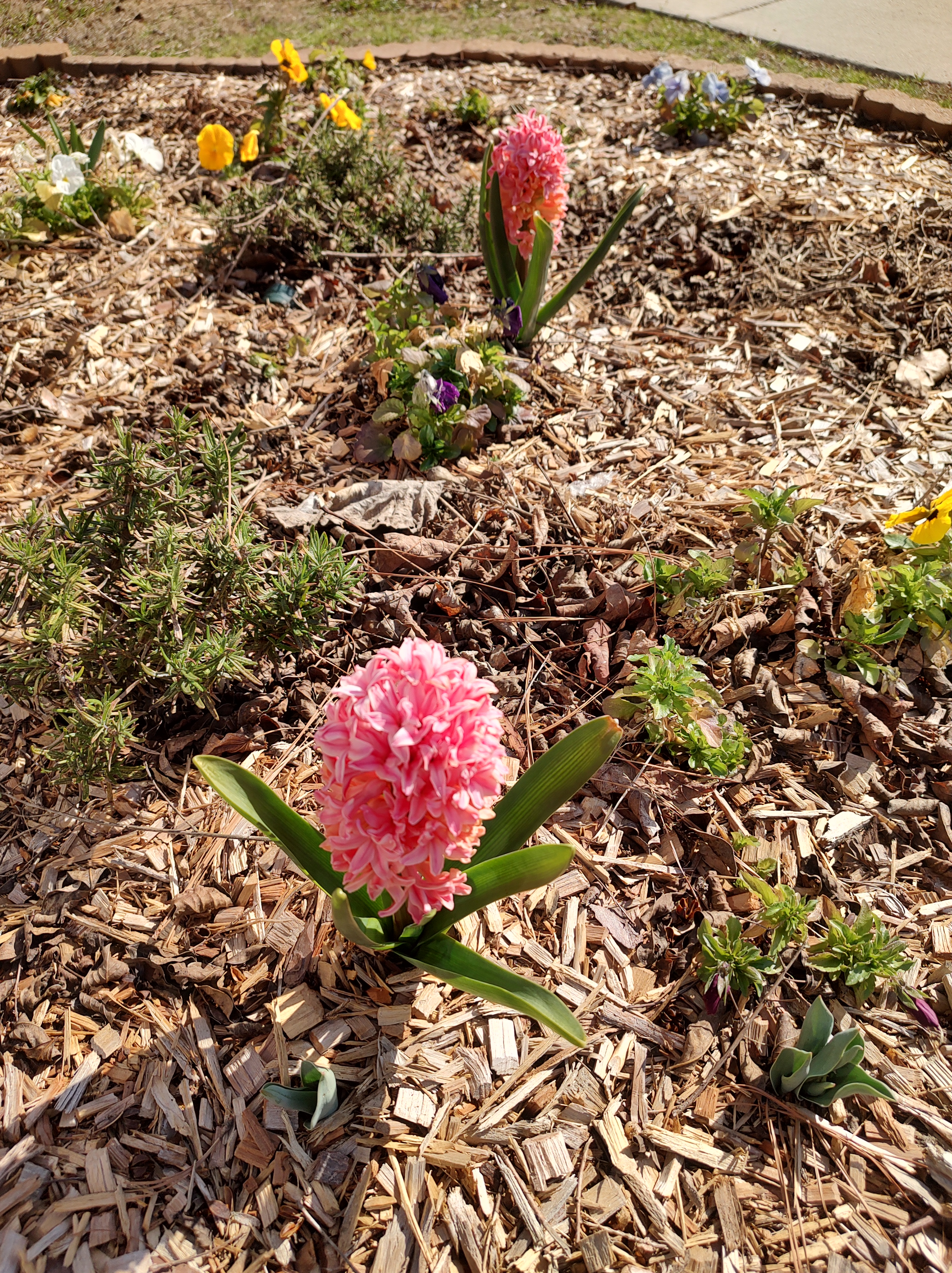
A bag of bulbs arrived recently and are now in the ground; I planted them but will be surprised when they start popping up in late winter. Years ago, at my house in another town, I randomly planted ninety crocuses in the front yard one November. I planted them so I knew they were there. Even so, I was always startled when the first bud appeared in early February.

Pre-planned serendipity.

Book Review: Magic City

My review for Magic City by Burgin Mathews was just posted on the Alabama Writers’ Forum website. Magic City, to be released in November, explores the rich heritage of jazz that emerged from the Birmingham area and went on to have national influence. Here’s a preview:

Magic City: How the Birmingham Jazz Tradition Shaped the Sound of America

Fresh Books

Alabama Writers’ Forum has just published a new crop of reviews. I review Ayana Mathis’s new novel, The Unsettled, and a packed collection of short stories, The Best of the Shortest, that grew out of the legendary “literary slugfest” Southern Writers Reading in Fairhope, Alabama. And while you’re there, enjoy Susie Paul’s lively review of Jacqueline Allen Trimble’s How to Survive the Apocalypse, a new book of poetry. Check them out here:

Reviews

How to Sidewalk – 2023

Birmingham’s Sidewalk Film Festival is a festival which packs a lot of action, films, workshops, panels, and parties into a single weekend – the last full weekend in August before college football begins (this is Alabama, after all). The 2023 edition, which ended on August 27, was the 25th Annual Sidewalk. I have been going for most of those years and realized that my Sidewalk tee shirt from 2003 was older than many of the people around me on Opening Night.

In the years before I moved back to Birmingham, I would get a hotel room downtown on Sidewalk weekend, park the car, and walk everywhere. Last year, I tried commuting from my house south of town to downtown for the weekend’s events. In the process, I found that I was missing things I wanted to see.

John Hand Building, Birmingham

This year, I went back to the tried-and-true hotel plan and booked a room at the Elyton Hotel at the “Heaviest Corner on Earth” – the intersection of 20th Street and 1st Avenue N. The “Heaviest Corner” designation is a relic from the early days of skyscrapers and Birmingham’s “Magic City” boom years, when skyscrapers ranging from ten to twenty-one stories were built between 1902 and 1912 on each corner of the intersection. The Elyton is in the sixteen-story Empire Building, catty-corner from the twenty-one story John Hand Building – still one of the most impressive tall buildings downtown.

Before the pandemic and other complications arose in my world, I averaged seeing two or three movies a week in movie theatres. They aren’t made for small screens and I don’t like to watch them on small screens. Now, though, I depend on the annual Sidewalk Fest to splurge. Over the years I have learned “how to Sidewalk” and, to use a much-overused word, I “curated” a list of my weekend movie destinations. In addition to four nights of “Spotlight” films (“Alabama,” “Life & Liberty,” “Shout LGBTQ+,” and “Black Lens”), the festival screens over 300 titles (shorts and features) over three days on nine screens within walking distance in downtown. It’s important to plan, knowing there’s no way to see everything you might want to see. In the early years, I tried to catch as many titles as possible. My record, on a weekend when I saw a lot of shorts screenings, was thirty-two titles under my belt; nowadays, I know what I would be most interested in and draw up a more reasonable and relaxed schedule. I have seven screenings on the list this year.

OPENING NIGHT

After checking in, unpacking, and settling into my room on Friday, I headed up to the rooftop bar, Moonshine, to check out the views. To the south, there are views of the railroad tracks that run through the center of the city, Railroad Park, the sprawling UAB campus and Children’s of Alabama hospital, the Five Points South and Highland Park neighborhoods crawling up Red Mountain, and the ubiquitous Alexander Shunnarah law firm billboard perched atop the old Bank for Savings Building.

To the north, the central city skyline dominates. What stands out for me in that view, though, is how much green is visible in all directions. The Birmingham Green project was started when I was an elementary school student. Now, the tree-lined streetscape of 20th Street provides a shaded promenade to Linn Park and the museums, stadium, and sports and entertainment spaces beyond the City Walk.

After spending time on the roof, it was time to grab dinner and catch a movie.

Art for Everybody, directed by Miranda Yousef; Alabama Theatre

I debated whether to catch the Opening Night film. In the early years of Sidewalk, more challenging films were offered on Opening Night. That seemed to end and go in the other direction after a John Sayles film was the opener and audiences were not pleased. The nadir was an opening night movie about a famous cat on social media. Since then, opening night selections have been more middle-of-the-road, trying to appeal to a wide audience. We all gather for Opening Night and split into our various tribes of film tastes on Saturday and Sunday.

Art for Everybody explores the surprisingly complex rise and spectacular fall of Thomas Kinkade, the “Painter of Light,” whose work was retailed in shopping malls throughout the country. In exploring Kinkade and his following, the film also touches on the national divide in the country. After Kinkade’s death from an overdose of alcohol and drugs, his daughters discover a vault of personal artworks that are completely different from the works he’s known for and cause some art critics to have second thoughts about Kinkade as an artist.

Art for Everybody is a surprise, but the most valuable part of the screening for me was the Q&A afterwards. Listening to director Miranda Yousef during the Q&A, I started to recall the days when I took great pleasure in being a striving creative artist. Yousef’s career in film, primarily as a film editor, has finally led to her directing a surprising and moving work of documentary art about art.

Leaving the Alabama, I was in the middle of the popular Sidewalk Opening Night Party in the street on 3rd Avenue N. Looked like fun, but I headed the two blocks to my hotel and bed.

SATURDAY

Passages, directed by Ira Sachs; ASFA Dorothy Jemison Day Theatre

I was excited to see the latest film by Ira Sachs so soon after reading competing reviews by Richard Brody and Anthony Lane, two film critics for The New Yorker whom I like very much and often agree with. Their reviews of Passages, however, run counter to each other and I was anxious to see with whom I agreed.

Passages presents a disturbing love triangle when Tomas (Franz Rogowski), who is married to Martin (Ben Whishaw), strikes up an obsessive affair with Agathe (Adele Exarchopoulos). The manic Tomas, a demanding film director, is one of the least appealing, most annoying, protagonists I can think of. He is full of cringe-worthy moments and pronouncements, and I wondered why anyone would be willing to put up with him. I didn’t like putting up with him for ninety minutes and was happy it was screened in the morning so I could forget it quickly.

Lane writes, “It’s the unhappiest film I’ve watched in a long while, steeped in Freudian pessimism …” Brody exults “the realm of emotional and sexual freedom that ‘Passages’ explores … is the crucible of imagination, the hallmark of progressive politics, and the essence of art.”

Alrighty then. I am Team Lane on this one.

Free Time, directed by Ryan Martin Brown; Sidewalk Cinema

Free Time is a comedy about a Millennial, about to turn 30. Drew (Colin Burgess) abruptly quits his desk job to find freedom and happiness. His ennui at work turns into ennui on the streets and spurs a movement of Millennials who, lemming-like, follow Drew’s dead-end lead. The amusingly frustrating performance by Burgess carries the movie. It is a refreshing document of a generational moment.

Parachute, directed by Brittany Snow; Lyric Theatre

Actor Brittany Snow adds “writer/director” to her resume with her debut directing effort, Parachute, written with Becca Gleason. Parachute is a look at Gen Z angst, addiction, and dependency that is, surprisingly, not a total buzzkill. In fact, the angsty are also rather charming. Riley (Courtney Eaton), fresh out of rehab for eating, body image, and relationship disorders, meets Ethan (Thomas Mann), a really nice guy with gradually revealed “issues” of his own. From serious subject matter, Snow applies a light touch that treats a serious subject seriously but is never gloomy in the process.

Leaving Parachute, I realized that, without planning to, I chose three narrative features in a row with really frustrating protagonists. Riley makes a series of bad choices and seems to dig herself further into a hole of her own making while a group of steadfast friends try to support her. We root for Ethan to win her over and become more than her “good friend.”

Moonage Daydream (2022), directed by Brett Morgen; Sidewalk Cinema

No frustrating protagonist here. Moonage Daydream, a trippy documentary about David Bowie, was released last year and had a run at Sidewalk Cinema in 2022. Sidewalk brought it back for the film festival audience that packed the house. Sidewalk co-founder and audience favorite Alan Hunter provided some pre-screening comments, including a reminder that he appears in Bowie’s 1990 “Fashion” video, and the tidbit that he and Bowie’s wife, Iman, took an acting class together.

Bowie, always a fascinating figure, moves majestically through Moonage Daydream in all of his personae – from elegant to extreme. Vintage video, performances, interviews, and plentiful music provide a kinetic audio feast, a celebration of a singular, irreplaceable artist.

Moonage Daydream seemed to be the proper way to end a full film-viewing day. Before turning in, I decided to walk a few blocks to a place that my writer friend John T. Edge told me to visit as soon as possible. House of Found Objects is Faizel Valli’s latest venture in downtown following the closure of his very popular Atomic Bar and Lounge. The place is an art installation with a bar. On a crowded night, it was hard to take it all in. John T. Edge wrote a great description for Garden and Gun: John T. Edge Toasts a Birmingham Bar Where Patrons Are the Stars – Garden & Gun (gardenandgun.com)

SUNDAY

I have always loved the quiet of downtown Birmingham on a Sunday morning. It has become a tradition for me for seek out meditative documentaries for my Sunday Sidewalk experience. After checking out of the hotel, I drove around for a while. People were walking dogs, taking morning runs, riding bikes. Birmingham streets would have been deserted not that long ago, before the downtown area became a residential as well as business hub. I like the neighborhood feel of today.

45365 (2009), directed by Bill Ross IV & Turner Ross; Birmingham Museum of Art

The fact that I know the zip code of Sidney, Ohio, tells how big an impression the Ross Brothers’ 2009 documentary about their home town made on me. In honor of the 25th Sidewalk, programmers added screenings of some films that have been shown over the past two-and-a-half decades. 45365 certainly merits a repeat viewing.

45365 chronicles life in a small American city. There is no narration – just an all-seeing camera following the people who live there. There is an occasional visit to the control booth of a local deejay. Most of the characters are only seen for a moment or two, but we feel like we know, have known, them.

I feel comfortable declaring that 45365 is one of my favorite movies of the 21st Century so far. Check out the trailer: 45365 Trailer – YouTube

King Coal directed by Elaine McMillion Sheldon; Sidewalk Cinema

After reading reviews and watching the trailer for King Coal, the documentary by Elaine McMillion Sheldon, I knew it would be the perfect documentary to pair with 45365. Sheldon, who is from West Virginia, explores the coal industry in Appalachia, the mythology and pride that surround the culture, and the hopes for a future beyond coal. King Coal, filmed in parts of several states, deals with the complexity of an industry that has sustained its communities while it also has exploited and destroyed them. At one point, Sheldon says, “I remember learning that if I said anything bad about the King, I was betraying my loved ones.” Watching the film, and remembering a time when Birmingham was dominated and sustained by iron and steel and heavy industry, I understand the conundrum Sheldon addresses in her lyrical and poignant celebration of her home, its past, and its uncertain future. Here’s a preview:

King Coal (2023) | Official Trailer | Full HD – YouTube

There was plenty more to see, but I decided that King Coal was a fitting denouement to a good weekend of viewing. Plus, walking from venue to venue in 96-degree temperatures helped me lose five pounds (another reason to attend this festival).

Those who love movies owe it to themselves to check out future Sidewalks. Years ago, Time listed Sidewalk as one of the “Top 10 Festivals for the Rest of Us.” MovieMaker has cited it many times, including as one of “The 25 Coolest Film Festivals in the World” and “20 Great Film Festivals for First Time Moviemakers.”

No matter what’s going on in my world, I’m always happy I showed up at Sidewalk.

Happy Sidewalk!

New Review for Alabama Writers’ Forum: Flawed Good People

Former Alabama governor “Big Jim” Folsom figures prominently in this collection of five plays. For those who don’t know about Alabama’s progressive (by Alabama standards) governor at the dawn of the Civil Rights Era, this might be a worthwhile introduction.

Flawed Good People: Civil Rights Era Plays from Alabama

Fonfon

 I am met with the inevitable smirk whenever I suggest to out-of-towners that they might want to have a meal at Chez Fonfon, Frank and Pardis Stitt’s charming bistro next door to their acclaimed Highlands Bar and Grill in Birmingham’s Five Points South. I am expected to account for the name, which might seem frivolous and silly on first hearing. I used to say that perhaps in a discussion to come up with a suitable name for a French-style bistro, somebody said I dunno, let’s just call it something like Chez Froufrou, Fonfon – something like that and it stuck. That one didn’t seem to satisfy anyone so I did some research and found that there is a Chez Fonfon in Marseilles. When I tell those smirking people that I think it was named in honor of a famous French bistro, smirks disappear.

When they take my advice and eat there, any skepticism vanishes. Chez Fonfon is even more pertinent today since its neighbor, Highlands, has been closed since the pandemic. The Stitts have reopened Fonfon, Bottega, and Bottega Café, but Highlands, the restaurant that heralded Birmingham’s lauded modern culinary scene, has not yet returned. There are hopeful rumors circulating that Highlands may be back before the end of 2023.

I’m not dining out much these days. I find, though, that on those rare occasions when I can get away for a relaxing dining experience, Chez Fonfon is one of my go-to spots. When my friend, Anne, recently contacted me and asked if I might be available to have dinner at Chez Fonfon on a certain night, I replied, “Book it and I’ll make it happen.”

Not only was I able to meet Anne for dinner but, when I got there, my friend Deborah, who lives in New Mexico, was with her to surprise me. The meal with a friend had become a celebratory reunion with dear friends from Tuscaloosa days.

A few days after the Chez Fonfon dinner, I had a conversation with another friend who had just returned from her first trip to New Orleans. We talked about her New Orleans dining in classics like Commander’s Palace and Galatoire’s and even some of the newer places and agreed that, although the food is exceptional, it’s the quality of service that makes so many New Orleans restaurant experiences so truly unforgettable.

The same is true of the Stitt-owned restaurants in Birmingham where service is always impeccable, knowledgeable, and attentive without being obtrusive. I tend to always order fish at Fonfon and my Gulf grouper, with a rich sauce, field peas, and a corn and cherry tomato relish was the perfect plate for my taste. Anne and Deborah did not hesitate to order the crabcakes with seafood from the fishing village of Bayou La Batre on Alabama’s coast, garnished with butter beans, chives, and beurre blanc. A crisp Sancerre was the perfect accompaniment.

It’s impossible – or at least inadvisable – to have a Chez Fonfon meal without one of their famed desserts. Heeding the tradition of Carolinians and chef Bill Smith, formerly of Chapel Hill’s Crook’s Corner, who say that a citrus dessert is the proper dessert after seafood, I ordered a berry trifle with lemon curd. Anne and Deborah ordered coconut pecan cake and Basque cake. As always, the desserts were delightful and worthy of raves.

The meal was punctuated by memories of times past in Tuscaloosa and in Birmingham’s Southside. Five Points South is a historic part of the city dominated by Spanish Baroque architecture, hotels, and entertainment options. An extensive refurbishment was nearing completion on the centerpiece of the district, Frank Fleming’s sculpture and fountain, “The Storyteller.” As we left the restaurant on a steamy July evening, we walked across the way to pay homage to the fountain and the place, the site of many memories across the years.

I find that my own post-pandemic outings are fewer and farther between. Because of the challenges we have all faced, those times seem even more special when they happen. Being able to meet with friends again, being able to enjoy a relaxing and amazing meal, being able to breathe and laugh and remember past adventures – all those things make for an evening that will last in memory.

________________________________________________________________________

On down the mountain toward the city center, about ten blocks south of the Stitt restaurants, is the Rotary Trail, a half-mile linear park built on a former railroad bed. At the eastern end of the trail, nestled beneath an overpass, is “Frank’s Table,” a sculpture by Gregory Fitzpatrick in honor of Frank Stitt. The table, in stainless steel topped by Alabama marble, incorporates iconography representative of honeybee wings. Its dedication reads, in part, “Frank’s culinary and cultural contributions to our community have provided a table at which we can all sit.”

Frank’s Table

Here’s to many more great meals at table with friends.


On Reading Jim Murphy’s “Versions of May”

Perhaps my favorite poem by Norman Dubie, the poet who died in the winter of this year, is “Pastoral,” a quietly startling poem about a woman nursing her baby as her father is shot to death. “…all the snow is red, the horse’s / Blood is white,” Dubie writes, before he gets to a memorably haunting final line: “Terror is / The vigil of astonishment.”

My synapses started firing while I read Jim Murphy’s new book of poetry, Versions of May (Negative Capability Press, 2023), and came across the poem “Letter to Westerberg” with the words about the “damaged and distorted / record that you left like blood on snow.” Soon after, in the poem “Terra Nova,” Murphy writes of “nothing known for sure / except the sweet terror of horizons.”

The ability of words to stoke evocative connections is a powerful thing and the fact that the words “blood,” “snow,” and “terror” sent me back to a much-admired poem from the 1970s illustrates the power of the written word, and poetry especially, to transform and stimulate. Dubie and Murphy share wide-ranging ken and conjure familiarity from the obscure.

Versions of May grabbed me from the first poem, “Grave as Blackberries” – an invocation, of sorts, calling forth joy and Miles Davis. Murphy writes poetry of subtext, in which larger truths and histories often lurk beneath the façade – poetry pentimento, in a way. Conversely, an expansive vision might give way to an intensely personal insight at the turn of a phrase.

In “Southern Holi,” a poem about the Hindu “Festival of Colors” in India, “filaments of the distant past” become “lost in the compact present.” Vestiges of that past abruptly halt the adults; the children frolic on, “not a worry in the world.” Murphy’s poems cover a world of topics with frequent shout-outs to jazz, blues, and rock musicians.  Chet Baker, The Beatles, Blind Willie Johnson, Hall and Oates, Jane’s Addiction, Jim Morrison, Lou Reed, Nina Simone, and others make cameos in these pages. In “Phone Call to Morrison,” he writes, “I’m trying to reach you on a black phone / in the hall, hung by its neck until dead.”

Murphy’s poems address joy and beauty, friends and family and bliss, but often with a keen sense of the darkness that lies beneath. These poems are set throughout the United States as well as in far-reaching locations in Mexico, India, and Vietnam. Section 2, a series of 13-line poems, considers topics that begin with a breath and continue to the death of a parent. “At last, you had become the chords,” he writes for his mother.

These are robust and vital poems – each with something to be pondered and savored. As Murphy writes “In Defense of Chet Baker”:

“You hear that? Someone / somewhere is singing.”