5th of July


Fallout Shelter Logo  One of my credit cards was compromised online recently by an Uber patron, it seems. The problem was addressed and headed off fairly quickly but when I told my mother about it in a telephone conversation she began to lament all of the crime and evil that are taking place around us and that thread inevitably lead to concern over our politicians, gun laws, and the hopeless impending election. I thought about that for a while and finally I said, “Well, yeah, but at least we don’t have to worry about the stagecoach getting held up by a bunch of armed bandits.”

We’re always living in scary times, I guess.

I was too young to fully participate in the 1960s. But I was there and aware and curious as a young boy – reading the daily newspaper from an early age and never missing the national news that aired each evening at 5:30. I knew (kind of) what was going on in the world around me.

It was pretty interesting. And pretty scary at times.

In October 1962 when the Cuban Missile Crisis was happening, I was nearing the end of my second month of second grade. I wasn’t sure what was going on but was aware of the gravity in the voices of the newscasters and the hushed tones of my parents as they discussed the news of the day. The teachers at school would huddle together outside the classroom, whispering and looking anxiously back at their charges.

In the television in the den the grim voices were reporting on foreboding things that I didn’t quite comprehend. We usually watched Huntley and Brinkley in those days.  I remember going out into the back yard and looking up at the skies at the dark clouds gathering. Or is that just my imagination playing tricks with my memory?

I didn’t understand what was happening but I was aware when the threat of the Cuban Missile Crisis was past and there was a palpable sigh of relief among the grown-ups.

Radio Free Europe was an agency that was broadcasting news and programming from the west into the communist bloc behind the “Iron Curtain.” In the ‘60s, regular television public service announcements would raise awareness about Radio Free Europe. Those PSAs would feature a European deejay behind the controls at a radio station introducing the American song “On Broadway” by The Drifters.

1964 presidential candidate Barry Goldwater’s campaign ads featured the image of Soviet premier Nikita Khrushchev warning the west that “We will bury you!” For many Baby Boomers, I suspect that Khrushchev’s was the face of the boogeyman.

In addition to the usual attractions and agricultural exhibitions of a state fair, I remember a trip to the state fair at the old fairgrounds on 3rd Avenue West in Birmingham in the 60s that also featured fallout shelters for the home back yard. Climbing into the tight quarters, there was information on how many supplies would be needed to survive nuclear fallout. Civil defense signs indicating the locations of fallout shelters were still scattered around when I was grown.

During the time that I was discovering the Beatles, the Stones, Dylan, and Motown, I was also living in Birmingham at the height of the Civil Rights movement. Anticipation about the Cold War was augmented by consciousness of the various social movements afoot stateside.

Back then “Breaking News” reports on the television were really breaking news and we would stop and wait to see what had happened. The PTA at Green Acres School had just finished its drive to supply a television for every classroom (largely by collecting S&H Green Stamps) so my third grade class was able to watch live as the announcement was made that President Kennedy had been shot and killed.

Schools had regular bomb drills and “duck and cover” was a mantra promoted in instructional films by a helmeted “Bert the Turtle.” Green Acres was a neighborhood school and most of its students lived within easy walking distance. I lived a block from the school and even had permission to go home for lunch.

So I wasn’t concerned when we got a note to take to our parents saying that on a selected day all city school students would be dismissed promptly at 3:00 and were to walk, not run, to their home. This applied to the children who were picked up at school as well as the majority of us who walked. The directive said that somebody should be at the student’s home to record precisely what time the student arrived. For the majority of us in my neighborhood in the ‘60s that person would have been our mothers.

The next day we were instructed to return the filled out time sheet to our teachers. The result of this exercise was that those of us who could walk home within a certain amount of minutes would be released to our homes in the event of an impending air attack. The rest would remain at the school with their teacher to “duck and cover” I guess.

I was a young and naïve schoolboy but I was pretty sure even then that the duck and cover routine wasn’t going to be any kind of protection if the Soviets started bombing us. There was solace in the fact that I would at least get to be home when it happened.

The 1960s continued and in October 1969 I was in junior high in Nashville. On the day of the Vietnam Peace Moratorium I got to school and heard whispering all around. Some of the students were organizing a massive school walk-out at 1:00 p.m. to protest the war. It was hard to concentrate in class with the tension and anticipation. Between classes, in classes, and during lunch people kept asking, “Are you walking out?”

I kept saying, “I don’t know. Let’s wait and see what happens.” But deep down I knew I probably wouldn’t. I’d get in trouble with Dad and Mother if I left school without permission.

At 12:55 the nervous energy was bubbling throughout the school. I had overheard some of the teachers talking together and trying to decide the best course of action when the walk-out occurred.

Suddenly the static-filled school PA system came on and an assistant principal made an announcement that the entire school would go outside at 1:00 p.m. and stand in silence for ten minutes to honor the soldiers who were serving or who had been killed in Vietnam and that regular classes would resume at 1:15.

There were grumbles among the student organizers that their thunder had been stolen by the administration. For me and probably most of my classmates there was relief that we would not have to make a decision about civil disobedience that afternoon. When our ten minutes were up the majority of us went back to class; a few walked down the street and away …

The 1960s was a combustible and scary time – albeit one with a fabulous soundtrack and lots of style.  Looking back from the perspective of a much more complicated world half a century later, the struggles of the 1960s seem better defined, much less confusing, and – frankly – much less threatening than the world we are dealing with in today’s 24-hour never-ending news cycle.

Back then, we could more easily put a face with the threat and the moral boundaries seemed more clear. Nowadays, not so much. The fireworks and celebrations of Independence Day are always followed by the realities of July 5.

Ensley

DSCN0435 Each person’s Ensley narrative varies but the through-line boils down to this: Ensley is a proud and tight-knit community on the west side of Birmingham that once was a bustling steel-making industrial center with omnipresent smokestacks, industrial barns and sheds, shift whistles, train traffic, and massive blast furnaces. Because it was a 24-hour town full of shift-workers, many Ensley businesses in the early to mid-20th century were 24/7 operations.

The jazz standard “Tuxedo Junction” is about a club at an Ensley streetcar crossing. Erskine Hawkins, a Birmingham native, is the composer of that tune. My favorite rendition is Glenn Miller and his Orchestra’s chart-topping 1940 big band arrangement.

When U.S. Steel shut down its Ensley works in the early-1970s, the area’s population and businesses began to disperse.

DSCN0399Today, ghosts of Ensley abound; much of the community is semi-abandoned and desolate. Birmingham media have a tendency to report anything that occurs in western Birmingham as happening in “Ensley” and you have the additional burden of a bad rep and the not always accurate impression of an abundance of crime.

Crime is definitely a problem these days in Ensley but the community seems to get more blame than it deserves. Recently, when I was visiting my mother in her over-the-mountain Birmingham neighborhood, a local television news report was covering a recent shooting in “Ensley.” When the address of the crime was given Mother looked at me and said “That’s a Central Park address – why are they calling it Ensley?” For some reason any bad news from the west side of the city automatically gets attributed to Ensley.

DSCN0430Katherine Webb’s 2014 article “Who Is Ensley?” in Weld (www.weldbham.com/blog/2014/01/29/who-is-ensley) provides a good overview of efforts to resurrect present-day Ensley from the challenges it has encountered since the steel mills were shut down. The article provides plenty of first-person evidence of the pride that still hangs strong in the community.

My father was raised on Avenue D and Mother moved around the corner from him to 25th Street as a teenager. Ensley was the starting point for Grover and Jean Journey’s 63-year marriage. Dad and Mother left Ensley for good in the early 1950s but Dad never ceased to be a proud “Ensley boy.” DSCN0429

Mother still talks about shopping in Ensley as a young woman and I remember visiting Ensley department stores such as Cotton’s and Goldstein & Cohen with Mother and Grandmother when I was a little boy. Dad’s first job was at the poultry shop that Fred Trucks owned over on Avenue E. Marino’s grocery store, which operated then, still operates on Avenue E across from what used to be Ensley Lanes bowling alley.

One could get a meat and three at Ensley Grill or “all you can eat” catfish at Catfish King’s Avenue E location in the building that was once the Franklin Theatre. In Catfish King, tables were set along each side of a center aisle on raised sections that once held rows of theatre seats and the stage was still there (the grand drape too, as I recall).  These places were still around when I hit my teens.

Dad’s childhood home, in drastically altered form, is still standing and inhabited on Avenue D but the house that Mother’s family lived in around the corner is gone. A house that was once owned by Mother’s grandfather, Houston McCarn – who lived in Cullman but invested in Birmingham real estate when the city was still young, still stands on the corner down the street from Dad’s house. It has been long abandoned.  DSCN0407

It is these ghosts of the past and the hope for community renewal that still draw me to Ensley. But my main draw these days is an ongoing fascination with the beauty and decay of the former Ensley industrial sites that were abandoned when the steel mills shut down. The railroad tracks are still active through the site and the viaduct over the tracks where 20th Street-Ensley becomes Birmingport Road heading out to the river is a good spot to linger and observe the buildings and remaining stacks that are being rapidly reclaimed by nature.

On a clear day, peering down from the middle of the Ensley viaduct toward Fairfield, you can see to U.S. Steel’s Fairfield plant where the remaining blast furnace was idled in 2015. Fairfield and Ensley steelmaking operations have gone from tens of thousands of workers at their peak to a few hundred at the pipe mill in Fairfield today.

On a hot June morning, the mimosas are prolific at the Ensley plant. Rusty railings and sagging metal buildings with broken windows sit along abandoned roads that used to teem with trucks and industrial vehicles. The few remaining stacks stand tall amid the ruin and rubble. A train creeps through the site, taking loads to more remote locations that are not yet abandoned. DSCN0420

In the modern post-industrial era, things come and go more quickly than in earlier epochs but, to me at least, these 20th century industrial remains have a pride and dignity equal to that of ancient ruins of early civilizations. The craggy, mineral-laden ground that now nourishes the mimosas, poke weed, kudzu, and wild vegetation of the Ensley ruins is the same ground that nourished my family in a recent past that seems impossibly far away.

I will always go back to check on Ensley. DSCN0404

Tomato Sandwich

DSCN0367 There are many things to love about sultry summer weather and one of them is the opportunity to check out the farmers markets that spring up from spring to fall. When I go to a farmer’s market, I don’t go to linger and socialize; I go to do my business and move on. My typical routine is to make the rounds of all the stalls – making a mental note of what looks good this week – and then to make one more pass to make my purchases and leave. My typical trip to a farmers market takes about fifteen minutes.

That is not to say that I am completely antisocial at the market. There are purveyors that I have seen for years now and have come to know and we always catch up with each other. But there are usually other customers to be served and I don’t like to take up too much of their time so we speak, quickly share any news, and promise to see each other next week.

Today at a local market there were beginning to be tomatoes. By midsummer the tomatoes will be abundant but now, in late spring, good local tomatoes are just beginning to appear. Today it was clearly time to make the first tomato sandwiches of the season.

I have always known tomato sandwiches but I find that I still occasionally get a puzzled look when I mention them to certain people. For those of us who have known them from childhood, there is no standard way to build a tomato sandwich and everybody has evolved a preferred technique over time. My tomato sandwiches are constantly changing based on my tastes and what is available.

The essential ingredients for a tomato sandwich are a tomato, bread, and mayonnaise. The rest is up to taste and imagination. I always challenge myself to use only the freshest available local ingredients.

I usually buy larger tomatoes and I look for them to be less ripe so they will last. Today, however, a Cullman County farm was displaying small to medium size ripe red tomatoes that I knew were destined to go home with me and to be the star of my first tomato sandwich of the season.

I grabbed a loaf of Mrs. London’s bread that was made this morning. It is a fluffy soft bread that I have been buying for years now. Mrs. London’s bread is about the best I’ve ever tasted. There were sweet red spring onions at another stand and I always buy a container of Humble Heart Farms goat cheese; my flavor of choice this week was the Mediterranean blend.

DSCN0361I was ready to go home and make a late afternoon lunch of local ingredients, starring the tomato.

As I walked into my back yard, I plucked some basil off the plants growing near the back gate, went into the house, and began to assemble the ingredients for a sandwich.

Mrs. London’s bread needs a bit of toasting to take on the load of a soggy tomato sandwich so I started the oven, cut off two generous slices of bread, and toasted it on both sides.

The tomatoes were sliced, the basil leaves were washed and picked, and the red onion was sliced into slivers. When the bread was toasted, I generously slathered mayonnaise (Blue Plate or Duke’s work just fine) and sprinkled some goat cheese on top of the mayonnaise.  Basil leaves were layered onto the mayonnaise and goat cheese. A drop of lemon was squeezed over the basil.

Next the onion was spread over the basil. Then slices of tomato were generously layered, completely covering one of the slices of bread, with salt and pepper added at the end.

After I pressed the two slices of bread and ingredients together, I drizzled olive oil over the top slice and let the sandwich sit for a few minutes so the ingredients could meld. I ate it with some fresh strawberries from the farmers market and a big glass of iced tea.

The first day of summer is still a couple of weeks away, but the first tomato sandwich of the season tastes like summer to me. And, except for the mayonnaise and olive oil, everything I ate came from farms within twenty-five miles of my basil in the back yard.

Eat fresh and local this summer. DSCN0354

Springtime and Verlyn Klinkenborg: An Appreciation

DSCN0329 Over the past year, it has been hard to keep the stress and my journal separate and the reader has had a share in what has been going on with my family and me. Yet, even at the darkest moments, I have tried to keep the journal as upbeat and positive as possible.

As spring makes its way into the summer and temperatures in northern Alabama are starting to hit the 90s, I am spending more time out of doors – my favorite place to be – and once again watching nature around my small patch of suburban life. In the past week, for the first time this season, I have noticed the fireflies emerging at dusk. My plants in pots and in the ground are doing okay but it has been dry and daily watering has become a necessity. The robins are playful and cagey, seeing how close they can get to me as they hunt worms and forage before they scamper away if I make a move to pick up a glass or rub my leg.

The magnolias are blooming, I don’t have a magnolia tree but there is one across the street. When I was growing up we occasionally had magnolias in the yard and there was a time when Mother would use the large sturdy leaves for Christmas decorations, often highlighting them with gold paint. The magnolias this year haven’t peaked yet but the trees are full and will be magnificent soon.

Many years ago my family decided to spend Memorial Day at my house and I was determined to have magnolia blossoms on my table. I spotted a gigantic untended magnolia tree in my neighborhood and knocked on the door to ask permission to clip a few blossoms. The lady that opened the door had deeply etched skin the color of old coffee grounds. When I asked her for permission to take some magnolia blossoms from her tree she said, “Is that what that is? A magnolia?”

I confirmed that it was and she said, “I never knew what that tree was called. Take all the flowers you want.”

Last night, as I was watering the backyard plants, I spotted a pot in bloom behind the schefflera. The schefflera spends the cool months inside the house and I didn’t realize something was growing behind it in the corner of the yard. When I pulled the pot forward, there was a healthy hydrangea beginning to bloom. Here’s the rub: the two hydrangeas I have planted and tended to over the past few years are healthy but refuse to blossom for me; this one, which I don’t even remember planting, seems to be doing just fine on its own, thank you very much. There’s a lesson there, but I’m not sure what it is. DSCN0321

Perhaps the most consistent comment I receive about “Professional Southerner” is that the reader finds a calm and relaxation in reading what I wrote. That is a good thing to hear since I began the online journal in 2013 at a time when there was much turmoil going on around me and I wanted these essays to be a break from the stresses of work and everyday life.

Meditating and observing in the yard put me in mind of the journalist and writer Verlyn Klinkenborg whose essays on “The Rural Life” were just about the most satisfying things to hit the pages of The New York Times for close to sixteen years from 1997 to 2013. Klinkenborg lives on a farm in upstate New York and his essays for the Times are meditations on the day-to-day life of the farm in a calm and pensive manner. His observations on the simple matters of everyday life always leave an impression of welcome solitude and the profundity of things which are all around us.

Klinkenborg came to mind when I revisited a collection of his essays in the book The Rural Life (hardcover: Little Brown and Company, 2002: paperback: Back Bay Publishing, 2004) which is a compilation of his Times essays. I gave the book to my Mother for Mother’s Day several years ago, hoping it would be as comforting to her as it is to me.

Reading the essays after several years, it occurs to me that I may be attempting in my recent writing to capture some of the tranquility and spirit that I get while reading Klinkenborg’s minimal and essential meditations in The Rural Life and its sequel, More Scenes from the Rural Life (Princeton Architectural Press, 2013).

In Klinkenborg’s final “Rural Life” essay for the Times on Christmas 2013 he addressed the ways in which his readers’ imaginations embellished the scope and reality of his modest farm. He wrote:

I am more human for all the animals I’ve lived with since I moved to this farm. Here, I’ve learned almost everything I know about the kinship of all life. The only crops on this farm have been thoughts and feelings and perceptions, which I know you’re raising on your farm, too. Some are annual, some perennial and some are invasive – no question about it

But perhaps the most important thing I learned here, on these rocky, tree-bound acres, was to look up from my work in the sure knowledge that there was always something worth noticing and that there were nearly always words to suit it.

Thanks, Klinkenborg. May your imagination forever notice and embellish. DSCN0336

Serenity Now: Reflections on a Weekend

(for Anne T.)

DSCN0316 (2) So here’s the deal: Because of family matters in Birmingham, I have not spent an entire weekend in my house in eleven months. On the weekend of May 20 through 22 I had a dinner engagement over in the Shoals in Florence  and planned to spend the weekend at my house and return to Birmingham on Monday (I am on a break until Memorial Day).

On Friday morning I began to cultivate a kitchen herb garden in my tiny back yard and re-pot and re-plant some things that have been neglected in the past year. I met with my friends Scott and Michelle and their two daughters for dinner at a favorite chili place on Friday night but the daughters preferred Mexican  with buddies so Scott and I were dumped and had to be bachelors for the night (well, Scott did – I’m always a bachelor for the night).

My friend Cindy, who was supposed to be my companion on Saturday night in Florence, was forced to cancel and I was suddenly looking at wasting a much sought-after ticket for a sold out dinner. These are amazing dinners, however, so I was going whether the other ticket was taken or not.

I immediately thought of my friend Anne who lives in Decatur – about halfway between Huntsville and Florence. I also remembered that my friend Anne is a very busy and active woman and would most likely be out-of-town for the weekend.

I sent a text with a somewhat embarrassed invitation and, to my surprise and delight, Anne texted back “Yes. What time?”

Just before I got to Anne’s house in Decatur, my “low tire pressure” warning came on and I pulled into the driveway with a tire rapidly deflating. Anne was happy to drive her car and I decided to deal with the tire after the dinner.

As we prepared to leave for the Shoals, Anne’s beloved 16-year-old Jack Russell terrier, Zeke, had a frightening seizure and Anne rallied to try to get Zeke through the crisis. Zeke’s seizure ended but he remained disoriented and Anne called upon a trusted friend to sit with him for the evening.

Slightly disoriented ourselves, Anne and I left Decatur in Anne’s vehicle and she said the only stop we needed to make was for “petrol.” We pulled into a station on the outskirts of town and suddenly were met with a Michael Jackson impersonator with full Michael Thriller-era wig and complexion performing full out to “Beat It” in the filling station parking lot. Anne assured me that he was a Decatur tradition and passing vehicles rolled down their windows and cheered him as they passed. Anne wanted to tip him but I wasn’t so sure. Now I wish we had because how many guys are committed enough to run around performing Thriller tracks in Decatur in full Michael drag?

Next time I see him, I’ll take a picture. He gets a tip from me next time.

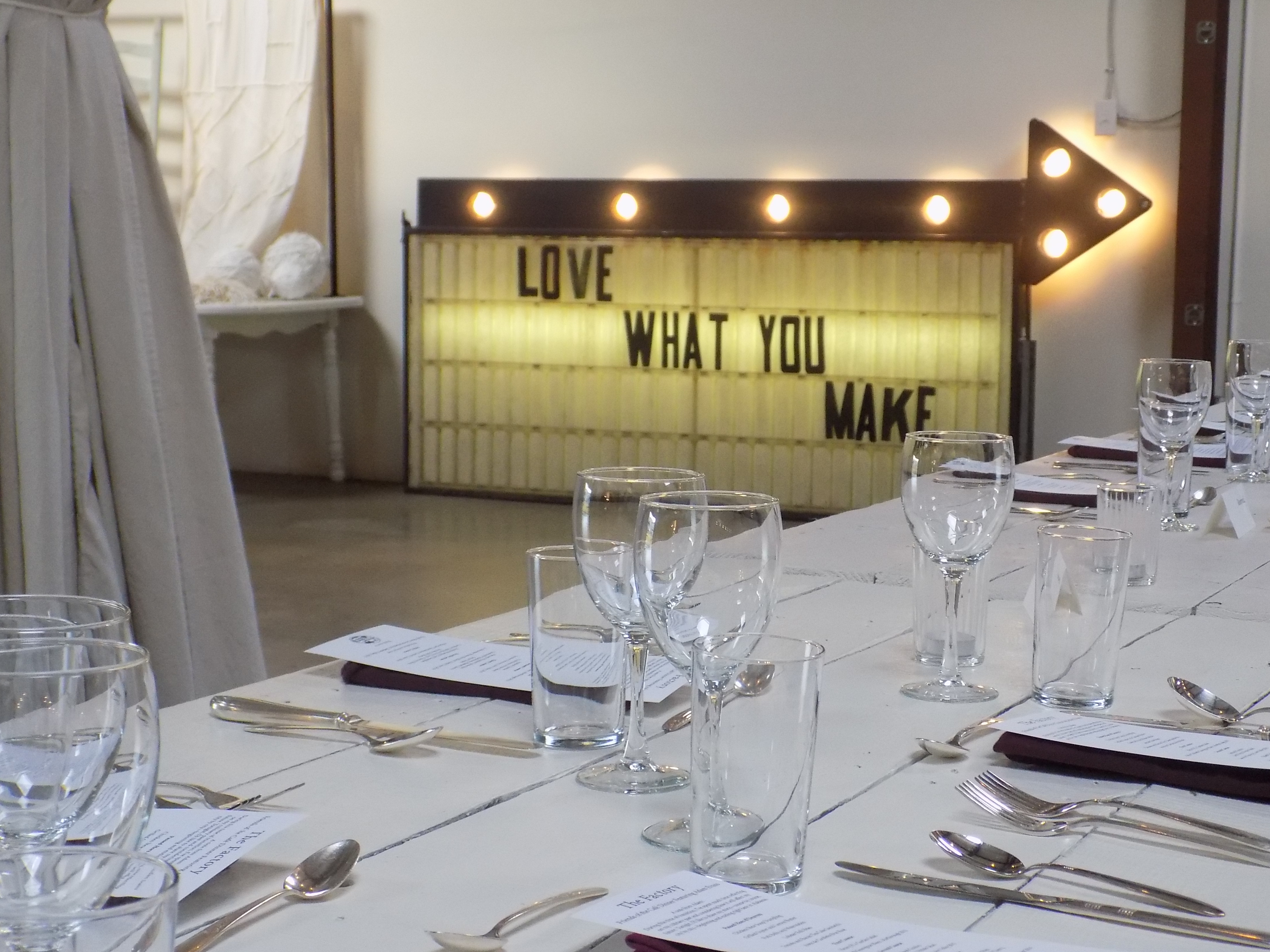
When we got to the Alabama Chanin Factory in Florence for the Spring Harvest Friends of the Café dinner, the place was already jovial and full and hors d’oeuvres were being passed.  We grabbed a devilled egg and headed toward the dining area and were greeted by Natalie Chanin, the acclaimed “slow fashion” designer and host for the dinner (www.alabamachanin.com).

Anne was her always charming self, as was Natalie, but as we moved away Anne muttered “I’ve wanted to meet Natalie Chanin for years and when I finally do I have egg in my mouth.” Not to worry – Anne had another conversation with the designer at the end of the evening and I don’t think there was any notice of the hors d’oeuvres incident.

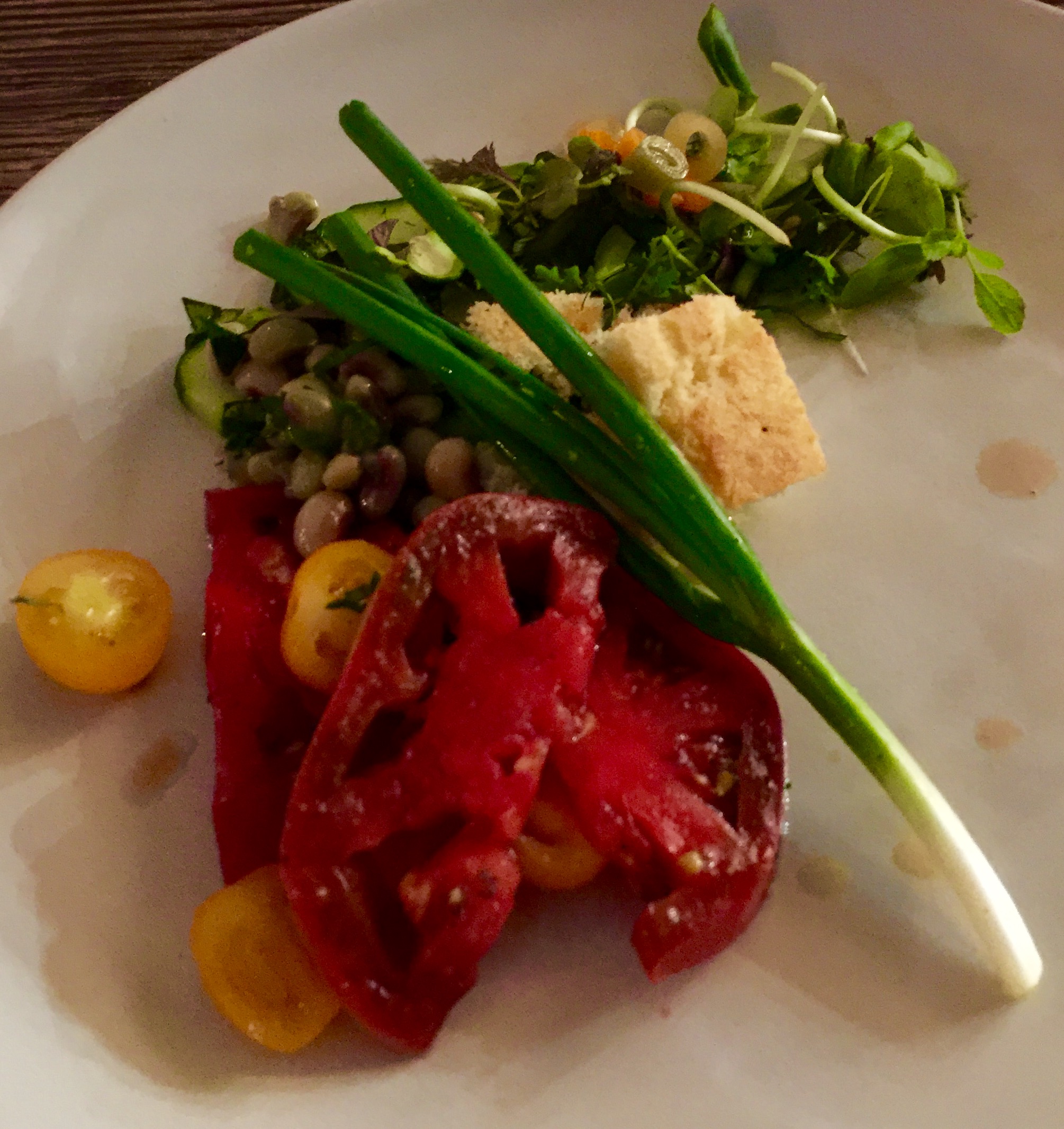
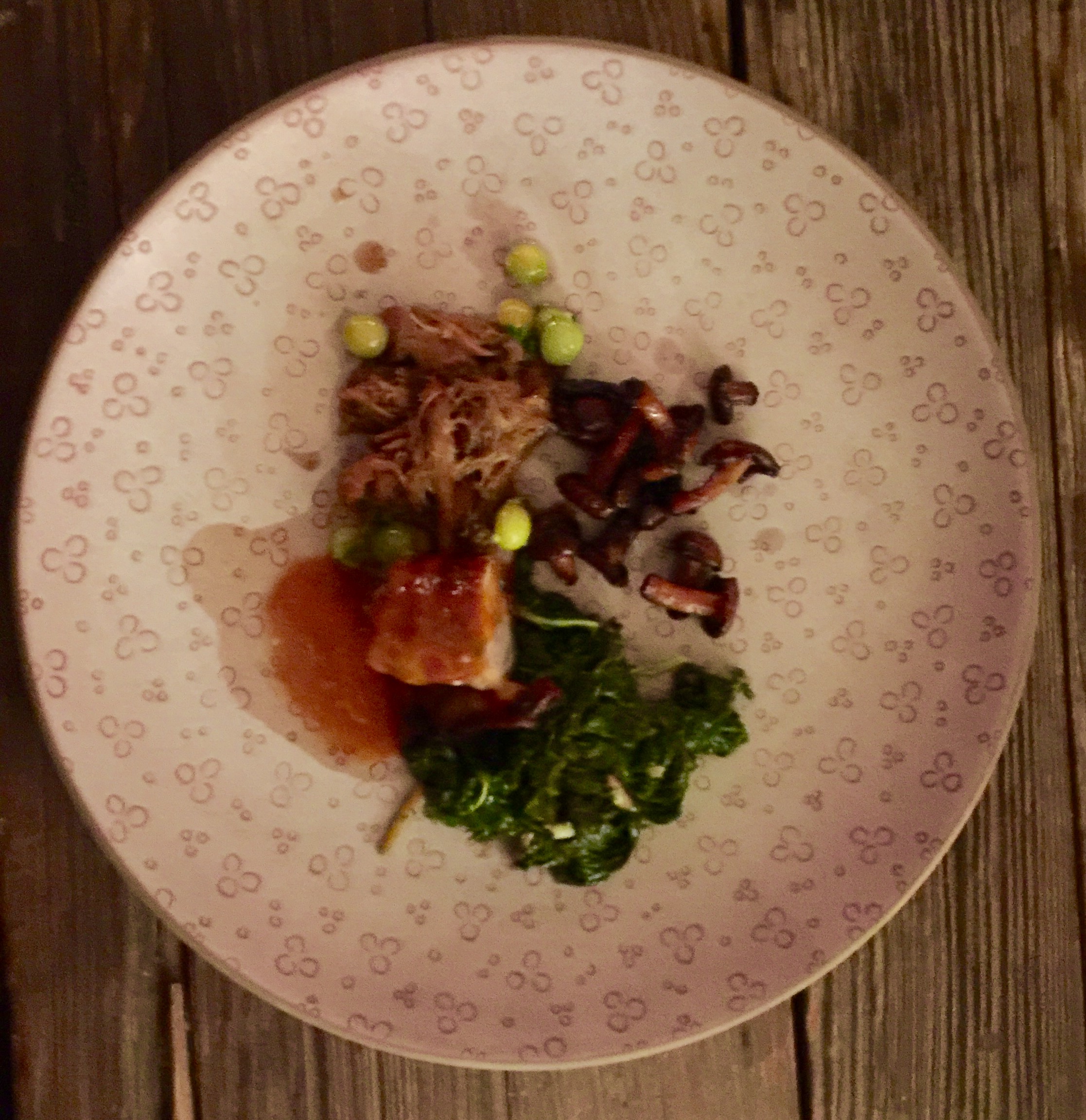
I need to write an essay on the dinner itself, and I plan to (but I got no decent photos – was far too busy eating the food and chatting). The featured chef for the evening was the Factory’s resident chef, Zachariah Chanin, and it was one of my favorite meals ever at the space (I think I’ve made six of the ten Friends of the Café evenings). The amazingly fresh spring harvest ingredients were primarily from Bluewater Creek Farm in Killen, Alabama, an organic farm run by Collins and Liz Davis in partnership with Doug and Donna Woodford (www.bluewatercreekfarm.com). I wrote about my tour of Bluewater Creek Farm in the essay “Sustainability and Soul” in November 2014. IMG_0837

Suffice it to say, the meal was brilliant. Each Friends of the Café event is a benefit and this one was no different. The honoree was Nest, a non-profit organization that supports artisans and makers throughout the world and with which Alabama Chanin is very involved (www.buildanest.org).

Incidentally, the dessert, a strawberry shortcake with local strawberries macerated in a thyme simple syrup with freshly whipped cream is assuredly the best and freshest I’ve ever tasted. Almost as good as the dessert’s taste was watching Zach Chanin and his staff assembling the dozens of desserts on the café bar.

As always, new acquaintances and friends were made at the family-style seating. Anne and I sat across from a couple from Indianapolis. “What brings you to the Shoals?” I asked. “We drove down for dinner” was the honest reply. A family next to me had driven in from Corinth, Mississippi, for their first Factory meal and assured me they’d return.

During dinner, a spontaneous conversation erupted at my end of the table about “Seinfeld” catch phrases.

“A Festivus for the rest of us.” “Not that there’s anything wrong with that.” “The Bro.” “Sponge-worthy.” “Yadda yadda yadda.” “The Contest.”

And my personal favorite  – “SERENITY NOW!”

As always when I am at the Factory, the spirit of community and connection is palpable. In addition to the fine company in the room, Anne texted our friend Deb in Paris and we both wished she was with us. So the good feelings spread beyond Alabama and the Shoals and were truly international. After a thoroughly satisfying evening of food and sociability, we said our goodbyes and walked out under a bright and friendly full moon. When we got back to Decatur my tire was flat as a pancake.

It was late. Anne offered her guest room and I decided AAA could wait until morning.

By morning, I went downstairs to find Anne tending to a much calmer Zeke and my ruined tire was tended to by a particularly pleasant AAA tow truck driver. At last, I was back on the road and headed home.

A very wise woman once advised me that I should reserve a part of each week to be quiet, relax, and regroup. When my schedule allows, that time has always been Sunday night at my house. I cook a good meal, sit quietly, and listen to soothing music until time to go to bed.

I realized that this particular Sunday night would be the first chance I’ve had to renew that tradition in a long while. Inspired by Zach Chanin and Bluewater Creek, I surveyed my recent farmers market purchases to see what I could put together that was fresh and local and planned a healthy evening meal. I needed to run to the grocery store to supplement some things. In the produce section I ran into a friend I hadn’t seen in over two years. As we quickly caught each other up on what had been happening, I realized anew how hectic my life has been recently; no wonder I feel tired

Returning from the store I decided to sit in the back yard to savor the warm weather, have a cold drink, and observe my weekend’s progress before cooking commenced. As I sat quietly, I heard a plaintive voice in the back alley: “Se-REN-ity … here, Serenity.”

As the voice got closer to my back gate I saw a woman looking in every direction and calling for Serenity.

I went out the gate and into the alley. “What have you lost?”

“My dog, Serenity. We just moved in to the house down the street and somebody left the gate open and she got out.”

I told her I would keep an eye out for Serenity and asked what she looked like.

Serenity is a Jack Russell terrier.

As I write this, I am sitting in the tire store getting a new tire. The HVAC guy should be at the house by the time I get back, working on some outside conduits. I’ll pack to go back down to Birmingham where there seems to be a full schedule waiting for me, including a trip to Tuscaloosa, taking Mother and her neighbor to see the Cahaba lilies in bloom, this season’s first peach run to Chilton County, a Japanese steakhouse dinner to celebrate my nephew finishing sixth grade.

When I get time, I’ll have to make some cheese straws for those new neighbors – the ones who named their dog “Serenity.”

Railroad Park

DSCN0284  Growing up, I lived in Birmingham during some of its most tumultuous years. Through it all, I loved the place and was a vocal advocate for its potential to anybody that would listen. I find that most Birminghamians across the board seem to be a loyal bunch even as we recognize the challenges.DSCN0269

The last time I lived in Birmingham in the early 1990s, the movement toward developing city center living and lofts was being discussed even as the discussion was being met with skeptical smirks. I was an advocate for downtown living and hoped to be a pioneer in downtown Birmingham loft living but my career track had other ideas.

Birmingham is now in the midst of that long-anticipated renaissance as it is touted as a food destination, as it boasts more public green space per capita than any other American city, as it is competing successfully for new development, and as it aggressively restores long-neglected buildings and properties.  DSCN0262

Birmingham’s central district is divided into north and south by railroad tracks that run through the center of the city. The financial district and the historical downtown are north of the tracks and the medical center, UAB campus, and Five Points South entertainment districts are south.

For many years the area next to the railroad tracks was a no man’s land of broken concrete and chert, poke sallet and weeds. In 1910 Railroad Park (www.railroadpark.org) opened as a 19-acre green space with trees and lakes, numerous paths and recreational areas, a food area and performance space, and nine acres of open, sloping lawn.

DSCN0290Railroad Park sparked development in that part of Birmingham south of the railroad tracks and now Regions Field, home of the Birmingham Barons baseball team (www.milb.com), is across the street from the park, Restaurants, micro-breweries, shops, apartments, lofts, and condos make the area a populated and busy space with new development all around. A couple of blocks from the eastern edge of Railroad Park, Rotary Trail in the Magic City (www.birminghamrotary.org), a four-block long green space claimed from an abandoned railroad bed, continues the expansion of green space to the former industrial site that is now Sloss Furnaces National Historic Landmark (www.slossfurnaces.com). Railroad Park was designed by Tom Leader Studio and was the 2012 winner of the Urban Land Institute’s Urban Open Space Award. Among its competition was New York City’s High Line.

An expansive park in the heart of downtown might have sounded like a place nobody would come to a few years ago but now it is always full of people and a great place to stroll or relax, picnic and play. Scattered through the park are descriptions of the city’s industrial heritage and stunning new views of the downtown area. Paths are made of recycled materials and bricks and rocks from the site are used throughout as the bases of benches and platforms.

Trains are constantly moving along the tracks in each direction.DSCN0283

On a recent visit to Railroad Park I saw families celebrating birthdays, people catching a bite to eat, frisbees and sunbathers on the lawn, people walking dogs, a dodgeball game. Many people were just hanging out until time to walk over to Regions Field to catch the Barons game.

I restrained myself from starting up a conversation with a young man sitting quietly under a tree and reading The Great Gatsby – just about my favorite novel ever.

Railroad Park is a relaxing respite in the middle of an increasingly vibrant city center. It is one more example of the city of Birmingham getting it right. There seem to be lots more examples these days. DSCN0305

New Pioneers of Bessemer

DSCN0230 I have always been interested in the history of the postbellum industrial South. In fact, that history intrigues me far more than the antebellum South. Part of that interest probably stems from growing up in Birmingham – which did not exist during the Civil War and was founded in 1871, six years after the War ended.

The visionaries who brought Birmingham into existence as the first industrial giant of the post-war South were pioneers. As the city has evolved, the heavy industry which was its original raison d’etre has disappeared and been replaced by medicine and finance. Some factories still survive but there are large swaths of abandoned areas which once bustled with shift workers and 24-hour muscle.

I carry James R. Bennett and Karen R. Utz’s Iron and Steel: A Guide to Birmingham Area Industrial Heritage Sites (www.uapress.ua.edu) in my car. It is a handy reference to the industrial history of the region. My parents’ house sits on the side of Shades Mountain just above the site of the Oxmoor Furnace, Jefferson County’s first blast furnace. Oxmoor Furnace was tied to the Red Mountain mines, the site of which has been reclaimed by nature and is now the sprawling Red Mountain Park – one of the largest urban parks in the United States.

About thirteen miles southwest of downtown down I-20/59 is the postbellum industrial town of Bessemer which was incorporated in 1887, when Birmingham was sixteen.

Today, areas of Bessemer are blighted and most of the bustling heavy industry is gone. The Pullman Standard plant stopped manufacturing railroad cars decades ago and the iron and steel factories are long gone. Throughout Bessemer are reminders of its more thriving past — rusted relics of train trestles, factory sites, abandoned mines. During its heyday, when Bessemer was a town populated by shift workers, it was a 24-hour town – as were Fairfield and Ensley, industrial towns and communities between Bessemer and downtown Birmingham that are also reeling from economic challenges.

Bessemer has made an admirable effort to diversify and bring in business. Its location along the interstate is full of the types of businesses that one finds at any interstate intersection. The 109-year-old Bright Star (www.thebrightstar.com) is still a popular restaurant in the middle of downtown and Bob Sykes Bar-B-Q (www.bobsykes.com) on the Bessemer Superhighway has continued to pack people in since 1957. The downtown area is full of interesting old masonry buildings – some still well-maintained and others in dire need of repair. It’s a fascinating small city with a rich history and an abundance of reminders of a more flourishing past.

Last week my mother mentioned that the Bessemer Historical Homeowner’s Association (www.bessemerhistoricsociety.com) was presenting a tour of historic Bessemer homes and gardens over the weekend and that she would like to go. We planned to go on Sunday afternoon and it turned out to be a miserably rainy and windy day but we decided we’d go anyway and see what we could see.

The first stop on the tour was in Bessemer’s Lakewood neighborhood. The Wilson House, nicknamed “The Abbey,” is a sprawling house from 1926 on top of a hill overlooking the lake and its assorted white swans and other fowl. I was interested in checking out a Lakewood home since that community was an annual part of my family’s tour of Christmas lights when I was a boy in Birmingham. I haven’t been to Lakewood to see Christmas lights in five decades, probably, but a Christmas tree frame still floated on a platform in the middle of the lake so I guess it’s still a holiday destination.

“The Abbey” was the only Lakewood house on the tour. The rest of the tour went deeper into the heart of Bessemer’s residential area near downtown and that is where the true meaning of the event began to coalesce. Many of the proud homes on the tour were in the middle of streets that were partially abandoned and dilapidated. Freshly renovated treasures were sitting next to vacant lots and houses that were falling in on themselves.

Some of the houses were true mansions in their time; others remain mansions now. There were grand houses with monikers like “The Castle” and “The Abbey.” It was interesting how many times I entered a house and the first words out of the tour guide’s mouth were how many fireplaces the house contains; the Shaw House on Dartmouth Avenue may have been the winner, I think, with thirteen.

DSCN0239Most of the houses on the tour were recently renovated or in the process. I enjoyed the elaborate grand houses but I was most struck by the smaller and more modest homes that I could imagine myself actually living in. Many of the houses are owned by young couples or singles that have made a commitment of time, trust, and money to come into Bessemer neighborhoods that others might overlook as being past their relevance. These new pioneers – and I find them in many communities these days – are gambling that they can help restore a vitality that has faded in communities that are still worth our notice.

Bessemer’s Clarendon Avenue is a street I have never traveled before last week. Two of the houses on the tour were along that boulevard with its wide grassy median. Sections of Clarendon are in extreme disrepair but a drive down it – even in a raging Sunday afternoon thunderstorm – leaves little doubt of its former grandeur. The imposing house referred to as the “Moody Mansion” is truly impressive but the “Clay-Green House,” the more modest cottage directly across the street, was where I wanted to linger. The young couple who owns and is renovating the place have updated it beautifully while retaining its historic integrity.

The next to last house on the tour, the Matthews House on Owens Avenue, was also across the street from a big grand house, but its charm and warmth attained in a still progressing renovation were what caught my eye and attention. Again, a young owner has taken on the challenge of helping to revive the house and its neighborhood.

The storm got progressively worse and we ended up skipping two of the eight houses on the tour. Even so, the afternoon was well spent and inspiring; there are new pioneers of Bessemer to admire. I wish them well. DSCN0241

Tonic

DSCN0179 The restorative powers of the Friends of the Café dinners at the Alabama Chanin Factory in Florence are palpable each time I go. At the most recent dinner I attended in March, walking through the factory doors had cathartic impact.

For those who have never visited the Alabama Chanin factory (www.alabamachanin.com) – which is the workplace for the artisans and craftspeople responsible for clothing designer Natalie Chanin’s line of organic hand-crafted clothing and other lifestyle products – the space itself has an instant sense of community and a tonic effect. The aesthetics of the place are in a harmonic balance and the products displayed in the retail area are diverse but somehow all work together. Art works and objects of interest are placed throughout; they are spare and do not overwhelm. DSCN0184

The Factory’s Café is helmed by Zach Chanin, executive chef (and Natalie’s son), and serves exceptional and locally sourced menus daily. Periodically, however, the Factory hosts guest chefs and special evening meals that provide camaraderie and splendid dining.

At the March event, the meal was the product of the unpredictable collaboration between Frank Stitt, Birmingham-based chef and restaurateur, and South Carolina pitmaster Rodney Scott. Stitt’s flagship Birmingham restaurant, Highlands Bar and Grill (www.highlandsbarandgrill.com), has been nominated for the James Beard Foundation’s “most outstanding restaurant” award for eight years in a row now. The 2016 winners will be announced in San Francisco at a ceremony on May 2. Scott’s Bar-B-Que (www.thescottsbbq.com) in Hemingway, South Carolina, is legendary among pork barbecue aficionados and gained new  followers when the original cookhouse burned to the ground in 2013 and The Fatback Collective, a project of Southern Foodways Alliance (www.southernfoodways.org), teamed up to sponsor a “Rodney Scott’s Bar-B-Que in Exile Tour” to raise money to get Scott’s home turf back in operation. The “tour” travelled throughout the South, introducing his singular barbecue to an even broader audience.

The combination of Stitt and Scott is an inspired pairing and the resulting meal at The Factory was masterful. Diners were greeted with a “Southern Apertivo Highball” featuring vermouth, Capelleti, citrus, bitters, and Birmingham’s Buffalo Rock Ginger Ale. Pass-around hors d’oeuvres were crudités and a tasty combination of pork rind and pimento cheese.

About twenty minutes before seating for the meal, as the diners assembled, Rodney Scott and Zach Chanin brought in the whole hog and displayed it on a table in the showroom. We all gathered like paparazzi to snap photos and take in the sight and the aromas.DSCN0182

Frank Stitt introduced the meal by saying that Rodney Scott prepared the whole hog while Stitt and staff conceived and prepared the side dishes. Stitt was charmingly persnickety about the correct way to pass dishes at table. Grassroots Wines did the wine pairings with the various courses.

After a beautiful asparagus salad with farm egg, “just dug” potatoes, and ham hock vinaigrette, the abundant second course was served family style. Mr. Scott’s magnificent barbecue pork was accompanied by a turnip gratin, a hearty salad featuring farro and barlotti beans with grilled red onion, and a Brussels sprout slaw with pecorino dressing. I recently told a vegetarian friend that even though pork was featured, she would have had no problem getting her fill from the side dishes. DSCN0188

Dessert was Dol’s chocolate bourbon torte with marinated strawberries. “Dol” is Dolester Miles, the pastry chef at Highlands who is also nominated for a James Beard Award this year as outstanding pastry chef. If you have ever eaten one of Ms. Miles’s desserts, you will know that the nomination is highly deserved.

I have written previous essays about the sense of pride and community that permeates events at The Factory. Amazing meals by renowned talents only add to the aura of the place that Natalie Chanin’s singular vision has created. Each time I leave a Factory event, I look forward to the next opportunity to be there.  The next dinner at The Factory will feature in-house chef Zach Chanin. Can’t wait.IMG_0754

Eulogy

DSCN0193  My father, Grover E. Journey, died on March 21 at a hospital in Mississippi. Mother and I were on the way to Mississippi when we got the word that he was gone. My brother had left a couple of hours earlier but it was a five hour drive; none of the family got there before Dad passed away.

The service was held on Thursday, March 24, at Elmwood Chapel in Birmingham. Three Baptist ministers – Dad’s current pastor and two preacher friends he knew for decades – shared memories, prayer, and scripture. At Mother’s request the song “Going Home” was played — burned from a homemade audio cassette from the 80s of a scratchy gospel quartet vinyl LP from the 60s that Mother and Dad loved. My brother, Rick, assembled a beautiful video of visual images chronicling Dad’s life, set to Bob Seger’s “Like a Rock.”  On the printed program were the lyrics to “The Far Side Banks of Jordan” that I knew from a Johnny and June Carter Cash duet on June’s final album, Press On.

At the brief graveside service in Elmwood Cemetery, after the prayers and scripture, jazz trumpeter Chuck King stepped up to the casket and played “Yea, Alabama!” – the University’s fight song. At the end there was a chorus of “Roll Tide!” from the mourners. My Dad would love that final touch. His grave in Elmwood is not that far from Coach Bryant. It was a sad occasion but also a fitting celebration of a full and well-lived life.

My brother introduced his video and there wasn’t really any discussion of a eulogy from me, although it was mentioned and I declined. My role was to help expedite the week as much as possible. The ministers and the video eloquently said most of what needed to be said. Jim McCain, a minister who was also a neighbor and decades-long friend, got in some witty quips in a very moving remembrance of Dad as a friend and “a good man.” My favorite was his comment that “Grover would sell his lawnmower to eat at the Bright Star,” referencing that favorite restaurant.

At the visitation prior to the service, there were people — strangers to me and people I knew — who were compelled to recount various kindnesses  and assistance Dad had offered to them over the years. One man said, “I am the man I am today because of your dad.”

Since then, I have wondered what I would have said if I had spoken and what I might have said that was different from what the ministers – Tony Barber, Jim McCain, and Herbert Thomas – had so beautifully said – all of it punctuated by the images on Rick’s video.

These are some of the things I might have mentioned:

Dad and Mother were a formidable team for over 63 years. They were independent and occasionally stubborn. As a team, they didn’t always agree; Mother was never the kind of wife who felt bound to abide by her husband’s opinions and Dad always respected and valued that in her. He didn’t try to run her life and she didn’t try to run his. However, she would help him in his work and he would help her in hers. I remember when I was a kid and Dad would bring in extra work to help with family finances; we would all chip in and help – sometimes long into the night. Sometimes Mother would take on extra work with the same results – a family project.

There were times growing up when I was a little jealous of my parents’ relationship. They were always good parents to me but they had such a tight bond that I sometimes felt a little out of the loop.

Mother and Dad were long-time Sunday School teachers in the 4- and 5-year-old classes at Circlewood Baptist. Many of their Sunday School kids stay in touch and have gone on to distinguished and successful lives, thanks in part to “Miss Jean” and “Mr. Grover” and others who taught with them for many of those years. I remember many Saturday nights when Mother and Dad would be preparing projects for the next morning’s class.

Mother and Dad were partners in PTAs throughout their sons’ education, but especially with my brother when they were settled in Tuscaloosa (we moved frequently when I was growing up so there were lots of starts and stops in my education). Eventually, my parents moved through the ranks to become officers in Tuscaloosa’s City Council of School PTAs, with Dad eventually serving as city-wide president for the PTAs.

My parents engineered the early success of the shoebox Christmas ministry there at Circlewood, spending hours and hours each fall collecting, monitoring, and delivering thousands of gift shoeboxes packed full of goodies and necessities to be distributed to children around the world. From that start, Circlewood’s Christmas shoebox outreach is still going strong and has grown to be one of the largest among churches in the region.

Dad and Mother had each other’s back through thick and thin. Whenever there was a health crisis, they pulled together and pulled through, advocating for one another each step of the way. Occasionally they fought for each other. On more than one occasion I told my parents that I wouldn’t want to be their doctor; they would challenge the medical professionals if they felt they were not being treated well or accurately. I realize now that with the current state of healthcare, their attitude is a wise one.

Dad was always a good provider and took care of his family through good times and bad. I didn’t fully appreciate the extent of his commitment to Mother until she had malignant melanoma in 1986 and lost an eye to the cancer. Dad encouraged her and supported her every step of the way – convincing her that she could start driving again, bringing her out into the world again, convincing her that she could go on. She has pressed on with dignity and grace for over thirty years now.

When it was Mother’s turn to become a health advocate for Dad, she stepped in with strength and courage. She was resolute and uncompromising every step of the way. During the final five months of his life, while Dad was continuously hospitalized, Mother was at the hospital for hours every day – until Dad was moved 315 miles away to a facility in Mississippi. As soon as she entered the room he would reach out his hand for her and kiss her. She would sit and hold his hand for hours and when she would leave he would always kiss her goodbye.

When Dad got to the point where he couldn’t speak for himself, Mother did her homework, got multiple opinions, asked many questions, and made strong and often tough decisions. Once, when Mother was talking to a respiratory therapist who had also become a friend, she was second-guessing herself and some of her decisions and said, “… but I think if the roles were reversed he would have made the same decisions for me.” I was in the room and was the only one who was watching Dad during this conversation. When Mother said she thought he would have made the same decisions for her, Dad’s eyes darted to Mother and he shook his head “Yes.” I was the only one who saw that but it put my mind at ease that he was on board with the extreme measures being taken to try to prolong his life.

There are many other memories as well. Dad’s barbecue was some of the finest I’ve ever tasted. His fried chicken wings were amazing and unique and I have never found their match since. Dad didn’t like to make reservations or over-plan a trip; this lead to some pretty roundabout and adventurous vacations and road trips over the years. He was an “Ensley boy” – growing up on Avenue D in the shadows of the steel mills – and anybody who knows Birmingham in the early to mid-20th century knows immediately what that phrase means. Dad would talk about the Ensley boys going across town to take on the Woodlawn boys on occasion.

He would talk about riding his bike with his brothers and cousins from Ensley to a swimming hole on Shades Creek and in later years he would sometimes drive around on Sunday looking for that favorite swimming spot. He never could find it and I suspect it’s located somewhere in what is now the Robert Trent Jones golf course at the Ross Bridge resort.

Dad was a lifelong and die-hard Alabama football fan. Once, he had to take on Bear Bryant; Dad was setting up the Coliseum for winter registration and Bryant, the athletic director as well as football coach, insisted he needed it for a basketball practice. “That Journey man,” as Bear referred to him, held his ground and said, “Coach, I have been told to prepare the Coliseum for registration tonight and that is what I’m going to do.” Registration set-up went on as planned. I never heard where the basketball team practiced that day.

There are plenty of other memories to sustain me. All in all, however, one can’t adequately memorialize Dad without talking about the strength and commitment of his marriage to Mother. I know that would please him.

Communion: Haitian Vodou Flags at the Birmingham Museum of Art


DSCN0143   The Birmingham Museum of Art has always been my museum. It has been there, across the street from the north end of downtown’s Linn Park, as long as I can remember. It’s the first museum I knew; I still remember my first visit on a Sunday afternoon with Mother, Aunt Polly, and a cousin when I was about 7-years-old. When Dad’s office was downtown, I would occasionally go to work with him and idle away a morning or afternoon in the museum collection. Since then, I have always felt at home there. Even when I lived far away from Birmingham I would try to work a visit to the museum into each trip home.

Beyond my sentimental attachment, the Birmingham Museum of Art is also an excellent museum with an impressive and wide-ranging collection ranging from African, Asian, Native American, and Pre-Columbian Art to American, contemporary, folk, European, and decorative arts. One of my favorite places at the museum is a multi-level sculpture garden where I like to be at any time of the year. I didn’t appreciate how good the Birmingham museum was until I started traveling around the country and visiting other museums. DSCN0136

Most importantly, the Birmingham Museum is a city-owned museum that is still free to the public (except for the occasional special exhibition).

I spent the morning there visiting a current exhibit, “Haitian Vodou Flags from the Cargo Collection.” The small but impressive exhibition is shown in a dark room with lights highlighting the colorful flags and accompanied by video of a Haitian Vodou ceremony. Vodou was a religion established with the Africans’ arrival in Haiti in the 1500s; because Vodou was outlawed by the European colonial powers, it was practiced in secret and evolved to include Catholic saints and symbols along with the loa – Vodou spirits. There are links with American “voodoo” but Haitian Vodou has distinctions which set it apart from the American tradition most identified with New Orleans.

DSCN0122The flags on display are generally colorful square patches bedazzled with beads and sequins. As evidenced in the video, the flags may be hung, flown, or draped over the shoulders and backs of celebrants. Images combine iconography of Christian, African, and Masonic traditions and recognizable types include a Madonna and St. Patrick, snakes writhing at his feet. The textiles are stunning in intricacy, vibrance, and design detail.

I enjoyed the exhibit in its own right but another incentive was to view the legacy of Robert and Helen Cargo. In the late-70s, between undergrad and graduate school, I lived in an apartment taking up half of the ground floor of a two-story white frame house on Tuscaloosa’s Caplewood Drive near the University of Alabama campus. My landlords, Robert and Helen Cargo, lived directly across the street. Dr. Cargo taught French at the University. They were good landlords and I remember when I took the apartment Mrs. Cargo instructed me that I could open and close the blinds in the front windows but not to raise them because that would look “tacky.”

When Hurricane Frederick moved inland from the Gulf and Mobile Bay and dumped a tree on my house, I was at work on the University campus. Mrs. Cargo called me to let me know that my apartment was not damaged but that the tree which had toppled onto my house was the “biggest uprooting I ever saw.” Indeed, the house I lived in was included in a segment on Frederick’s damage that night on the “NBC Nightly News.”

I hope I was a good tenant; I think I was. But once I threw a party at my place on the Saturday night of Labor Day weekend and some of the party-goers got the bright idea to go down the street and t.p. writer Barry Hannah’s front yard. I didn’t hear about the escapade until after the fact; I expected to get an earful about it from Mrs. Cargo first and Barry second but fortunately I never got the reprimand from either source.

Not long after I moved on from the Caplewood house, Robert Cargo Folk Art Gallery opened up on 6th Street in downtown Tuscaloosa. The Cargos were important collectors of folk and outsider art – I had admired some of their pieces on the very few occasions I had been in their house – and the downtown storefront provided a place to share the collection, interact with dealers, and continue acquisitions. The Robert and Helen Cargo African American Quilt Collection was probably the most notable part of the impressive collection.

Robert Cargo died in 2012, preceded by Helen Cargo a few years earlier. A year after Dr. Cargo’s death, their daughter Caroline donated approximately 700 items of the Robert Cargo Folk Art Collection and the quilt collection to the Birmingham Museum of Art. The gift included over 75 Vodou flags the Cargos collected from the makers over the course of several trips to Haiti during the 80s and 90s. Many of those flags are included in the current exhibit.

Over the twenty years the Cargo Folk Art Gallery was open in downtown Tuscaloosa, I had visited and was well aware of the impressive quilt collection and numerous other works of folk and outsider art but the Vodou flags were unknown to me until the museum announced the current exhibition.

The last time I visited with Dr. Cargo at his gallery was in November 2003, the day after the legendary Tuscaloosa dive, the Chukker, closed its doors. Dr. Cargo was making plans to close the Tuscaloosa gallery and ship the collection to Caroline in Philadelphia where the Gallery would continue. I told him that the gallery’s closing would be a loss to Tuscaloosa. “Ahh,” he mused, “I don’t think it will be as momentous as losing the Chukker, but I hope some people might miss us.”

Robert and Helen Cargo were gracious people and passionate collectors. It was good to remember them and commune with their spirits today at my favorite museum amidst some of the objects they collected and loved. DSCN0141

.