The Kindness of Strangers

DSCN0070  I refused to turn the radio on as I followed the ambulance in a constant driving rain. I suspected there were tornadoes nearby; if there were, I didn’t want to know. It turns out I was right. And suddenly, after eyes glued to the back of an ambulance for 315 miles, I find myself in Meadville, Mississippi.

I feel like I had a primer on health care inadequacy after a week spent in ultimately futile battle with the inhumanity of Medicare regulations and the rampant cruelty and indifference of large hospital corporate administrators. My father had been released from his hospital five miles from his home and Mother to a facility 315 miles and five hours away.

The critical care ambulance drove nonstop from Birmingham to Meadville, Mississippi, and I followed behind. When we reached the small hospital in a steady drenching rain I was greeted with the news that the area we had driven through had been peppered with tornado watches, warnings, and a few actual touchdowns, just as I suspected.

I have spent plenty of time in Mississippi and briefly lived there on three separate occasions during the ‘70s and ‘90s but I had never heard of Meadville in southwestern Mississippi somewhere between Brookhaven and Natchez. It is a two-traffic light town with a small hospital that houses a unit specializing in weaning patients like my dad off ventilators. DSCN0071

From the outside, the one-story beige brick facility looks like a mid-20th century elementary school. On the inside is a staff of caring and highly competent medical professionals, under the leadership of “Dr. Ben” Yarbrough, with the common goal of helping people.

My mother’s health problems prohibit her travel with Dad so I came along for the first week to meet his caregivers and make sure he gets settled in comfortably.

When I started the “Professional Southerner” journal in 2014, my goal was to use it as an escape and diversion – to use it as a way of forgetting my job and stresses. In the past nine months, however, that has become a challenge as my father’s health declined and he was continuously hospitalized starting in October. Distractions have become hard to come by.

Instead of focusing on Dad’s hospitalization and treatment, however, I want to write about that much-vaunted Mississippi hospitality; it has been visible in full force since I arrived here a few days ago, soaked and exhausted.

Shortly after we arrived, Mitzi, the ward clerk, asked if there were any special needs. I told her that my parents are life-long Baptists and that Dad likes to be prayed with. I wondered if she might put me in touch with a local Baptist minister so that I could invite him to visit with Dad. Within minutes, I had a name and an email address and the next day Bro. Marvin Howard of Mt. Zion Baptist showed up at Dad’s bedside to talk with him and pray for his healing and recovery. He asked for Mother’s number in Birmingham so that he could let her know he had seen Dad and promised to come by one or two times a week during Dad’s stay. He invited me to come out to his house if I needed a place to stay; he offered to have me out for a home-cooked meal with him and his wife.

Since the nearest commercial lodging to Meadville is a half hour away in either direction, I came prepared to stay in Dad’s room. The accommodations are tight and, despite several nurses’ best efforts to position my convertible chair/bed, I was awakened several times on the first night by nurses or nurses’ assistants climbing into the bed with me to position themselves to turn Dad.

On day two we switched to a recliner in another part of the room but every time I moved the recliner sort of folded up on me. The nurse was very concerned for my comfort but I assured her that it is about Dad’s comfort and well-being and not mine; I can fend for myself.

I usually don’t eat meals on a very regular schedule but, living in the hospital with not much distraction, I find that mealtimes at the small hospital cafeteria are how I gauge the day. The breakfast service includes an array of breakfast staples to choose from – grits, scrambled eggs, sausage and bacon, biscuits and gravy, a selection of breads, jams, and jellies.

Lunch service changes daily but there is a selection to choose from each day, and desserts – pies, cake, bread pudding – are generous and plentiful. It’s a small hospital and the cafeteria ladies quickly learn your face and tastes. Even so, eating in the cafeteria here conjures memories of a childhood of frequent moves with Dad’s work and the constant feeling of being the “new kid” — when lunch time was often the most awkward time of the day.

For supper, a box meal is prepared and waiting for patients’ guests who are staying at the hospital. If you snooze you lose since the boxes are only available for pick-up from 5:30 to 6:00. One of the cafeteria ladies gave me a container of vegetable soup last night to take with me and warm in the microwave if I got hungry later.

On the morning of day three, the ward clerk called me away from Dad’s room and said that the local Methodist church has a former pastorium a half mile from the hospital that is no longer being occupied. She said that she had heard I wasn’t getting much sleep in the hospital and asked if I would care to stay there so I might get a decent night’s sleep. It was like a weight had been lifted since I had already started dreading that night’s sleep in the crowded little hospital room.

I gratefully took the offer. Dr. Bo Gabbert, a retired physician from the area who is active in the Meadville Methodist Church, showed up at the hospital later to pray with Dad, take me to the house, and turn over the key.

As I was sitting in Dad’s room writing this post this morning (after a good night’s sleep), Dr. Gabbert reappeared in Dad’s room with a gift. It’s a prayer shawl knitted by ladies from the church. A card with the shawl contains a prayer for recovery on the front and the signature of all of the ladies who worked on it on the back. The shawl is specifically crimson for Dad’s beloved Alabama Crimson Tide.

This is Dad’s fourth day of treatment in Meadville and marked improvements have already occurred in his breathing and physical health. The treatment will take a while and I anticipate a number of trips back and forth to Meadville but Franklin County Memorial Hospital is giving me a lesson in what a difference a caring community and committed and caring medical professionals can make.

One of Mississippi’s many great writers, Tennessee Williams, penned that famous line about depending on “the kindness of strangers.” Dad and I came to Meadville as strangers among strangers but have quickly and lovingly been absorbed into a community of unmatched kindness and generosity.

It is a time for hope and giving thanks. DSCN0065

Note: My father, Grover E. Journey, passed away at Franklin County Memorial Hospital in Meadville at 9:35 p.m. on Monday, March 21. He was buried on Thursday, March 24, at Elmwood Cemetery in Birmingham. We will always remember the kindness of the people of Meadville.


A Serenade, an Unexpected New Community: Birmingham V.A. Medical Center

DSCN0051  My father, Grover Journey, has always been reticent about his military service. He served stateside in the U.S. Army during the Korean era. His older brother, Richard, was killed in combat in Korea and his younger brothers, Paul and Huey, served in the Army around the same time as Dad, shortly after Richard’s death. Dad was serving when I was born in Fort Benning and he was in the reserves for several years until his honorable discharge.

But Dad never seemed to want to talk about his active years in the Army. I always wondered if it had something to do with the fact that Richard was deployed to Korea and Dad’s service was all domestic. Richard died before Dad married Mother a few years before I was born but his loss seemed to silently hover over Dad and his family. My paternal grandfather – Dad’s father, Tod – was an angry and bitter man and I often wondered if that was triggered by the loss of his oldest son in combat. Dad never seemed to want to discuss it; Richard still smiles in the small photo on his tombstone at Elmwood Cemetery.

In recent years, however, it seemed that Dad was a little more willing to acknowledge his Army service. When I accompanied my parents to their church for a patriotic service honoring the military, Dad stood proudly when the time came for Army veterans to be recognized. He stood again and, in a faltering voice, spoke Richard’s name when the time came to honor those who had died in battle in various American wars.

Dad’s recent long-term illness and hospitalization (107 days and counting) has created a need in my family to reach out for various sources of help and support to navigate the nightmare that is American healthcare. We have found support and encouragement from a number of sources but our need became more urgent recently when the Birmingham facility where Dad is currently being treated called in another facility five and a half hours from Birmingham to evaluate Dad. Mother was informed at short notice that if the decision was made to release Dad to the other facility and she refuses the move his Medicare coverage could be terminated. Mother’s health is declining and she has not been able to travel long distances without complications for years so moving my father so far has the potential to be devastating to her – to all of us.

Some of the advocates who have supported and advised us have suggested turning to the Veterans Administration for help. When others failed to get V.A.response and action on Dad’s behalf, Mother took on the task and, after a lengthy meeting with a V.A. representative in Tuscaloosa, Dad was enrolled in the system for the veteran’s benefits he earned; Mother was given an appointment with a V.A. social worker at the Birmingham Veterans Administration Medical Center

Mother and I went to the Birmingham meeting on Wednesday, February 3, and met a bemused and kind social worker who wasn’t sure what support V.A. could provide but took copious notes and assured us she would see what might be done to assist my Dad.  Her concern and sincerity were obvious; “She’s a nice lady,” Mother said as we walked down the hall after the appointment.

The Birmingham V.A. hospital is a large facility teeming with activity. Veterans of all ages and conditions are in the halls and offices and waiting rooms. The wait for elevators was ridiculously long and as Mother and I waited for an elevator to ground level we heard a harmonica down the hall playing “Anchors Aweigh.” Eventually, the source of the music, a veteran wearing a patriotic tee-shirt and Army cap, appeared around a corner of the elevator lobby, accompanying a Navy veteran in a wheelchair. They stopped to wait with us for an elevator and the man with the harmonica looked in our direction. “What branch did you serve in?” he asked.

“Her husband, my father, was in the Army,” I said.

“So was I,” he grinned and proceeded to serenade Mother with a rollicking version of “The Caissons Go Rolling Along.”

When he finished and Mother thanked him, he looked at an amputee in a wheelchair across the way, said “Hey, Jarhead!” and launched into “From the Halls of Montezuma.” “I hope that was okay,” he said. The Marine thanked him, saying “That sounded perfect to me.”

In fact, the harmonica player proceeded to play the song of every branch of the military before it was over (that’s how long it was taking for an elevator to arrive). Finally, after no elevator came, he looked at Mother and said, “Are you looking for an elevator that’s going down? Follow me.” He led a procession of several of us – walking, with canes, in wheelchairs – to another bank of elevators, chatting amiably the whole way.

At some point Mother mentioned that she is 81 and there was a chorus of disbelief from all of the veterans surrounding her. One called a buddy over and told him that “this lady is 81.” “No way are you 81,” said the buddy.

Mother has been quite sick recently and is exhausted by her regular vigils by my father’s hospital bed. Still, I thought I detected a slight hint of a spring in her step as she made her way out of the V.A., surrounded by admiring and complimentary vets.

I realized too that I had discovered a tight and supportive community that my father is a part of and that I never really experienced until yesterday, at a conference, trying to attend to Dad’s pressing health needs.

It gave me renewed hope and energy. It gave me a new perspective on those who serve.

(The photos at the beginning of the essay are, Left, my uncle, Richard Journey, and Right, my father, Grover Journey. They are teenagers and the photos were taken at their Grandmother and Grandfather Bodie’s farm in Mississippi.)

The Oasis

I woke up this morning craving a cheeseburger from The Oasis.

If you travel from west to east on University Boulevard in Tuscaloosa you will go through downtown and the heart of the University of Alabama campus. Continuing past Alberta City and the iconic neon sign of the Moon Winx Lodge (which survived the April 2011 tornado despite devastation all around it) you’ll pass through Five Points and a less populated area of Tuscaloosa’s edges. Eventually, University merges with U.S. 11 in Cottondale. Just past that merger point, one might almost miss The Oasis, a ‘50s-era roadhouse on the left.

If you’re in the neighborhood, try not to miss it. I haven’t been there in a long time but the place makes a vivid impression.

The Oasis is the kind of place that would have been referred to as a “beer joint” when I was growing up. It’s in a squat one-story red brick building with double neon zigzags across the top and “OASIS” centered up and left of the glass front door. Pick-up trucks are usually dominant in the front parking lot and motorcycles are often pulled around on the side. A free-standing neon sign tops a pole just to the right of the building. It is topped by the words “THE OASIS” flanked by saguaro cacti and a big neon “BEVERAGES” below. East Tuscaloosa along University Boulevard has long had some great neon.

The small entrance counter and cash register directly in front of you as you come in the door open into a basic dining room to the left with a few booths, tables, and a bar. Of course there was always a great jukebox.  A closed off barroom with a pool table is in the back with its own entrance near the rear of the building. I think I have peeked back there exactly once.

Be warned: Because the Oasis is out of the city limits (I guess) the place is still smoker-friendly and one dines there in a haze of stifling cigarette smoke. I guess it was always a smoke-filled room but I didn’t notice it so much in the days before strict non-smoking regulations. Now it hits you as soon as you open the door. I had recommended the cheeseburger to my parents a few years ago and they went in and immediately went out because of their health problems and the smoke (which I had forgotten to warn them about). The waitress came out and took their order and told them she’d bring it out to the car.

The Oasis has always felt to me like a place where one might go to cheat on a spouse. Maybe it’s the country music playing on the jukebox and the smoky atmosphere. Maybe it’s the clientele. I think it’s a combination of all of the above. Even if the waitress approaching the table doesn’t start off with “What’ll you have, darlin’?” you’ll feel like she did. The wait staff is friendly, experienced, and earthy. They have never suffered fools gladly.

The Oasis cheeseburger seals the deal. It’s a perfect old-style all-beef patty cooked on a flat-top grill with American cheese melted on the top. This is nestled beneath a pillowy top bun with the works – onions, tomato, lettuce, pickle, ketchup, and mustard. Some poll ranked the Oasis cheeseburger as among the top five cheeseburgers in Alabama; I find such rankings annoying but this one got it right by recognizing the Oasis (and I think the winning cheeseburger was Chez Fonfon in Birmingham).  Accompany your Oasis cheeseburger with a generous order of hot crinkle-cut fries. The Oasis was always the kind of place that would wrap a napkin around an ice cold long-neck beer to absorb the cold bottle’s moisture.

I passed The Oasis hundreds of times before I stopped and ate there. In the 1980s a jazz musician friend took me to The Oasis for the first time for lunch. (On that same afternoon, he convinced me how much better my life would be with a pair of Vuarnet sunglasses and I overspent on sunglasses for years after.)

I longed to be a “bad boy” back then but never really had what it took to pull it off. The Oasis, however, instantly spoke to my bad boy instincts and after that first trip I often looked for a good excuse to make the drive east on University.

I was directing a production of Sam Shepard’s “Fool for Love” in 1986. Shepard is a favorite of mine and the twisted and longing love story of an emotionally damaged couple in a run-down motel room in the Mojave Desert is a great example of his singular aching vision. One night after a Friday night rehearsal I told Kitty, the actor playing the female lead, that we were going to do some research on her role after the Saturday afternoon rehearsal and that she should dress in character.

On Saturday afternoon Kitty showed up for rehearsal wearing a little too much make-up and with her honey-brown hair dyed jet black. She wore a low-cut red blouse, skin-tight jeans, and spike heels.

“Perfect,” I said. “Where to?” asked Kitty.

After rehearsal, Kitty, the stage manager, and I piled in the car and headed out to The Oasis. It was mostly a male clientele late on a November Saturday afternoon. I started handing Kitty quarters to feed the jukebox. Every eye followed her as she leaned across the jukebox and picked out the most plaintive cryin’ in your beer tracks.

Kitty, who was already a skilled actor, was finding her character with each sip of a cold one and with each quarter in the jukebox. We paid up and headed for the car. As Kitty was getting in the car, a group of women in a pick-up truck slowed down. One of them rolled down the window and yelled “Slut!” at Kitty. The truck and its women sped away, slinging gravel in the wake.

“Well that was fun,” said Kitty with a sly grin. “Where to next?”

We decided to go to Leland Lanes in Alberta City and bowl for a while.

Satsumas for the New Year


DSCN0046 Few food-related experiences please me more than buying a bag of just-picked satsumas off the back of a pick-up truck on the edge of a pecan orchard in Baldwin County on Christmas week.

Some of the most distinctive icons of nature in the American South – magnolias, camellias, and azaleas come to mind – came over from Asia. Satsuma oranges have Asian origins too and are a part of the mandarin orange family. Mobile and Baldwin Counties on the Alabama Gulf Coast are part of a Southern “Satsuma Belt” that stretches from Texas to Florida and there is pretty specific history about how the tasty fruit got its start in Alabama. The Mobile County town of Satsuma gets its evocative name from the fruit. “Satsuma” ranks right up there with “Sipsey” among my favorite Alabama place names.

Satsumas are a medium-sized, mostly seedless, orange citrus with a distinctive skin that easily pulls away from the fruit, making it simple to peel and eat without much mess or trouble. Satsuma season starts in the fall just before the holidays commence. The fruit gets sweeter as the season progresses and its rich sweetness peaks right around the time Christmas comes around.

I always grab a few bags of satsumas when I am in Baldwin County before Christmas. Last year the weather was uncooperative and satsumas were hard to find. In years past, I usually bought my satsumas from a lady whose truck was often parked on the corner of Fairhope Avenue and Church Street in downtown Fairhope. This year there was a good crop and an abundance of stands, pick-up trucks, and signs on the side of the road alerting the public that there were satsumas to be had. The recent deluge of rain may have put a slightly early end to the season, I hear, but three days before Christmas I saw a man with a tent, a parka, and a large umbrella selling baskets of satsumas during a pounding rainstorm (with distant thunder) on a Fairhope side street.

While satsumas are a tasty treat to just peel and eat, I also usually make an ambrosia with satsumas as the citrus component. This year, between frequent visits to the hospital, my mother and I only had time to grab a satsuma in lieu of a meal on a few occasions. Mother would usually pack a couple of satsumas in her bag of provisions before a day spent by my father’s bedside but just as often she would give them away to a nurse or respiratory therapist.

I had to get to Huntsville to take care of some end of month duties at the house and the satsuma rations at Mother’s house in Birmingham were getting low when I left. Fortunately, in Huntsville today, I saw a sign advertising “Mobile County Satsumas” outside a store and dashed in to grab the last two bags they had for the season.

That should get us into a new year, perhaps into an ambrosia, and tide us over for a few days until the next crop of satsumas makes its appearance before Thanksgiving of 2016.

Happy New Year (and, oh yeah, Roll Tide).

Leaving Point Clear: December 2015

DSCN0037 On my last day in Point Clear I was awakened early by a tornado warning. I walked out onto my balcony to watch the storm system move from Mobile over the bay to the Eastern Shore. The wind picked up; the ancient live oaks around the lagoon shook fiercely as a single white ibis took flight from the water, startling white against the dark grey clouds. The storm was clearly moving to the north of me, toward Daphne and Spanish Fort. Most of the worst of the weather system had moved still farther to the north when I pulled away from the resort a few hours later and began to drive toward ominous skies.

I finagled an abbreviated version of my annual pre-Christmas retreat to the Grand Hotel in Point Clear on Mobile Bay this year despite plenty of concern; my calls back and forth to Mother and the hospital were frequent.

DSCN0041It was a shortened stay with welcome warm temperatures (despite the less than ideal weather threat) and I was able to find time to do some of the things that make this annual holiday season visit so essential to my mental well-being. Shortly after arrival on Sunday afternoon it was time to meet a contingent of the Brunson family for afternoon tea in the Grand lobby. The holiday crowd was large and festive. We adjourned from the Grand to Allison and Richard Brunson’s inviting bayside home where their oldest son John had been inspired to make a Chicago-style deep dish pizza which was savory, rich, and delicious and which seemed to exceed everybody’s positive expectations – including John’s and the brothers who assisted him. At least four other pizzas in delicious combinations were baked to accompany John’s masterpiece and we all overindulged – except for family friend Kenneth who sensibly made a salad for himself from unused pizza toppings.

On Monday, time was spent resting and reading, walking around the grounds, and exploring Fairhope and environs in search of fresh satsumas, a juicy citrus that makes its appearance in Baldwin County right around Christmas and may often be found in my New Year’s Day ambrosia. A massage was scheduled for Tuesday and it was a pleasure to catch up with Judy at the front desk; the massage therapist, Claudia; and the wonderful attendants in the quiet room, J.C. and Al. All of them provide a comforting and stress-free escape from the tension beyond the spa’s peaceful walls.

My good friend Kitty from graduate school and, later, from professional theatre gigs, was visiting with her family in Spanish Fort and met me for dinner in Fairhope on my final night. Dragonfly foodbar was the destination as we savored foodsmith Doug Kerr and staff’s always creative concoctions.

On that drizzling final morning before the trip back to Birmingham, I swung by Punta Clara Candy Kitchen to grab the requisite pralines.

St. Francis on the Point church sits across the road from Punta Clara Kitchen and the Wash House restaurant. Leaving Punta Clara, there was a sign in front of the tiny St. Francis chapel that said “CHAPEL OPEN FOR PRAYER.” I have photographed that chapel many times and have used it on my annual Christmas card but the doors have always been locked on those previous visits. I have tried to photograph the interior through the windows in the past so it was a treat this time to be able to go and sit quietly inside.

The warm and peaceful chapel provided meditation, shelter, and comfort from the various storms I faced on the drive home to Birmingham and, later, farther north to Huntsville and my house north of the Tennessee River. I was grateful for all the people who are “lifting us up” as my family faces the day to day of serious illness. “Lifting up” is my friend Judy Prince’s phrase for prayer.

As I compose this, I am sitting once again in my father’s Birmingham hospital room looking across Shades Valley at the foggy but brightly lit visage of Vulcan standing sentry over this valley and downtown Birmingham beyond Red Mountain. I will still be sitting here in a few minutes when midnight comes and it is Christmas Day. Somehow, with Dad sleeping peacefully at the moment, the twinkling lights of Homewood in the distance, and the stained glass windows of a church down below, this seems a good refuge to sit out the remains of a Christmas Eve. I will be here still when the sun of a fresh Christmas morning glimmers over the mountain to the east.

Merry Christmas. May you find comfort and joy with those you love.DSCN0040

“… a brief meditation …” – Take 3

Church (c. 1871); Maplesville, Alabama; December 2016

 Here, again, is an updated version of an essay, “Why I Mail Christmas Cards,” from December 2014. Each year, I am asked about my Christmas card project so here’s another take:

My Christmas cards went in the mail on December 1. I started designing my own Christmas cards in 2004 and it has become something many of my correspondents seem to appreciate. And now expect.

I looked forward to receiving and looking at Christmas cards when I was a child and many of the people who sent cards to my parents every year were people I never met but felt I knew from the stories my mother would share about them each December when the card arrived. Genevieve O’Brien in Chicago, Christine Allen in Georgia, and Doris and Bill Fuller in Fort Worth are among the annual cards we received without fail from people I never met. When I was grown and out on my own, I would send Christmas cards as often as I could but sometimes work schedules or finances would make it prohibitive.

From a very young age I had set opinions about Christmas greetings and Christmas décor. For example, I am a Southerner and never quite understood why so many Southerners would buy into the Madison Avenue version of Christmas and send out pristine snow scenes and winter scenes depicting images that were not part of my reality of the season growing up in Alabama. I have traveled and worked all over the country and I have had white Christmases a few times. But the Christmases of most of my life have been bracing Alabama Christmases with a chill in the air and no snow. Actually, I’m not a fan of snow and have never once dreamed of a white Christmas.

When I decided to design my own Christmas cards I wanted to feature photographs that represented December in the South. I developed rules: 1) The photograph had to be taken during the month of December and 2) the photograph had to be taken somewhere in Alabama. Those are the only hard and fast rules but over time most of the photographs have been of old country churches I have discovered around the state. A couple of times the image has been landscapes around Mobile Bay where I try to spend some time each December. The project began shortly after 9/11 and every card since then has included the phrase “Peace on Earth.”

The only exception was in 2005, the year of Hurricane Katrina. I didn’t design the card that year; instead, I purchased museum holiday cards with a detail from a still life of a bountiful holiday table which somehow reminded me of good times on the Gulf and in New Orleans.

I developed rituals: I try to get my card to the printer around October 1 each year. I start signing and addressing the cards by November 1. On December 1, my cards are in the mail. Over time the mailing list has gotten quite large. Most of the people on my list don’t send cards anymore. For me, however, it’s a way of keeping in touch with old friends and acquaintances all over the world. Some of them are people I may never see again but I like to keep a connection. I’ve moved around a lot in my life and the Christmas card list is something that keeps me in touch and grounded.

Most people who know about or receive my Christmas cards are grateful and look forward to them each year. Someone might ask if I’ve picked next year’s image yet or they’ll send me a new mailing address to ensure that they won’t miss this year’s card.

But occasionally someone will grouse “I don’t know why you do it. Who has the time? It’s so expensive. And so much trouble.” Here’s my response: If you don’t want to do it, don’t do it. I do it because it gives me pleasure. I look forward to it. I want to do it.

With each card I sign and with each address I write on an envelope, it’s a brief meditation on that recipient.

When I first moved to Huntsville, there was a lady, Grace Clark, who lived in my apartment complex. We didn’t see each other often, but whenever we did we’d have a very pleasant conversation. I added her to my Christmas card list. She never mentioned my cards but when I moved from that apartment to my house I kept sending Christmas cards to Mrs. Clark. A couple of years ago, when Christmas was past, I received a note from a woman I didn’t know. She was Mrs. Clark’s daughter telling me that her mother had recently passed away. She told me that when she was going through her mother’s papers, she found a stack of my Christmas cards. Mrs. Clark had saved each one over the years.

If you don’t have time to send Christmas cards, I totally understand. I’m busy too. I have no time for Facebook and Twitter. We each choose what we have time to do.

The 2017 image, by the way, is a church in Maplesville, Chilton County, Alabama, that was built around 1871, the year that Birmingham was founded. It sits serenely beside a railroad track, down the street from the town’s old train depot

I have realized that the frequent choice of little white country churches for the annual mailing almost makes it seem like I’m sending the same card every year. I’m toying with the idea of some changes for next year’s Christmas card. Stay tuned …

and Happy Holidays.

A Thanksgiving Dressing


IMG_2069  No Southerner I know stuffs the bird. In my experience we always serve dressing on the side. My Grandmother Harbison made a cornbread dressing and Grandmother Journey served a fancier oyster dressing, still using cornbread as a base. I like both but Mother is partial to a plain cornbread dressing without oysters so her cornbread dressing is what we have for the holidays.

Near Thanksgiving last year I shared memories of my Grandmother Harbison’s kushmagudi, a cornbread and potlikker dish which has become a staple of our cold weather holiday table. During my father’s extended hospital stay, Mother has often mixed up a quick kushmagudi when she gets home from the hospital at night.

As my Grandmother Harbison’s health made it more challenging for her to cook the holiday feasts, Mother began to make her own cornbread dressing from a recipe she found somewhere. It’s a very easy recipe, moist and rich, and even though it wasn’t exactly the same as Grandmother Harbison’s dressing, it got Grandmother Harbison’s seal of approval.

The celery in the cornbread recipe reminds me of another Thanksgiving tradition at my family’s house. In addition to using celery in the dressing, Mother has always put out a dish of raw celery sticks with our turkey. I grew up with raw celery as part of the Thanksgiving meal and never thought it was unusual until people from outside the family informed me that they had never heard of such a thing. Even so, it is a nice complement to turkey and dressing and cranberry sauce. We put celery sticks on our turkey sandwiches on Friday and that is a crunchy and delicious addition to the Thanksgiving leftover tradition too.

Even though circumstances dictate a spartan Thanksgiving this year, I packed Mother’s cornbread dressing recipe just in case I find the time to make it. And remember that a proper cornbread recipe does not include sugar.

Simple Cornbread Dressing

4 cups crumbled cornbread
2-3 slices crumbled white bread
½ cup chopped celery
1 cup chopped onion
2 large eggs
Sage, to taste
¼ teaspoon black pepper
2 cups chicken broth
1 can cream of chicken (or cream of mushroom) soup, undiluted

Combine all ingredients and mix well. Refrigerate for at least 1 hour (or overnight) for flavors to blend. Pour into 2-quart baking dish. Bake at 350 degrees for 25-30 minutes.

Happy Thanksgiving.

Thanksgiving 2015: “Simple Gifts”

IMG_2063    Abraham Lincoln declared the national holiday of Thanksgiving in 1863 amidst some of the darkest days of the Civil War. Lincoln hoped the gesture might be a unifying measure. That didn’t really happen back then but Thanksgiving has since become a time of celebration and unity that transcends the crass commercialism that accompanies it. We take a day – or maybe only a moment – to pause and give thanks for whatever blessings we may have. Lincoln’s gesture reminds us that at the worst and most hopeless of times, we should remember what we have to be grateful for.

2015 has been a tough year for my family. As I write this, my father is in his fifth week in an intensive care unit. It has been very touch and go but after some pretty radical procedures Dad will soon be moved to a specialty care facility at another hospital where the goal is for him to progress to the point that he can come back home.

This would be good news for everybody, but especially for my mother who has been by Dad’s side every single day, holding his hand for hours on end and diligently making tough decisions about his care. My parents have been married almost 63 years and the bond between them is unusually strong, especially in the tough times. Mother is a cancer survivor; when malignant melanoma was found in one of her eyes thirty years ago Dad was beside her, fighting tirelessly with her the whole way. They have been a formidable and indominatable team throughout their decades together. Now it’s Mother’s turn to speak for Dad and she is showing how tough, resolute, and resilient she can be.

In the six months since my Dad’s health issues began a noticeable decline, some of my friends and acquaintances have faced their own challenges, serious illness, and a few deaths. Back in the summer I remarked to a friend that “I’m not ready for this part of my life.”

Who is?

So we take it day by day and try to be as positive as possible, even on the bad days and through the dreaded phone calls in the middle of the night. Dad still can’t speak but this weekend he wrote a few sketchy notes. He asked for his glasses and then wrote “How do I get out of here?” When Mother arrived at the hospital he wrote “I love love you.”

Mother said last week that there would be no Thanksgiving celebration this year. I understand how she feels and know how difficult it will be to work in Thanksgiving among the hospital visits.

Yet, remembering Lincoln’s gesture as well as the gesture of the English immigrants and indigenous people at that proverbial first American thanksgiving, it seems that the hardest of times may call for the most fervent of thanks. These times give us an opportunity to reflect on what we still have and appreciate and hope for.

We may not have a feast with a bird and all the fixings but I am sure my family and I will find time enough and reasons to give thanks on Thursday.

IMG_2067Simple Gifts (Shaker dance tune)
– Joseph Brackett (1848)
‘Tis the gift to be simple, ’tis the gift to be free,
‘Tis the gift to come down where we ought to be,
And when we find ourselves in the place just right,
‘Twill be in the valley of love and delight.

I thank you for reading my journal.

Finding the Links in the Paint Rock Valley

IMG_2019  The small white wood-frame Presbyterian church building in the community of Trenton, Alabama, in the Paint Rock River Valley of northeast Alabama is the sort of simple church architecture I seek out in my travels. The church was built in 1903 and held its last service in 2008. The building’s current owner, Trenton native Jean Arndt, graciously opens it for community events. It no longer has heat and electricity; when I first visited in 2013 there were handmade quilts draped over each pew for the visitors to wrap themselves against the November chill.  IMG_2006

The ambience, along with the soft light filtering through the many windows, created a warm, cozy venue against a chilly rainy mid-autumn Saturday when I returned to Trenton Presbyterian Church for the second time recently. The event was the Heritage Harvest Festival 2015, part of the effort of my friend Judy Prince and her network of supporters to build and nurture community in the Paint Pock Valley.

IMG_2016

I travelled down early with three communication arts videographers – Howard Melton, Julian Johnson, and L’Debra Henderson – who are my students at Alabama A&M. We were there to shoot the event to provide video documentation. The bad weather caused the turnout to be small but the gathering was engaging and responsive.

Musicians and storytellers were among those in attendance. Trenton native Billy Smith performed a set of 17th Century Scottish tunes on the lute. His performance was prefaced with memories of his family and of growing up in Trenton. He also included a history lesson on the Moorish origins of the lute and the instrument’s adaptations over the years. IMG_2035

Jean Arndt gave an informative history of the church and her family’s generations-long affiliation with it. She had a particularly evocative account of car headlights illuminating her night-time baptism in the nearby Paint Rock River in the ‘40s.

The area’s rich Native American history – particularly with the Cherokee nation – was remarked upon and Judy Prince gave her personal testimony about the history of the area and her efforts to build community throughout her life and career not only in the Paint Rock Valley but as a social worker and Civil Rights activist in Birmingham and Mississippi in the 1960s. IMG_2043

Trenton native Randy Jones provided musical accompaniment on the church’s old piano as the gathering sang cherished heritage hymns including “What a Friend We Have in Jesus” (my mother’s favorite), “Amazing Grace,” and “Simple Gifts,” the Shaker hymn. Jones later performed the adaptation of “Simple Gifts” from Aaron Copland’s “Appalachian Spring.”IMG_2055

Observing the gathering, I realized that the goals of Paint Rock Valley’s cozy harvest gathering have much in common with the recent Friends of the Café dinner I attended at the Alabama Chanin factory in Florence. Although these were very different proceedings, each sought to bring diverse communities together to build a unified and productive whole.

A theme of the Florence event was a celebration of handmade items and locally grown and sourced foods and the concept of the “maker” in all of its incarnations. Similar themes come to play in the efforts of Judy and others in the Paint Rock Valley. The burgeoning revivals of handcrafted and farm to table, the various “roots” movements, and the call to be better stewards of the land and our natural environment are themes that Paint Rock Valley and Alabama Chanin have in common although each comes at it from a different place. While Alabama Chanin originates with a Shoals-based fashion designer, Judy Prince’s Connect UP efforts find focus in a rural and comparatively isolated valley along the lyrical Paint Rock River. IMG_2022

Driving down to Birmingham on Saturday afternoon, I mulled the lessons and similarities of these two discrete but intricately related gatherings. The links are clear and the aims are the same. It is up to all of us to make the connections.

It may be the case that with increased awareness, participation, and attention to the honest and talented people in and from Paint Rock Valley, Paint Rock Valley’s time in the spotlight may be imminent. IMG_2056

Community activist Judy Prince is pictured above. More information about the Joys of Simplicity Wellness Adventures and the Connect UP Program may be found at Judy’s website, www.tinyurl.com/lutybme.

Makers and Others at the Alabama Chanin Factory

IMG_1991 I live in a high tech town full of engineers, IT, military, and rocket scientists. That is all well and good for them and they speak of the place as a mecca but I am a liberal arts guy from Birmingham who has lived and traveled all over the country working in the performing arts. I have lived in Huntsville for thirteen years now and have a difficult time finding my niche in that community.

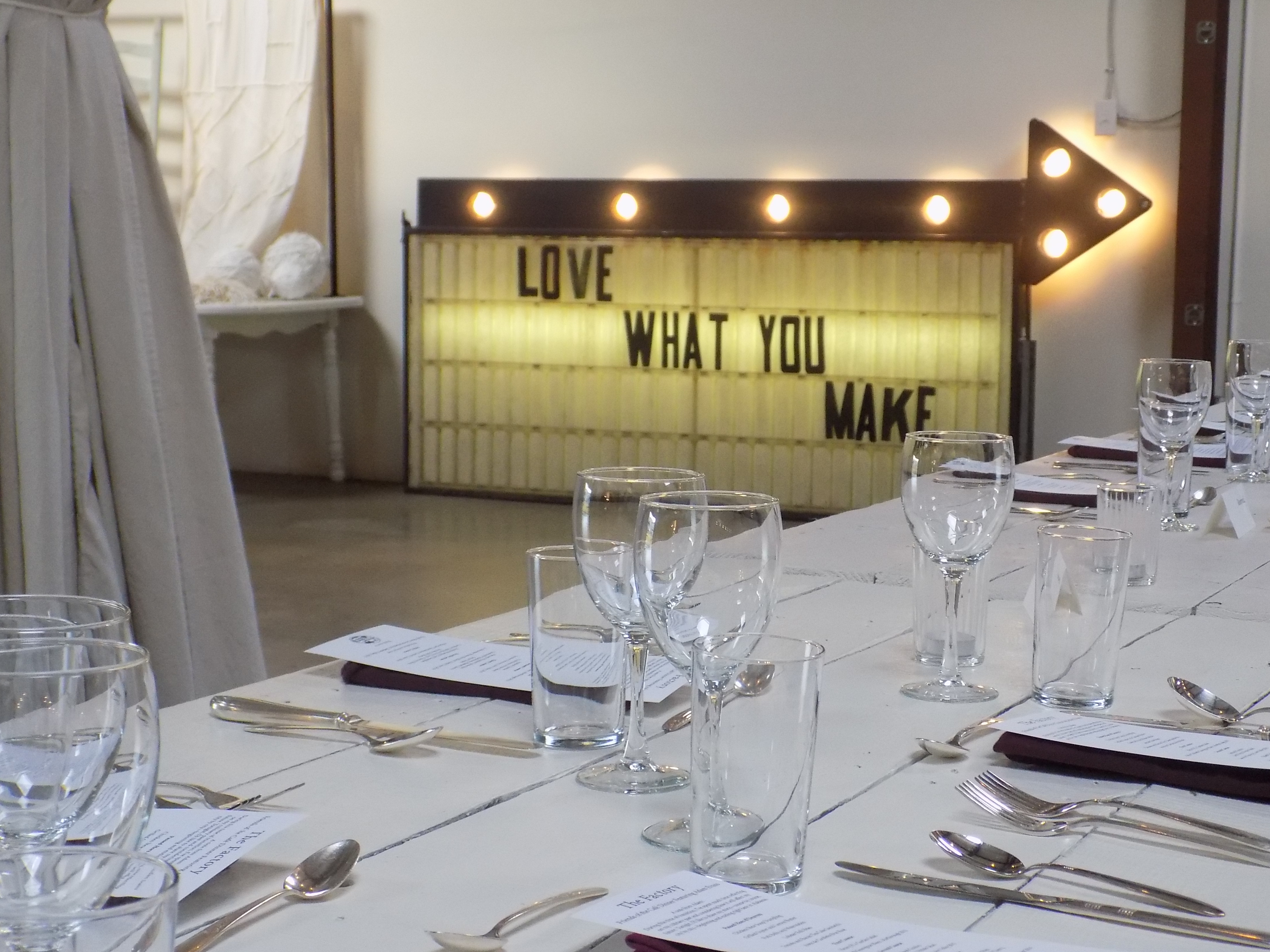
So I was fortunate indeed to be able to travel over to Florence again to attend the most recent Friends of the Café dinner at the Alabama Chanin Factory on Saturday, October 24. This is a trying and stressful time for my family with my father in the hospital; my mother, bless her, knew I had reservations for the dinner and insisted that I travel up for the night. IMG_1993

I have attended several of these Alabama Chanin (www.alabamachanin.com) events over the past sixteen months. Natalie Chanin is doing great things to spark community from her design business based in the Shoals and she and her phenomenal staff always create a lovely and memorable evening of food and camaraderie. In addition to Chanin’s amazing hand-sewn fashion designs and clothing, the Factory store features books, pottery, art, and other products, most of them crafted by various makers from the South and beyond. The aesthetic of the place is flawless and I am always restored and inspired when I leave the Factory. When I attend the Alabama Chanin dinners I feel like I have found a place where I “belong.”

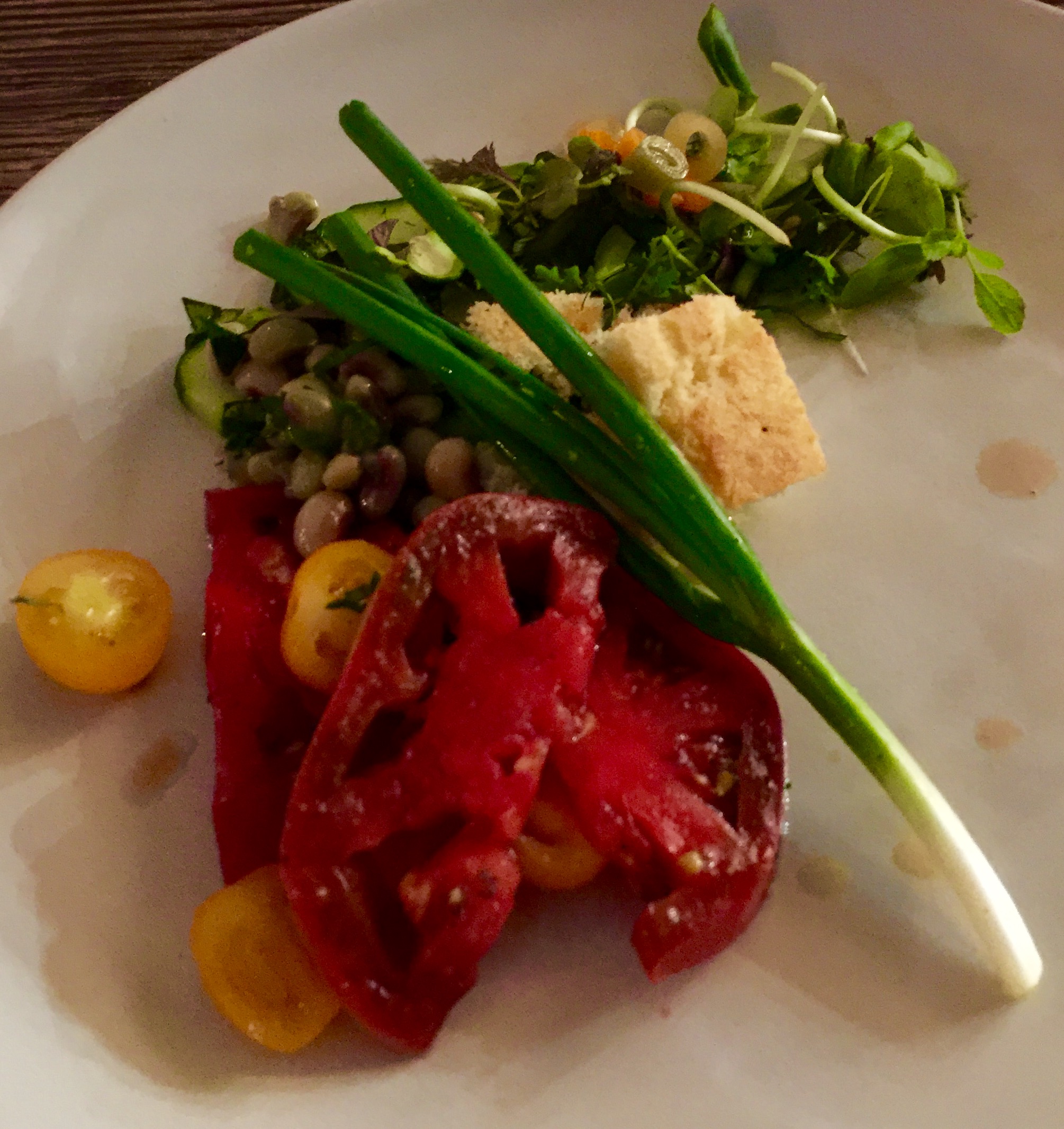
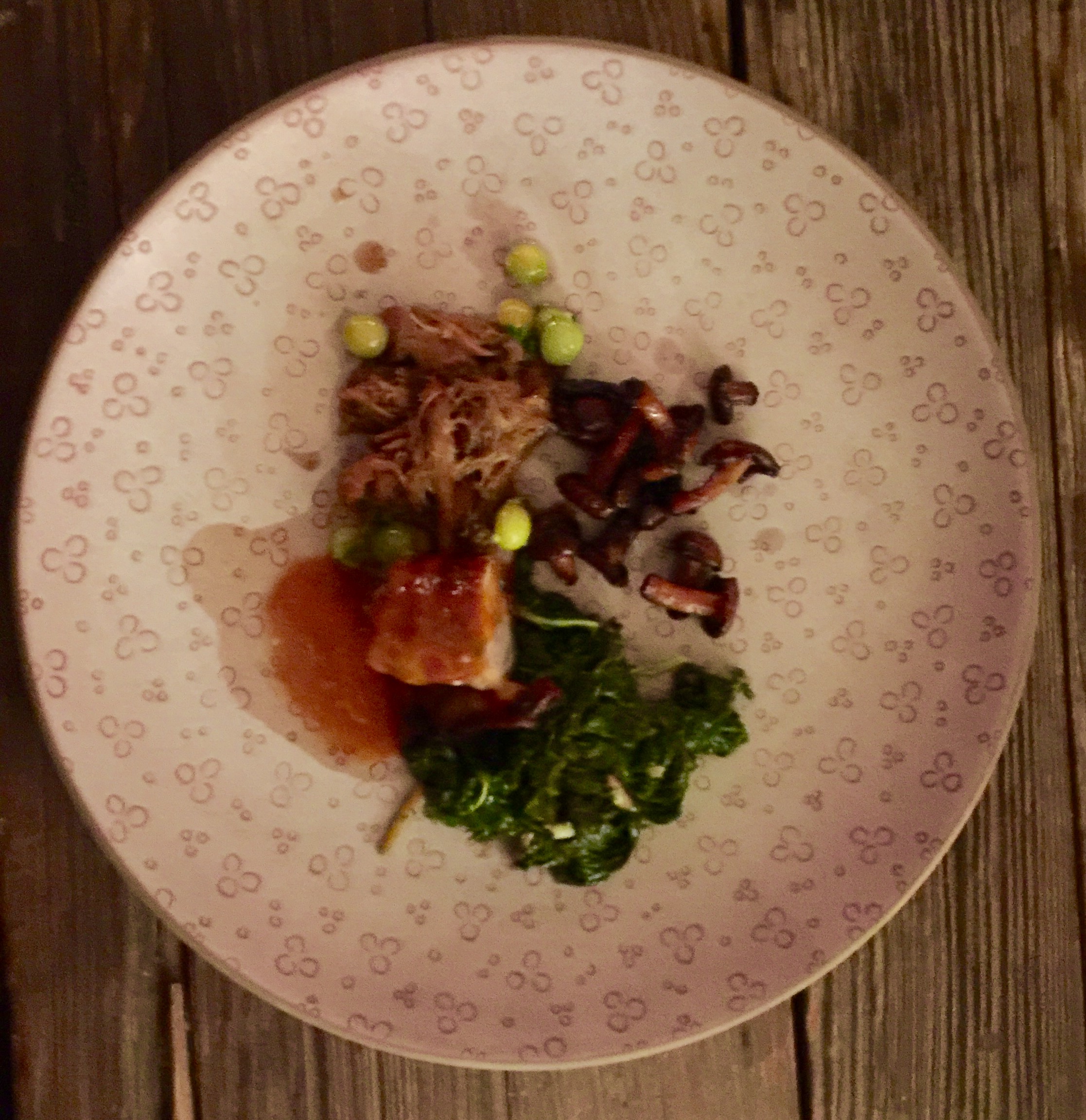
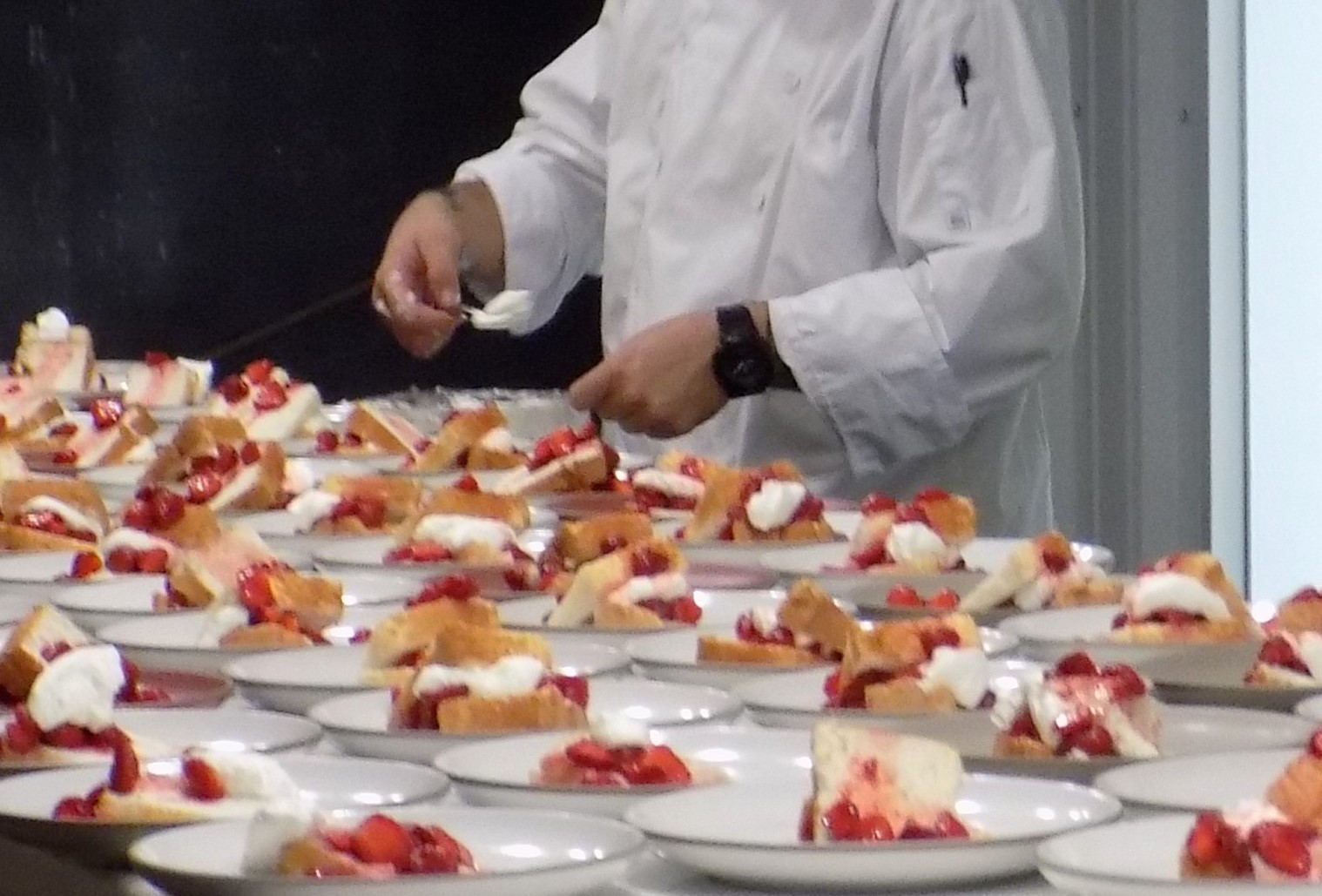
IMG_1995Chef Anne Stiles Quatrano of Bacchanalia (www.starprovisions.com) and other Atlanta food destinations was the guest chef for the evening. After cocktails and an assortment of passed hors d’oeuvres, diners sat down to a four course meal with wine pairings starting with a Georgia white shrimp cocktail. The second course was served family-style and featured a whole roasted Green Circle chicken in a large vessel with bitter greens and roasted chicken jus vinaigrette.

A simple and elegant cheese course featured Grayson cheese with hazelnuts and crispy honeycomb presented on a circle of fine wood. Finally, the dessert course was canales with a rich coffee cream and Revelator coffee (www.revelatorcoffee.com).IMG_1999

“Southern Makers,” an Alabama collective of artists and artisans (www.southernmakers.com), was a sponsor of the event and guests received a “Maker Box” of Alabama-made products introduced by Garlan Gudger of Cullman’s Southern Accents Architectural Antiques (www.sa1969.com). Oxford American magazine (www.oxfordamerican.org), another sponsor, is now partnering with Southern Makers to expand the collective to include artisans, artists, and makers from throughout the South. Lee Sentell of the Alabama Tourism Department took the opportunity to discuss the upcoming “Year of Alabama Makers” during which makers throughout the state will be featured in tourism publicity and events.

Finally, Chef Quatrano brought and signed copies of her gorgeous cookbook Summerland: Recipes for Celebrating with Southern Hospitality. This is one of the prettiest cookbooks I have seen with a long and varied collection of recipes and commentary.

During the comments throughout the evening, someone mentioned that even though people travel from faraway destinations to see Alabama Chanin’s operation and to have the Factory experience, many Alabamians have not yet heard about her business, what she does, and her wide-spread  influence. The word is getting out, however, and with the continued efforts of Alabama Chanin, Southern Makers, Oxford American, Alabama Tourism, and many other makers and supporters throughout the state more people will be aware of the hidden treasures to be found and nurtured throughout Alabama and the region.

A night at the Factory in Florence always gives me hope.

IMG_1997