Last Minute Shopping for Chocolate-Covered Cherries

IMG_1074   My parents’ house was quiet and last minute preps were pretty much finished by 5:00 p.m. on Christmas Eve when I retreated to the bedroom to reread “A Christmas Memory,” Truman Capote’s timeless and touching memoir of a childhood Christmas in Alabama. I’ve lost count of how many times I’ve read that beautifully written story.

As tumultuous as Capote’s later life became, “A Christmas Memory” is an enchanting and innocent tale of a seven-year-old boy and his 60-something-year-old distant cousin making fruitcakes and homemade presents in Monroeville in Depression-era south Alabama. I saw Capote read the story live during an appearance at The University of Alabama and it is still a cherished and moving literary memory.

Capote was in his later years – he was only 59 when he died in 1984 – and his various addictions and career disappointments had taken their toll. His legendary bitchiness was definitely on view that night in Tuscaloosa as he read and commented on various passages from his career.

When he read “A Christmas Memory” to end the evening, however, he seemed somehow transformed. The arch bitterness left his voice and one felt like we were seeing a brand new Capote – untouched by the jadedness and later trials of his life. There were many cynics in that audience – I was one of them – and I will venture to guess that most of those in the room were Alabamians who had grown up with the story; it was my first-hand observation that none of us left the room unmoved by the power of that beautifully written memoir told in such an honest and loving voice.

On this Christmas Eve 2014, as I reread the story, I got to the familiar passage in which the narrator lists the things he would like to be financially able to give to his cousin.  “I would like to buy her a pearl-handled knife, a radio, a whole pound of chocolate-covered cherries …”

Then it hit me. I have seen no chocolate-covered cherries in my parents’ house this year. My dad loves chocolate-covered cherries at Christmas – the inexpensive kind you find at the discount stores. As long as I can recall, there were always boxes of them at the house, gifts from friends who know about Dad’s passion.

Some of the friends who always supplied the boxes of cherry treats are now too far away for the gift exchange. My sister-in-law and nephew always make chocolate-covered cherry mice around the holidays and this year’s batch had already come and gone closer to Thanksgiving.

For years, I would send Dad a box of the Harry and David chocolate-glazed Bing cherries until my mother confided that he really preferred the cheap cherries you could get at the drugstore.

And this year it was Christmas Eve and there were no chocolate-covered cherries in the house. I looked at the clock – 5:20 – and went in to where Mother was reading.

“Did anybody bring Dad chocolate-covered cherries this year?”

She grimaced and said “I completely forgot.”

I told her I’d be back and headed for the door. She whispered who is going to be open now? and I assured her that there were places open until 6 or later on Christmas Eve.

“Try the drugstore first,” she said.

The drugstore was crowded but near the front door were shelves with chocolate-covered cherries on sale – two boxes for the price of one.

I grabbed two boxes, wished the cashier a Merry Christmas, drove back to the house, and passed the chocolates off to Mother who put them in stockings at the fireplace.

With my Christmas shopping finally done,  the clock struck 6:00 as I went back to the bedroom and finished Capote’s story.

Photographing Churches

IMG_1059    O! How I love time spent south of the salt line in December! We were all doubtful that I’d be able to see my friends Deb and Jeana Brunson in Fairhope this year but they arrived in town on Thursday, my last day at The Grand, from Las Cruces, New Mexico, and Tallahassee, Florida, respectively.

We gathered for afternoon tea at The Grand with Deb and Jeana, their brother Richard and his wife, Allison, and Allison and Richard’s dapper youngest son, William, who insisted on wearing a tie for tea at The Grand. I helped him tie the tie and commented that with his blue blazer, button-down shirt and tie, and khakis, he looked like an Alabama frat boy headed to a game. All of the Brunsons had a Christmas concert to attend but Deb, Jeana, Allison, Richard, and I met later for a memorable meal at Dragonfly Foodbar in downtown Fairhope.

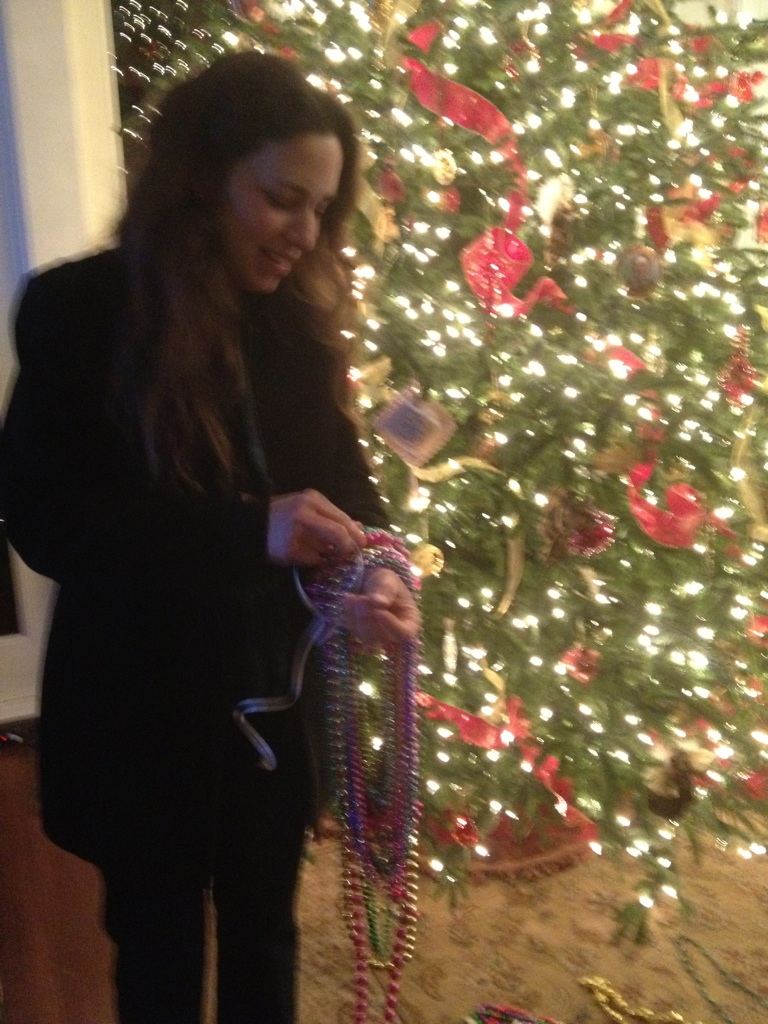
During dinner, I mentioned that I was out of Mardi Gras beads and Allison and Richard insisted that I stop by their house and get some of their stash. Later, at their beautiful home on Mobile Bay, Allison and Richard not only brought out a load of shiny beads from storage, but they also insisted on untangling them, separating them by size, and tying each bundle together before they loaded them into a huge box which should fulfill my Mardi Gras bead needs for a while. Allison Brunson sorting Mardi Gras beads  Richard Brunson sorting Mardi Gras beads

It is a true friend, I realize, who will sort and tie your Mardi Gras beads.

As I headed north from Point Clear on Friday, I realized that it was December 19 and I had not photographed any churches for my 2015 Christmas card. Realizing that there was still plenty of time and that there were a couple of back-up buildings I might use in north Alabama, I decided to keep my eyes open for any Christmas card-worthy churches along the drive home. In an earlier post for this journal, I recount my criteria for my annual Christmas card designs. I look for buildings that are often vernacular, were photographed in the month of December, and are always honest.

IMG_1011

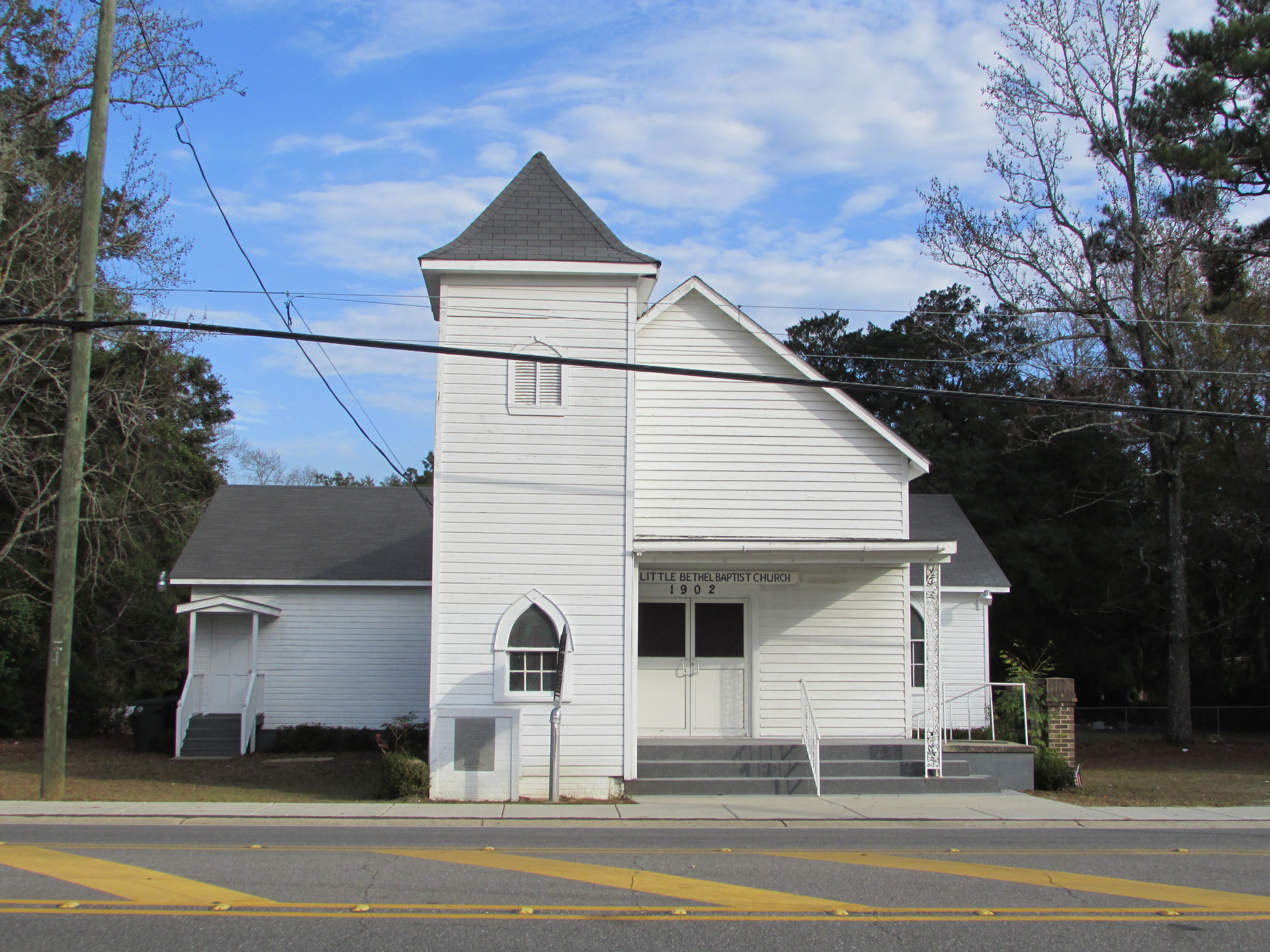
On this most recent trip, I had already taken photographs of Little Bethel Baptist Church in Daphne. Traveling along Alabama SR 225 in rural Baldwin County, I decided to check out St. John’s, a small yellow Catholic chapel that I had passed many times before but never photographed. As I pulled away from St. John’s, I noticed a small white building through the trees. I pulled off the road again and discovered what looks like a former schoolhouse that is now designated as “James E. Cook Memorial Presbyterian Chapel.” It is a charming little church I had never before noticed.

IMG_1021  IMG_1024

A few hours later, approaching Montgomery, I remembered the small town of Lowndesboro off U.S. Highway 80 between Selma and Montgomery. Highway 80 from Selma to Montgomery has been designated by the National Park Service as the “Selma to Montgomery National Voting Rights Trail,” a national scenic byway. Turning off 80 onto CR 29 into Lowndesboro, one travels through an impressive and well-maintained collection of antebellum architecture compressed into a very brief stretch of road. I have been to the town several times now, but it is always a shock to see such pristine examples of domestic and non-secular architecture in such a compact little community (population 140).

A particular oddity among the roadside attractions of Lowndesboro is the C.M.E. church, erected around 1830. Instead of a traditional steeple, the building is topped by a structure which was the original dome of the first Alabama state capitol in Cahaba. It was moved to Lowndesboro and mounted on the church when the original capitol building in Cahaba was demolished. IMG_1042

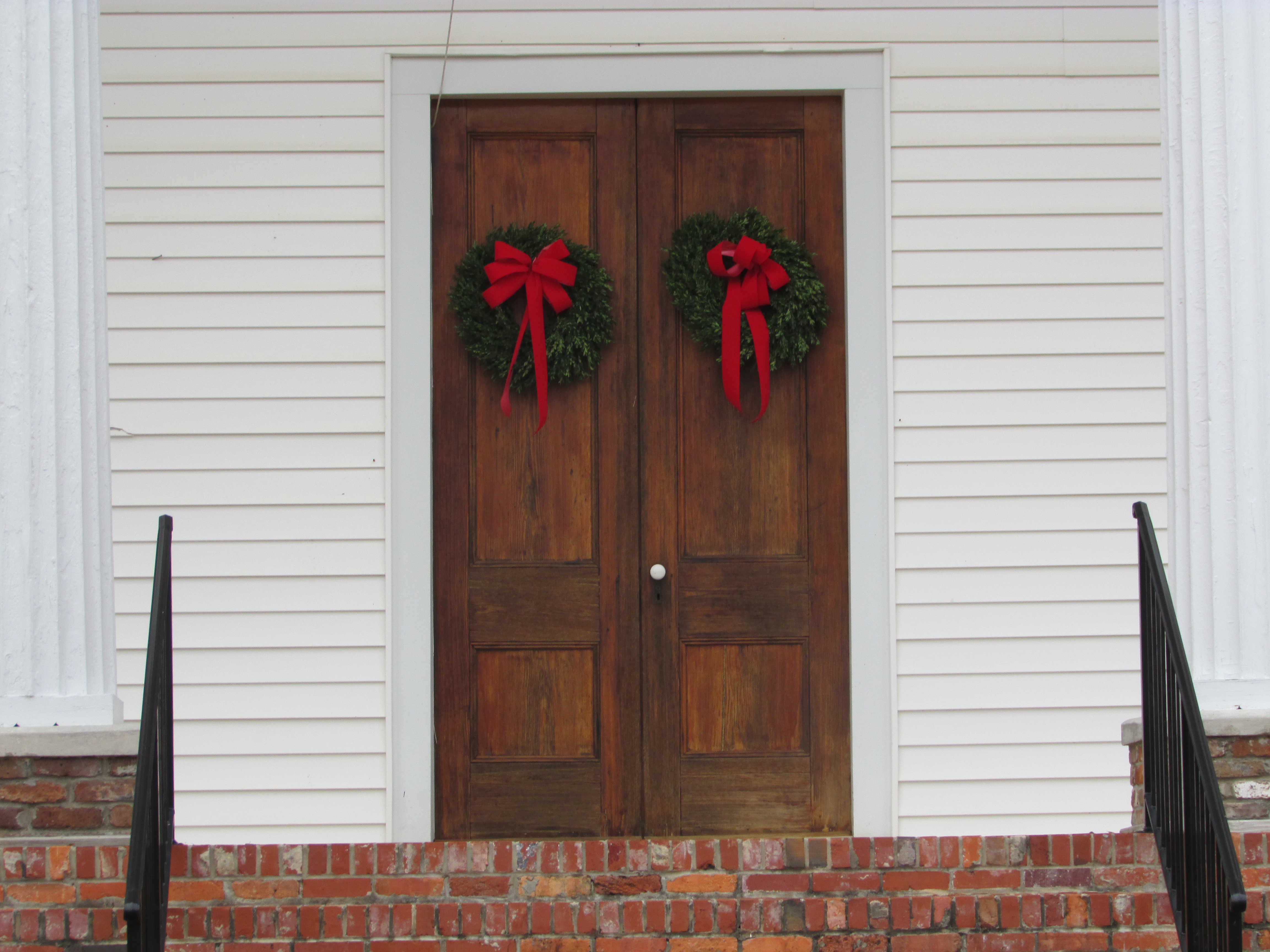
IMG_1035St. Paul’s Episcopal is a stately and dignified structure. Lowndesboro Baptist has intricate Carpenter Gothic detailing in the wooden columns on its portico. Lowndesboro Presbyterian (pictured at the front of this post) has simple Doric columns. IMG_1047

The only one of the impressive old churches that did not make the cut was Lowndesboro United Methodist. The main structure is very handsome but I couldn’t get past the steeple, which just couldn’t quite live up to the building’s base. Alabama-native writer Eugene Walter, who was quoted in an earlier post, referred to such steeples as “little-prick.” I now regret not taking a picture of the building, since it was a lovely church (other than that unfortunate steeple) and I likely won’t be back in Lowndesboro for a while.

Lowndesboro was a treasure trove in my search for picturesque churches. After roaming the street and photographing for about an hour, I drove away with the certainty that I have now found my Christmas card image for 2015. The challenge will be choosing just one out of many.

A playwright friend recently sent a note from Los Angeles and said “it isn’t Christmas at our house until your church arrives!” It is because of such kind words from many friends and correspondents that I take particular pride and effort in my December sojourn to photograph churches and other images of the season throughout Alabama.

Merry Christmas.IMG_1055

South of the Salt Line

IMG_1004   Fairhope, AL. I first learned the phrase “south of the Salt Line” from the great boulevardier and Mobile native Eugene Walter, who is worthy of his own post and will get one from me soon enough. It was Walter’s contention, based on growing up in his beloved Mobile, that “folks who live below Alabama’s salt line are a little crazy.”

He means “crazy” in a good way. Walter’s philosophy is extensive but it has to do with the belief that Southerners who live with ocean salt in the air tend to be a little less uptight, reserved, and conservative. He felt it applied to people in south Alabama, the Mississippi coast, and the environs of New Orleans in particular. I hope he’s right because whenever I travel down this way, regardless of the weather, I like to roll down the window and breathe a little of the salt air. It frees me up, somehow. On the other hand, there are a lot of Republicans down here.

An added benefit of my annual sojourns to the Grand Hotel in Point Clear is my proximity to the chain of little Baldwin County towns south of the Salt Line along the Eastern Shore of Mobile Bay. When I hit the northeastern start of the Bay, I travel through Spanish Fort, Daphne, Montrose, and Fairhope prior to my arrival in Point Clear and The Grand on Scenic Hwy. 98. IMG_0999Continuing past The Grand along Scenic 98 to regular 98, I cross the Fish River and Weeks Bay and arrive in Magnolia Springs.

I could spend my entire vacation on the grounds of the Grand and in the environs of Point Clear, but explorations of the surrounding communities make the trip richer and even more special. I like to contrast Baldwin County’s Eastern Shore with a popular stretch of Highway 30-A in the Florida panhandle that has become a mecca for striving professionals. The village of Seaside is lovely and had the best intentions but its appeal and success have caused a desecration of 30-A in many ways. The once undeveloped byway is now congested with developments, each seeing how they might out-pastel and out-gentrify the other. 30-A developers slash the landscape and then build homes and business districts evocative of the turn of the previous century, causing gridlock, exorbitant prices, and desecration of a once pristine local landscape. The towns of Alabama’s Eastern Shore naturally have the authenticity and character that all of those Seaside-inspired communities struggle mightily to achieve.

IMG_0982Fairhope, Alabama, was founded in 1894 as a utopian “single tax” colony. Historically, it was a place that encouraged progressive free thinking. The downtown is thriving with locally-owned businesses and the area is a draw for artists and writers. There are art galleries, specialty shops, antiques, and other treasures throughout the walkable downtown which is beautifully and seasonably landscaped year-round. Page and Palette (www.pageandpalette.com) is a particularly fine independent bookstore. The Kiln (www.thekilnstudio.com) is a ceramics gallery and studio that I never fail to visit and usually I walk out with new items for gifts or for my ceramics collection. Owner/artist Susie Bowman has beautiful tastes and a beautiful shop.

Over time, I have found my favorite Fairhope eateries at each end of the price spectrum.

IMG_1006 Last night I had another great meal at Camellia Café in downtown Fairhope (www.camelliacafe.com). Chef Ryan Glass presents an impressive array of fine dining options in a cozy and relaxed setting. Down the street from Camellia Café on Section Street is Master Joe’s (www.masterjoessushi.com), a startlingly fine sushi place in the middle of fried fish territory.

Other great options downtown include Panini Pete’s (www.paninipetes.com), a bustling place that spills out into an attached conservatory and onto the courtyard of Fairhope’s French Quarter shopping district. I love the muffaletta panini but everything on the menu is worth a try. In a new downtown location – or new to me, anyway – is Dragonfly Foodbar (www.dragonflyfoodbar.com). IMG_0980 “Foodsmith” Doug Kerr presents an ever-changing menu of creative small plates, bowls, and tacos. Dragonfly continually offers fine dining dishes at affordable prices in a dive-y setting. Now that they have moved from the former hot dog stand location on Fairhope Avenue to larger digs on Church Street the wait is no longer hours like it used to be.

Farther out, Wintzell’s (www.wintzellsoysterhouse.com), with a Fairhope location just down scenic 98 from The Grand, is a Mobile establishment that has branched out with a handful of locations on the coast and farther inland. It provides a large variety of seafood options with its signature Gulf oysters served “fried, stewed, or nude.” Wintzell’s is usually the destination on my first night in the area, a familiar and comfortable place after a long drive.

Market by the Bay (www.marketbythebay.com) has added a Fairhope location to complement its original location in Daphne. I like to order the Market’s shrimp po’ boy that has so much shrimp in it that I have started calling it “box full o’ shrimp.” The Market’s location in Daphne is a great seafood market in addition to a cozy eatery.

Closer to The Grand in Point Clear is the Wash House restaurant (www.washhouserestaurant.com). The Wash House is located in a rustic building, part of which housed the washing facility for the large country house on the main road. IMG_0987 I have dined alone and with friends at the Wash House on many occasions and the experience always feels like a special occasion. The restaurant is behind the old farm house that is now the home of Punta Clara Kitchen (www.puntaclara.com). Punta Clara is my local stop for pralines to carry back home. They sell all kinds of handmade specialty foods, jams, jellies, and preserves. Punta Clara Kitchen products are usually well-represented at my New Year’s Day lunch for friends.

I always enjoy traveling the expanse of Baldwin County but I usually find myself staying in the area surrounding Point Clear and The Grand resort. IMG_0990 A short trip down the coast on Highway 98 takes me through huge pecan groves, farms, and homes. Shortly after crossing the Fish River and Weeks Bay, I arrive in the town of Magnolia Springs, which is as idyllic as its name suggests.  Residents along the Magnolia River in Magnolia Springs still get mail delivered by boat to boxes on the edges of their piers. Live oaks arch over the narrow streets and I usually find myself ditching the car and taking long leisurely walks through the streets and along the river. A popular dining option in Magnolia Springs is Jesse’s (www.jessesrestaurant.com). IMG_0997

For those who wonder why I always return to the same place for my December getaway, it’s hard to explain the attraction of the place unless they experience it for themselves. When I first started coming down here, I felt an obligation to venture away from Point Clear and would plan side trips into Mobile, or down to Gulf Shores and Orange Beach, or over into coastal Mississippi. Eventually, I realized that it was enough – and exactly what I needed – to just come to The Grand and relax, occasionally venturing out to places that are minutes away. I feel like there is still plenty of Baldwin County to discover and explore.

With that in mind, I take a deep and relaxing breath of salt-infused air, take a left when I ought to take a right, and check out the next treasure south of the Salt Line. IMG_0962

Postcard from The Grand

     IMG_0938  Point Clear, AL. People have been coming to a hotel at this spot for rest and rejuvenation since the 1830s. For me, a visit to The Grand Hotel in Point Clear, Alabama, (www.Mariott.com/Point-Clear) has become an annual December event. I occasionally get down here at warmer times of the year but the pre-Christmas visit is my constant.

IMG_0948


The Grand Hotel is located on the Eastern Shore of Mobile Bay, a short distance south of the town of Fairhope, at a point where the bay broadens as it gets closer to the Gulf of Mexico. The various buildings overlook the Bay and out toward the Gulf on one side and a peaceful lagoon surrounded by ancient, Spanish moss-dripping live oaks and walking paths on the other. The grounds are expansive and beautifully landscaped with paths along the bay. Pathways open to the public radiate beyond the resort and one is welcome to stroll past the private sides of bay-front Point Clear homes and get a sense of local living.

In the warm months the place bustles. A huge swimming pool is full of sun-worshippers and all kinds of outdoor activities – biking, kayaking, croquet, beach bonfires, etc. – are available throughout the grounds.

Now, in December, it is more quiet and less crowded and I have found that this trip is a perfect and much-needed way to shake off my job after a demanding semester and to brace for the holidays with family and friends.

IMG_0941

As might be expected from such a place, there is a feel of tradition. Hurricane Katrina did massive damage to the Alabama coast in 2005 and the hotel was closed for over a year while renovations occurred. When I returned in December 2006 after the renovation, I was relieved to see that the restoration had taken pains to restore the look and feel of the place prior to the storm.

The site has history and tradition and it manages to retain the feel without overwhelming one with the past. Every afternoon there is a small military procession through the grounds ending at a Civil War-era cannon. After the hotel’s military history is recounted – it served as a military hospital during the Civil War, was fired upon during the Battle of Mobile Bay, and the grounds include a Confederate cemetery containing the remains of many casualties of the Battle of Vicksburg (which happened 250 miles away) – the cannon is fired and can be heard throughout the area.

While the cannon fires outside, an afternoon tea is held around the grand fireplace every afternoon at 4:00. There is a blazing fire and a huge Christmas tree this time of year.

IMG_0927

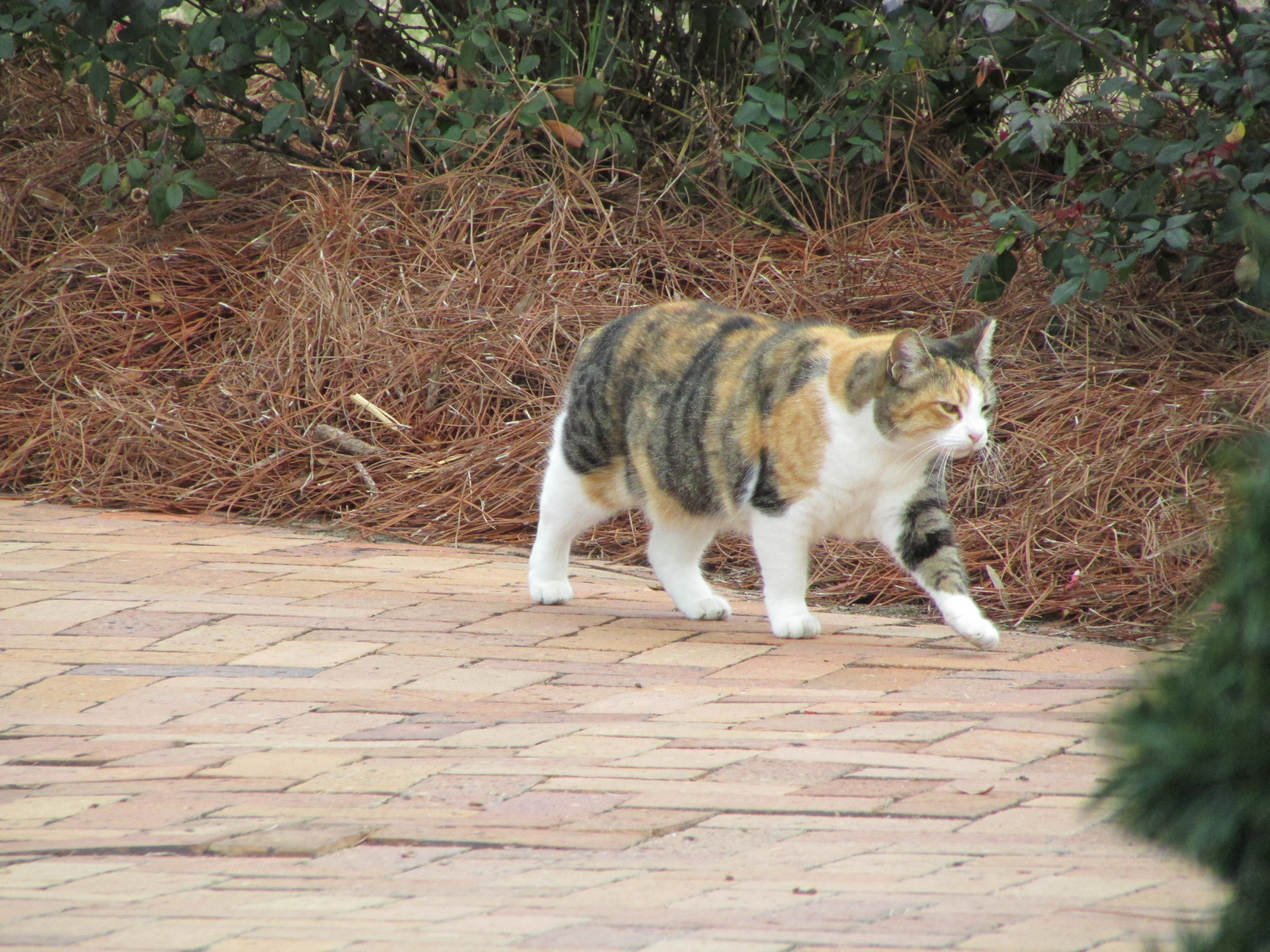
Outside Bucky’s Birdcage Lounge, also located in the main building, is a sunset bell that is rung thirty minutes before sunset each day. It is a reminder to move toward the lounge and toward the Bay-front to observe and celebrate what is almost always a spectacular sunset. “Bucky” Miller was a beloved employee of the Grand for 61 years and a life-sized statue of Bucky stands outside his namesake lounge, his hand extended in greeting. Bucky’s cats still roam the grounds – or by now maybe Bucky’s cats’ descendants. I was greeted by one of Bucky’s cats as I went into the main building for check-in yesterday.

IMG_0933    IMG_0925

I have heard about the Grand my whole life but I didn’t start coming down for regular visits until over a decade ago in the early 2000s. Several years ago an acquaintance who used to come to the Grand for decades remarked, when I told him I was about to come down, “I hear the Grand isn’t so ‘grand’ anymore.” (Isn’t there always that guy?) Things change and the events of the past may not be happening with the velocity they once had, but my Grand experience is always peaceful and invigorating and exactly as grand as I want it to be. The fact that I always splurge and treat myself to a massage at the hotel’s highly-rated spa makes my experience that much more grand.

In the earlier years of the Grand’s history, it was owned by individuals and families. It is now a Marriott resort owned by Retirement Systems of Alabama, part of Alabama’s much lauded Robert Trent Jones Golf Trail (the property includes Lakewood Country Club). The staff is international and far-flung in origin but there are many locals who work here too and there are faces and names that are familiar to me trip after trip. It may all be an act, but I will say that the employees at the Grand always seem happy and they make every guest feel special and welcome. It’s a wonderful place for families and couples but I am usually here as a single and feel totally at home and comfortable as such.

IMG_0959

I was already in my 40s when my recurring “Grand experience” began. I know people who started coming here with their families when they were very young. There are always happy children and young people at play when I make my visits. However, I have always felt that I started coming at just the right time for me – at a time when I was looking for stability and peace of mind in my life. I worry that if I had started my annual treks even a decade earlier I might have found the place a little staid and slow.

I have a long list of places I still want to visit in this world, but, for me, if I want to relax and regroup, coming back to a place I know and a place where I feel like I can just sit on the balcony and while the day away with a good book is the ticket to a perfect vacation (New Orleans is another of those places for me). After staying in buildings all over the resort, I now have and always request my favorite room in the Spa building. IMG_0911


So, the Grand it is and the Grand it will be for this December and, I hope, many Decembers to come.

IMG_0939


Food Memory: Mother’s Fresh Apple Cake


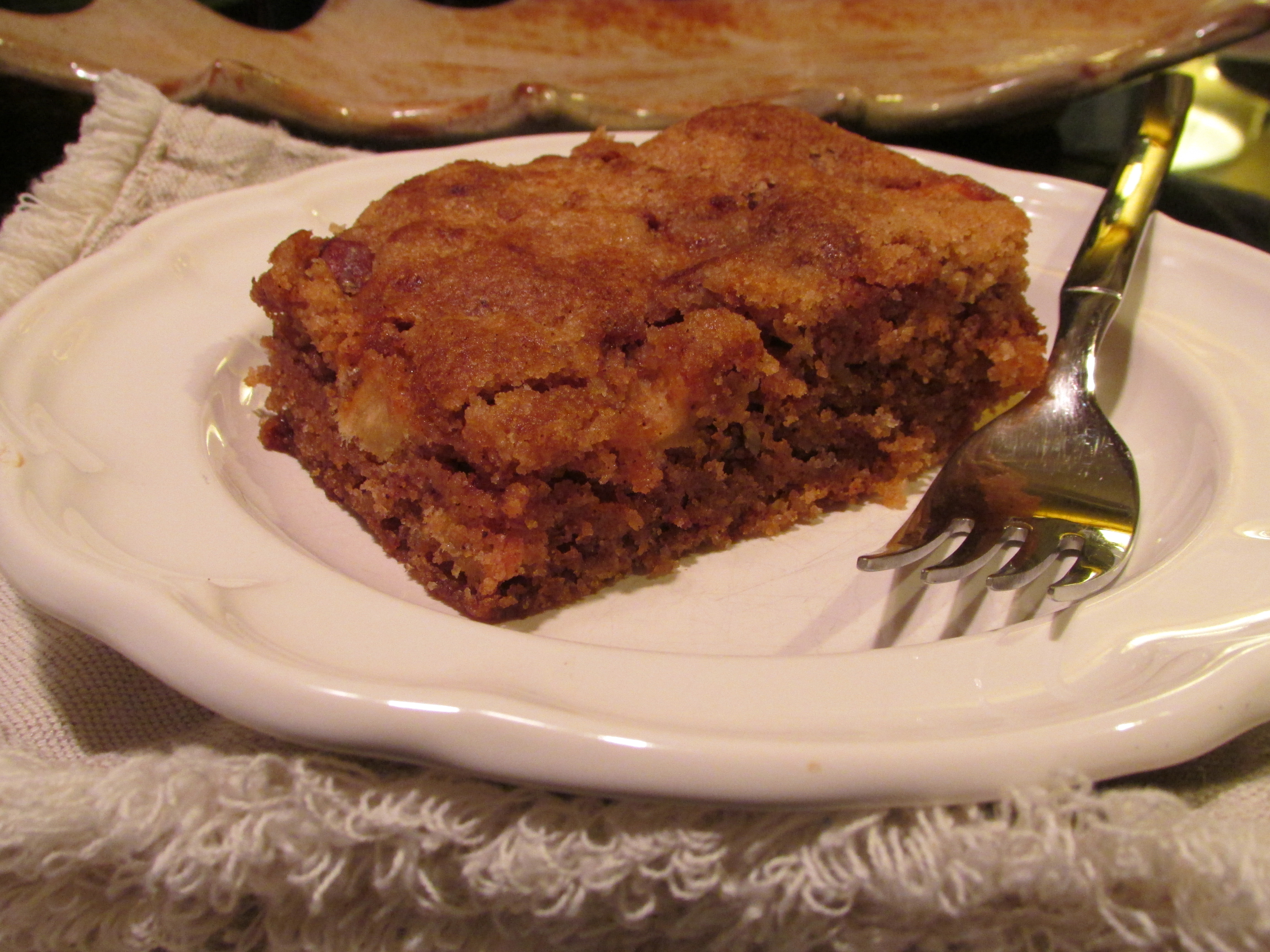
IMG_1122  Last night friends invited me over for dinner. As we ate Lake Erie perch, we talked about food – where holiday meals would be eaten, travel plans, restaurant favorites, and New Year’s meals and itineraries.

Food and food memory are key to everybody’s holiday traditions and powerful seasonal associations come from foods around the holidays.

Jean Harbison Journey, my mother, would be the first to tell you that she never cared to be known for her cooking. As a young woman getting married and starting a family in the ‘50s, she – like most women of her generation – was looking for convenience and ways to juggle feeding a family with her busy schedule of work, volunteering, and other activities. She was heavily engaged in P.T.A., church, and community.

Even so, she got meals on the table and there were always favorite meals and special treats that she made. None of her dishes, however, got and gets as much attention as her fresh apple cake. There are many fresh apple cakes out there but Mother’s has to be among the finest I’ve ever tasted – okay, it’s by far the best. She gets just the right combination of firmness and moisture and once somebody has sampled Mother’s cake, they always want more.

The process is a collaboration between Mother and Dad with him chopping the apples and stirring the mixture to Mother’s satisfaction. In years past, I would come to town for Christmas only to find my parents busy in the kitchen with almost a factory line in motion of putting together and baking cakes for the family meals and as Christmas presents for friends. The whole house smells like Christmas on these occasions. Sometimes I would chauffeur as Mother delivered cakes on Christmas Eve.

Oftentimes, people brazenly asked Mother to bring one of her fresh apple cakes. This applied even to doctors’ offices. Mother would have an appointment scheduled and would get a call from the office asking if she might be bringing an apple cake along. She always tried to comply.

Mother and Dad have slowed down and aren’t able to make the volume of fresh apple cakes they used to make but the cake still makes appearances on holidays, birthdays, and special occasions. She occasionally still takes one to the offices of favorite doctors and their staffs when she feels like it.

I have tried to make Mother’s recipe exactly once. The right flavor was there but the texture and form were a mess and I haven’t dared try again, although Mother gave me several pointers about what I might do differently next time. I gather that I should spray my cake pan with Baker’s Joy baking spray and have noted that on my copy of the recipe (if I ever get the courage to try it again). I also suspect that I overworked the batter and should have let it rest longer. I gave the recipe to a friend years ago and she said it took her four tries to get it tasting like Mother’s.

When my brother anchored a television news program, Mother was invited on to demonstrate how to make her fresh apple cake. She performed like someone who had been in front of the camera all her life and was told later that it was one of the most requested recipes at the station.

It is a perfect cake for dessert at any meal and is always a favorite for breakfast. Mother is a teetotaler and I would never dare do it, but I suspect that this would be a great cake to drizzle with a bourbon-based sauce.

As Christmas quickly approaches, I’m sharing Mother’s recipe with my highest recommendation. I’ll tell you up front that even if you follow the recipe to the letter, I doubt that it will match hers. But it will still be delicious and memorable.

Jean Journey’s Fresh Apple Cake

 2 1/2 cups plain flour

 2 cups sugar

1 teaspoon baking soda

2 teaspoons baking powder

1 teaspoon salt

1 cup chopped pecans

1 cup oil

2 eggs

1 teaspoon vanilla flavoring

3 cups apples, chopped (Mother usually uses tart apples)

  1. Combine and mix all dry ingredients.
  2. Add oil, eggs, and vanilla.
  3. Mix well by hand.
  4. Add chopped apples.
  5. Mix well. If dough is stiff, let it stand for a while and mix again.
  6. Pour mixture into a tube pan.
  7. Bake in a pre-heated oven at 350 degrees for 50-60 minutes.


“… a brief meditation …” : Why I Mail Christmas Cards

IMG_0444   My Christmas cards went in the mail on December 1. I started designing my own Christmas cards over a decade ago and it has become something many of my correspondents seem to appreciate. And expect.

I looked forward to receiving and looking at Christmas cards when I was a child and many of the people who sent cards to my parents every year were people I never met but felt I knew from the stories my mother would share about them each December when the card arrived. Genevieve O’Brien in Chicago, Christine Allen in Georgia, and Doris and Bill Fuller in Fort Worth are among the annual cards we received without fail from people I never met. When I was grown and out on my own, I would send Christmas cards as often as I could but sometimes work schedules or finances would make it prohibitive.

From a very young age I had set opinions about Christmas greetings and Christmas décor. For example, I am a Southerner and never quite understood why so many Southerners would buy into the Madison Avenue version of Christmas and send out pristine snow scenes and winter scenes depicting images that were not part of my reality of the season growing up in Alabama. I have traveled and worked all over the country and I have had white Christmases a few times. But the Christmases of most of my life have been bracing Alabama Christmases with a chill in the air and no snow. Actually, I’m not a fan of snow and have never once dreamed of a white Christmas.

A number of years ago I decided to design my own Christmas cards and feature photographs that represented December in the South. I developed rules: 1) The photograph had to be taken during the month of December and 2) the photograph had to be taken somewhere in Alabama. Those are the only hard and fast rules but over time most of the photographs have been of old country churches I have discovered around the state. A couple of times the image has been landscapes around Mobile Bay where I try to spend some time each December.

The only exception was in 2005, the year of Hurricane Katrina. I didn’t design the card that year; instead, I purchased museum holiday cards with a detail from a still life of a bountiful holiday table which somehow reminded me of good times on the Gulf and in New Orleans.

I developed rituals: I try to get my card to the printer around October 1 each year. I start signing and addressing the cards by November 1. On December 1, my cards are in the mail. Over time the mailing list has gotten quite large. Most of the people on my list don’t send cards anymore. For me, however, it’s a way of keeping in touch with old friends and acquaintances all over the world. Some of them are people I may never see again but I like to keep a connection. I’ve moved around a lot in my life and the Christmas card list is something that keeps me in touch and grounded.

Most people who know about or receive my Christmas cards are grateful and look forward to them each year. Someone might ask if I’ve picked next year’s image yet or they’ll send me a new mailing address to ensure that they won’t miss this year’s card.

But occasionally someone will grouse “I don’t know why you do it. Who has the time? It’s so expensive. And so much trouble.” Here’s my response: If you don’t want to do it, don’t do it. I do it because it gives me pleasure. I look forward to it. I want to do it.

With each card I sign and with each address I write on an envelope, it’s a brief meditation on that recipient.

When I first moved to Huntsville, there was a lady, Grace Clark, who lived in my apartment complex. We didn’t see each other often, but whenever we did we’d have a very pleasant conversation. I added her to my Christmas card list. She never mentioned my cards but when I moved from that apartment to my house I kept sending Christmas cards to Mrs. Clark. A couple of years ago, when Christmas was past, I received a note from a woman I didn’t know. She was Mrs. Clark’s daughter telling me that her mother had recently passed away. She told me that when she was going through her mother’s papers, she found a stack of my Christmas cards. Mrs. Clark had saved each one over the years.

If you don’t have time to send Christmas cards, I totally understand. I’m busy too. I have no time for Facebook and Twitter. We each choose what we have time to do.

This year’s image, by the way, is St. Luke’s Church (c. 1850), a cedar church in Cahaba. Cahaba is a ghost town and state park now, but it was Alabama’s first state capital from 1820-1826.

Happy Holidays.IMG_0456


The Alpha Dog and the Lone Wolf: An Allegory

The Lone Wolf, while exploring the landscape, comes across the Alpha Dog who has recently been deeply wounded and is alone and howling for attention. The Lone Wolf, who instinctively runs alone, approaches the Alpha Dog with caution. There is the usual circling and sniffing and eventually the two begin to tentatively run together. The Lone Wolf goes away for brief stretches but the Alpha pursues him and draws him back in. The Lone Wolf’s natural instinct is to withdraw but as the two continue to run together, a kindred bond develops. The Alpha begins to get stronger and starts to regain his confidence and, with it, his sense of dominance. The Lone Wolf does not challenge the Alpha’s natural dominance. Nor does he succumb to it. The two run together as equals. Occasionally one or the other might bare his teeth, growl, and resist, but for the most part each finds a mutual trust and respect for the other.

As his strength returns, Alpha’s pack begins to slowly reassemble. The Lone Wolf cautiously comes into the edges of Alpha’s pack while still maintaining his distance and independence. The Wolf wants to run with the Alpha Dog but he doesn’t totally trust the pack mentality. The Alpha begins to more aggressively try to assert dominance over the Wolf to maintain his standing in the pack. Most of Alpha’s pack accept Wolf into the group but a few of the weaker ones begin to feel threatened by him. The Wolf runs alongside the Alpha without challenge but the Wolf is strong and Alpha begins to feel challenged nonetheless.

The Alpha and the Wolf continue to circle and sniff at each other. Occasionally they run in peace and freedom and occasionally the Alpha, feeling that his autonomy is threatened, snaps at the Wolf and drives him away. But their paths continue to cross and the chase continues. On occasion, the Wolf is wandering alone and he senses that the Alpha is observing him from the distance. Warily, he begins to ease back in the Alpha’s direction and the Alpha takes him in, only to bare his teeth and drive him away again. This pattern, established, continues. The bond that has been established is strong but the challenges to the natural tendencies of each of the animals always intrude, causing inevitable conflict. The connection is strong. The challenges, on occasion, are stronger.

The Wolf, confused, wanders. He climbs a steep mountain, reaches the peak, and tentatively begins to take steps to the other, less familiar, side. The urge to turn around for one last look is strong. But he doesn’t. He keeps walking down the mountain toward the clearing in the wilderness …

Food Memory: Kushmagudi


IMG_0881     As the cold weather holidays roll in, I look forward to family food traditions. Going into Thanksgiving week and celebrations in Birmingham with my family, food memory kicks in bigtime.

There is a dish called “kushmagudi” (this is my own spelling; there is no official spelling) which is always on the Journey family tables at Thanksgiving and Christmas. It is simple Southern food and its name (and my phonetic spelling) has no precedence that I can find.

My brother wrote a lovely essay about this dish a couple of years ago but since I haven’t been able to retrieve it, I will reintroduce the basics to “Professional Southerner” readers.

My grandmother Eula Harbison used to make kushmagudi and I always assumed that it was a known thing, like salt on watermelon, pepper on cantaloupe, and celery sticks served with turkey. As long as I can remember, kushmagudi was on the holiday table so I would mention it casually and be surprised at the blank stares I received. As I lived and traveled around the country, I realized that nobody outside my immediate family seems to have a clue what “kushmagudi” is.

Many might know some variation of the dish, I think, but not by that name.

Kushmagudi is nothing more than a tasty mixture of crumbled cornbread with the potlikker of turnip greens. I say “nothing more” but I am convinced that one needs a cook’s instinct to pull off the right mix. I have always heard stories about Grandmother feeding the masses of her family and crowds from church at short notice in the ‘30s and ‘40s and having family move into her family home between jobs and houses, during travel, etc. Based on what I know, I realize that Grandmother’s kushmagudi may have been invented as Depression food and a way to make the food in the rural house and garden go farther.

Based on what I know, I am sure that the word “kushmagudi” is Grandmother’s own coinage to name a dish she already knew but reinvented for her immediate and extended families. I have talked with Southerners who know a variation of potlikker and greens but, so far, none outside my own family have referred to it as “kushmagudi.”

After Grandmother died in December 1995, I was asked if I would make the kushmagudi for Christmas. I will admit that I was daunted. I had eaten it all of my life but I had never thought about it.

I relaxed and thought about the dish. I realized that it is a basic and instinctual recipe and that if one understands its components one should be able to make it in a satisfactory manner.

Here’s my basic recipe for my grandmother’s kushmagudi:

Eula McCarn Harbison’s Kushmagudi

  1. Make 1-2 cakes of cornbread or use leftover cornbread if you have it (remember that sugar is never acceptable in cornbread).
  2. Boil up a pot of turnip greens with your favorite spices and seasonings.
  3. Bring the greens to a boil and simmer on low for at least a half hour.
  4. In a large mixing bowl, crumble 1-1½ of the cakes of cornbread.
  5. Ladle the potlikker of the greens over the crumbled cornbread in the mixing bowl and mix to your preferred consistency and taste.
  6. Let the mixture meld for a while, keep it warm, and serve it.

I like to mix some collard greens with my turnip greens to vary the flavor of the potlikker a bit. Grandmother tended to use less spices in her greens than I do; she used salt and pepper. I like to add a little pepper sauce, sage, bacon fat, garlic powder, thyme, and other seasonings to the greens before I strain them into the cornbread. I also might add a small dash of sugar to the greens (but never to the cornbread). I also like to mix more of the actual greens into the mix. Grandmother generally just used the potlikker and served the seasoned turnip greens as a separate side dish.

This is truly a recipe that may be adapted to your and your family’s preference.

A bowl of kushmagudi with a glass of buttermilk is a perfect meal on a chilly night in late fall or winter.

Even though kushmagudi is cornbread-based, it is different enough that my family serves it alongside Mother’s traditional cornbread dressing. I think one must sprinkle pepper sauce over a good kushmagudi at table. This is a dish that is always on my family’s table at Thanksgiving and Christmas and is often a side at my New Year’s Day luncheon.

If you have a variation of this dish, or a variant name, I would love to hear from you. If you’ve never tried it, you ought to. It’s easy and tasty.

Happy Thanksgiving.

“Hello … I’m Johnny Cash”

IMG_0878      I still remember 1968, of course, as a watershed year in the U.S. and world events. Vietnam was going full-force and the nightly news always opened with that day’s casualties from the war. Johnny Watts, a family friend from our Birmingham neighborhood, was one of that year’s casualties. I had spent much of the early part of the year as an inquisitive little news junkie watching assassinations, riots, televised funerals, the May ’68 Paris protests, and out-of-control political conventions in Chicago and Miami Beach. In November 1968 Richard Nixon was elected. ‘Nuff said.

In fall 1968 I was a surly teenager who was miserable when my father’s job transferred the family from Birmingham to Nashville. The Nashville junior high school I transferred to was far behind the Birmingham school I had transferred from in most of my courses and I dreaded getting out of bed each morning. I look back now and realize that I was a nightmare for my parents during that time.

Looking back, there’s not much to redeem my year in Nashville from late-1968 to late-1969. But I find that much of what I remember and think fondly of – and it had its moments – is centered on the music and entertainment industry, fitting recollections for a year in “Music City.” We moved to a suburban area called Antioch and it turned out that Dolly Parton – then a young singer on Porter Wagoner’s television show – lived down the street. She would wave to my little brother as she drove past the house in one of her Cadillacs (gifts from Porter, we were told) on Saturday afternoons on the way to perform at the Opry.

One Saturday morning, Dad had business on Nashville’s Broadway and we had driven into town with him. Mother, my brother Rick, and I were sitting in the car waiting when Mother said, “That’s Bill Monroe.” I looked up to see a very distinguished man wearing a suit and a grey hat strolling down Broadway. There was the “Father of Bluegrass” and, while it didn’t fully register then, it totally registers now that here was the man who invented one of the most complex and culturally pristine genres of American music.

It was the late ‘60s and I was a Rolling Stones and rock ‘n’ roll fan but the move to Nashville forced me to attend to Nashville’s pervasive country music culture. This wasn’t totally foreign to me since I had family members who played bluegrass and my Granddaddy Harbison was an avid listener to country music.

Besides Dolly Parton down the street, local television stations would air a smorgasbord of syndicated country shows on the weekends. I wouldn’t admit it but I would watch the thirty-minute syndicated shows of Porter Wagoner, Bill Anderson, Marty Robbins, Billy Walker, Lester Flatt and Earl Scruggs, and others late into the night. The Happy Goodman Family and other gospel groups had Sunday morning gospel shows. I am a little amazed that I remember this. I am more amazed that I’m owning up to it.

A Nashville indie television station aired an afternoon teen dance program called “17 Time.” It is thanks to “17 Time” that the Ohio Express song “Chewy Chewy” will be forever etched in my mind.  My brother, who was a toddler and could not have known better, loved “Chewy Chewy” and it was on our turntable incessantly. While I’m venting, the same toddler also made “Bang Shang a Lang” by The Archies a staple in the house. You owe me big time, Rick; actually, I just re-listened to both of those bubblegum hits and I have to admit that they’re both pretty catchy in an insipid way.

The 1968 Elvis Presley television special “Elvis” aired on December 3, 1968, less than a month after we moved to Nashville. I remember lingering with my 21-month-old brother in the television section at Sears while Mother and Dad were buying things for the house (or maybe Christmas presents). I caught a few minutes of the acoustic set with Elvis performing in the round with messy hair and a black leather jacket. Elvis had been relegated to teeny bopper movies by this point in his career but it was obvious that this television special denoted something big and new in his future. I wished I had stayed home to watch it and the next day, at my new school, Elvis was all my classmates were talking about.

“Did you see Elvis last night?” one asked.

“I saw a little of it while I was at Sears,” I said.

“Oh man,” came the reply. “Elvis is back!”

Apparently that was the consensus since that telecast will forever be known as the “Elvis Comeback Special.”

On the day I enrolled at my new Nashville school, a new girl was enrolling with me. She was moving to town from Los Angeles and her dad, she said, was a television producer. This was fitting since it was days after Nixon had won the presidency with his “Southern Strategy” and the entertainment world was looking to Nashville and the South for inspiration and ratings.

Within weeks, in early 1969, two of the major networks announced television variety shows that would be filmed in Nashville. ABC was going to shoot “The Johnny Cash Show” as a summer replacement variety show. CBS was going to shoot a cornpone answer to NBC’s popular “Laugh-In” and call it “Hee Haw.” Local television reported that the cast and creative staff of “Hee Haw” took a hayride from the airport to downtown. It was a corny publicity stunt but it was supposed to signify that Hollywood was coming to Nashville. The Cash show and “Hee Haw” began production in 1969. Nashville entertainment was getting the big head and going mainstream.

Even though I pretended to be too sophisticated to watch “Hee Haw,” I will say that I often did and that “Gloom, Despair and Agony on Me,” one of its signature songs, summed up my adolescent angst at the time. Years later, when I was griping about something to my friend Clay Christian, I was taken aback when I realized that he was softly mouthing “Gloom, Despair, and Agony on Me.” I got over my bad self and started to sing along: “Deep dark depression, excessive misery / If it weren’t for bad luck I’d have no luck at all / Gloom, despair, and agony on me.” It’s no “He Stopped Loving Her Today,” but it’s a classic in its own right.

That may have cemented my friendship with Clay forever.

As entertaining as all of these things may have been, the major event was “The Johnny Cash Show.” Cash was already a popular entertainer in my household and this was before he had quite achieved massive hipster cool beyond the rockabilly set. The show was filmed in Ryman Auditorium when it was still the home of the Grand Ole Opry.

When ABC began shooting shows I did not rest until my parents got tickets to a taping. On a Tuesday night my mother, our next door neighbor, and I traveled to the Opry House to see the show. My dad and the husband next door babysat Rick and the neighbors’ baby. Here’s context: Standing in line at the Opry House, people nearby were debating the merits of the 1966 Mike Nichols film Who’s Afraid of Virginia Woolf? starring Elizabeth Taylor and Richard Burton. Mike Nichols died yesterday.

When we were finally seated in the Ryman and waiting for the taping to begin, I excused myself to go to the restroom. I had no idea where the restroom was and just started walking down the nearest stairs I found. Finally, when I got to the bottom of the stairs, I walked down a hallway. I didn’t see a restroom but heard voices from a room off the hall. I walked into the room and found myself in what I suppose was a dressing room. Johnny Cash, Carl Perkins, and the Statler Brothers, instruments in hand, were sitting there.

Conversation stopped. “Do you know where the restroom is?” I said. I realized later how ridiculous that sounds.

I don’t remember who told me to go back up the stairs but somebody did and I eventually found the restroom. I made my way back to my seat. I’m not sure I mentioned what had just happened.

Eventually, the show started up. On a darkened stage, a spot hit the man in black, He strummed a chord on his guitar, turned and looked at the camera, and snarled, “Hello … I’m Johnny Cash.”

Think about this: It was Johnny Cash performing on the Ryman stage. His back-up singers were June Carter and the Carter Family. Mother Maybelle Carter, the matriarch of twentieth century country music, was on that stage along with her daughters — June’s sisters – Anita and Helen. Carl Perkins and the Tennessee Three were playing. The Statler Brothers were backup singers and comic relief.

The guests that night were singers Gordon Lightfoot and Evie Sands. Dan Blocker, who played “Hoss Cartwright” on the iconic TV western “Bonanza,” was a guest on that show also but he was not present for the taping we attended. He was only announced and talked about as if he were there. His actual performance came at later tapings and was spliced into the finished product.

A comedy duet, Dick Clair and Jenna McMahon, provided comedy relief. Clair and McMahon were probably pretty innocuous as a quipping married couple but they seemed terribly witty and urbane to me at age 14. Because I had seen them at Cash’s show, I kept up with Clair and McMahon on the television sitcom and variety circuit for years. Dick Clair would be among the many entertainment talents who died of AIDS in the 80s.

It was a television taping so there was lots of downtime while sets and new set-ups were underway. I’m sure my mother and our neighbor got bored but I was mesmerized the whole night. I enjoyed watching Johnny Cash and June Carter banter when the cameras weren’t on.

That was the only taping of the Cash show that I got to attend. The taping I saw turned out to be the second show aired in the summer of 1969. The first show had Joni Mitchell and Bob Dylan as guests. “Best of” videos are available and I strongly recommend them to anyone interested in music.

The Cash show is still legendary among fans of American popular music of every genre. I almost made a list of the artists who appeared but couldn’t figure who I might possibly leave out.

Johnny Cash’s album, “Johnny Cash at San Quentin,” was released in the summer of 1969 as the television show premiered. It was a constant on my turntable for years. I can truthfully say that I was a Johnny Cash fan before it was cool (outside country circles) to be a Johnny Cash fan.

Over 34 years later, my phone rang around 3:00 a.m. on a September morning. The call was from my brother, Rick, who was the anchor of an early morning news program at the time. He was on the set reviewing the overnight news breaks.

“Don’t panic, Mother and Dad are fine,” he said. “And I would never call at this hour but in this case I thought I should make an exception … Johnny Cash is dead. I thought you’d want to know.”

His was the first of many calls I got that day.

My Grandmother’s Quilt

IMG_0861   In the popular imagination, there has long been a romanticized picture of quilting as “quilting bees” in which ladies gathered, gossiped, and used their genteel skills to create colorful quilts. Folk art aficionados and museums have elevated quilts made for everyday use into works of art and the market for vintage quilts has gone through the roof in recent decades.

Quilts are works of art but lost on many are the practical utilitarian reasons for quilts to exist in the first place. As beautiful and artful as quilts may be, they were used to keep us warm and most of the people – mostly women – who created them were creating them as part of their job to feed and clothe and look to the comfort of their families. As beautiful as many quilts are and as much pride as is shown in the careful and intricate construction of quilts, their exhibition and appeal to collectors was far from the motivation for the quilter. More likely the motivation was along the lines of Will it keep the family warm at night? and Will it hold up? and Will I be embarrassed for the neighbor ladies to see it hanging on my clothesline?

As a child, I was fascinated with the quilts that would come out of the chiffarobes and cedar chests and closets when the nights started to become cool in the fall. The intricate patterns and pieces of fabric told a tale of the maker and her family. As I became older, my mother would occasionally offer me quilts that she had from her or Dad’s families. I have never turned down the gift of a quilt and now have a small but precious collection.

I am always curious about the provenance of the family quilts I receive but, because of the nature of the pieces and their creation, the information is often sketchy. These quilts, after all, were not made to be passed down as heirlooms. They were made to cover people and beds and serve a purpose. I have quilt tops that never got quilted and at least one quilt attributed to Snow Patton Journey, one of my paternal great-grandmothers.

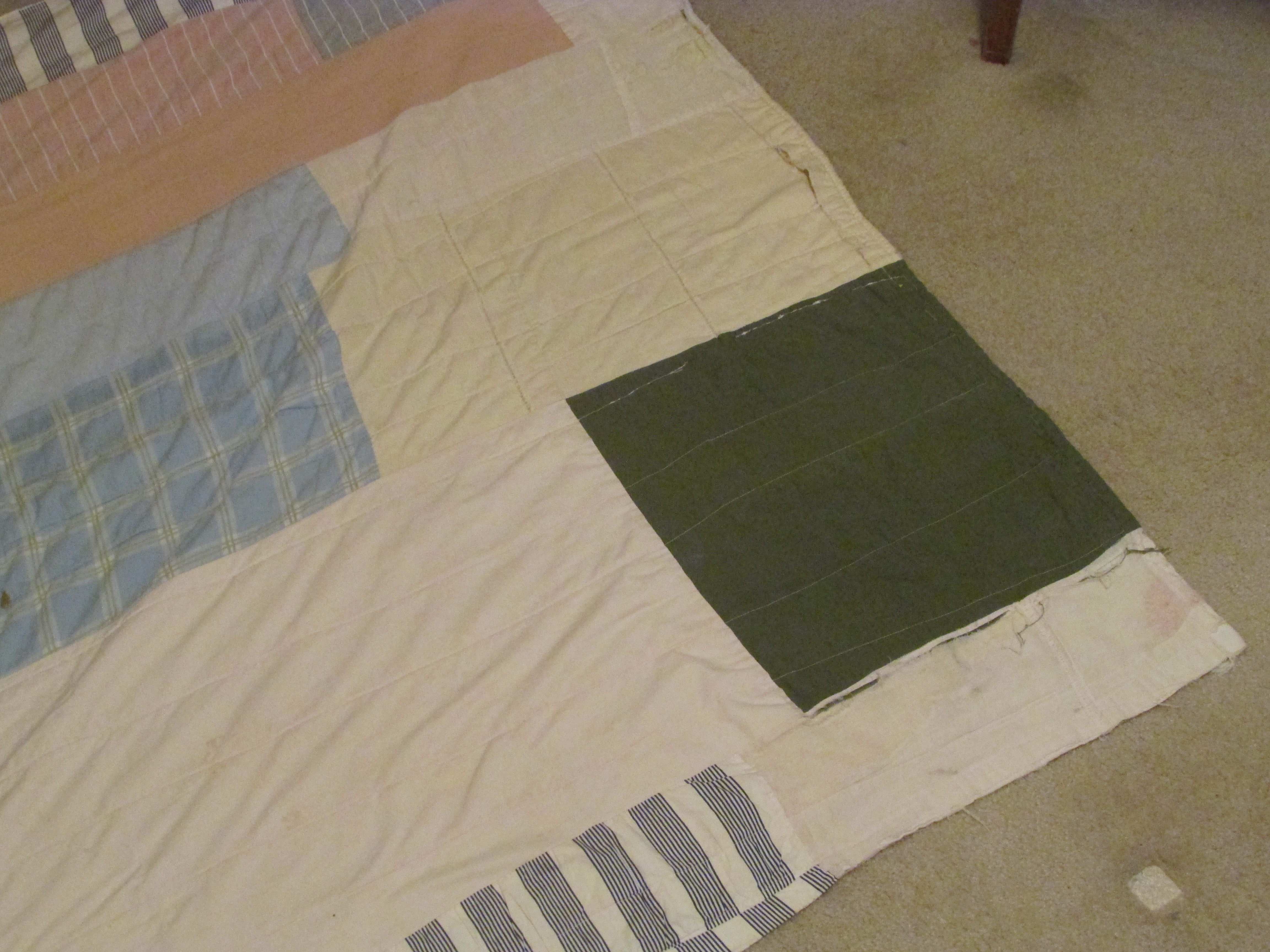
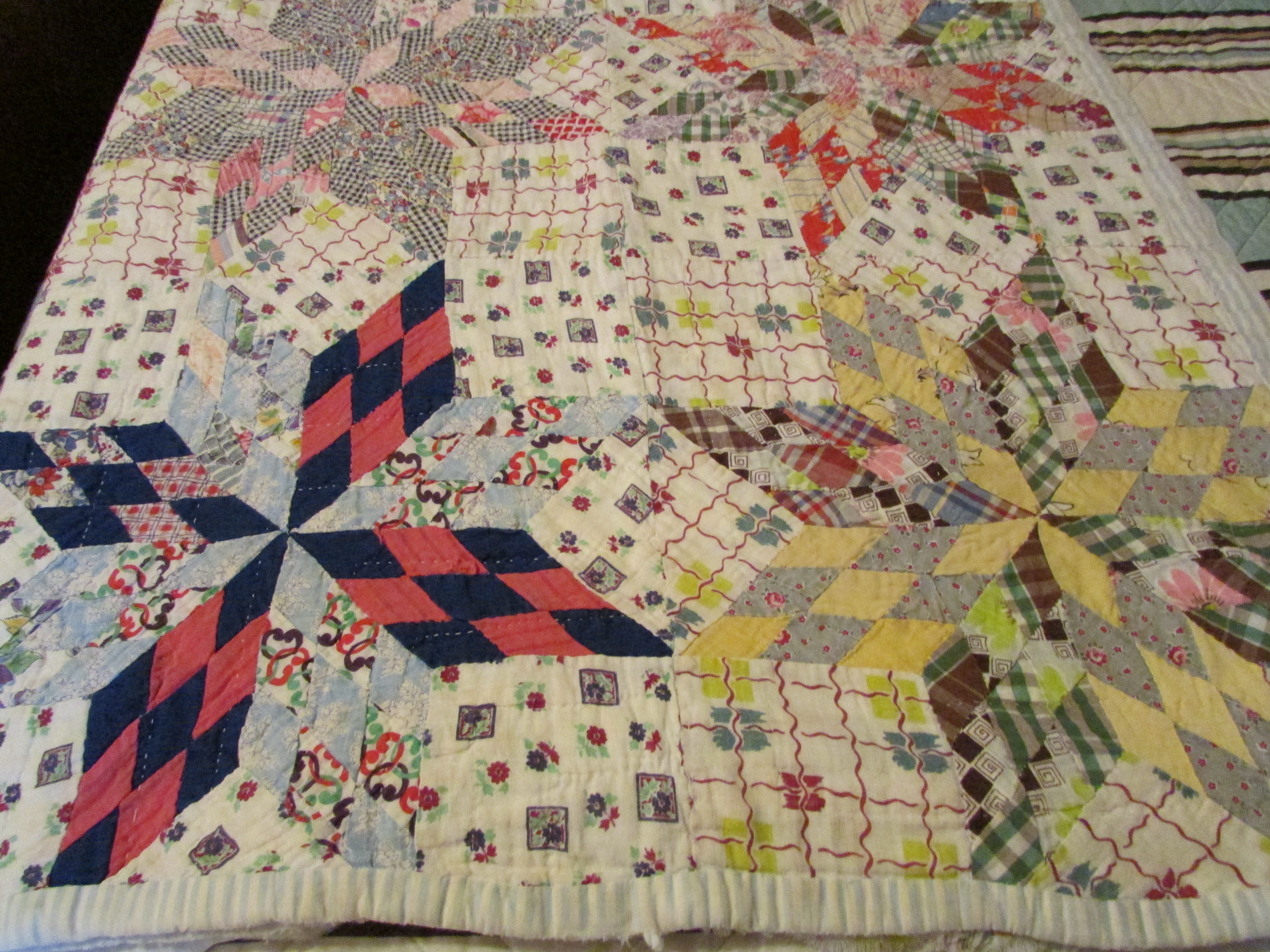
Most of the quilts I have, however, were made by Eula McCarn Harbison (1909-1995), my maternal grandmother. All but one of Grandmother Harbison’s quilts are traditionally patterned –star and snowflake forms are popular – and delicately and masterfully structured. There is one exception and that quilt is on my bed as I write this and has been on my bed every cold season for years. This exception is one that my mother gave to me with the disclaimer that “your grandmother would be horrified if she thought anybody would see this one.”

I hope Grandmother Harbison is not horrified when I say that this is my favorite quilt and I am proud to show it to others. It is clearly a “crazy quilt,” with unmatched and large pieces of fabric and no patterning. In examining it, my guess is that it was put together very quickly (perhaps in advance of an approaching cold spell?). It is also the heaviest and warmest quilt I have ever encountered. I don’t much like cold weather but one of the few pleasures of “the weather of northern aggression” is knowing that I will be sleeping under this amazing quilt for a while. My mother can’t remember when this quilt was made but I am guessing the 1940s before Mother’s family relocated to Birmingham after World War II. Mother says that’s a good guess since she doesn’t recall Grandmother quilting after the move to Birmingham.

IMG_0857

As an artist and as a lover of art, my tastes often run toward the modernist and minimalist and Grandmother Harbison’s quilt fits in both categories in its abstract and random collection of fabrics and in its asymmetrical and challenging composition. There is a large square of solid olive fabric placed near one of the corners that always reminds me of the blocks of color or text found in some Asian prints. This would not have been something my grandmother necessarily knew about but the artistic impulse and prescience intrigues me. Grandmother always said that every room should have a touch of red somewhere and I always thought Well, she and Diana Vreeland have that in common! 

One of Grandmother’s “nicer” more traditional quilts lives on the foot of the bed in my guest room but it’s the thick and crazy one that will cover me tonight and for many nights to come.

IMG_0870

(All quilts shown are by Eula McCarn Harbison.)