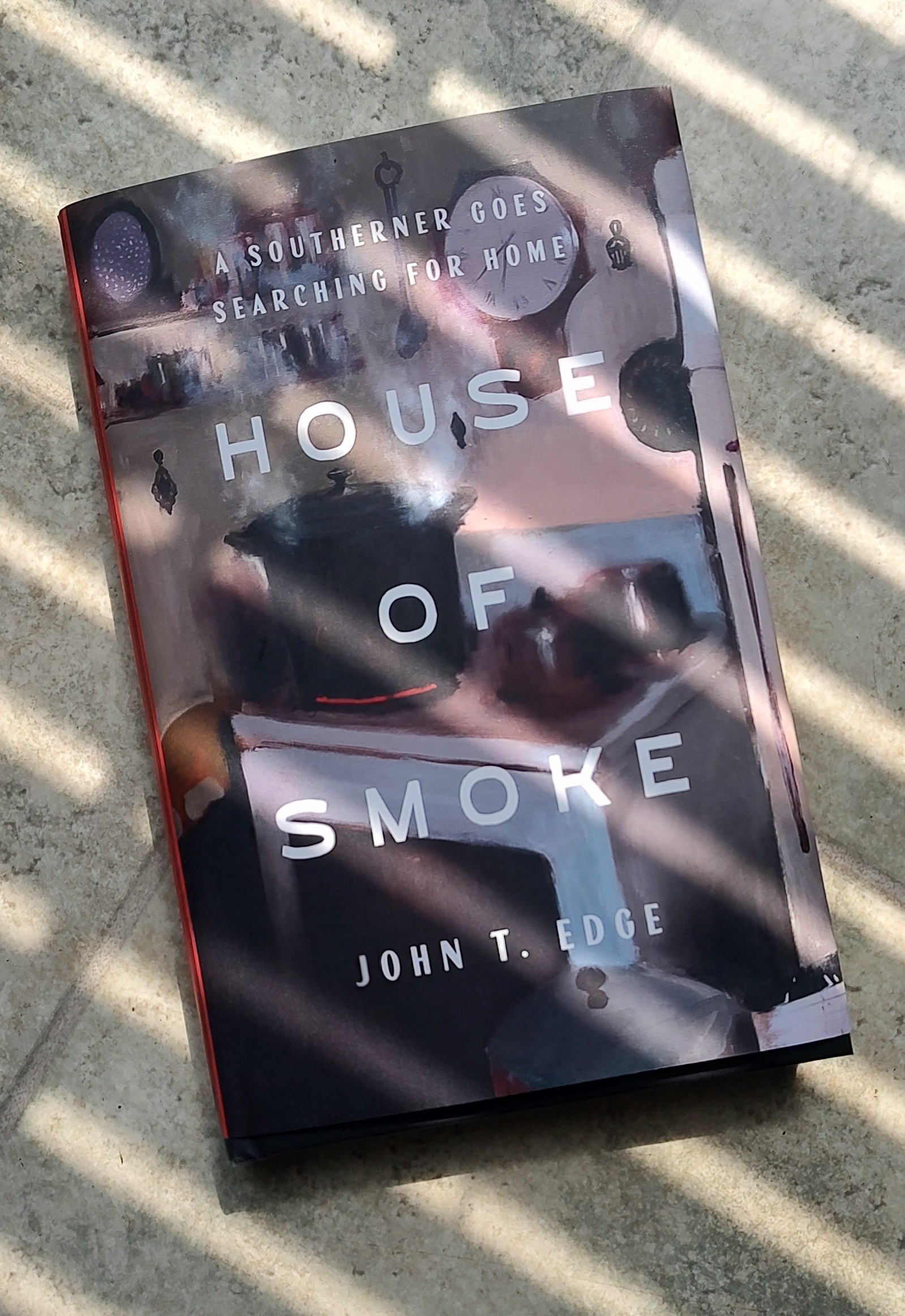
The number of accomplished writers to emerge from Alabama and with significant ties to the state is a source of hope and pride. Here is a link to my piece on the March 7 induction of the 2025 class. Check out the list of previous inductees at the end.
Review: Deep Water, Dark Horizons by Suzanne Hudson
Occasionally, while reading Suzanne Hudson’s collection Deep Water, Dark Horizons, I felt like I might be eavesdropping on some kinfolks — y’know, those kinfolks you don’t necessarily like to claim. The collection commemorates Hudson’s 2025 Truman Capote Prize and you can read my review for Alabama Writers’ Forum here:
The Golden Promise of Spring
On a bright and chilly morning after a weekend of storms, the promise of Spring is murmured in little things. The flocks of migrating birds that filled the yards, the feeders, and the trees in the woods beyond for a few weeks seem to have moved on. A solitary male cardinal sits in the bare limbs of the Rose of Sharon. The hummingbird feeders will go up soon.
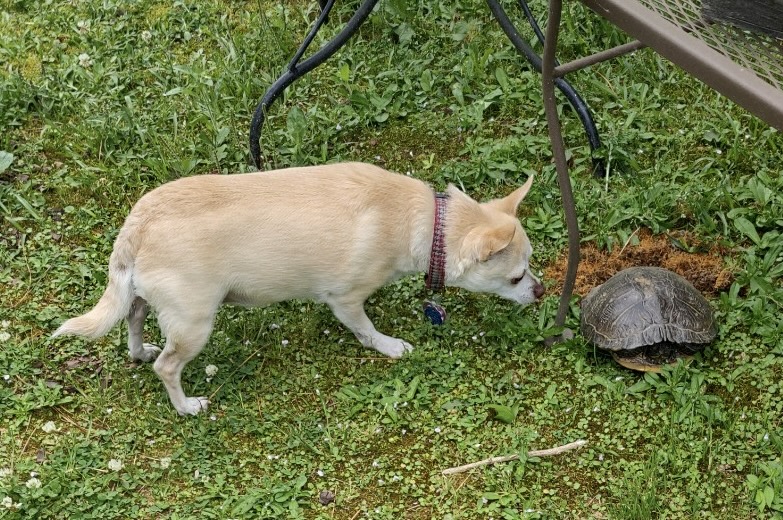
When I opened the blinds a few days ago, six blue jays were gathered on the grass, feeding peacefully amidst a couple of cardinals. I’ve never seen six bluejays together before. A covey of crows fussed from high in the pines and the smaller birds were busy on the edges. It was a peaceable kingdom until Lulu the chihuahua bounded out for her morning constitutional.
The foliage of lilies to come peeks out from the straw in the flower bed. Perhaps their blooms will coincide with this year’s late Easter. I thinned out the lilies after last year’s bloom but it appears they have multiplied again.
A closer look at the Rose of Sharon yields the buds beginning to pop forth. The foliage down the mountain is slowly emerging, but the busy intersection at the foot of the mountain is still clearly visible through the trees. Soon, the thick foliage down the mountain will make the intersection vanish in a curtain of green.
There is an appealing subtlety to Spring. It’s constantly sneaking up on us. One day the crocus bloom and just as quickly they’re gone in a couple of weeks. I have just noticed the blooms have popped out on the pine trees. A neighbor’s Carolina jasmine, pronounced dead after a hard late freeze a couple of years ago, is back and blooming more lushly than ever.
Finding the beauty and blatant symbolism in the heralds of Spring brings peace and tranquility and, always, a hope for better days to come. 
New Southern Fiction
What We Are Becoming is a story anthology from SouthArts and Hub City Writers Project. I reviewed it recently for Alabama Writers’ Forum.
The Problem of the Hero — How to Watch
NOTE: In 2023, I posted this essay about a new movie about novelist Richard Wright, playwright Paul Green, and their collaboration with Orson Welles on a stage production of Native Son. I am reposting that essay and attaching exciting news about the streaming release.
The Problem of the Hero is a compelling historical drama about the clash between men of principle in 1941. The men are novelist Richard Wright and playwright Paul Green, liberal Southerners – one Black, one White.
The two writers have been collaborating on a stage adaptation of Wright’s landmark novel, Native Son, to be produced on Broadway, directed by Orson Welles. (Orson Welles directing Native Son might also be a source of contention today.) The film explores the conflict between Wright and Green about the final page of the stage adaptation. Green wants the final scene to offer a hope of redemption for Wright’s protagonist, Bigger Thomas; Wright does not. Green feels the need to cater to what will be a mostly White audience on Broadway; Wright has no intention of catering to anybody.
The film highlights the efforts of two men, each an advocate for civil rights, who view that advocacy from very different perspectives. At one point, Richard Wright (J. Mardrice Henderson) reminds Paul Green (David zum Brunnen) of the “difference between knowing and empathizing.” He asserts that Green has the luxury of choice – a luxury not available to Bigger Thomas and the downtrodden he represents. Green’s responses often echo the confusion that comes to those who try to do what is right, but don’t know how it might be received.
Although the movie is set in 1941, its pertinence rings strongly today in ongoing discussions of agency and who has the right to speak for, and represent, whom. It’s a discussion that applies to much more than writers; it’s a discussion now that is essentially changing the definition of what it means to be an actor.
Director Shaun Dozier masterfully presents The Problem of the Hero with cinematic finesse from a screenplay by James A. Hodge and Ian Finley, from Finley’s one-act play, “Native.” It’s a beautiful film to look at with cinematography by Steve Milligan and editing by Dozier. Most of the action takes place in and around New York’s St. James Theatre during final rehearsals for Green and Wright’s stage version of Native Son. That setting provides the background for creative presentation of the story as Green and Wright’s discussions take place backstage, in the auditorium, in dressing rooms, onstage, in rehearsals, during a light check. On a few occasions, the relative quiet of the film is broken by the bluster of Orson Welles (Charlie Cannon) who, true to form, sucks the air out of the room each time he enters the frame.
The Problem of the Hero features grown-up debates between formidable sparring partners about issues simmering for centuries, that have come to a more urgent forefront again within our own past decade. Eight decades after the events chronicled in this film, the conversations are as timely as they’ve ever been.
Wright and Green are articulate spokesmen for points of view that are heading generally in the same direction, but inevitably come to an impasse. Still, their discussion remains courteous, patient, and forthright. On those occasions when anger flares, it’s best to pay close attention. Canada Lee (Brandon Haynes), the actor playing Bigger Thomas in the play, comments to Green that he and Wright “fight like brothers.” Paul Green remarks that “not every friendship can survive the artistic process.”
This is intimate filmmaking. Green and Wright each have exceptional scenes with others. Green reveals his frustrations to Canada Lee in an unhurried cigarette break. Wright recounts a troubling childhood memory to actor Nell Harrison (Josephine Hall) during a dressing room visit. There is a pause when his story is over. Nell’s perfect response is a simple sigh, “oh.”
Mostly, however, the screen belongs to Green and Wright, in the beautifully paired casting of David zum Brunnen and J. Mardrice Henderson. The conviction and level of their discourse is rare in films these days. Green is a patriot in the old-fashioned sense, with a firm belief that the country is headed in the right direction, despite its setbacks. You can see his pain when he realizes his friend and collaborator is an atheist, a communist. Wright has no delusions about the forces of racism in his native land – yearning to find freedom in Paris, even at a time when Nazis are occupying France. When Green scoffs at racist utterances, calling such things “nonsense,” Wright replies, “There’s danger in nonsense, Mr. Green. Enough people speak the same nonsense at the same time and it might as well be the truth.” Thinking of our current national situation, I found myself sighing oh.
The Problem of the Hero carries a subtle metaphor about a single candle being held in vigil outside a prison where an execution is taking place. A futile gesture, perhaps, but it is gradually joined by other candles in the darkness.
The Problem of the Hero is currently playing on the film festival circuit with distribution news forthcoming. The early reviews I have seen have been unanimously positive. I would encourage you to remember this title and seek out this film at your first opportunity. Here’s the trailer:
______________________________________________________
Now, here’s new information about how you can watch The Problem of the Hero:
EbzB Productions/WhyNot Theatricals remains deeply humbled by your support on this journey, and we hope it continues. Our recent distribution deal with Buffalo8 is only the beginning. This film is a testament to the dedication of over 100 artists (most of them from North Carolina) who brought this story to life. Please help us to amplify its impact.
As The Problem of the Hero prepares for release on Apple TV and Amazon in the U.S. and North America, we’re thrilled to announce its availability in regions worldwide, spanning the Caribbean, Europe, Asia, and Africa. But we don’t want to stop there—we want this film to reach even more people, sparking conversations and broadening perspectives.
📢 Here’s how you can support:
✅ Preorder on Apple TV starting March 14, 2025.
✅ Share the news with friends, colleagues, and film lovers.
✅ Forward this email or repost on social media.
✅ Share the trailer: https://www.youtube.com/watch?v=xPFbKbCWcWg
Your voice is powerful. Your support is invaluable. Thank you for being part of this journey!
Book Review: Don’t Let the Devil Ride by Ace Atkins
Crime writer Ace Atkins will be inducted into the Alabama Writers Hall of Fame on March 7, 2025. I recently reviewed his latest book, his thirtieth, for Alabama Writers’ Forum.
Here’s the review:
Muscoda
Taking a shortcut to a doctor’s appointment a while back, I absent-mindedly missed my turn. The trigger that cued me was the gaping and abandoned entrance to a mine structure which was sitting right there on the side of the road. I had never seen it before, realized I had just missed my turn, and vowed to come back and photograph the place when I had more time.
This new-to-me site was near a community of mining-cottage style houses that I had passed often, remnants of the Muscoda red ore mining operation. Back when the miners lived in company housing, communities would pop up of mostly uniform houses of vernacular design. In the Muscoda community of Bessemer, a few miles from Birmingham, these houses can still be found dotting the area. The particularly striking style that seems to predominate around certain parts of Bessemer is recognizable by its pyramidal roof topped by a chimney. These houses typically were four rooms with a living and kitchen area to one side, two bedrooms on the other side, and a central fireplace to heat the house. Some of the houses still standing appear to have been amended and expanded over time, bathrooms for sure have been added, but others seem to have remained essentially true to their original design. To me, they are elegant in their simplicity; the masonry of the mine structures is elegant decay.
These reminders of the Birmingham district’s industrial past are everywhere and I am always pleased when I discover ones I did not notice before. Remnants of mining railroads, steel factories, and coal mines dot the area; some might find them unsightly but they are vivid reminders of what ignited and sustained the area in the not-so-distant past. Many are vine covered, decaying, returning to the earth they came from. The hiking trails in sprawling Red Mountain Park, on land once owned by U.S. Steel, often go past abandoned mine entrances and structures related to local heavy industry. Such history amid lush nature is a powerful statement.
These places are as important to an understanding of the relatively short post-colonial history of this place as Greek and Roman antiquities are in Europe and ancient Native mound cities that can be found not that far away. Perhaps I romanticize a bit, but both of my grandfathers were factory workers in the Birmingham steel industry so it becomes personal to understand it better. I can remember when Birmingham made national headlines in the early 1970s for industrial pollution crises so there is undeniable advantage to the area’s shift to a “cleaner” economic base; the industry was damaging to the environment and the work was brutal and we must keep in mind the lives and value of the workers who did it and those who still do it every day. Birmingham’s dominant employer now is the UAB medical district, an ever-expanding entity that practices its own brand of tyranny. Such is American capitalism, I reckon.
My Muscoda discovery, along the waning ridges of Red Mountain, was a delight since I had not seen it mentioned in guides to industrial sites in the Birmingham area. In Oxmoor Valley, along Shades Creek at the foot of Shades Mountain, is the site of the Confederate-era Oxmoor furnaces, the first in Jefferson County. Unlike the Muscoda mines, no structures remain at that site – only a historic marker and a cemetery down the road.
I will continue to miss my turn and check on those Muscoda structures now and again. Like the Alabama-born photographer William Christenberry in his beloved Hale County, I will keep track of the progress of decay. Someday, probably after I am gone, only vines and brambles and crumbling brick shards will remain to mark what was. 
Book Review: Leviathan by Robert McCammon
Robert McCammon, a true master of suspense, will be inducted into the Alabama Writers Hall of Fame in March 2025. His most recent novel, Leviathan, is the tenth and final book in the popular Matthew Corbett series. I recently reviewed it for Alabama Writers’ Forum:
Trying to Find the Humor
When American composer George Gershwin died at age 38, novelist John O’Hara wrote, “George Gershwin died on July 11, 1937, but I don’t have to believe it if I don’t want to.” A few days ago, I woke up with those words on my mind. To shamelessly borrow from O’Hara, Donald J. Trump was inaugurated on January 20, 2025, but I don’t have to believe it if I don’t want to.
Actually, unlike Trump in 2020, I acknowledge the results of the 2024 election, so his unlikely win (not a “mandate,” by the way) is shocking. And I’m shocked that those who voted for him appear to have forgotten the events around the January 6, 2021, insurrection. They are rewriting the history, but we watched it live. It seemed like something we could never forget. Obviously, many did.
There are so many despicable, egregious, and absurd things Trump has done in just a few days. He does and says things that would have been unthinkable and inexcusable not that long ago. In the world he is trying to create, the words “diversity, equity, and inclusion” have become objectionable to far too many people. His mental acuity and stability are clearly in a diminished state. And he never seemed that bright to begin with.
I try to remember Garrison Keillor’s suggestion that whenever Trump speaks we should imagine him in a sparkly red gown with dangly earrings. Try it; it helps – especially when he talks about renaming the Gulf of Mexico.
It’s hard to laugh, however, when he pardons almost 1500 of his fellow January 6 insurrectionists. Felons have to look out for each other, I reckon. It’s hard to laugh when the President of the United States uses Israeli hostages and their families as a backdrop prop at one of his Inauguration Day mob scenes as he calls the insurrectionists “hostages.” The January 6 cartoon character known as the “QAnon Shaman” announced that with this pardon he was “gonna buy some motha f—ing guns.” An Alabama insurrectionist, in a locally televised interview, expressed gratitude that his 2nd Amendment rights were being restored. The desire to buy weapons seems to be the priority of newly-pardoned insurrectionists.
Let’s think about that for a moment.
________________________________________________
It seems to me that the opposition to Trump and his MAGA movement decided to tone it down after he won the election, to give him the benefit of the doubt. We were too easy on him, too civil. He needs to be called out for what he is. American citizens need to be reminded, whether they want to hear it or not.
A lesser-known part of my biography is that I have an undergraduate degree in political science, with a concentration in political theory. I say that only to give credence to my belief that Trump has fascist tendencies. I won’t call him a fascist outright since he is not bright or well-read enough to have any specific political ideology. He goes where his whims and the promise of money blow him. But we must keep pointing out the crimes he committed and is being accused of, the crimes he fomented by his words and actions, and the disgrace he continues to bring on our country and its reputation. He is an international laughing stock.
I was very proud of what Rev. Budde said to Trump in support of her Christian faith at the prayer service at the National Cathedral this week. Trump doesn’t sit in a church pew very often, so I think it is incumbent on our spiritual leaders to preach humanity and humility to him when they get the rare chance. It won’t stick, but it’s worth the effort.
Whew. I needed to get that off my chest. I’ll keep trying to find the humor in the situation whenever I can.
Jimmy Carter’s Literary Legacy
As we continue to evaluate and honor the legacy of President Jimmy Carter, a new book of essays has been released that considers the many books Carter authored. The Literary Legacy of Jimmy Carter: Essays on the President’s Books is a comprehensive consideration of the dozens of books that Carter, who never used a ghostwriter, wrote — mostly in the years of his post-Presidency. I reviewed it for Alabama Writers’ Forum: