Fonfon

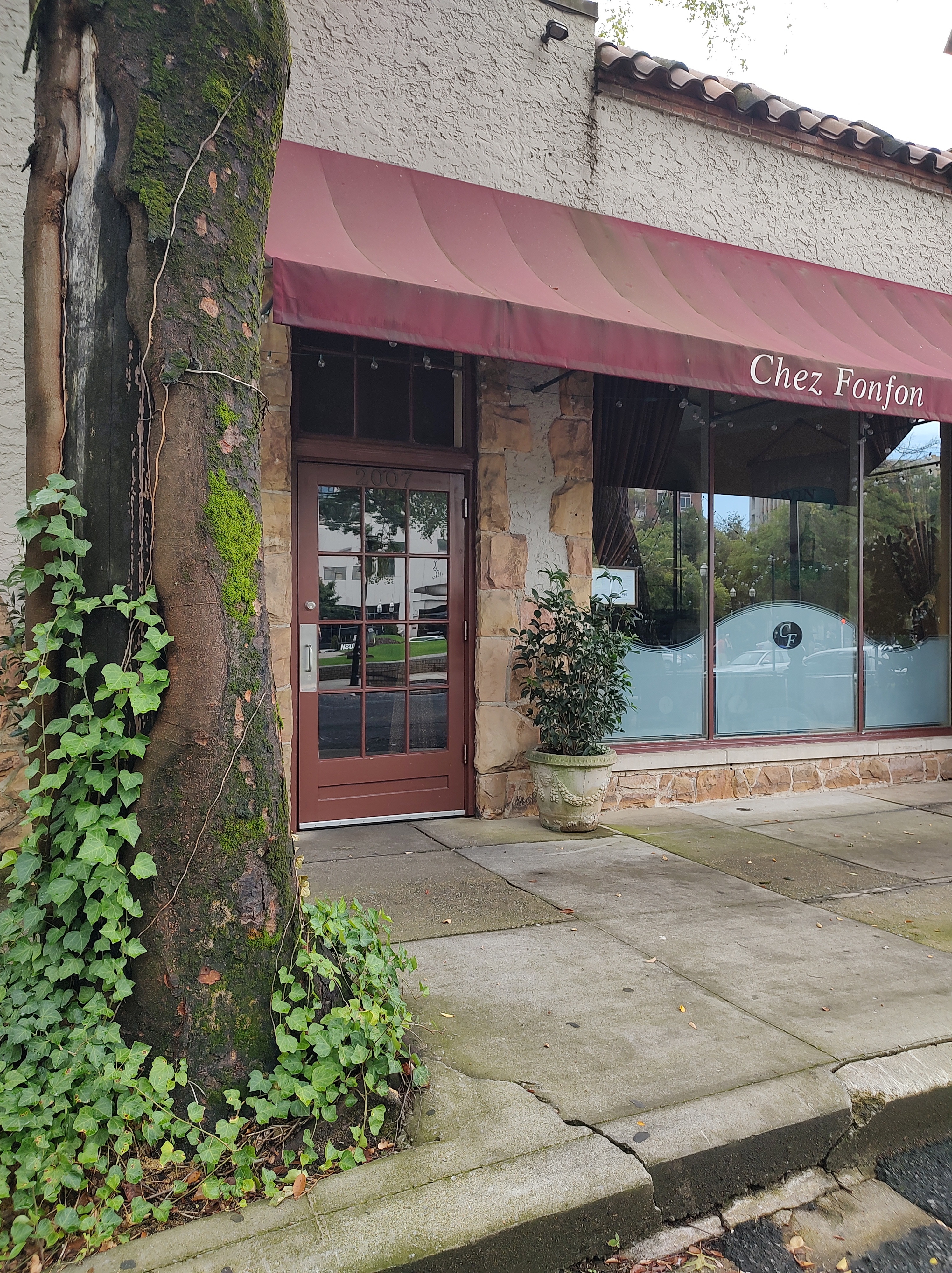
 I am met with the inevitable smirk whenever I suggest to out-of-towners that they might want to have a meal at Chez Fonfon, Frank and Pardis Stitt’s charming bistro next door to their acclaimed Highlands Bar and Grill in Birmingham’s Five Points South. I am expected to account for the name, which might seem frivolous and silly on first hearing. I used to say that perhaps in a discussion to come up with a suitable name for a French-style bistro, somebody said I dunno, let’s just call it something like Chez Froufrou, Fonfon – something like that and it stuck. That one didn’t seem to satisfy anyone so I did some research and found that there is a Chez Fonfon in Marseilles. When I tell those smirking people that I think it was named in honor of a famous French bistro, smirks disappear.

When they take my advice and eat there, any skepticism vanishes. Chez Fonfon is even more pertinent today since its neighbor, Highlands, has been closed since the pandemic. The Stitts have reopened Fonfon, Bottega, and Bottega Café, but Highlands, the restaurant that heralded Birmingham’s lauded modern culinary scene, has not yet returned. There are hopeful rumors circulating that Highlands may be back before the end of 2023.

I’m not dining out much these days. I find, though, that on those rare occasions when I can get away for a relaxing dining experience, Chez Fonfon is one of my go-to spots. When my friend, Anne, recently contacted me and asked if I might be available to have dinner at Chez Fonfon on a certain night, I replied, “Book it and I’ll make it happen.”

Not only was I able to meet Anne for dinner but, when I got there, my friend Deborah, who lives in New Mexico, was with her to surprise me. The meal with a friend had become a celebratory reunion with dear friends from Tuscaloosa days.

A few days after the Chez Fonfon dinner, I had a conversation with another friend who had just returned from her first trip to New Orleans. We talked about her New Orleans dining in classics like Commander’s Palace and Galatoire’s and even some of the newer places and agreed that, although the food is exceptional, it’s the quality of service that makes so many New Orleans restaurant experiences so truly unforgettable.

The same is true of the Stitt-owned restaurants in Birmingham where service is always impeccable, knowledgeable, and attentive without being obtrusive. I tend to always order fish at Fonfon and my Gulf grouper, with a rich sauce, field peas, and a corn and cherry tomato relish was the perfect plate for my taste. Anne and Deborah did not hesitate to order the crabcakes with seafood from the fishing village of Bayou La Batre on Alabama’s coast, garnished with butter beans, chives, and beurre blanc. A crisp Sancerre was the perfect accompaniment.

It’s impossible – or at least inadvisable – to have a Chez Fonfon meal without one of their famed desserts. Heeding the tradition of Carolinians and chef Bill Smith, formerly of Chapel Hill’s Crook’s Corner, who say that a citrus dessert is the proper dessert after seafood, I ordered a berry trifle with lemon curd. Anne and Deborah ordered coconut pecan cake and Basque cake. As always, the desserts were delightful and worthy of raves.

The meal was punctuated by memories of times past in Tuscaloosa and in Birmingham’s Southside. Five Points South is a historic part of the city dominated by Spanish Baroque architecture, hotels, and entertainment options. An extensive refurbishment was nearing completion on the centerpiece of the district, Frank Fleming’s sculpture and fountain, “The Storyteller.” As we left the restaurant on a steamy July evening, we walked across the way to pay homage to the fountain and the place, the site of many memories across the years.

I find that my own post-pandemic outings are fewer and farther between. Because of the challenges we have all faced, those times seem even more special when they happen. Being able to meet with friends again, being able to enjoy a relaxing and amazing meal, being able to breathe and laugh and remember past adventures – all those things make for an evening that will last in memory.

________________________________________________________________________

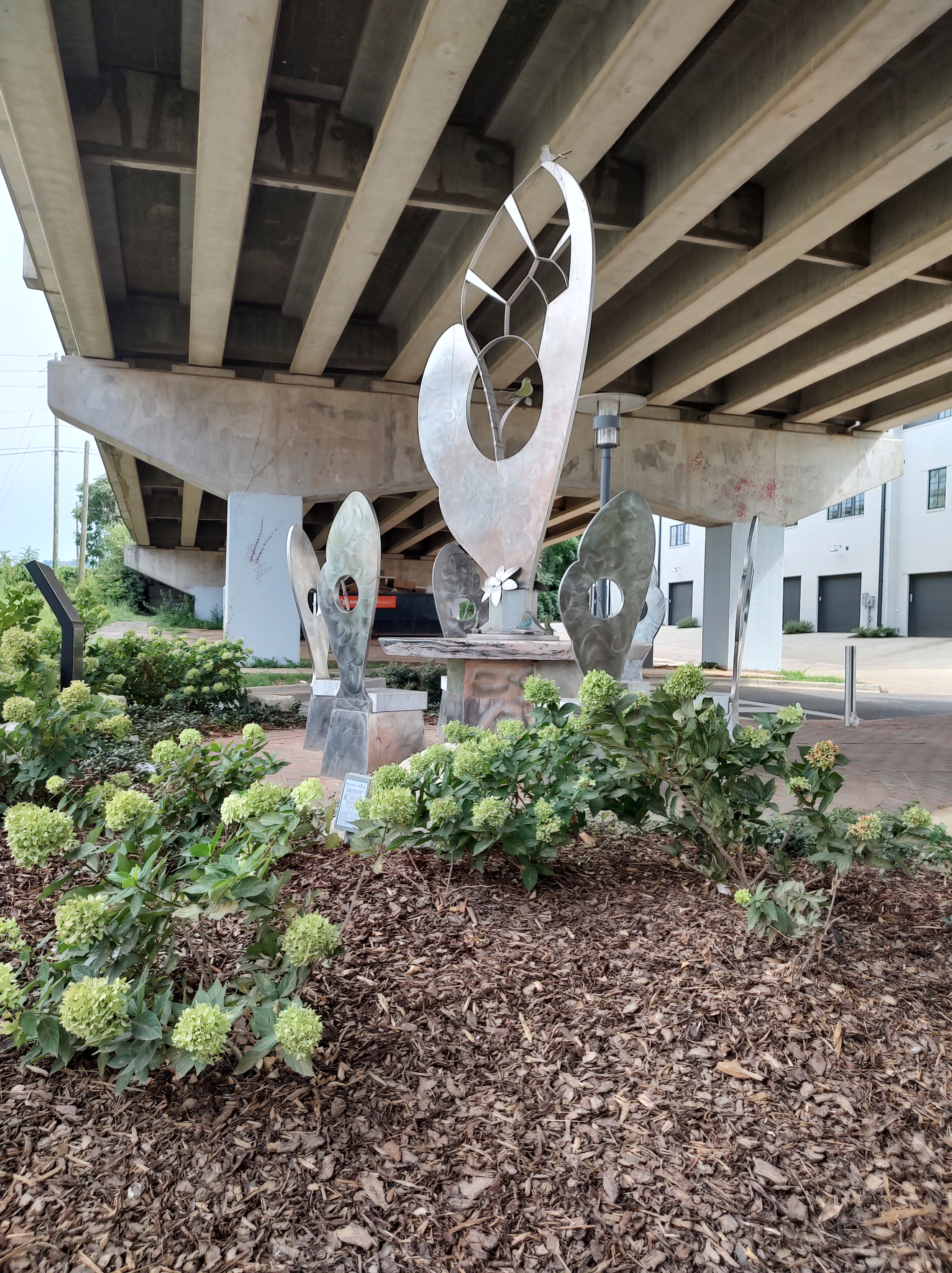
On down the mountain toward the city center, about ten blocks south of the Stitt restaurants, is the Rotary Trail, a half-mile linear park built on a former railroad bed. At the eastern end of the trail, nestled beneath an overpass, is “Frank’s Table,” a sculpture by Gregory Fitzpatrick in honor of Frank Stitt. The table, in stainless steel topped by Alabama marble, incorporates iconography representative of honeybee wings. Its dedication reads, in part, “Frank’s culinary and cultural contributions to our community have provided a table at which we can all sit.”

Frank’s Table

Here’s to many more great meals at table with friends.


On Reading Jim Murphy’s “Versions of May”

Perhaps my favorite poem by Norman Dubie, the poet who died in the winter of this year, is “Pastoral,” a quietly startling poem about a woman nursing her baby as her father is shot to death. “…all the snow is red, the horse’s / Blood is white,” Dubie writes, before he gets to a memorably haunting final line: “Terror is / The vigil of astonishment.”

My synapses started firing while I read Jim Murphy’s new book of poetry, Versions of May (Negative Capability Press, 2023), and came across the poem “Letter to Westerberg” with the words about the “damaged and distorted / record that you left like blood on snow.” Soon after, in the poem “Terra Nova,” Murphy writes of “nothing known for sure / except the sweet terror of horizons.”

The ability of words to stoke evocative connections is a powerful thing and the fact that the words “blood,” “snow,” and “terror” sent me back to a much-admired poem from the 1970s illustrates the power of the written word, and poetry especially, to transform and stimulate. Dubie and Murphy share wide-ranging ken and conjure familiarity from the obscure.

Versions of May grabbed me from the first poem, “Grave as Blackberries” – an invocation, of sorts, calling forth joy and Miles Davis. Murphy writes poetry of subtext, in which larger truths and histories often lurk beneath the façade – poetry pentimento, in a way. Conversely, an expansive vision might give way to an intensely personal insight at the turn of a phrase.

In “Southern Holi,” a poem about the Hindu “Festival of Colors” in India, “filaments of the distant past” become “lost in the compact present.” Vestiges of that past abruptly halt the adults; the children frolic on, “not a worry in the world.” Murphy’s poems cover a world of topics with frequent shout-outs to jazz, blues, and rock musicians.  Chet Baker, The Beatles, Blind Willie Johnson, Hall and Oates, Jane’s Addiction, Jim Morrison, Lou Reed, Nina Simone, and others make cameos in these pages. In “Phone Call to Morrison,” he writes, “I’m trying to reach you on a black phone / in the hall, hung by its neck until dead.”

Murphy’s poems address joy and beauty, friends and family and bliss, but often with a keen sense of the darkness that lies beneath. These poems are set throughout the United States as well as in far-reaching locations in Mexico, India, and Vietnam. Section 2, a series of 13-line poems, considers topics that begin with a breath and continue to the death of a parent. “At last, you had become the chords,” he writes for his mother.

These are robust and vital poems – each with something to be pondered and savored. As Murphy writes “In Defense of Chet Baker”:

“You hear that? Someone / somewhere is singing.”

Book Review: Saturday and the Witch Woman

Thomas Oliver Ott’s Saturday and the Witch Woman is a historical novel about real people set against events at the start of the Haitian Revolution in 1791. It’s a page-turner, providing insights into Toussaint L’Ouverture, the human toll, and the many factors that came together to ensure the success of the insurrection. Here’s my latest review for Alabama Writers’ Forum:

Saturday and the Witch Woman: A Novel of Remembrance

“Oh, for a bee’s experience …

Of clover and of noon!” – “The Bee” by Emily Dickinson

Trying to savor the summer while having some restraints on my activities, I have been thinking a lot about the bees. I have been watching them a lot, keeping in mind alarms about declining bee populations. Specifically, I have been staying at my mother’s house full-time, so I shifted focus from attracting bees to my own small yard in Rocky Ridge to observing the activity around her garden home community on the steep west slope of Shades Mountain.

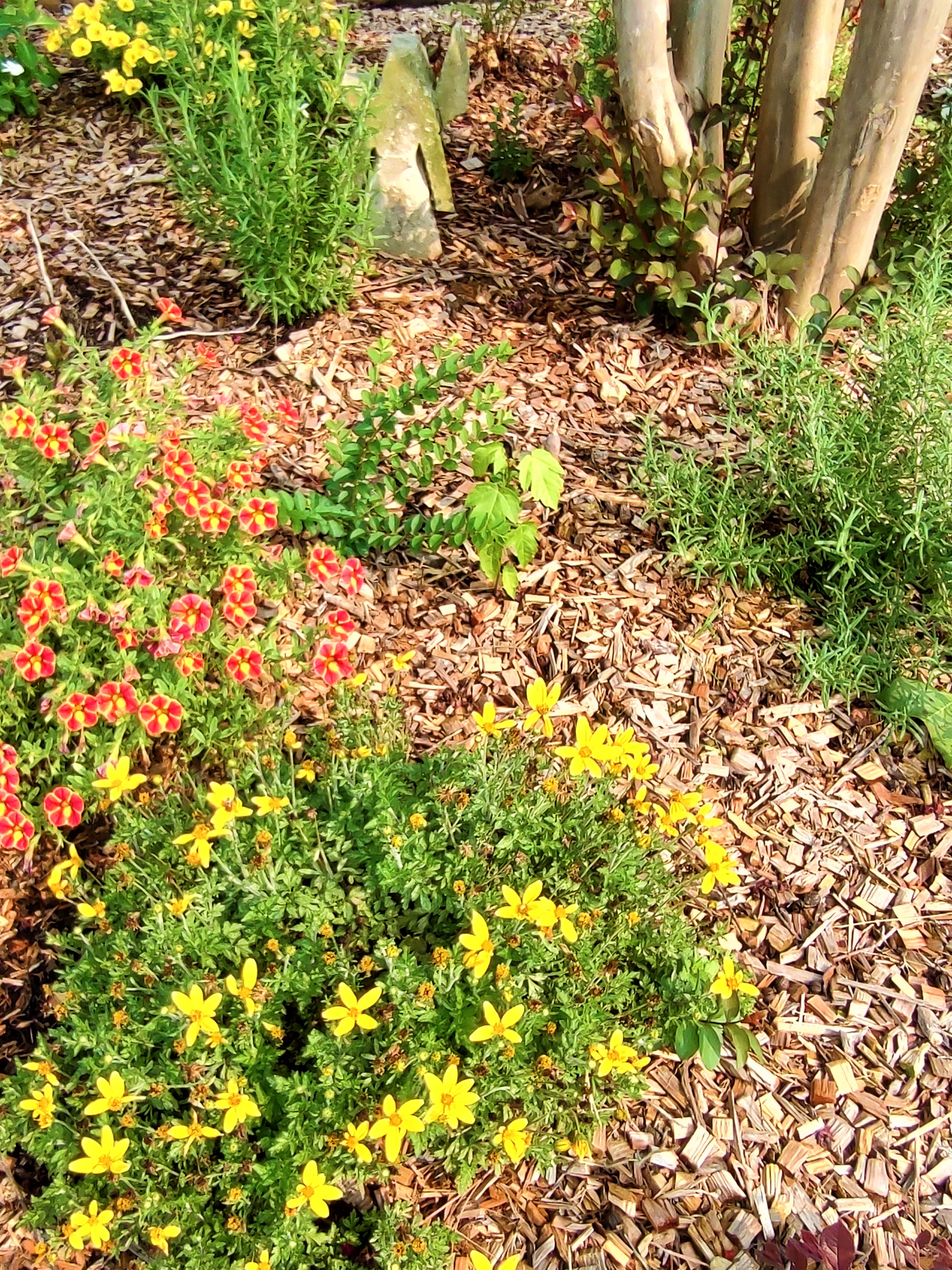
A late freeze brought the demise of a large loropetalum shrub encircling a tall crape myrtle in Mother’s front yard. When the loropetalum was removed, we decided to plant a variety of blooming and leafy plants in its stead. It turned out to be a good move – with compact bidens, calibrachia, rosemary, vinca, and Japanese painted ferns putting on a frisky, flourishing show beneath the deep crimson blooms of the crape myrtle. I keep a careful watch over the volunteers – some are welcome; others will take over if left alone.

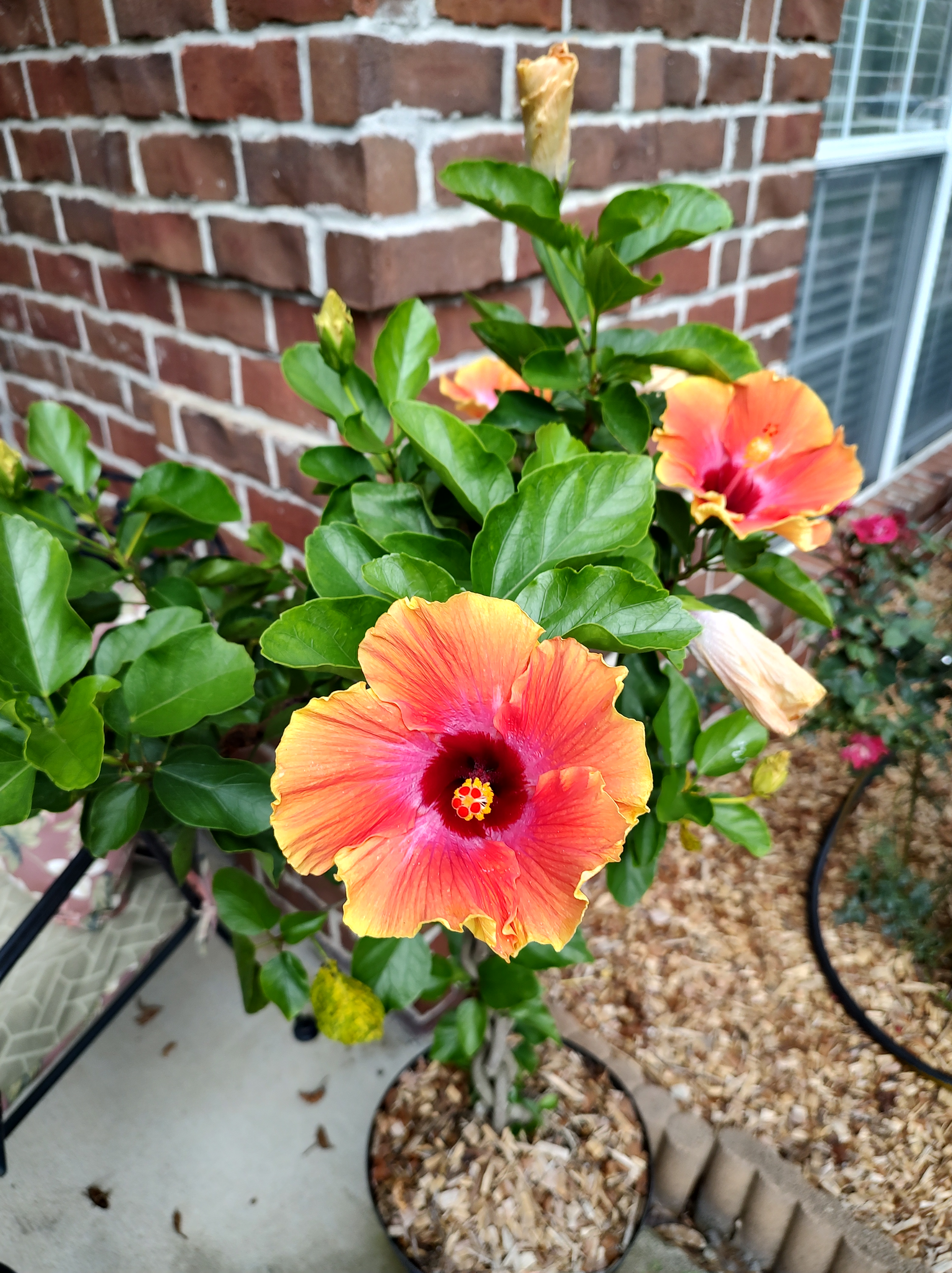
On the porch, a yellow begonia holds court in a hanging container, with lysimachia flowing toward the ground. The large blooms of a braided mandevilla in a unique coral and golden hue are a favorite of my mom’s, but the blooms drop after one day, leaving the plant leafy without flowers on occasion. It shields an always trustworthy heuchera which was joined this year by a lacy volunteer that was just too charming to eliminate. The lacy foliage will wither away in late-fall, but the heuchera, if it acts according to habit, will still be flourishing next year.

As you come into the entry space, a ruellia – commonly called a “wild petunia” and known for an invasive nature – stands confined in a container, grounded by impatiens and lysimachia. Its delicate morning blooms fall off daily, to be replaced by new blooms the next morning. The roses in a bed next to the house have seen better days, but they are hanging in there. Bees, butterflies, and the occasional hummingbird show up and regular rainfall and diligent watering are keeping everything happy so far in the stifling July heat.

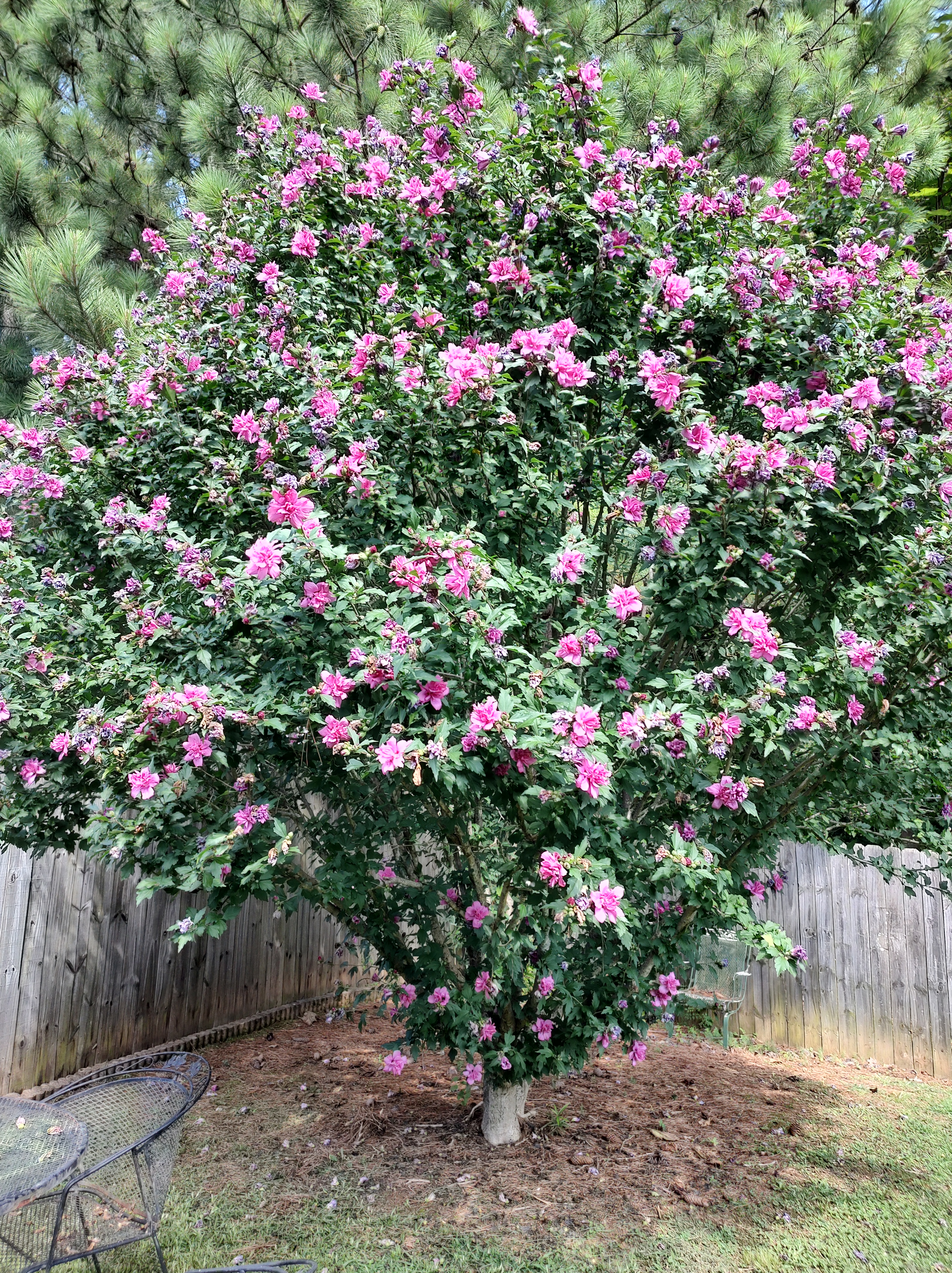
But here’s the kicker: There’s a Rose of Sharon in my parent’s backyard that grew from a sprout and is probably in excess of twelve feet now. It’s covered with fuchsia blooms and – at any given time – hundreds of bees. I know Rose of Sharon is a common name used for a number of plants – this one is a hibiscus – but I like the tradition and antiquity of the appellation and plan to use it until the plant police come knocking. Bees have always loved this specimen, but this year seems to be a banner year for its bee population from early morning to sunset. There is a constant low buzz from the tree when we wander into the yard.

Slightly to the side of the Rose of Sharon is a raised bed my dad created. I haven’t had a chance to properly tend to it this year, but it is lush and beautiful in its wildness anyway. Purple heart and yellow lantana grow in a bed with four less-than-stellar rose bushes. The in-ground Easter lilies bloomed late and those plants have taken their time fading away. Like many other plants, the odd weather seems to have confused them; one healthy looking lily has developed three new bulbs (in the middle of July!) but I do not expect them to bloom.

It hasn’t been a great few years for the roses of any kind and my grandfather’s ancient rose bushes, grown from cuttings of the mother plant, have struggled to flower. The hummingbird feeders do not seem as busy as usual, but an occasional hummer is spotted at the feeders and among the bees in the Rose of Sharon. It’s a challenge to keep the bird feeders stocked; it’s a bigger challenge to keep the squirrels away, but Lulu, the prancing chihuahua, likes nothing better than to chase the squirrels. Mourning doves are the primary customers at the feeders, but a pair of cardinals are frequent visitors since late-winter, as are an occasional bluebird and blue jay and a red-headed woodpecker. Wrens and chickadees are also in evidence, I think, but I hesitate to say much since a reader pointed out recently that I don’t seem to know the difference. I pay my annual due diligence to the Audubon Society and the Arbor Day Foundation but I’m not always good at the identification part of the test.

These are the things that inhabit my alternate garden in summer 2023.

Book Review: Unmasking the Klansman

Here’s my latest book review for Alabama Writers’ Forum.  Dan T. Carter’s Unmasking the Klansman: The Double Life of Asa and Forrest Carter is bizarre and troubling and, unfortunately, absolutely true.

Unmasking the Klansman: The Double Life of Asa and Forrest Carter

Long, Last, Barry

After a night out with friends in 1979, I returned to my apartment on Caplewood, a pleasant winding residential street at the end of the Strip, down the road from the University of Alabama. As I put the key in the lock, my neighbor Mike walked out on the porch. “Barry was here earlier,” he said.

“Yeah?”

“Yeah. I kinda had to run him off.”

“What was he doing?”

“Actually, he was trying to break into your apartment.”

“Really … did he happen to say why?”

“He said he was a writer and he needed inspiration and that you had a record album he needed to listen to tonight, right now. He was pretty adamant.”

“And …”

“I told him it looked like you weren’t home and he needed to leave, that I couldn’t let him break in.”

“How’d he take it?”

“He was annoyed and argued a little, but he left. Do you know what he was looking for?”

“I do.”

The next day, I grabbed Planet Waves from my record stack and walked a couple of doors down to Barry’s studio in the backyard of a neighbor’s house.

He was in.

“Here’s the album you were looking for last night,” I said. “Take it. Keep it. You can have it, and please don’t come knocking at my door anymore. And don’t ever try to break into my house again. Please.”

___________________________________________

Barry Hannah, the novelist that Truman Capote called “the maddest writer in the USA” and whom Alfred Kazin praised as “a writer of violent honesty and power” was my neighbor in Tuscaloosa in 1979. His studio was two doors down and his house was farther down on the curve that pointed Caplewood back toward the university.

When I heard that Hannah was coming to the University of Alabama to teach creative writing, I grabbed his first novel, Geronimo Rex, and was transfixed by the vibrant energy and muscle of the words on the page. He always wrote like nobody else with a style that was impossible to emulate – for anyone foolhardy enough to try.

I started hearing “Barry stories” from my writer friends as soon as Barry hit town, but I didn’t meet him until his hugely acclaimed volume of short stories, Airships, was released and I got a copy signed at Another Roadside Attraction, a bookstore on the Strip. He asked my name, proclaimed it a “great name,” and inscribed the book to me with a comment about my name.

I later loaned that signed copy of Airships to a friend and he never returned it. I asked him about it and he denied that he borrowed it, but I know he did. I always remember people who borrow and steal my books. (I’m talking about you, Jim.) After I started hanging out with Barry, he signed another copy of Airships, but the inscription was less personal.

After I moved into the apartment down the street from Barry’s house, we began to run into each other more often. He’d occasionally show up at my door and I was occasionally invited down to his house or studio.

One night late, a friend and I were sitting in Barry’s living room and Frampton Comes Alive! was on the turntable. When “Do You Feel Like We Do?” came on and the signature talk box guitar solo kicked in, Barry picked up his trumpet and began to blow, trying to match the talk box sound. It was a bizarre moment in time, but Barry’s effort was so earnest that we weren’t sure how to react. Once it was over, I think I offered a noncommittal wow.

_______________________________________________

But my most bizarre “Barry story” begins on another late night at Barry’s house. Barry suddenly turned to me and said, “The Paris Review wants to publish an interview with me. I’ve told them I will only do it if I can choose the interviewer. Edward, do you want to do my Paris Review interview?”

Remember, this was forty-four years ago and I was trying to keep up with Barry, so some details are fuzzy. I have no clue if Paris Review was trying to do a Barry Hannah interview in 1979, and I was skeptical that I would be considered to write it, but it was a promising adventure and I didn’t hesitate to go along.

I was even more skeptical when Barry said we would do the interview the next morning at the studio, but I called in to take the day off, gathered a cassette recorder and blank tapes, and showed up at the studio at the appointed time. I was pretty sure I wasn’t prepared to do a proper Paris Review interview.

Barry, drink in hand, was waiting for me when I got to the studio. We chatted for a while until I finally asked if we could start the interview. Barry insisted that I needed something to drink and poured a glass full of something rancid that he referred to as white wine. It had a strong chemical smell and something unsavory was floating on the bottom. I thanked him, put the glass to the side, and started the recorder.

I wasn’t really prepared for a writer interview with twelve hours’ notice, so I asked him about his childhood in Mississippi, his family, other Mississippi writers and influences, autobiographical elements in his stories, teaching creative writing. I rambled and so did he. His responses were tangential and he kept coming back to a poem he had just written, called “Certain Feelings.” “I have certain feelings about this room / I have certain feelings about doom …” and on like that. I was pretty sure we weren’t having a Paris Review-level interview. I wasn’t sure if Barry was putting me on, making a fool of me, or was just that far gone. I wasn’t sure how I should respond to the bad poetry of “Certain Feelings.”

After a very long time, Barry looked at my wine glass. “Why didn’t you drink the wine?” he asked. I told him that I thought the wine had turned, or something. He grabbed the glass and shrieked in horror and said he gave me the “wrong glass.”

The interview basically was over when he said, “Let’s go get a drink.” I agreed and Barry picked up the phone, called Lee’s Tomb, a downtown bar and music venue at a former loading dock, and ordered four cocktails to go. We climbed into Barry’s MG convertible and drove the few blocks to Lee’s Tomb, where a bartender stood on the side of the road with a tray and four cocktails. Barry tipped the bartender, told him to put it on his tab, and roared off, announcing that we were going for some barbecue.

As we crossed the river into Northport, Barry announced that he wanted to go get his kids and drove to a neighborhood. He stopped at the end of the drive where his ex-wife lived and told me his kids were inside and he wanted them to go get barbecue with us.

“She’ll get mad if I go to the door,” he said. “You’ll have to go. Tell her you’re a writer for The Paris Review, interviewing me, and that we want to take my kids for barbecue.”

As I got out of the car, he said, “Use a French accent.” After all these years, I blush to admit that I took his suggestion.

I walked up the long drive to the front door and rang the bell. It opened immediately; she was waiting for me. “Bonjour, madame,” I said in the worst attempt to have a French accent ever. “I am in town to interview Barry Hannah for The Paris Review. He would like to take his children out for barbecue and I would like to meet his children.”

She scowled at me, at the MG, and at me again. It was a practiced scowl that I’m sure she had been called upon to use frequently with Barry’s “associates.”

“Go home,” she said, and closed the door.

I took the long walk back to the MG. “She said we should go home – no kids today.”

Barry looked back at the house for a long time. Finally, he took a long breath and said, “Let’s kill her.” I’m sure he didn’t mean it.

“Let’s go get some barbecue,” I said. And we pulled away and went to Archibald’s. The meat was good, but the wind was taken out of the day and we ate and went back to the studio on Caplewood, stopping again for curb service at Lee’s Tomb on the way. Barry said we’d have to finish the “interview” some other time and that was the last time the Paris Review interview was mentioned.

________________________________________________

But Barry and I kept hanging out for a while. Occasionally he would summon me down to the studio to hear something he was writing. One night, very late, he knocked on my door, woke me up, and said he wanted me to look at something he’d just written. I dressed and went down to the studio, he made a drink, and I read a few paragraphs about Judy Moody, a charismatic young woman who had recently made a run for mayor of Tuscaloosa and lost in a close runoff. Barry describes her as “a true person waiting to talk to you and comfort you.”

On another night, he saw my lights on and dropped by. I was listening to Planet Waves, the first album collaboration between Bob Dylan and The Band. The Last Waltz documentary was recently released and I was going though a major The Band phase.  Barry wanted to listen to Planet Waves over and over. I have no idea which song was so important to him but the next night he was breaking into my house for the album.

That led to the incident that opened this essay.

__________________________________________

I mostly avoided Barry after that. Occasionally, we’d see each other out and about and nod in passing. Sometimes, I’d hear the trumpet being played on the balcony down the street, its often shrill notes breaking the peace of Caplewood. One weekend, a group from a party I was hosting decided it would be fun to roll Barry’s yard. I didn’t find out until after the fact and worried that there might be a confrontation. The next day, I walked down to see Barry’s yard and trees covered in toilet paper; the following day, it was gone. Nothing ever came of it.

Barry was never very happy in Tuscaloosa and his legendary drinking contributed to a preponderance of local “Barry stories.” I heard the famous story about him pointing a gun at a student in a fiction writing workshop and every version was a little different. I even heard the story from the grad student that the gun was allegedly pointed at; according to him, the story was true. Barry’s version was much more sanitized – something about using the gun to illustrate the various parts of a short story. No matter whose version you heard, though, Barry brought a gun to a creative writing class.

I moved away from Caplewood later in ’79 and saw Barry out and about less and less. I bought Ray as soon as it came out in 1980. In Ray, Barry writes about sex and violence and frequently uses the n-word with what we used to call “reckless abandon.”

_______________________________________________

There was a terrible movie called Walking Tall that came out in the early ‘70s. The head of a local movie chain gave his personal endorsement of that movie in radio ads. “Walking Tall is rated R for violence, not sex,” he said. “So bring the whole family.”

You can’t make that up. It was the ‘70s.

_____________________________________________

When I read Ray, I realized that the rambling stream of consciousness is partially a surreal recap of Barry’s experiences during the writing of that short novel. I realized that some of his rambles during the “interview” were a test run for passages that wound up in the book. That passage about Judy Moody is there – section XVIII, as is the “Certain Feelings” poem that he recited to me off and on throughout the interview day (XIV). In the novel, a student recites “Certain Feelings” to Ray and Ray slugs him. I finally knew how I was supposed to respond to that poem.

I haven’t told my “Barry story” very often. Partially, I was embarrassed by the out-of-control aspect of the whole series of episodes, especially the French accent episode at his ex-wife’s house. His name would come up in conversation now and then and I would sometimes mention that I had known him briefly in Tuscaloosa. During a conversation with members of an Atlanta-based New Wave band, Swimming Pool Qs, a band member cited Barry Hannah as an influence in their music and I mentioned that I had hung out with him at one time. My cred immediately rose with the band.

I ran across those Paris Review interview cassettes as I was packing for a move sometime in the ‘90s, listened to a few minutes, was mortified, and tossed them. If they had been found, they would have been an embarrassment to Barry and me. Sorry. I couldn’t let them exist.

______________________________________________

After Barry left Tuscaloosa, he worked with filmmaker Robert Altman for a while, and then he went to Oxford, Mississippi, to teach at Ole Miss. I heard stories about his drinking in the first years there and then I heard he got sober. I would run into people who had been in Oxford and knew Barry and it was the tale of two Barrys. Some stories were from the heavy drinking phase and others were from the sober phase. Overall, Oxford seems to have been the right place for him to land. I’m sure he had plenty of barbecue with his kids there.

I thought about trying to get back in touch, but never did. Eventually, Barry had a series of health problems and reported seeing Jesus in his hospital room.

The Paris Review ran Lacey Galbraith’s interview with Barry Hannah in Winter 2004, twenty-five years after our trial run. I re-read it not long ago and it’s a great interview. Look it up in the archives – “ Barry Hannah, The Art of Fiction no. 184.”

Long, Last, Happy was a posthumous collection of short stories published not long after Barry died in 2010. He’s buried in the same Oxford cemetery as Faulkner and some of his friends slapped one of those I’D RATHER BE READING AIRSHIPS stickers on Faulkner’s grave shortly afterward. I bought a copy of Long, Last, Happy at Faulkner House Books on a trip to New Orleans with my brother in 2011. Late that night, back at the hotel, I started randomly reading the stories – many of which I already knew from Airships and other collections – while my brother tried to sleep on the other side of the room. I giggled heartily way into the early morning.

When the proprietor of the bookstore had seen what I was buying, she said, “A good Southern boy.” Did she mean me for reading it? Or Barry for writing it? I think she meant both.

Book Review: Space Oddities by Joe Cuhaj

Here’s my latest Alabama Writers’ Forum book review for all of the space nerds out there. While you’re at it, check out the other recently posted reviews. There are books for every taste — Celebrate Them.

Space Oddities: Forgotten Stories of Mankind’s Exploration of Space

Empty Nest

In the earliest days of spring, a pair of Carolina wrens got busy building a nest on a piece of wood at the top of a porch column at my mother’s house. It seemed like a fine piece of property at a place where other animals couldn’t climb, sheltered from the elements, with a roof overhead. As soon as they would make some progress, a gust of wind would blow their handiwork to the porch floor and the birds would pick up and start all over.

After a couple of frustrating days, the wrens moved on. By the next day, I noticed activity at an empty flower pot on a narrow shelf next to Mother’s back door. Over some busy days, the pair of wrens constructed an igloo-shaped nest incorporating natural elements as well as artificial eucalyptus foliage that had been abandoned on the shelf. The narrow shelf had an Easter cross hanging from it and the birds would perch there as they made their entrances and exits at the nest. The nest is a bit of a post-modern showpiece combining found, natural, and people-made elements. Frank Gehry would be proud, I think.

There was concern that the nest might be bothered by the frequent traffic in and out of the backdoor but the birds seemed blasé about the human and dog presence and Lulu, the trusty chihuahua, stayed mostly oblivious to the activity just a few feet above her head. Occasionally, though, I’d catch her looking up with curiosity; she knew something was up. Since the nest was always visible from the breakfast nook through the backdoor window, it became a daily source of entertainment and the birds’ work ethic was fervent and impressive.

Finally, the nest activity got quiet and I would see the female staring back at me as I went in and out of the house. One morning, as I went to replenish the bird feeders, she was gone and I peeped in to see four speckled eggs on the bed of the nest. As I pulled away, I saw the mother sitting on the arm of a lawn chair, watching. As soon as I left, she returned to the nest. After that, activity was confined to the male occasionally visiting the nest and the female occasionally flying out for a few minutes at a time. I am making assumptions about gender here since, to my eye, there appears to be no distinct difference between the male and female.

After a while, there was increased activity and it seemed the two adults were going back and forth with things in their mouths. I got closer to the window and saw four naked chicks with mouths wide open. The adults were in the yard, digging for bugs and worms, taking turns feeding the hungry babies. Whenever there was sound or movement near the nest, the four mouths would pop open on cue.

After a few days, four mouths became three. I did research on baby chick mortality and learned that it was quite common for chicks to die in the nest. The mother either pushes the dead one out of the nest or leaves it there to be trampled by the other chicks.

Time went on and the three babies grew and began to have scraggly tufts of feathers. One morning, while I was preparing breakfast, I noticed a flurry of nest activity and moved to the window in time to see a chick wobbling on top of the nest. An adult was anxiously flying around and finally the chick hopped to an arm of the cross and assessed the possibilities. The other two chicks poked their heads out of the nest opening and watched.

At last, the first brave chick flew/fell to the porch floor and seemed intent on getting into the house. Eventually, it made its way to the grass and finally flew up to a patio chair with its parents watching anxiously, fluttering around.

By the time the first chick got to the lower branches of the rose of Sharon, the second chick was sitting on the edge of the nest. The adults turned their attention to the second baby and it eventually took basically the same path as its sibling.

By this time, the third chick had withdrawn back into the nest. The parents kept popping in with treats and seemed to be waiting for it to fly away, too, but nothing happened. This went on for most of the afternoon and then it stopped. That night, I looked into the nest as I walked out the back door. The hesitant chick sat in the back of the nest, eyes open, and stared back at me.

The next day was about the same, with adults going back and forth with food offerings. Sometimes they came out with their beaks empty and other times the food was still in their beak when they left. That night I peeked in the nest again; now, the little bird was still breathing, but was turned away from the nest opening.

On the third day, adults came back a few times carrying food, and left each time with food still in their beak. The last time I saw one visit the nest, it looked in for a moment, flew up to the arm of that cross, flew back to look in, and flew high into the woods behind the house. As far as I know, it never returned.

I researched what to do and the most common response I found was to leave the nest and the birds alone. One expert even chastised, Don’t try to “save” a nestling and then ask me why it died.

So we left it as it was for a few days with a vague hope something would happen other than the inevitable. Isn’t that the story of our lives – hoping for something other than the inevitable?

Finally, I went out and lifted the beautifully constructed nest out of the flower pot, took one last look at the lifeless hatchling, and filled the nest cavity with straw. Lulu and I walked out to the woods beyond the back gate. I had planned to place the nest under a tree and cover it with straw, but when I was out there, I found a tree with a sturdy fork in the branches, just low enough to reach. I placed the nest in the tree and, as Lulu and I walked back to the yard headed for the house, I realized that this little bird had lived an entire life – and beyond – without ever leaving the comfort of its well cared-for nest. I hope that was enough for it.

As for the two birds that survived the nest, well – occasionally I’ll see a not-quite-mature wren scuttering in the back yard or feeding at one of the feeders. I like to think that’s one of the hatchlings from those four speckled eggs not that many weeks ago.

Sorry Men in Southern Literature

If you’re looking for a unique collection of creative nonfiction short stories with a great title, Sorry Men in Southern Literature may be what you’re looking for. Rebecca Browder has crafted a memorable group of characters as she explores “sorry men, foolish women, and lost children.” Check it out:

Sorry Men in Southern Literature