
 Friday O, me of little faith. I approached the 28th edition of Birmingham’s Sidewalk Film Festival with no small amount of trepidation. After studying the schedule and the synopses of films, watching some trailers, and second-guessing the wisdom of buying a VIP pass for a festival that I wasn’t expecting to enjoy much – not to mention booking a hotel room in the midst of the festival so that I could park and walk for three days on a still-healing broken ankle, I entered the festivities with a grim attitude. It has been a rough year and I wasn’t expecting to be pulled out of my doldrums sitting in dark movie theatres on the last weekend in August. But then, there was the cinephile temptation of a few hundred moving picture titles spread out over ten screens within walking distance of each other in the course of fifty hours. A doldrum-buster, perhaps?
So I parked my car for the weekend, checked in to the Elyton, walked around downtown for a while to loosen up my feet, got a really good bowl of gumbo from a food truck, and walked back to the Alabama Theatre for Opening Night. At some point in years past, the Sidewalk powers-that-be decided that the opening night was more about feel-good films and the party – before and after – than it was about serious movie-making. In recent years I have often opted to skip the opening night screening altogether. This year, though, I decided to give the Opening Night film, John Wilson’s debut feature documentary, The History of Concrete, a chance. It was funny for a while – an entertaining short was in there somewhere – but at some point it was tiring and ultimately I found it depressing and walked out of the screening. No offense to Wilson and his loyal fanbase – it’s not you, it’s me I’m sure. It has a really good trailer, by the way.
I was glad I walked out because everybody was in the theatre watching the doc and the streets were quiet and relatively empty. People were quietly preparing in anticipation of the block party. I have always felt invigorated walking the streets of downtown Birmingham – even in the bleak years before the downtown rebirth. The theatre marquees looked good up and down the street. I still miss the neon. I’m feeling old.
Saturday In the early years of Sidewalk, I tried to see how many screenings I could squeeze into a weekend. With 250-300 titles to choose from, depending on how many programs of short documentary and narrative films I worked in among the features, I could sometimes get in about three dozen titles. I was careful in selecting my programming, but it used to be a source of pride that I had the stamina for such an undertaking – and I realized even then that I still had only seen maybe ten percent of what was on offer.
I don’t do that anymore.
So on Saturday, after a good breakfast, I headed to the Carver Theatre for a double-feature of documentaries about the city of Birmingham. “As Goes the South,” directed by Brian “B+” Cross and Eric Coleman, is an enjoyable, booster-ish look at Birmingham personalities and success stories; “Birmingham’s Front Lawn,” directed by Michele Forman, is a deep dive into the genesis and evolution of Birmingham’s Railroad Park, a sprawling park in the middle of the central city that occupies once desolate land along the phalanx of railroad tracks that bisect downtown.
With my civic responsibilities fulfilled, it was off to Birmingham Museum of Art and the Polish film, Glorious Summer, directed by Bartosz Szpak and Helena Ganjalyan. It’s a dystopian enigma about three women, living a cloistered existence in a crumbling palatial pile, with all of their earthly needs fulfilled so long as they remain within the geographic boundaries set for them by disembodied voices and mysteriously appearing texts. The outside world’s presence is an occasional explosion or flames in the far distance. Two of the women employ ways of communicating through touch as they play, exercise, follow directions, contemplate their plight, practice their deaths, plot their escape. The film is cryptic, perplexing – beautiful to behold and baffling to contemplate. It lingers long after the closing credits and I’m still trying to come to grips with what it’s saying. In short, it’s why I go to film festivals.
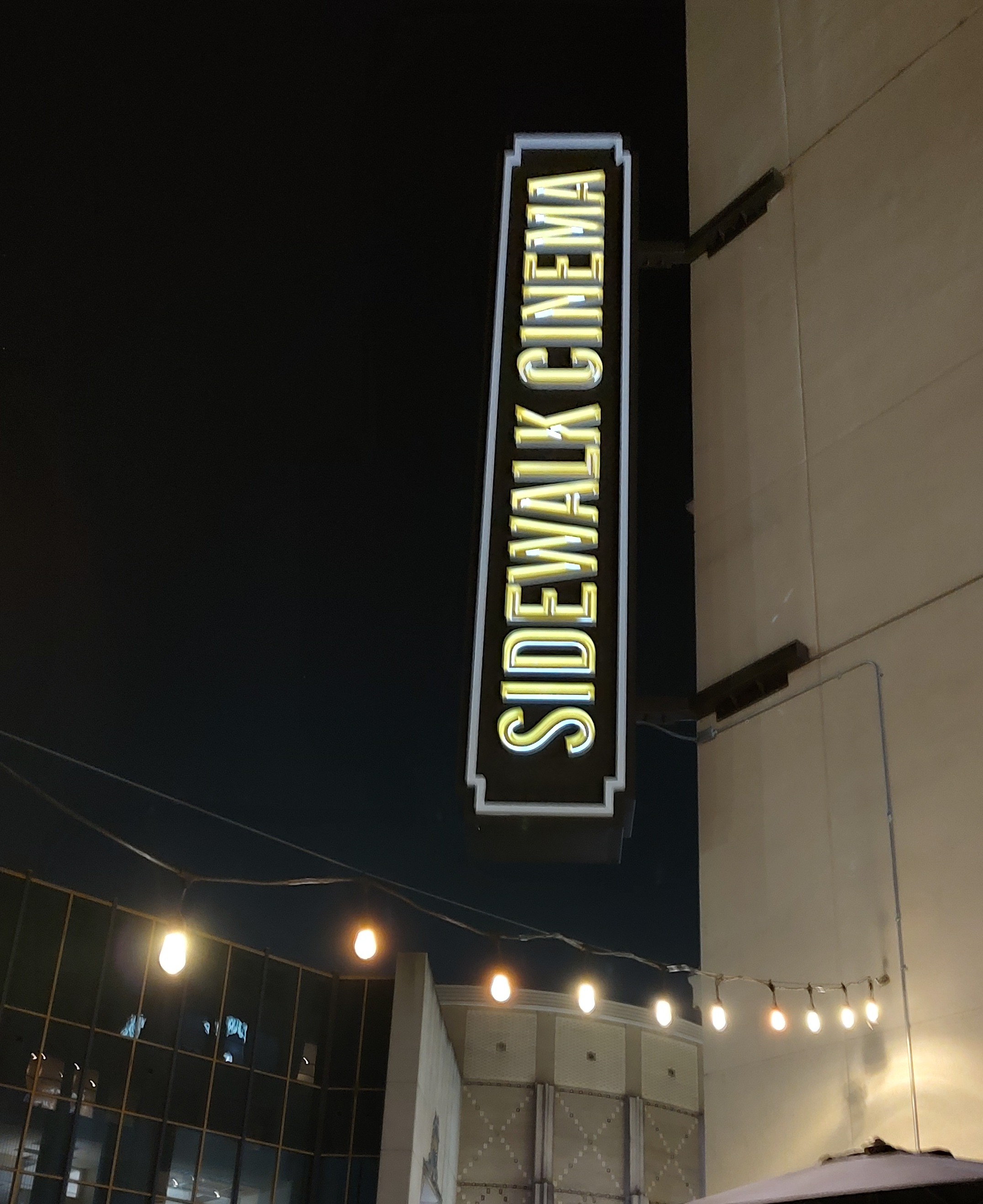
Or maybe the reason I go to film festivals is the episodic situational comedies like Human Theories, directed by Jess Zeidman, with a cast of dozens that played at the Sidewalk Cinema in the afternoon. The New York of Human Theories is bleak, dark, and grimy – the antithesis of the crisp and glistening New York of Woody Allen’s best comedies. Warhol said that in the future everybody would be famous for fifteen minutes; the actors in Human Theories typically get only two or three minutes before it’s off to the next thing. It’s very funny and uncomfortably real.
It had been a lot of walking between screenings and my ankle was beginning to feel it. I decided to do something I used to never do at Sidewalk: Quit while I was ahead, have a good late lunch, go back to the Elyton, take a nap. Those were smart decisions. After the nap, I took a nighttime walk around the theatre district and decided not to take in any more movies that night. I realize that another of the reasons I go to the festival is for the opportunity to walk aimlessly around the city and feel its pulse, and mine.
Sunday After checking out of the hotel and retrieving my car, I found a perfect place to park in front of Sidewalk Cinema where I expected my weekend of movie-going to end. Then I walked the few blocks to the Carver Theatre to get in line early for my next program of short documentaries. There weren’t many people waiting yet and I quipped to a waiting couple that “I arrive early so I can get a seat in the back.” Old habits are hard to relinquish and I have been most comfortable in the back row of a theatre since my days directing plays, taking notes inconspicuously in the back. As we were taking our seats in the theatre, the couple from the lobby passed me settling in to my back row seat on the aisle.
“You really meant it,” the man said. “I thought you were joking. I thought people got here early to sit in the front.”
Gesturing to the whole room, as more people began to come in, I said, “It’s all yours.”
A woman seated near the front said, “I love watching films at Sidewalk on a Sunday morning.” I have said the same thing over the years; some of the Sidewalk films that stick most vividly with me were viewed on a Sunday morning (Family Portrait, 45365, and Icepick to the Moon come immediately to mind from past Sidewalk Sunday mornings).
I initially chose this set of nine short documentaries because of the film, “The Chukker: Nation of Misfits.” The Chukker was a seedy and superlative watering hole in downtown Tuscaloosa for almost half a century. Every strata of society was welcome – except perhaps for the strata that was embarrassed to be in such a diverse and rich smorgasbord of people. University of Alabama students Nate Billings and Charlotte Gale, who were probably born right around the time the Chukker went away to be replaced by a fountain in a public square, gathered up footage to create a history of the bar and its ongoing cultural legacy. Since I first went to the Chukker as a toddler in 1957, the year after it opened, when it also served food as a grill during the day, I have always had a soft spot for the place and its history.
Another short film in the program, “Adi,” directed by Sukanya Subramaniyan, was recommended to me by my physician, who is also a musician. It features the musical trio Vishnu, Davis, & Haleigh, who have forged a distinctive and ethereal sound from musical traditions of Appalachia and India. Following doctor’s orders, I introduced myself to Davis and Haleigh in the lobby and found another group of musicians I plan to follow. Theirs is a lovely sound.
By noon, morning had passed, but the film The Birds Tell Me All There Is to Know, the debut feature by director Aidan Cronin, will no doubt remain in my mind in my personal pantheon of “Sunday morning films at Sidewalk.” It provided a needed balm in a challenging year. Using outdated video cameras, non-professional actors, and an analog point-of-view, Cronin has crafted a moving and beautiful film about memory, loss, youth, and aging. Cronin is a patient director and his film demands a patient and attentive viewer. He lingers, his cast lingers, and the audience must linger to get the full benefit of what this deliberate film has to offer. Its quiet power is a challenge to achieve and I hope to see more from Cronin in the future.
The Ark, a documentary by Viacheslav Rakivskyi and Jeremy Chilnick, is urgent and topical, taking place during Russia’s current incursion in Ukraine. A Ukrainian family, in the process of establishing a place for healing, is asked by a soldier to care for his goats while he is away in combat. The floodgates are opened and the family finds itself the caregiver for hundreds of animals displaced by the Russian invasion, including a donkey amputee who becomes the heartbeat of the film. Against all odds, the film is inspirational and uplifting and a call for all to fight oppression in its many forms.
I left The Ark screening with another “must see” on my list and a couple of others that I might try to get into. A quick survey of the rivulet of lines coming out of the Sidewalk Cinema entrance convinced me that I wouldn’t get in, so I dashed to my prime parking spot and went on my way. As always, it was a great weekend.
Why do I go to Sidewalk? To see films and meet artists that I may not have discovered otherwise. I am rarely disappointed.

