Tag Archives: Alabama

Community and Kentuck

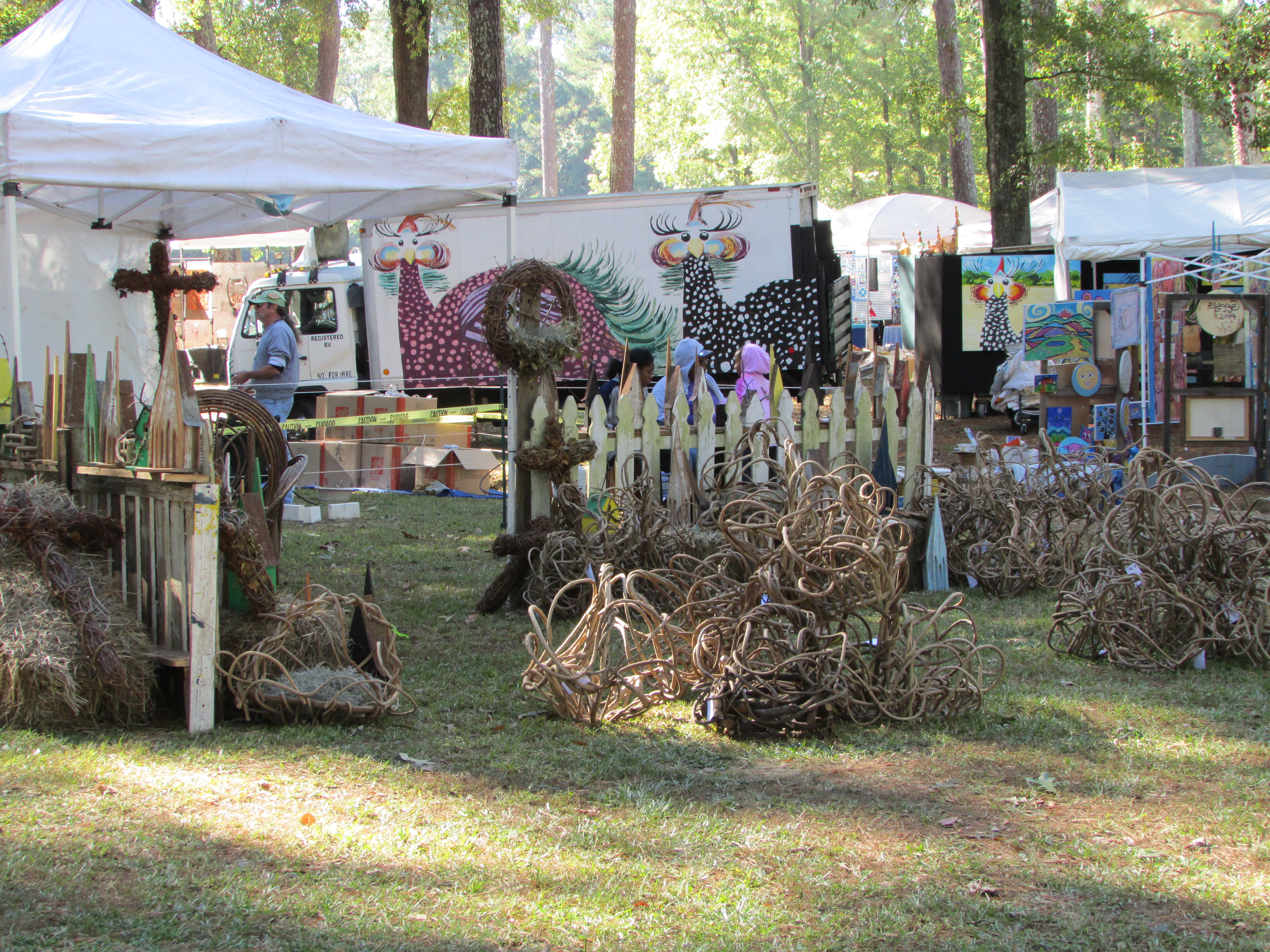
IMG_0775   I never know what will catch my eye at the Kentuck Festival of the Arts in Northport, Alabama, right across the Black Warrior River from Tuscaloosa. It is always held on the third weekend in October (www.kentuck.org).

This weekend, October 18-19, was the 41st running of the Kentuck Festival. I began attending when the Festival was in its toddler stage, around #2 or #3. I’m not sure which one because, like turnip greens, Kentuck now seems ubiquitous in my life. Journalist and Columbia University professor Claudia Dreifus writes that Alabama is a “hotspot” for visual and musical art and that “Kentuck is an incubator, a nursery, a home.”

The festival started on a small local scale in 1971 and has grown in size and reputation ever since, frequently and nationally being touted as among the finest of its kind. Folk, self-taught, and visionary artists have always been the backbone of the Kentuck Festival but it includes a diverse and impressive array of visual artists from the South, throughout the United States, and beyond. The festival takes place in a wooded area of a park not far from Northport’s downtown but the Kentuck organization operates year-round with resident artists, studios, galleries, and workshops spread along Main Street and throughout the city.

Everything builds to the festival. Artists, dealers, patrons, and sightseers converge from all over the country to purchase, mingle, look at art, and meet the artists. Demonstrations, musical performances, storytellers, and food areas round out the sensory overload of the event. I counted more than 250 artist exhibitors in booths spread among towering trees. An added bonus was when I stumbled upon an art installation in an environment adjacent to the Festival grounds. Meredith Randall Knight’s M.F.A. exhibition, “The Marrow of It,” features nebulous concrete abstractions nestled within and interacting with a natural environment just steps from the festival.

IMG_0786

The sense of community is palpable and is one of the factors that always brings me back. Kentuck gives me an opportunity to visit with friends – many of whom I only see annually at Kentuck and some of whom I have known since I was an undergraduate at Alabama in the ‘70s. I can check out new directions in their art, find out how the art circuit has been this year, and catch up on the family.

Among those friends I count on seeing are Lou and Daniel Livingston. It’s always good to see Daniel’s bold works in clay, bright and shiny and delicate. Tim Weber, whose work I’ve followed and collected since he was in residence at Kentuck, is constantly creating new forms in his clay work as well as revisiting and fine tuning forms that he has been doing throughout his career. Close by Daniel Livingston’s area are Andrew and Etta McCall and their lovely little church structures and bird houses and free-form baskets.

T.R. Reid keeps creating whimsical and original whirligigs while his partner, Jeanie Holland, displays her colorful mixed media wares one booth over.

Folk pottery legend Jerry Brown has his face jugs on display among the exhibitors and the Miller family from Miller’s Pottery in Brent, Alabama, throws pieces as patrons look on. The Millers have roots going back to the early days of Alabama potteries.

Amos Paul Kennedy, whose letterpress shop used to be based in Alabama locations, has now relocated to Detroit, Michigan, but still sets up a press at Kentuck to produce his array of colorful and clever posters

I have pieces by all of the aforementioned artists in my home and living with their art is made even more special by knowing and interacting with the artists. Most of my pieces were purchased directly from the maker.

Charlie Lucas, the “Tin Man” and a legend in his own right, seems always to be hard at work on new sculptures in the rusting metal enclosure that houses his work at the festival. Steve Shepard’s outspoken and brightly colored paintings, often sprinkled with his unharnessed opinions on politics and other issues, are as entertaining as the animated conversations with the artist himself.

A new Kentuck discovery this year was Clay Bush, who makes amazing bags, wallets, backpacks, satchels, and other designs from repurposed automobile seatbelts. The structure of his designs is flawless and the execution is masterful

My main purchase this year was a copper and steel balanced wind vane by Allan Kress of the Alabama Forge Council. The finely wrought copper feather moves wistfully, dancing delicately with the breeze. I never know what will catch my eye at Kentuck and I never know, until I’m there, what I’ll be bringing home. For one weekend in October, a community of artists in Northport, Alabama, supplies positive and creative energy that will sustain and inspire me in the days to come.

IMG_0800

Food Memory: Cheese Straws

IMG_0760 In every community in the South – church, club, work, neighborhood – there seems to be the one lady who is famous for her cheese straws. Neither of my grandmothers made cheese straws, nor does my mother. But I have always known about them and associated them with significant occasions – parties, weddings, wakes – and in every Southern community it seemed that there was always a lady – always a woman – who was celebrated for her cheese straws.

When I worked at Alabama Shakespeare Festival, that lady was Mrs. Betty Campbell, a theatre supporter and erstwhile ASF board member.

A member of that theatre company knew that he had truly arrived and been accepted into the fold when Mrs. Betty Campbell graced him with a tightly wrapped little package of cheese straws tucked into his box at the theatre. After I had been at the theatre for about a year, I was delighted to find a package of Mrs. Betty Campbell’s cheese straws placed neatly in the center of my desk when I returned from lunch one afternoon. The golden baked morsels lived up to their reputation and were worth the wait. And they were consumed quickly.

But that was the only time Mrs. Betty Campbell ever honored me with cheese straws. I waited patiently, but a second offering never materialized. This nagged me for a while and then, one Sunday morning in the New York Times magazine, I ran across an article, “Eat the Rich Stuff,” by Julia Reed, a Mississippi native. In the piece she remembers tastes of her own childhood and how they inform her adult Christmases. The article is wonderful but the real revelation is the fact that at the end of the article Reed shares her favorite holiday recipes, including one for cheese straws.

I read the recipe carefully and realized I can do that. Why I thought have I spent my life at the mercy of old ladies with cookie presses to get my cheese straw fix when all I have to do is buy some basic ingredients and a cookie press (whatever that is) and I can have my own fresh homemade cheese straws whenever I get the urge?

I went shopping for a cookie press at a local kitchen supply place, but first I had to figure out what it was. I approached a customer who sort of looked like she might be a Junior Leaguer. She would know. “Excuse me,” I said, “where might I find a cookie press?”

She eyed me. “You’re going to make cheese straws, aren’t you?” she said.

“I plan to try.”

She took me straight to a shelf of cookie presses and pointed out her favorite, an Italian model. She wished me luck and went on her way. I left the store with a sparkling new cookie press and a resolve to become the first man, to my knowledge, to make cheese straws.

The first batch turned out well. I began to add my own touches to the recipe, share the results with family and friends, and get accustomed to the process. One of the first things I learned was that all of those old ladies were strong. It was a workout of the wrist and arms to squeeze those straws out of the tiny opening of the cookie press and onto a baking sheet.

The first true test of my cheese straw mastery came on a visit to Greensboro, Alabama, a small town in Hale County. I went down for a quick visit to see my friend Randall and decided to take a bag of freshly baked cheese straws to him and his mother. When I presented them, both were surprised that I had baked them. Some friends – Greensboro ladies that I had known over the years – had been invited over for afternoon tea.

When we were seated, Randall set out a plate of my cheese straws. I tensed a little, knowing that I was among a group of Southern cooks who knew their way around cheese straws.

“These are delicious. Where did you get them?”

“Eddie made them,” Randall said. I was among people who had known me so long that I was still “Eddie” to them.

There were looks of disbelief and then astonishment.

Finally, someone said, “Well, they’re delicious and it’s obvious you used real butter. That’s essential.”

I assured them that real butter had indeed been used and then found myself comparing cheese straw recipes with the ladies. I was happy I had passed the ultimate test of the cheese straws and was validated in the belief that I could serve and present cheese straws with confidence.

Later, I remember thinking Is this what my life has become? Sitting around comparing cheese straw recipes with a bunch of ladies older than my mother?

Oh well. I can think of worse fates.

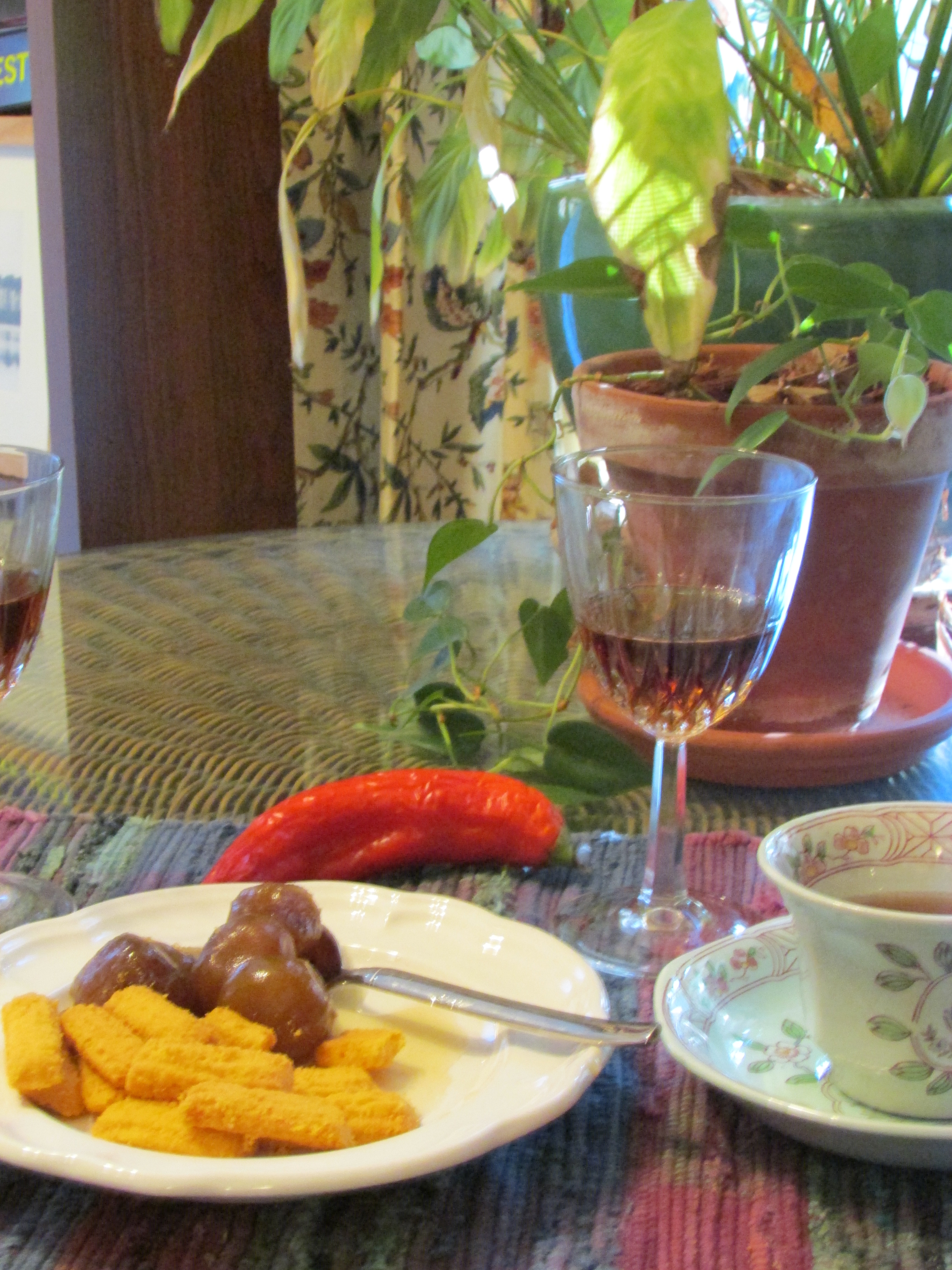
I continue to bake cheese straws for special people and special occasions and continue to enjoy the surprised gasps when I reveal that these straws were made by a man. I haven’t baked any in almost a year but when the temperatures begin to drop and the air gets crisp the urge to buy some fine cheddar and make up a batch begins to twitch. This time of year a few cheese straws with fresh figs (or fig preserves), a glass of sherry, or a cup of warm tea hit the spot.

Here’s my recipe. It is adapted from the recipe in Julia Reed’s 2001 New York Times piece which was in turn adapted from a cookbook called Southern Sideboards Cookbook by Winifred Cheney. Over time, I have made my own revisions, and that is what I’m sharing with you.

CHEESE STRAWS

1 stick (8 tablespoons) of softened unsalted butter

8 ounces finely grated extra-sharp cheddar cheese (I like to mix white and yellow cheddar)

½ teaspoon salt

1 teaspoon cayenne pepper (I like my straws hot)

1½ cups plus 1 tablespoon sifted flour

  1. Preheat oven to 350 degrees. Mix the butter with the cheese and seasonings in a large bowl. Add the flour and knead into a smooth dough.
  2. Pack the dough in batches in a cookie press and press through the round-ridged opening onto an ungreased cookie sheet to form “straws.” 2½-3 inches are good, but I just squeeze until it seems long enough or stops on its own.
  3. Bake until golden and crisp, usually about 12 minutes in my oven. Remove from the cookie sheet with a metal spatula, cool, and store in an airtight container.

The straws break easily but that doesn’t affect the taste, does it? Also, depending on temperature and humidity, I sometimes sprinkle a little water on the dough in the press so that it comes out more easily.

Oh yeah – if you make these and people love them, mention my name.

Tracking Down Mrs. Roosevelt

IMG_0746 A couple of weeks ago I spent fourteen fascinating hours watching Ken Burns’s newest documentary, “The Roosevelts: An Intimate History.” I have had a fondness for Franklin and Eleanor Roosevelt since I heard my grandmother talk about them when I was growing up.

It is easy to forget after so many years how important FDR’s Great Depression recovery policies were to the country as a whole and particularly to the part of north Alabama and the Tennessee River Valley where I currently live. At the time the Tennessee Valley Authority was inaugurated as part of Roosevelt’s New Deal, the improvements in the infrastructure for north Alabama led to the development and progress of the decades to come. TVA’s Wilson Dam changed the Shoals area immeasurably. I am convinced that Huntsville’s considerable growth and the development of its substantial technology, space, and defense industries can be traced directly back to the technological advances spawned by the Roosevelt administration of the 1930s. I am also convinced that some of the local politicians who run campaigns railing against “big government” and “government interference” would not have been born if not for the government assistance and programs that came to the aid of so many millions during the Roosevelt New Deal era.

Tennessee Valley Authority (TVA). Works Progress Administration (WPA). Civilian Conservation Corps (CCC). Federal Housing Authority (FHA). Social Security Administration (SSA). The alphabet soup of programs initiated by the FDR administration is large and impressive. Some of them still exist today. Most towns, wherever you travel in the country, still utilize the legacy of the New Deal in extant public spaces, buildings, tourist sites, roads and highways, dams and factories. The WPA art works, photographs, performing arts, and literature were created by many people — some of whom would move on to become among the brightest lights of twentieth century American arts.

When Roosevelt took office in 1933, about 90% of urban Americans had electricity compared to roughly 10% of rural Americans. The Rural Electrification Administration (REA) was created to rectify that situation and by 1942 the number had risen to 50%. Ten years later, close to 100% of Americans in rural areas had electricity.

My grandmother often talked about listening to Roosevelt’s “Fireside Chats” by her radio (after the REA had supplied electricity to her family’s rural Cullman County residence). My mother still has recollections of my Grandmother Harbison pulling her chair right up to the radio to listen to the coverage of FDR’s funeral in 1945. She sat listening all day.

During a recent conversation about the Burns documentary, Mother mentioned how she had always enjoyed reading Eleanor Roosevelt’s daily syndicated newspaper column, “My Day,” which ran from the time Mrs. Roosevelt was First Lady in 1936 to her death in 1962. “I wish I had saved those in a scrapbook or something,” she said. “Wouldn’t it be nice to look back at them now?”

My quest had begun.

Fuelled by the documentary, I searched for a book compilation of the columns. What I found was My Day by Eleanor Roosevelt: The Best of Eleanor Roosevelt’s Acclaimed Newspaper Columns 1936-1962, edited by David Emblidge (New York: MJF Books, 2001). I ordered it and will soon give it to my mother, but I am reading it first and having a grand time of it. Mrs. Roosevelt’s written communication skills are as clear, blunt, and articulate as her husband’s much-lauded oral communication skills and she tackles a staggering array of issues with taste, tact, and progressive common sense. There are also warm personal insights about holiday outings with the family, gardening, fashion(!), and the amazing array of 20th century personalities she knew — from her uncle Theodore Roosevelt to John F. Kennedy, from Helen Keller to Autherine Lucy, Shirley Temple to Nikita Krushchev, Winston Churchill to Humphrey Bogart, … you get the idea.

I have a tattered and fraying tee-shirt with FDR’s image that I usually just wear for yard work. One afternoon I wore it to one of the local farmers’ markets and a vendor at one of the produce stands called me over. “My parents loved FDR,” she said. “My dad always said he saved us from sure ruin.”

“My Day” and Ken Burns’s striking new documentary provide human and first-hand insights into some of the most important events of the twentieth century. We all need to remember and learn.

Weeding Organic Cotton

IMG_0724 In 2012 I received an email from Billy Reid’s organization with an interesting proposition. It seemed that Natalie Chanin and Billy Reid, both fashion designers based in Florence, Alabama, were experimenting with growing organic cotton in a small field near Trinity, a town between Decatur and the Shoals area of Alabama. The email asked for volunteers to come out to the field to help weed – no small task when you’re growing organic.

Natalie Chanin’s Florence-based label, Alabama Chanin, features handmade garments made with American-grown organic cotton. The problem is, there is no organic cotton grown in Alabama that she can use and she has to source her cotton from some place in Texas. The purpose of the Trinity experiment was to see what kind of luck they’d have growing their organic cotton locally. A September 5, 2014, edition of The New York Times “T” magazine blog chronicles the Alabama Chanin cotton harvest.

Back in 2012 I heeded the call out of curiosity and because it isn’t every day that one is invited to weed in a fashion designer’s organic cotton field.

I drove to Trinity one sunny Saturday morning and the only other person in the field that morning was Lisa Lentz; she and her husband had lent the project the seven acres to plant the cotton. I didn’t have too much time to spend in the field that morning but I weeded hard while I was there and learned more details about the project from Lisa. I had worked in a cotton field once before; when I was a young boy, on a visit to Cullman County, Alabama, with my mother and grandmother, my Cullman County cousins got a kick out of putting their skinny city cousin in the field for a while with a sack over his shoulder. I wasn’t very useful out in the field that morning but I remember it was rough on the hands and hard work to remove the cotton and place it in the sack.

It was equally challenging to pull weeds in Trinity in 2012 but I drove away with a sense of accomplishment, sore knees, and a curiosity about how the experiment would work out. There were subsequent appeals a few weeks after my morning of weeding for volunteers to pick the cotton ready for harvest. I had conflicts that kept me from going back out but was glad I had a connection to the project. A friend, when I told him I had spent a morning weeding organic cotton, smirked a little and asked how organic cotton clothes would feel any different from any other cotton clothing. I was surprised he asked that since he is very environmentally conscious and fuels one of his vehicles with recycled cooking oil. I explained that it wasn’t so much the feel of the cotton but the toxic chemicals that were not going into the earth and the water supply that mattered.

In July of this year, I was at the Alabama Chanin Factory for a Friends of the Café event and asked Natalie Chanin about the status of the Trinity organic cotton project. She told me the finished cotton was in the factory being turned into tee-shirts. When the tee-shirts went on sale a couple of weeks ago, I had to grab one. It may be the most expensive tee-shirt I’ve ever owned, but I definitely feel I had a hand – and knees – in the effort. And, back to my friend’s comment about what difference organic cotton makes: It’s likely all psychological – but it is probably the most comfortable tee-shirt I’ve ever put on my body.

The Peach Highway and Jimmie’s Peach Stand

100_1927  I get a little reflective as the Alabama peach season draws to a close. The state of Georgia, of course, has appropriated all of the peach titles and has done an admirable job of marketing its peaches as if they are something special. But a growing number of Southerners have discovered the rich and considerable delights of peaches grown in Chilton County, Alabama. On a May morning in the French Market in New Orleans a few years ago, I was pleased to hear a local shopper ask a vendor if any Chilton County peaches had arrived yet. He replied that he didn’t have any but that the lady a couple of stalls down had just gotten her first delivery of the season that very morning – “and they sure are good this year.” The shopper grinned like a child on Christmas and rushed to buy a basket.

I have long been a fan of Chilton County peaches but it was only when I moved back to Alabama in 1999 that I became something of a snob about them. The local crop is becoming better known and any traveler on I-65 between Birmingham and Montgomery is bombarded by the billboards promoting the tourist-driven peach shops at exits around Clanton. The biggest billboard of all for Chilton County peaches is the giant peach water tower at exit 212 in Clanton. The giant peach water tower in Gaffney, South Carolina, is older and bigger but each makes its point with kitschy panache.

To truly get a feel for Chilton County peaches, however, you must wander off the interstate and experience the numerous peach stands along Highway 82. When I lived in Montgomery from 1999 to 2002 I frequently traveled U.S. Highway 82 on the way to Tuscaloosa, where my parents lived at the time. Outside Montgomery, traveling northwest on 82, after going past the Robert Trent Jones Golf Trail resort and subdivisions in the town of Prattville, the highway turns aggressively two-lane and rural through Autauga, Chilton, and Bibb counties on the way to Tuscaloosa.

As soon as you pass into Chilton County, from either direction, the roadside stands begin to appear. Some vendors come and go and others have been there for years. Sometime around Mother’s Day the stands, which have stood vacant during the cooler months, put up their freshly painted signs and the first succulent peaches of the year make their debut, lined up in full farm baskets and beckoning to all travelers. It is almost impossible not to stop. That moment – when I catch sight of my first peach stand of the season open for business with that sensual peach color and aroma – has become one of the defining moments of the growing season. My heart soars; I have been known to shout.

After sampling most of the stands, one has become my clear favorite – not just for consistent quality but for sheer “ambience,” if that word applies for a humble fruit stand on a lonely stretch of rural highway (and I think it’s the perfect word). Jimmie’s is my hands-down favorite peach stand in Chilton County.

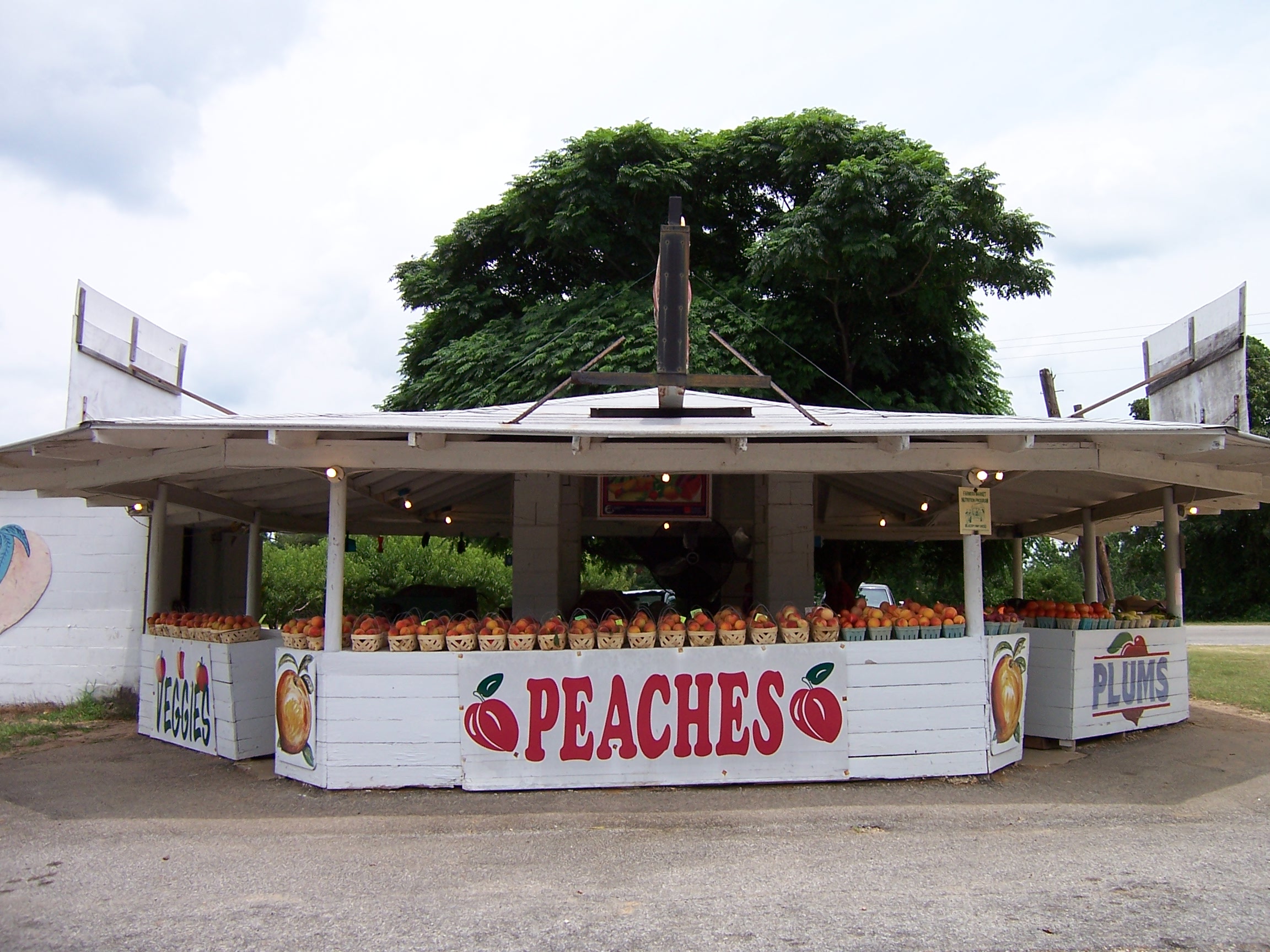
Jimmie’s is located at a fork at the top of a hill where County Road 15 feeds into Highway 82. It’s a simple open wooden structure with display space on two sides facing each road. Baskets of peaches are lined up across the shelves facing Highway 82 and whatever other produce is in season is usually displayed on the other side.

Jimmie’s, which is a family-run stand, only sells peaches that they grow. To drive the point home, one of their peach orchards stands next to the stand and the truck regularly pulls in with peaches and other produce from orchards and parts of the farm farther down the road. A few years ago I asked Mrs. Harrison if they had any okra in yet and was told that they had sold out of okra that morning but if I could wait a few minutes they were out in the garden getting some more now. A few minutes later the truck pulled up and Mrs. Harrison told them to unload the okra first since “that’s what this man is waiting for.”

I now live in north Alabama, but my parents are in Birmingham and I manage to drive the seventy-something miles from Birmingham down to Jimmie’s every two weeks during the season. Usually I buy a basket for myself and fill additional orders from friends throughout Alabama. The car smells amazing on the trip back after the “peach run.”

If you happen to get to Jimmie’s after hours, and if anything was left when they closed up for the night, there’s an honor box so you can buy what you need, leave the money in the box, and be on your way. Honor boxes. You don’t see them much anymore but every time I encounter one it strikes me as one of the most civilized and hopeful things left in the world.