Tag Archives: Alabama

In a Summer without Peaches

This year’s first trip down to Chilton County to get peaches at Jimmie’s Peach Stand on Highway 82 was delayed a couple of weeks; it usually happens on Mothers’ Day weekend but when I arrived at the stand near the end of May there were few baskets left for the day. Mrs. Harrison and her son, Lynn, told me their peach crop was going to be truncated this year.

According to news reports, the same sparsity occurred throughout the 2017 Southern peach crop.  I had worried about the effect that a late brutal cold snap might have on this year’s peaches but the Harrisons assured me that it had not been that but the lack of enough cold weather in the 2016-17 winter.

So, I bought all of the peaches the stand had left that day to try to satisfy the promises I had made to people in North Alabama.

For years, I have tried to save a Jimmie’s peach to have on Labor Day night. The people at Jimmie’s said this year’s crop would likely be finished by mid-June; it usually lasts until the end of July and has been known to go deep into August. I promised to make one more trip to Chilton County before the stand closed for the season; I never made it back down but the one basket of Jimmie’s peaches I had this year was as delicious as always and quickly gone.

In the meantime, I tried to satisfy my peach cravings with the offerings of the Tennessee River Valley closer to my house and by trips to the Saturday morning Pepper Place Market and the Alabama Truck Farmers Market in Birmingham. Often, when I got to Pepper Place, the vendors with peaches were sold out early in the day due to smaller than usual supplies.

And the prices went up – sometimes drastically – for what peaches there were.

My favorite Tennessee River Valley peach vendor, Isom’s in Athens, was a no-show this year at the Thursday evening Greene Street Market that I frequent in Huntsville. I settled for a couple of other Greene Street vendors with peaches but was disappointed in the product. So far I’ve had the best luck with Reeve’s Peach Stand on highway 36 outside Hartselle.

I haven’t seen a single local fig this year but that has become commonplace. My friends with fig trees have been lamenting the lack of figs for several years now.
My time spent in my own yard has been limited during the warm season due to travel back and forth to Birmingham but the drought ended this summer and my back yard, which is usually pretty hopeless by the heat of August, is still lush and green. The grass is being cut weekly and needs it more often than that.

That very late freeze in the spring killed off some of the house plants that had already been moved outside and many of the outside plants were already in bud and bloom when the freeze got them so the schedule has been off this year. The Brunson begonia, an ancient begonia that I grew from cuttings friends gave me several years ago, was a casualty of the freeze as were a schefflera and nine-foot ficus, but other things sprang back to life, I acquired new plants, and “volunteer” plants filled the gaps.

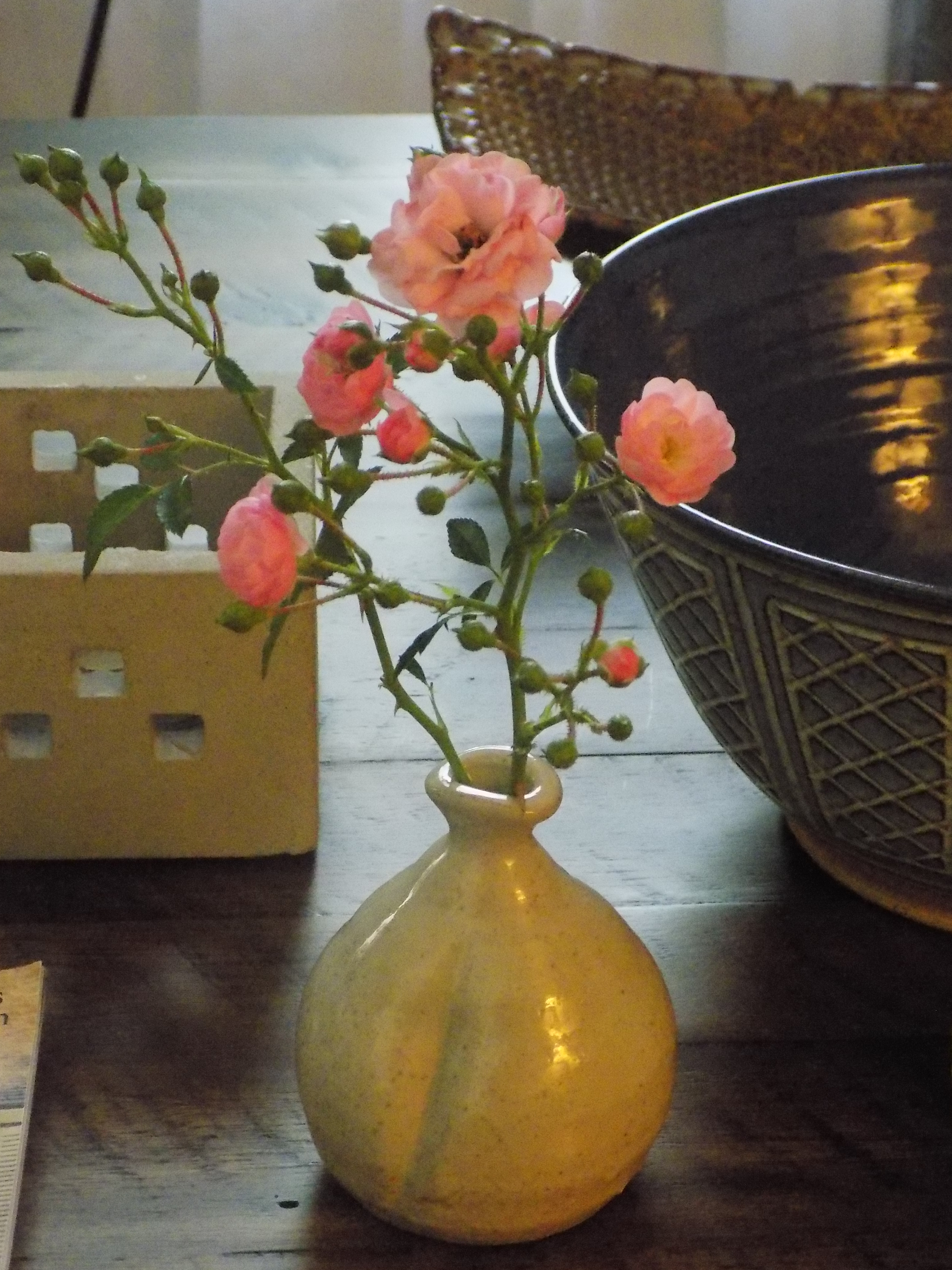
My grandfather’s wild rose took the freeze as a minor setback and then took off with a vengeance. Its blooms and buds have occupied my back yard and occupied a small bud vase on the coffee table in the living room all season. Another wild rose at the back gate that my friends Scott and his daughter Cecilia foraged with me from the lake across the street from their house has had to be pruned back several times already; it produced exactly one bloom this year, which is exactly three less than it produced last year – but it is still a welcoming and lively green and thorny thing outside the gate.

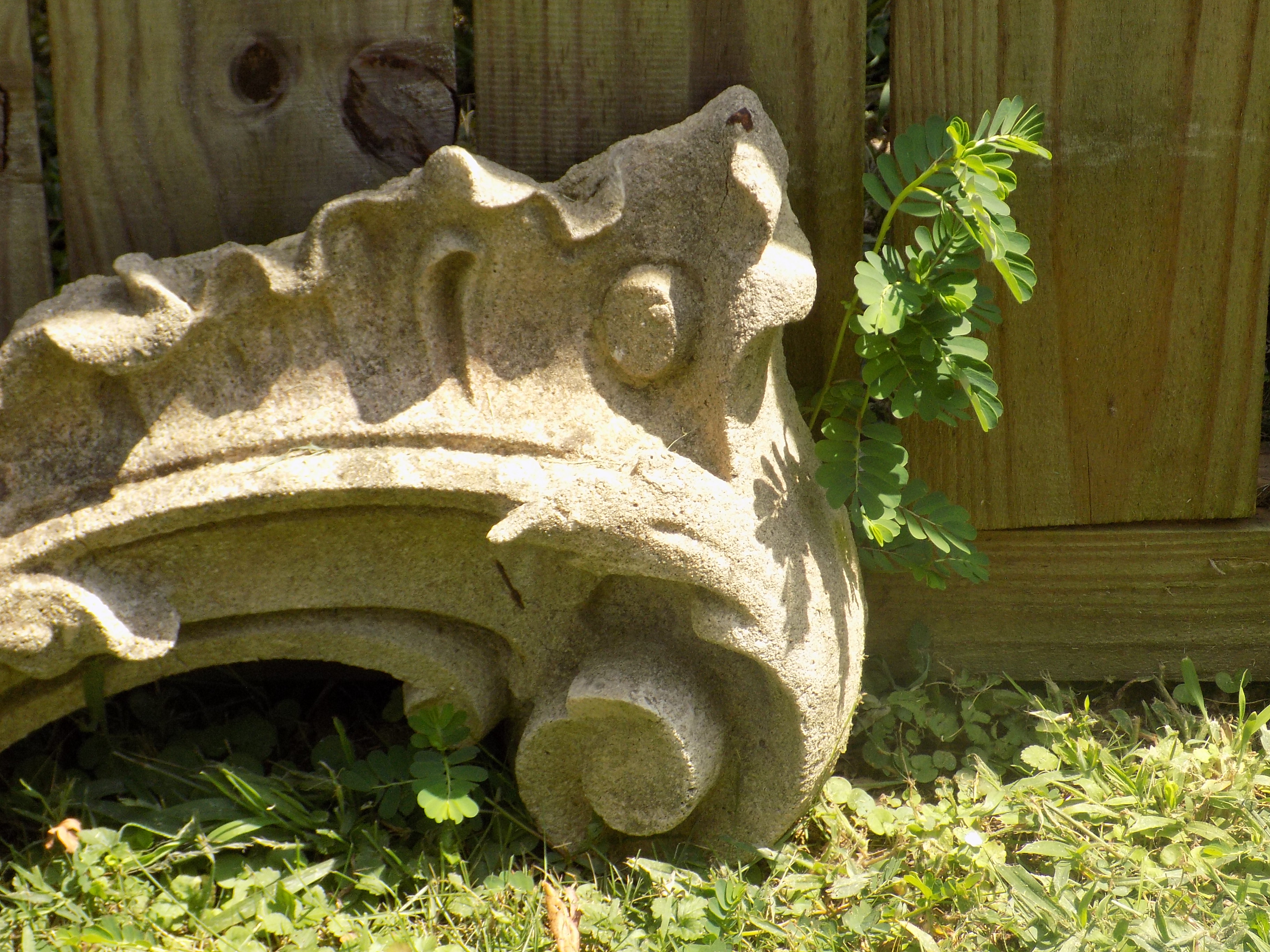
The small beds and containers in the front yard recovered quickly after the freeze and have reemerged more prolific than ever. A pony-tail palm that I have nurtured for almost twenty years in the same concrete container given to me by my Granddaddy Harbison almost thirty years ago lives in the house most of the year and had just been moved outdoors when the freeze hit while I was out of town. I had given up on it but now it seems rejuvenated by its near-death experience and is coming back even more elegantly than before.
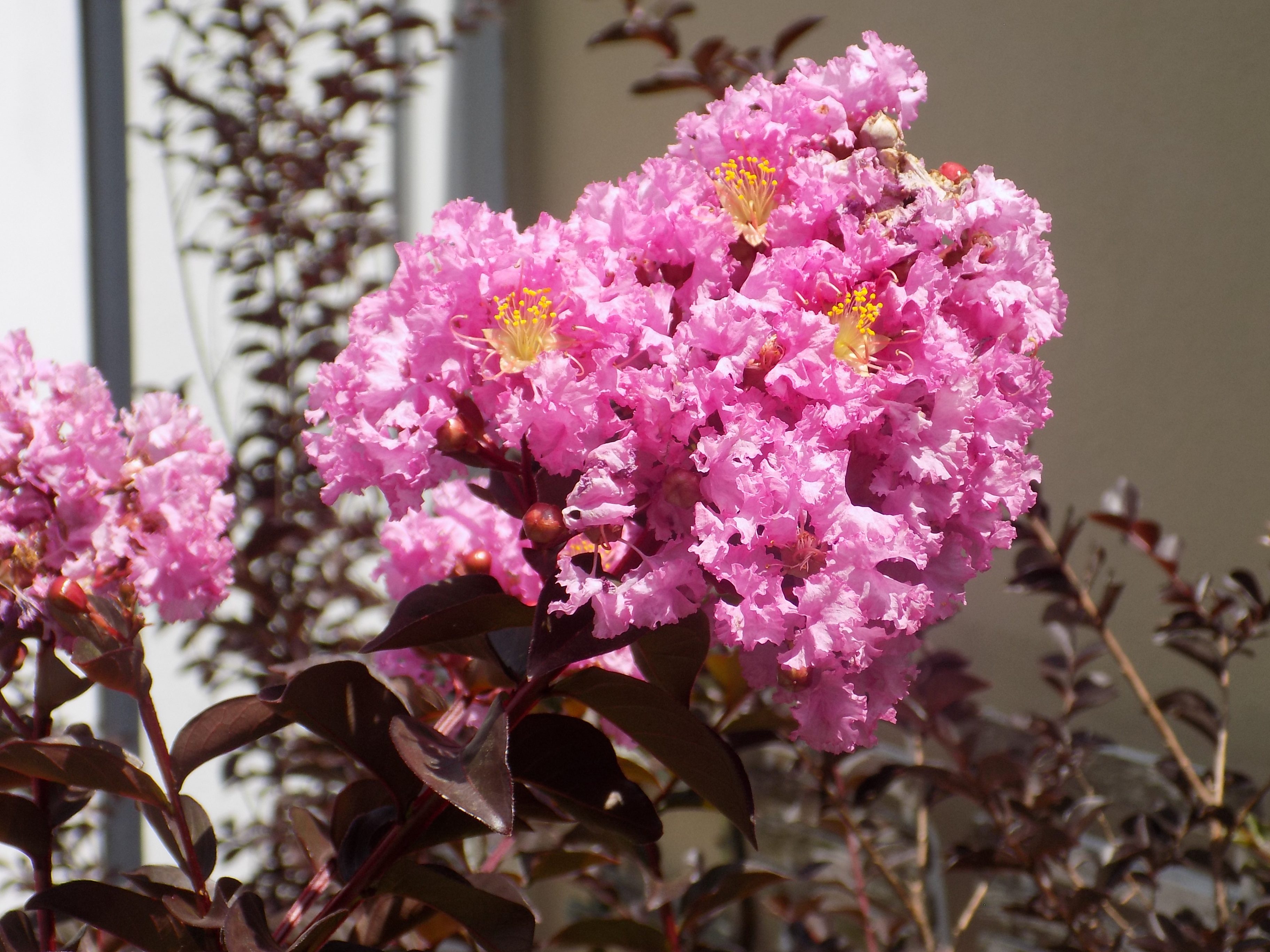
The four crape myrtles outside the back door were flourishing until the freeze killed them back; they have only just now recovered and begun to bloom. The Rose of Sharon – which has become a tree – is still full of white blooms but is cowered by the neighbor’s towering cherry tree which encroaches on its sunlight. My Rose of Sharon seems to be dying away slowly. I sit and wonder how to address the situation: My neighbor loves her cherry tree and it puts on a magnificent show for the two or three weeks it is in bloom in early spring. I appreciate the opportunity to share the view and shade as it overhangs my back fence.

But it is becoming very evident that my Rose of Sharon can’t compete much longer and I contemplate how to fill in the gap in the back corner of my yard that its loss will create.

The season’s greatest surprise, though, is the redbud that I picked up at a plant giveaway at Mother’s church over a year ago. It was essentially a stick in the ground with one struggling leaf when I got it. I put it in my back room with a lot of light and nursed it through the winter with no success. I moved it outside and it was trying to bud until it became another of the casualties of that late freeze.

It sat there, in its container, in the corner of the yard by the house like a dead stick because I didn’t have time to get rid of it. The guy who cuts my grass assured me that there was no hope. By June the little redbud began to bud and now it’s flourishing. I think I’ll let it winter inside for one more year and put it in the ground next spring. 

My time enjoying my little postage stamp of yard has been limited this year, but it still has provided hours of stolen pleasure with many weeks to go. I’m already hatching plans for next year’s improvements and looking forward to next summer being one with an abundance of peaches to savor; I will have to make up for my summer without peaches.

Old Dog, New Tricks … Sprouting

Sometime in the ‘70s, when Harmony Natural Foods opened along the University Boulevard Strip in Tuscaloosa, the store was a radical change from everything else on the Strip. It was close to my apartment and I would occasionally drop in for lunch – a sandwich or a salad. Harmony was really the only place in town to get the particular kinds of natural foods it was serving.

Harmony was an outgrowth of the hippy movement moreso than it was a harbinger of the food movements to come but it has managed to straddle both; it moved from the University Strip to Tuscaloosa’s McFarland commercial drag, changed its name to Manna Grocery and Deli, and is still in operation spanning five decades.

Back when I was a Harmony customer, I would dash across the street to Charles and Co. and grab a Coke before I went to have my “healthy” meal. I wasn’t always in the mood for the juices and herb teas that were the Harmony beverage options.

The food was generally good, but I remember an abundance of alfalfa sprouts on everything. I realized I am not a fan of alfalfa sprouts – they were fine as they were being eaten but had a metallic and lingering aftertaste that was and is unpleasant to me. Finally I started specifying “no sprouts” when I placed my order.

After all of these years, if I am ordering something that I suspect might have alfalfa sprouts, I will ask to have them left off.

Recently, though, while I was strolling through Pepper Place Saturday Market in Birmingham, one of the guys from the Iron City Organics microgreens stall motioned me over. “I want you to try something,” he said, and almost before I could say okay he clipped off a couple of tiny sprouts from a tray and I put them in my mouth.

The fleshy green sprouts popped with a burst of summer that was tangy and refreshing.

“What is that?” I asked.

“Sunflower sprouts,” he replied.

I had to have some and I took them home and used them in salads and as a garnish for various dishes. When I ran out of that first batch, I was anxious to get more.

Last week, when I went to Pepper Place, a visit to Iron City Organics was the absolute priority. There were trays of fresh sprouts still in the dirt and, after sampling, I came home with more sunflower sprouts, added wasabi microgreens to the mix, and am now thinking of all the ways I might use these and all of the other Iron City Organic crop. In addition to the variety of microgreen sprouts, Iron City also has full grown produce – kale, mustard, radishes, etc. – and a fine array from which to choose.

The guys at the stall are so passionate and take such pride in the product they are nurturing and providing that it’s hard not to catch their enthusiasm. They clearly know how to run a business and serve their customers; a search of their online presence backs up that perception.

I have recently become obsessed with accessing fresh watercress, which is hard to find, and now, thanks to the guys at Iron City Organics, I am embarking on a whole new sprouting angle to my menus.

But I’m still avoiding the alfalfa sprouts, thank you. 

Friends of the Cafe: Ashley Christensen

The first day of Summer 2017 ushered Tropical Storm Cindy up from the Gulf and energized the air farther inland in Birmingham, where I was helping to celebrate my mother’s birthday. It has been a few years since I experienced the typical effects of a tropical storm and – while I always hope there is no significant damage or injury – I always find the balmy air and windy bands of sporadic rain to be invigorating and energizing.

I reread The Great Gatsby as I have done for years on the Summer Solstice.

I was in my twenties when I began my annual reading of The Great Gatsby and the ritual has almost taken on a superstitious nature; if I missed a year, I would feel like something was awry. But I always manage to get in my June reading of the book and, after dozens of readings, I always find something new in Fitzgerald’s writing. And my heart always pounds in anticipation of the book’s inevitable ending.

On this most recent reading, I was struck near novel’s end by Nick Carraway’s account of a recurring West Egg nightmare – “a night scene by El Greco” in which a bejeweled drunken woman in a white evening dress is borne on a stretcher by “four solemn men in dress suits” to the wrong house. “But no one knows the woman’s name, and no one cares.”  That particular paragraph had never stopped me in my tracks until this reading.

Perhaps that passage stood out this time because I read it while sitting in a car in the parking lot in Tuscaloosa in a steady tropical rainstorm, while Mother was in a beauty shop appointment. Those meteorological conditions just added to the gloom of Gatsby’s rain-soaked funeral in which he is laid to rest with only Nick, Gatsby’s father, a few servants, the local mailman, and the owl-eyed former party guest in attendance. I usually reread Gatsby outdoors in the sunlight so the weather definitely added a different perspective this year.


­­­­­­­­­­­­­­­­­By the time Saturday afternoon rolled around, the weather had cleared and the balmy weather turned blistering. Summer’s advent and Cindy dominated the days leading up to the most recent Friends of the Café event at the Alabama Chanin Factory in Florence (www.alabamachanin.com). North Carolina chef Ashley Christensen of Poole’s Diner and other Raleigh dining venues (www.ac-restaurants.com), was helming the meal. Once again, the event was a benefit for Southern Foodways Alliance (www.southernfoodways.org). I am proud to be a long-time member of the SFA, helping in a small way to support all of the good works the organization does.

Friends Anne, Michelle, Scott, and I traveled to the Shoals for the meal. Arriving at the Factory we were warmly greeted by Natalie Chanin, the creative force behind Alabama Chanin and the impetus for many community-building events, including an awesome schedule of Friends of the Café dinners.

The gathering was already going strong when we arrived. A delicious array of passed hors d’oeuvres included fried green tomatoes topped with Alabama jumbo lump crab salad and Hook’s three-year cheddar pimento topping a cucumber slice. Along the serving table were shots of a sweet corn mousse with piquillo pepper.  The mousse literally melted in one’s mouth like a passing dream of sweet corn taste. A “Summer Cindy” libation was poured – Prosecco and Jack Rudy grenadine with a sprig of rosemary.

The seated meal began with a salad of local lettuces and vegetables dressed with buttermilk and roasted garlic. Next came a slice of heirloom tomato pie with spicy greens and sherry. My quest for the perfect tomato pie began years ago with the tomato pie competition that was an annual event at Decatur’s Willis-Gray Gallery (now Kathleen’s). The Decatur event hasn’t been held in several years but Ashley Christensen’s take on tomato pie is now the hands-down winner.

The third course was chargrilled Bear Creek ribeye steak cooked perfectly and served family style along with Poole’s macaroni au gratin and a room temperature marinated summer succotash which brought back vivid memories of my Grandmother Harbison’s take on hearty southern succotash.

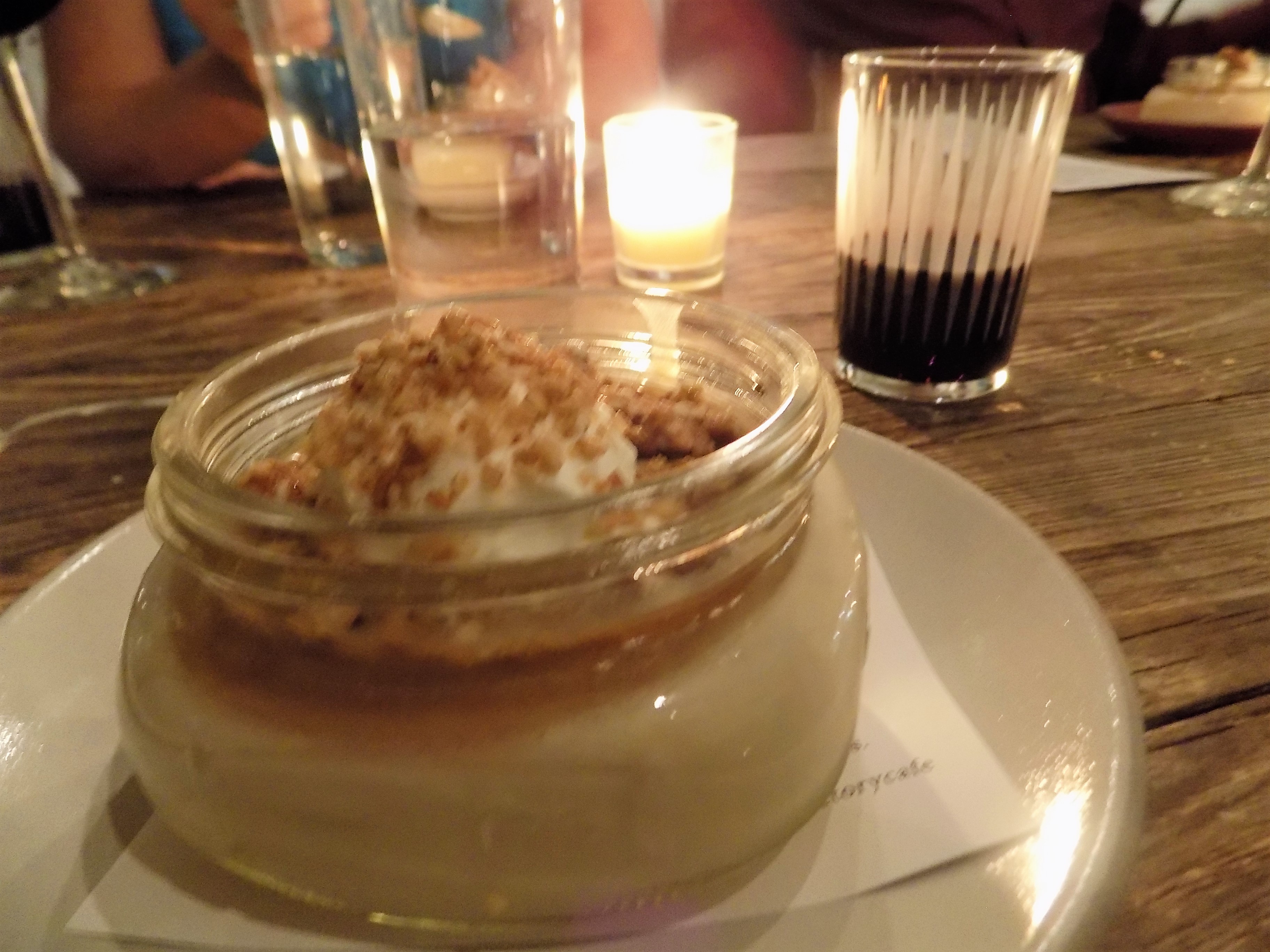
The dessert course of a coffee panna cotta with Irish whisky caramel and North Carolina pecan granola crunch was served with a deep and earthy port.

I have never been disappointed in a meal at the Factory and Christensen’s recent menu continues to raise the bar.

Christensen seems to be as warm, down-to-earth, and authentic as the carefully selected ingredients she elevates. I think I have attended all but three of the Friends of the Café dinners and Ashley Christensen was the chef for my second in 2013.

When Natalie Chanin asked me recently which had been my favorite of the meals over the years, Ashley Christensen’s name was one of the first that came up. Now, Ashley Christensen is the first of the guest chefs in the series to come back for an encore. It seemed unlikely that she could top her first memorable performance at the space, but last Saturday night she did.

Copies of Christensen’s cookbook. Poole’s: recipes and stories from a modern diner (Berkeley: Ten Speed Press, 2016), were available for purchase and signing at the end of the event. It is a cookbook chock-full of exciting, well-explained recipes as well as a good introduction to the founding of Poole’s and to the James Beard Award-winning chef’s culinary aesthetic. It also provides the stories and impetus behind her restaurant empire of seven downtown Raleigh establishments. Chanin referred to her friend as “badass” and the book is full of Christensen’s warm and earthy takes on the food world (she refers often to an affinity for “beer flavored beer”).

For me, thanks to the friends who went with me, to Alabama Chanin, and, especially, to Ashley Christensen, that turbulent first week of summer 2017 ended on a high note indeed.

Serendipity under a Strawberry Moon

 Bird song and the comforting sounds of barnyard animals filled the late Spring air as the first fireflies of the evening began to twinkle in the woods of the Wheeler National Wildlife Refuge amid the backwaters of the Tennessee River.

 A group was gathered for dinner under the open pavilion at 1818 Farms (www.1818farms.com) in the northwest corner of the quaint and historic town of Mooresville, Alabama (pop. 54), in Limestone County between Huntsville and Decatur. In the wildlife refuge, a canoe glided by in the distance, adding a magical moment to the dinner; I hoped the canoe party looked to their right and saw our gathering beneath the Italian globe lights and flaming torches so that a glimpse of the farm through the trees might add to the magic of their journey at dusk.

It is the rare weekend when I am not traveling so when my friend Anne contacted me on Thursday to see if I might be interested in attending the 1818 Farms “Farm to Table” dinner on Friday, it was serendipitous that I had already made plans to stay at home.

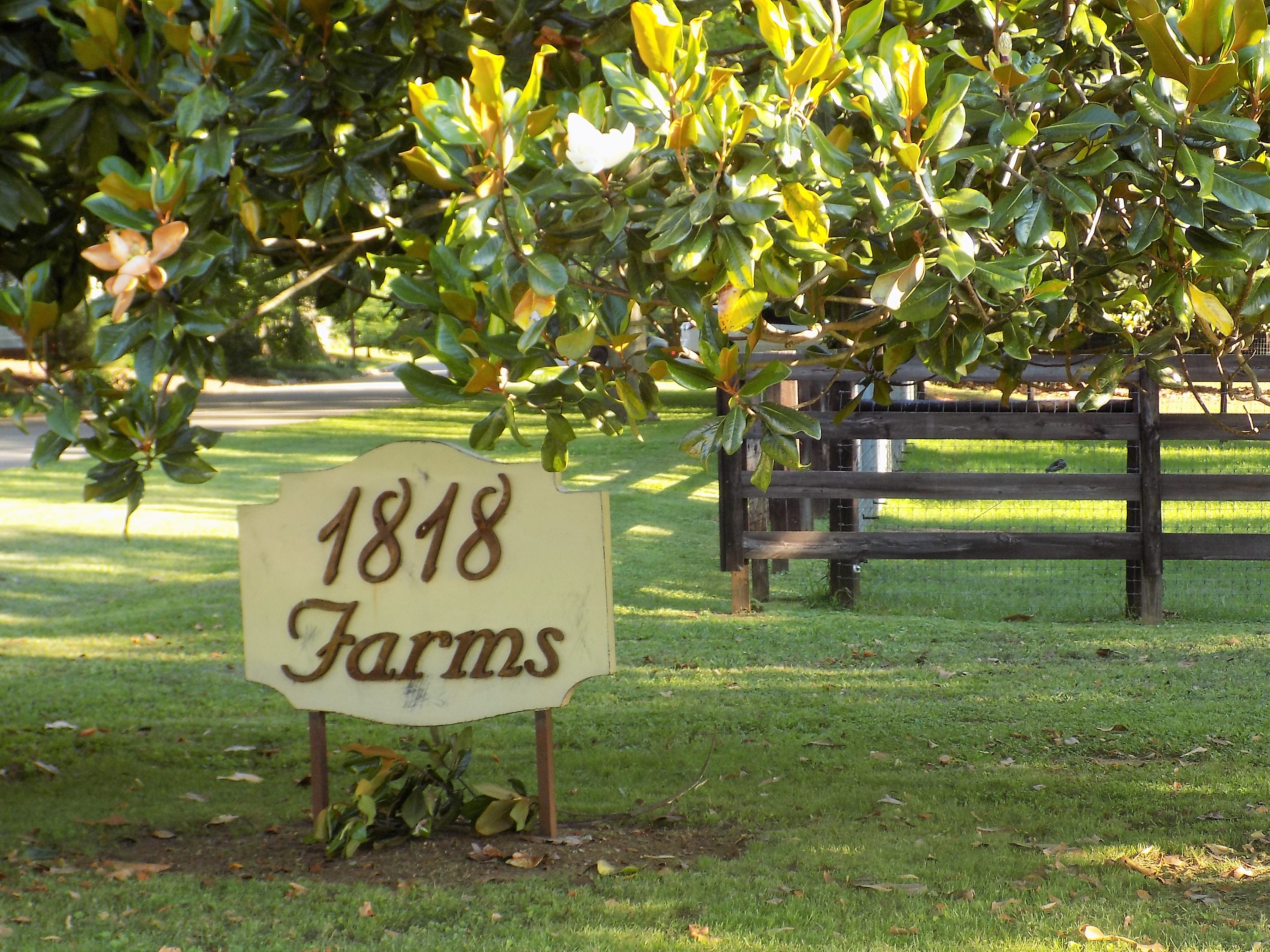
1818 Farms covers three acres in tiny Mooresville. It is owned and lovingly tended by Natasha and Laurence McCrary and their family. A stroll through the property includes visits with chickens, cats and kittens, goats, pigs, sheep, and a Great Pyrenees dog to guard the assorted livestock. All of the animals seem incredibly content. Anne and I visited with three tiny kittens; one was designated to remain on the farm and the McCrarys were looking for good homes for the other two.

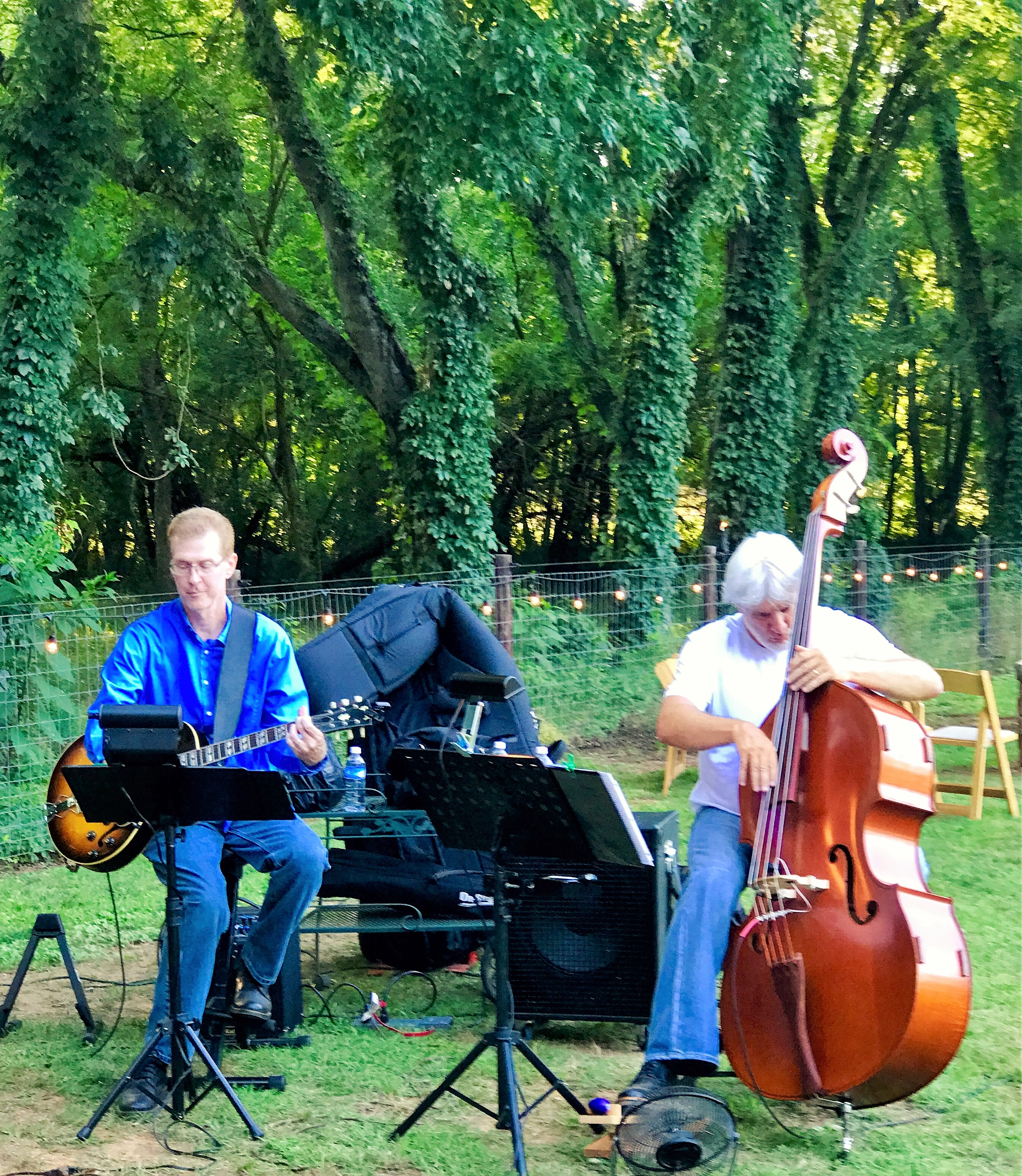
The farm is beautifully curated and a sense of calm begins at the front gate. Everywhere one looks there is a place to rest the eye. The animals are friendly and accessible, the raised garden beds are lush and filled with bloom and beauty, and the woods and wetlands of the wildlife refuge provide the western boundary beyond the border fence. A mellow instrumental duo provided music at the edge of the pavilion throughout the evening.

This was my first time to attend one of the 1818 Farms dinners. The meals started a few years ago in collaboration with Chef Jake Reed, the charismatic owner of the charming Albany Bistro, a great neighborhood restaurant in Decatur (www.albanybistro.net). Reed is winding down the Albany Bistro business (which now is open for catering and special events only) and has recently opened the new Table in the Garden eatery (www.tblrestaurant.com) at Huntsville Botanical Gardens.

“Chef Jakob” is a committed devotee to the “farm to table” philosophy and every meal I had at Albany Bistro is evidence that he practices what he preaches in creative and dynamic ways. His modern takes on local ingredients are fresh and innovative but he frequently acknowledges the enduring lessons he learned in the kitchens of his mother and grandmother.

Passed around hors d’oeuvres included fried green tomatoes with a horseradish sauce, wonton cups with herbed chevre and summer vegetables (the cheese was from Humble Heart Farms www.humbleheartfarms.com in Elkmont, my favorite goat cheese purveyor), and possibly the best sausage balls I have ever tasted.

After the assembled guests were seated and the meal was introduced by Natasha and Chef Jakob, the first course of a summer vegetable tart in a puffed pastry crust was presented. It was followed by green bean and potato salad with lemon terragon vinaigrette.

The main course was grilled chicken with a balsamic peach glaze, grilled peach, and arugula. For dessert, Chef Jakob presented a bacon and bourbon cupcake. As shocking as a bacon and bourbon cupcake might sound, the result tasted like a fairly traditional cupcake but with interesting notes and hints throughout; I especially liked the crisp bacon crumbles on the top.

Chef Jakob created a lovely dinner that was reserved and memorable – unmistakably fresh, local, and seasonal. The presentation and ambience of the event were lovingly executed.

By the end of the meal, the twilight had turned to deep darkness and the animals were settling in for the night. Natasha was gathering up provisions for a couple who had decided to adopt one of the kittens and photographs were being taken to commemorate the adoption. As we stopped to check in on the roosting chickens in their spacious coop, Natasha passed. “They don’t realize how lucky they are,” she said of her menagerie.

Indeed, I felt lucky to be able to visit their home for a few hours. During the dinner, I had noticed a full moon beginning to peek through the canopy of trees. Native Americans refer to the first full moon of June as the “strawberry moon.” That strawberry moon shone brightly as I hit the highway for home and a restful sleep.


Legion Field

dscn0633 The massive steel girders and beams of Birmingham’s Legion Field have thrilled me since I was a kid growing up in the city.  “The Old Gray Lady” is 90-years-old and, even though her best days are likely behind her, she maintains a majesty and charm. Another proud old sports arena, Rickwood Field, sits a short drive from Legion Field and is the oldest remaining professional baseball field in the country. Rickwood opened in 1910 and the first Legion Field game was played in 1927.

When I was in college, the University of Alabama’s significant games and major rivalries were played at Legion Field. In those days, Denny Stadium on campus in Tuscaloosa was a perfect little 60,000 seat bowl and half of the home games were played there while the other half went up the highway to Birmingham. This is years before Bryant-Denny became the 101,000+ seat behemoth that it is today and before big-time college football had become so “corporate.” dscn0624

Coach Paul “Bear” Bryant was the coach then and, depending on which national polls you’re counting, my freshman year was the year of Alabama’s ninth national championship and Bryant’s fourth of six. The most enduring memory of my years attending Alabama games at Legion Field is the image of Bear Bryant, hat always in place (despite the legend, it wasn’t always a houndstooth hat), leaning casually against the goal post and watching the team warm-up. One time, when Alabama offered Bryant a significant boost in salary (which would be paltry by today’s standards), he commented that it would be unseemly for the football coach to make more than the college president. Times have changed.

In those pre-ESPN days of a finite number of television channels and networks, the weekly choice of televised college football games was limited and it was always a treat when Alabama football was nationally televised – usually on ABC and usually with the great sports broadcaster Keith Jackson calling the game (“Whoa, Nellie!” and “Hold the phone!” Jackson would say at particularly exciting moments).

In 1981 Bryant broke the record of the most wins by any college football coach up to that time. Keith Jackson was in the booth. The opponent was Auburn and the game was played in Legion Field. The final score was 28-17. At halftime, Bryant growled to interviewer Verne Lundquist that his players were acting “like they’re afraid they’ll hurt somebody’s feelings or something.”

During those years the upper deck was in place on the east side of the stadium and the capacity of the stadium was around 70,000 with more expansions to come. For many years the words “Football Capital of the South” were displayed inside Legion Field and for most of those years that was true. At its peak, Legion Field could hold over 83,000. When a structural review in 2004 determined that the upper deck was not up to code, the city removed the deck and the stadium now seats about 71,000.

With the increased capacity of Bryant-Denny in Tuscaloosa, the University of Alabama began to schedule more home games away from Legion Field. The annual “Iron Bowl” between Alabama and Auburn was always played at Legion Field from 1948 to 1988. Tickets were split evenly between the schools and they alternated the “home team” each year. After Auburn moved the game to Auburn in their “home team” years, Alabama would continue to play the game in Birmingham in their “home” years until the end of the century. The Birmingham location is the reason that the game is called the “Iron Bowl” in the first place. And the game is still and forever the “Iron Bowl’ even though it will probably never be played in Birmingham again.

The last time I lived in Birmingham, I could see Legion Field across town from my apartment on Red Mountain. When an Alabama game was televised I would host watch parties at my place; if the game was at Legion Field and something went wrong I was known to go out on the balcony and yell toward the stadium (a couple of times, maybe more …).

In the heyday of big stadium concerts, Legion Field hosted acts like the Rolling Stones, U2, and Pink Floyd. The last time I saw the Stones live was at Legion Field for the 1989 “Steel Wheels” tour. dscn0625

Among the monumental architecture at the entrance to Legion Field, which was named to honor the American Legion, are two reclining lions and, at the base of the two flag poles, American bald eagles. A later monument, centered between the flag poles, memorializes Bear Bryant. A quote from Reagan at the time of Bryant’s death is engraved beneath Bryant’s bust on one side and Bryant’s own words about what it takes to be a “winner” are on another.  On the façade of the stadium these days are the words “Built by Legends.” dscn0628

The Iron Bowl is gone but Legion Field still hosts annual games like the “Magic City Classic” between Alabama A&M and Alabama State. The Classic has been played in Birmingham for seventy years. The Birmingham Bowl is the latest and longest lasting in a series of post-season bowl games played in the stadium. The first two SEC championship games were at Legion Field. The stadium has been the site for high school football and major soccer events and was home to local football teams of the several short-lived efforts to challenge the NFL (WFL, USFL, XFL, etc.).

Legion Field will once again be the home field for the resuscitated University of Alabama at Birmingham Blazers football team in fall 2017. For those of us who remember the Old Gray Lady’s glory years, it’s somewhat sad to see the mostly empty stands for UAB games.

Legion Field was already in its fifth decade when the Houston Astrodome opened and was declared the “Eighth Wonder of the World” in 1965. These days, the Astrodome is virtually obsolete — empty and avoiding the wrecking ball – but Legion Field soldiers on.

Long may she live. Roll Tide. dscn0635

Conecuh Sausage for the New Year

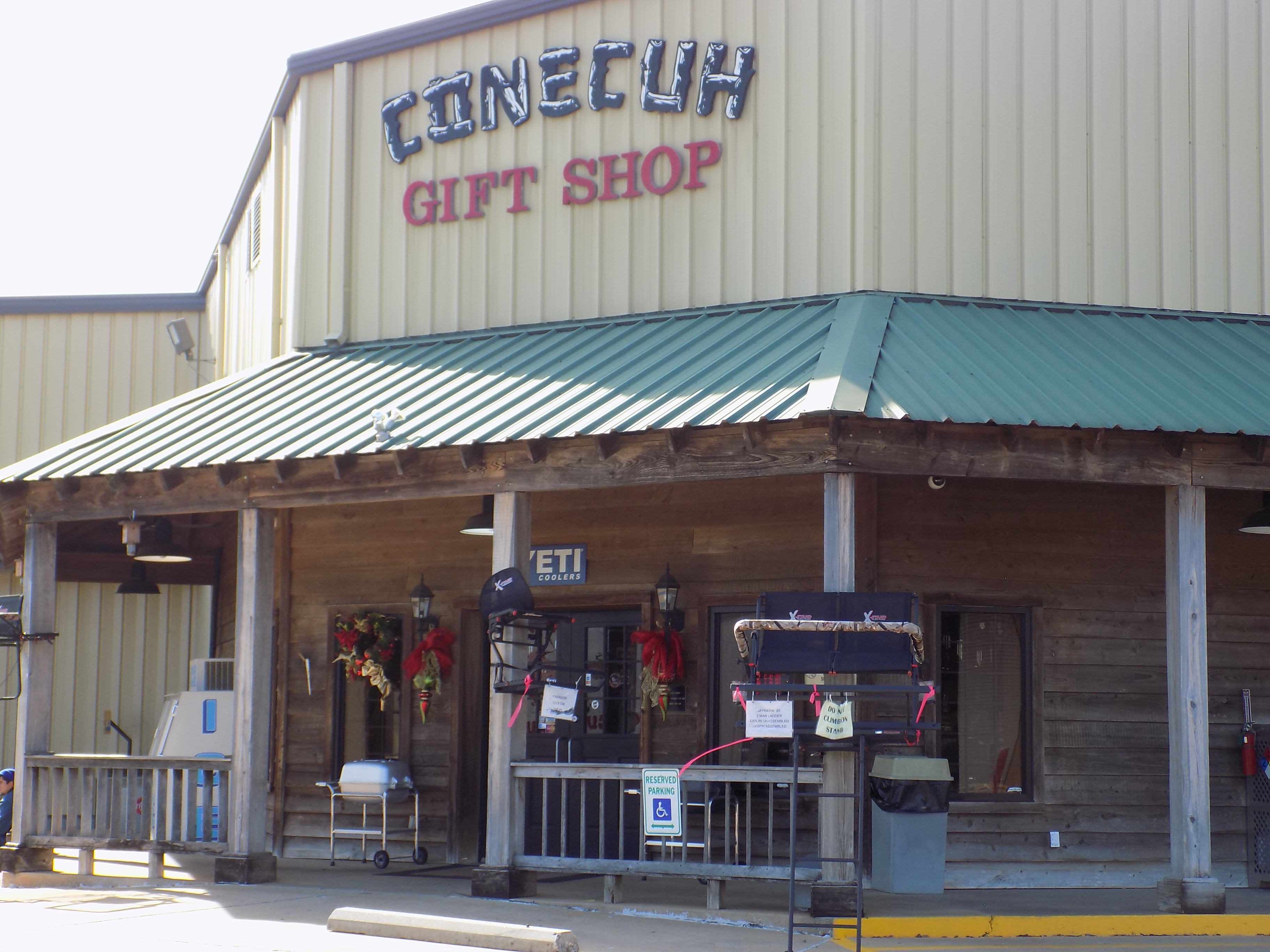
dscn0600 Traveling north on I-65 from Mobile Bay, the aroma of hickory smoked sausage is too tempting to resist at exit 96 in Evergreen so I had to stop to check out the Conecuh Sausage Company’s store.

Conecuh Sausage (www.conecuhsausage.com) is made in Evergreen, Conecuh County, Alabama, in a factory visible east of I-65 about halfway between Montgomery and Mobile. The business, still owned by descendants of founder Henry Sessions, has been in operation since 1947. The family protects Sessions’s original recipes and still uses his distinctive smoking techniques. It is only fairly recently that the products have been available on a wide scale. When I followed the enticing smell of hickory smoke to the factory recently, trucks were bustling in and out, headed in all directions with their tasty cargo. dscn0601

Conecuh Sausage Co. products include hickory-smoked sausages, hams, bacons, and turkeys in a variety of flavors and with a range of heat. A unique blend of seasonings makes the flavors stand out and it quickly became my sausage of choice. I always keep Conecuh sausage on hand and I have to be careful when I open a package; once it’s opened, it’s quickly gone.

Fortunately, Conecuh brand sausage is available throughout Alabama and is featured in restaurants all over the state. On a recent visit to Mobile Bay, I saw dishes featuring Conecuh sausage on three separate menus.

Not that long ago Conecuh sausage was only available in south Alabama locales so I was surprised to find out recently that it is now distributed in over twenty states throughout the southeast, as far west as Kansas, along the Great Lakes, and up the east coast into New England (where it would be an excellent addition to a clambake or a lobster boil). The products are also available for shipment throughout the continental U.S.

Conecuh sausage is great on the grill or cooked in an iron skillet on the stovetop as an appetizer. It’s my favorite for turnip green soup or jambalaya and is a good seasoning for greens and pots of beans. The company’s website includes a variety of recipes.

Here’s one I particularly like, just in time for New Year’s celebrations:

New Year’s Soup

2 tablespoons olive oil

2 cups chopped yellow onion

2 tablespoons minced fresh garlic

1 pound Conecuh Hickory Smoked Sausage, chopped

3 quarts chicken broth

1 28-ounce can diced tomatoes, drained

8 cups chopped fresh turnip greens

1 tablespoon Conecuh Pork, Poultry, and Wild Game Seasoning

3 tablespoons apple cider vinegar

1½ teaspoons salt

3 15.8 ounce cans black-eyed peas, drained

In a large Dutch oven, heat olive oil over medium high heat. Add onion, garlic, and sausage. Cook, stirring frequently, until lightly browned, about 6 minutes. Add broth and tomatoes; bring to a boil. Add greens, Conecuh seasoning, vinegar, salt, and peas. Reduce heat to low; simmer until greens are tender. 10-12 servings dscn0619

More Brief Meditations

100_1587-3  My Christmas cards went in the mail this week. Previous essays have chronicled my long-standing project of photographing old Alabama churches during the month of December for my next year’s Christmas card. I have written about how signing and addressing each card has become a “brief meditation” on the recipient.

2016 was a challenging year for my family and me. Last year at this time Dad was already hospitalized and there was no opportunity to go on photography expeditions. But many of my friends have begun to expect my annual Christmas card and I feel a responsibility to complete the task. The process of choosing the annual design, verse, and photo has become a welcome annual ritual that I use as an escape from day to day pressures.

Since I didn’t take any church photographs in December 2015, I went back through my files to look at previous photographs of churches that I haven’t used. I kept returning to a 2007 image of Havana Methodist Church, an 1870 structure visible on Highway 69 in the small Black Belt community of Havana between Moundville and Greensboro.

The Havana church was a frequent subject of artist William Christenberry, whose long career was centered on photographs, paintings, sculptures, and assemblages inspired by the Black Belt, especially Hale County where Christenberry’s grandparents lived. Christenberry visited and photographed his humble architectural and landscape subjects year after year, photographing their decline and bringing fame to a green barn, a Sprott church, and a Palmist sign hanging upside down in the broken window of an abandoned store, among other iconic images. When I photographed the church in 2007 I visited the family plots of Christenberry’s ancestors buried in the small churchyard cemetery. 100_1589

Christenberry always photographed full images of the Havana church so I decided to use a detail of the church’s handsome roof as the main image on the front of my card and put a thumbnail of the full church on the back. The church’s elegant simplicity inspired me to use a verse from Joseph Brackett’s “Simple Gifts,” a Shaker dance song, as the inside message for the card. The “Simple Gifts” tune is probably best known from composer Aaron Copland’s orchestral adaptation of it for “Appalachian Spring,” the score he first composed for a Martha Graham dance.

On the back I provided the photograph credit and the note that the photograph was inspired by Christenberry along with a memorial statement for Dad, who passed away in the spring.

Ironically, as I was leaving the post office on the day that I mailed my large batch of cards, I heard the news that William Christenberry died at age 80 on November 28. That news about one of my favorite artists and fellow University of Alabama MFAs (who received his three decades before I received mine) made a bittersweet holiday season even more so.

Even bittersweet, I still look forward to a bright and pleasant holiday season full of comfort and joy and I still have a fervent hope for a better and more restful year to come.

Happy Holidays. 100_1587

Helen Keller. The Myth of Water. Jeanie Thompson

dscn0515  Helen Keller (1880-1968) is arguably the most famous person to ever come from Alabama. The story about how the young deaf and blind Helen was given words by her teacher, Anne Sullivan, is still well known. She went on from the water pump in Tuscumbia to become a Radcliffe graduate – the first deaf and blind person to ever earn a B.A.; an acclaimed and much translated author and lecturer; a world traveler who knew French, Latin, Greek, and German, in addition to English, sign language, and Braille – and she could read lips with her fingers!; and an advocate for the rights of people with disabilities.

She was an American Socialist, a member of Industrial Workers of the World, and a pacifist who visited Hiroshima before the bomb and again afterward to lament the harm mankind is capable of perpetrating. We know that she fell in love with and planned to marry a man who served briefly as secretary for her and Sullivan and that the planned elopement never occurred. This was in a time when people with disabilities were most often discouraged from having romantic relationships.

It seems she knew all of the most prominent people of her time: Alexander Graham Bell, Enrico Caruso, Charlie Chaplin, sculptor Jo Davidson, the Roosevelts, and Mark Twain were among her friends and she knew every American president from Grover Cleveland to Lyndon Johnson.

Helen Keller had handicaps but seems to have overcome all barriers which were placed before her. Alabama chose her to represent the state on its state quarter in 2003 (the only U.S. coin to feature Braille) and Alabama chose a statue of seven-year-old Helen at the water pump to represent the state in the U.S. Capitol Visitors Center as one of two Alabamians in the National Statuary Hall Collection (Gen. “Fightin’ Joe” Wheeler is the other). Of course there is irony in the circumstance that what is considered one of the most conservative states in the nation is so prominently represented by such a progressive liberal. I love that irony.

Helen Keller was a subversive in many ways.

At her reading at Carnegie Visual Arts Center in Decatur, Alabama, on September 15, poet Jeanie Thompson commented that nowadays a traditional poetry reading almost seems to be a “subversive act” since such events are so rarely done anymore.

Jeanie Thompson’s new book, The Myth of Water (www.uapress.ua.edu), is a lovely collection of poems “from the life of Helen Keller.”  Each poem is an imagistic contemplative meditation in a first person voice. The persona is usually Helen but there are also poems in the voices of those who encountered her in her life.

It thrilled me to know that Jeanie Thompson has a new collection on the shelves. I have known her poetry since we were both at the University of Alabama and her books like White for Harvest: New and Collected Poems and Litany for a Vanishing Landscape have a permanent home on my bookshelves.

In The Myth of Water Thompson weaves a life from childhood to death and beyond in a series of brief and often breath-taking poems which attempt to break through the silence and explore what Helen Keller must have been thinking, feeling, seeing in her heart and in her mind’s eye. These are 34 poems of loss and longing, heightened consciousness and humanity, the challenges and triumphs of an unvanquished spirit hungry for life. Thompson’s is an ambitious and daunting project, flawlessly rendered.

By entering a sensory-deprived existence, which found ways to not only compensate but to prevail, Thompson’s poems heighten the reader’s own senses and awareness. I thought I knew what I needed to know about Helen Keller. Now, after reading these poems, I long to learn more. The Helen Keller quote – in English and in Braille – on the Statuary Hall statue is “The best and most beautiful things in the world can’t be seen or even touched, they must be felt with the heart.” Thompson has made an imaginative journey into Helen’s heart.

After the reading, I took the Upper River Road south of the Tennessee on the drive back to Huntsville from Decatur. A full moon shone down on cotton bolls that had just burst open, glowing white and pure in the dark fields, the first cotton I have seen this year.

A light rain began to fall as I parked and headed to my back door. I turned to look up at the full moon, still showing through thin clouds. The cool water fell softly on my face as if for the first time.

Pounding the Sidewalk, 2016

DSCN0490 When I arrived in Birmingham on Friday afternoon for the 2016 edition of the Sidewalk Film Festival it never occurred to me that of the eighteen movies I would see over 48 hours, I would drive home on Sunday night most pumped about a documentary that featured performances by high school color guards.

Contemporary Color is directed by Bill Ross IV and Turner Ross, the filmmaking brothers whose 2010 documentary 45365 about nine months in the life of Sidney, Ohio, is still one of my favorite movies to be screened at Sidewalk ever. The Ross Brothers’ latest, Contemporary Color, was conceived and produced by David Byrne, one of my musical heroes, and documents a one-night only event at Brooklyn’s Barclays Center. Byrne invited ten high school color guard units to perform live performances set to original music written especially for the event by contemporary artists including David Byrne, Nelly Furtado, Devonte Hines, How to Dress Well, Lucious, and St. Vincent. Each of the artists performs their compositions along with the color guards live at Barclays.

It’s hard to explain, really.

The Ross Brothers take the live event and turn it into a hypnotic meditation on color guards, interspersing concert footage with individual profiles, backstage glimpses, rehearsal footage, artful segues, and, at one point, the voice of an enthusiastic New Jersey grandfather cheering in the arena. The cinematography, sound, and editing are stunning. Especially powerful are shots of a young color guard performer doing his routine alone in the garage of a house juxtaposed with his powerful performance at the actual event. Contemporary Color is a fierce and brave movie presented without irony. I kept being reminded somehow of Godfrey Reggio’s “Qatsi trilogy” of trance-inducing films scored by Philip Glass that were released between 1983 and 2002.

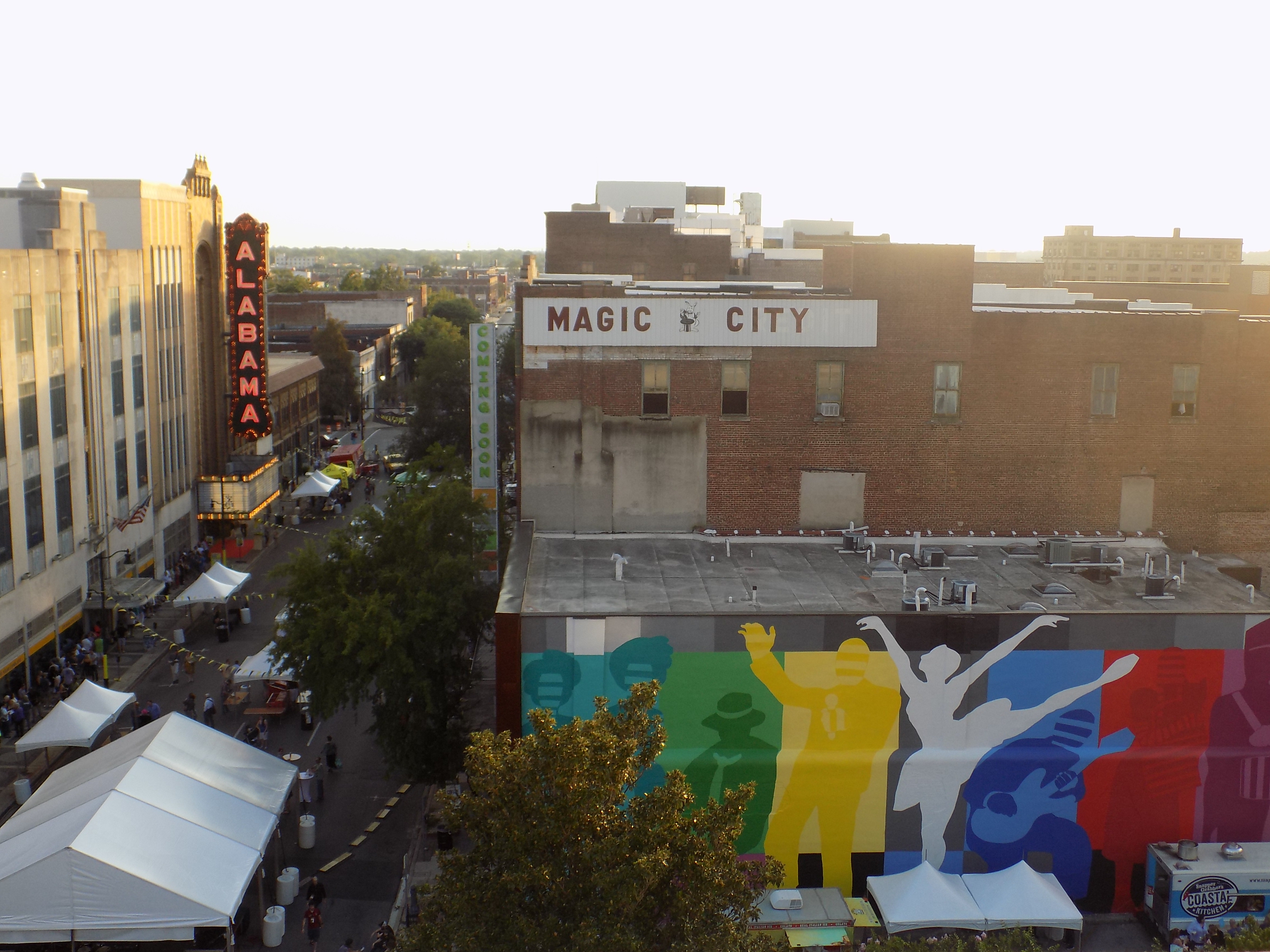
The thing that can be most frustrating about Sidewalk is also one of the things that I enjoy most about it. Nearly 200 titles of all lengths and genres are presented on ten screens at seven locations on the north side of Birmingham’s city center in a single weekend. With ten or more screenings running simultaneously from early morning to late at night, you must plan carefully to get the full benefit. Even with the most precise planning, one is always going to miss out on something he wanted to or should have seen. That is part of the charm of the event — keep them wanting more.

Contemporary Color was the biggest surprise of the weekend but there was plenty to enjoy and savor; I only walked out of one screening (which shall remain nameless).

A nice little character-driven narrative feature called Little Men, directed by Ira Sachs and screened at the Alabama, was my kick-off to a Saturday full of screenings. Sachs has the restraint to end his film at the exact right moment. Little Men is full of fine performances by grown-ups like Greg Kinnear and Jennifer Ehle but the breakout performance is by a young newcomer – a kid named Michael Barbieri, playing “Tony.” I look forward to seeing more of his work in the future.

DSCN0513My Sunday screenings started off at the newly restored Lyric Theatre with DePalma, a talky documentary about Brian DePalma, one of my personal “guilty pleasure” directors. DePalma, directed by Noah Baumbach and Jake Paltrow, is packed with scenes from DePalma’s classics like Carrie and Dressed to Kill, Scarface and The Untouchables, and a generous sampling of other directors’ movies that influenced the quirky and opinionated DePalma.
Sidewalk brings in motion pictures, audiences, and filmmakers from all over the world but it has always been notably generous in finding room to showcase Alabama filmmakers. I always work some of those screenings into the weekend. Clearly the most popular of the Alabama-centric titles this year was Gip, Patrick Sheehan’s award-winning documentary about gravedigger / blues musician Henry “Gip” Gipson. Gip, who cites his age as “somewhere between 80 and 100,” is the proprietor of the last remaining juke joint in Alabama

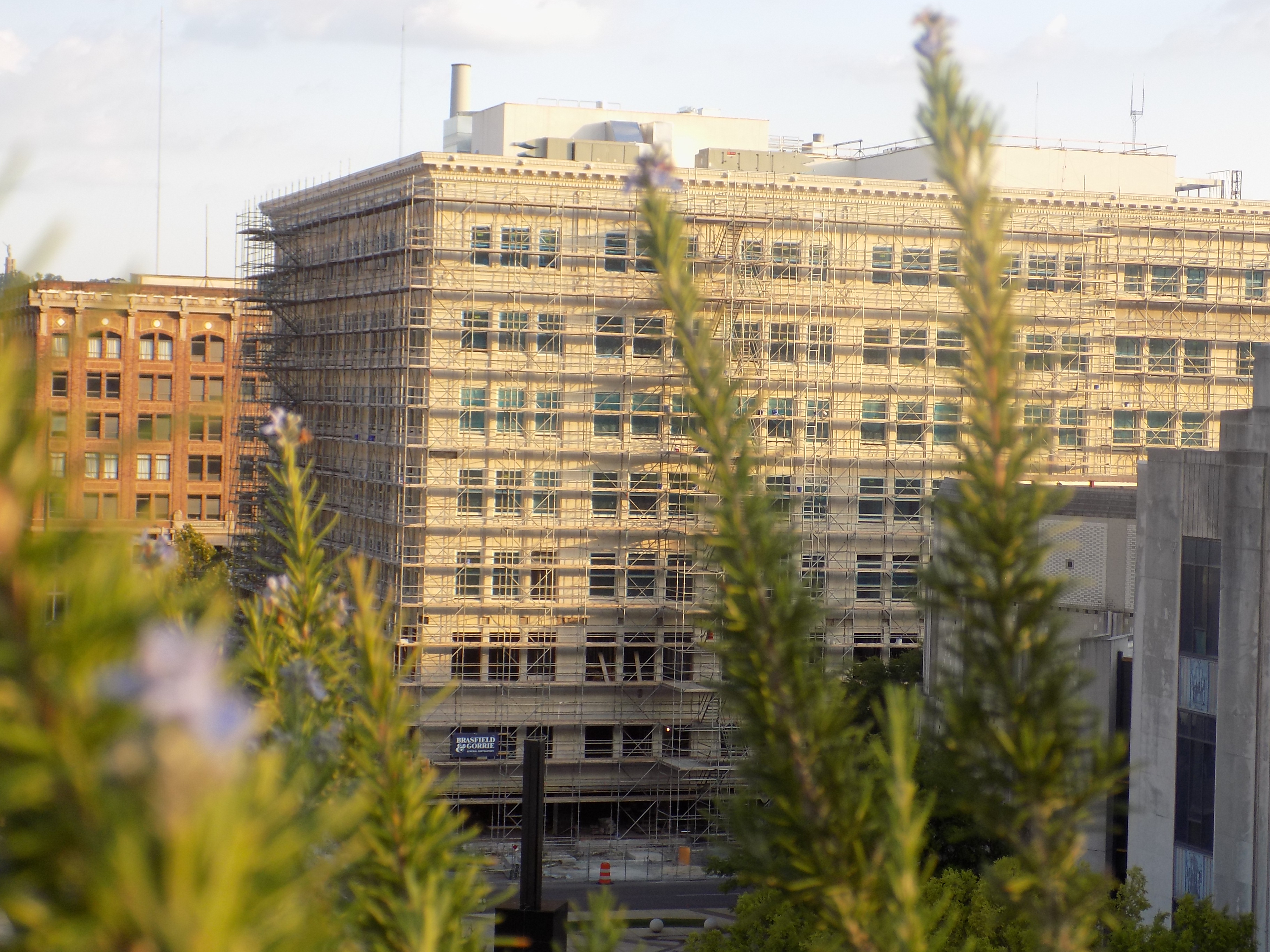
DSCN0488Birmingham’s central city core is undergoing a resurgence and that is partially a result of the efforts of Sidewalk at the festival and throughout the year. At opening night, it was announced that the multi-use refurbishment of the old Pizitz department store building (Pizitz was my favorite of the big downtown department stores as a youth) is set to include permanent offices for Sidewalk and two 100-seat movie theatres.  The new development will be “The Pizitz.”

Downtown Birmingham on the final weekend in August is an indie film lover’s paradise, full of memorable characters on the screens and in the streets. I always leave inspired. DSCN0493

The Farmers Market on Finley Avenue

  DSCN0456 Recently, when I didn’t feel motivated to navigate the hordes crowding into the more trendy local farmers’ markets, I headed out to Finley Avenue and Birmingham’s old Alabama Farmers Market (www.alabamafarmersmarket.org), a sprawling complex of open air sheds and rows of warehouses where truck farmers sell their seasonal harvests 24/7 and resident vendors display their agricultural products.

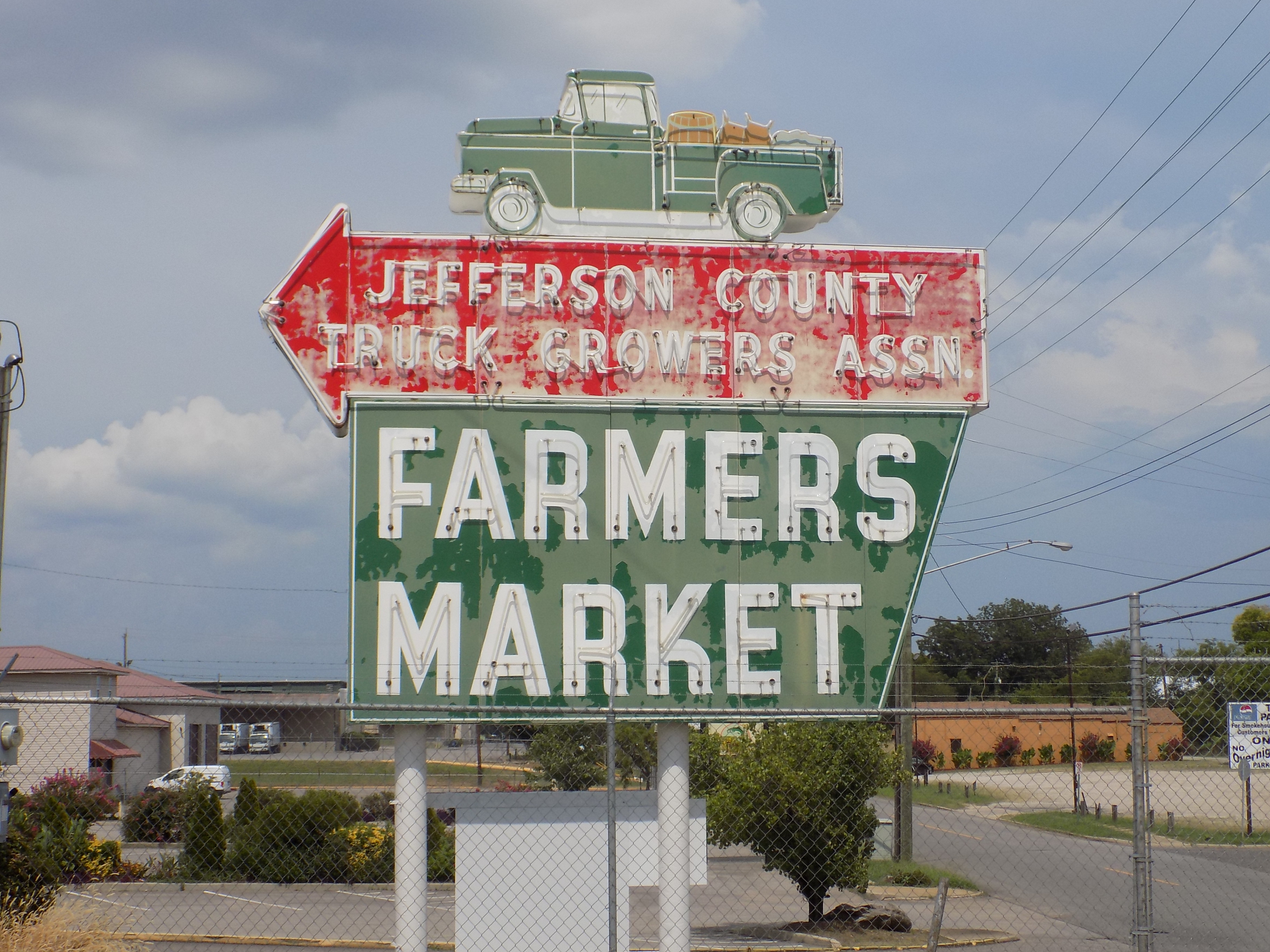
DSCN0449As far back as I can remember that big farmers market has been on Finley Avenue in Birmingham’s westside. The Jefferson County Truck Growers Association formed in 1921 and the Association’s Alabama Farmers Market moved to its Finley Avenue location in 1956.

When I was a child we would take Grandmother Harbison to Finley Avenue where she would stock up on fresh produce for the amazing meals she seemed to always be cooking. She would also can and “put up” for the winter in the big chest freezer down in the basement. Grandmother seemed to always have a large pot of homemade vegetable soup warming on the stove no matter the season. DSCN0450

I am an ardent supporter of local food and community farmers; I might hit three farmers markets over the course of any given week during the warm months. I’m talking about those weekly pop-up markets with farmers selling their wares in avenues of tented stalls for three to five hours.  If you pay attention, you can find such markets almost every day of the week at a church or parking lot near you.

These weekly neighborhood markets have become ubiquitous and popular– which is great — and many have expanded to include artisans and musicians, deejays and demos. I used to feel refreshed after a Saturday morning stroll through Birmingham’s Pepper Place Market but these days I mostly feel stressed and relieved to get away from too many people, too much noise, animals and their people hogging the pathways, and unnecessarily wide baby strollers. The carnival atmosphere begins to distract from the market’s original purpose to get local food to local residents.

So it was a refreshing change to go out to Finley Avenue after too many years away and get back down to just the basics of a farmers market with growers selling off the backs of trucks. The mechanical pea-shellers were cranking out bushels of peas in mere minutes. Some vendors featured rows of canned items with assorted pickles, local honey, chow chow, soups and such.  In August there are abundant mounds of watermelons, cantaloupes, and tomatoes. DSCN0451

The sights, sounds, and aromas took me back to a time when farmers’ markets were less abundant but the shoppers were probably more earnest about their fresh local food. The people who frequented these markets weren’t just seeking out the coolest heirloom tomato (I’m a fan of heirloom tomatoes, too, by the way) but were focused on the values of locally sourced food and finding ways to feed a family in healthy, sustainable, and economical ways.

The originals like Alabama Farmers Market on Finley will be around for a long time. DSCN0457