Tag Archives: Alabama

More Brief Meditations

100_1587-3  My Christmas cards went in the mail this week. Previous essays have chronicled my long-standing project of photographing old Alabama churches during the month of December for my next year’s Christmas card. I have written about how signing and addressing each card has become a “brief meditation” on the recipient.

2016 was a challenging year for my family and me. Last year at this time Dad was already hospitalized and there was no opportunity to go on photography expeditions. But many of my friends have begun to expect my annual Christmas card and I feel a responsibility to complete the task. The process of choosing the annual design, verse, and photo has become a welcome annual ritual that I use as an escape from day to day pressures.

Since I didn’t take any church photographs in December 2015, I went back through my files to look at previous photographs of churches that I haven’t used. I kept returning to a 2007 image of Havana Methodist Church, an 1870 structure visible on Highway 69 in the small Black Belt community of Havana between Moundville and Greensboro.

The Havana church was a frequent subject of artist William Christenberry, whose long career was centered on photographs, paintings, sculptures, and assemblages inspired by the Black Belt, especially Hale County where Christenberry’s grandparents lived. Christenberry visited and photographed his humble architectural and landscape subjects year after year, photographing their decline and bringing fame to a green barn, a Sprott church, and a Palmist sign hanging upside down in the broken window of an abandoned store, among other iconic images. When I photographed the church in 2007 I visited the family plots of Christenberry’s ancestors buried in the small churchyard cemetery. 100_1589

Christenberry always photographed full images of the Havana church so I decided to use a detail of the church’s handsome roof as the main image on the front of my card and put a thumbnail of the full church on the back. The church’s elegant simplicity inspired me to use a verse from Joseph Brackett’s “Simple Gifts,” a Shaker dance song, as the inside message for the card. The “Simple Gifts” tune is probably best known from composer Aaron Copland’s orchestral adaptation of it for “Appalachian Spring,” the score he first composed for a Martha Graham dance.

On the back I provided the photograph credit and the note that the photograph was inspired by Christenberry along with a memorial statement for Dad, who passed away in the spring.

Ironically, as I was leaving the post office on the day that I mailed my large batch of cards, I heard the news that William Christenberry died at age 80 on November 28. That news about one of my favorite artists and fellow University of Alabama MFAs (who received his three decades before I received mine) made a bittersweet holiday season even more so.

Even bittersweet, I still look forward to a bright and pleasant holiday season full of comfort and joy and I still have a fervent hope for a better and more restful year to come.

Happy Holidays. 100_1587

Helen Keller. The Myth of Water. Jeanie Thompson

dscn0515  Helen Keller (1880-1968) is arguably the most famous person to ever come from Alabama. The story about how the young deaf and blind Helen was given words by her teacher, Anne Sullivan, is still well known. She went on from the water pump in Tuscumbia to become a Radcliffe graduate – the first deaf and blind person to ever earn a B.A.; an acclaimed and much translated author and lecturer; a world traveler who knew French, Latin, Greek, and German, in addition to English, sign language, and Braille – and she could read lips with her fingers!; and an advocate for the rights of people with disabilities.

She was an American Socialist, a member of Industrial Workers of the World, and a pacifist who visited Hiroshima before the bomb and again afterward to lament the harm mankind is capable of perpetrating. We know that she fell in love with and planned to marry a man who served briefly as secretary for her and Sullivan and that the planned elopement never occurred. This was in a time when people with disabilities were most often discouraged from having romantic relationships.

It seems she knew all of the most prominent people of her time: Alexander Graham Bell, Enrico Caruso, Charlie Chaplin, sculptor Jo Davidson, the Roosevelts, and Mark Twain were among her friends and she knew every American president from Grover Cleveland to Lyndon Johnson.

Helen Keller had handicaps but seems to have overcome all barriers which were placed before her. Alabama chose her to represent the state on its state quarter in 2003 (the only U.S. coin to feature Braille) and Alabama chose a statue of seven-year-old Helen at the water pump to represent the state in the U.S. Capitol Visitors Center as one of two Alabamians in the National Statuary Hall Collection (Gen. “Fightin’ Joe” Wheeler is the other). Of course there is irony in the circumstance that what is considered one of the most conservative states in the nation is so prominently represented by such a progressive liberal. I love that irony.

Helen Keller was a subversive in many ways.

At her reading at Carnegie Visual Arts Center in Decatur, Alabama, on September 15, poet Jeanie Thompson commented that nowadays a traditional poetry reading almost seems to be a “subversive act” since such events are so rarely done anymore.

Jeanie Thompson’s new book, The Myth of Water (www.uapress.ua.edu), is a lovely collection of poems “from the life of Helen Keller.”  Each poem is an imagistic contemplative meditation in a first person voice. The persona is usually Helen but there are also poems in the voices of those who encountered her in her life.

It thrilled me to know that Jeanie Thompson has a new collection on the shelves. I have known her poetry since we were both at the University of Alabama and her books like White for Harvest: New and Collected Poems and Litany for a Vanishing Landscape have a permanent home on my bookshelves.

In The Myth of Water Thompson weaves a life from childhood to death and beyond in a series of brief and often breath-taking poems which attempt to break through the silence and explore what Helen Keller must have been thinking, feeling, seeing in her heart and in her mind’s eye. These are 34 poems of loss and longing, heightened consciousness and humanity, the challenges and triumphs of an unvanquished spirit hungry for life. Thompson’s is an ambitious and daunting project, flawlessly rendered.

By entering a sensory-deprived existence, which found ways to not only compensate but to prevail, Thompson’s poems heighten the reader’s own senses and awareness. I thought I knew what I needed to know about Helen Keller. Now, after reading these poems, I long to learn more. The Helen Keller quote – in English and in Braille – on the Statuary Hall statue is “The best and most beautiful things in the world can’t be seen or even touched, they must be felt with the heart.” Thompson has made an imaginative journey into Helen’s heart.

After the reading, I took the Upper River Road south of the Tennessee on the drive back to Huntsville from Decatur. A full moon shone down on cotton bolls that had just burst open, glowing white and pure in the dark fields, the first cotton I have seen this year.

A light rain began to fall as I parked and headed to my back door. I turned to look up at the full moon, still showing through thin clouds. The cool water fell softly on my face as if for the first time.

Pounding the Sidewalk, 2016

DSCN0490 When I arrived in Birmingham on Friday afternoon for the 2016 edition of the Sidewalk Film Festival it never occurred to me that of the eighteen movies I would see over 48 hours, I would drive home on Sunday night most pumped about a documentary that featured performances by high school color guards.

Contemporary Color is directed by Bill Ross IV and Turner Ross, the filmmaking brothers whose 2010 documentary 45365 about nine months in the life of Sidney, Ohio, is still one of my favorite movies to be screened at Sidewalk ever. The Ross Brothers’ latest, Contemporary Color, was conceived and produced by David Byrne, one of my musical heroes, and documents a one-night only event at Brooklyn’s Barclays Center. Byrne invited ten high school color guard units to perform live performances set to original music written especially for the event by contemporary artists including David Byrne, Nelly Furtado, Devonte Hines, How to Dress Well, Lucious, and St. Vincent. Each of the artists performs their compositions along with the color guards live at Barclays.

It’s hard to explain, really.

The Ross Brothers take the live event and turn it into a hypnotic meditation on color guards, interspersing concert footage with individual profiles, backstage glimpses, rehearsal footage, artful segues, and, at one point, the voice of an enthusiastic New Jersey grandfather cheering in the arena. The cinematography, sound, and editing are stunning. Especially powerful are shots of a young color guard performer doing his routine alone in the garage of a house juxtaposed with his powerful performance at the actual event. Contemporary Color is a fierce and brave movie presented without irony. I kept being reminded somehow of Godfrey Reggio’s “Qatsi trilogy” of trance-inducing films scored by Philip Glass that were released between 1983 and 2002.

The thing that can be most frustrating about Sidewalk is also one of the things that I enjoy most about it. Nearly 200 titles of all lengths and genres are presented on ten screens at seven locations on the north side of Birmingham’s city center in a single weekend. With ten or more screenings running simultaneously from early morning to late at night, you must plan carefully to get the full benefit. Even with the most precise planning, one is always going to miss out on something he wanted to or should have seen. That is part of the charm of the event — keep them wanting more.

Contemporary Color was the biggest surprise of the weekend but there was plenty to enjoy and savor; I only walked out of one screening (which shall remain nameless).

A nice little character-driven narrative feature called Little Men, directed by Ira Sachs and screened at the Alabama, was my kick-off to a Saturday full of screenings. Sachs has the restraint to end his film at the exact right moment. Little Men is full of fine performances by grown-ups like Greg Kinnear and Jennifer Ehle but the breakout performance is by a young newcomer – a kid named Michael Barbieri, playing “Tony.” I look forward to seeing more of his work in the future.

DSCN0513My Sunday screenings started off at the newly restored Lyric Theatre with DePalma, a talky documentary about Brian DePalma, one of my personal “guilty pleasure” directors. DePalma, directed by Noah Baumbach and Jake Paltrow, is packed with scenes from DePalma’s classics like Carrie and Dressed to Kill, Scarface and The Untouchables, and a generous sampling of other directors’ movies that influenced the quirky and opinionated DePalma.
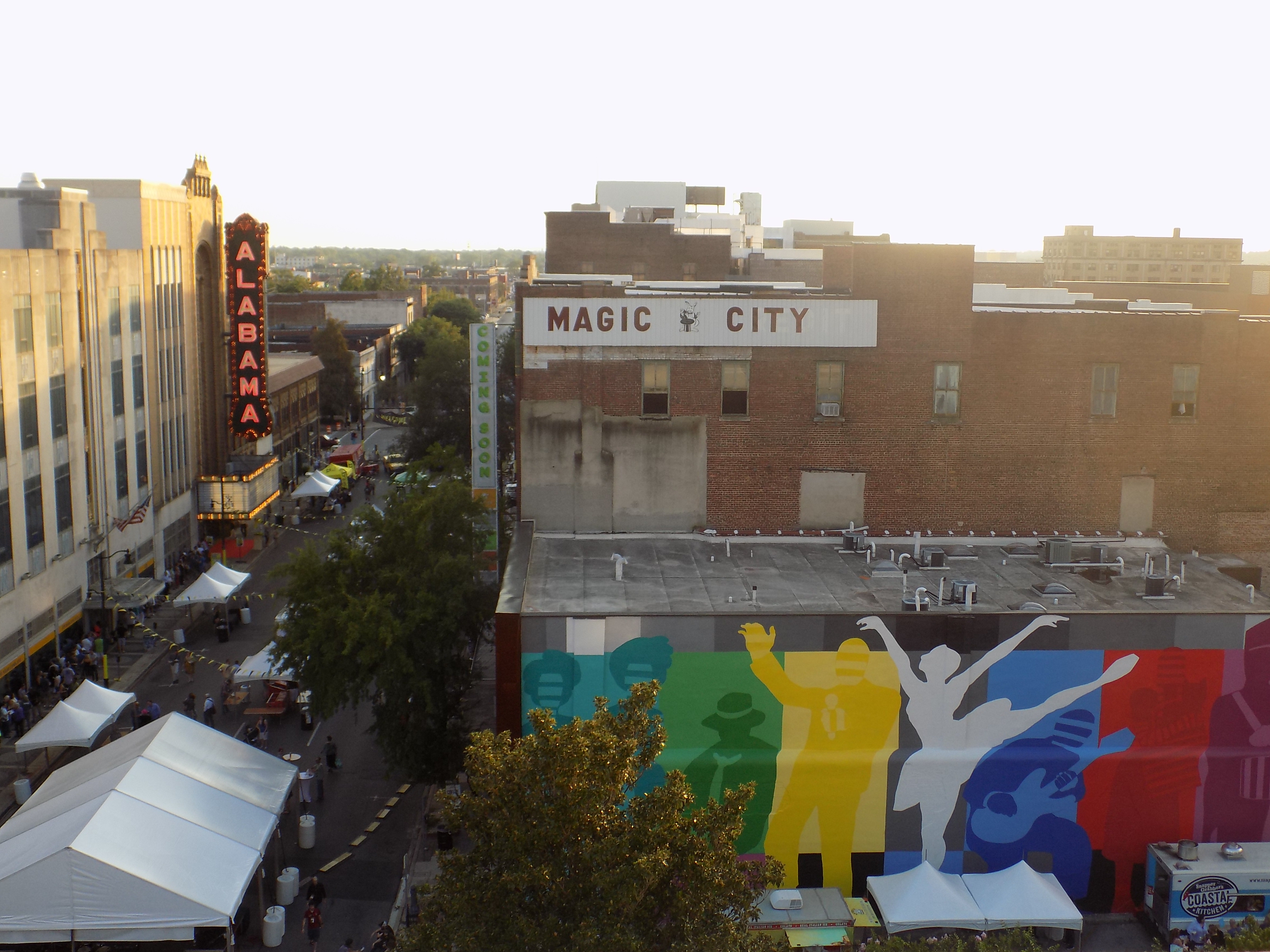
Sidewalk brings in motion pictures, audiences, and filmmakers from all over the world but it has always been notably generous in finding room to showcase Alabama filmmakers. I always work some of those screenings into the weekend. Clearly the most popular of the Alabama-centric titles this year was Gip, Patrick Sheehan’s award-winning documentary about gravedigger / blues musician Henry “Gip” Gipson. Gip, who cites his age as “somewhere between 80 and 100,” is the proprietor of the last remaining juke joint in Alabama

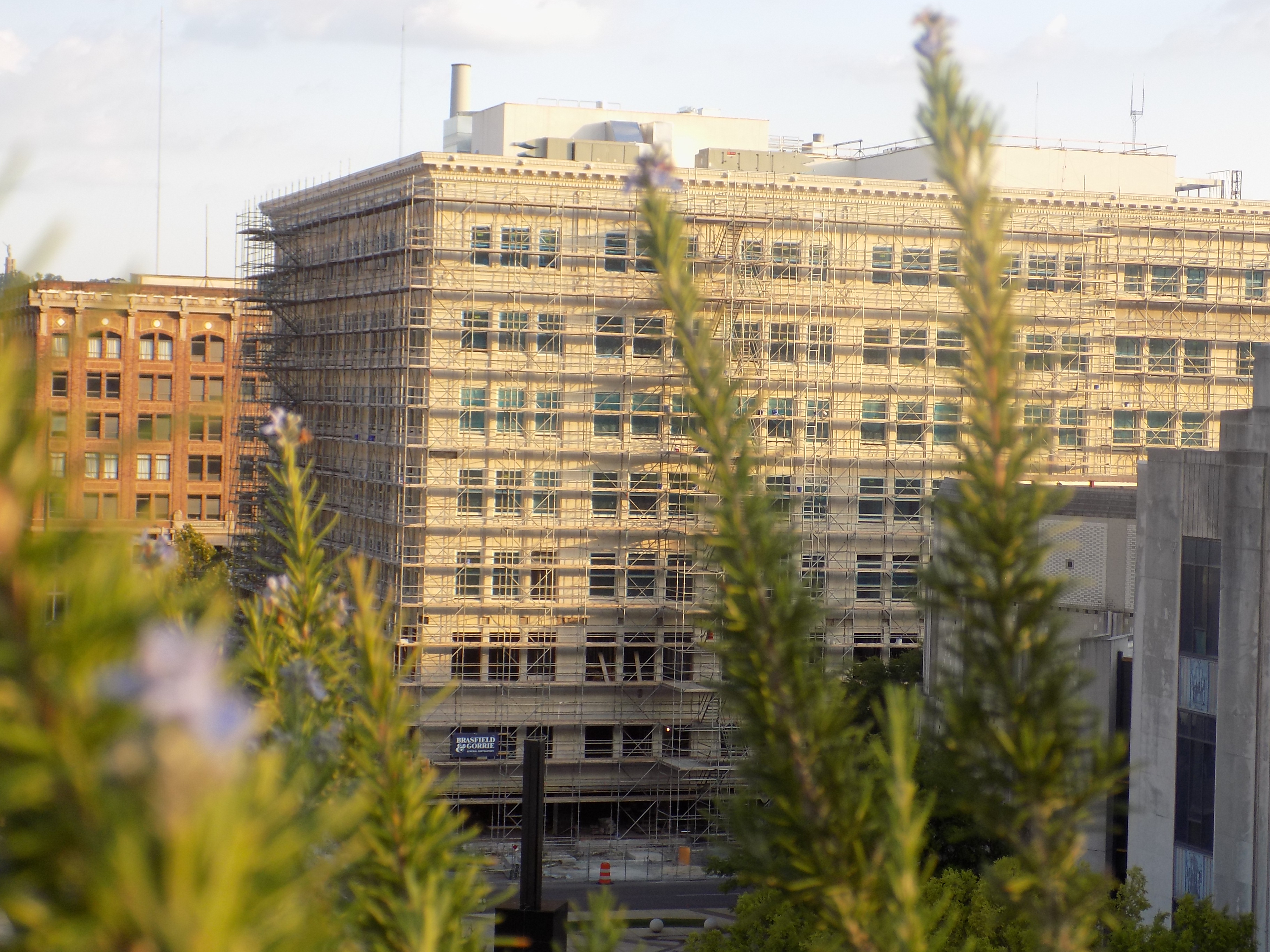
DSCN0488Birmingham’s central city core is undergoing a resurgence and that is partially a result of the efforts of Sidewalk at the festival and throughout the year. At opening night, it was announced that the multi-use refurbishment of the old Pizitz department store building (Pizitz was my favorite of the big downtown department stores as a youth) is set to include permanent offices for Sidewalk and two 100-seat movie theatres.  The new development will be “The Pizitz.”

Downtown Birmingham on the final weekend in August is an indie film lover’s paradise, full of memorable characters on the screens and in the streets. I always leave inspired. DSCN0493

The Farmers Market on Finley Avenue

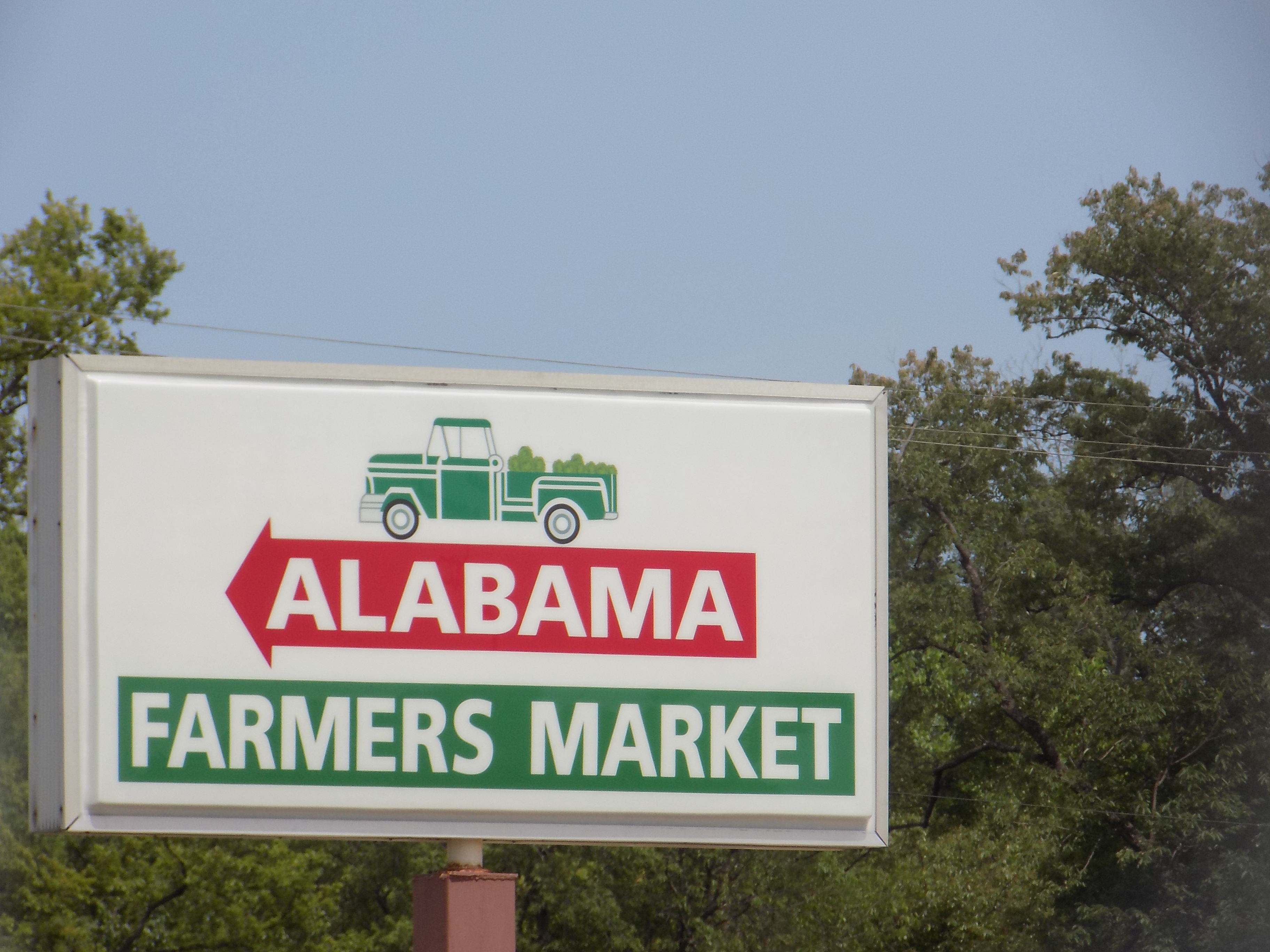
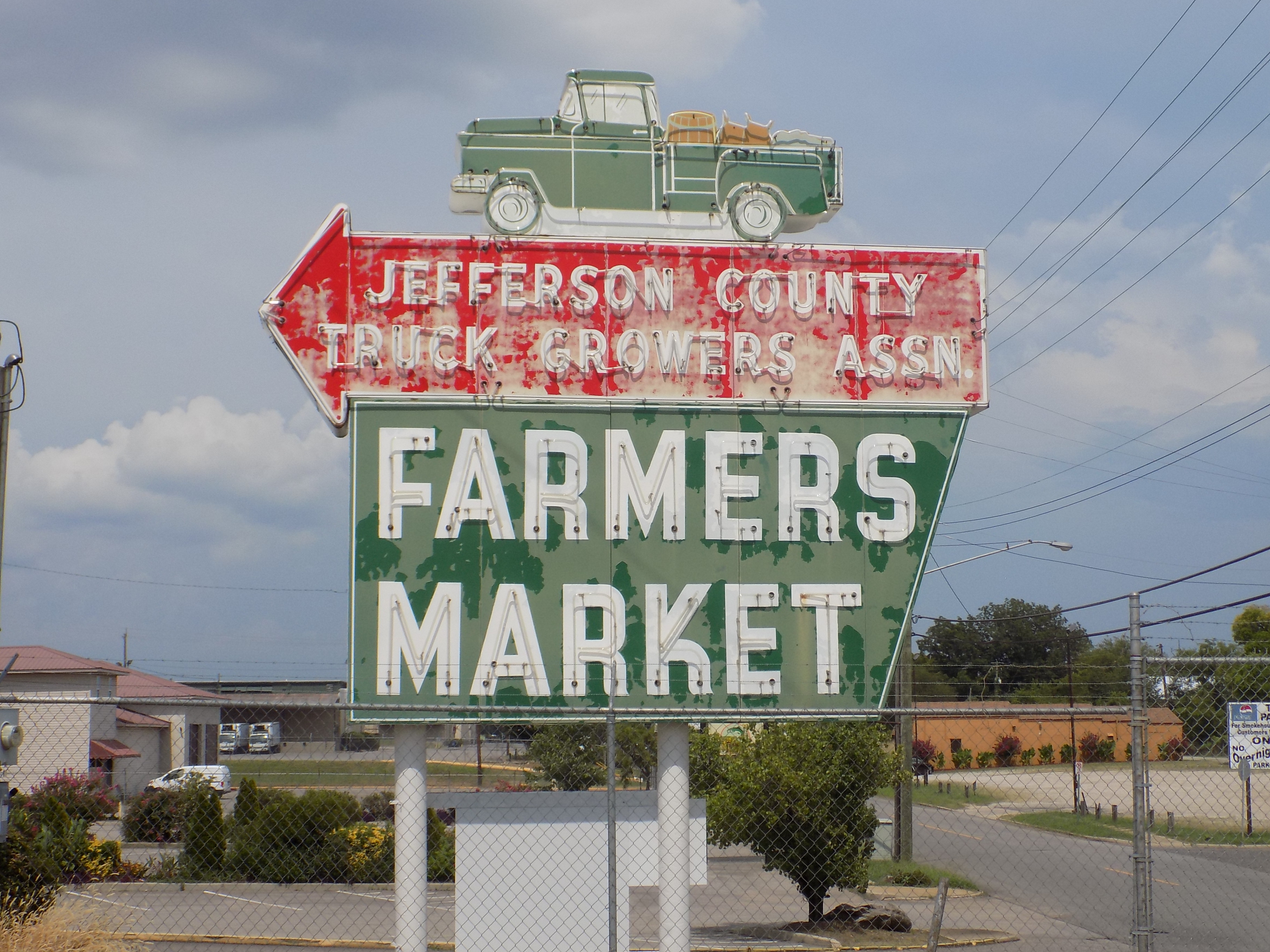
  DSCN0456 Recently, when I didn’t feel motivated to navigate the hordes crowding into the more trendy local farmers’ markets, I headed out to Finley Avenue and Birmingham’s old Alabama Farmers Market (www.alabamafarmersmarket.org), a sprawling complex of open air sheds and rows of warehouses where truck farmers sell their seasonal harvests 24/7 and resident vendors display their agricultural products.

DSCN0449As far back as I can remember that big farmers market has been on Finley Avenue in Birmingham’s westside. The Jefferson County Truck Growers Association formed in 1921 and the Association’s Alabama Farmers Market moved to its Finley Avenue location in 1956.

When I was a child we would take Grandmother Harbison to Finley Avenue where she would stock up on fresh produce for the amazing meals she seemed to always be cooking. She would also can and “put up” for the winter in the big chest freezer down in the basement. Grandmother seemed to always have a large pot of homemade vegetable soup warming on the stove no matter the season. DSCN0450

I am an ardent supporter of local food and community farmers; I might hit three farmers markets over the course of any given week during the warm months. I’m talking about those weekly pop-up markets with farmers selling their wares in avenues of tented stalls for three to five hours.  If you pay attention, you can find such markets almost every day of the week at a church or parking lot near you.

These weekly neighborhood markets have become ubiquitous and popular– which is great — and many have expanded to include artisans and musicians, deejays and demos. I used to feel refreshed after a Saturday morning stroll through Birmingham’s Pepper Place Market but these days I mostly feel stressed and relieved to get away from too many people, too much noise, animals and their people hogging the pathways, and unnecessarily wide baby strollers. The carnival atmosphere begins to distract from the market’s original purpose to get local food to local residents.

So it was a refreshing change to go out to Finley Avenue after too many years away and get back down to just the basics of a farmers market with growers selling off the backs of trucks. The mechanical pea-shellers were cranking out bushels of peas in mere minutes. Some vendors featured rows of canned items with assorted pickles, local honey, chow chow, soups and such.  In August there are abundant mounds of watermelons, cantaloupes, and tomatoes. DSCN0451

The sights, sounds, and aromas took me back to a time when farmers’ markets were less abundant but the shoppers were probably more earnest about their fresh local food. The people who frequented these markets weren’t just seeking out the coolest heirloom tomato (I’m a fan of heirloom tomatoes, too, by the way) but were focused on the values of locally sourced food and finding ways to feed a family in healthy, sustainable, and economical ways.

The originals like Alabama Farmers Market on Finley will be around for a long time. DSCN0457

Peaches, 2016


DSCN0447  We’re not even to the halfway point of calendar summer and I’m already starting to miss it. Nowadays public schools start ridiculously early and the place where I teach will be starting its fall semester before long. All of these things contribute to the feeling that summer is almost over. At least there is the salve of the impending start of college football season.

What really triggers my late-summer doldrums is the prospect of another local peach season coming to an end. On my most recent trip to Jimmie’s Peach Stand in Chilton County, one of the Harrison sons predicted that their peach trees would only be yielding for another ten days to two weeks this year. The drive to Chilton County and along back country roads to Jimmie’s is always a tonic for me and I hate to see it end each year around this time.

I have written about Jimmie’s in the past and about my regular trips during their season which usually commences around Mother’s Day and ends in late-July and occasionally into August. I try to get down every two weeks during the season and I try to only eat Chilton County peaches purchased at Jimmie’s.

In a conversation a few years ago, I asked Jimmie Harrison for recommendations of good peaches in north Alabama. “I always thought Mr. Isom grew a good peach,” he said, referring to Isom’s peach orchards near Athens. So when the Jimmie’s crop is depleted, I can usually rely on Isom’s for another basket or two (www.isomsorchard.com).

Jimmie’s peaches without any embellishment are perfect and this year’s crop seems to bear an overall larger fruit than usual. It’s impossible to have a surfeit of peaches but occasionally they get pretty ripe before I can get to them and I have some fallback recipes to make sure that not a single peach is wasted. I don’t make many pies so when I’m ready to throw peaches in the oven it’s usually in a cobbler.

Over the years I have collected some ways to take full advantage of peach season and their abundance and, with the local season’s end upon us, it’s time to share a couple of fresh and simple peach recipes.

The peach salsa is simple and has multiple uses. Use it however you would use any other type of salsa but I love it on a fish taco. The following recipe makes a nice batch.

Peach Salsa

2 large ripe peaches, peeled, pitted, and diced

3 tablespoons thinly sliced green onions (white and green parts)

1 teaspoon grated lime zest

1½ tablespoons fresh lime juice

1 tablespoon chopped parsley

¼ jalapeno pepper, seeded and minced

Cayenne pepper to taste

salt to taste

Simply mix all ingredients together and serve.

The Peaches and Beaujolais dessert recipe originally came from Frank Stitt’s Southern Table cookbook. Over time I have used it so much without referencing the cookbook that I think it has morphed into my own version. In fact, I pulled out his recipe not long ago to copy for a friend and realized that I have taken liberties with the original. I had forgotten that the original uses granulated sugar along with the brown sugar.  Here  is how I basically make it these days:

Peaches and  Beaujolais

1 medium ripe peach, peeled, pitted, and quartered

1½  tablespoon dark brown sugar

4-6 ounces good Beaujolais or Morgon

Put half of the dark brown sugar in the bottom of a wine glass. Put peach quarters in glass. Drizzle the other half of dark brown sugar over the top of the peaches. Pour Beaujolais (or Morgon) over the peach and sugar mixture. For a really decadent variation, embellish the Beaujolais with Cointreau or Grand Marnier. Garnish with mint leaves.

Both of these peach recipes capture the freshness and vibrancy of the summer season for me and enhance that distinctive peach essence in an exciting way.

Make the most of the rest of your summer. Hmm … shouldn’t local figs be here soon?

Ensley

DSCN0435 Each person’s Ensley narrative varies but the through-line boils down to this: Ensley is a proud and tight-knit community on the west side of Birmingham that once was a bustling steel-making industrial center with omnipresent smokestacks, industrial barns and sheds, shift whistles, train traffic, and massive blast furnaces. Because it was a 24-hour town full of shift-workers, many Ensley businesses in the early to mid-20th century were 24/7 operations.

The jazz standard “Tuxedo Junction” is about a club at an Ensley streetcar crossing. Erskine Hawkins, a Birmingham native, is the composer of that tune. My favorite rendition is Glenn Miller and his Orchestra’s chart-topping 1940 big band arrangement.

When U.S. Steel shut down its Ensley works in the early-1970s, the area’s population and businesses began to disperse.

DSCN0399Today, ghosts of Ensley abound; much of the community is semi-abandoned and desolate. Birmingham media have a tendency to report anything that occurs in western Birmingham as happening in “Ensley” and you have the additional burden of a bad rep and the not always accurate impression of an abundance of crime.

Crime is definitely a problem these days in Ensley but the community seems to get more blame than it deserves. Recently, when I was visiting my mother in her over-the-mountain Birmingham neighborhood, a local television news report was covering a recent shooting in “Ensley.” When the address of the crime was given Mother looked at me and said “That’s a Central Park address – why are they calling it Ensley?” For some reason any bad news from the west side of the city automatically gets attributed to Ensley.

DSCN0430Katherine Webb’s 2014 article “Who Is Ensley?” in Weld (www.weldbham.com/blog/2014/01/29/who-is-ensley) provides a good overview of efforts to resurrect present-day Ensley from the challenges it has encountered since the steel mills were shut down. The article provides plenty of first-person evidence of the pride that still hangs strong in the community.

My father was raised on Avenue D and Mother moved around the corner from him to 25th Street as a teenager. Ensley was the starting point for Grover and Jean Journey’s 63-year marriage. Dad and Mother left Ensley for good in the early 1950s but Dad never ceased to be a proud “Ensley boy.” DSCN0429

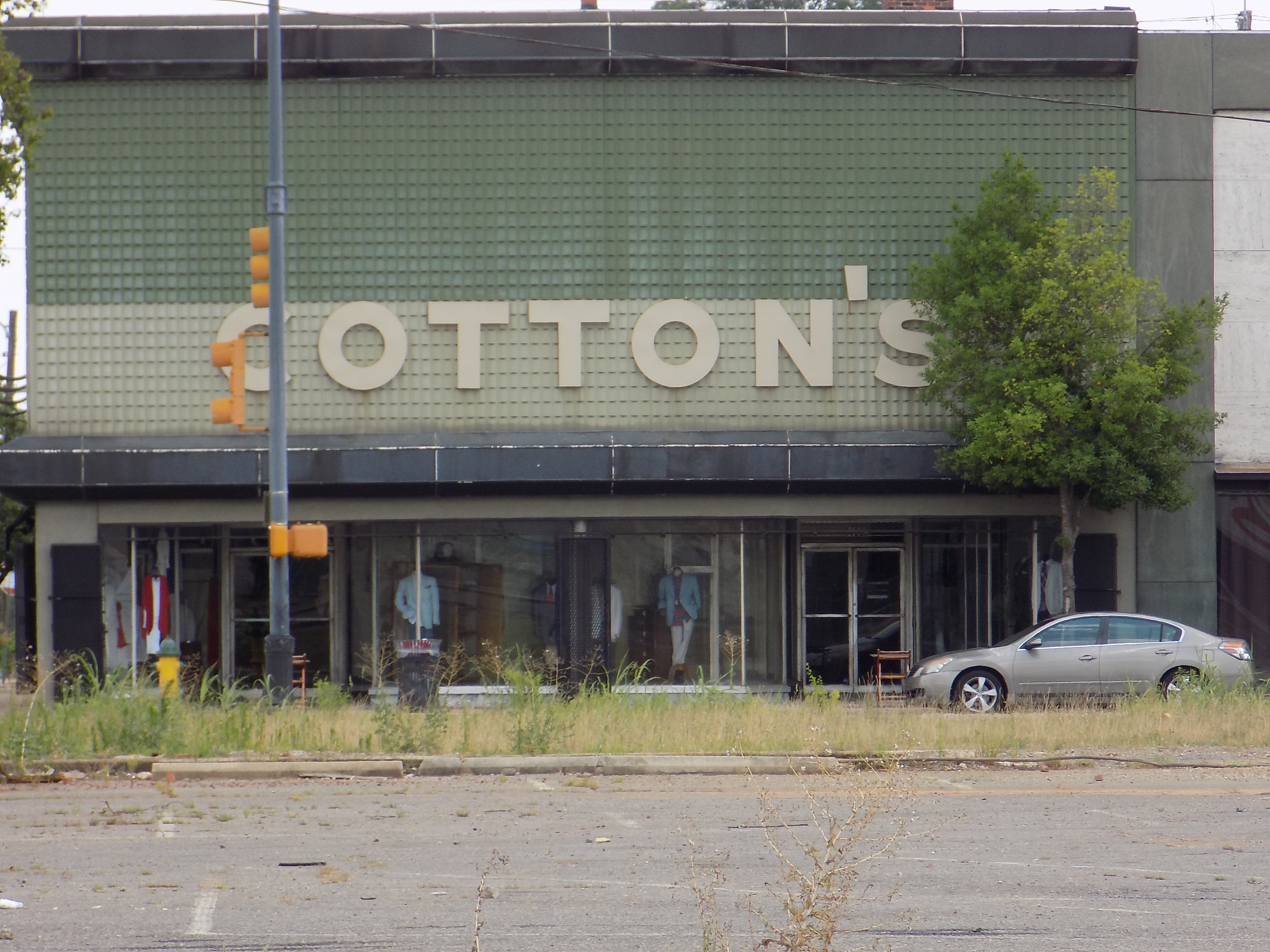
Mother still talks about shopping in Ensley as a young woman and I remember visiting Ensley department stores such as Cotton’s and Goldstein & Cohen with Mother and Grandmother when I was a little boy. Dad’s first job was at the poultry shop that Fred Trucks owned over on Avenue E. Marino’s grocery store, which operated then, still operates on Avenue E across from what used to be Ensley Lanes bowling alley.

One could get a meat and three at Ensley Grill or “all you can eat” catfish at Catfish King’s Avenue E location in the building that was once the Franklin Theatre. In Catfish King, tables were set along each side of a center aisle on raised sections that once held rows of theatre seats and the stage was still there (the grand drape too, as I recall).  These places were still around when I hit my teens.

Dad’s childhood home, in drastically altered form, is still standing and inhabited on Avenue D but the house that Mother’s family lived in around the corner is gone. A house that was once owned by Mother’s grandfather, Houston McCarn – who lived in Cullman but invested in Birmingham real estate when the city was still young, still stands on the corner down the street from Dad’s house. It has been long abandoned.  DSCN0407

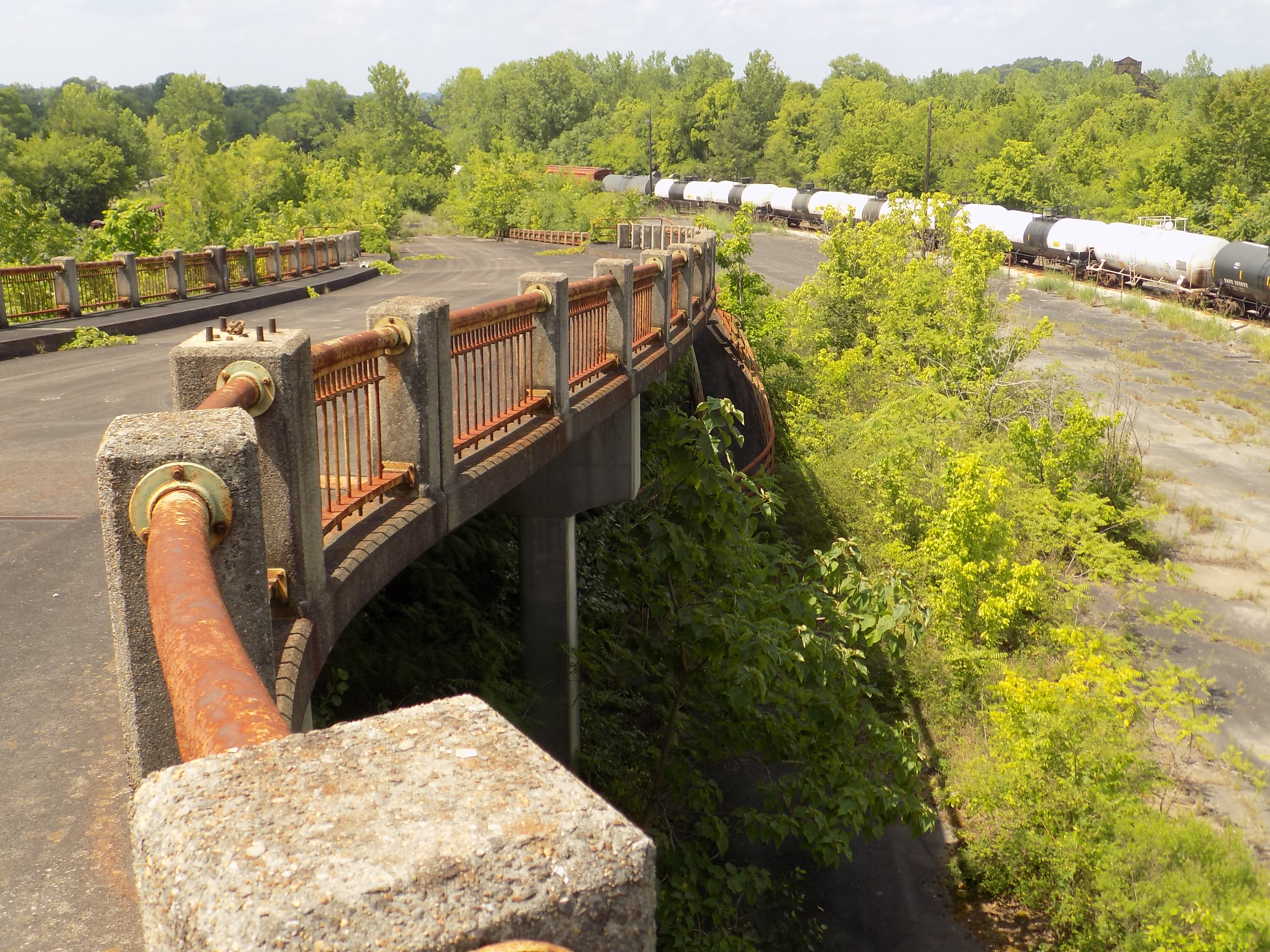
It is these ghosts of the past and the hope for community renewal that still draw me to Ensley. But my main draw these days is an ongoing fascination with the beauty and decay of the former Ensley industrial sites that were abandoned when the steel mills shut down. The railroad tracks are still active through the site and the viaduct over the tracks where 20th Street-Ensley becomes Birmingport Road heading out to the river is a good spot to linger and observe the buildings and remaining stacks that are being rapidly reclaimed by nature.

On a clear day, peering down from the middle of the Ensley viaduct toward Fairfield, you can see to U.S. Steel’s Fairfield plant where the remaining blast furnace was idled in 2015. Fairfield and Ensley steelmaking operations have gone from tens of thousands of workers at their peak to a few hundred at the pipe mill in Fairfield today.

On a hot June morning, the mimosas are prolific at the Ensley plant. Rusty railings and sagging metal buildings with broken windows sit along abandoned roads that used to teem with trucks and industrial vehicles. The few remaining stacks stand tall amid the ruin and rubble. A train creeps through the site, taking loads to more remote locations that are not yet abandoned. DSCN0420

In the modern post-industrial era, things come and go more quickly than in earlier epochs but, to me at least, these 20th century industrial remains have a pride and dignity equal to that of ancient ruins of early civilizations. The craggy, mineral-laden ground that now nourishes the mimosas, poke weed, kudzu, and wild vegetation of the Ensley ruins is the same ground that nourished my family in a recent past that seems impossibly far away.

I will always go back to check on Ensley. DSCN0404

Serenity Now: Reflections on a Weekend

(for Anne T.)

DSCN0316 (2) So here’s the deal: Because of family matters in Birmingham, I have not spent an entire weekend in my house in eleven months. On the weekend of May 20 through 22 I had a dinner engagement over in the Shoals in Florence  and planned to spend the weekend at my house and return to Birmingham on Monday (I am on a break until Memorial Day).

On Friday morning I began to cultivate a kitchen herb garden in my tiny back yard and re-pot and re-plant some things that have been neglected in the past year. I met with my friends Scott and Michelle and their two daughters for dinner at a favorite chili place on Friday night but the daughters preferred Mexican  with buddies so Scott and I were dumped and had to be bachelors for the night (well, Scott did – I’m always a bachelor for the night).

My friend Cindy, who was supposed to be my companion on Saturday night in Florence, was forced to cancel and I was suddenly looking at wasting a much sought-after ticket for a sold out dinner. These are amazing dinners, however, so I was going whether the other ticket was taken or not.

I immediately thought of my friend Anne who lives in Decatur – about halfway between Huntsville and Florence. I also remembered that my friend Anne is a very busy and active woman and would most likely be out-of-town for the weekend.

I sent a text with a somewhat embarrassed invitation and, to my surprise and delight, Anne texted back “Yes. What time?”

Just before I got to Anne’s house in Decatur, my “low tire pressure” warning came on and I pulled into the driveway with a tire rapidly deflating. Anne was happy to drive her car and I decided to deal with the tire after the dinner.

As we prepared to leave for the Shoals, Anne’s beloved 16-year-old Jack Russell terrier, Zeke, had a frightening seizure and Anne rallied to try to get Zeke through the crisis. Zeke’s seizure ended but he remained disoriented and Anne called upon a trusted friend to sit with him for the evening.

Slightly disoriented ourselves, Anne and I left Decatur in Anne’s vehicle and she said the only stop we needed to make was for “petrol.” We pulled into a station on the outskirts of town and suddenly were met with a Michael Jackson impersonator with full Michael Thriller-era wig and complexion performing full out to “Beat It” in the filling station parking lot. Anne assured me that he was a Decatur tradition and passing vehicles rolled down their windows and cheered him as they passed. Anne wanted to tip him but I wasn’t so sure. Now I wish we had because how many guys are committed enough to run around performing Thriller tracks in Decatur in full Michael drag?

Next time I see him, I’ll take a picture. He gets a tip from me next time.

When we got to the Alabama Chanin Factory in Florence for the Spring Harvest Friends of the Café dinner, the place was already jovial and full and hors d’oeuvres were being passed.  We grabbed a devilled egg and headed toward the dining area and were greeted by Natalie Chanin, the acclaimed “slow fashion” designer and host for the dinner (www.alabamachanin.com).

Anne was her always charming self, as was Natalie, but as we moved away Anne muttered “I’ve wanted to meet Natalie Chanin for years and when I finally do I have egg in my mouth.” Not to worry – Anne had another conversation with the designer at the end of the evening and I don’t think there was any notice of the hors d’oeuvres incident.

I need to write an essay on the dinner itself, and I plan to (but I got no decent photos – was far too busy eating the food and chatting). The featured chef for the evening was the Factory’s resident chef, Zachariah Chanin, and it was one of my favorite meals ever at the space (I think I’ve made six of the ten Friends of the Café evenings). The amazingly fresh spring harvest ingredients were primarily from Bluewater Creek Farm in Killen, Alabama, an organic farm run by Collins and Liz Davis in partnership with Doug and Donna Woodford (www.bluewatercreekfarm.com). I wrote about my tour of Bluewater Creek Farm in the essay “Sustainability and Soul” in November 2014. IMG_0837

Suffice it to say, the meal was brilliant. Each Friends of the Café event is a benefit and this one was no different. The honoree was Nest, a non-profit organization that supports artisans and makers throughout the world and with which Alabama Chanin is very involved (www.buildanest.org).

Incidentally, the dessert, a strawberry shortcake with local strawberries macerated in a thyme simple syrup with freshly whipped cream is assuredly the best and freshest I’ve ever tasted. Almost as good as the dessert’s taste was watching Zach Chanin and his staff assembling the dozens of desserts on the café bar.

As always, new acquaintances and friends were made at the family-style seating. Anne and I sat across from a couple from Indianapolis. “What brings you to the Shoals?” I asked. “We drove down for dinner” was the honest reply. A family next to me had driven in from Corinth, Mississippi, for their first Factory meal and assured me they’d return.

During dinner, a spontaneous conversation erupted at my end of the table about “Seinfeld” catch phrases.

“A Festivus for the rest of us.” “Not that there’s anything wrong with that.” “The Bro.” “Sponge-worthy.” “Yadda yadda yadda.” “The Contest.”

And my personal favorite  – “SERENITY NOW!”

As always when I am at the Factory, the spirit of community and connection is palpable. In addition to the fine company in the room, Anne texted our friend Deb in Paris and we both wished she was with us. So the good feelings spread beyond Alabama and the Shoals and were truly international. After a thoroughly satisfying evening of food and sociability, we said our goodbyes and walked out under a bright and friendly full moon. When we got back to Decatur my tire was flat as a pancake.

It was late. Anne offered her guest room and I decided AAA could wait until morning.

By morning, I went downstairs to find Anne tending to a much calmer Zeke and my ruined tire was tended to by a particularly pleasant AAA tow truck driver. At last, I was back on the road and headed home.

A very wise woman once advised me that I should reserve a part of each week to be quiet, relax, and regroup. When my schedule allows, that time has always been Sunday night at my house. I cook a good meal, sit quietly, and listen to soothing music until time to go to bed.

I realized that this particular Sunday night would be the first chance I’ve had to renew that tradition in a long while. Inspired by Zach Chanin and Bluewater Creek, I surveyed my recent farmers market purchases to see what I could put together that was fresh and local and planned a healthy evening meal. I needed to run to the grocery store to supplement some things. In the produce section I ran into a friend I hadn’t seen in over two years. As we quickly caught each other up on what had been happening, I realized anew how hectic my life has been recently; no wonder I feel tired

Returning from the store I decided to sit in the back yard to savor the warm weather, have a cold drink, and observe my weekend’s progress before cooking commenced. As I sat quietly, I heard a plaintive voice in the back alley: “Se-REN-ity … here, Serenity.”

As the voice got closer to my back gate I saw a woman looking in every direction and calling for Serenity.

I went out the gate and into the alley. “What have you lost?”

“My dog, Serenity. We just moved in to the house down the street and somebody left the gate open and she got out.”

I told her I would keep an eye out for Serenity and asked what she looked like.

Serenity is a Jack Russell terrier.

As I write this, I am sitting in the tire store getting a new tire. The HVAC guy should be at the house by the time I get back, working on some outside conduits. I’ll pack to go back down to Birmingham where there seems to be a full schedule waiting for me, including a trip to Tuscaloosa, taking Mother and her neighbor to see the Cahaba lilies in bloom, this season’s first peach run to Chilton County, a Japanese steakhouse dinner to celebrate my nephew finishing sixth grade.

When I get time, I’ll have to make some cheese straws for those new neighbors – the ones who named their dog “Serenity.”

“… a brief meditation …” – Take 3

Church (c. 1871); Maplesville, Alabama; December 2016

 Here, again, is an updated version of an essay, “Why I Mail Christmas Cards,” from December 2014. Each year, I am asked about my Christmas card project so here’s another take:

My Christmas cards went in the mail on December 1. I started designing my own Christmas cards in 2004 and it has become something many of my correspondents seem to appreciate. And now expect.

I looked forward to receiving and looking at Christmas cards when I was a child and many of the people who sent cards to my parents every year were people I never met but felt I knew from the stories my mother would share about them each December when the card arrived. Genevieve O’Brien in Chicago, Christine Allen in Georgia, and Doris and Bill Fuller in Fort Worth are among the annual cards we received without fail from people I never met. When I was grown and out on my own, I would send Christmas cards as often as I could but sometimes work schedules or finances would make it prohibitive.

From a very young age I had set opinions about Christmas greetings and Christmas décor. For example, I am a Southerner and never quite understood why so many Southerners would buy into the Madison Avenue version of Christmas and send out pristine snow scenes and winter scenes depicting images that were not part of my reality of the season growing up in Alabama. I have traveled and worked all over the country and I have had white Christmases a few times. But the Christmases of most of my life have been bracing Alabama Christmases with a chill in the air and no snow. Actually, I’m not a fan of snow and have never once dreamed of a white Christmas.

When I decided to design my own Christmas cards I wanted to feature photographs that represented December in the South. I developed rules: 1) The photograph had to be taken during the month of December and 2) the photograph had to be taken somewhere in Alabama. Those are the only hard and fast rules but over time most of the photographs have been of old country churches I have discovered around the state. A couple of times the image has been landscapes around Mobile Bay where I try to spend some time each December. The project began shortly after 9/11 and every card since then has included the phrase “Peace on Earth.”

The only exception was in 2005, the year of Hurricane Katrina. I didn’t design the card that year; instead, I purchased museum holiday cards with a detail from a still life of a bountiful holiday table which somehow reminded me of good times on the Gulf and in New Orleans.

I developed rituals: I try to get my card to the printer around October 1 each year. I start signing and addressing the cards by November 1. On December 1, my cards are in the mail. Over time the mailing list has gotten quite large. Most of the people on my list don’t send cards anymore. For me, however, it’s a way of keeping in touch with old friends and acquaintances all over the world. Some of them are people I may never see again but I like to keep a connection. I’ve moved around a lot in my life and the Christmas card list is something that keeps me in touch and grounded.

Most people who know about or receive my Christmas cards are grateful and look forward to them each year. Someone might ask if I’ve picked next year’s image yet or they’ll send me a new mailing address to ensure that they won’t miss this year’s card.

But occasionally someone will grouse “I don’t know why you do it. Who has the time? It’s so expensive. And so much trouble.” Here’s my response: If you don’t want to do it, don’t do it. I do it because it gives me pleasure. I look forward to it. I want to do it.

With each card I sign and with each address I write on an envelope, it’s a brief meditation on that recipient.

When I first moved to Huntsville, there was a lady, Grace Clark, who lived in my apartment complex. We didn’t see each other often, but whenever we did we’d have a very pleasant conversation. I added her to my Christmas card list. She never mentioned my cards but when I moved from that apartment to my house I kept sending Christmas cards to Mrs. Clark. A couple of years ago, when Christmas was past, I received a note from a woman I didn’t know. She was Mrs. Clark’s daughter telling me that her mother had recently passed away. She told me that when she was going through her mother’s papers, she found a stack of my Christmas cards. Mrs. Clark had saved each one over the years.

If you don’t have time to send Christmas cards, I totally understand. I’m busy too. I have no time for Facebook and Twitter. We each choose what we have time to do.

The 2017 image, by the way, is a church in Maplesville, Chilton County, Alabama, that was built around 1871, the year that Birmingham was founded. It sits serenely beside a railroad track, down the street from the town’s old train depot

I have realized that the frequent choice of little white country churches for the annual mailing almost makes it seem like I’m sending the same card every year. I’m toying with the idea of some changes for next year’s Christmas card. Stay tuned …

and Happy Holidays.

Let Us Now Praise Greensboro, Alabama … (and Randall Curb)

100_3060  Greensboro, Alabama, is about 45 minutes due south of Tuscaloosa in the area referred to as Alabama’s “Black Belt.” The designation “Black Belt” originally referred to the region’s rich dark topsoil but the population of the area is mostly African-American and the designation is so frequently misconstrued to refer to the area’s demographic that “Black Belt” now has different meanings for different people. I stick with the traditional meaning (and frankly find the subsequent meanings to be borderline offensive).

Greensboro is the county seat of Hale County with a population of about 2500. It was a thriving town prior to the Civil War but now the Black Belt is among the economically poorest areas in the United States. Even though the area is poor economically, it is culturally and historically rich and abundant.

Greensboro is off the beaten path but through the years pilgrims of all sorts have come to follow the origins of James Agee and Walker Evans’s book Let Us Now Praise Famous Men, Agee’s epic examination of three sharecropper families in the Black Belt with Evans’s now-iconic photographs. It was on Greensboro’s courthouse square that Agee first met the sharecroppers who lived in nearby Mills Hill and would become the book’s foci. 100_3058

The text which became the book Let Us Now Praise Famous Men originated as Agee’s commission for an article for Fortune magazine on Southern sharecroppers under the New Deal. Agee brought Evans onto the project to provide the photographs. The resulting essay was more ambitious and sprawling than Fortune could deal with and the magazine never published Agee’s piece. When Agee expanded the article into a book that was published in 1941 the tome famously sold a scant 600 copies.

Let Us Now Praise Famous Men was rediscovered in the 1960s and has developed followings among each generation ever since. It still serves as a totem and inspiration for writers and a searing portrait of the lives of people who might be forgotten.

Greensboro appears in the book as “Centerboro.” The famous photographs by Evans of the families and the town are enduring images of 20th Century American photography. Greensboro is a quaint town, full of patina and charm. Writers, artists, photographers, architects, and various and sundry “do-gooders” and others show up there to wander around the area or put down stakes. The town’s Main Street looks much like it looked when Evans photographed it; the town wasn’t prosperous enough to deface or demolish the buildings. Houses along Main Street and Tuscaloosa Street stay essentially the same although many of the owners no longer have the means to keep them as pristine and polished as they once were.

The Greensboro area and Hale County are places that are central to the oeuvre of contemporary photographer William Christenberry. Contemporary painter Julyan Davis has used the town and its environs as subject matter over the years. Auburn University’s Rural Studio, conceived by architect Samuel (“Sambo”) Mockbee to provide innovative affordable housing for people who need it, is headquartered in Newbern near Greensboro. Pie Lab, which was envisioned as a place where locals and others might come together to have a piece of pie, a cup of coffee, and discuss solutions to the area’s challenges, is located on Main Street, as is a shop where bicycles are crafted from bamboo. 100_2281

I have traveled to Greensboro all of my life and have had friends there for decades. Many old houses in Greensboro still have names like Glencairn and Magnolia Grove. I have fond memories of traveling from Tuscaloosa to a summer lawn party on the grounds of Glencairn where most of the rambling guests were wearing summer whites and a croquet game was taking place on a flat area of lawn. Costume designer Walter Brown McCord would entertain with lubricated dinner parties at the Queen Anne-style home of his parents, “The Colonel” and Octavia McCord, on Main Street. Walter Brown’s dinners always included his signature Eggs Benedict somewhere on the menu.

100_3073Greensboro holds mostly good memories for me as a visitor. I occasionally have students from Greensboro in my classes. A few years ago when I was telling one of my students that her hometown was one of my favorite places to visit she pondered the idea for a moment and said, “You might not feel that way if you grew up there.”

It is no surprise then that novelist and travel writer Paul Theroux traveled to the Black Belt and to Greensboro for his recently published book Deep South, an ambitious excursion into the lesser-traveled parts of the South. He spends time in rural South Carolina and Georgia near the Savannah River nuclear facility, in Alabama’s Black Belt, in Mississippi’s Delta, and in the hills and hollows of the Arkansas Ozarks, among other detours. 100_3087

It is also no surprise that Janet May, proprietor of Blue Shadows Bed and Breakfast in Greensboro, asked Theroux, in apparent exasperation at his incessant questioning, “Do you know our Randall Curb?”

I have known Greensboro’s Randall Curb since my college days in Tuscaloosa in the 1970s. I had been hearing about him before we met. Mutual acquaintances had assured me that I must know the man one of them referred to as “the blind sage of 12th Avenue.” I finally met Randall when these same acquaintances and Randall were leaving an afternoon screening of Alien at the Tide Theatre on “The Strip” as I was arriving for the next screening.

After that meeting and over time I became a regular at Randall’s house on 12th Avenue, spending many pleasant hours in the closest thing I will probably ever find to the enlightened and civilized salon  of Gertrude Stein and Alice B. Toklas at 27 rue de Fleurus in Paris. There were always good books to discuss, good programs to watch, good music to appreciate, good magazines to skim, and good and erudite company to be had.

Randall has partial vision and is legally blind but that has not stopped him from being one of the most widely-read and discerning readers I have known. He avidly attends movies and theatre when he has the opportunity and has a keen interest in the visual arts. For years, Randall has made numerous trips to England – especially in the summers when he likes to escape the Alabama heat; I have never encountered a more devoted Anglophile. In my personal collection of postcards there are some beautiful ones from Randall detailing his adventures in London, Oxford, and other far-flung English locales.

We stayed in touch and I have visited regularly since Randall returned to Greensboro and I left Tuscaloosa for good. On most visits, I am treated to food and desserts prepared by Maxie Curb, Randall’s gentle and soft-spoken mother who lives nearby and usually joins us for a time during my visits. She is one of the great Southern home cooks, always astounding with her kitchen skills and culinary insight.

Despite Greensboro’s relative isolation, it seems much of the world comes to Randall’s door. During the years I have known him he has been a friend and correspondent of writers, painters, photographers, and all kinds of other interesting people. He is a particularly perceptive and generous critic and some of his impressive correspondences were started by the subject’s response to things Randall wrote. Throughout our friendship I have been constantly amazed at the people Randall just happens to know. Of the dozens of photographs on display throughout Randall’s house, one of my favorites is the one of a young dapper Randall standing alongside Eudora Welty.

So it seems inevitable that Paul Theroux ended up at Randall’s door and writes about him at length throughout his book and during his travels in Greensboro and the Black Belt. After reading Deep South, I’m convinced that Theroux may think Randall is the only Southern man who reads books and listens to classical music.

It is through Randall that Theroux met the nonagenarian Alabama short story writer Mary Ward Brown. He writes fondly of his time with her and Randall at her home near Marion. As it turns out, she passed away just weeks after their meeting.

Traveling the back roads of Theroux’s ambitious book, it is nice to occasionally run across familiar places and old friends. They bring back memories of past pleasures and a wanderlust to find new roads to explore and to return to Greensboro before too long.100_3150(The photograph above was taken in Newbern, Alabama, of Randall Curb and Maxie Curb.  The other photographs in this essay are taken in Greensboro. All photographs were taken by the author of the essay.)

On (re)Reading Walker Percy

IMG_1782  One of my assignments during graduate school was to assist the surly and pompous professor who briefly headed up the playwriting and dramaturgy program. He was a Boston native, out of Yale and Carnegie-Mellon, and some kind of Orson Welles scholar. His current assignment was at a Southern university but he made no effort to disguise his contempt for Southerners and the South.

I found him rude and offensive but tolerably amusing and treated him with a level of respect he had not earned. One afternoon we sat in his office discussing scripts that had been submitted to the department’s playwriting program and that conversation veered off onto a number of topics.

“Welles Scholar” leaned back in his chair, eyed me seriously, and said, “I like you, Journey. You’re that rare breed – an intelligent Southerner.”

I seriously eyed him back and said, “Y’know, that may be one of the most insulting things that’s ever been said to me.” I told him I had to get to a seminar and politely excused myself, fuming.

From that moment on, I detested “Welles Scholar” and was delighted to see him leave at the end of that academic year. I’m sure he meant the statement as a compliment to me but the cluelessness, arrogance, and stupidity which informed the comment made me angry and still makes me angry whenever I think about it.

I had not thought of the Welles Scholar story for a number of years but it came back to me this week as I was renewing my acquaintance with the writing of Walker Percy.

The great writer Walker Percy (1916-1990) is legitimately claimed by three states – Alabama, Louisiana, and Mississippi. He was born in Birmingham and lived there until he was 13. After the death of his father, his mother moved the family to Georgia. When she died, he and his brothers were taken in by a bachelor uncle in Greenville, Mississippi. He graduated from the University of North Carolina, earned a medical degree from Columbia, and contracted tuberculosis that lead to a lengthy recovery at a sanitorium in upstate New York. Percy spent the bulk of his adult years in the New Orleans area, eventually settling with his wife, Mary Bernice (“Bunt”), and children across Lake Pontchartrain in Covington, Louisiana.

Percy’s writing is deeply probing and intellectual, mixing Existentialist philosophy and scientific inquiry with Roman Catholic theology and the search for spiritual fulfillment. He deals brilliantly with the South and the complexity of the Southern “character.” He writes with amused suspicion and insight about both the South and other parts of the country but the observations are always filtered through a sense of what it means to be “Southern” in all of its forms.

Percy’s novels often focus on a flawed protagonist who doesn’t quite seem to belong anywhere but continues the quest for meaning and belonging nevertheless. Percy’s books are challenging and they tackle some weighty issues with an underlying wit, compassion, and turn of phrase that make them compelling and entertaining.

Percy’s first published novel, The Moviegoer (1961), is still his most acclaimed. I discovered that book, and Percy, early in my college years and it is still a favorite literary discovery; I find new areas for focus with each reading.

Until this week, I had not read Percy in a while. I ran across an item about him recently and decided it was time to revisit him. Since I had never read his second novel, The Last Gentleman (1966), I pulled it from my bookshelf and started to read. Here’s the odd thing: I began to run across passages that had been obviously underlined by me – they were the sorts of sentences and words that I would have underlined. The book was also full of evidence of previously dog-eared pages.

I still underline passages in books and frequently dog-ear pages. I was never one to write comments in the margins, although I occasionally do that too. This is one of the reasons I will always want to deal with the object of the book; I take pleasure in the tactile physical presence as I do in the words contained therein.

So I was quickly aware that I had already read The Last Gentleman at some point in time. At the beginning I thought Okay, it will start coming back to me as I read on. I read on. It all felt new to me and the last moment of the last page surprised me as if it were brand new. It was an eerie and enjoyable experience. The effect was heightened by the fact that the main character, Will Barrett (usually referred to, ironically, as “the engineer”), suffers from episodes of déjà vu and amnesia. My previously underlined passages were a form of déjà vu for me, the reader, and the fact that I had no memory of the story was my amnesia.

Another odd thing is that the city in which much of the book takes place is clearly based on Birmingham (Walker Percy confirmed as much) and a frequently mentioned landmark in the book is clearly a veiled reference to George Ward’s old “Vestavia” estate on the crest of Shades Mountain that gave Birmingham’s Vestavia Hills suburb its name. (That estate, by the way, is now the location of Vestavia Hills Baptist Church for those readers who know Birmingham geography.) I am surprised that I didn’t remember any of that from my previous reading.

Although I still don’t recall reading the book the first time, I’m sure that I thoroughly enjoyed it that first time just as I thoroughly enjoyed it this week. That certainty is based on the passages I underlined.

Buoyed by my rediscovery of The Last Gentleman, I grabbed The Moviegoer and had the opposite experience of total recall and recognition. It was like revisiting an old friend and I remembered and enjoyed each juicy detail. The Moviegoer is a New Orleans novel and Percy makes no effort to disguise the geography or the names of the actual places. The Moviegoer is the “Ur-text” for all of Percy’s concerns and themes in his novels, essays, and philosophical writings to come.

I wonder if any other writer uses the word “malaise” as often as Percy. The word peppers the text of The Moviegoer. Even so, I think Percy has an ongoing optimism tempered with realism that informs all of his writing. It is much-discussed in Percy scholarship that his early life was dogged by suicide – his grandfather and father committed suicide and he always believed that his mother’s fatal car wreck was a suicide.

The novels I read this week are at least half a century old but I still share the protagonists’ sense of displacement and mistrust in a modern world transitioning to post-modern (post-future? – where are we now?) modes. The changes seem large to the ’60s protagonists – how would the world appear to and discombobulate them half a century later?

The issues that occupy Percy and his characters never go away or find resolution; they just morph as the decades fall into place, one after another. How fortunate we are to have access to timeless writing that deals with these issues so searchingly, so entertainingly, and with such compassion and humor.

That Welles Scholar comment about the rarity of the “intelligent Southerner” came back to me while I was reading Percy, one of the most probingly intelligent of 20th Century American writers — as well as one of the most Southern. I fantasized a face-off between “Welles Scholar” and Percy.

Percy would have eaten him alive.