Tag Archives: Birmingham

Sidewalking 2024

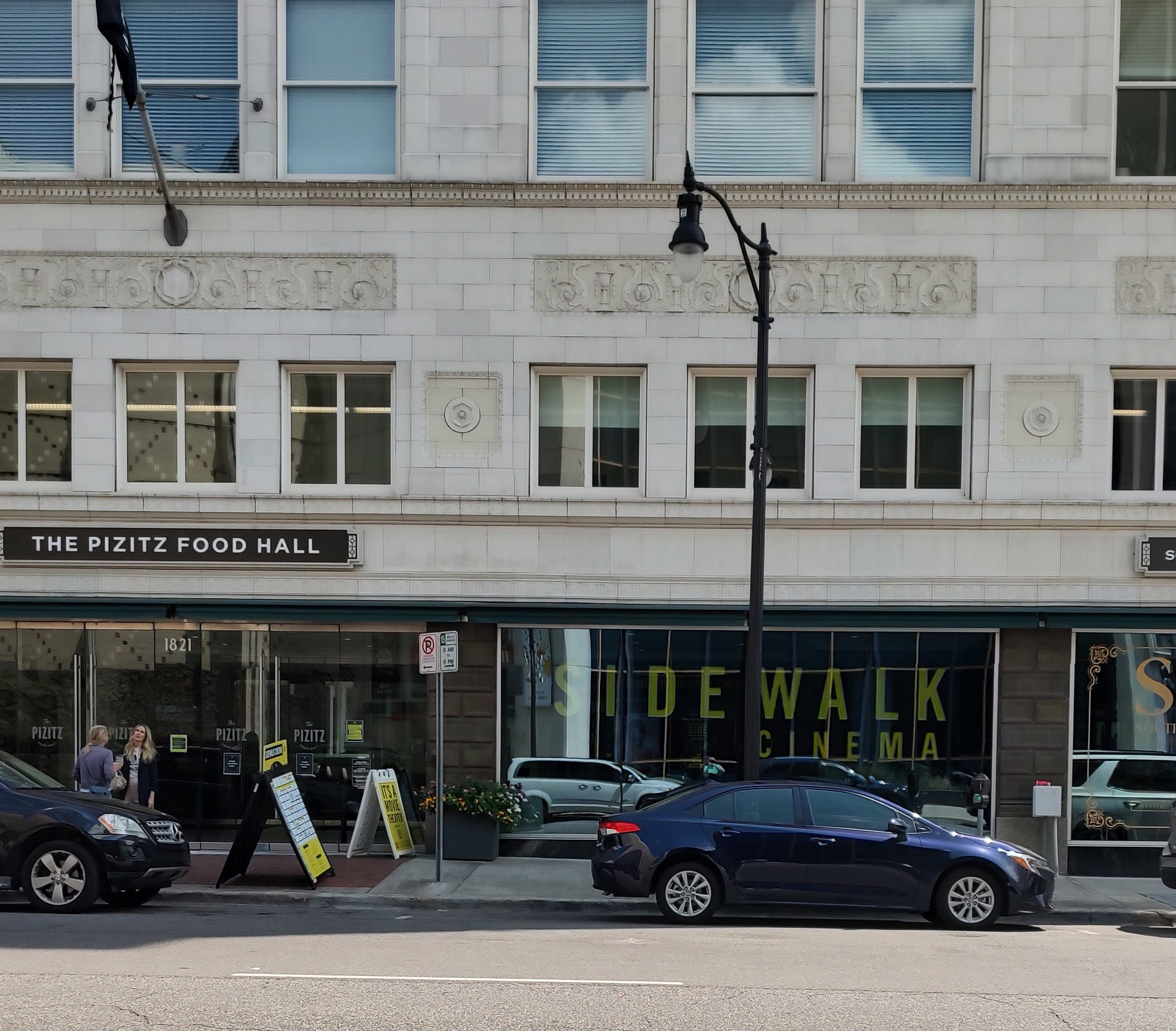
Each year, on the final August weekend before the start of college football season, Birmingham’s Sidewalk Film Festival fills the north side of downtown with screenings, workshops, panels, and events focused on what’s happening in the world of independent filmmaking. Sidewalk has garnered many designations from film media over the years, including nonspecific adjectives like “coolest” and “fabulous.” It was also, more specifically, designated as one of the “Great Film Festivals for First-Time MovieMakers.” I’ve been present for the majority of the twenty-six iterations of Sidewalk and am delighted and proud that it became what it has become. Sidewalk Film Center + Cinema, in the basement of the Pizitz building, houses two cinemas showing movies year-round in intimate state-of-the art theaters that have become my favorite places to catch a movie in the city. The Festival even went on in 2020, at the height of the pandemic, in a drive-in theatre format at an outlet mall just outside the city. “Cool,” right?

It is my habit to book a room at the Elyton Hotel, on the southern edge of the festival, at the proverbial “Heaviest Corner on Earth,” ditch the car, and walk and walk … and walk among ten downtown venues showing about 250 titles from morning to late-night. A filmmaker friend who showed his film at Sidewalk years ago quipped that “now I understand why they call it ‘Sidewalk’.”

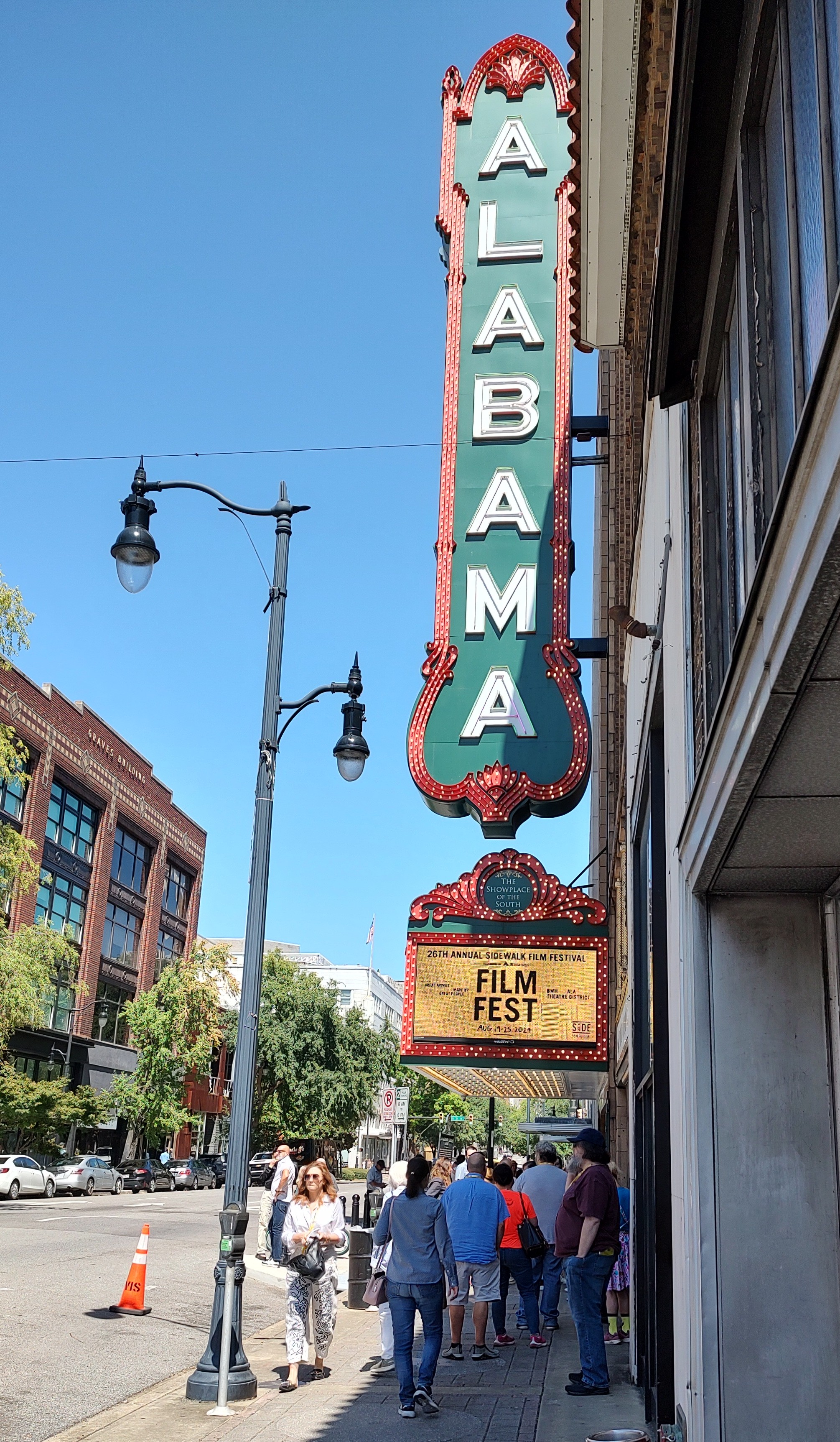
The 26th Annual Sidewalk opened at the Alabama Theatre on Friday night with Exhibiting Forgiveness, the debut film by visual artist Titus Kaphar starring Alabama native Andre Holland.

Easing in to a full day of movie watching on Saturday, I decided to watch “Saturday Morning Cartoons” at the Sidewalk Cinemas where sugary cereals and milk, coffee, cold pizza, Bloody Marys, and mimosas were on hand. Cleansed by cartoons and breakfast food, I walked over to the next block to catch a live organ performance by Nathan Avakian at the Alabama Theatre, Birmingham’s 1927 vintage “Showplace of the South.” Avakian provided accompaniment for a classic Harold Lloyd short and several three-minute contemporary films from the International Youth Silent Film Festival (IYSFF), all of which were directed by talented youth between the ages of thirteen and twenty.

Refreshed and awake, it was time to dive into the real business of the day and start watching movies. I am not keeping up with cinema like I used to so my selections were based largely on instinct. I am relieved to say that my instincts were good. My first full-length screening, Family Portrait (2023) at Sidewalk Cinema, was my best choice, but more about that later.

At the Birmingham Museum of Art, Chaperone (2024), directed by Zoe Eisenberg, features a compelling, sometimes painful, performance by Mitzi Akaha as an almost-thirty slacker who, despite pressures to accept responsibility, is content in her life until she accidentally gets romantically involved with a much younger guy.

Rushing back down to the Lyric Theatre, the night was closed out with My Name Is Alfred Hitchcock (2022), a high-concept documentary caper by Mark Cousins. The film is narrated in a voice, purported to be Hitchcock’s, about the various elements of Hitch’s filmography. It’s an entertaining ruse and a relaxing opportunity to revisit snippets of Hitchcock’s films and reexamine his mastery of suspense.

Sunday morning was the time for Sleep (South Korea, 2024), directed by Jason Yu. Yu’s suspenseful film, about a young couple suddenly beset with sleepwalking that quickly becomes a nightmare, is a deftly handled debut by Yu with strong and affecting performances by Jung Yu-mi and Lee Sun-kyun as the besieged couple.

My Sunday schedule is often heavy with documentaries and Resynator, directed by Alison Tavel, explores Tavel’s search for information about a father she never knew. Her father, Don Tavel, invented a synthesizer in the 1970s. In discovering the history of the Resynator synthesizer, Alison also forges a connection with her father.

Turning to more locally-focused fare – which is a Sidewalk standard, A Symphony Celebration: The Blind Boys of Alabama with Dr. Henry Panion III (2024), directed by Michael Edwards and Henry Panion, played at the recently-renovated Carver Theatre. My fandom of the Blind Boys took hold in the ‘80s when I was fortunate enough to attend The Gospel at Colonus, Lee Breuer and Bob Telson’s brilliant stage adaptation of the ancient Greek play, Oedipus at Colonus by Sophocles. The production featured Morgan Freeman as the Messenger and the Blind Boys of Alabama, collectively, as Oedipus. A Symphony Celebration chronicles a Birmingham performance by the Blind Boys with full orchestra and chorus. A centerpiece of the performance is the Blind Boys’ signature rendition of “Amazing Grace” to the tune of “House of the Rising Sun,” a controversial choice that has become the Blind Boys’ most enduring hit.

The Almost Lost Story of Tuxedo Junction (2024), directed by Katie Rogers, is about a spot in the Ensley neighborhood of west Birmingham that is both mythologized and forgotten. My dad grew up on Avenue D in Ensley and I have known the humble building that stands at what was once a streetcar junction for as long as I can remember. Also, I cannot help tapping my toes whenever I hear the Erskine Hawkins-composed jazz standard, “Tuxedo Junction,” a piece inspired by that now-neglected place. It was heartening to see the large crowd that filled the Carver to watch the documentary; maybe more people remember than we realize.

_________________________________

Now, if I’m lucky, I will see at least one movie each year at Sidewalk that I won’t forget. Most of what I saw in this 2024 edition was of fine quality and merit. However, the film that I can’t stop pondering is Family Portrait (2023), directed by Lucy Kerr.

A large family is gathered at an idyllic riverside home on a warm summery day. It is the appointed day to take the annual family photo for the Christmas card before the gathered begin to disperse. The news of the mysterious death of a distant relative begins to spread through the house. The family matriarch, who meticulously plans the annual card, walks away and seems to disappear. As the rest of the family goes blithely through their carefree day, daughter Katy (Deragh Campbell) becomes increasingly anxious – to take the picture, to find her mother. The mood of this quiet film becomes increasingly frantic, desperate, foreboding.

Family Portrait is a beautiful film – beautiful cinematography by Lidia Nikonova, beautifully edited by Karlis Bergs, brilliant sound design by Nikolay Antonov and Andrew Siedenburg. In a dreamlike prologue, the family aimlessly gathers at the river and the camera follows first one and then another, moving carefully back and forth and among the family members. Santa Claus hats are being handed out on a bright warm day; a man is given a hat, places it on a passing child’s head, and, when the child discards it, the man reluctantly picks it up and walks toward the others as the camera glides to another point of interest. Sound begins to bleed in, subconsciously at first – faint childish chatter, adult banter, nature sounds … and then the opening titles appear.

Exposition is casual and dialogue overlaps. We learn that the family are Texan. Katy is not married to her Polish partner, Oleg (Chris Galust); he has been designated the photographer for the portrait since he’s not “family.” A relative’s iconic World War II photograph was appropriated for Vietnam War propaganda of some sort. There is a brief sequence in which Katy and Oleg read an excerpt from a Barbara Bush memoir they have pulled from a shelf (I recognized the book cover from my mother’s bookshelves). A couple of hired workers go about their business inside and outside the house. Something is amiss and the specter of Covid is clearly looming here, but has not yet become a conscious issue for the family. A lyrical underwater swim late in the movie raises many questions as Katy emerges, soaking wet, and walks back toward the house. A slice of life story becomes surreal, off-balance. It seems that nobody remembers that Katy and Oleg are late for a ride to the airport.

Movies like Family Portrait are the reason I go to film festivals.
3rd Avenue West

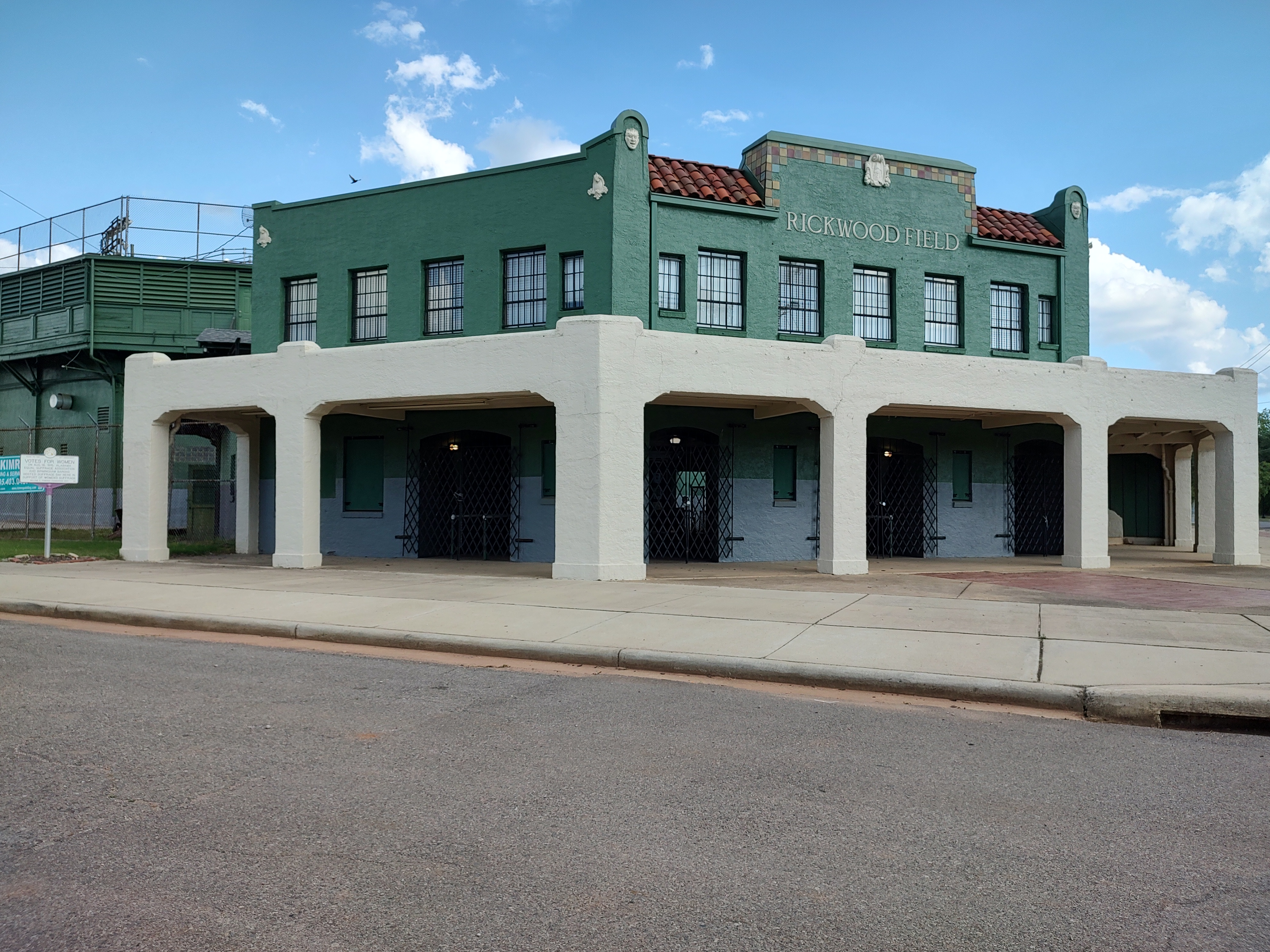
Rickwood Field; Birmingham

When Chicago’s Comiskey Park was demolished in 1991, Birmingham’s Rickwood Field, built in 1910, became the oldest professional baseball park in the United States (www.rickwood.com). The history of the storied baseball field in what is now a less-traveled section of Birmingham’s West End will be revealed to a wider audience on June 20, 2024, when Rickwood hosts Major League Baseball’s nationally televised tribute to the Negro Leagues with a regular season game between the San Francisco Giants and the St. Louis Cardinals. Birmingham native and Hall of Famer Willie Mays, who began his professional baseball career as a Birmingham Black Baron in 1948, will be the honoree.

In the years of segregation, the Birmingham Black Barons shared Rickwood with the Birmingham Barons. Even for those who are not big baseball fans, lists of the ballplayers who played at Rickwood – either as members of the local teams or with exhibitions or traveling teams – is impressive to the point of being daunting. In addition to Willie Mays, there are Hank Aaron, Vida Blue, Ty Cobb, Piper Davis, Dizzy Dean, Joe DiMaggio, Lou Gehrig, “Shoeless Joe” Jackson, Mickey Mantle, Stan Musial, Satchell Paige, Jackie Robinson, Babe Ruth, Honus Wagner, and so many more. When Birmingham native Charlie O. Finley owned the Oakland A’s, his 1967 minor league Birmingham A’s roster boasted Dave Duncan, Rollie Fingers, Reggie Jackson, Tony LaRussa, and Joe Rudi.

The Birmingham Barons’ current home is Regions Field in downtown but they play a throwback game at Rickwood every season. Rickwood is listed on the National Register of Historic Places. A very active Friends of Rickwood organization has worked for decades to nurture and refurbish the baseball park, which remains a facility for a local college and Birmingham city schools. Major League Baseball has chipped in with upgrades over the past year, since the Negro Leagues salute was announced. Sneak peeks indicate that the changes and upgrades have not diminished the essential character of the proud structure or its infield. I can still imagine my dad as a teenager riding his bicycle from Ensley to Rickwood to sell concessions in the stands. From Rickwood Field, one can see 3rd Avenue West.

__________________________________

When I was a kid, Birmingham was still a center of heavy industry and factory-life was going strong in areas like the U.S. Steel works in Fairfield and Ensley and other industrial sites. Because of shift work, the commercial areas of these places were twenty-four-hour districts.

To a young boy, the bustle and energy of western Birmingham was exciting. I had grandparents in Ensley and Fairfield Highlands and lived in the Green Acres community from second to eighth grade; much of my growing up years was spent in those areas.

In those days before the interstate, 3rd Avenue West was the central thoroughfare of west Birmingham. Going east on 3rd Avenue West, it became 3rd Avenue North and went downtown into the theatre district. Going west, it became Bessemer Super Highway. Bessemer Super Highway was originally modelled on the German autobahn and was destined to be the first controlled-access highway in the United States. Funding dried up in the Depression, but the four-lane with wide medians was still impressive for its time.

I particularly remember a row of motels including a Wigwam Village Motor Court, a chain featuring teepee-shaped cabins around a central teepee main building. My parents bowled at the Holiday Bowl and Alabama’s first Holiday Inn was along that stretch.

Occasionally, we would hear about a “gas war” up on the highway. Gas stations would start competing for the lowest prices and cars would line up to take advantage as long as it lasted. I can remember gas getting as low as ten cents a gallon before a filling station owner blinked and gas prices began to make their way back up to the average price of 31 cents a gallon.

5 Points West Shopping City was a sprawling shopping center with a large variety of shopping options. My mother has particularly fond memories of New Williams and Parisian department stores at the site. A Parisian saleslady would lay aside boys’ clothes that she thought Mother might like to consider for me.

Across from the shopping center was the Alabama State Fairgrounds. In those days it was a real fall state fair with agricultural exhibitions, a grandstand, and a large midway with carnival rides. Kiddieland Park was the small amusement park on the southwest corner of the fairgrounds. Fair Park Drive-In Theatre was at the other end and the Birmingham International Raceway occupied the grandstand area. The Birmingham Crossplex, an athletic facility, occupies the space now.

There were other favorites along 3rd Avenue like El Charro, a Mexican restaurant in a time before there were Mexican restaurants and fast-food joints everywhere. Spinning Wheel was a local chain of ice cream drive-ins. It was close by Lowe’s Skating Rink, a popular spot where my parents had dated. Carnaggio’s had traditional Italian. A unique dining choice where my family was regular was Porter’s Cafeteria, a meat and three on a balcony overlooking a drugstore.

Those places always felt special to me.

________________________________

Memory gets burnished with time. And, as time erases remnants, younger generations who were not first-hand witnesses are strained to give credibility to those memories. That’s true of many areas in Birmingham’s West End. Much of the news from 3rd Avenue West is negative these days, but there are still places of pride and plenty of good memories in the western part of town. Rickwood Field’s upcoming moment in the spotlight should help to revive memories of that area’s importance to local history. Perhaps, also, it might inspire further positive development.

Book Review: Magic City

My review for Magic City by Burgin Mathews was just posted on the Alabama Writers’ Forum website. Magic City, to be released in November, explores the rich heritage of jazz that emerged from the Birmingham area and went on to have national influence. Here’s a preview:

Magic City: How the Birmingham Jazz Tradition Shaped the Sound of America

How to Sidewalk – 2023

Birmingham’s Sidewalk Film Festival is a festival which packs a lot of action, films, workshops, panels, and parties into a single weekend – the last full weekend in August before college football begins (this is Alabama, after all). The 2023 edition, which ended on August 27, was the 25th Annual Sidewalk. I have been going for most of those years and realized that my Sidewalk tee shirt from 2003 was older than many of the people around me on Opening Night.

In the years before I moved back to Birmingham, I would get a hotel room downtown on Sidewalk weekend, park the car, and walk everywhere. Last year, I tried commuting from my house south of town to downtown for the weekend’s events. In the process, I found that I was missing things I wanted to see.

John Hand Building, Birmingham

This year, I went back to the tried-and-true hotel plan and booked a room at the Elyton Hotel at the “Heaviest Corner on Earth” – the intersection of 20th Street and 1st Avenue N. The “Heaviest Corner” designation is a relic from the early days of skyscrapers and Birmingham’s “Magic City” boom years, when skyscrapers ranging from ten to twenty-one stories were built between 1902 and 1912 on each corner of the intersection. The Elyton is in the sixteen-story Empire Building, catty-corner from the twenty-one story John Hand Building – still one of the most impressive tall buildings downtown.

Before the pandemic and other complications arose in my world, I averaged seeing two or three movies a week in movie theatres. They aren’t made for small screens and I don’t like to watch them on small screens. Now, though, I depend on the annual Sidewalk Fest to splurge. Over the years I have learned “how to Sidewalk” and, to use a much-overused word, I “curated” a list of my weekend movie destinations. In addition to four nights of “Spotlight” films (“Alabama,” “Life & Liberty,” “Shout LGBTQ+,” and “Black Lens”), the festival screens over 300 titles (shorts and features) over three days on nine screens within walking distance in downtown. It’s important to plan, knowing there’s no way to see everything you might want to see. In the early years, I tried to catch as many titles as possible. My record, on a weekend when I saw a lot of shorts screenings, was thirty-two titles under my belt; nowadays, I know what I would be most interested in and draw up a more reasonable and relaxed schedule. I have seven screenings on the list this year.

OPENING NIGHT

After checking in, unpacking, and settling into my room on Friday, I headed up to the rooftop bar, Moonshine, to check out the views. To the south, there are views of the railroad tracks that run through the center of the city, Railroad Park, the sprawling UAB campus and Children’s of Alabama hospital, the Five Points South and Highland Park neighborhoods crawling up Red Mountain, and the ubiquitous Alexander Shunnarah law firm billboard perched atop the old Bank for Savings Building.

To the north, the central city skyline dominates. What stands out for me in that view, though, is how much green is visible in all directions. The Birmingham Green project was started when I was an elementary school student. Now, the tree-lined streetscape of 20th Street provides a shaded promenade to Linn Park and the museums, stadium, and sports and entertainment spaces beyond the City Walk.

After spending time on the roof, it was time to grab dinner and catch a movie.

Art for Everybody, directed by Miranda Yousef; Alabama Theatre

I debated whether to catch the Opening Night film. In the early years of Sidewalk, more challenging films were offered on Opening Night. That seemed to end and go in the other direction after a John Sayles film was the opener and audiences were not pleased. The nadir was an opening night movie about a famous cat on social media. Since then, opening night selections have been more middle-of-the-road, trying to appeal to a wide audience. We all gather for Opening Night and split into our various tribes of film tastes on Saturday and Sunday.

Art for Everybody explores the surprisingly complex rise and spectacular fall of Thomas Kinkade, the “Painter of Light,” whose work was retailed in shopping malls throughout the country. In exploring Kinkade and his following, the film also touches on the national divide in the country. After Kinkade’s death from an overdose of alcohol and drugs, his daughters discover a vault of personal artworks that are completely different from the works he’s known for and cause some art critics to have second thoughts about Kinkade as an artist.

Art for Everybody is a surprise, but the most valuable part of the screening for me was the Q&A afterwards. Listening to director Miranda Yousef during the Q&A, I started to recall the days when I took great pleasure in being a striving creative artist. Yousef’s career in film, primarily as a film editor, has finally led to her directing a surprising and moving work of documentary art about art.

Leaving the Alabama, I was in the middle of the popular Sidewalk Opening Night Party in the street on 3rd Avenue N. Looked like fun, but I headed the two blocks to my hotel and bed.

SATURDAY

Passages, directed by Ira Sachs; ASFA Dorothy Jemison Day Theatre

I was excited to see the latest film by Ira Sachs so soon after reading competing reviews by Richard Brody and Anthony Lane, two film critics for The New Yorker whom I like very much and often agree with. Their reviews of Passages, however, run counter to each other and I was anxious to see with whom I agreed.

Passages presents a disturbing love triangle when Tomas (Franz Rogowski), who is married to Martin (Ben Whishaw), strikes up an obsessive affair with Agathe (Adele Exarchopoulos). The manic Tomas, a demanding film director, is one of the least appealing, most annoying, protagonists I can think of. He is full of cringe-worthy moments and pronouncements, and I wondered why anyone would be willing to put up with him. I didn’t like putting up with him for ninety minutes and was happy it was screened in the morning so I could forget it quickly.

Lane writes, “It’s the unhappiest film I’ve watched in a long while, steeped in Freudian pessimism …” Brody exults “the realm of emotional and sexual freedom that ‘Passages’ explores … is the crucible of imagination, the hallmark of progressive politics, and the essence of art.”

Alrighty then. I am Team Lane on this one.

Free Time, directed by Ryan Martin Brown; Sidewalk Cinema

Free Time is a comedy about a Millennial, about to turn 30. Drew (Colin Burgess) abruptly quits his desk job to find freedom and happiness. His ennui at work turns into ennui on the streets and spurs a movement of Millennials who, lemming-like, follow Drew’s dead-end lead. The amusingly frustrating performance by Burgess carries the movie. It is a refreshing document of a generational moment.

Parachute, directed by Brittany Snow; Lyric Theatre

Actor Brittany Snow adds “writer/director” to her resume with her debut directing effort, Parachute, written with Becca Gleason. Parachute is a look at Gen Z angst, addiction, and dependency that is, surprisingly, not a total buzzkill. In fact, the angsty are also rather charming. Riley (Courtney Eaton), fresh out of rehab for eating, body image, and relationship disorders, meets Ethan (Thomas Mann), a really nice guy with gradually revealed “issues” of his own. From serious subject matter, Snow applies a light touch that treats a serious subject seriously but is never gloomy in the process.

Leaving Parachute, I realized that, without planning to, I chose three narrative features in a row with really frustrating protagonists. Riley makes a series of bad choices and seems to dig herself further into a hole of her own making while a group of steadfast friends try to support her. We root for Ethan to win her over and become more than her “good friend.”

Moonage Daydream (2022), directed by Brett Morgen; Sidewalk Cinema

No frustrating protagonist here. Moonage Daydream, a trippy documentary about David Bowie, was released last year and had a run at Sidewalk Cinema in 2022. Sidewalk brought it back for the film festival audience that packed the house. Sidewalk co-founder and audience favorite Alan Hunter provided some pre-screening comments, including a reminder that he appears in Bowie’s 1990 “Fashion” video, and the tidbit that he and Bowie’s wife, Iman, took an acting class together.

Bowie, always a fascinating figure, moves majestically through Moonage Daydream in all of his personae – from elegant to extreme. Vintage video, performances, interviews, and plentiful music provide a kinetic audio feast, a celebration of a singular, irreplaceable artist.

Moonage Daydream seemed to be the proper way to end a full film-viewing day. Before turning in, I decided to walk a few blocks to a place that my writer friend John T. Edge told me to visit as soon as possible. House of Found Objects is Faizel Valli’s latest venture in downtown following the closure of his very popular Atomic Bar and Lounge. The place is an art installation with a bar. On a crowded night, it was hard to take it all in. John T. Edge wrote a great description for Garden and Gun: John T. Edge Toasts a Birmingham Bar Where Patrons Are the Stars – Garden & Gun (gardenandgun.com)

SUNDAY

I have always loved the quiet of downtown Birmingham on a Sunday morning. It has become a tradition for me for seek out meditative documentaries for my Sunday Sidewalk experience. After checking out of the hotel, I drove around for a while. People were walking dogs, taking morning runs, riding bikes. Birmingham streets would have been deserted not that long ago, before the downtown area became a residential as well as business hub. I like the neighborhood feel of today.

45365 (2009), directed by Bill Ross IV & Turner Ross; Birmingham Museum of Art

The fact that I know the zip code of Sidney, Ohio, tells how big an impression the Ross Brothers’ 2009 documentary about their home town made on me. In honor of the 25th Sidewalk, programmers added screenings of some films that have been shown over the past two-and-a-half decades. 45365 certainly merits a repeat viewing.

45365 chronicles life in a small American city. There is no narration – just an all-seeing camera following the people who live there. There is an occasional visit to the control booth of a local deejay. Most of the characters are only seen for a moment or two, but we feel like we know, have known, them.

I feel comfortable declaring that 45365 is one of my favorite movies of the 21st Century so far. Check out the trailer: 45365 Trailer – YouTube

King Coal directed by Elaine McMillion Sheldon; Sidewalk Cinema

After reading reviews and watching the trailer for King Coal, the documentary by Elaine McMillion Sheldon, I knew it would be the perfect documentary to pair with 45365. Sheldon, who is from West Virginia, explores the coal industry in Appalachia, the mythology and pride that surround the culture, and the hopes for a future beyond coal. King Coal, filmed in parts of several states, deals with the complexity of an industry that has sustained its communities while it also has exploited and destroyed them. At one point, Sheldon says, “I remember learning that if I said anything bad about the King, I was betraying my loved ones.” Watching the film, and remembering a time when Birmingham was dominated and sustained by iron and steel and heavy industry, I understand the conundrum Sheldon addresses in her lyrical and poignant celebration of her home, its past, and its uncertain future. Here’s a preview:

King Coal (2023) | Official Trailer | Full HD – YouTube

There was plenty more to see, but I decided that King Coal was a fitting denouement to a good weekend of viewing. Plus, walking from venue to venue in 96-degree temperatures helped me lose five pounds (another reason to attend this festival).

Those who love movies owe it to themselves to check out future Sidewalks. Years ago, Time listed Sidewalk as one of the “Top 10 Festivals for the Rest of Us.” MovieMaker has cited it many times, including as one of “The 25 Coolest Film Festivals in the World” and “20 Great Film Festivals for First Time Moviemakers.”

No matter what’s going on in my world, I’m always happy I showed up at Sidewalk.

Happy Sidewalk!

“Oh, for a bee’s experience …

Of clover and of noon!” – “The Bee” by Emily Dickinson

Trying to savor the summer while having some restraints on my activities, I have been thinking a lot about the bees. I have been watching them a lot, keeping in mind alarms about declining bee populations. Specifically, I have been staying at my mother’s house full-time, so I shifted focus from attracting bees to my own small yard in Rocky Ridge to observing the activity around her garden home community on the steep west slope of Shades Mountain.

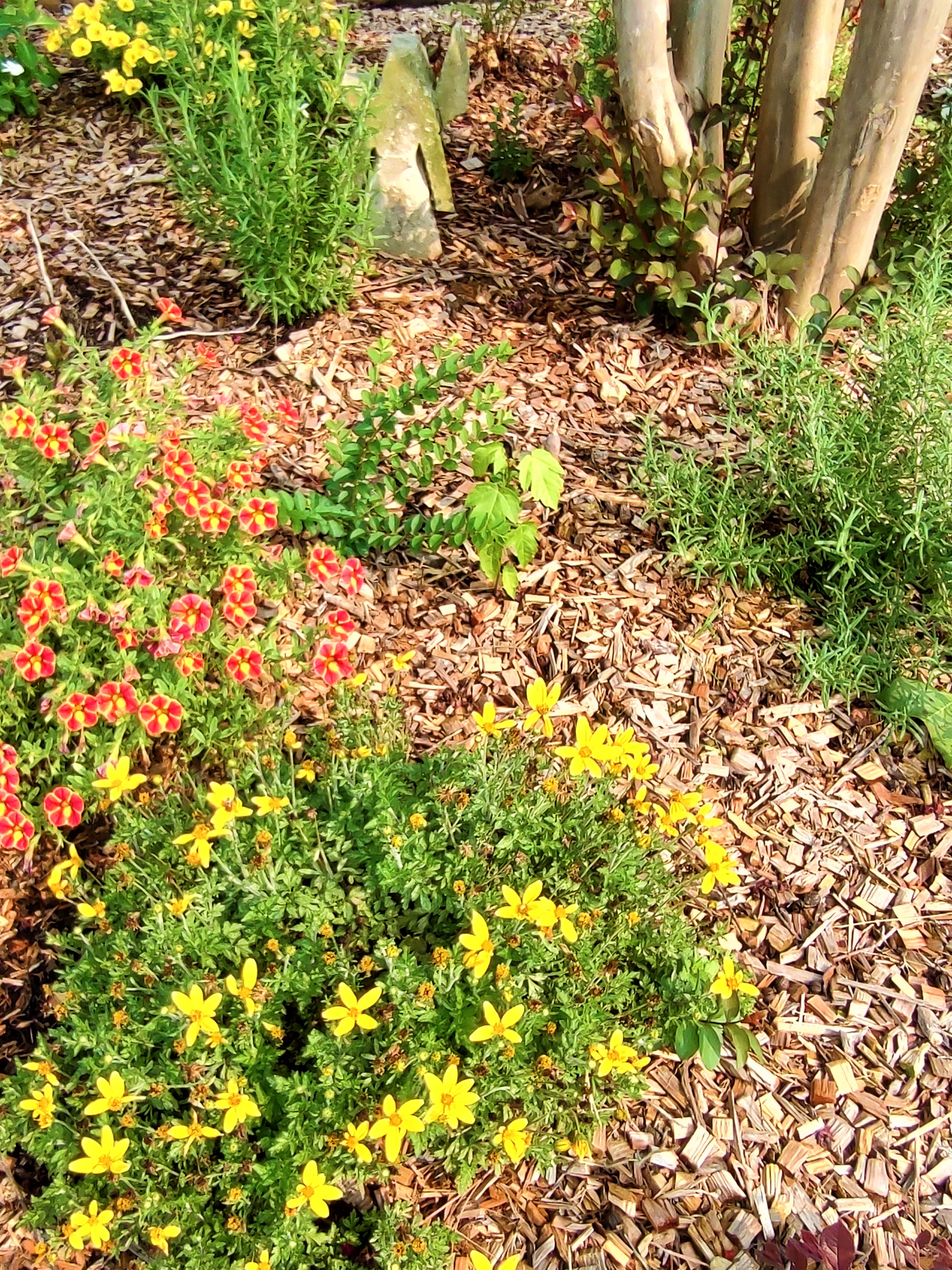
A late freeze brought the demise of a large loropetalum shrub encircling a tall crape myrtle in Mother’s front yard. When the loropetalum was removed, we decided to plant a variety of blooming and leafy plants in its stead. It turned out to be a good move – with compact bidens, calibrachia, rosemary, vinca, and Japanese painted ferns putting on a frisky, flourishing show beneath the deep crimson blooms of the crape myrtle. I keep a careful watch over the volunteers – some are welcome; others will take over if left alone.

On the porch, a yellow begonia holds court in a hanging container, with lysimachia flowing toward the ground. The large blooms of a braided mandevilla in a unique coral and golden hue are a favorite of my mom’s, but the blooms drop after one day, leaving the plant leafy without flowers on occasion. It shields an always trustworthy heuchera which was joined this year by a lacy volunteer that was just too charming to eliminate. The lacy foliage will wither away in late-fall, but the heuchera, if it acts according to habit, will still be flourishing next year.

As you come into the entry space, a ruellia – commonly called a “wild petunia” and known for an invasive nature – stands confined in a container, grounded by impatiens and lysimachia. Its delicate morning blooms fall off daily, to be replaced by new blooms the next morning. The roses in a bed next to the house have seen better days, but they are hanging in there. Bees, butterflies, and the occasional hummingbird show up and regular rainfall and diligent watering are keeping everything happy so far in the stifling July heat.

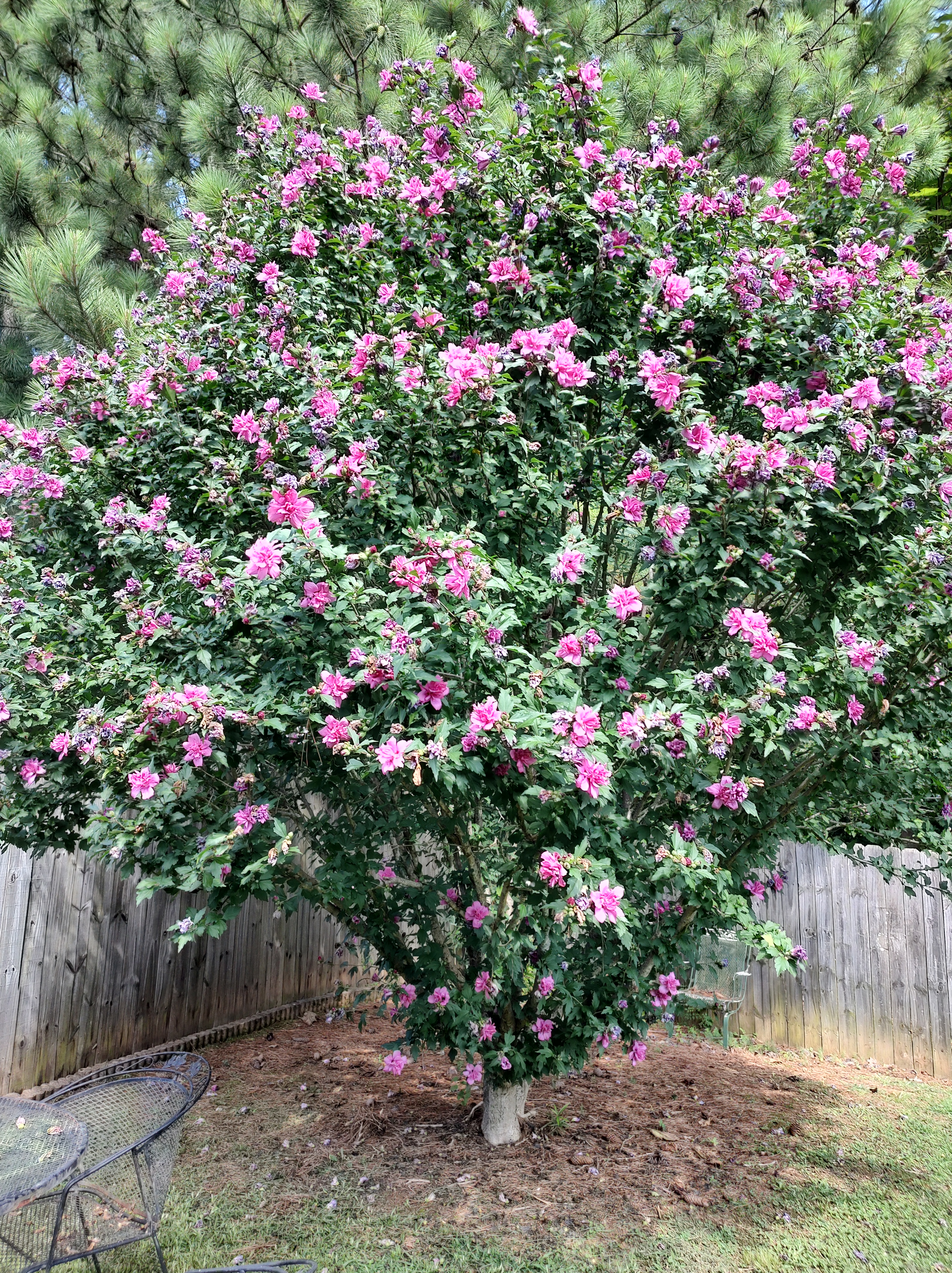
But here’s the kicker: There’s a Rose of Sharon in my parent’s backyard that grew from a sprout and is probably in excess of twelve feet now. It’s covered with fuchsia blooms and – at any given time – hundreds of bees. I know Rose of Sharon is a common name used for a number of plants – this one is a hibiscus – but I like the tradition and antiquity of the appellation and plan to use it until the plant police come knocking. Bees have always loved this specimen, but this year seems to be a banner year for its bee population from early morning to sunset. There is a constant low buzz from the tree when we wander into the yard.

Slightly to the side of the Rose of Sharon is a raised bed my dad created. I haven’t had a chance to properly tend to it this year, but it is lush and beautiful in its wildness anyway. Purple heart and yellow lantana grow in a bed with four less-than-stellar rose bushes. The in-ground Easter lilies bloomed late and those plants have taken their time fading away. Like many other plants, the odd weather seems to have confused them; one healthy looking lily has developed three new bulbs (in the middle of July!) but I do not expect them to bloom.

It hasn’t been a great few years for the roses of any kind and my grandfather’s ancient rose bushes, grown from cuttings of the mother plant, have struggled to flower. The hummingbird feeders do not seem as busy as usual, but an occasional hummer is spotted at the feeders and among the bees in the Rose of Sharon. It’s a challenge to keep the bird feeders stocked; it’s a bigger challenge to keep the squirrels away, but Lulu, the prancing chihuahua, likes nothing better than to chase the squirrels. Mourning doves are the primary customers at the feeders, but a pair of cardinals are frequent visitors since late-winter, as are an occasional bluebird and blue jay and a red-headed woodpecker. Wrens and chickadees are also in evidence, I think, but I hesitate to say much since a reader pointed out recently that I don’t seem to know the difference. I pay my annual due diligence to the Audubon Society and the Arbor Day Foundation but I’m not always good at the identification part of the test.

These are the things that inhabit my alternate garden in summer 2023.

Thornton Dial: “I, Too, Am Alabama”

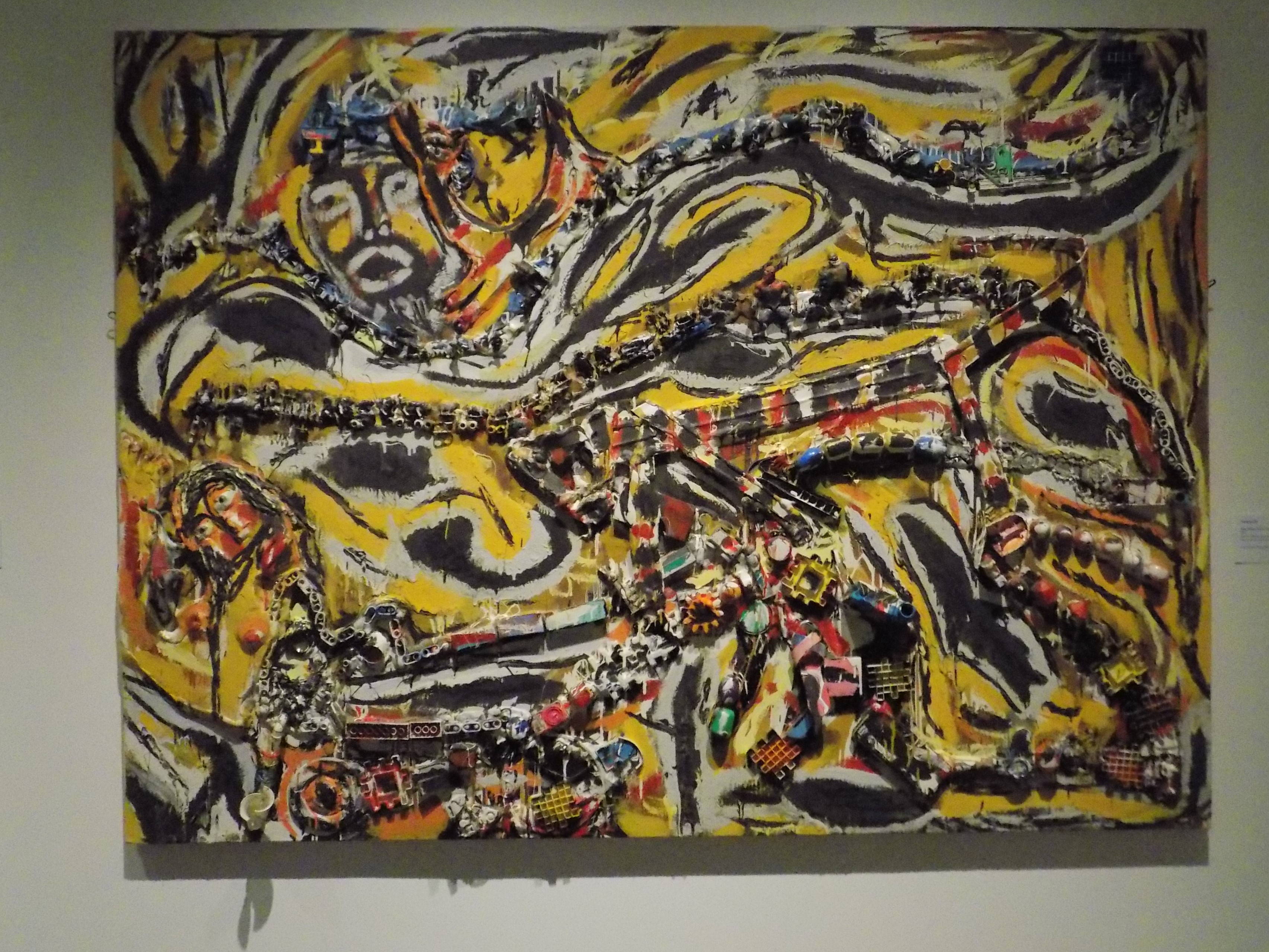
“Antioch” – Thornton Dial

“I, Too, Am Alabama,” an eye-opening retrospective of the transcendent art of Thornton Dial, is currently on-view at the Abroms-Engel Institute for the Visual Arts on the UAB campus in Birmingham. Thornton Dial (1928-2016) is often lumped with groups of artists referred to as “outsider,” “self-taught,” “primitive,” or “folk” artists. The Abroms-Engel exhibition prefers the label “vernacular artist” and clarifies that Dial’s artistry holds its own with mid- to late 20th-early 21st century contemporary artists of many styles.

Over the years, I have usually viewed Dial’s art alongside other of his contemporaries in the vernacular art movement. His importance was clear in those earlier shows but walking into large galleries surrounded by nothing but Thornton Dial’s work in a variety of media makes it clear just how significant his artistic vision is.

An Alabama native, Dial was born in Sumter County and spent most of his life in Bessemer, outside Birmingham. He worked as a metalworker at Bessemer’s Pullman-Standard plant until it closed in 1981, after which he focused on his artistic output. Dial’s first solo art exhibit was in New York in 1993 and marked the beginning of his rise to recognition in the art world.

“How Things Work: The Parade of Life” – Thornton Dial

“I, Too, Am Alabama” derives its title from the Langston Hughes poem “I, Too” and its famous final line, “I, too, am America.” In the current show at Abroms-Engel, the curators, Paul Barrett, assisted by Tina Ruggieri, have assembled a large collection of Dial works from various sources and in various styles. Large hanging works are dominant, but there are sculptures, works on paper, and smaller works scattered throughout the exhibit.

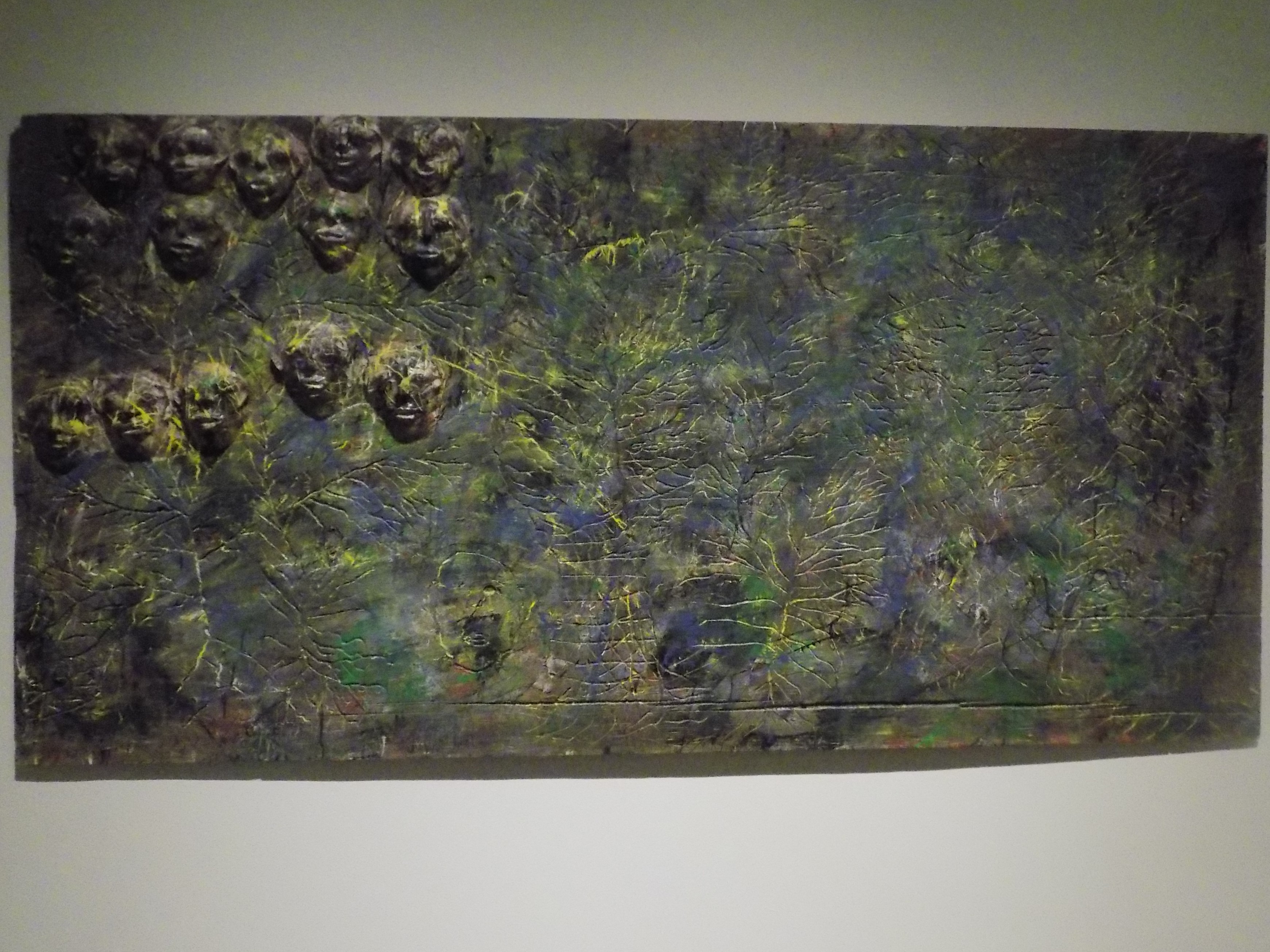
Most of Dial’s work, and something he has in common with other vernacular artists, consists of elements of assemblage. His incorporation of found objects includes toys, metals, cloth, plastics, shoes, gloves, tree branches, gravel, rope, carpet, soda bottles, hickory nuts, and myriad other objects. I think that one of the elements that makes this work most striking to me is that these found objects are most often embedded within layers of paints – enamels, spray paints, oils. These painted coatings transform the artworks from found to finished.

“Fairfield” – Thornton Dial

In “Fairfield,” for example, a found patchwork quilt is merged onto a canvas, flanked by two shadowy quilters, one of whom looks squarely at the viewer. “Separation,” a muted abstraction, is beautiful to gaze upon as other, smaller, suggestions of words and images appear among its various fragments. The complexity of works like “Nobody Know What Go on Behind the Jungle” and “How Things Work: The Parade of Life” demands extended and repeat viewing and, still, obscured images emerge each time.

Dial’s work addresses social issues and history, especially the history of Blackness, civil rights, and the concept of otherness in the United States. His recurring motif of the tiger is a symbol of survival. The viewer must ponder these works to find intrinsic messages. With Dial, an agenda never supersedes his artistic agency; these are, first and foremost, masterful creations of an assured individual vision.

“Separation” – Thornton Dial

“Nobody Know What Go On Beyond the Jungle” – Thornton Dial

“I, Too, Am Thornton Dial” will be on view at Abroms-Engel until December 10. A companion show of Dial’s works on paper is at Samford University’s School of the Arts Gallery through December 2.

Amid the Snowflakes at Aldridge Gardens

Aldridge Gardens, a 32-acre public garden in the Birmingham suburb of Hoover, surrounds a lake on property that was once the home of Kay and Eddie Aldridge (www.aldridgegardens.com). I first knew of the Aldridge gardening family through Aldridge Garden Shop and Nursery, a great source for plants that was located for decades on Red Mountain, across from the entrance to Vulcan Park.

Snowflake hydrangea at Aldridge Gardens

Eddie and his father, nurseryman Loren Aldridge, discovered and patented the stunning “Snowflake” variety of oak-leaf hydrangea that is now popular throughout the South and beyond. Aldridge Gardens is a perfect showcase for the Snowflake and dozens of other varieties of hydrangea, azaleas, and other flora. Sculpture is placed throughout the garden, and a Veterans’ Memorial Arbor and Pentagon Plaza are located at the far end of the property, recently accented with fading wisteria dripping from the arbor.

The Aldridges first saw the property when they were on-site in the ‘60s to plant three magnolia trees for the Coxe family who lived there at the time. They saw the potential for a public garden on the site and Eddie Aldridge’s dream for a “garden of destiny” was born. He and Kay bought and lived on the estate in the ‘70s and negotiated the transfer to the city of Hoover in the ‘90s with the understanding that the grounds would remain a public space in perpetuity.

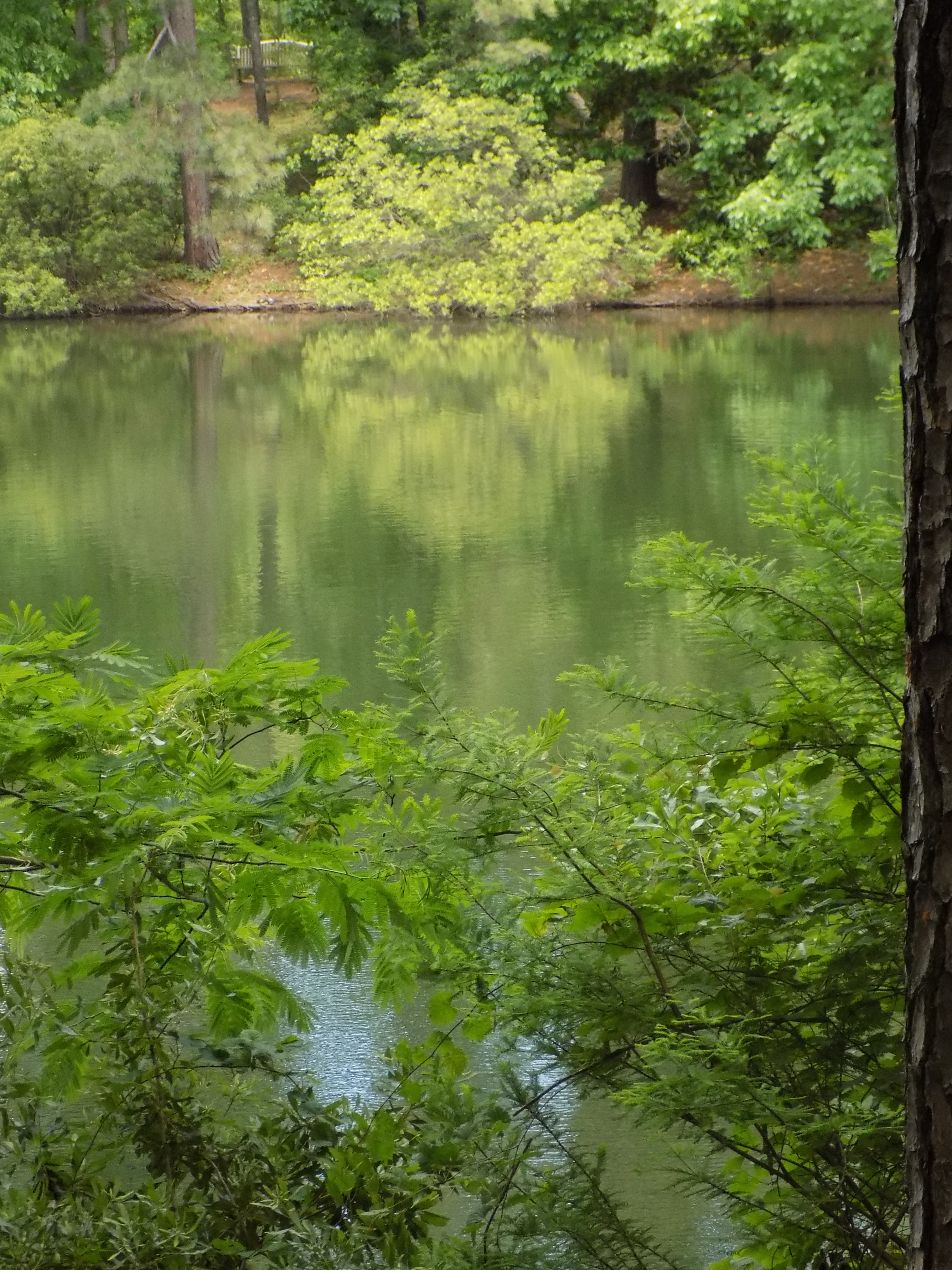
A half-mile trail goes around the lake and separate paths diverge into other areas of the garden, along with woodland trails through an urban forest and alongside a meadow. Some areas feature gardens dedicated to specific plants. On a recent May morning, I spotted six tortoises sunning themselves on a fallen tree that was partially submerged in the lake with other tortoises coming and going around them.

The Gardens are off a bustling road and near a busy interstate, but after a few minutes on the grounds, that noise seems to fade away as birdsong and quiet streams take focus. On a sunny day, the dappled shade creates contrasts in light that glimmers from the water and profuse foliage all around. Honeysuckle creeps up among other plants and the perfume of jasmine permeates here and there. Snowflake hydrangeas are predominant, however, in their Aldridge Garden’s home-place.

Aldridge Gardens is just one of many splendid and occasionally unexpected green spaces to be found in the Birmingham area. Having it three miles away from my house makes it ideal for a quick getaway while running errands. Two Snowflake hydrangeas in my backyard, acquired last year to celebrate my move back to Birmingham, are doing just fine and provide a hint of the nearby gardens on days when I can’t get away. The snowflakes have not quite peaked yet, but they are magnificent nevertheless and give promise for a lush summer to come.

My backyard Snowflakes

Of Bricks and Stones

Ensley High School

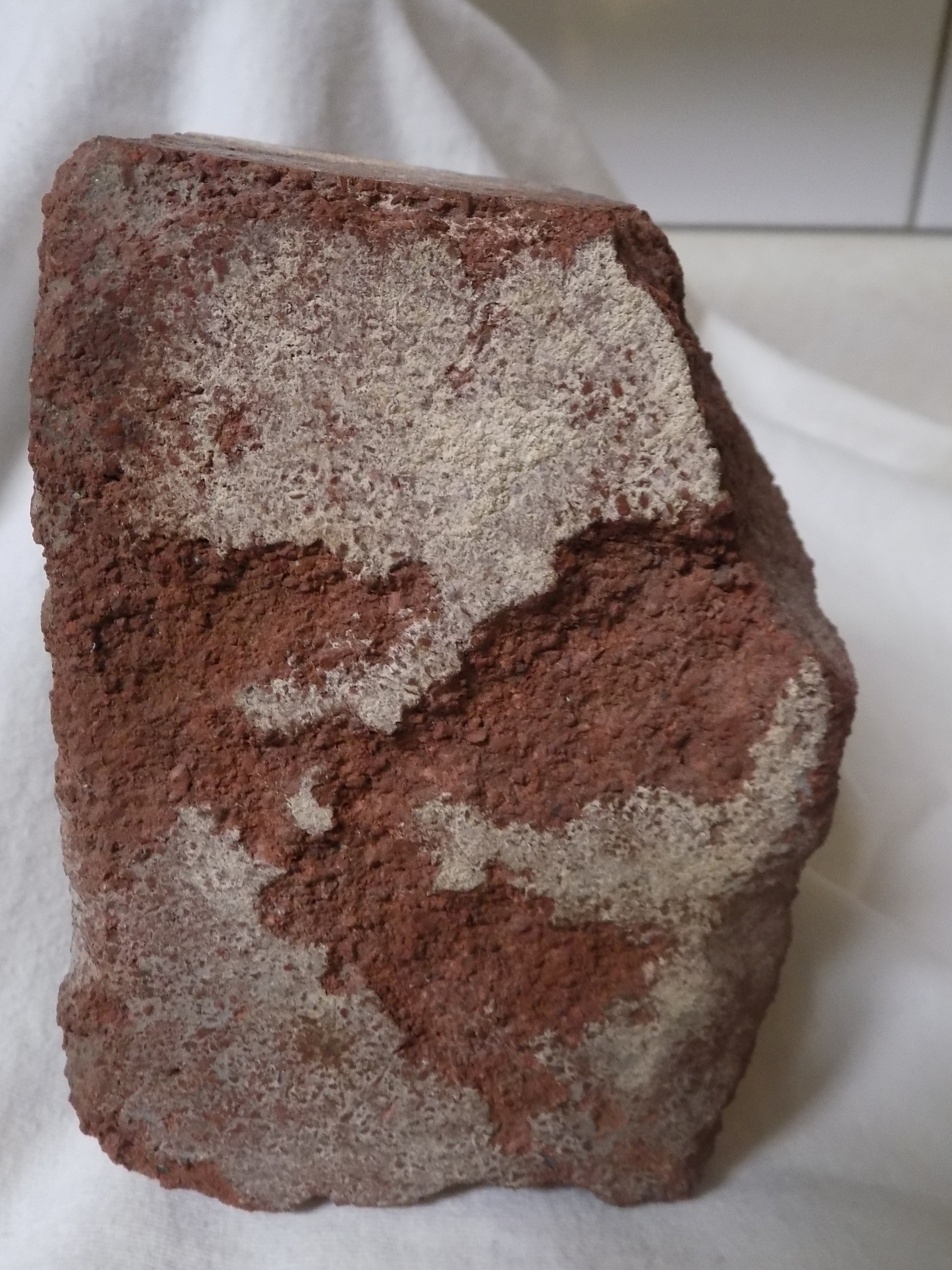
I got a brick for Christmas. And it was one of the more meaningful presents I received.

It was a brick from the ruins of the demolished Ensley High School, my father’s alma mater, on Birmingham’s west side. The building held its first classes in 1910 and closed at the end of the 2005-2006 academic year. A fire gutted the abandoned school in 2018 and its final demolition began in 2021 to make way for a multi-use complex.

Grover Journey graduated from Ensley in the early 1950s and was student body vice-president in his senior year. Mother and I always marveled that, wherever we might be, Dad could sniff out an Ensley grad from his era.

Listening to Dad’s stories, I always had the impression that their bitterest high school rivals were in Woodlawn, across the city on the east side of town. The Woodlawn community is having a resurgence these days and Ensley, which went into a rapid decline when its steel mills closed in the ‘70s, is now looking forward to its own renaissance. It has a long way to go. Dad’s boyhood home is one of only two houses still standing on the once crowded block where he grew up and met Mother.

Along with the pink-ish tan exterior brick, my special Christmas gift included a well-worn and annotated copy of Shakespeare’s King Henry the Eighth from what was once a voluminous Ensley High School Library. The card in the book has signatures of withdrawals dating from the 1920s to the 1950s. A student named Charles Ingram checked it out seven times in succession in 1956. My mother also received a brick and a Shakespeare volume and I now worry about the fate of all of the other books from the EHS Library. I’m hoping there is an effort to preserve them.

That precious Ensley High School brick now joins another brick from a long-gone Birmingham landmark. The Tutwiler Hotel, opened in 1914 on Twentieth Street downtown, was the grande dame of the city’s hotels until it closed for good in 1972. It was imploded in 1974. The implosion did not go quite as planned; one part of the building crumbled to the ground – I remember watching it live on television – and another part stayed up and was eventually demolished by more conventional methods.

Not long after the demolition, I made my way through an opening in the fence at the construction site and grabbed a brick as a keepsake of the place. It has now been with me spanning six decades and many moves. In fact, I am looking at it as I write these words.

Tutwiler Hotel

The Ridgely Apartments, near Linn Park and a few blocks from the old Tutwiler, were refurbished and re-christened as the “Tutwiler Hotel” in 1986. The Ridgely building was actually built a year earlier than the original Tutwiler with the involvement of some of the same developers and architects, so I guess it’s a fair enough trade-off if the original had to go. I’ve stayed there a few times, but when somebody tells me they are staying at “the Tutwiler,” I am quick to point out that there was once a grander, “real and original,” Tutwiler.


Preservation efforts in Birmingham have never fully recovered from the loss of Birmingham’s magnificent Terminal Station in a 1969 demolition. The building’s elaborate Beaux-Arts design featured two 130-foot towers and an elaborate dome covered in tile and a decorative glass skylight. Its loss opened eyes, spurred other cities’ preservation efforts, and made Birmingham preservationists more tenacious.

Birmingham’s Southern Research Institute (SR), an affiliate of the University of Alabama at Birmingham (UAB), has dealt a blow to Birmingham preservation with its acquisition of and plans to destroy Quinlan Castle, a medieval-inspired, stone-clad former apartment building on a rise in Birmingham’s Southside, built in 1927.

SR’s CEO, in a sketchy, badly-composed justification of the institute’s decision to demolish the building, describes the proposed bland replacement building as a “castle for the 21st Century.” He also has the bad taste and gall to cite the collapse of the Surfside condo in Miami as a motivating factor for the decision to destroy the castle.

Nobody is fooled. It is clear to anyone who knows that building that it could never have become a research laboratory and I’m not sure why Southern Research has to use that ruse as a justification for the demolition of a historic element of local urban architecture. UAB and Southern Research have the clout to do about anything they care to on the Southside. UAB already blighted part of the Southside skyline by erecting an eyesore – an oversized parking shed that they refer to as the football team’s “practice field.” So I think the big question for many of us now is why the SR expansion has to happen on the Quinlan Castle site.

In 1990, when I was moving to Birmingham to take a theatre job, my apartment hunting began with Quinlan Castle. It was already pretty run-down, and closed a few years later, but the charm of the building was intact and it had mighty potential. The small apartments, which would have been quite snazzy in the Roaring ‘20s, opened onto a central courtyard. There were even cannons in a couple of the turrets along the crenellated roof. It would have been perfect for me as a college student, but I had moved on and opted for a more modern abode up the mountain. Still, the castle gave me a smile each day as I passed it on the way to work.

I went to Quinlan Castle around Christmas, just to see if it is still standing. As of a couple of weeks ago, it’s still there. A part of me hopes that cooler heads have prevailed and that SR is considering other sites for its “21st Century castle” of innocuous sterile labs.

If you’re in the area, go over to 2030 9th Avenue South and pay homage to another endangered part of Birmingham architectural history while it still stands.

Quinlan Castle, December 2021

Van Gogh Is Visiting Birmingham

 A favorite memory of the day after Thanksgiving is of my parents taking me to Pizitz department store in downtown Birmingham and taking the escalators to the sixth floor and Santa’s Enchanted Forest. The memory of that tradition that stands out most for me was probably in the mid ‘60s. The line wound through cheerful displays of reindeer, winter scenes, and elves at work in their workshop. At the end of the path, Santa on his throne was there to greet all. After Pizitz, we trekked across the street to check out the holiday windows at Loveman’s and went a few blocks north to see the city’s newly-lit Christmas tree in Woodrow Wilson (now Linn) Park. Finally, my parents took me to a book store on Southside and treated me to a book of my choosing. In this particular memory, it was a Dr. Seuss book.

Pizitz is now a residential building where I go to see indie films at Sidewalk Cinema and to grab a bite in the expansive food hall. Loveman’s long ago became a children’s science museum. But I never go to that part of town without remembering that one special night after Thanksgiving.


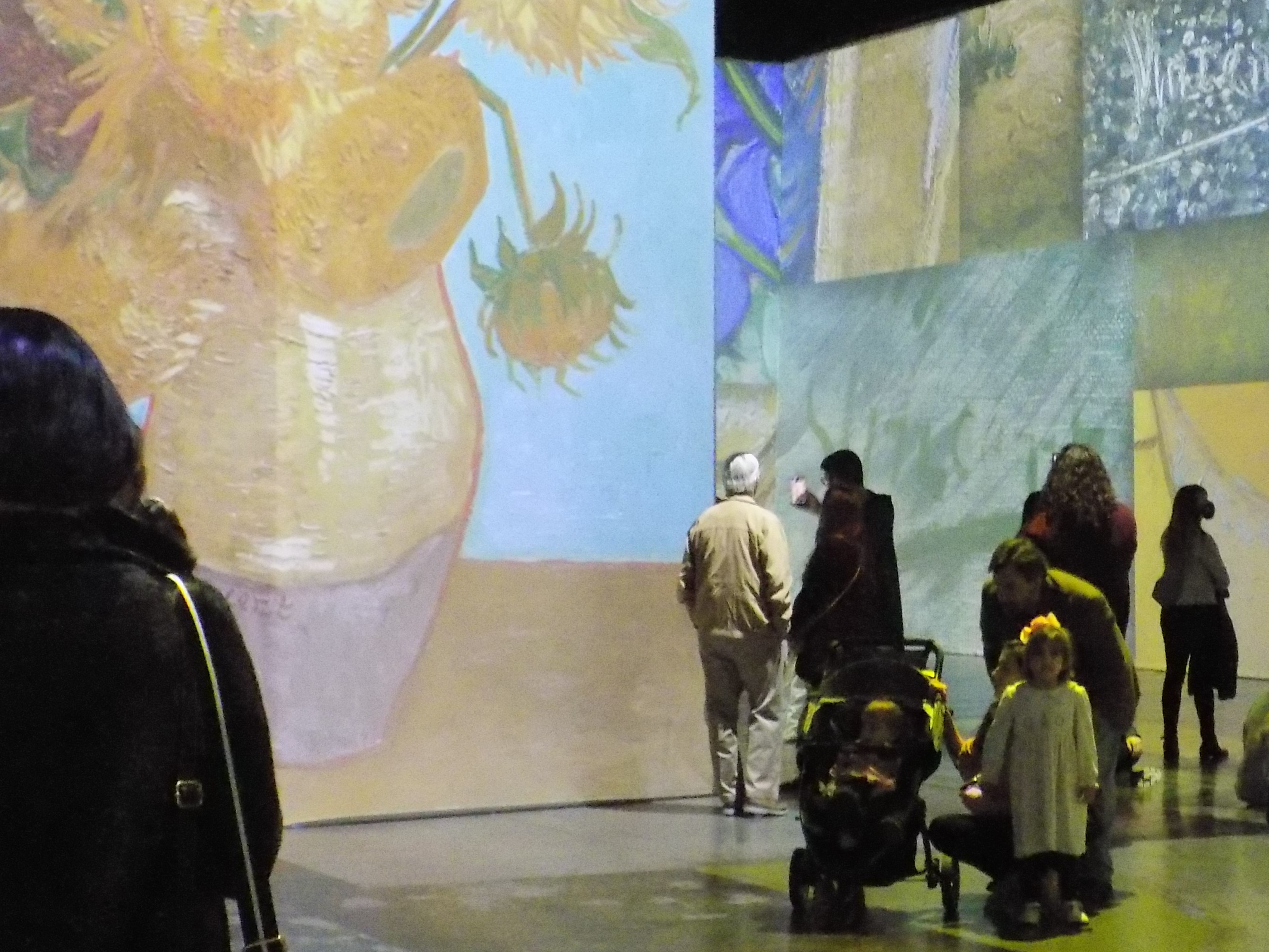
I thought of Santa’s Enchanted Forest this week when I took my mother to the Birmingham-Jefferson Convention Center for “Beyond Van Gogh: The Immersive Experience.” People of all ages wandered through the three rooms of the event and I realized, as I watched kids scamper around, that a memorable holiday experience was being created for a lot of people that night.

One of the odd cultural touchstones of this second year of pandemic is the fact that about half a dozen “immersive” shows inspired by the art of Vincent Van Gogh have sprung up and been attended by enthusiastic responses wherever they landed around the world. The iteration playing in Birmingham through January 2 is the creation of French-Canadian Mathieu St-Arnaud and his team at Montreal’s Normal Studio. A Monet immersion is beginning to make the rounds and I understand that a Frida Kahlo event is in the works for 2022.

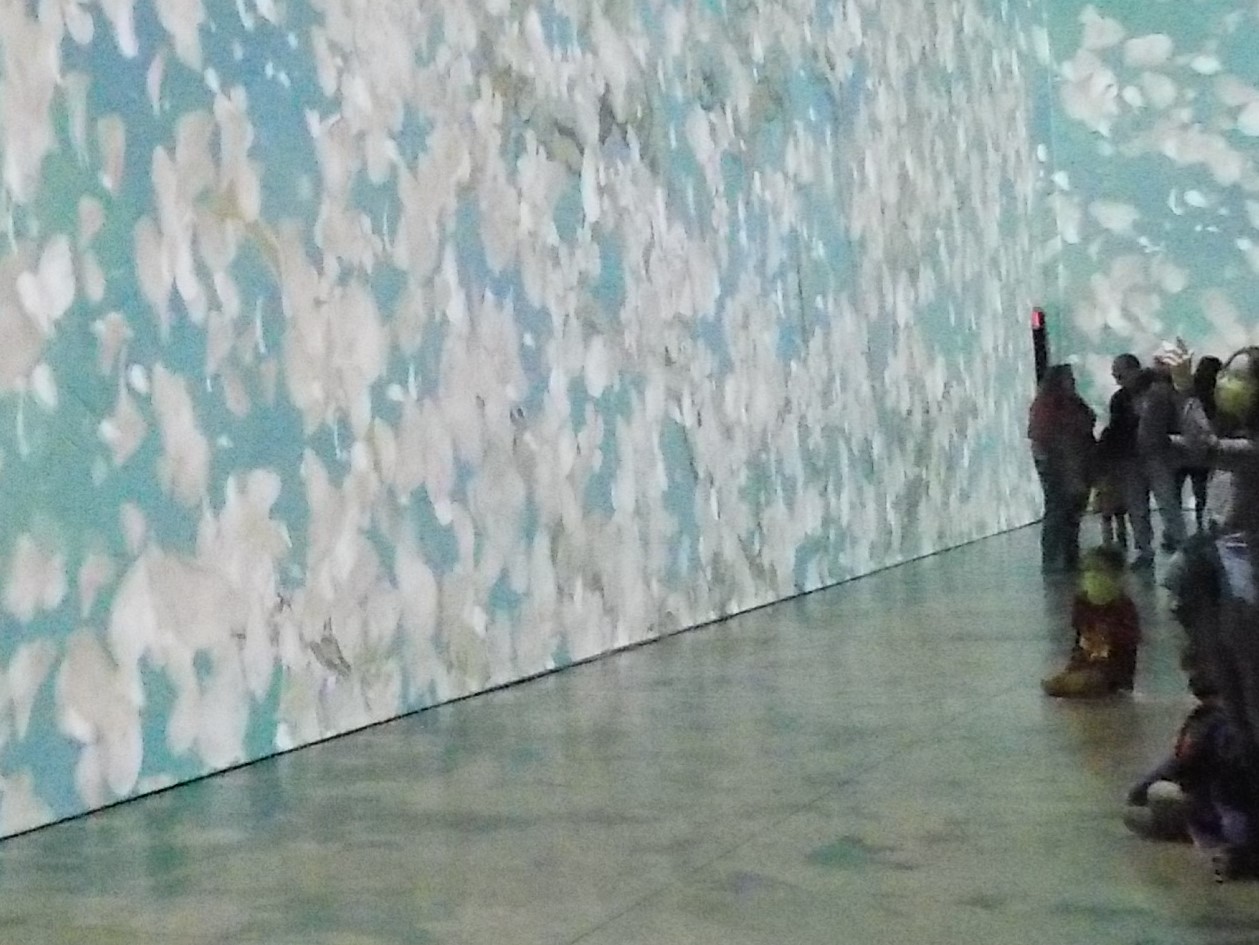
The art of each of those artists seems ripe for the sort of trippy experience I witnessed in Birmingham. The “Beyond Van Gogh” immersion begins with a line moving through a room that serves as a primer for Van Gogh, with panels providing capsule synopses of the artist’s often tortured life, interspersed with comments that include quotes from letters between Vincent and his brother, Theo. The viewer then enters the “Waterfall Room,” which seems to be there primarily to acclimate the audience to the main room. Vertigo is a real risk as the flowing abstractions move down the wall and across the floor. I realized that I needed to be careful about looking down.

The main room, which the publicity bills as “masterpieces … freed from frames” is the reason for the experience. Scored to instrumental music, with an occasional voiceover, the room has projected images flowing across all walls, on three tall triangular pillars in the middle, and over the floor. Some projections are reproductions of Van Gogh’s work but much of the event is flowing abstractions and layering of images from line to detail to color to a recognizable painting. When we entered the room, almond blossoms covered the walls and floor; some of the flora was static while other petals floated gracefully all around. It was a breathtaking moment to enter.

The audience is free to move around. Several sat on the floor. Some moved constantly, others stayed in one place; cameras and selfies were abundant all around. The experience is truly beautiful and mesmerizing in many ways. As I get older, I am more drawn to contemplative experiences, art that frees the mind to wander and find connections. Several dozen people of all ages were in the room and it seemed that each viewer was having a singular experience.

The musical score is often soothing, often soaring, and generally adds to the grandeur of the experience. There is, for me at least, one jarring exception: A lovely instrumental version of Paul Simon’s “America” plays in conjunction with the almond blossoms and beyond. That song is so familiar, at least to a Boomer like me, that I found myself humming along and distracted. Why I thought is “America” part of a Van Gogh exhibit? I still haven’t figured it out.


There have been snarky reviews and comments about the various Van Gogh immersions by art critics around the country. (I’ve written a fair amount of critical essays and reviews through the years and I know snark when I see it; I have perpetrated it on occasion.) The reviews seem to feel that the public domain status of Van Gogh’s work is being exploited and that the various immersions cheapen the work. They don’t think the works’ complexity is given its due or something like that. They don’t think it educates enough – or something like that.

Mainly, however, the snark seems to be aimed at the audience: They take too many selfies; they miss out on the true experience of viewing the works in a museum. There are children running around. It’s all just too “commercial.” The producers make a bald-faced appeal to the audience, especially the “influencers,” to take photos and spread the word. The gift shop is offensive … Or something like that. I saw one article that even told readers which museums they could go to and see the actual works represented in the immersion. That piece was by a New York writer.

I get their righteous snark. I really do; there were moments during the event when I felt that I was being a little bit suckered. But they miss the point. These enterprises are clearly commercial and are buoyed by the entertainment aspect of a necessary and mostly pleasant escapism inspired by the art of Vincent Van Gogh. All audiences do not necessarily have the access to the authentic art of Van Gogh that a New York audience might. And I suspect that the majority of the audience for an “immersive” art experience already has at least a basic knowledge of the art they’re being immersed in; that’s probably why they bought the ticket to begin with (and it’s not a cheap ticket). Others, who may not know the work but are drawn in by the enthusiastic word-of-mouth, may be inspired to learn more after the experience. As for the children, I was amazed at how well-behaved they were. And I was delighted when something would happen that would stop them – wide-eyed and gaping – in their tracks.

My mother, for one, left the experience “a little sad.” Viewing the work, and watching the audience response, she found it sad that Vincent did not live to experience the acclaim he achieved in his post-mortem.

These immersive experiences are certainly destined for oversaturation and for the waning popularity of audience-pleasers of the past like Cirque du Soleil and Riverdance. But, for now, they are achieving their goals and providing an interesting footnote and diversion for our need to readjust and recalculate in the face of a pandemic that doesn’t seem to fade away gracefully.


In Act Two, scene nine of Sam Shepard’s 1980 play, True West, a mother returns home from her vacation and announces to her son that “Picasso’s in town.” Her son replies that “Picasso’s dead, Mom.” The mother insists, replying, “No, he’s not dead. He’s visiting the museum.”

In the final weeks of 2021, at least, Vincent Van Gogh is not dead; he’s visiting Birmingham’s convention center and he’s providing a pleasant and enjoyable hour or so of community and escape.