Tag Archives: The Great Gatsby

Notes on a Century of Gatsby

The university where I taught was hosting a mini-symposium about F. Scott Fitzgerald’s The Great Gatsby in conjunction with the local library and the National Endowment for the Arts. I was the moderator and had gathered the participants for a planning session before the event. At some point in the conversation, I casually stated that I thought the Twenties would have been an exciting time to be alive.

There was a moment, and then one of the professors muttered, “As long as you were white.” Another chimed in, “… and a man.”

I was chastened and kept my mouth shut. However, some of my favorite writers were publishing in the 1920s – William Faulkner, T.S. Eliot, Gertrude Stein, etc. George Gershwin was composing. The Harlem Renaissance highlighted the talents of Hughes and Hurston and so many others. The New Yorker magazine was founded, and modern art was bursting forth. Speaking strictly for myself, I still think it would have been an inspiring time to be alive (if only one could maneuver a way to exit prior to the Great Depression).

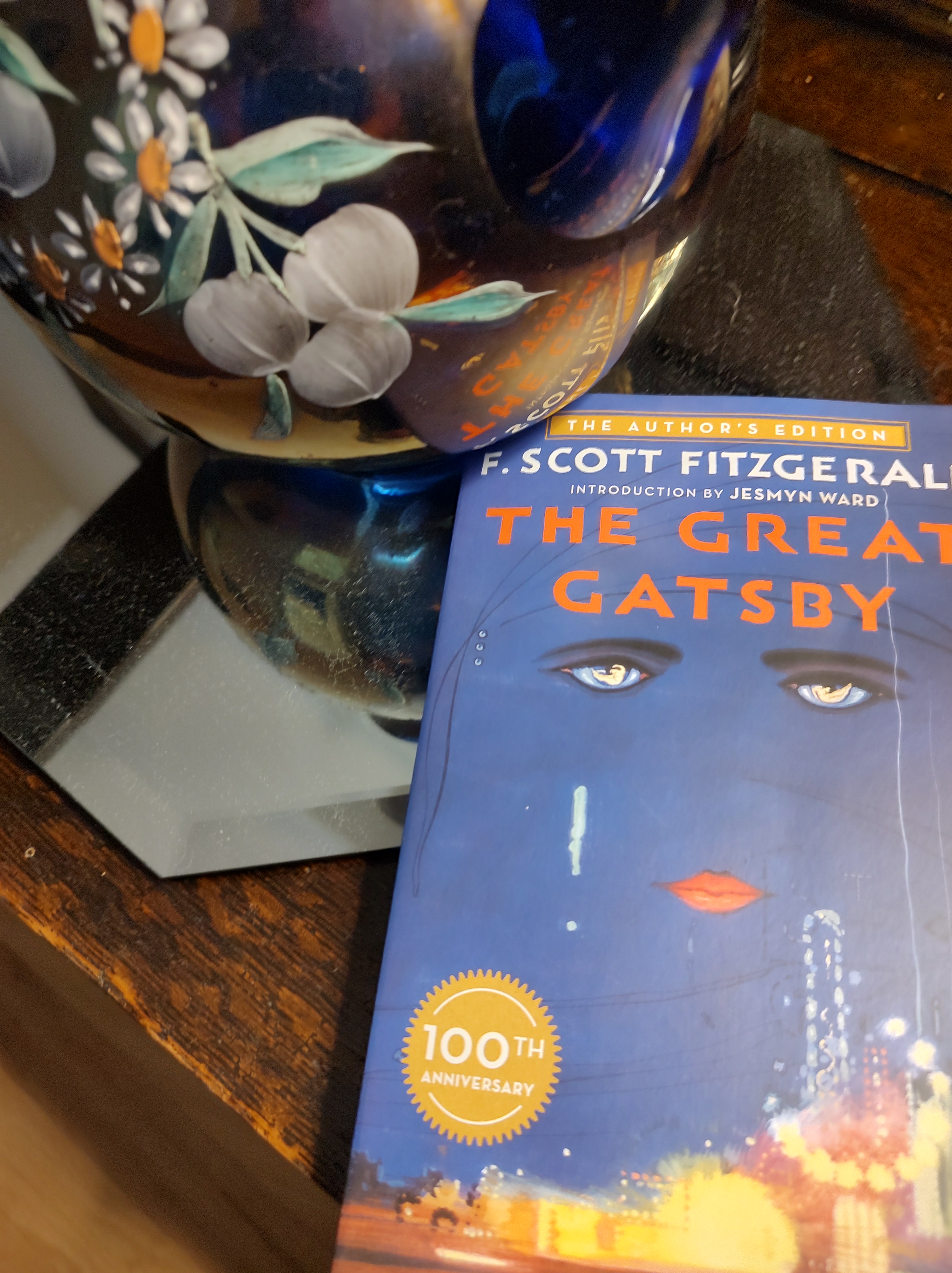
And in 1925, F. Scott Fitzgerald’s The Great Gatsby was published. I try to stop myself from writing about my ritual of reading F. Scott Fitzgerald’s The Great Gatsby on every Summer Solstice. But since much commotion heralded the centennial of that enduring novel in April of this year, I need to address my ritual once more. It began in high school when we were assigned Gatsby in an American lit class. I think that’s a good age to read the book for the first time – a time when adult thoughts are edging out the preoccupations of childhood and adolescence, when many are just getting an inkling of what romantic love might be all about. Cynicism hasn’t yet taken hold.

In the book, Daisy muses that she always looks forward to the longest day of the year and then forgets it when it comes. “We ought to plan something,” her friend Jordan dreamily says. For some reason – mainly because I always looked for the longest day of the year and then forgot about it until it was past – I thought I should plan to read The Great Gatsby on the longest day of the year.

And so I did. I am prone to such plans and then letting them slide away, but I have stuck to the reading Gatsby thing. By my calculations – I might have missed a year somewhere along the way – I have read Gatsby annually, and on the same day, for over half of the hundred years since its publication.

Over the years, it never gets old; there’s always a new moment or turn of phrase to discover. I look forward to the Summer Solstice just because I know I will be revisiting the Eggs of Long Island. As I grow older, Gatsby grows in meaning and grace. Over time, my waning tolerance for the arrogance and wealth of Tom and Daisy Buchanan has decreased and James Gatz of North Dakota has begun to look increasingly foolish and naïve in his quixotic quest. I understand how careless Jordan Baker could inspire a fleeting adolescent crush in any number of grown men. (When Tom is in the middle of one of his racist rants, Jordan breezily shuts him down with “We’re all white here.”)  I feel sorry for the Wilsons – Myrtle and George – and think that we all have known marriages like theirs, one way or the other. And now, when I read the book, I think They’re all so young.

But of all of them, it is Nick Carraway, the narrator, whose voice I most enjoy visiting once a year. I sort of trust him when he says he is one of the “few honest people that I have ever known,” although anyone who would say that about himself is already suspect (it’s kind of like declaring yourself a “stable genius”).

____________________

I underline passages in books, although I have always done it sparingly, like a standing ovation. Each time I read Gatsby I linger over lines and passages I underlined in past summers. Sometimes it makes perfect sense; other times, I think Why did that catch my attention? Occasionally, it takes me right to a certain place in my life and I know what prompted those words to grab me at that specific time. At one point in the book, Nick realizes that it is his thirtieth birthday and the “portentous, menacing road of a new decade. … the promise of a decade of loneliness, a thinning list of single men to know, a thinning briefcase of enthusiasm, thinning hair.” I can tell you exactly when I underlined that passage. I have gone through several paperbacks of The Great Gatsby since my ritual began. I keep them even after they fall apart and are replaced. One remaining copy was damaged after it was thrown up into the air to avoid an incoming wave on a beach somewhere. It avoided the surge, but not the saltwater.

____________________

On those first readings of The Great Gatsby, I was not aware of Fitzgerald’s Alabama connections. Zelda Sayre was a new name to me. It was only after Fitzgerald’s daughter, Scottie, came to speak to my sophomore lit class, that I began to realize the significance of Alabama in the Fitzgerald biography. It was while he was stationed in Montgomery that Scott and Zelda met. Later, in 1931 and 1932, when they briefly rented a house in Montgomery’s Cloverdale neighborhood, Zelda worked on her novel, Save Me the Waltz, and Scott wrote part of Tender Is the Night. Their daughter, Scottie Fitzgerald Lanahan, moved to Alabama around the time she spoke to my class. She became active in social advocacy and politics in Alabama later in life, partially to atone for some of the Jim Crow legislation of her prominent politician grandfather, and spent her final years in her mother’s hometown.

Anyone familiar with Fitzgerald’s story will recognize the influence of Zelda on Scott’s writing, and especially in his creation of Daisy Buchanan in Gatsby. Zelda famously said, “Mr. Fitzgerald — I believe that is how he spells his name — seems to believe that plagiarism begins at home.”

____________________

One of Andy Kaufman’s most frustrating stunts was when he decided to read The Great Gatsby to an audience. He would start reading in a sonorous voice and he would not stop. Audiences would catcall and scream for him to stop and he would taunt them, threatening that if they did not quieten down, he would stop reading. They would persist, but he would not stop. Eventually, after his reading had taken the audience beyond the breaking point, he told them if they did not stop, he would have to play the recording he brought. As the audience pleads for him to play the recording, he finally puts down the book and cues up the record – a recording of Andy Kaufman reading The Great Gatsby.

It’s a brilliant piece and, in its building tension and absurdity, there is an underlying truth. The Great Gatsby is so beautifully written, the words are so crisp and precise, that I always want to read passages aloud just to hear the words. Kaufman picked up on that urge and his madcap stunt shows just how outrageous and cloyingly precious it is to force people to listen.

Kaufman’s stunt aside, the theatre ensemble called Elevator Repair Service won massive acclaim and made its reputation with a production called Gatz in which The Great Gatsby is performed, word for word, from start to finish. Set in a drab office, a bored office worker pulls out a copy of Gatsby and begins to read it aloud. The other workers begin to recite the text – in its entirety – and play the various characters, all in their office setting. The performance lasted eight hours including two short breaks, an intermission, and a dinner break. It was a hit and has been toured and revived by Elevator Repair Service several times since its 1999 premiere. It probably sounds like torture to many — as torturous as that Kaufman bit  — but, given the opportunity, I would happily sit through Gatz.

_____________________

There is one passage in Gatsby that I always ponder; it never ceases to intrigue me and is one of many moments that feeds my deep affection for the story. It comes at the end of Chapter VI after Gatsby opens up to Nick about his Daisy obsession. Nick notes that despite Gatsby’s

… appalling sentimentality, I was reminded of something – an elusive rhythm, a fragment of lost words, that I had heard somewhere a long time ago. For a moment a phrase tried to take shape in my mouth and my lips parted like a dumb man’s … But they made no sound, and what I had almost remembered was uncommunicable forever.

That moment passes; it’s not referenced again. No other writer has so effectively captured that moment of something “on the tip of the tongue” that is almost there and disappears, never to return. I am not sure that any other writer has tried.

Page by Page, Measuring a Life

WARNING: This essay deals with what has become known as a “first-world” problem, so be aware of that as you read. I am very aware of how privileged I am to be stressed about lost books.

I bought a house in the spring. I like it, I like the location, and I know that I will be happy there. Eventually. I moved in on June 1, unpacked, and had the interior arranged the way I wanted it by Independence Day. On July 20, I came downstairs to find water leaking from upstairs onto my kitchen counters; the plumbers and I discovered a well-disguised leak in an upstairs guest bath that had been missed in the home inspection.

Extensive, mainly hidden, damage was found that resulted in my having to get all new floors upstairs, new stairs, and new ceilings downstairs. I used the opportunity to make some upgrades. The house, upon completion, will be much better than it was when I moved in.

The contractors finished their work a few days ago and I spent Saturday putting my stuff back in place. The books in the upstairs bookshelves had been packed away by the construction crew and left in the garage during the construction.

I am a little OCD about my books. They are always placed in alphabetical order by author or, in the case of biography, subject. Even in my most impoverished days in grad school, living in a squalid four-plex in the student ghetto on 13th Avenue, I always kept my books carefully organized. When a career in professional theatre moved me frequently around the country, I always moved with a trailer filled with my books and shelves to be assembled on arrival. Often, the books, my clothes, and some pots and pans were about all I had to move.

When the work on the house was completed, the construction crew moved my books back up to the bedrooms where my bookshelves waited. I hate moving, but I take pleasure in stocking my bookshelves. On Saturday, as I unpacked and alphabetized my books, I discovered that letters “A” through “F” and part of “G” are missing. I searched everywhere in the house and garage where boxes of books might possibly disappear with no luck. I contacted the contractor and project manager to let them know. The contractor got very defensive and assured me that he didn’t take my books; I never thought he “took” them, but I have a hunch they might have been accidentally hauled out with construction debris. It seems far-fetched, but no other explanation comes to mind.

The contractor washed his hands of the problem, but the project manager says he will have the dumpsters checked at the company site (a horrifying prospect). Somehow, I don’t have a lot of confidence in the success of the dumpster dive.


Over the years, I have occasionally weeded out some books. I donated 250 titles to the library on this last move. Another 150 play scripts and theatre books were donated to my old academic department when I retired. By my rough estimate, another 180+ books have now been potentially lost in this latest development. I have been trying to do a mental inventory of some of the books that have been lost. Here is a by no means complete (and alphabetized) list of authors I have remembered so far:

Achebe. Agee. Amis. Atwood. Avedon’s Portraits (1976). Baldwin. Bangs (Lester). Ann Beattie. Beckett. Bragg. Anthony Burgess. Capote. Jimmy Carter. Raymond Carver. Chabon. Cheever. Mark Childress (a college classmate). Cleage. Cunningham. DeLillo. Dickens. Didion. Norman Dubie (whose “Pastoral” is one of my favorite poems ever). John T. Edge. Eggers. T.S. Eliot. Walker Evans photographs. Percival Everett. Faulkner (everything he ever wrote, plus biographies, and critical materials). Fitzgerald. Richard Ford. Franzen. Gaines – Charles and Ernest. Ginsburg …

Also, critical studies of film director Robert Altman. Dozens of issues of The Black Warrior Review, a literary magazine. Photographic volumes on Birmingham and Alabama history. Personally inscribed and signed first editions. Books I bought in high school. Books I bought a couple of months ago.

As I keep listing, I get increasingly out of sorts, but you get the idea. Other readers will understand. Fortunately, my collections of cook books, books on architecture, gardening books, and art books are housed in other parts of the house so those collections remain intact.

I have been asked on more than one occasion if I have read every book on my shelves. Yes, I have. In fact, a book didn’t go on the shelf until I had finished reading it.

I have been asked why I keep the books if I’ve already read them. If you ask a question like that, I’m afraid you will never understand. Suffice it to say, some books I re-read. Some books I use for reference. Some books I just want to have around.

An example: I read The Great Gatsby every year on the Summer Solstice. A decades-long ritual. Once a copy of Gatsby is worn out, I replace it with a new edition, but keep the worn-out copies on the shelf. It is interesting to see my notations in the text from readings past; I mark my life by the passages that once stood out to me and now mean less, and by the passages that I have never particularly noted before which suddenly take on a significance with age.


In 1990, in a home robbery, my entire sizable collection of vinyl records was stolen, along with my stereo system. That was hard, but I shifted to CDs and moved on. This book loss seems more visceral, somehow, and harder to wrap my head around. My book collection from the middle of “G” to “Z” is intact, but one whole bookcase is completely empty.

Almost empty, I should say. I just finished reviewing a book and had not placed it on the shelves yet. The author’s last name starts with the letter B.

James Braziel, it’s all up to you, man. You’re standing in for a host of good authors.

Summer Solstice 2020

Near the start of Fitzgerald’s The Great Gatsby, Nick Carraway says, “I had the familiar conviction that life was beginning over again with the summer.” This year, one hopes for more truth than usual in that statement as we count down a dismal year. As the sun begins its slow six-month drift south, perhaps some of the disease, divisiveness, and turmoil will ebb.

I would feel remiss if I did not acknowledge the Summer Solstice – the longest day of light of the year – and my annual re-reading of The Great Gatsby. I found time to attend to the plants in my yard as the frequent rains of Spring seem to once again be yielding to a Summer threat of drought. There was frequent enough rain through the last several months. I don’t think we’re in danger yet, but it hasn’t rained in several days and I was dripping sweat after only a half hour of yard work earlier.

I managed to make my second trip to Harrison Farms in Chilton County a few days ago and got peaches for myself, and for friends and family who have standing orders. Lynn, one of the Harrison sons, indicated that this might be an abbreviated peach season, but Mrs. Harrison said this week that their cantaloupes and watermelons aren’t ready yet and that gives me hope for a little longer season of opportunities to make the relaxing drive to Chilton County. The okra was coming in and I got a basket of perfect baby okra to bread and fry.


The peaches at the Harrisons’ acres of orchards near Maplesville are my summer touchstone, and were a sideways inspiration for “Professional Southerner.” In 2012, I spent every other Saturday of peach season traveling to Chilton County with a videographer to collect footage and interviews for a documentary about Chilton County peaches with a focus on Harrison Fruit Farm.

We collected several hours’ worth of video over a really pleasant summer. I remember an August afternoon when we set up in the parking lot of Fat Girls’ Barbecue in Billingsley and spent an hour shooting the setting sun over rolling hills of central Alabama. We spent one entire Saturday shooting the Peach Festival parade and related events in downtown Clanton. When we finally got into the editing process, the videographer’s husband decided she was spending too much time on the project for too little compensation and she abandoned me.

A filmmaker colleague at the university looked over the footage, decided that we needed to re-shoot a lot of things, and offered to help to finish the project. Before we could make that happen, my colleague got sick and died and I was never able to track down the missing footage. When I gathered my belongings from my office for retirement last month, I came across a mysterious external hard drive in the far reaches of my book shelf. Maybe … I will have to find time to check.

The film is still vivid in my head – I even got permission to use a Pat Metheny track I really like for underscoring. Whenever I make a peach run to Harrison Farms, I feel guilty that the family was so generous with their time – they all sat for interviews – and the documentary never happened.

But the experience inspired an essay that subsequently inspired me to start the “Professional Southerner” journal. That essay, “The Peach Highway and Jimmie’s Peach Stand,” continues to be one of the most popular posts of the journal over the years. The peach stand and I are about the same age and trips down there always lift my spirits, even during the uncertainty of Summer 2020.

Ode to Summer – 2019

The verb “slather” was coined specifically to describe putting mayonnaise on bread for a tomato sandwich. Linguists and the dictionary may disagree, but that’s my story and I’m sticking to it.

I can never let the Summer Solstice pass without once again expressing my joy at the advent of the season. The Great Gatsby is pulled off the shelf for its annual reading and the bounty of the various farmers markets and highway farm stands becomes increasingly diverse and delectable. The sun rises early and sets well into the evening, giving the heat of the day plenty of time to build in intensity.

The occasional pop-up shower or passing thunderstorm cool things down for a moment, yielding to a sultry steamy aftermath.

The summer tomato sandwich is a seasonal standby once more, its structure changing, based on what other ingredients are available to adorn it. Ripening tomatoes are lined up on the kitchen counter to lend inspiration to another juicy lunch from local farms. It is hard to choose from all of the varieties available; this week, my counter sports more conventional red tomatoes instead of the always tempting heirlooms available to select in cardboard boxes at several of the booths.

A loaf of 10-grain bread from the Mennonite ladies provides two slices to slather with mayonnaise. One slice is topped with several slices of tomato while the other is covered with a layer of basil leaves from the back yard herb garden and crumbles of chipotle pimento cheese from Humble Heart Farms, my favorite purveyor of local goat cheese (www.humbleheartfarms.com). A paper-thin slice of onion tops the basil and cheese. Before the sandwich is assembled, the tomatoes are topped with a sprinkle of sea salt and freshly ground pepper.

Finally, after heating a couple of pats of butter in the iron skillet, the sandwich is pressed and cooked until both sides are golden brown.

I pour a glass of iced tea and sit down for lunch at the plant-filled table in the back room that I use as a library, looking out over the lush green growth of my compact back yard beyond. To be honest, by August that “lush green growth” will be trending brown (if recent summers are an indicator), but my relish of the summer months will not be diminished. Today’s sandwich is a quick and delicious way to celebrate the local tomatoes and to cherish the vibrant first days of the official summer season.

Have a great summer.

A Summer Solstice Celebration

photo by D. Brunson

I love the heat and activity of summer – the long days, the unpredictable showers, living out-of-doors. I always like to mark the Summer Solstice with a special activity, including my annual reading of The Great Gatsby, a novel set over the course of a summer told in the conversational voice of Gatsby’s erstwhile sidekick, Nick Carraway. It is Fitzgerald’s most perfect novel.

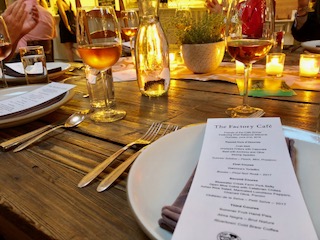
I have known since last October that I would be spending the evening of the 2018 Summer Solstice in Florence. I have written frequently about the “Friends of the Café” series of dinners at the Alabama Chanin Factory (www.alabamachanin.com). These usually serve as fundraising events for Southern Foodways Alliance (www.southernfoodways.org) and are among the most anticipated events on my annual calendar. They are an escape.

The June 2018 dinner marked not only the Summer Solstice but a reunion with old friends, the opportunity to introduce friends who’ve never met each other, and the first “Friends of the Café” dinner for several of the people at my table.

I rode over to Florence from Decatur with my friends Anne and Deborah. Deborah, a Mobile native, was visiting from New Mexico. At the same time, my friends Scott and Michelle, with Scott’s parents, Jim and Judy – who were visiting from Ohio, were driving over from Owens Cross Roads, just over the mountain from Huntsville. Carol, a friend from Chicago, was already ensconced in Florence where she was attending week-long patterning workshops at Alabama Chanin.

When we arrived at the Factory, we were greeted with a beverage called the “Summer Solstice” – a refreshing mix of mint and peach-infused tea and Prosecco, ideal for celebrating the official start of my favorite season and for launching an impeccable meal.

Chef Rebecca Wilcomb

The chef for the evening was Rebecca Wilcomb, the 2017 winner of the James Beard Foundation Award for Best Chef – South. Wilcomb is Executive Chef at Herbsaint (www.herbsaint.com), a favorite New Orleans restaurant (I have a few) that is part of Chef Donald Link’s family of restaurants celebrating Louisiana roots and foodways.

Chef Wilcomb strayed a bit from her typical Herbsaint fare for this special Factory dinner, paying homage to her mother’s Italian roots – and especially to food prepared by her Italian grandmother in her kitchen in Italy. The meal was sumptuous and generous with Italian-inspired takes on fresh local food.

As the tribe gathered, hors d’oeuvres were passed by the always amazing Factory staff. I made sure I tracked down at least one of everything. The crab melt was a buttery mini-sandwich filled with perfectly rendered crab filling. Chickpea fritters with caponata, a well-spiced vegetable blend, provided a rich mouthful. Skewers of large spice-forward shrimp were incredible, and my favorites were skewers of beef chunks with anchovy and olive.

Dark clouds were gathering as we took our seats at the intimate Factory table settings. Thunder and lightning began to herald a passing storm as Natalie Chanin made her welcoming comments. The noisy storm prompted Deborah and me to exchange glances to acknowledge that a storm was the ideal accent for this special meal to cap the longest day of the year.  As the lightning began to subside, the rain intensified, pounding an energetic percussive beat on the Factory’s metal roof. Just as quickly, the storm moved away.

There was a lot of rain in the spring and recently; it promises to be a good year for fireflies.

  The first course for the seated meal was “Giannina’s  Tortellini.” It was revealed that Chef Wilcomb had never before served these tortellini at her restaurants or at a public gathering. Her Italian grandmother’s tortellini recipe was a special start to the meal with the stuffed tortellini served in a subtly flavorful broth. I tilted my bowl at the end to ensure that I could spoon out every last drop.

photo by D. Brunson

That first course was a finely rendered tease for the hearty second course to come. Served family style, it included six beautifully prepared and seasoned dishes highlighted by both a meat and fish offering. Pork belly from nearby Bluewater Creek Farm (www.bluewatercreekfarm.grazecart.com) was passed around along with an Open Blue cobia (www.openblue.com) from the Caribbean, paired with Calabrian chilies. The delicate white fish was a unanimous hit at our table, with a subtle creamy taste. Italian rice salad, marinated lunchbox peppers, a dish piled high with whole charred okra, and a beautiful bowl of seasoned porcini mushrooms completed the course.

photo by D. Brunson

The feast ended with platters piled with summer fruit hand fries; fig, blueberry, and peach pies were available and most of my dining partners managed to sample one of each. I was pretty full by that time and only ate two – fig and, of course, peach.

This will be one of the most memorable of the Factory meals because of the friends – old and new – who congregated for a very special event. I realized that all of the people who were seated at my table were there – either directly or indirectly – because of me. I worried that everybody might not have a good time but that concern melted away as we all talked and laughed, enjoyed the food together, and toasted the promise of summer.

An added treat of these dinners is the opportunity to see a chef I admire in a new context. Chef Wilcomb always brings to mind a favorite table by the window at Herbsaint; now, Herbsaint will always remind me of Giannina, her Italian grandmother, and of a Summer Solstice that was celebrated with friends in a most memorable way.

As we left the factory, the rains had moved on and a steamy glaze danced across the pavement of the road on a hot summer night. 

Friends of the Cafe: Ashley Christensen

The first day of Summer 2017 ushered Tropical Storm Cindy up from the Gulf and energized the air farther inland in Birmingham, where I was helping to celebrate my mother’s birthday. It has been a few years since I experienced the typical effects of a tropical storm and – while I always hope there is no significant damage or injury – I always find the balmy air and windy bands of sporadic rain to be invigorating and energizing.

I reread The Great Gatsby as I have done for years on the Summer Solstice.

I was in my twenties when I began my annual reading of The Great Gatsby and the ritual has almost taken on a superstitious nature; if I missed a year, I would feel like something was awry. But I always manage to get in my June reading of the book and, after dozens of readings, I always find something new in Fitzgerald’s writing. And my heart always pounds in anticipation of the book’s inevitable ending.

On this most recent reading, I was struck near novel’s end by Nick Carraway’s account of a recurring West Egg nightmare – “a night scene by El Greco” in which a bejeweled drunken woman in a white evening dress is borne on a stretcher by “four solemn men in dress suits” to the wrong house. “But no one knows the woman’s name, and no one cares.”  That particular paragraph had never stopped me in my tracks until this reading.

Perhaps that passage stood out this time because I read it while sitting in a car in the parking lot in Tuscaloosa in a steady tropical rainstorm, while Mother was in a beauty shop appointment. Those meteorological conditions just added to the gloom of Gatsby’s rain-soaked funeral in which he is laid to rest with only Nick, Gatsby’s father, a few servants, the local mailman, and the owl-eyed former party guest in attendance. I usually reread Gatsby outdoors in the sunlight so the weather definitely added a different perspective this year.


­­­­­­­­­­­­­­­­­By the time Saturday afternoon rolled around, the weather had cleared and the balmy weather turned blistering. Summer’s advent and Cindy dominated the days leading up to the most recent Friends of the Café event at the Alabama Chanin Factory in Florence (www.alabamachanin.com). North Carolina chef Ashley Christensen of Poole’s Diner and other Raleigh dining venues (www.ac-restaurants.com), was helming the meal. Once again, the event was a benefit for Southern Foodways Alliance (www.southernfoodways.org). I am proud to be a long-time member of the SFA, helping in a small way to support all of the good works the organization does.

Friends Anne, Michelle, Scott, and I traveled to the Shoals for the meal. Arriving at the Factory we were warmly greeted by Natalie Chanin, the creative force behind Alabama Chanin and the impetus for many community-building events, including an awesome schedule of Friends of the Café dinners.

The gathering was already going strong when we arrived. A delicious array of passed hors d’oeuvres included fried green tomatoes topped with Alabama jumbo lump crab salad and Hook’s three-year cheddar pimento topping a cucumber slice. Along the serving table were shots of a sweet corn mousse with piquillo pepper.  The mousse literally melted in one’s mouth like a passing dream of sweet corn taste. A “Summer Cindy” libation was poured – Prosecco and Jack Rudy grenadine with a sprig of rosemary.

The seated meal began with a salad of local lettuces and vegetables dressed with buttermilk and roasted garlic. Next came a slice of heirloom tomato pie with spicy greens and sherry. My quest for the perfect tomato pie began years ago with the tomato pie competition that was an annual event at Decatur’s Willis-Gray Gallery (now Kathleen’s). The Decatur event hasn’t been held in several years but Ashley Christensen’s take on tomato pie is now the hands-down winner.

The third course was chargrilled Bear Creek ribeye steak cooked perfectly and served family style along with Poole’s macaroni au gratin and a room temperature marinated summer succotash which brought back vivid memories of my Grandmother Harbison’s take on hearty southern succotash.

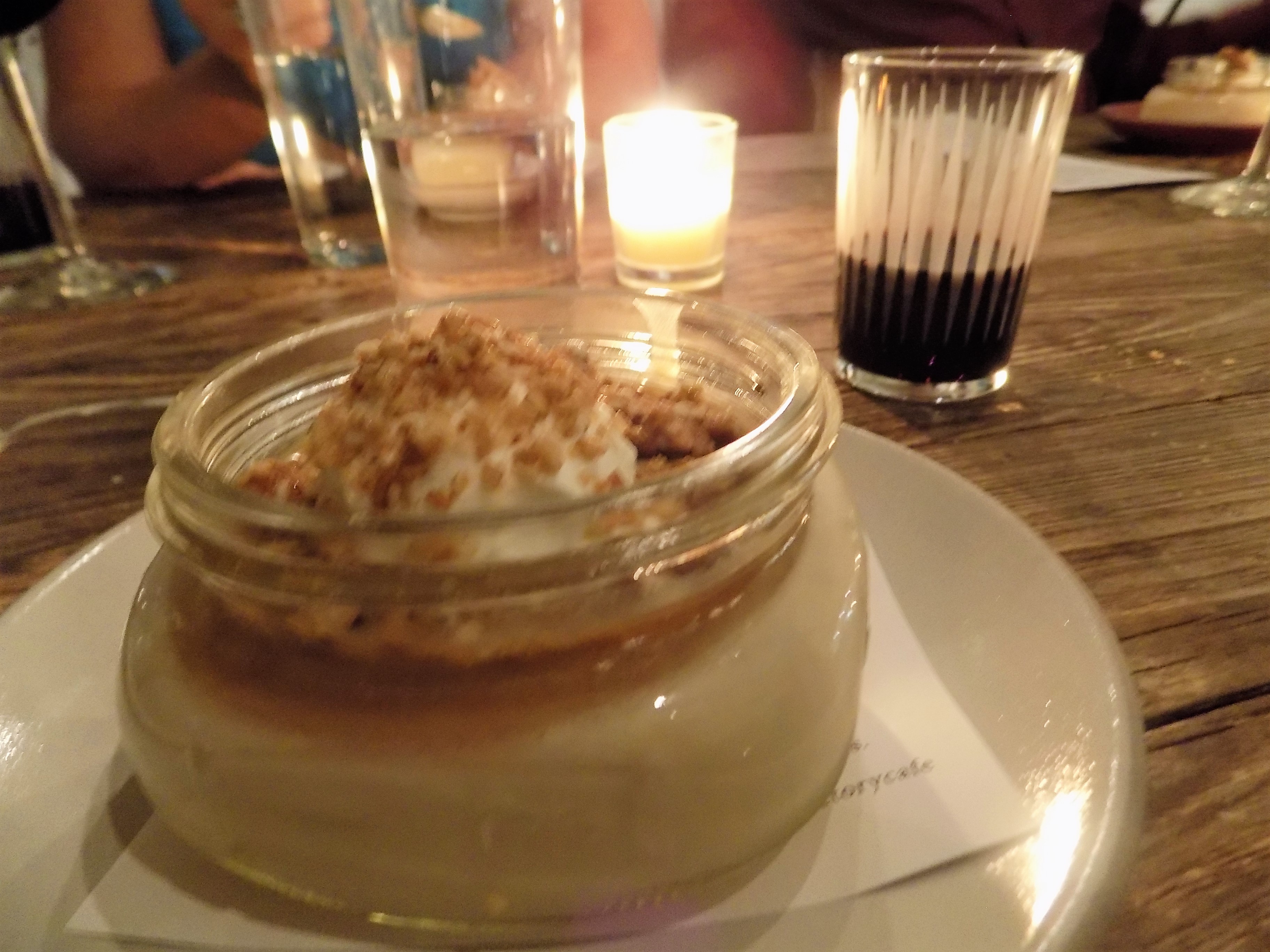
The dessert course of a coffee panna cotta with Irish whisky caramel and North Carolina pecan granola crunch was served with a deep and earthy port.

I have never been disappointed in a meal at the Factory and Christensen’s recent menu continues to raise the bar.

Christensen seems to be as warm, down-to-earth, and authentic as the carefully selected ingredients she elevates. I think I have attended all but three of the Friends of the Café dinners and Ashley Christensen was the chef for my second in 2013.

When Natalie Chanin asked me recently which had been my favorite of the meals over the years, Ashley Christensen’s name was one of the first that came up. Now, Ashley Christensen is the first of the guest chefs in the series to come back for an encore. It seemed unlikely that she could top her first memorable performance at the space, but last Saturday night she did.

Copies of Christensen’s cookbook. Poole’s: recipes and stories from a modern diner (Berkeley: Ten Speed Press, 2016), were available for purchase and signing at the end of the event. It is a cookbook chock-full of exciting, well-explained recipes as well as a good introduction to the founding of Poole’s and to the James Beard Award-winning chef’s culinary aesthetic. It also provides the stories and impetus behind her restaurant empire of seven downtown Raleigh establishments. Chanin referred to her friend as “badass” and the book is full of Christensen’s warm and earthy takes on the food world (she refers often to an affinity for “beer flavored beer”).

For me, thanks to the friends who went with me, to Alabama Chanin, and, especially, to Ashley Christensen, that turbulent first week of summer 2017 ended on a high note indeed.

Waning Days of Summer

IMG_0726  When you live alone you develop routines and rituals. At least that has been my experience. I don’t know when I started the ritual of reading F. Scott Fitzgerald’s The Great Gatsby on the first day of summer, but I know exactly why.

On page 11 of The Great Gatsby, during a dinner party fraught with marital mystery and tension, Daisy Buchanan says, “I always watch for the longest day in the year and then miss it.” Her friend Jordan Baker replies, “We ought to plan something,” and yawns.

I didn’t yawn. Like Daisy, I often watched for the longest day of the year – the first day of summer – and then forgot it until it was past. On my third or fourth reading of The Great Gatsby, that passage resonated with me and, following Jordan’s bored advice, I made a plan: I always read The Great Gatsby on the longest day of the year. I can’t remember exactly when I started that ritual – probably in the late ‘70s – but it continues to this day. And I have never missed the longest day of the year since.

William Faulkner is my favorite writer (good Southern boy that I am) but I think Fitzgerald’s The Great Gatsby is the most perfect American novel. It’s a short read; I can knock it out in about three hours. But it is so compactly and intricately structured that I never tire of it even though I have now read it upward of forty times. I always discover something new or respond to something I never responded to in previous readings. I first read the novel in high school and, unlike many young readers, I loved it immediately. I studied it again in college and then found myself drawn to it periodically after those initial readings. And then I developed my summer ritual.

I love summer. I love the heat and the sweatiness and the long days and the outdoor activities. In my part of the South, many people seem to relish complaining about the heat and humidity of summer but I cherish it. I’d rather be too hot than too cold any day. So not only does The Great Gatsby represent my literary tastes, it has also come to represent my favorite time of the year.

The reason I am talking about the beginning of summer at the end of summer is because I am winding down the summer of 2014 with a book that is about The Great Gatsby and that I am thoroughly savoring. Literary critic Maureen Corrigan has authored a new book, So We Read On: How The Great Gatsby Came to Be and Why It Endures, that is an extended meditation and exploration of Fitzgerald’s masterpiece. It amuses me that Corrigan’s book exploring The Great Gatsby is twice as long as the novel itself. It turns out that Corrigan may be an even bigger fan of the book than I am although she admits to not liking it in high school. I heard Corrigan tell an interviewer that she has read Gatsby at least fifty times and I knew I had to check her book out.

It was worth it. And reading it now, three months past the first day of summer, is giving me a nice way of transitioning to ever shorter days and ever dropping temperatures. I must admit that the only thing that bothers me on that first day of summer in June is the knowledge that the second day of summer will be a bit shorter, and the next shorter still as we take the plunge to the shortest day of the year in December.

The Great Gatsby itself takes place over a summer season. In the first pages the narrator, Nick Carraway, comments that “life was beginning over again in the summer.” Toward the end, he mentions that “there was an autumn flavor in the air” on the day that Gatsby is killed.

Maureen Corrigan, in So We Read On, has provided this reader with the perfect way to ease into the fall.

“So we beat on, boats against the current, …” Thanks, F. Scott. And thanks, Ms. Corrigan.