
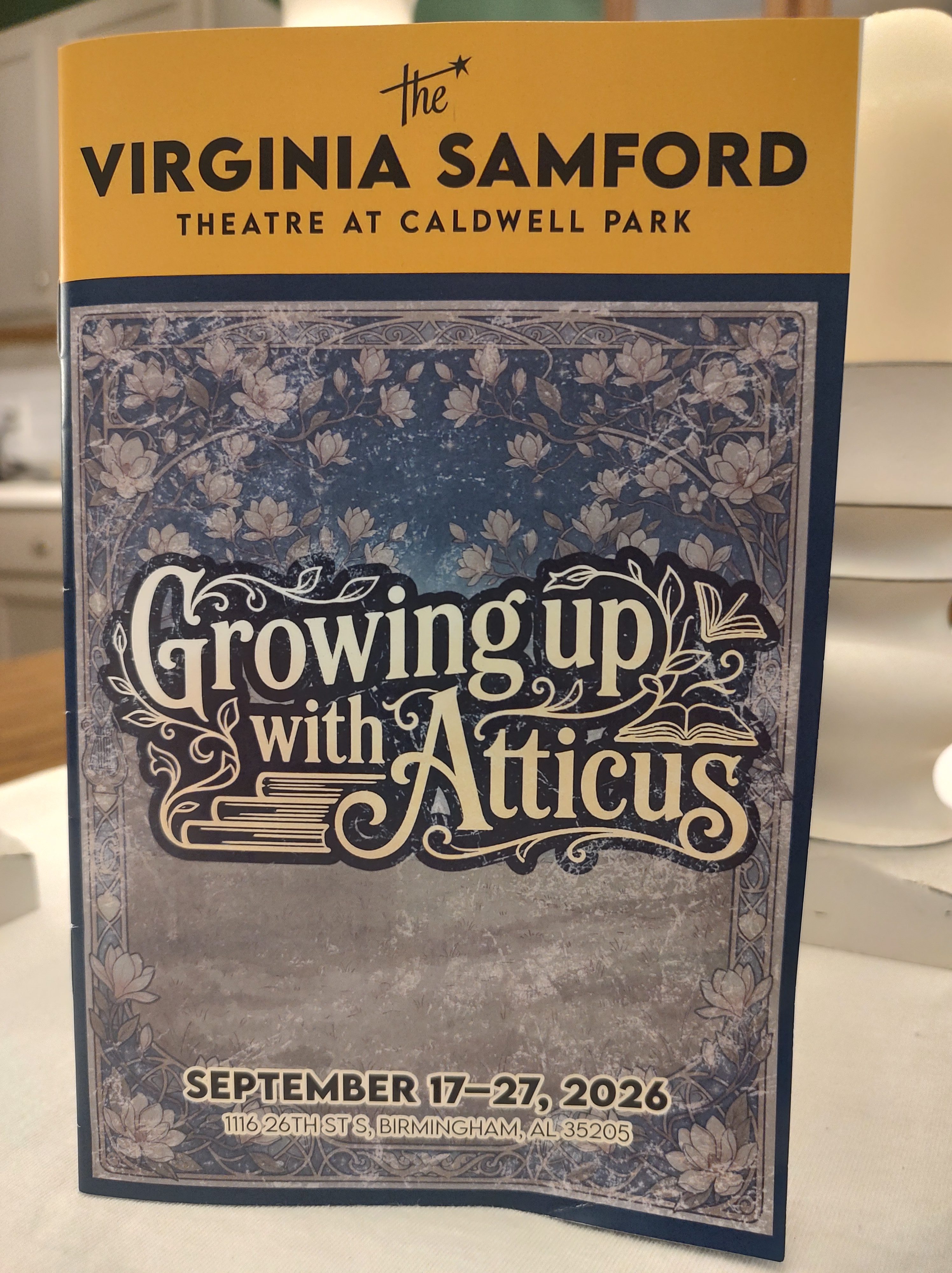
 Birmingham’s Virginia Samford Theatre is celebrating its centennial in the 2026-2027 season. In 1927, it was founded as The Little Theatre, home to Birmingham’s community theatre. By the time I was growing up in the city, it was Clark Memorial Theatre, home to Town and Gown Theatre. When Town and Gown was dissolved at the turn of the century, the building was purchased and restored, renamed Virginia Samford Theatre, and continues to be a home for local live theatre.
The building has a rich history beyond the theatre and its shows. Writer and actor Fannie Flagg, as a shy fifteen-year-old, found her “tribe” at Town and Gown after volunteering to be a spotlight operator for a show and eventually became an actor on its stage. In the 1960s, Town and Gown gained a reputation for hosting successful auditions for major films looking for juvenile actors. Auditions for the film adaptation of Carson McCullers’s The Heart Is a Lonely Hunter, to be filmed in Selma, were held there and a young Sondra Locke lied about her age and landed the lead. I auditioned there for the juvenile lead in The Reivers, the film adaptation of William Faulkner’s last novel, starring Steve McQueen. I only got one callback but one of my classmates was flown to Los Angeles to audition with McQueen. Even so, a Hollywood kid was cast in that one. But Town and Gown’s most notable coup in film casting is the fact that Philip Alford and Mary Badham – neither of whom had previous acting experience – were cast as Jem and Scout Finch in the acclaimed and enduring film adaptation of Harper Lee’s To Kill a Mockingbird, starring Gregory Peck in his Oscar-winning role as Atticus Finch.
That history gives added luster to the fact that Virginia Samford Theatre opened its centennial season with the world premiere of Growing Up with Atticus, starring Mary Badham – “Scout” from the movie, and Cecilia Peck – Gregory Peck’s daughter. Growing Up with Atticus, directed by David Strickland, is presented as a conversation between two life-long friends, amplified by clips from To Kill a Mockingbird, photos, scrapbook images, and footage from various projects by Mary Badham and Cecilia and Gregory Peck.
Mary and Cecilia have known each other since childhood and have remained close ever since. That bond is evident in the comfort they share with each other onstage, sitting in chairs with a pitcher of tea, as they reminisce about the filming of To Kill a Mockingbird. Mary was eight years old when she was cast in Mockingbird and was ten when she was nominated for an Academy Award as Supporting Actress in the film; she is still the youngest Supporting Actress nominee in Academy history. The supporting actress Oscar that year went to Patty Duke, another juvenile actor, for her role as Helen Keller in The Miracle Worker, still another film adaptation of an Alabama-set literary work. Growing Up with Atticus incorporates video from the 1963 Oscar ceremony, including Gregory Peck’s acceptance speech, with Mary Badham’s explanation of why the cameras couldn’t find her when her name was called as a nominee.
It is those kinds of personal, intimate revelations that make the two-woman stage presentation so captivating. The show is a lovefest – from the haunting film score by Elmer Bernstein that plays as the audience is seated to the testimonials of the audience during a second act Q&A. The Q&A makes each performance a unique and singular experience. At the matinee I attended, a woman in the audience recounted how her father was imprisoned for his political activism and was inspired by the example of Atticus Finch standing up for what is right. A young girl who asked a question was named “Scout” to honor the book and movie’s influence on her parents. Audience members spoke of traveling from Arkansas, Louisiana, Virginia – just to see the show.
The performance includes content about the Civil Rights movement and the 1963 “Birmingham Campaign” in particular. Mary Badham recounts her chilling first encounter with racism on a Birmingham city bus with her nanny when the driver stopped the bus and separated her from her nanny so they would each be sitting in the racially “correct” seats.
During the Q&A that I attended, it was revealed that Sephira Shuttlesworth, the widow of Rev. Fred Shuttlesworth, was in the audience. Rev. Shuttlesworth was a guiding force in the Birmingham civil rights movement and Mrs. Shuttlesworth spoke briefly to the audience with words that were powerful, moving, and hopeful. After Mrs. Shuttlesworth was recognized, one audience member spoke up to say that Dr. King “got the credit” for the Birmingham Campaign, but Rev. Shuttlesworth “did the work.”
After I attended Growing Up with Atticus, I was asked if I enjoyed “the play.” I’m not sure how to respond since it isn’t really a play; it’s an event, an experience, and, at times, it feels like a revival meeting. There is one scene in the performance, however, that is theatrical in a way that elicits chills in the recounting. Cecilia and Mary discuss the pivotal nighttime scene when Atticus is sitting and reading in front of the courthouse, keeping vigil while Tom Robinson is imprisoned inside. On the screen above them, that scene from the movie is shown: A lynch mob arrives and confronts Atticus. Soon after, Jem, Scout, and their friend Dill arrive to check on Atticus. In the confusion that ensues, Scout recognizes Mr. Cunningham – the father of her classmate, Walter – and says “hey’’ to him. As Scout’s monologue continues, it is picked up by present-day Mary standing at the front of the stage. Another light comes up on Cecilia Peck standing beside the lamp, in the place her own father stood in the movie. As the filmed scene ends, Cecilia Peck and Mary Badham stand together, reflecting that powerful father-daughter moment on screen almost sixty-five years ago.
The magnificent performance and inspirational life-long influence of Gregory Peck is a focus of Growing Up with Atticus, but Harper Lee, Alabama, the Badham family, “the Book,” and “the Movie” also are prominently featured throughout. Ultimately, it seems, the conversation and interaction with Ms. Badham and Ms. Peck is about Family – the one we’re born into and the ones we choose. Cecilia Peck talks about the powerful bond her parents had with Harper Lee throughout their lives and her family’s annual visits to Lee in New York and, later, Monroeville. She introduced her husband, son, and the son’s girlfriend in the audience at that matinee. The son’s name – Harper Peck.
For their performance coda, Badham and Peck chose the words that Gregory Peck wrote in his notes at the end of his script for To Kill a Mockingbird – words that guide his portrayal of Atticus and words we’re urged to remember and live by: “Fairness, Courage, Stubbornness, Love.”

