What Is Remembered | Look Away

I saw Joan Baez don a grey Confederate soldier’s cap, probably picked up at some local tourist stand, to sing Robbie Robertson and The Band’s “The Night They Drove Old Dixie Down” at a pop-up concert in Mobile. It was April 1976 and the event was one of the two Mobile performances of Bob Dylan’s legendary “Rolling Thunder Revue.”

I skipped a final exam to be there.

The song is poor fictional Virginia farmer Virgil Caine’s lament about his plight at the end of the Civil War. The song, written by a Canadian musician, was not perceived as “racist” at the time. But I doubt that Baez could comfortably perform the song in a cheap Confederate soldier’s cap in 2020; I would have a difficult time applauding it now – with all of the baggage it has come to contain. Even so, it is an undeniably great song and Baez gave an indisputably great performance.

At a time when we are trying to become an anti-racist society, we are challenged to become more conscious of race than at any time in my existence. I learned early on that it is rude to label people based on their race and ethnicity or gender or religion or sexual orientation. Now it is demanded.

White Southerners have often been accused of “living in the past.” I’m afraid we’ve reached a time when the entire nation is living in the past and we’re too paralyzed to move forward.


I taught at an HBCU (Historically Black College / University) for the last eighteen years of my career before retiring in May. On occasion, a student would find out I was from Birmingham (mostly – my family moved around a lot) and ask me what part of town. I would answer that we lived in “Green Acres” during my elementary school years and those familiar with the city would jaw-drop and say, “Journey, you’re from the hood!”

Green Acres was not called “the hood” in the ‘60s when I lived there, but times and places change. If I wanted to really blow my students’ minds, I would mention that my dad graduated from Ensley High School.

During those years, Green Acres was an all-white school. It was almost a decade after Brown v. Board and Birmingham city schools were still in the process of integrating. The city had operated its schools on the principle of neighborhood accessibility and, while there were communities of color close to Green Acres, the nearest were in the county – not the city – school system. More diverse parts of the city – especially closer to the city center – were more quickly integrated, but the regrettable “white flight” to the suburbs was gaining steam.

In the interesting time in which we are living, I find myself looking back on my early years in the still much-segregated South. I may have been in the city that Martin Luther King, Jr. declared the “most segregated city in America” in 1963, but, even then, I found the claim somewhat dubious; it was what one might expect from an Atlantan.

I was never oblivious to the struggles going on in my city and around the country. George Wallace was our governor and Bull Connor was wielding his power in Birmingham and forging sores the city has not yet been fully able to erase.

I was in elementary school when the 16th Street Baptist Church was bombed by Klansmen. That was the same year that Wallace was grandstanding in the schoolhouse door at the University of Alabama to symbolically block the entrance to Black students. It was the time of the Selma marches; the third effort made it beyond the Edmund Pettus Bridge and captured the imagination of the world when it reached the Alabama Capitol steps.

I was not “raised” by a Black woman, as some of my friends claim they were, but Black people were ubiquitous wherever I went in the city. Neighborhoods were still considered segregated, but if you walked through the opening in the shrubbery in my Grandparents’ Harbison Fairfield Highlands back yard, you were in a Black community. My grandfather and I would take his dogs for walks through that neighborhood where he seemed to be on a mutual first-name basis with all of the people we met.

My Grandparents’ Journey house was in the shadow of U.S. Steel’s Ensley Works. Their neighborhood was considered segregated, but directly across the street from them were blocks of houses entirely occupied by Black people. The idea of segregation on that street was more of a ludicrous technicality than a reality. Also, my Grandfather Journey was less “neighborly” than Granddaddy Harbison.

Kiddieland was a small amusement park in one corner of the old state fairgrounds in Five Points West. I remember one Saturday at Kiddieland, I got to the coveted first row of the modest  roller coaster. Mother and Dad were sitting the ride out so I had the seat to myself until the ride operator put an African American kid about my age in the seat next to me. I looked over and smiled and said “hey” before the ride took off. My seatmate remained silent until we were about to climb the first rise; then he looked over at me and said, “You soda cracker!” Ruined my ride.

On many days, when I was still pre-school age, Mother and Grandmother Harbison took me shopping. On one of those days, at Goldstein & Cohen, a department store in downtown Ensley, Mother was trying on dresses while I was waiting and hanging out in the women’s department. I got thirsty and took a drink from a water fountain. A sales clerk quickly moved in and scolded me; I had apparently drunk from the “wrong” fountain. My mother, hearing the kerfuffle, rushed out, still buttoning her dress, grabbed my arm, informed the sales clerk that she would decide when her child needed discipline, and took me out.


In those years, my father’s office was in downtown Birmingham, at 20 S. 20th Street. He worked for a national company that manufactured and sold printing equipment. As I quickly learned, everybody – on whichever extreme of the political spectrum – needed printing presses to get their messages out. Dad’s territory included churches and schools, department stores and groceries, political and activist organizations, newspapers, and government offices.

I remember one time driving in the car with Mother to Dad’s office. On a downtown street, we were met with a Civil Rights protest coming toward us from the next block. Mother muttered “March,deftly maneuvered the car down the next block, and we arrived at 20 S. 20th Street without delay.

In the summer months, when school was out, Mother and I would occasionally accompany Dad around central Alabama as he made his calls. I especially remember one trip when Mother was not along – either because she was pregnant with my brother or because she was home with the baby.

Dad’s calls took us to his usual clients – small town printers, newspapers, and churches, schools, colleges, etc. In Sumter County, he called on a print shop housed on a farm. It was a Black-run operation and Dad probably told me its name, but all I remember now is that he referred to it as some sort of “separatist organization.”

Years later, I learned that the earliest incarnations of the Black Panther Party were in Alabama in 1965 with Stokely Carmichael’s leadership of the Lowndes County Freedom Organization. I still try to connect the possible dots between that and my Dad’s clients in Sumter County.

The main reason that summer day with my dad stands out is for his final sales call of the day. After leaving Sumter County in late afternoon, we went through Tuscaloosa on the way back to Birmingham. There, in early evening, Dad made one last business call on a business called Imperial Press in a tight two-story building on the main street of downtown Tuscaloosa.

As we pulled into the parking place, Dad said, “It’s called Imperial Press; it’s a front for the Klan.”

Not only was it a front, but we entered the place to be greeted by Bobby Shelton, the “Grand Wizard” (what a silly organization; what pathetic, silly titles and costumes).

I couldn’t wait to get away, but I sat patiently in Shelton’s office while my dad conducted his business, just as he had done at every organization we visited during the course of that day. I looked at framed signed photographs inscribed to their “friend Bobby” by prominent politicians of the time.

Dad was a salesman and all of these diverse characters were his clients. As we drove back to Birmingham, I expressed my pre-teen repugnance and embarrassment at meeting the Klan. Dad asked me how I felt about the Sumter County “separatists” (I still wish I could remember the name of the group) and I told him they seemed “nicer.” “Did they seem ‘nicer’,” he asked rhetorically, “because they were a different race and you didn’t feel embarrassed by them?”

My dad was no Atticus Finch, but he was a good man who often gave me perspectives that I have clung to for life.


In 1973, I was a freshman at Alabama when I watched Gov. Wallace crown Terry Points as the first African American Homecoming Queen at the University. Soon after, Sylvester Jones, my classmate at Birmingham’s Shades Valley High, was elected the first African American Vice President of Alabama’s SGA. In my senior year, Cleophus Thomas, a friend from the University’s Program Council, was elected UA’s first African American SGA President. (I had run against Cleo, a sorority girl, and an umbrella-pilfering frat boy on the platform of abolishing SGA, a principle I still believe in.)

In 1988, shortly after midnight on a June night, the 25th anniversary of Wallace’s Stand in the Schoolhouse Door, my friend Clay and I climbed to the balcony of Foster Auditorium to commemorate the anniversary. It’s odd that none of these events seemed to have happened in as quick succession as they did. It all felt like distant history from June 1963.


Decades later, in a classroom at the HBCU, a student asks me once again where I’m “from.”

“Birmingham,” I answer for the umpteenth time.

Her eyes squint and her mouth wrinkles into a sneer. “You’re not really from Birmingham.”

I start to respond, but realize that she has decided the only way to legitimately be from Birmingham is to be Black and from Birmingham.

A student who knows me leans to her and says, “His dad graduated from Ensley. He’s really from Birmingham.”

I decide to let the whole exchange hang there. But it still bothers me: I’m not sure I truly belong anywhere.


Diane McWhorter, a writer from the privileged Birmingham suburb of Mountain Brook, wrote a Pulitzer Prize-winning book, Carry Me Home, in 2001. Her journalistic research and documentation about the Birmingham campaign of the Civil Rights movement are impressive. McWhorter makes the mistake, however, of putting herself and her lily-white upbringing into the narrative by weaving in a shaggy dog story about her father’s conjectural involvement in the 16th Street Baptist Church bombing (almost certainly a fictional conjecture).

McWhorter leveraged her book into a career of sorts, commenting on race relations in the South whenever someone wants her point of view. She presents herself in Carry Me Home as an ingenuous Mountain Brook girl, somehow oblivious to what’s going on just a few miles over the mountain from her house.

McWhorter is only a few years older than me.

When I read her book, I kept thinking, if you were growing up there and then, How could you not know?
September Song

My mental and emotional soundtracks tend to run toward the very seasonally suggestive. While George Winston’s December album never works for me beyond its titular month, Joni Mitchell’s The Hissing of Summer Lawns lags after Labor Day.

September rolls around and it’s hard to ignore the imminence of Autumn. The last days of August were grey and partly gloomy as the eastern-most remnants of Hurricane Laura passed through northern Alabama; other storms followed in her wake. Fall college football season will be so depleted as to create anxiety and despair rather than jubilation; it’s hard to work up the usual enthusiasm for a Kentucky Derby on Labor Day weekend without crowds. Even so, I want Bob Baffert-trained horses to win.


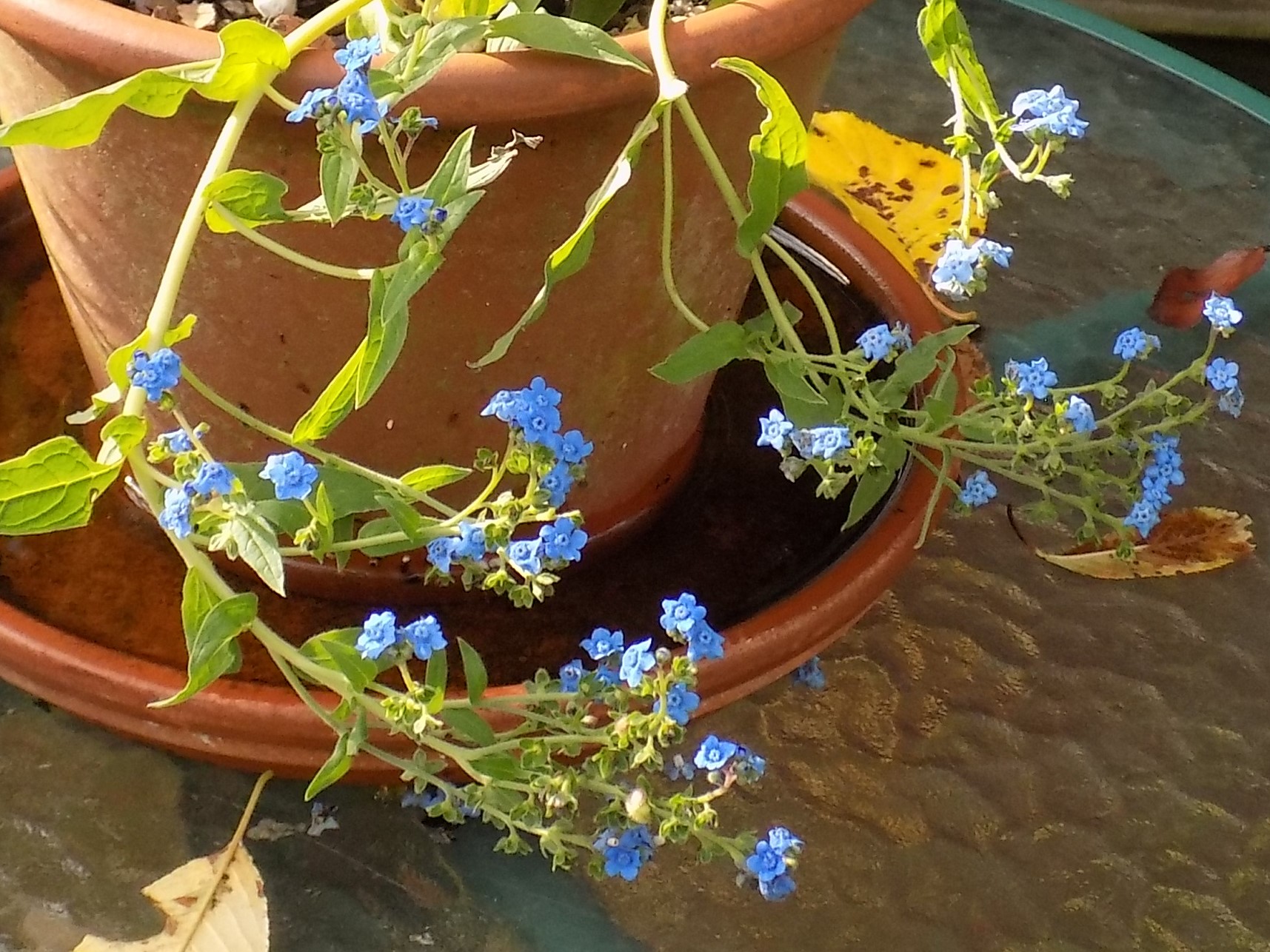
Back in the early summer, four packets of flower seeds arrived in my mother’s mail with a charitable solicitation. They sat around for a bit and, one day, when I had the luxury of working in my yard, I popped them in four separate pots without great expectations.

Ultimately, most of the seeds have sprouted and grown with varying levels of success, but the only ones to bloom so far are the vivid blue forget-me-nots. The garden table and surrounding yard where they sit is laden now with leaves from the cherry tree in the neighbor’s yard. That tree is always the first to shed its leaves, but also among the first to herald spring a few months later.


Short days and cooler weather often have a negative effect on my mood, but a suggestive impact on my inner soundtrack. I will swear that yesterday, on the first morning of September, I woke up with Earth, Wind & Fire’s “September” running constantly through my head.

As I got more awake, “Try to Remember,” from the Tom Jones and Harvey Schmidt chamber musical The Fantasticks, began to dominate with its recurring motif of words that rhyme with September and other infectious internal rhyme and wordplay.

More fully awake, the tune that haunts me is Green Day’s “Wake Me Up When September Ends,” a song that, like all universal literature, morphs depending on the moment. Written in response to a parent’s death from cancer, it has dealt with the tragedy of 9/11 and war and the loss of life and dignity after Katrina.

My most visceral musical response to this particular September of 2020, however, is Rosanne Cash’s haunting duet with her father, Johnny, in her song “September When It Comes,” a plaintive song of memory, pain, and reconciliation. She sings:

Well first there’s summer, then I’ll let you in.
September when it comes.

These past six months have done a number on all of us. The pervasive pandemic and its still-indecisive outcomes and after-effects have worked on all of our nervous systems, regardless of our political affiliations. The fact that it has become political adds to the undeniable and needless tension and stress.

I have chosen to minimize my intake of “news” for a while. I need to step back and more judiciously protect the information I consume. I need to halter the despair.


The writer, Verlyn Klinkenborg, whose contemplative essays often provide balm in times of stress, remarked on the over-saturation of media coverage in the aftermath of 9/11 almost nineteen years ago. He calls 9/11/2001 “that sudden Tuesday.” Could it ever be summarized more perfectly?

Reacting to the saturation of media coverage of that event, and to the fact that we Americans were re-playing the tragedy over and over on our screens, Klinkenborg wrote:

It’s hard to know, just yet, whether for each of us this witnessing has caused an erosion or a sedimentation, a stripping away of the skin or a callusing. But paradoxical as it may sound, to continue to bear witness, in conscience, it may be necessary to stop watching for a while, to turn off the television, to break what for some people has become a self-reinforcing circle of despair.


In those stoic days after 9/11, I was working at Alabama Shakespeare Festival in Montgomery. Our theatre complex was located in a pastoral park, across the lake from the Montgomery Museum of Fine Arts. A couple of days after “that sudden Tuesday,” I escaped to the Museum for a quiet lunch away from the news reports that permeated every space I encountered.

A group of older ladies was seated at a table near me. As I eavesdropped on their chatter, I discovered that they were from all over the country — stuck for a while at a hotel in Montgomery, waiting for the airports to open and for travel to resume. Periodically, during the conversations, I heard references to the tragedy that had left them all stranded for a moment in time. Mostly, however, I heard the resolute and determined voices of American women who were forced together in the most unlikely of circumstances and were making connections and “making do” until they were able to move on with their lives.  They were awaiting the break in the clouds that engulfed us.


Might that “circle of despair” be somehow broken in this current moment?

Remembering Jesse Owens

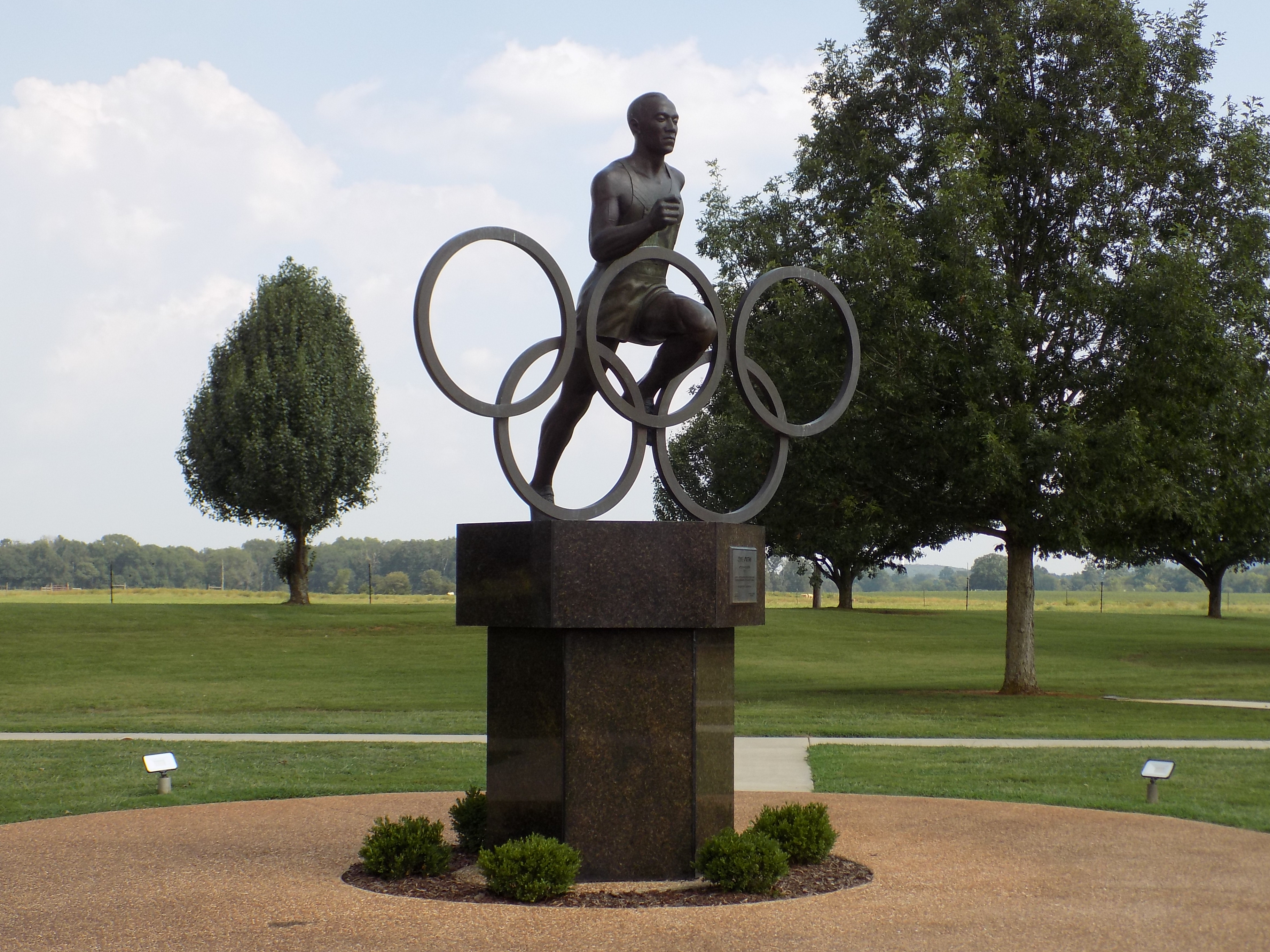
Jesse Owens by Branko Medenica

Traveling up I-65 from Birmingham with a friend a few years ago, we passed a billboard for the Jesse Owens Park and Museum (www.jesseowensmemorialpark.com) in Oakville, an unincorporated community in Lawrence County, Alabama. My friend, who is from Ohio and was a college track athlete there, said, “What is a Jesse Owens museum doing in Alabama?”

“He was born here.” My friend didn’t know that; I guess a lot of people don’t.

James Cleveland Owens (1913-1980), who later became famous as “Jesse,” was born into a sharecropper family in Oakville. His reputation began to be made when the family relocated to Cleveland, Ohio, and Jesse became a high school track star before becoming a star college athlete at Ohio State. At a Big Ten meet in Michigan in 1935, Owens broke three world records and tied a fourth in a seventy-minute span.

The primary Owens legend was born from his participation in the 1936 Berlin “Nazi” Olympics where he put the lie to Hitler’s assertion of Aryan superiority by winning four gold medals and establishing an Olympic long-jump record that stood for over a quarter century. Ironically, the best visual documentation of Owens’s Olympic triumphs is seen in Olympia, German documentarian Leni Riefenstahl’s propaganda film about the 1936 Olympics.


The Oakville park is a bucolic place, with views of farms in the near distance, athletic fields, and places for picnics and reflection. The museum has an impressive timeline, film, and interactive displays with artifacts and details of the life of Owens.

A sand jump pit borders one of the walkways so that aspiring athletes might compare their skills to Owens’s 26 ft. 5 ¼ in. Olympic record.

Of most interest to me is the recreation of the Oakville sharecropper’s house where Owens was born and grew up prior to the family’s move to Cleveland. A narration of the house is available, spoken by Owens’s brother, Sylvester.

Jesse Owens was the youngest of ten children – all of whom shared a pallet in a small room next to the main room. The main room also held the bed where the parents slept. The back of the house is a long room with a sparsely-furnished kitchen on one side and a wooden table and chairs on the other.

An Owens statue, by Birmingham-based sculptor Branko Medenica (www.brankoart.com), stands between the house and the museum. It shows Owens symbolically breaking through the Olympic rings. The statue was unveiled on the day in June 1996 when the Olympic torch, carried by Owens’s grandson, passed through tiny Oakville on its way to the Atlanta Olympics.

Paul Rudolph’s Alabama Legacy

Ridgelawn Drive, in the small north Alabama town of Athens, is a pleasant and shady residential street of well-kept lawns and attractive houses. The fact that two of those houses were designed by a premier architect of the mid-20th Century is a surprise that adds to the charm of the place.

On a recent free afternoon, I decided to drive the 30-something miles to Ridgelawn to finally see the Wallace House, designed by American architect Paul Rudolph (www.paulrudolph.org) in the early 1960s. I am always on the prowl for distinctive architecture and have known of that Athens house for decades, but had never taken the time to track it down.


Paul Rudolph (1918-1997), who studied at Harvard under Walter Gropius of the Bauhaus, was born in Kentucky. His father was a Methodist preacher. Paul, as a “preacher’s kid,” was accustomed to frequent moves. He and his family lived in Athens in his high school years and he spoke years later of the Southern architectural influence on his aesthetic:

… my first memories of architecture were the Greek Revival buildings of the area and the sharecroppers’ cottages, both of which intrigued me no end. Both seemed to have a complete validity – in other words, vernacular and so-called high architecture.

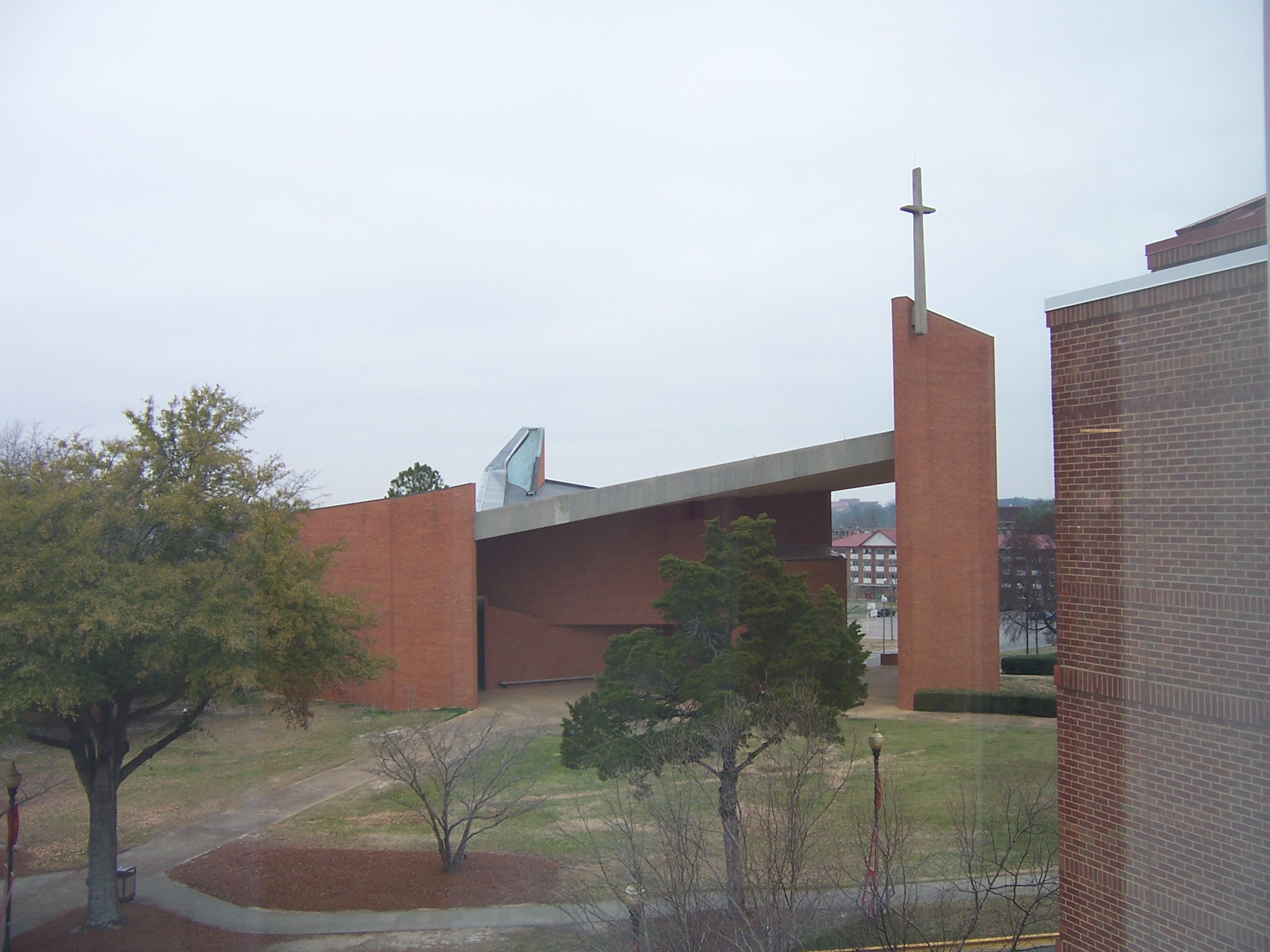
There are several Rudolph buildings in Alabama, including houses and buildings in Auburn, and the Chapel at Tuskegee, which Rudolph designed in collaboration with Tuskegee University students.

Chapel at Tuskegee

I am curious about a spectacular unbuilt 1965 design for the “Callahan Residence” in Birmingham. I am aware of another modernist house, designed by Moshe Safdie, on Red Mountain that was owned by a Callahan family and suspect the Rudolph design might have been a contender for that site.

Rudolph earned his bachelor’s degree in architecture at what is now Auburn University, entered the master’s program at Harvard Graduate School of Design, served a stint as a soldier in World War II, and finally completed his master’s from Harvard in 1947.

After six years as Chair of Architecture at Yale, Rudolph returned to private practice in 1964, around the time the Wallace house was completed. One of Rudolph’s most noted and enduring designs from those years is the Yale Art and Architecture Building.

Rudolph is most identified with the “brutalist” movement in modern architecture. His buildings were often super-functional without extraneous adornment. They often incorporate structures of basic concrete with some glass. The style can be foreboding and oppressive to the eye. As a lay architecture enthusiast, I appreciate what the brutalist movement was doing, but I don’t always find it appealing.


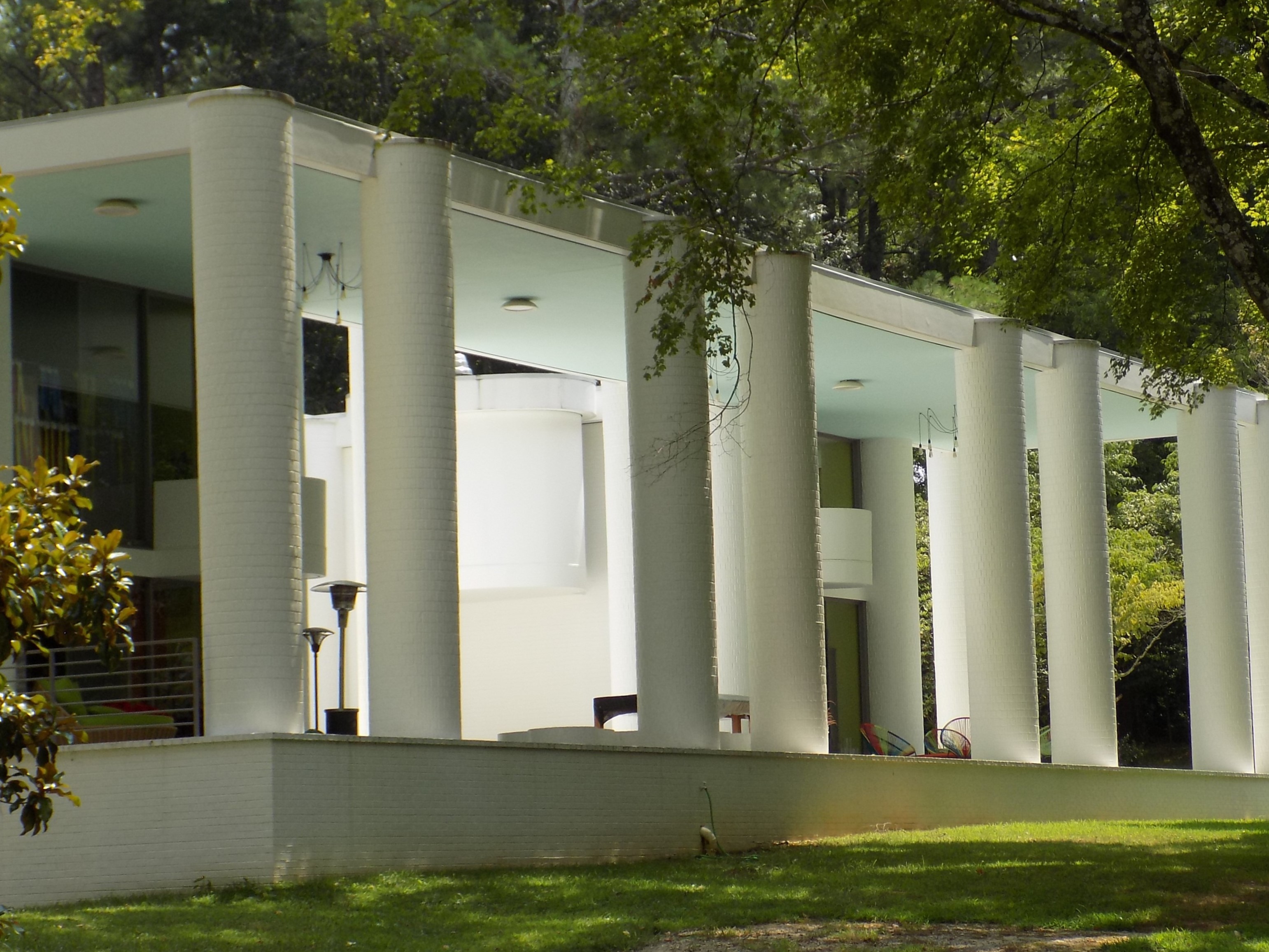
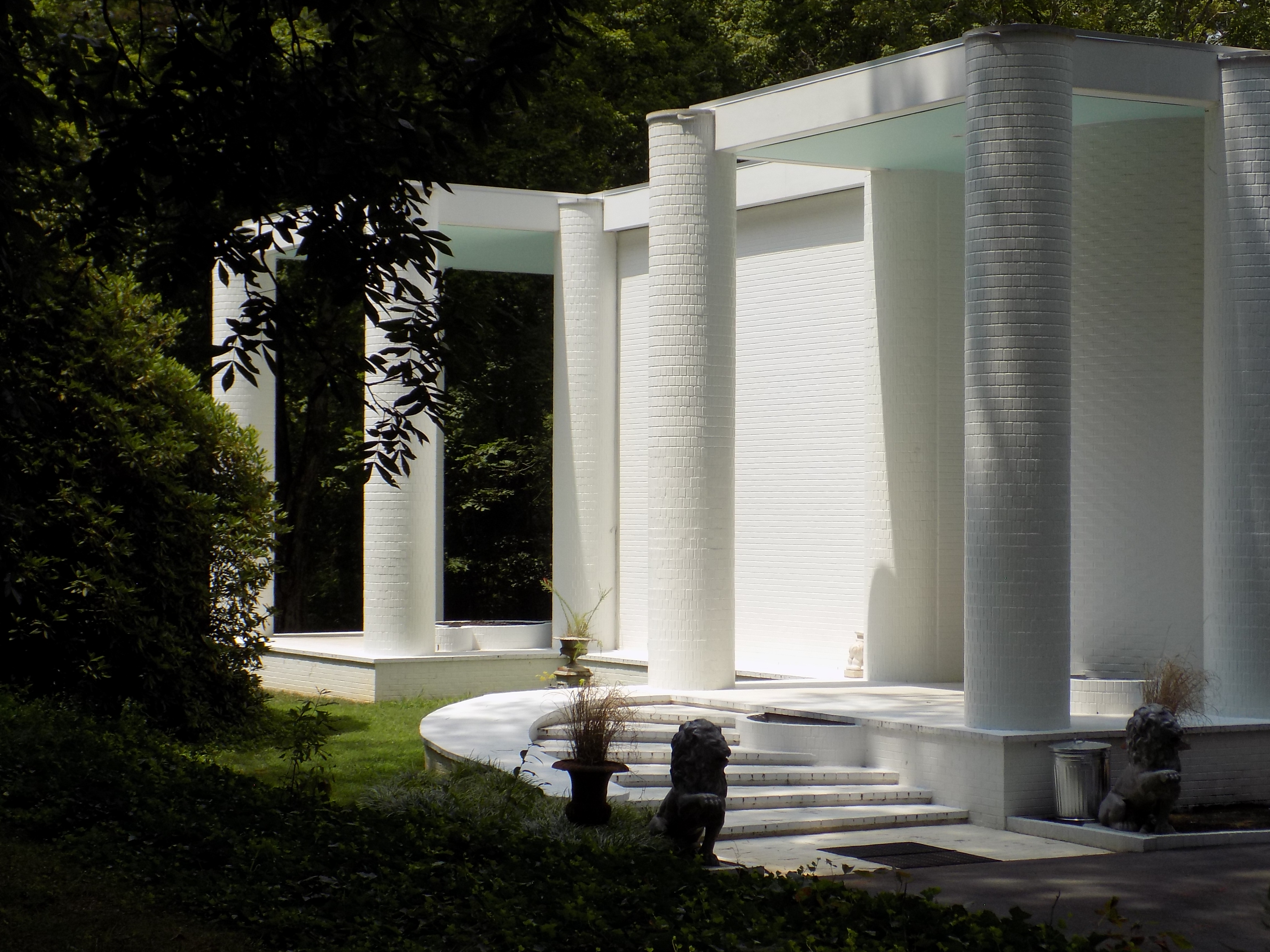
Back at Ridgelawn Drive in Athens, I came to a big curve in the road and there it was. On first view, the house was such a stark white, and there was so much blank white space in what I supposed was the front of the house, that I wasn’t sure what to think. It seemed almost like a construction site, but the windows just under the flat roof looked like the house was lived in. I don’t trespass on private property so I made do with views from the street.

A grand oval driveway goes up to the building on that side and a curved set of steps indicates an entrance that is not quite visible.

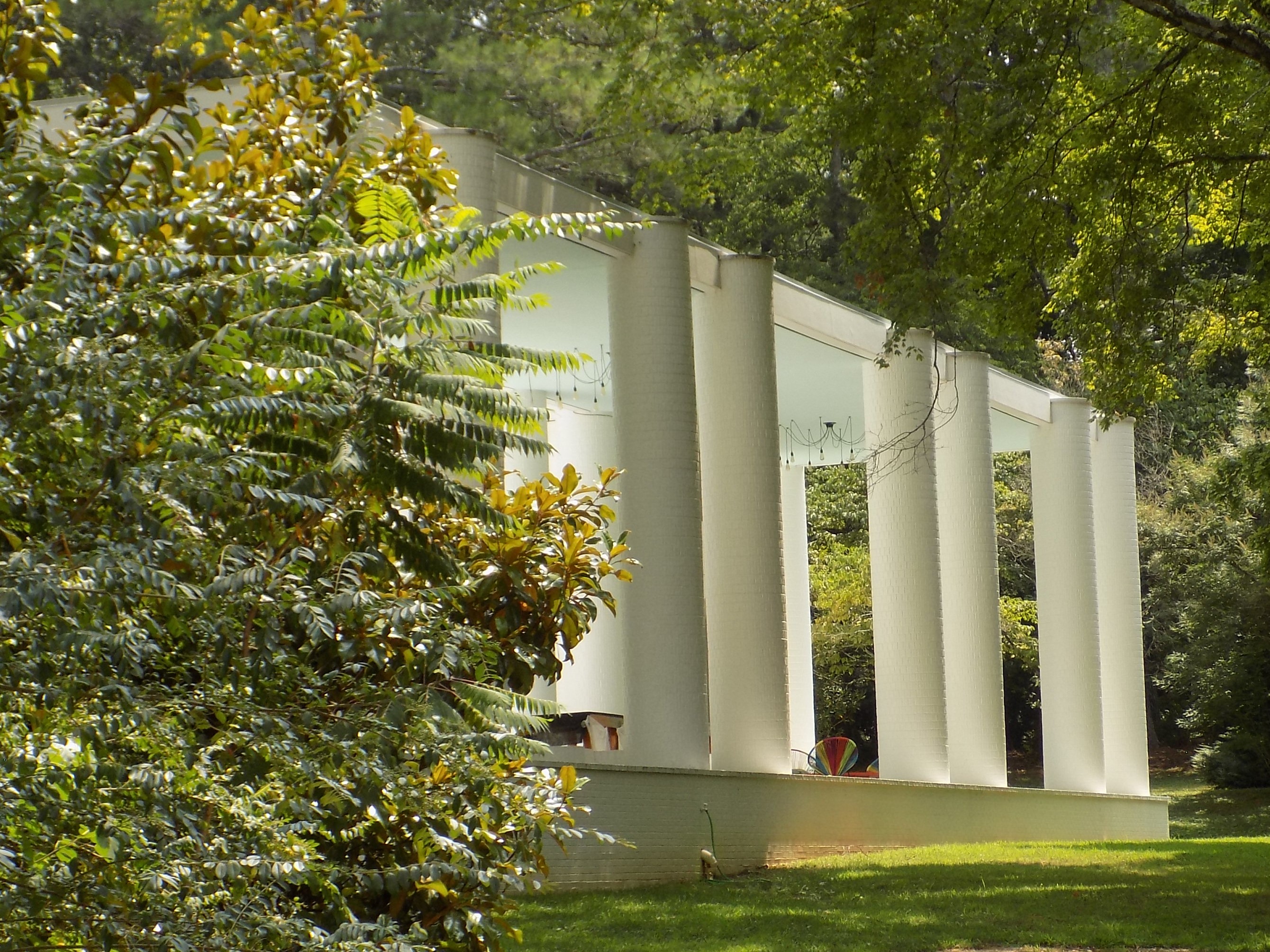
As one continues around the road’s curve, the mature trees are such that the house itself is often obscured. Reaching a mailbox on the side of the road, another angle comes into view. This is, technically, the “rear” of the house, but the power of the design starts to make sense as the house and its spacious courtyard and porch open themselves to a shady wooded lawn.

The house features an open courtyard and 32 massive brick columns, painted a vivid white, supporting a barely visible roof at the façade. When I visited, the façade was in shade, but a distinctive glow emanated from the open courtyard. The house, from the street, seemed to shine from within.

Rudolph said

If you know the location of this house it is clear that it really comes from the Greek Revival architecture of the South, but it certainly doesn’t have any Greek Revival symbols, although its image is similar because it tries to solve some of the same problems.

The stark white and glass basics of the house’s exterior are occasionally broken up by flower pots and concrete lions, colorful chairs in the courtyard, and color fields visible near the entrances. On the day of my visit, two lawn deer were situated at a distance in the back yard; one was standing steady and the other had fallen.

The Wallace family occupied the house until Frances Garth Wallace, who had been a childhood friend of Rudolph, passed away in 2015.

I thought I had sufficiently done my homework on the Wallace House. As I drove back down Ridgelawn and out of the neighborhood, I noted that the other houses on the street were so conventionally removed from the style of the Wallace House.

I noted that there was one other house down the street that looked like it had clearly been impacted by the Rudolph design. When I got home and began to do a little more research about the Wallace House, I discovered that the house that had caught my interest was the Martin House, another Paul Rudolph design on Ridgelawn. In fact, the Martin House actually predated the Wallace House by several years.

Not far away from Ridgelawn Drive, the quaint and charming courthouse square in downtown Athens belies the existence of significant mid-century architecture hidden away in another part of town.

… not such a bad place to die: A Memory of August

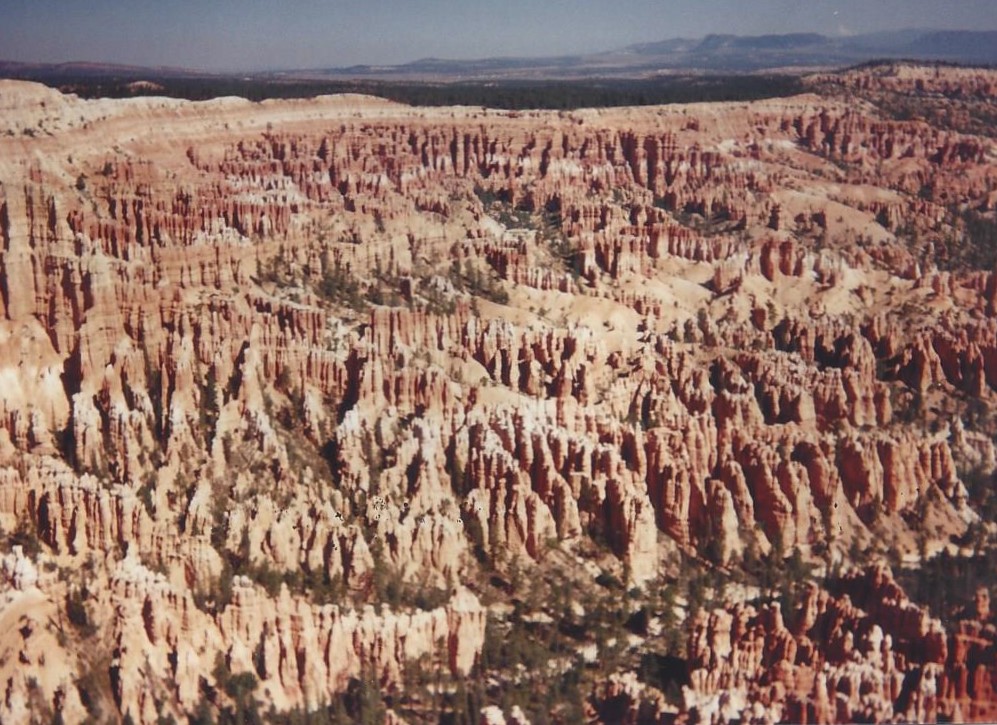
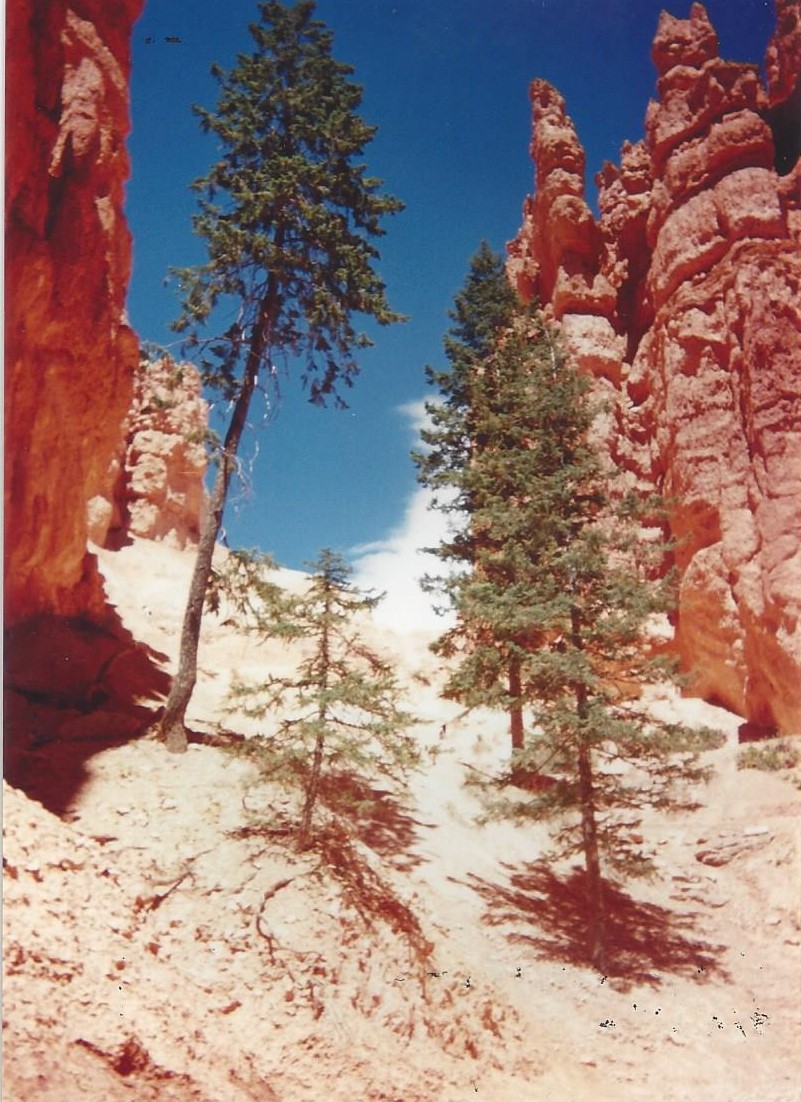
Starting at Sunset Point, the Navajo Loop trail in Utah’s Bryce Canyon is a moderately difficult 1.4-miles. A series of dramatic switchbacks leads to the canyon floor before the trail moves back up through the hoodoo-laced canyon to the rim. On reaching the floor, one looks up at the dots of people looking into the canyon from various observation points and thinks Was I up there? Back at the top, looking down into the vast reach, one wonders Was I really down there?

Bryce Canyon is one of the most memorable natural sites in the United States with its multitude of hoodoos rising from the red rocks of southwest Utah’s high desert. No matter how many photos one has seen, nothing quite prepares you for the first actual view from the rim. The hoodoos are the product of millennia of erosion. Indigenous people were likely aware of the place 12,000 years ago but human habitation of the foreboding area is only documented as recently as 200 A.D. Mormons settled in the general area in the late 19th Century, but its remote location made Bryce Canyon a relative late-comer to the tourist trade. That is probably a blessing.

The Bryce Canyon hoodoos provide a noble and majestic presence, silently watching over the landscape. Hoodoos are found around the world, but Bryce Canyon is the planet’s largest concentration of the eerie, often human-seeming, forms.

A reward of living among the Mormon throngs in St. George, in southwestern Utah, in 1995 was its proximity to amazing scenery. St. George was three hours from the north rim of the Grand Canyon; Zion National Park was less than an hour away in the other direction; and Bryce Canyon was an hour and change drive from Zion. If I ever got weary of natural wonders, Las Vegas was a couple of hours away during my more superficially-inclined days off.

I first saw Bryce Canyon and hiked Navajo Loop during that summer of 1995. I was with friends, we took our time, and the hike was peaceful, contemplative, and stunning from top to bottom and back. The trail includes some of Bryce’s signature locations like Wall Street and Thor’s Hammer. After hiking Navajo Loop, we had time and energy to explore some of the adjoining, picturesque, and less challenging Queen’s Garden trail.


Seven summers later, in August 2002, I was back in southwestern Utah, conducting auditions at a theatre in Cedar City. I added an extra day to the trip just to renew my acquaintance with Bryce Canyon. I picked up the rental car early in the morning so that there would be time to make stops along the way, especially at Cedar Breaks National Monument, another spectacular hoodoo-filled amphitheatre between Cedar City and Bryce.

On the dusty outskirts of Bryce Canyon National Park, I made sure to stock up on water and supplies at the general store at Ruby’s Inn, and to get extra sunscreen for what was already a sizzling day. Teeming crowds were along the rim road at several overlooks. I stopped at a few to view the grandeur of the Bryce Canyon amphitheatre before diving in.

With fond memories of my previous leisurely hike on the Navajo Loop, I decided to start my hiking there. With hiking boots securely tied and backpack sensibly packed, I embarked on the beckoning switchbacks that initiate the trail. There were far fewer hikers than gawkers and only a few hikers were above and below me as I entered the trail and began the descent to the canyon floor.

Taking regular short breaks to hydrate and savor the scenery, I reached the bottom of the trail as refreshed and enthusiastically as I had seven years earlier. To be honest, I was proud of my vigorous endurance.

Eventually, it was time to start my ascent and plot out the next hike to end the day. Pleased with my progress so far, I set off up the trail. Looking at the dots of people at the top, I thought I’ve got this.

The more I climbed, the more my legs ached to the bone. As I trudged, I felt the sweat dripping from every pore in my body – even the more inconvenient ones. I kept looking up to the blasted rim that never seemed to get any closer. I was guzzling water by this point, but it didn’t help.

The book of Proverbs cautions that “pride goeth before the fall” and I kept hearing that in my throbbing, sweating, miserable head.

Near the halfway point of my ascent, I flopped onto a convenient boulder and sat in a puddle of my own perspiration, trying to look like anything but a damp dishrag. Children stared as they passed with their parents; they sidled up to a mother or father, obviously asking about the desperate looking man on the rock. The parents, placing a firm hand on their back, urged them to keep moving.

A couple of times, hikers — either solo or in a pair — would ask, “You okay?”

“I’m fine,” I’d reply. “Just relaxing, enjoying the view.”

I was thinking This is not such a bad place to die.

I’m sure some of those early Mormon settlers thought the same thing, but probably with a more optimistic frame of mind. Although Ebenezer Bryce, one of those settlers, is quoted as saying “It’s a helluva place to lose a cow.”

Eventually, somehow, I rallied, got back up, and slowly climbed on. When I reached the connector to the Queen’s Garden trail, I mustered a wan smile, thought not today, and  got back to Sunrise Point and my rental car.

After sitting at the overlook for a spell and looking back at the depth from which I came, I drove away from Bryce, eagerly vowing to tackle it once again at some future time.

Eighteen Augusts later, I still look forward to it.

Ascetic August 2020

Local tomatoes are prolific in this mid-summer early August as I gratefully accept all offers from friends and neighbors. There may be a glut of home-grown tomatoes right now; they will – like the summer – disappear soon enough, and much too soon for my tastes.

Not long ago, not having a fresh tomato on hand, and sort of craving tomatoes, I made the mistake of buying one on a whim at the grocery store. It has been years since I purchased a supermarket tomato and I was shocked anew at the lack of taste and the plastic consistency; I was reminded why I swore off supermarket tomatoes in the first place. After a couple of bites, I threw the pretender out and waited for a farmers’ market or a kind friend to come through. I never had much luck growing tomatoes on my own.

Fortunately, tomatoes have been coming from all directions in the past few weeks and I haven’t wasted a single one. Salads, tomato sandwiches, and sharp acidic sauces are the order of the day and, for many meals, a tomato sandwich or two suffice.

After the first frost, I may use good canned tomatoes – preferably Italian San Marzano, as needed, for recipes and sauces, but the authentic taste of a fresh locally grown summer tomato, still warm from the plant, is the epitome of summer southern comfort.

In the ascetic summer of 2020, simple home-based pleasures like fresh tomatoes take on added significance. I’m grateful for my retirement; this fraught fall semester of teaching would surely have done me in.


I recently read a piece about Ernie Pyle, the iconic World War II war correspondent who was a casualty of the war in Japan in 1945. In a dispatch during the war, he wrote: “Someday when peace has returned to this odd world, I want to come to London again and stand on a certain balcony on a moonlit night and look down upon the peaceful silver curve of the Thames with its dark bridges.”

Tonight, a full moon is just appearing through the trees over Green Mountain and I understand Pyle’s longing — a longing that is in most of us, I suspect. Pyle expresses the opportunity to return to something loved, something missed, something yearned for. The idea of “normal” is toppled, but we try to make amends.


In 1989, Norman Rene’s Longtime Companion, with a script by Craig Lucas, was the first theatrical film to address the AIDS crisis. In the final scene, three friends who have survived the initial onslaught of the virus – before it was quite understood – are walking along a lonely Fire Island beach. They are musing about what it will be like when a cure is found.

Willy, Campbell Scott’s character, says, “I just want to be there,” cuing a fantasy sequence in which hundreds jubilantly flock to and party on their beach. The three stalwarts are reunited with their old friends who have succumbed to the (then) mysterious virus. As abruptly as it began, the fantasy ends, and the three figures are left once again on the beach, alone.

Ronald Reagan’s denial of the AIDS outbreak during his presidency, in the early years of that particular pandemic, calls to mind the current self-serving denial of the Oval Office’s current occupant. I cannot change the world, so I will try to nurture myself with its bounty and trust the doctors to see us through. And I will vote come election day.

I just want to be there.

Pecan Peccadillo

I-65, exit 289; Alabama

In this overly contentious and troubling time, it’s refreshing to see people take to LinkedIn to quibble over the pronunciation of a simple word.

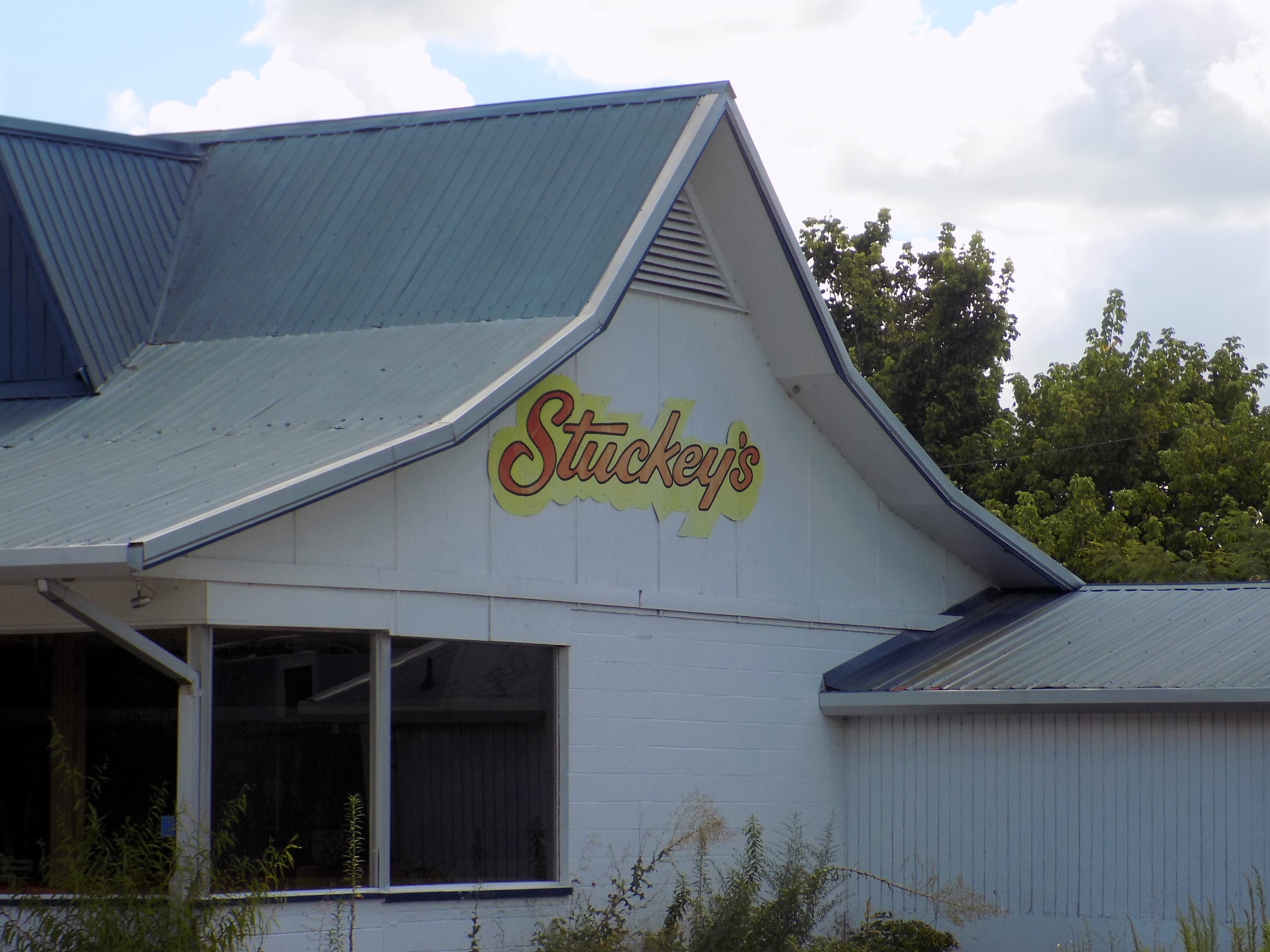
Stuckey’s, the iconic roadside chain of highway stops (www.stuckeys.com), was a constant in my family travels growing up, especially on trips to the Gulf coast. It was a true roadside attraction, offering pecan-based treats, fast food and sodas, souvenirs, gasoline, and convenient (and usually clean) restrooms.

While the chain is best known for its exceptional pecan products, I was always partial to the sweet “fruit slice” candies that could usually be found. The last time I was in a Stuckey’s store, I was amused that the souvenirs seemed to be from every state – not just the state I was in.

W.S. and Ethel Stuckey of Eastman, Georgia, founded the brand in the 1930s. Their first location was a way to sell the Stuckey pecan crop. Soon, Mrs. Stuckey began to add to the offerings with things like divinity and pralines and, most notably, her special creation – the pecan log roll.

W.S. and Ethel’s granddaughter, Stephanie Stuckey, is the new CEO of Stuckey’s. Ms. Stuckey has launched an effort to locate and reclaim old Stuckey locations and rejuvenate the brand. As part of that effort, she has posted memories and details of her project. She has captured many imaginations along the way.

Among my favorite posts is the one in which she tells how her grandfather would fuel up with coffee and start driving the highways. When he had to stop for a restroom break, he would decide that was a good spot for another Stuckey’s store.

Recently, Ms. Stuckey posted what appears to be a vintage Stuckey’s ad with beautiful shiny pecans and the caption “It’s ‘PEE-CAN’.”

Cue the floodgates. People began to post reactions and support their side of the pecan pronunciation debate – a conflict that will never go away in the South. A commentary from a North Carolina man declared fervently that “PEE-CAN is the correct pronunciation!” and went on to say that any Southerner ought to know that and that those of us who say it any other way sound like Thurston Howell III on “Gilligan’s Island.”

I try not to jump into any fray these days, but I had to respond: “My Alabama family says ‘puh-KAHN’ and none of us sound like Thurston Howell. Also, Georgian Jimmy Carter, the epitome of a native Southerner, says ‘puh-KAHN.’ I bet you put peanuts in Pepsi — a sacrilege! Peanuts must go in Coca-Cola.”

I was enjoying the entertaining thread and had to stoke the fire by making reference to the old tradition – presumably Southern – of emptying part of a sleeve of salty peanuts into a bottle of soda, specifically Coca-Cola. Theories abound that the tradition was a convenient fast snack for blue collar workers or workers in the field in the early 20th Century. I had never known, until I saw it on a cooking show, that some people – North Carolinians, in particular – traditionally used Pepsi Cola instead of Coke for that down-home snack which I used to enjoy as a child. I guess it might work with Pepsi instead of Coke, but I will stick to Coca-Cola.

Still, the crux of the responses to the Stuckey ad was the acceptable pronunciation of “pecan.” Southern Living magazine has listed six variations on the pronunciation:

pah-KAHN; puh-CAN; PEE-can; PEE-kahn; pee-KAHN; and pee-CAN

I will be gracious and say that none of those are wrong, although I grew up hearing that a “pee-can” was something one kept in the car for emergencies on long trips. Or alongside the slop jar under the bed.

Most Georgians I know say “pee-CAN.” The aforementioned President Carter is a notable exception. I can’t think of any Alabamians I know who say anything other than “puh-KAHN,” and that includes some farmers who harvest and sell the nut. Priester’s Pecans in Fort Deposit, my favorite Alabama purveyor of pecan products (www.priesters.com), endorses the “puh-KAHN” pronunciation.

Pre-Pandemic, when I taught Voice and Diction classes, I would use “pecan” as an example of one of those words that has a variety of acceptable pronunciations. It isn’t necessarily even a detail of geography; I think it just has to do with who raised you. Like individual tastes in barbecue and cornbread, it has more to do with what one is familiar with and what one grew up with, and questions of relative quality become superficial.

For the record, though: I don’t accept the notion of sugar in cornbread; my barbecue tastes lean toward pork with vinegar-based sauces; I am still opposed to white barbecue sauce; and the old “peanut and soda” routine only works with a Coca-Cola.

I’m grateful to Stephanie Stuckey for giving me a pleasant distraction in difficult times. I am fully behind her ongoing crusade to reclaim and refurbish former Stuckey’s. Since I discovered her posts, I have been on the lookout for abandoned or rebranded Stuckey’s locations. I captured two as I travelled north on I-65 in Alabama this afternoon.

I-65, exit 318; Alabama

Stuckey’s is authentic, real-deal Americana. Its resurgence is a welcome antidote to the manufactured fake nostalgia of places like Cracker Barrel. I want a pecan log roll with a side of sugary “fruit slices,” and I want them now!

Shadows and Light

Shadow

There is a large quasi-Palladian window in the bedroom where I sleep at my parents’ house. Draperies cover the main window but the top arch is open. From the bed, I can see the stars, the clouds, and, frequently, the moon as it appears above Shades Mountain through the arch.

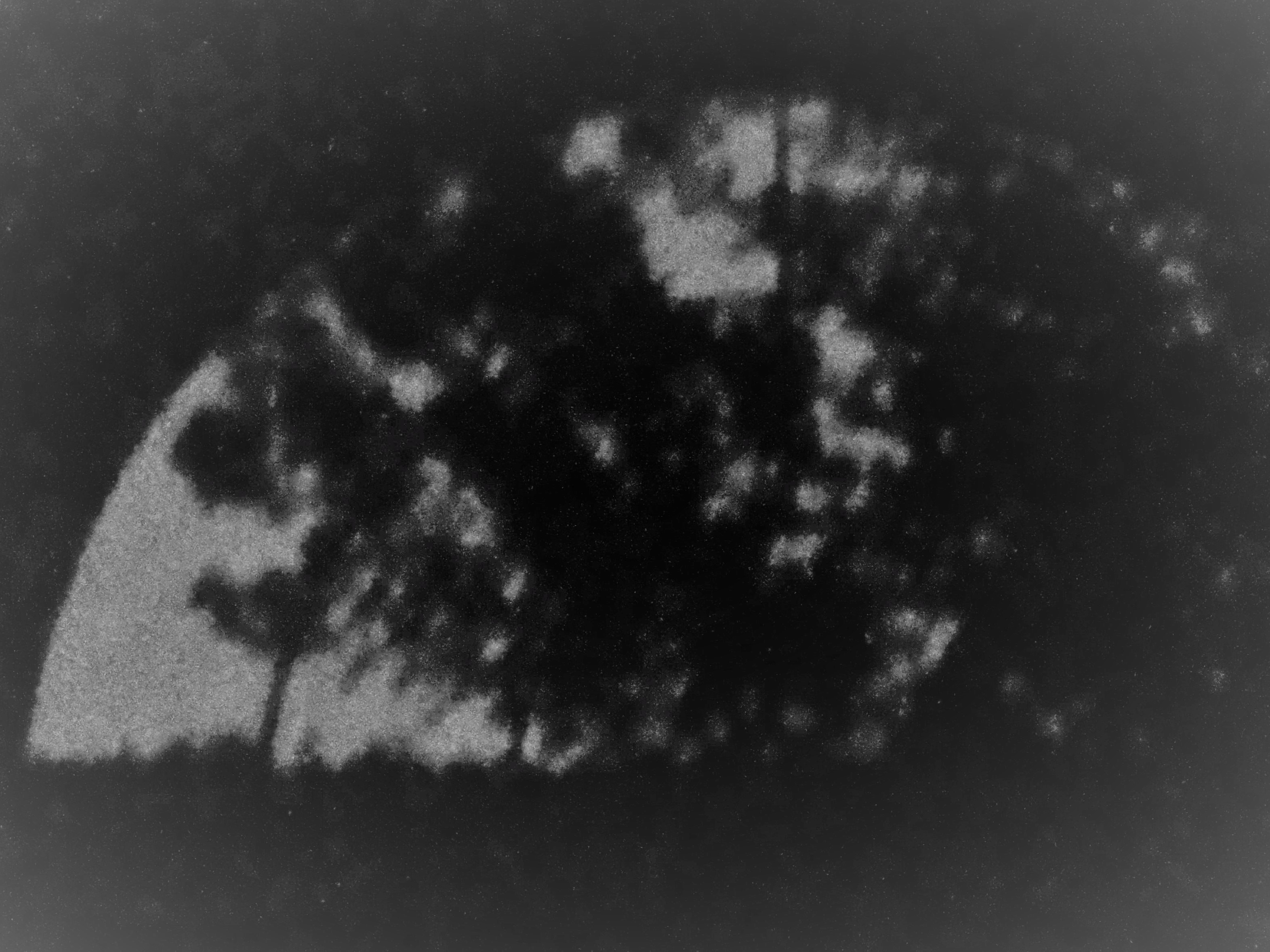
Just outside the window, a crape myrtle with rich burgundy blooms stands sentinel in the front yard. As I was going to sleep a couple of nights ago, I was struck by a silhouette on the bedroom wall opposite the window. A bright moon had cast a delicate shadow of the top branches of the crape myrtle. A gentle summer breeze was slightly blowing the branches and there was a lacy arched silhouette swaying against the bedroom wall. It relaxed me as I fell asleep.

Strangely enough, I started contemplating “Plato’s Cave.”

Plato’s “Republic,” from 380 B.C., includes an allegory about prisoners who have lived most of their lives in a cave, facing in only one direction toward the cave wall. Behind the prisoners is a fire and shadows of objects cast from the fire onto the cave wall are their only concept of “reality.” If they are ever able to escape from their cave of ignorance and see the true light, they tend to be distrustful and frightened of the true “reality” beyond their illusions.

It’s more complex than that, but that’s the gist. My political science degree must have kicked in one late night. I may just be excessively contemplative these days because I’m quarantined awaiting COVID test results. However, my night vision made me think about how we may be plagued just now with too many delusional cave dwellers in “leadership” positions and not enough seekers of enlightenment …

Mainly, though, I was struck by the beauty of a shadow on the wall as I sank into slumber a couple of nights ago.

Light

Dropping Deep: A Memory of July

In my years in Indiana in the mid-1990s, I worked a couple of summers as stage manager for two musicals running in rep at Lincoln Amphitheatre in Lincoln State Park, about forty miles east of Evansville.

I have found that summer theatre gigs – especially at outdoor theatres – have much in common with military boot camp. A crew of people living in close quarters, working hard, and unwinding when and if ever the opportunity arises.

Our “dark day” – the day on which we had no shows or rehearsals – was Monday. That was the day for resting a little, laundry, paying bills, shopping, car maintenance, and occasional impromptu parties or a nice dinner out.

Our technical director, Bud, would occasionally arrange group outings for Mondays. A “Christmas in July” event happened on a July Monday near the end of the season. It was held, naturally, in Santa Claus, Indiana, which was just a few miles from the state park.

My favorite Bud-organized event was the annual canoe trip on the Blue River near Milltown, Indiana. It was always held on the Monday closest to Independence Day. Most everybody in the company participated. After the Sunday night performance, we’d hit Schnuck’s and buy food and beverages to pack into coolers. My friend Randy always packed a large supply of chicken wings. Now that I’m thinking of it, I’m pretty sure I left my Blue River cooler to Randy when I moved to Texas.

On Monday morning, we’d leave Evansville early in cars and travel to Milltown (www.cavecountrycanoes.com). After grabbing our gear at the Milltown base, a school bus took our group of two dozen or more to the launch ramp seven miles upriver.

Even though our group started at the same ramp, it didn’t take long for everybody to spread out and the canoes travelled through quiet and solitude, passing an occasional angler or other canoers and kayakers along the way.

The Blue River is a scenic river with a series of Class 1 rapids passing through Indiana cave country on the way to the Ohio River. The bulk of the trip is through peaceful waters and verdant forests with the rapids comfortably spaced. Longer trips are available, but our 7-mile excursion – estimated at 2-4 hours length – was easily stretched longer with frequent pauses for breaks, lunch, and swimming at sandbars along the way.

It’s a perfect summer day that I looked forward to in my Indiana years.


Before you read on, you need to know this: … When I was a boy, I took swimming lessons at Midfield pool. The instructor was good and I learned to swim. On the final day of the two-week session, the swimming instructor wore street clothes and let all of the students just play in the pool, enjoying our newly-developed skills. That water play included a dive from the high diving board.

We had diving lessons earlier in the week and, while it was not my specialty, I was okay with it. On that final day, I eagerly climbed the ladder to the high dive to take my turn. When my turn came, I walked out to the edge of the board and looked down at the deep end of the municipal pool.

And I froze.

I don’t know how long I stood there, but it feels like a really long time. I wouldn’t jump, and I wouldn’t turn around and go back down the ladder. I was mortified. And petrified.

The other kids were urging me on, as were the adults at poolside. I still didn’t budge.

Finally, the poor swim instructor stripped down to his trunks and got in the pool. He assured me that if I would just jump, he’d be there if I had a problem.

Finally, I jumped and swam to the side. No problem. I still don’t know what happened to me up there on the high dive but, ever since, I am skittish in water over my head – especially if I’m not sure how deep it is.

Over time, however, when I do take the plunge, I have a habit of letting the fall continue after I hit the water until the downward momentum ends. Occasionally, I touch the bottom; usually, the fall stops before I get there. Then, I begin to swim back up to the surface. Nobody ever told me that isn’t the way it’s done …


Near the end of the Blue River canoe trip take-out point, the old Milltown Bridge crosses the river. It had been a tradition for some of the veterans of our group to jump off the bridge to close out the trip.

On my first Blue River adventure, my buddies in the group asked me if I would join them for the jump. Some were old hands at the ritual and others were first-timers like me. Given my trepidation with unknown depths, I was hesitant, but I finally decided to go for it. Five of us climbed up to the middle truss of the bridge and, after a short count, jumped in together.

The water was cool, deep, and pleasant and I allowed myself to drop until I wasn’t dropping anymore. It was freeing, a calming sensation that I still recall.

I slowly began my swim back to the surface of the flowing river. As soon as I surfaced, I heard shouts of “We’ve got him!” and three of my friends began grabbing at me to help me back to shore.

I had stayed under too long. I was being “saved,” it seems.

I kept insisting that I was fine to swim on my own, but my friends wouldn’t let me go until they had pulled me to the riverbank and forced me to lie on the ground, despite all my assurances that I was okay.

And oh, yes, we had drawn a crowd to watch my “rescue.”

I appreciate the concern. Now, all these years later, I still know I wasn’t in danger and would have successfully finished the swim on my own. I made a “note to self” to not allow the long drop to continue next time I plunged into deep water. It makes people anxious and causes all kinds of commotion.

Slightly embarrassed, I made my way to the showers, cleaned up, and changed clothes.


1971 news photo of Milltown Bridge by Berney Cowherd, Evansville Courier & Press

A subgroup of our canoers had made plans to travel over to Leavenworth, Indiana, for dinner at the Overlook, a restaurant on a bluff overlooking a gentle bend in the Ohio River. As we dined on home-style meals, the sun set across the Ohio. A nearly ideal Summer day – despite a brief setback – was drawing to its end with the evening drive back to Evansville in the direction of the setting sun.

Saharan Sunset | Moveable Feast

The fact that our lives in the Southeast United States this weekend were significantly influenced by an infusion of dust from the African Sahara is a reminder of how small our world is and how close we all are.

There is a quality of light on this early summer late afternoon that is striking. It’s hard to determine, really, how much is cloudiness as a front settles in and how much is the dust. I just finished re-reading Faulkner’s Light in August and, as a firm believer in the Faulkner claim that his title refers to an actual natural phenomenon, I prefer to attribute the odd quality of the sky today to natural occurrences from across the Atlantic.

Driving down a two-lane highway into Oxford, Mississippi, on an August afternoon some decades ago, I was sure that the specific light through the long-leaf pines was what Faulkner, and his wife, Estelle, who suggested the title Light in August, surely meant. It was a special and translucent light that is hard to describe. When you encounter it, you will surely recognize it.

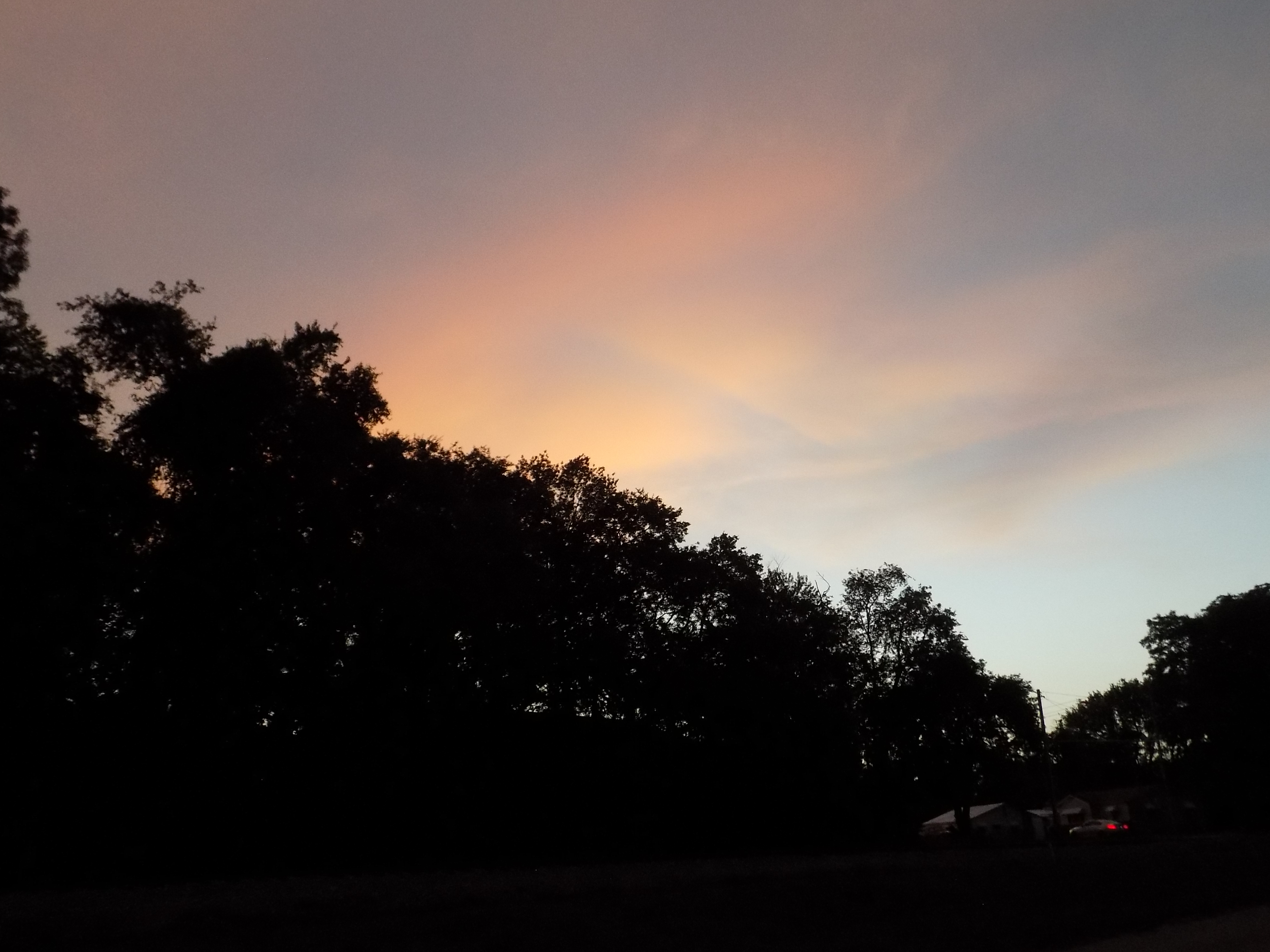
It has been raining off and on all day in north Alabama, and the pre-dusk light has taken on an intensely bright quality. The sunset last night was splendid, but tonight’s dusk tends to be leaning toward a chalky mundane.


Lifestyle changes have been the order of the day – every day – in this year of the pandemic. Much of my social activity for years centered around meals and an effort to satisfy my interest in foodways — in social as well as historical terms.

The last time I ate a meal in a restaurant was March. As restrictions have begun to be loosened – prematurely, I think – I still have no real desire to “dine in” for a while. I want to support my local eateries and I have ordered take-out from some of my favorite places in an effort to do so. Even as the restaurants do their part to ensure safety, there are just too many people who don’t seem to be taking this crisis seriously. Currently, I know of about eight people who are diagnosed with COVID.

I know many of the restaurants are open on a more restricted basis and I wish them well. I was amused to read that The Inn at Little Washington (www.theinnatlittlewashington.com), the much-acclaimed Virginia restaurant outside D.C., had plans to seat costumed mannequins in its dining rooms upon reopening so that the place would not feel so empty. It’s an amusing solution, but a little depressing, too.


Among the things I’m missing most are the Friends of the Café dinners in Florence at the factory/atelier of designer Natalie Chanin’s Alabama Chanin brand (www.alabamachanin.com).  These dinners began about five years ago and were my introduction to many chefs whose work was only previously known to me by their reputations and awards. I have met people from all over the world at these events and formed friendships along the way.

Four Friends of the Café dinner events were scheduled for 2020 and I had tickets to the whole series. The first two were postponed. The rest are up in the air for now. I am a little pessimistic about the likelihood that there will be any trips to Florence for Friends of the Café this year. The dinners also served as fundraisers for notable causes like Southern Foodways Alliance  and Chanin’s Project Threadways.

I have frequently written about these dinners in the past. The ambiance and sense of community they inspire always impressed me. Each featured chef has been on some part of the James Beard Award spectrum and the dinners have become a treasured part of my year.


American Public Television’s “Create” affiliate has aired the PBS show “Moveable Feast with Fine Cooking” (www.finecooking.com/moveablefeast) for a few years now. That program comes as close as anything I’ve found to capturing the spirit of those magical Florence meals. During the pandemic, “Moveable Feast” has become a brief escape for me, reminiscent of a more social time of the recent past.

The show’s title is inspired by a Hemingway title and quote about Paris in the 1920s. Each episode features a different location – sometimes American, sometimes international. The program host introduces the location and a couple of chefs from the area. They visit local purveyors to choose what to prepare for that evening’s “feast.”

Then it’s off to the kitchen where the host and guest chefs prepare their recipes for a pop-up communal meal. The show has always been appealing; nowadays, the sight of convivial guests gathering, hugging, shaking hands, toasting, and sitting down to have a meal together evokes bittersweet nostalgia.

“Create” showcased hours-long blocks of “Moveable Feast” episodes over the weekend and I found myself drawn to them – even though I had already viewed most of them. I was most pleased to revisit a charming episode in which host Michelle Bernstein visits and cooks with Jeremiah Tower, a godfather of California cuisine, in his current hometown of Merrida, Mexico. The occasionally prickly Tower, whose memoir California Dish is among my favorite books on food, exudes immaculate charm and wit as he shows Bernstein around the town and introduces her to a wealth of local ingredients and their knowledgeable purveyors.

In another favorite, host Pete Evans attends an event of “Outstanding in the Field” (www.outstandinginthefield.com), a roving pop-up restaurant event founded by artist Jim Denevan. The guest chef is Ravi Kapur and the site is Secret Sea Cove on the California coast. Guests at the table closest to the ocean get a gentle foot soaking as the tide moves in during the magical feast.

I was interested in what “Outstanding in the Field” is up to during the pandemic and found a moving letter from Jim Denevan on the website. He explains that the project is on hiatus until 2021 and concludes, “The table will be set. It will have been a long time coming. We are looking forward.”

In the milky sunset of a Saharan-influenced dusk, I will only add “Amen.”