Clover

  I have been accused of a lack of sentimentality. Constant moving around when I was growing up, I think, forced me to develop a hard shell. As the perennial “new kid,” I did not want to appear vulnerable.

Over time I have softened and am less hesitant to show my feelings.

My mother’s dog, Clover, died on April 3 and my heart is broken.

Growing up, my family always had dogs and the occasional cat. Mother and Dad’s last dogs, Sheba and Picasso, died when they were still living in Tuscaloosa and, by the time my parents moved back to Birmingham, Dad’s health was precarious; even though Mother wanted to get a dog, Dad’s health issues seemed to preclude it. When Dad passed away in spring 2016, Mother decided to get a companion and rescued a 5-year-old chihuahua with medium length hair.

The chihuahua had come into the shelter with a group of small dogs that we were told the owner could no longer take care of and the shelter had dubbed her “Great Aunt.” My mother renamed her “Clover.”

From the first day at the house, Clover was a sweet and considerate dog. At first, she seemed a little timid and was clearly afraid she might do something wrong in this new place where people were trying so hard to make her feel welcome. I asked Mother, “Have you ever heard her bark?” We weren’t sure if she even barked and we didn’t hear her bark for the first several days.

It didn’t take long for Clover to acclimate and eventually she started to bark. She had no interest in toys and, because she didn’t have many teeth, treats had to be carefully chosen. Her devotion to Mother was unwavering and she would sleep on the chair next to Mother’s bed, watching her through the night. If Mother got up to go to the bathroom, Clover would step inside to see that she was alright and then would go lie outside the door until Mother came back to bed.

She would never walk in front of people so she was never underfoot; we were amused by her nimble maneuvering to always be a step or two behind us. If someone came near Mother that Clover wasn’t sure of, Clover would subtly and strategically position herself between that person and Mother. She was basically toothless and not big enough to do much damage, probably, but she didn’t know that.

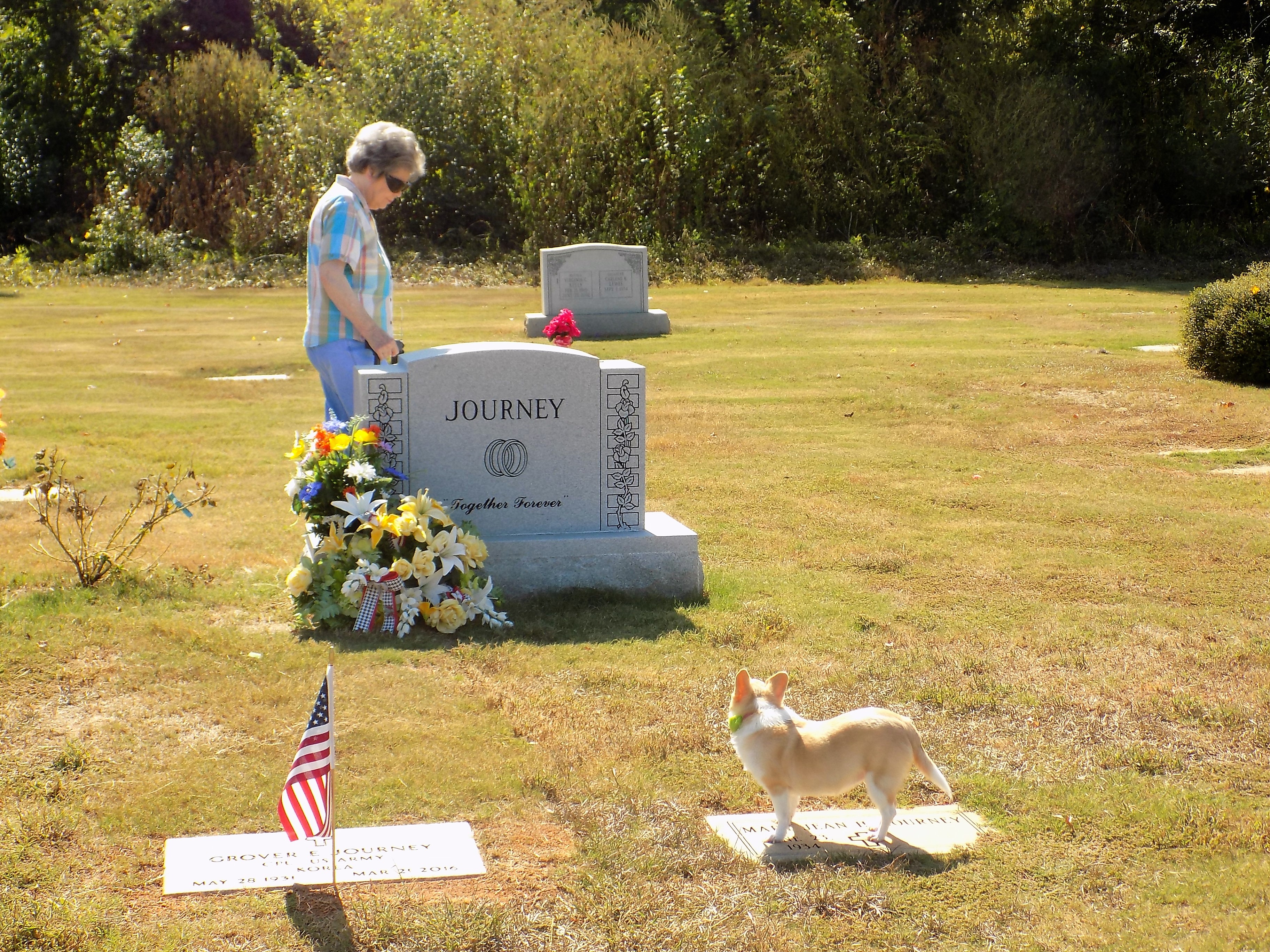
Mother would take Clover to the cemetery with her and Clover would eagerly jump out of the car and then step to the side until Mother emerged. Then, she would walk quietly behind Mother to Dad’s grave. While Mother visited, Clover liked to lie on Dad’s foot marker.  

When I spent the night at Mother’s house, I would hear Clover during the night walking to my bedroom door to check on me. If I sat up she would eagerly run to the side of the bed to be petted for a moment and then she would run back through the house to keep watch over Mother.

She loved to go for a ride in the car. If you said, “Clover, let’s go for a ride ,” she would bounce up and start dancing around; she couldn’t wait to jump in the car and go for a ride. She had a fascination with drive-thrus at restaurants and ATM drive-thrus. She would watch with curious interest as the cashier passed the food and exchanged money out the window and she loved the beeping sounds the ATMs made.

Clover had a preternatural love of belly rubs. Her eyes would roll back in her head ecstatically and after a good belly rub she would go to her bed and wallow in the after-effect.

Clover had a prodigious tongue. She could keep it contained inside her mouth if she wanted to but she rarely wanted to.

I credit Clover with helping Mother to get through the first year after Dad’s death. She brought some happiness and an element of joy back into a sad house. She helped me a lot, too, in that first year. When I would arrive at the house for a visit, I would ring the doorbell. The doorbell drove Clover crazy; she would stop whatever she was doing and start barking toward the door. But when I walked in the barking would stop and Clover’s entire body would shake as she would prance and dance around me and anticipate the first of many weekend belly rubs.

On an afternoon almost exactly a year after Dad’s death, Clover slowed down suddenly and without warning. She was lethargic, lacked energy. Mother was concerned and I joked “Oh, she’s been one of us for a year now; she’s just taking on the family trait – depression.”

But Clover wasn’t herself. When we would go for a ride in the car, she would wait to be picked up to get in the car. She wouldn’t jump out eagerly when we got to our destination.

I left her with Mother on Sunday afternoon, assuring Mother that Clover would snap out of whatever was wrong. After all, she had been given a clean bill of health just a few weeks earlier.

On Monday, Mother called me that Clover couldn’t walk and I rushed back to Birmingham to take her to the vet, Dr. Nikki Williams, who did several tests, found some blood irregularities, and kept Clover for a few days.

By the next weekend, Clover was back home and although she was clearly recovering she was not 100%. Still, she was back to as many of her old ways as she could muster and when I left the house on Sunday I felt good about her prognosis.

The next day, Mother called me and Clover had collapsed and had some sort of seizure. As soon as I could leave work, I rushed back to Birmingham but Mother and my sister-in-law had already gotten Clover back to Dr. Williams.

By Friday, Dr. Williams sent a very sick Clover to spend the weekend with us, thinking that a “couple of days of loving” with her family might help. Despite Clover’s valiant attempts, she seemed to be deteriorating rather than progressing and by Sunday afternoon Dr. Williams picked her up to care for her. On Monday, the vet informed Mother that there seemed to be no chance for improvement and Clover died in her vet’s arms on Monday night.

I may be being overly sentimental here, but it seemed in some ways that Clover was a bit of a guardian angel helping Mother get through the first year of losing Dad.  After that first rough year of comfort and love, her little body gave out on her.

She was irreplaceable. At the risk of cliché, I have no shame in saying our hearts are broken.

Notes on Didionland

 My most enduring images of California are fictional ones: Maria compulsively driving the freeways in Play It as It Lays; the snakes on the highway or coiled in the blanket of dead newlyweds or the rattlesnake in the playpen in the same novel.

Joan Didion’s 1970 Hollywood novel captured, for me, the angst and despair that I always associate with the sunny carefree surface California tries – still tries – to project despite the earthquakes, landslides, droughts, floods, and fire seasons that are the inevitable nightmare of the West Coast dream. Didion, with her detached style, digs to the core.

On my first and only trip to California – to L.A. for some auditions – it took over three hours for my hired car to get me from LAX to my Burbank hotel.

Beyond the auditions, the only thing I particularly cared to do was visit the Getty Center in Brentwood. I was more interested in the Richard Meier architecture and the Central Garden designed by Richard Irwin than the art, but it was nice to see Van Gogh’s “Irises.”

The beautiful, marble-clad buildings of the complex are stately and dignified. Even though they contain art, they feel barren in their context. There are hazy views of the city and the mountains and a vista of the Pacific to the west. Sounds of water over rocks, down runnels, splashing in fountains are ubiquitous. After living in the desert of southwestern Utah, I learned to understand the Southwest’s obsession with water and fountains and found it magnified in L.A.

My lunch at the Getty Center restaurant included one of the best Cobb salads I’ve ever had. It was my birthday so I had a dessert.

Throughout that Los Angeles trip, thoughts of images of travel forged in the wrought texts of Joan Didion were constantly evoked. The city was a reminder of Didion’s prose and of how that prose elicits a certain morbid fascination with California, even though the place holds no allure for me.


Didion’s essay, “In Bed,” about dealing with migraines, has for some reason stuck with me ever since I first read it in The White Album in 1990.

Then the pain comes, and I concentrate only on that. Right there is the usefulness of migraine, there in that imposed yoga, the concentration on the pain. For when the pain recedes, ten or twelve hours later, everything goes with it, all the hidden resentments, all the vain anxieties.

I have occasional migraines. Because Didion wrote that passage, I associate migraines with California, too.

The Year of Magical Thinking (2005), Didion’s most celebrated book of the 21st century, explores the nature of mourning and grief. It chronicles the year after Didion’s husband, John Gregory Dunne, dies unexpectedly. Before that book was published, Didion and Dunne’s daughter, Quintana Roo, died after an extended illness. Didion’s follow-up book, Blue Nights, focuses on Quintana’s death and expands on the themes of Magical Thinking.

A couple of years after The Year of Magical Thinking was published, a friend notified me of the death of her husband in an email. In the subject line, she wrote “Magical Thinking.” I thought Has Didion now defined grief, too?

Students tell me they plan to go to California after graduation. I say supportive things but I’m always thinking Why?

Didion would say Why not?

I never once planned to go to California.

Despite spending much of her adult life in New York, Didion always identifies and is identified with the West and California. She attempts to define her California identity in 2003’s Where I Was From, a collection of essays which explores the dichotomies and complexities of the place.

The first time anyone ever referred to me as an “Easterner” was on a trip to New Mexico in the 1980s. Prior to that I had only been called a “Southerner.” I remember that I was intrigued by the label and maybe a little pleased. Since then, I have realized that I am always most at home east of the Mississippi River.


I will read anything Joan Didion writes. That point is driven home by the fact that I just finished her latest “book,” South and West: From a Notebook (Alfred A. Knopf, 2017), which is a very compact compilation of some Didion journal notes from the 1970s.

South and West contains notes for stories that never quite came to fruition. “Notes on the South” is a document of a road trip Didion and Dunne took through Louisiana, Mississippi, and Alabama in 1970. “California Notes” is notes for a magazine piece about the Patricia Hearst trial but Patty Hearst is barely mentioned in that brief entry for a Rolling Stone article that never happened.

Still, the notes in themselves, with that contemplative Didion style, make for intriguing reading. The impetus for publishing the book of recycled notes at just this moment in time seems to be in response to the recent election cycle. In the “Notes on the South” section, Didion writes, about her decision to explore the South:

I had only some dim and unformed sense …that for some years the South and particularly the Gulf Coast had been for America what people were still saying California was, and what California seemed to me not to be: the future, the secret source of benevolent and malevolent energy, the psychic center.

Starting in New Orleans, Didion meanders, stops over in small towns, spends time in larger cities, doesn’t do what she planned to do, and doesn’t meet with people she planned to meet.

She observes beauticians, good ol’ boys, women at laundromats, men at diners watching soap operas, women at conventions talking about soap operas, ER doctors, men watching her swim in a bikini at a motel pool, Walker Percy, and snakes – lots of snakes. At dinner in Birmingham with Ivy League-educated locals, she muses on her dinner partners’ “rococo denial of their own sophistication, which I found dizzying to contemplate.”

For some reason, she couldn’t find William Faulkner’s grave in the Oxford cemetery where he’s buried. That perplexes me since I have visited that grave many times and it’s not that hard to find; I wish she had asked somebody for directions.

Her incisive observational eye provides details into the psyches of her subjects and, most effectively, sensory impressions. She finds that “everyone in Mississippi begins on the defensive.”

In Meridian, Mississippi, after a driving tour of the town with the white owner of the black radio station, she observes,

A few black women were on the streets, and they carried umbrellas against the sun. It was almost five o’clock. In the middle of 22nd Avenue, the main street of Meridian, there was a man holding a shotgun. He had on a pink shirt and a golfing cap, and in one ear there was a hearing aid. He raised the shotgun and shot toward the roof of a building several times.

The man is shooting at pigeons. “In this one demented afternoon,” Didion writes, “Mississippi lost much of its power to astonish me.”

The book presents “Notes on the South” as if the Zeitgeist-finding trip was never useful in producing a piece but it is surprising how much of that trip found its way – occasionally verbatim – into Didion’s 1977 novel, A Book of Common Prayer. That novel focuses on political upheaval in a Central American country, in the fictional Boca Grande, but much of the story of Charlotte involves semi-comatose road tripping through the American South and frequent references to an event that transpired at Birmingham’s Mountain Brook Country Club. In retrospect, “Notes on the South” is very present in A Book of Common Prayer.

107 pages of South and West are devoted to “Notes on the South.” The final section, “California Notes,” is a scant thirteen pages which mention Patricia Hearst but focus on Didion’s reflections and impressions of growing up and her family and cultural history there. Some of the material found its way into Where I Was From thirty years later.

“In the South,” she writes, “they are convinced that they have bloodied their place with history. In the West we do not believe that anything we do can bloody the land, or change it, or touch it.”

Ultimately in “Notes on California,” there is a search for what “home” means.

I am at home in the West. The hills of the coastal ranges look “right” to me, the particular flat expanse of the Central Valley comforts my eye. The place names have the ring of real places to me. I can pronounce the names of the rivers, and recognize the common trees and snakes. I am easy here in a way that I am not easy in other places.

Through Didion’s precise, distant, dry, and often bleak prose, every place she observes becomes Didionland.

Labyrinth

  During my time in Tuscaloosa, I lived in the student ghetto of houses and apartments behind The Strip of shops, bars, and restaurants on University Boulevard near the campus. Bryce and Partlow state mental health facilities were just past the campus and group homes and halfway houses were scattered among the student housing.

One particular resident, who stood out since he was always wearing a football helmet, had a routine which fascinated me. I would regularly see him start at one end of a block-long parking lot behind The Strip and walk a straight line to the other end. He would stop for a moment, turn, and walk precisely to the middle of the parking lot, stop, turn, and once again cut his previous distance in half. He would do this until the distance was so short that he would finally almost turn in a circle a few times. Finally, he would stop, mission completed, and go on his way. I watched him do this ritual on several occasions; his precision was prodigious.


Breathe, contemplate, take the first step … I have recently started walking labyrinths.

And even though I don’t classify walking a labyrinth the same as the helmeted guy’s routine, I do think about him on occasion when I am going through my labyrinth ritual.

I have always needed solitary meditative activities for my spiritual wellness and a labyrinth seems to fulfill that need. The symbolism of the activity – walking a unicursal path to the center and back – almost demands a contemplative state of mind. Since a modern labyrinth is not (usually) a maze, there is no need to think about the curves and turns of the path – one just goes with the flow.

I find the experience of walking a labyrinth akin to the feeling of visiting and walking the length of Tom Hendrix’s Wichahpi Commemorative Stone Wall off the Natchez Trace Parkway near Florence; the simple activity stirs a variety of thoughts and emotions along the way. Mr. Hendrix’s symbolism of a relative’s journey on the Trail of Tears becomes entangled with the visitor’s own thoughts and emotions in the moment.

The labyrinth has existed in various forms throughout cultures and history. In Greek mythology, the labyrinth was a complex maze used to contain the Minotaur.

It seems that the principal models for the contemporary labyrinths I have found are those found within medieval cathedrals. The labyrinth at the cathedral at Chartres is the most cited example and there are a number of versions of how it was used and what it symbolized within the medieval Christian church. Some sources assert that it symbolized the pilgrimage to Jerusalem but that seems to be a post-medieval concept.

Nowadays, modern labyrinths are found at churches, hospitals, wellness facilities,  educational institutions, private homes, and other locations. They seem mostly used for meditation, prayer, and focus; the symbolism is personal.

There are no rules for labyrinth walks but there seem to be traditions. It is traditional to take one’s shoes off, if practical, before entering the labyrinth. Take a moment to contemplate before embarking on the path. When the center is reached, take a moment before turning around and going back to where you began; it seems traditional to leave something behind in the center – a coin, a stone. When the labyrinth is completed, turn back and look at the path you have taken. Deep breaths at key points are recommended.

I have started taking the time to walk a labyrinth on my way home from work when I am able. It allows me to disconnect from the stress and the job and re-focus on other things I need to deal with.

There is a website, www.labyrinthlocator.com, that helps find labyrinths in any location. Once I found the website, I was surprised at how many there are and realized that I regularly pass labyrinth locations without realizing it. The World-Wide Labyrinth Locator database lists over 5300 labyrinths in over 80 countries. Twenty-nine are listed in Alabama and I have recently learned of one more, not listed, in Birmingham.

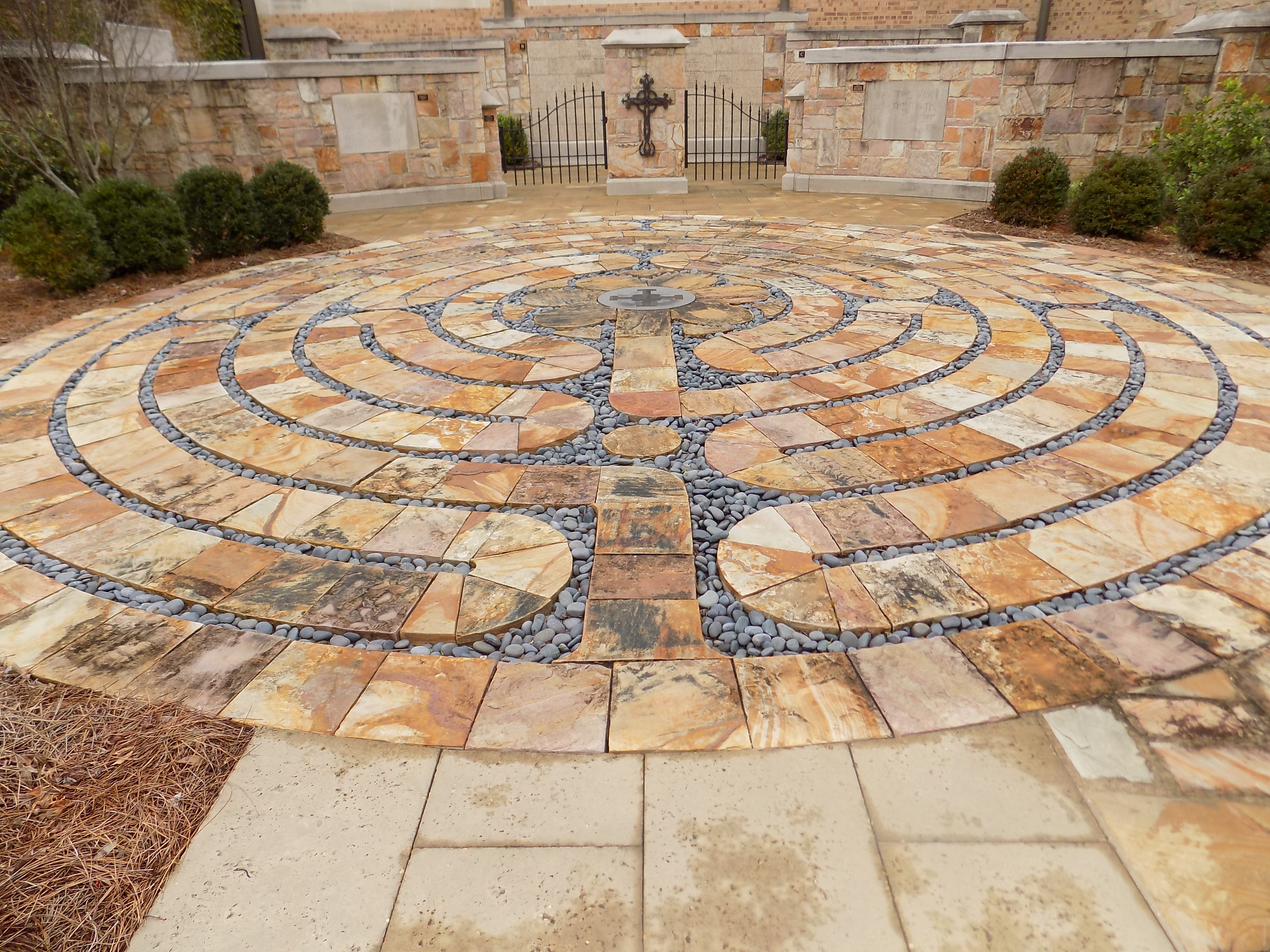
The one I just discovered is located at Trinity United Methodist Church in the Birmingham suburb of Homewood. It is a part of the church’s Prayer Garden and Columbarium. The church is on a busy road but the garden is below street level and that location, plus a trickling fountain at the entrance, filters out the street sounds and provides an added element of privacy to the space. The fact that the labyrinth is in front of a burial space makes it even more serene and introspective.

Walking the labyrinth, for me, is a compressed version of taking a contemplative nature walk. I find it calming and sensory. Since you can’t get “lost” walking a labyrinth, it becomes a “right brain task,” and a thoughtful exercise, like cutting the grass or sewing a button. (Or swimming laps, if you’re a better swimmer than I am.)

Such activities center me, somehow.

Breathe, contemplate, take the first step

Victuals

 For Americans of my generation, the word “victuals,” pronounced ‘vi-dls and sometimes spelled “vittles,” conjures up images of Granny Clampett of “The Beverly Hillbillies” cooking up something for Jed and the family. My own Grandmother Harbison occasionally used the word to refer to the scrumptious real food she was always preparing.

The word comes to us, after some alterations through French and English, from the Late Latin victualia meaning provisions for human consumption. My grandmother’s use of it probably harks to her Anglo-Saxon roots filtered through Appalachia. Those Anglo-Saxon roots are also likely the reason she sometimes still used the word “poke” to refer to a sack or bag.

These memories were conjured by the book I just read. I enjoy cookbooks that read like a narrative and few cookbooks fulfill that purpose as beautifully as Ronni Lundy’s Victuals: An Appalachian Journey, with Recipes (New York: Clarkson Potter / Publishers, 2016) with photographs by Johnny Autry.

Victuals explores and extols the foodways of the Southern Appalachians. The book has agendas: sustainable farming and environmental concerns come through loud and clear. But ultimately it is a celebration and explanation of a part of the country and a way of living that is sometimes undervalued and marginalized.

It is ironic that the trendiest chefs and food styles are discovering a way of food and living that has never gone away in the southern tangents of the great eastern mountain range. John Stehling of Asheville’s Early Girl Eatery observes, about southern Appalachia, “This place and its food have never died off, and it inspires me.” Indeed, a 2011 study declared southern and central Appalachia “the most diverse foodshed in North America.”

Lundy is among the founding members of Southern Foodways Alliance and has written extensively on Southern food, culture, and roots music over the years. With Victuals she digs deep into Appalachian roots in eight distinct, beautifully written, and well-documented sections which present stories, recipes, and individuals as well as document the threats that menace the noble and well-established way of living in the region. The sociology of Victuals is as compelling as its culinary focus in sections with titles like “Roots and Seeds,” “Apple-achia,” “Preserving,’ and “Husbandry.”

Victuals introduces the reader to a variety of farmers and butchers, chefs and cooks, purveyors, environmentalists, and food experts throughout the region. Many faces are new and others are familiar names like Chefs Sean Brock and John Fleer, and Chef Erik Neil of Chattanooga’s Easy Bistro and Main Street Meats. I was pleased to see a mention of Big Horse Creek Farm in Lansing, North Carolina, where a few years ago Suzanne and Ron Joyner were able to hook me up with some of the Hackworth apples that my mother remembered from her youth in Cullman County, Alabama.

Johnny Autry’s enticing photographs set one’s mouth to watering even before the text can be read. Soon after I received the book I casually opened it to a photo of English Pea Salad with Cream Dressing; it made me long for a taste and brought up memories of a long-forgotten dish. The recipe for Spiced Pickled Peaches makes my longing for the start of the spring Chilton County peach crop in a couple of months even stronger. There is even a mouth-watering section about chili buns and slaw dogs.

Other recipes inspire new ideas, such as “Buttermilk Cabbage Soup with Black Walnut ‘Pesto’” or “Ginger Bean Chowchow.” There is a piece on greens that is as informative as anything I’ve ever read about those Southern standards.

Lundy’s exploration of Appalachia extends from southern Ohio and West Virginia to northern Georgia. She does not include the southernmost Appalachian regions of northwest and north central Alabama but much of her reportage rings familiar to what I know and other segments, going deeper into the heart of the region, hold surprises.

Lundy is confronted with and explores the idea of “aspirational eating” – a foodways theory that suggests that the move from home-grown foods to convenience foods and commercial products was fueled not by convenience, availability, and taste but by the “aspiration” of the region to be more like the mainstream families seen in print ads and on television. This is apparently a new concept to Lundy (as it was to me) when she is first asked about it by an oral historian, but as she encounters the idea more she feels compelled to consider and address it.

Her best response comes from one of her book’s subjects, Walter Harrill, who owns Imladris Farm, near Asheville, with his wife, Wendy. Lundy says the Harrills have become the Asheville area’s premium suppliers of locally crafted jams and preserves. When asked about “aspirational eating,” Harrill muses:

“See, I think assuming ‘aspirational’ for a motivation assumes that those of us living here, in the mountains, are trying to be a part of the world ‘out there’. But the truth of it is, we look ‘out there,’ at the rest of the world, and then we kind of shake our heads and say, ‘Well, I just hate it for them’.”

Victuals is full of that kind of true and direct mountain wisdom.

Red State BBQ; Lexington, Kentucky

 “You’re up next, baby.”

Those are words that, when spoken by a grey-haired waitress in a barbecue joint, give a thrill of anticipation that what is coming up next will be something to remember.

During my recent trip to Lexington, Kentucky, I decided to check out listings for barbecue places while I was searching out a downtown place to have dinner.

The listing for “Red State BBQ” made me smile. I am a progressive liberal from what is designated a solidly “red state” and the whole “red state / blue state” dichotomy and discussion is a source of irritation for me. However, I admire the restaurant owner who has the cojones to name a place “Red State BBQ” and suspected that I would be pleased with the product. Truth be told, I rarely seek out barbecue in “blue” states.

And I never mix my politics with my barbecue.

Most of my Kentucky barbecue experience is based around Owensboro while I was living in southern Indiana. Moonlite Bar-B-Q Inn in Owensboro is almost a rite of passage if you’re in that part of the Ohio River Valley and barbecued mutton is distinctive to that part of western Kentucky.

Being new to Lexington, I wasn’t sure what to expect from the local eastern Kentucky ‘cue. I soon sensed that, much like Alabama, Kentucky barbecue is more local than regional and variety is the key.

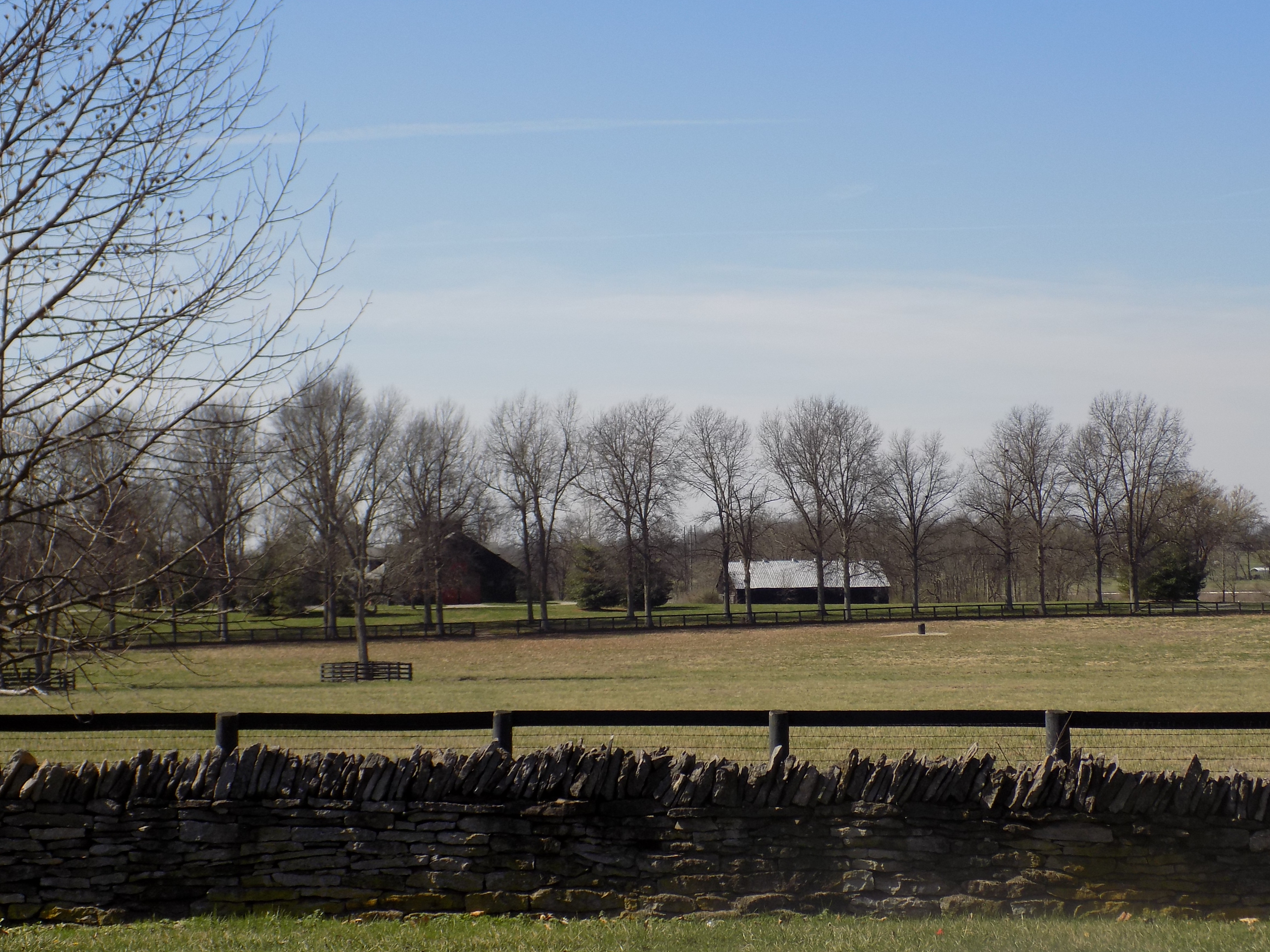
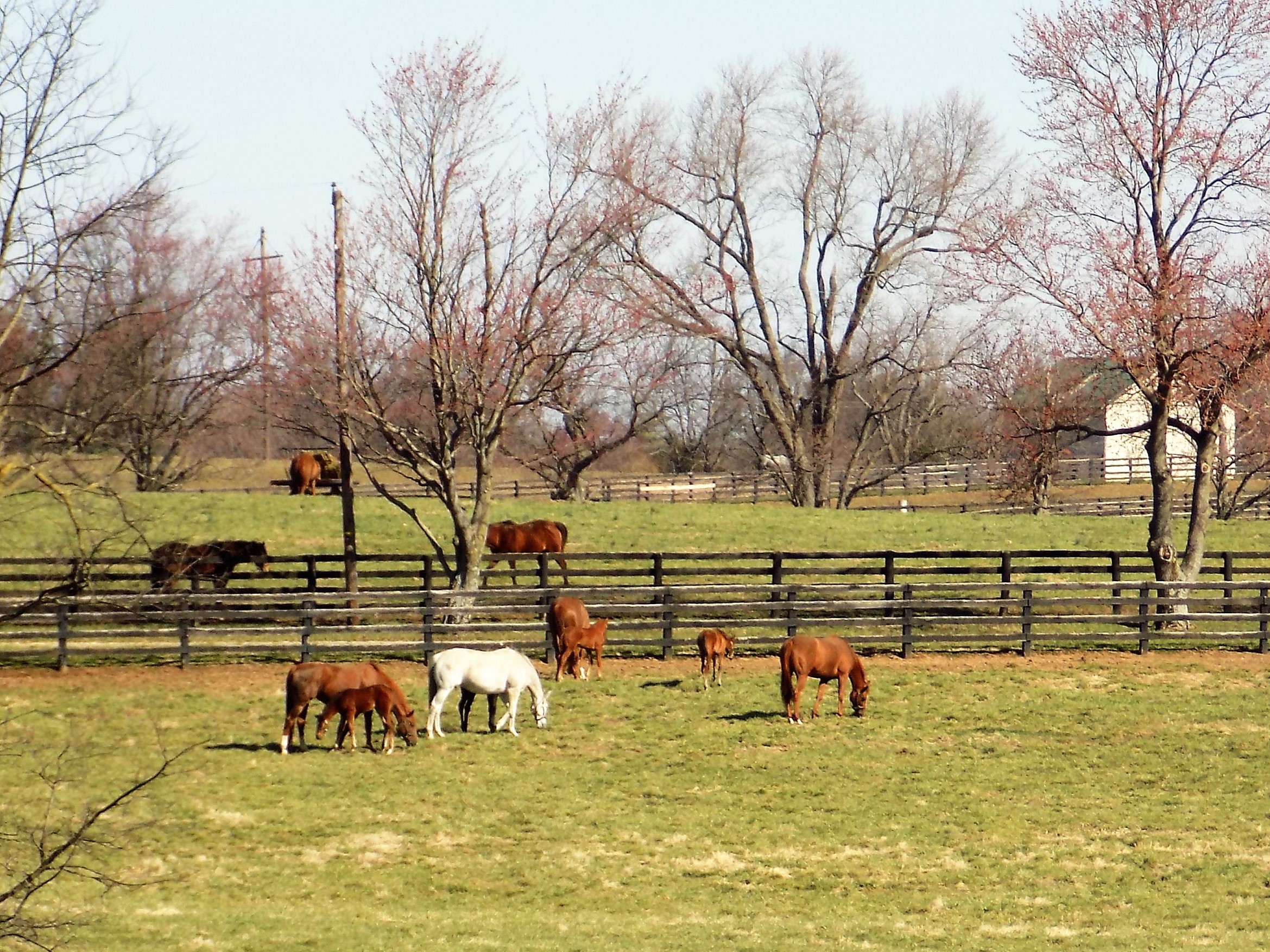
On Sunday morning, I checked out of my hotel and drove out of Lexington on Georgetown Road in search of Red State BBQ. Leaving the more commercial and industrial part of town I began to pass miles of wooden fencing and farms with horses grazing in idyllic settings. Eventually a long and low-slung building appeared up the road. It was alongside the driveway entrance to the Sunset Motel and sported a bright red “Red State BBQ” sign.

I was a little early and saw a lady looking out the window of the restaurant at me. I decided to drive on in to Georgetown and back and see what I could find along the way.

By the time I got back to the Red State parking lot, another car was waiting. We sat for a few more minutes until the restaurant’s OPEN sign flashed on and the lady who had been looking out the window at me was standing behind the counter taking our orders. Mine was the second order for the day and, by the time I finished, several more had lined up behind me.

I don’t like to eat a heavy meal before a long drive and so I ordered quickly. Later I wished that I had studied the menu and daily special more. There was a brisket special and I realized as more and more people ordered that the Red State brisket is quite popular with the locals. As a pork guy, though, I went with two porks – ribs and pulled.

For my two sides, I definitely should have thought longer before ordering; I wanted to try items I didn’t eat often and ordered beer cheese grits and corn pudding. It was only after I sat down at a table that I realized I had ordered two corn-based sides. And a corn muffin. Oh well.

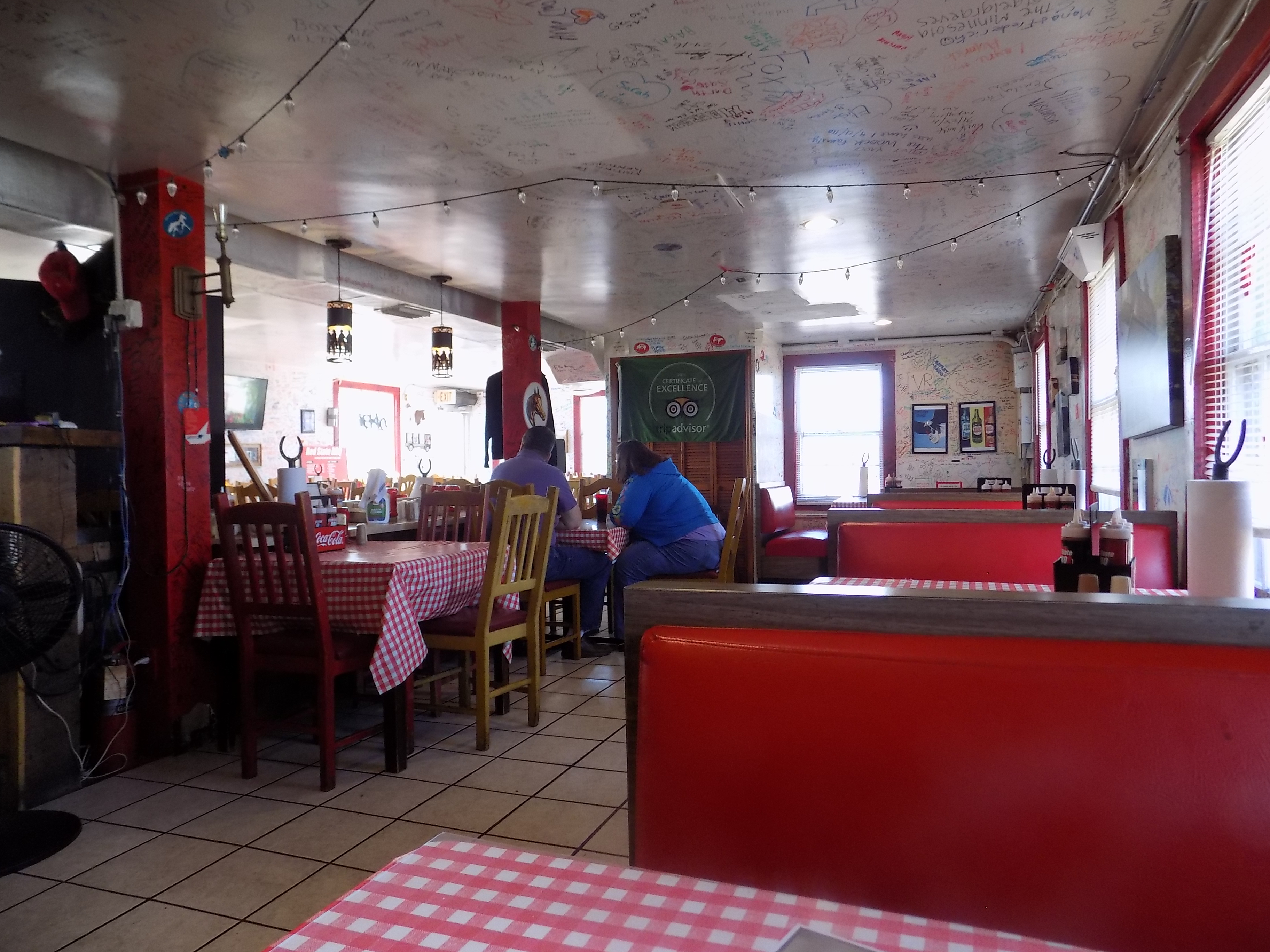
There was a wait but it gave time to soak up the Red State ambiance which included white walls and ceilings covered with names and messages written in multi-colored hues of markers. There were windows all around the dining room and sunlight poured in on a bright morning. Random items hung along the walls, various what-nots were here and there, and a horse theme was prevalent.

Coca-Cola cartons on each table displayed a variety of regional sauces to choose from: Memphis Sweet; Texas Spicy; South Carolina Mustard; North Carolina Spicy Vinegar; Kentucky Small Batch; and Alabama Show Horse.

Of course, the “Alabama Show Horse” was that white mayonnaise-based Morgan County sauce that I don’t like and that I don’t think truly represents the state – just the Tennessee Valley part of the state. Nevertheless, I was proud that Alabama was included in the parade and the South Carolina Mustard and Alabama Show Horse provided a definite variety to the collection of mostly red sauces.

I squeezed a small sample of each sauce onto my fingertip while I waited but I knew that I was bound to use the Kentucky Small Batch on my meal. This was a complex, slightly thick concoction with a bourbon and vinegar base and a lingering (but not cloying) sweetness from what I guessed was brown sugar and molasses.

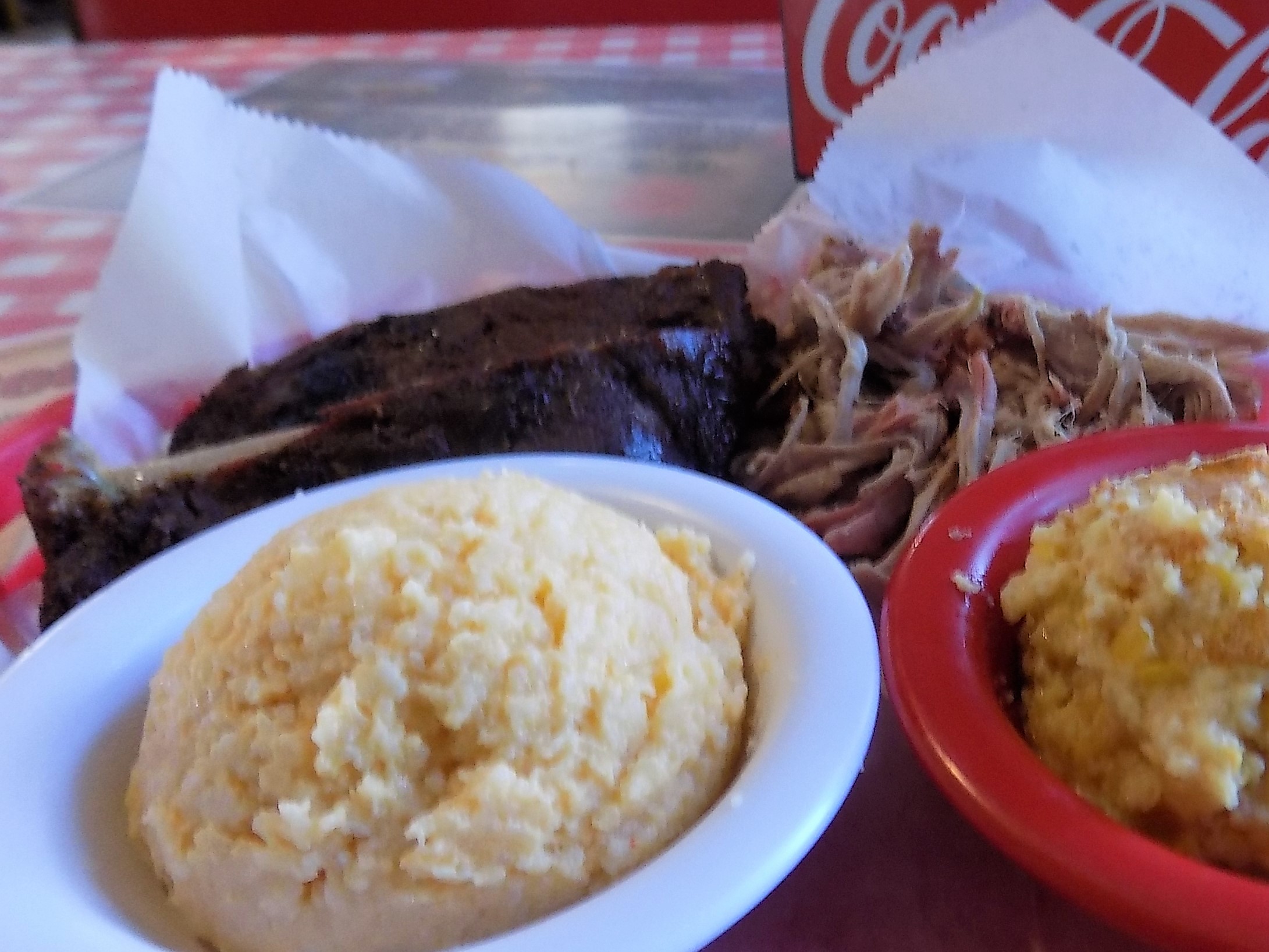
My plate arrived with a nice portion of pulled pork and two ribs. Red State uses a dry rub on the meat and that taste was complemented by a drizzle of Kentucky Small Batch that added a warm spicy bite. I used the sauce sparingly but liked the way it clung to the meat.

The ribs were small and tasty with a deep dark bark, the pulled pork was smoky and not very moist, and the scoops of grits and corn pudding and a corn muffin were good on the side along with a tall glass of sweet iced tea. I only regret that I didn’t substitute a corn-based side with cole slaw or greens.

I was anxious to hit the road and the meal filled me up but I should have sampled the desserts. Especially tempting were the Sav’s bourbon-flavored ice creams including Bourbon Chocolate, Bourbon Vanilla, and Bourbon Ball Chocolate, and the Peach Bread Pudding.

But one can only eat so much on a quick stop before a day of driving and I headed back into horse country, leaving behind a spunky barbecue joint which I enjoyed but will likely never see again. It was a smart choice for a final taste of Lexington.

Discovering Lexington and The Village Idiot

  LEXINGTON, KENTUCKY. I am an erstwhile horse racing fan, meaning that I follow the Triple Crown and check in on news about Bob Baffert, my favorite trainer, a few times a year. So I was intrigued to pass Man o’ War Boulevard and Keeneland Race Track as I drove into Lexington, Kentucky, for the first time.

Since 1983 I have regularly attended the annual Southeastern Theatre Conference (SETC) convention in early March. Several thousand students, academics, professionals, amateurs, beleaguered supportive parents, and a little bit of everything else one can find in the theatre and media converge on a conference center and spend five days jamming elevators, food courts, and hotel bars and restaurants as they audition, exhibit, network, perform, and choose from hundreds of panels and workshops.

SETC is the largest theatre conference in the United States. I was pretty fresh and young when I started attending, first as a stage manager for a community theatre production in competition, then as a job hunter, and later as a director and casting associate at the three days of actor “cattle call” auditions. Now, I go as an educator and a member of the Southern Theatre magazine editorial board.

It’s inspiring and invigorating in the first hours but by the time I attended a Friday afternoon editorial meeting there was a delayed response in the room and the sense of overload was palpable on most of the participants. SETC sessions start early in the morning and go until after midnight so it is perhaps a younger person’s game more that it’s mine. Still, I press on, up and down the escalators, past the horse-inspired fountain.

Most of my Kentucky sojourns focus on Louisville so it’s good to check out a new part of the state. The conference begins to wind down by Saturday afternoon so I usually set aside some Saturday time for unwinding and exploration of my own. I arrived in Lexington after a cold front passed through on Wednesday and my Saturday morning post-breakfast walk was a chilly and brisk one. By Saturday afternoon things had warmed up nicely, though.

Among the Victorian buildings comprising an area called “The Square” across from the conference center is the visitors center proclaiming Lexington the “Horse Capital of the World.” And, of course, University of Kentucky blue is everywhere. I can see two houses with connections to Mary Todd Lincoln and her family from my hotel room – one of them is next door to Rupp Arena. And I have caught myself humming “My Old Kentucky Home” more than once.

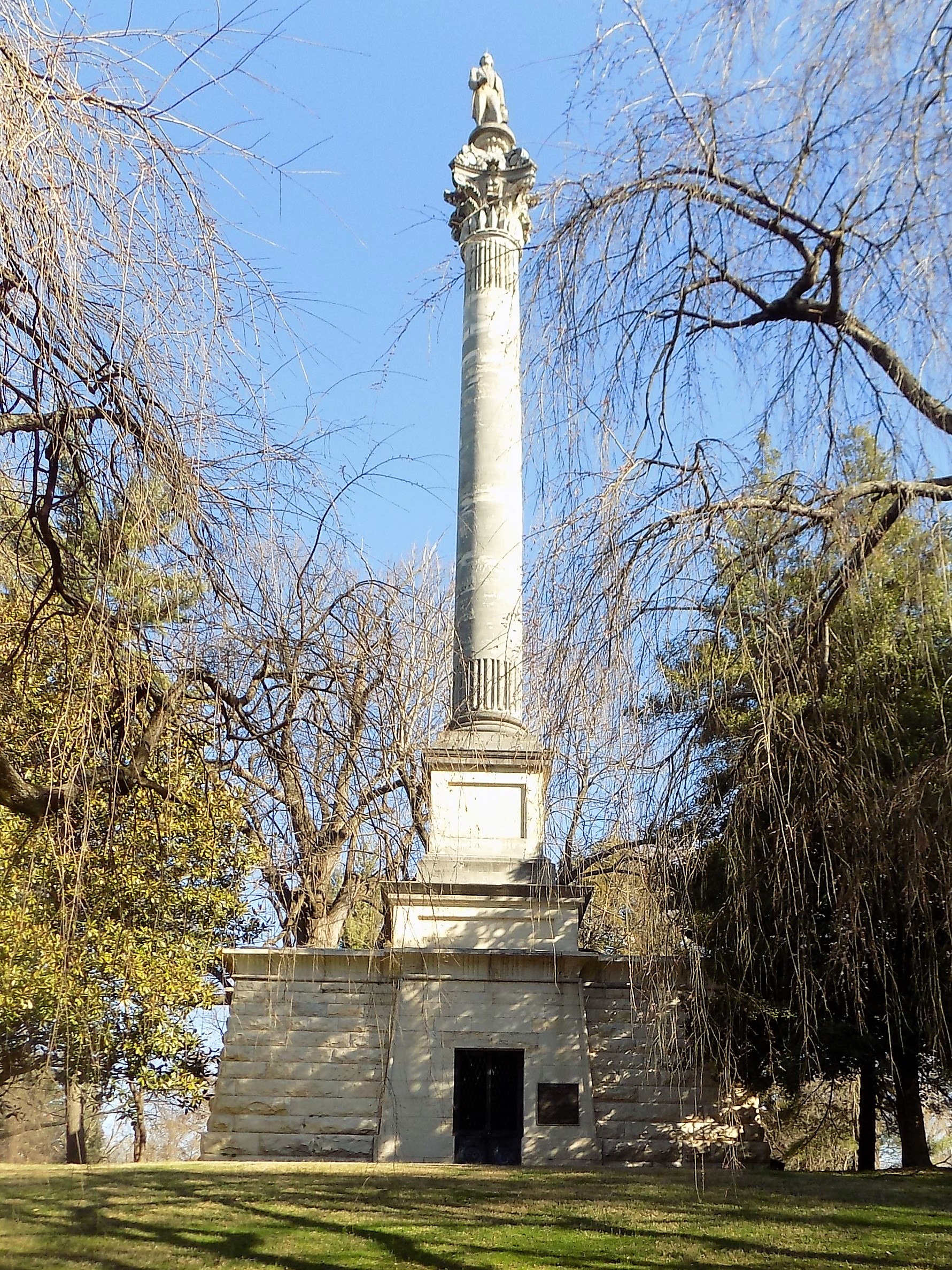
From my hotel window, I spotted a pedestal with a statue atop it. I ventured down Main Street to find that the mystery man on the 120-foot pedestal is “The Great Compromiser” and 19th Century statesman Henry Clay. He and his wife, Lucretia Hart, lie beneath the imposing monument in the dignified old Lexington Cemetery.

Because of the demands of the conference, many meals are grabbed on the run. A few years ago, however, my friends Janet and Russell and I started meeting for a relaxing dinner on Saturday night of the conference. I have known them since I lived in Jackson, Mississippi, and we always have a lot of catching up to do. More recently, my friends Kitty and Patty – both of whom go back to my graduate school years in Tuscaloosa – joined the crew.

Since I don’t know Lexington I decided to do a web search of dining near the hotels. I kept coming back to a place called The Village Idiot, which sounded ideal, with a varied and interesting menu to please a variety of tastes. I made a reservation and was a little nervous since it was my first time to book a restaurant for this group before checking it out in advance.

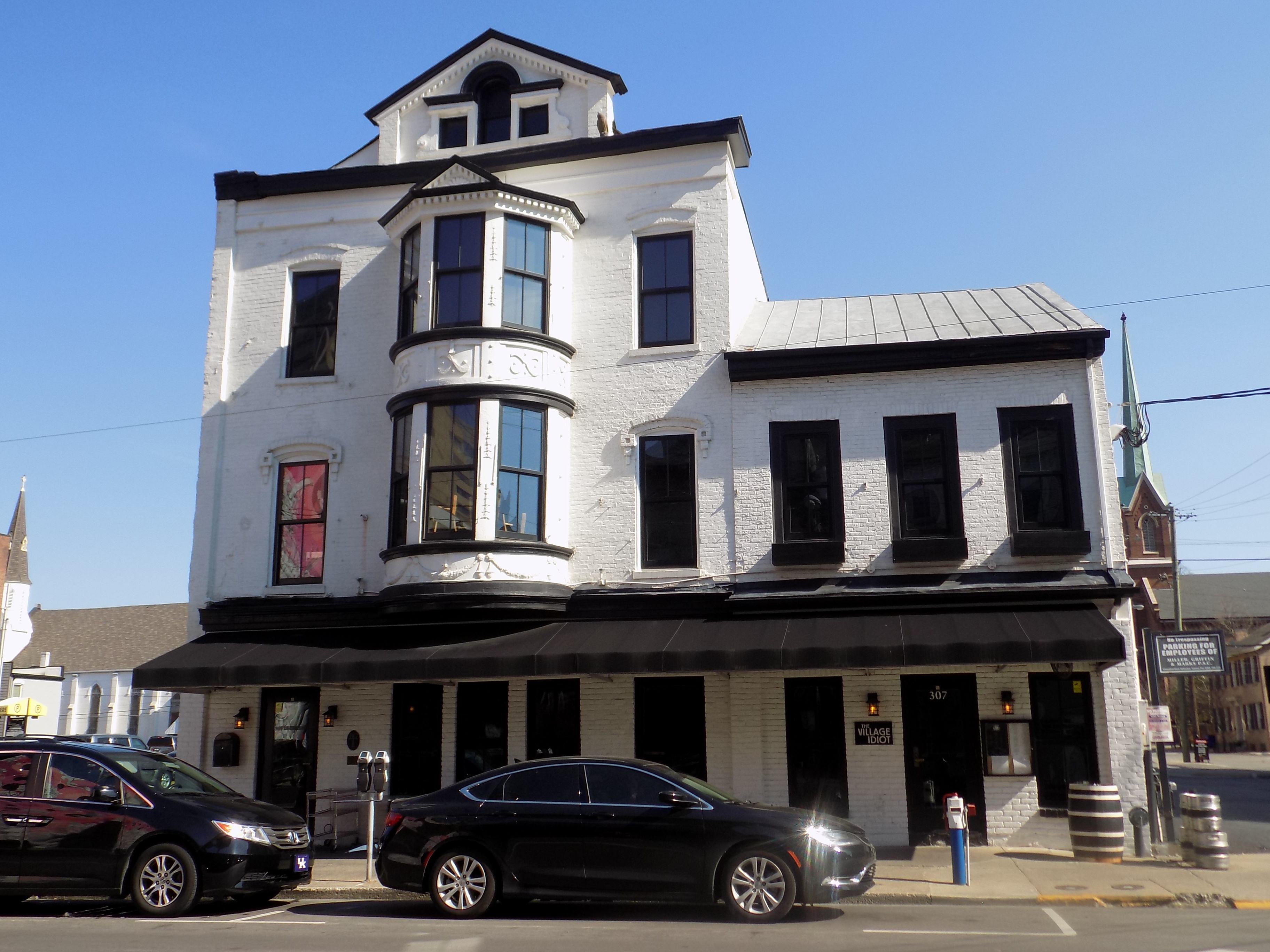
Not to worry. The Village Idiot is a new-ish gastropub in a circa 1825 former post office building. It is a three and a half story structure divided into several cozy bars and dining rooms. The menu is locally sourced and adventuresome and our party was pleased with every bite – starting with a shared artisan cheese plate.

I launched my main meal with a most generous dried fig and country ham “side salad.” Most of us had the New York strip but there was a very tempting pulled pork mac and cheese entrée. I thought seriously about ordering duck and waffles, The Village Idiot’s response to the chicken and waffle entrée that is ubiquitous on Lexington menus.  We finished feasting with a huge bourbon-sauced bread pudding with five spoons so we could share.

“The Purge,” a house drink combining Buffalo Trace, Ancho Reyes chili liqueur, ginger, and lemon was another popular hit at our table.

Head Chef Jason Richey and Chef de Cuisine Eric Angelo have their fingers on a fine balance of taste, variety, freshness, and style. Jeff, our waiter, was knowledgeable, charming, attentive, and eager to share with us “theatre folk” his theatre experiences back in high school.

I was relieved by the end of the dinner when our group declared The Village Idiot a great choice. After an exhausting conference, The Village Idiot was both invigorating and relaxing. We made it an early night since we all had long drives the next morning.

SETC is in Mobile next year. Before the group went our separate ways, we agreed that next year’s Saturday evening dining will be at one of my favorites – The Wash House, across Mobile Bay in Point Clear.

I guess I have a few more conferences left in me before I’m put out to pasture..

Wanderlust: My Grandfather’s Travels

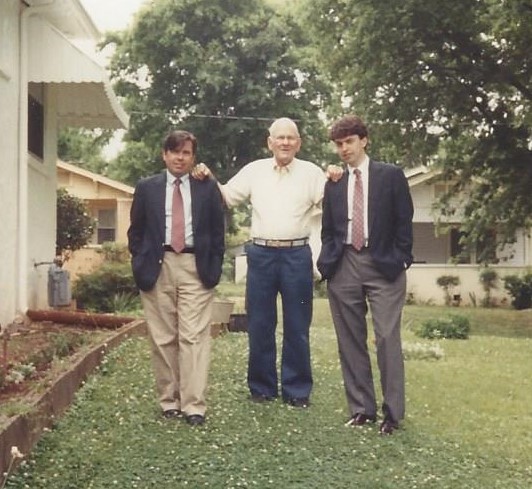
leonard-harbison-photo  My maternal grandfather, Leonard C. Harbison, was a wanderer all of his life. When I was young, he and my grandmother, Eula McCarn Harbison, lived in Fairfield Highlands in the western suburbs of Birmingham. From their house, you could see the Fairfield Works of U.S. Steel and the Ensley Works in the distance.

When Grandmother would hang clothes on the line to dry, she’d walk up and down the line with a damp rag to clean off the industrial soot. Even though it was bad for pollution, I loved to watch the robust factory activities, the trains coming and going, the smoke rising into the sky, and the orange glow when molten steel was poured at night.

Their street dead-ended at land that belonged to Woodward Iron and Granddaddy loved to take a walking stick, a dog, and a grandson on hikes along the creek in the wooded property. He had five grandsons in all and when one outgrew the walks, there would be another to fill in. When my brother was very young and I was a teen, I heard Granddaddy tell Grandmother “I like them when they’re that age. When they get older, I don’t have much use for them.” It wasn’t personal; he always had a sense of wonder and a love for nature and animals and he found that the younger boys would tend to get more excited about sharing it with him.

The federal interstate system eventually claimed the Fairfield Highlands house for right of way for I-20/59 but if you know where to look from the interstate — near the Allison-Bonnett Parkway / Jaybird Road exit – you can still spot a large oak tree that was in the backyard of that house. I used to climb that tree.

When the interstate moved in, my grandparents moved closer into Birmingham in the Central Park neighborhood. There was less space for nature walks but Granddaddy still would take a stick and a dog and walk the alleys of the neighborhood and sometimes over to the nearby Bessemer Super Highway to go to the pharmacy, to the grocery store, or to get a haircut.

Granddaddy often talked of his travels as a young man but nobody showed a lot of interest and I don’t remember a lot of the details. I just knew that he had travelled a great deal before he married and remembered comments about making tires in Ohio, working the oil fields in Oklahoma, and working on movie lots in California. He mentioned working with Tom Mix, a silent film actor who was the first “King of the Cowboys.”

Mother recently rediscovered a newspaper article about Granddaddy Harbison that was published in The Cullman (AL) Times in 1997, four months before he died. Under the headline “One Roaring Twenties Train Ride Was Enough for Young Hobo,” the article profiles some of Granddad’s adventures when he was a young man. Some of the time lines seem a bit skewed but he was recounting memories from seventy and more years earlier and small inaccuracies are to be expected.

Granddaddy grew up on his parents’ 500-acre farm in Trade, Alabama, in Cullman County. Charlie and Mary Lott Harbison farmed and raised livestock and Leonard, the second youngest of fifteen children, recounts idyllic days on the farm and hanging out at Luther Perdue’s general store.

He talks about hopping trains and “hoboing” – a popular activity for many young men (and some women) during that time. Woody Guthrie is perhaps the most famous proponent of that lifestyle. I was surprised to read that Granddaddy’s total “hobo” history consisted of one short trip from Cullman to Birmingham and back. He says that he met up with a “Yankee hobo” in Cullman and rode on top of the train, ducking for tunnels and overpasses. By the time he got to Birmingham, he had seen enough of the world and was ready to turn around and go home.

But his wanderlust continued and soon after his hobo adventure he moved to Akron, Ohio, working in the Firestone tire factory. After returning to Alabama from Akron comes the most intriguing part of the travel lore. Leonard, along with a brother, cousin, and friend, hopped in a Dodge and headed out west. I know he spent time in Oklahoma, Oregon, and California and he often mentioned Tom Mix and those Hollywood studio lots.

Why don’t we think to listen more when we’re young? I would love to hear more about the western travels – and especially about the movie lots – but at the time it just seemed like listening to somebody talking about the “olden days,” as we referred to them. My students now tend to say “back in the day” if I start to reminisce.

My grandfather loved all animals and he loved to hunt. He always had hunting dogs in a pen in the backyard of his Fairfield Highlands house. He was one of those southern hunters who was not that interested in the kill but in the “chase.” In fact, I’m not sure he carried a gun on his hunting trips. Instead, he and his hunting buddies would stay up all night drinking coffee by a camp fire and listen to the dogs run; they recognized the individual barks of the hounds and would listen to the chase until dawn. If the barking got too distant, they’d pick up and move to another location and listen.

His love of hunting is mentioned in that newspaper article as well as the fact that he met my grandmother at Ryan’s Creek Baptist Church after an all-night hunt with Rev. Charlie Johnson, the Ryan’s Creek preacher. He and my grandmother are laid to rest at the Ryan’s Creek cemetery, across the road from the church where they met.

Leonard and Eula married and had three children; they farmed in Cullman County and eventually moved to Birmingham in the ‘40s for Granddad to take a factory job until he retired in 1968. They maintained land in Cullman County and frequently went up for weekends during retirement. Granddaddy would go out into the woods and wander on those trips; he never tired of nature.

At first glance, it doesn’t seem that I have a lot in common with my Grandfather Harbison. But I love to take walks in the woods.

I inherited his love for plants and my house is filled with houseplants now that will be moved to the yard as soon as the weather gets reliably warm. In fact, I still use some of his containers for my plants.

I inherited his affection for “volunteers,” those plants that just pop up in the pots or in the yard. This has been an extraordinarily mild winter and I already have volunteers all over the yard. I don’t like to weed them out; they chose to grow there so I choose to let them. I’ll make the final decision in the spring when I see what my volunteers plan to do.

And I inherited his wanderlust, although I’m afraid my travels cannot compete with the style and romance of Granddaddy Harbison’s.

Note: The photograph is of my Grandfather Harbison (C), my brother (R), and me (L), taken at his and Grandmother’s Central Park home in 1988.

The Legacy of Mose T

dscn0706 Moses Tolliver (c. 1920-2006), more popularly known as Mose T, is one of the best-known of Alabama’s many self-taught artists. During the years that I lived in Montgomery, I would often see the artist sitting on the front porch of his house on Sayre Street when I would go to Martha’s Place, a soul food place a few doors down from Mose.

I heard that visitors often went by the house and invited themselves in to Mose’s place to check out the art and occasionally buy pieces. Each time I saw him sitting on the porch I considered going up to chat but it seemed rude to just drop by without asking or an invitation.

Moses Tolliver started painting in the 1960s. Most sources say he started painting after a work-related injury left him crippled and unable to continue his job in a furniture shipping warehouse. Mose T always said that he painted prior to the accident but that the accident left him more time to devote to his painting. Either way, a colleague at the furniture company, who painted as a hobby, suggested that Tolliver take painting lessons. Tolliver rejected the lessons and continued to develop his own style in his pictures. He often said that he wasn’t interested in “art,” just in making “pictures.”

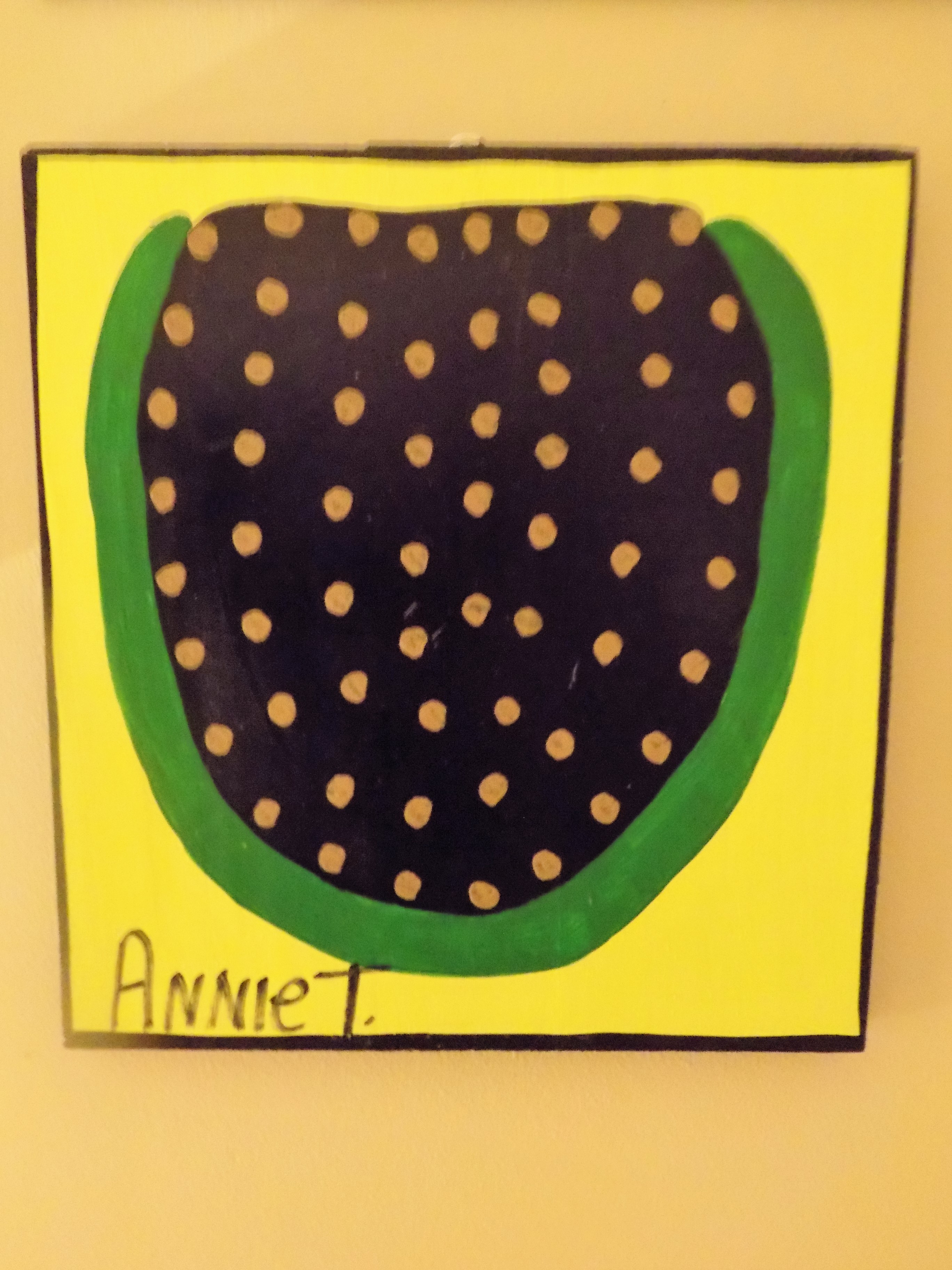
The first pictures Mose T made and sold featured a red cardinal as the subject. Throughout his life he painted many subjects including birds, snakes, fantastical animals, buses, watermelons and other fruit, erotic pictures of women straddling bicycles and tricycles and assorted objects, self-portraits and portraits of historic persons, and a world of imaginative, colorful paintings on an assortment of topics. His self-portraits feature him standing on crutches and he sometimes mixed his own hair in with the paint. dscn0705

The paintings are brightly and boldly colored; house paint on plywood seems to be his preferred medium but he also painted on random objects including tree stumps, Masonite, cardboard, table tops, and jigsaw puzzles.

I became aware of Mose T when I first started seeing museum shows featuring artists, usually self-taught, who operate outside the mainstream art establishment. It was around that time when one of the Birmingham-based department stores (either Parisian or Pizitz) promoted a line of tee-shirts carrying images of Mose T’s distinctive watermelon paintings.

Collecting original Mose T paintings is challenging. As the demand for his work increased he began to let some of his children do the paintings and he’d sign them if he approved of them. He had thirteen children and it is known that his daughter, Annie, and two of his sons, Jimmy and Charles, created works that Mose T signed and sold. dscn0702

Eventually Annie Tolliver began to sign her works as “Annie T” and developed her own distinct style and Jimmy and Charles began to produce their own work. I received a gift some years ago of a watermelon in the Tolliver style that was signed “Mose T Jr.” I was confused about the painting’s origins so when I purchased an “Annie T” watermelon from Annie Tolliver herself I mentioned that I had a watermelon signed “Mose T. Jr” and wondered who painted it. “That’s my brother,” she replied tersely and returned to another customer. I still don’t know which brother signed the painting but I assume it’s either Jimmy or Charles. dscn0694

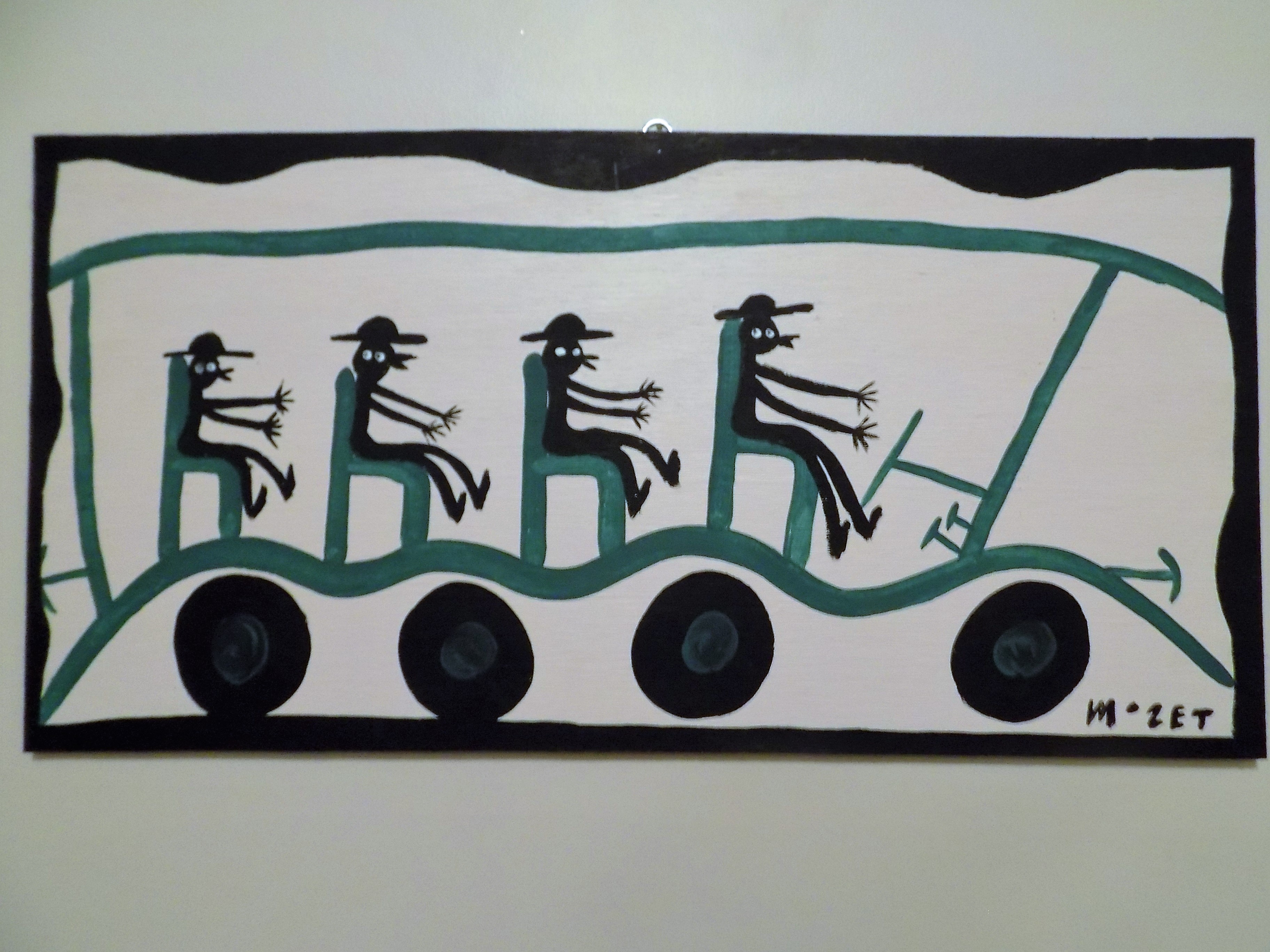
Even though watermelons are Tolliver’s most iconic image, my attention was drawn to another subject to which he frequently returned: buses. The bus as subject matter for a Montgomery-based artist is evocative of the 1955 Montgomery Bus Boycott which is such a seminal part of Civil Rights-era lore. I once read Mose T quoted as saying he preferred to paint empty buses but that people seemed to like them with people in them so that’s why he added people.

While I lived in Montgomery, I began to search out an empty Mose T bus for purchase. I did find one that I liked at a dealer but the price was prohibitive at the time and by the time I returned the painting had been sold.

Later, at another dealer, I spotted a bus with passengers with a price I could consider. It’s a green bus held up by four big black tires with muddy green swirls for hubs. A driver carries three passengers. All four have their legs dangling down and their arms sticking out. One can’t help but think of Mose T’s bird paintings with the four men’s arms resembling bird legs and their mouths that recall bird beaks. Each sports a broad-brimmed hat. I thought about it for a couple of days and went back to the dealer and owned it.

I had hoped to find an empty bus for the Tolliver collection but I really enjoy my frolicsome bus with its passenger load. I have no idea if Mose Tolliver painted it or just signed it but, either way, I love to look at it. And when you live with art, loving what you look at every day is the most important element, I think.

dscn0693

Note: A great resource for learning about many of the self-taught Alabama artists is Kathy Kemp’s Revelations: Alabama’s Visionary Folk Artists (Crane Hill Publishers, 1994) with abundant photographs by Keith Boyer.

Christopher Fennell’s “Light Tree”

dscn0676-2 Sculptor Christopher Fennell’s sculpture “Light Tree” has made an appearance on the sidewalk in front of a downtown Huntsville development and, even though it isn’t lit up yet, it is already a lively and striking addition to the Huntsville townscape.

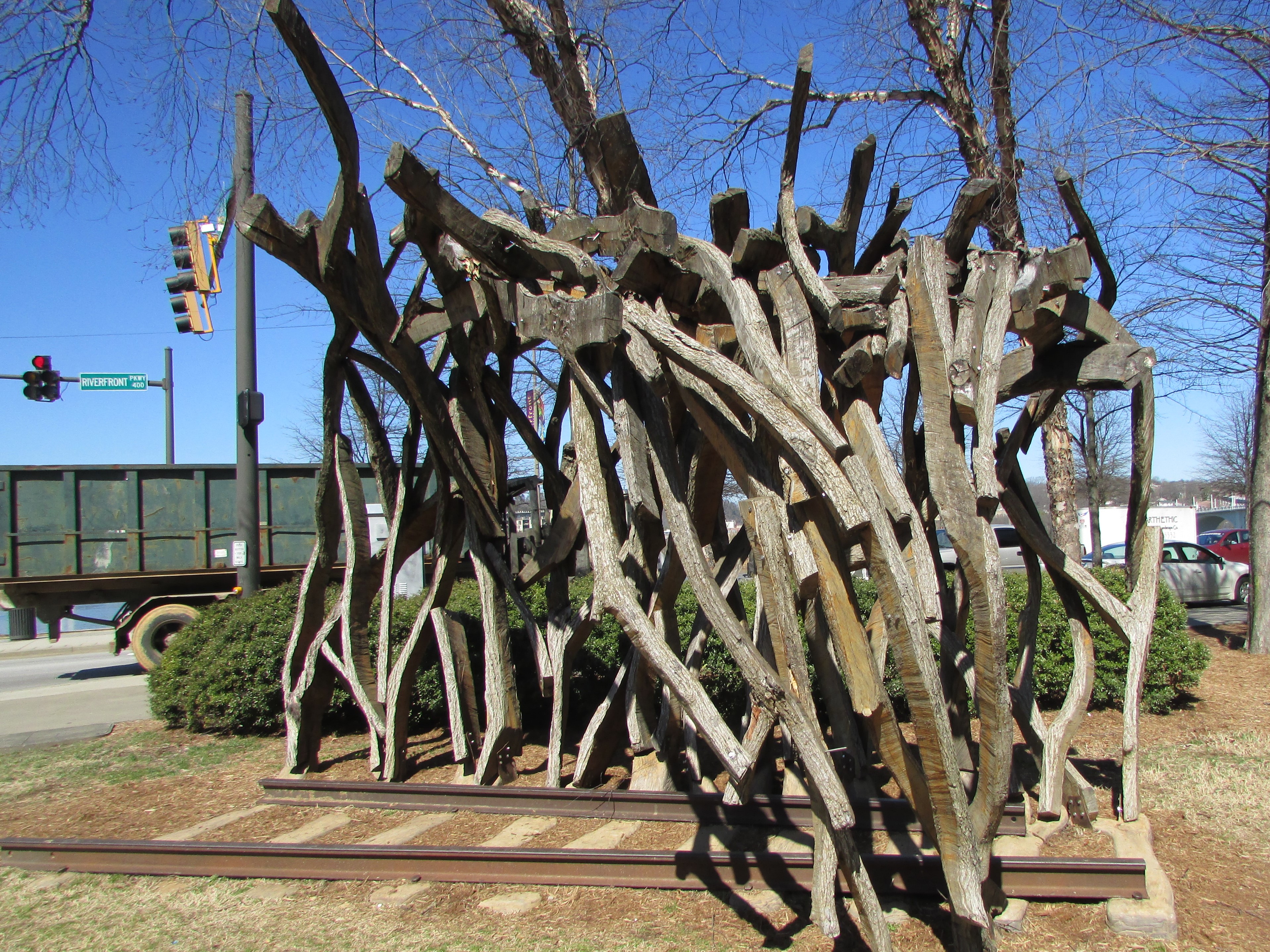
img_1199-2Outdoor installations made from recycled materials are Fennell’s specialty. When I became aware of the artist and his work, I began to run across his pieces as I travelled. “Rail Wave,” beside the river in Chattanooga, features railroad tracks across wooden ties that rise up into a cascading wave tunnel – one of Fennell’s recurring motifs. 

“Magic City,” Fennell’s temporary installation at an annual Birmingham art fair, featured boards covered with imaginative self-portraits made by Birmingham school-age artists. Fennell shaped the boards into a massive wooden flame that the viewer could walk inside, around, and through.

Browsing through Fennell’s website (www.cfennell.org), one sees recycled wood, boats, windshields, rods, baseball bats, ladders, garden tools, car parts, etc. transformed into installations – both permanent and temporary – and located throughout the country. The beautiful sculptures are often rooted in the shapes of nature and often tempered with a charming whimsy. Fire, water, wind, fish, and fowl are among frequent natural motifs. Also recurring are industrial relics redefined; one of my favorite Fennell incarnations is an old school bus transformed into a bus stop in Athens, Georgia.   

I met Chris Fennell and began to grasp the method behind his art when I tagged along with Scott Smith – another artist who makes frequent use of cast-off and recycled objects – and Chris to scope out a barn near Tullahoma, Tennessee. The barn was on a family farm that spanned generations and its razing was imminent.

Scott was contacted about the possible availability of tin and wood from the structure and contacted Chris to plan a trip. Chris and Scott examined and photographed the barn. Chris later went back and spent a couple of weeks taking the barn down and used the wood for future projects.

After earning degrees in mechanical engineering and sculpture at South Florida, Christopher Fennell got his M.F.A. in sculpture from Georgia. He uses his engineering background to assemble complex sculptures, often from hundreds of assorted pieces meticulously melded together for an effect that seems airy and effortless. Fennell is now based in Birmingham.

The new Huntsville sculpture is something of a departure from the typical Fennell piece. It is composed of sleek slate grey tree-like structures with “branches” topped by sixty lamps of different shapes. The graceful structures bend together forming a passage through the “Light Tree.” As one enters the downtown on Jefferson Street, the sculpture appears as a beacon to the area, even on a bright sunny day before its lights are shining.

My favorite view of “Light Tree” is in my rearview mirror as I drive past it. After passing the vibrant energy of the soaring sculpture, it becomes a calm and tranquil afterimage for the traveler moving on down the road.

“Light Tree” currently stands in the middle of a streetscape construction zone so it is hard to get up close right now. It will be lit nightly when the street project is done. I find myself taking detours through town on the way home these days just to check on the progress and anticipate the time when it will shine brightly and complete. dscn0670-2

Another Roadside Attraction: The Corn Palace

dscn0653  When I was growing up, we didn’t often travel too far from home. There were picnics and day trips but most excursions were of short distance and duration. I mostly grew up in Birmingham but when Dad’s work began to transfer us fairly regularly we moved around a lot; most of the moves were fairly close to home: Jackson, Nashville, Tuscaloosa.

The lengthier vacations were usually to Panama City, Florida, on the Gulf. My Journey grandparents had a fishing cottage on the Black Warrior River in Walker County, not far from Birmingham, and my Harbison grandparents had a weekend place on their farm land in Cullman County near Smith Lake, about an hour away. There were occasional trips to New Orleans, Atlanta. Montgomery, and we often went on overnight business trips with Dad to nearby towns. The bulk of the travel was within a 350-mile radius of wherever we lived at the time.

I wasn’t widely-travelled, but I had limitless wanderlust. In that heyday of magazines, my family’s magazine rack was always full. I was a voracious reader from an early age and I would read anything in the house from cover to cover whether it matched my interests or not. My Granddaddy Harbison raised hunting hounds and subscribed to The Hunter’s Horn, a magazine about hunting and hounds; I avidly read that also, even though I had no interest in hunting and my only hound was a pet beagle named Spotty with an ear-splitting bark back when I was in elementary school.

Any book was fair game. I was lucky enough to have parents who encouraged and never censored my reading and I attribute much of the success of my education to my reading habits. I would walk in a room and instantly sit with my face buried in a book. My teenage nephew now does much the same with his electronic gadgets and I’m hoping that is enhancing his knowledge the way printed matter enhanced mine.

In every magazine I read, I was particularly attentive to the travel ads. If there was a coupon to order a travel guide I would carefully clip it and send it to the address that was advertised.

So, even though I wasn’t widely-travelled in my actual life, I would sit for hours and ponder travel guides that took up a full drawer in my bedroom dresser. Through those printed guides I travelled the length and breadth of the country and the world. On my first trip to New York City, friends tried to surprise me by pointing out landmarks and asking if I knew what that building was, what that church or museum was, what park I was entering. I always knew the answer from reading books and magazines and watching movies. It all felt familiar even if I was seeing it live in person for the very first time.

In one 1960s South Dakota travel guide my youthful imagination was captured by an image of something called the “Corn Palace” in Mitchell, South Dakota (www.cornpalace.com). It was a multi-use municipal auditorium such as most communities built in the early twentieth century. What set it apart was its Moorish-style adornment with onion domes and minarets. Most exciting of all was that the Corn Palace sprang from a turn of the century movement of building “crop palaces” throughout the Great Plains. Mitchell’s iteration of this trend was entirely covered with corn murals.

I vowed then and there that if I ever found myself in South Dakota I would have to make a pilgrimage to Mitchell’s Oz-like Corn Palace.

Over time I grew out of my childhood travel guide obsession and eventually cleared my drawers of the books and brochures. Fast forward to 1989 and I am hired by Omaha’s Nebraska Theatre Caravan to stage manage their east coast tour of A Christmas Carol. Even though it was billed as an East Coast tour, our show had to get from Omaha to the East and tour dates were scheduled along the way in South Dakota, Iowa, Illinois, and Ohio. Looking over the itinerary in a phone conversation with one of the Playhouse staff, I was told we would play Mitchell, South Dakota.

I stopped her immediately. “Are we by any chance playing the Corn Palace in Mitchell?” She said we were – did I know the Corn Palace? I told her that indeed I did and that I had planned to visit it for years. She was amused that someone in Alabama had a mission to visit the Corn Palace.

Mitchell was one of our first stops on the tour and we drove there from a gig in tiny Sioux Center, Iowa. We arrived on Mitchell’s main street just at sunrise on a bitterly cold November Sunday morning. I was driving and most of the technical crew in the van was sleeping. I caught a glimpse of sunlight glinting off an onion dome a couple of blocks away and knew that my childhood goal had been reached. I shouted “There it is!” and woke several crew members who did not share my enthusiasm and were annoyed that their sleep was interrupted.

We were early for our load-in and had time to go grab breakfast. But first, one of our tour crew took pictures of me standing in front of the Palace. I know those photos are stored away somewhere but I haven’t been able to find them for years. All I can find are blurred photos of the Palace taken as we were leaving town that night and of a mural inside the auditorium. dscn0656

The Corn Palace continues to be a busy venue, I hear. Our show followed a Barbara Mandrell performance the night before. Mitchell is a small town but the great local crew was I.A.T.S.E. union members and I found out that many of the union guys were also local farmers, at least one of whom provided the corn for the murals. The Palace’s exterior murals have an annual theme which changes each year so the façade of the building takes on a whole new look from year to year.

The crows were having a field day on the façade of the Corn Palace. Our show was on Sunday afternoon and we didn’t spend the night in Mitchell so I spent as much of my break time as I could exploring the unique roadside attraction appeal of the facility and the town.

As we reboarded the crew van and set off for Des Moines, I vowed to return to Mitchell and the Corn Palace some day when I had more time to absorb the unique local vibe. I haven’t returned yet but when friends tell me they’re going anywhere near South Dakota I always implore them to take the detour into Mitchell and gawk at what bills itself as “The World’s Only Corn Palace.” I think their effort will be rewarded.