
“There are no unsacred places; there are only sacred places and desecrated places.” from “How to Be a Poet” by Wendell Berry
 “The Sacred Ordinary” is a temporary art installation in the Birmingham Civil Rights National Monument. It’s a minimalist but high-concept idea presented by the Ministry of Culture initiative of Birmingham’s 1504 Studio, “a narrative studio that integrates strategic communications with the visual arts.” The purpose of the “Sacred Ordinary” installation is to provoke contemplation and memory through place without signage. In part, it seems to be a response to the current administration in Washington’s efforts to erase history. 1504 writes, “Aging infrastructure, the passing of a generation of foot soldiers, and federal efforts to erase chapters of American history raise an urgent question: if institutions alone cannot sustain history, what role can the public play in caring for sacred sites?”
The installation includes only a few objects placed within the Birmingham Civil Rights District, focused on sites near Kelly Ingram Park and 16th Street Baptist Church, places that are essential to an understanding of the Civil Rights Movement of the 1960s. It’s a nighttime self-guided walk. Participants dial a phone number and hear a brief introduction by actor Andre Holland. From there, text prompts and ambient soundscapes are provided to accommodate the walk. Participants are urged to walk through silently, without speaking. This was easy for me since I was the only person around.
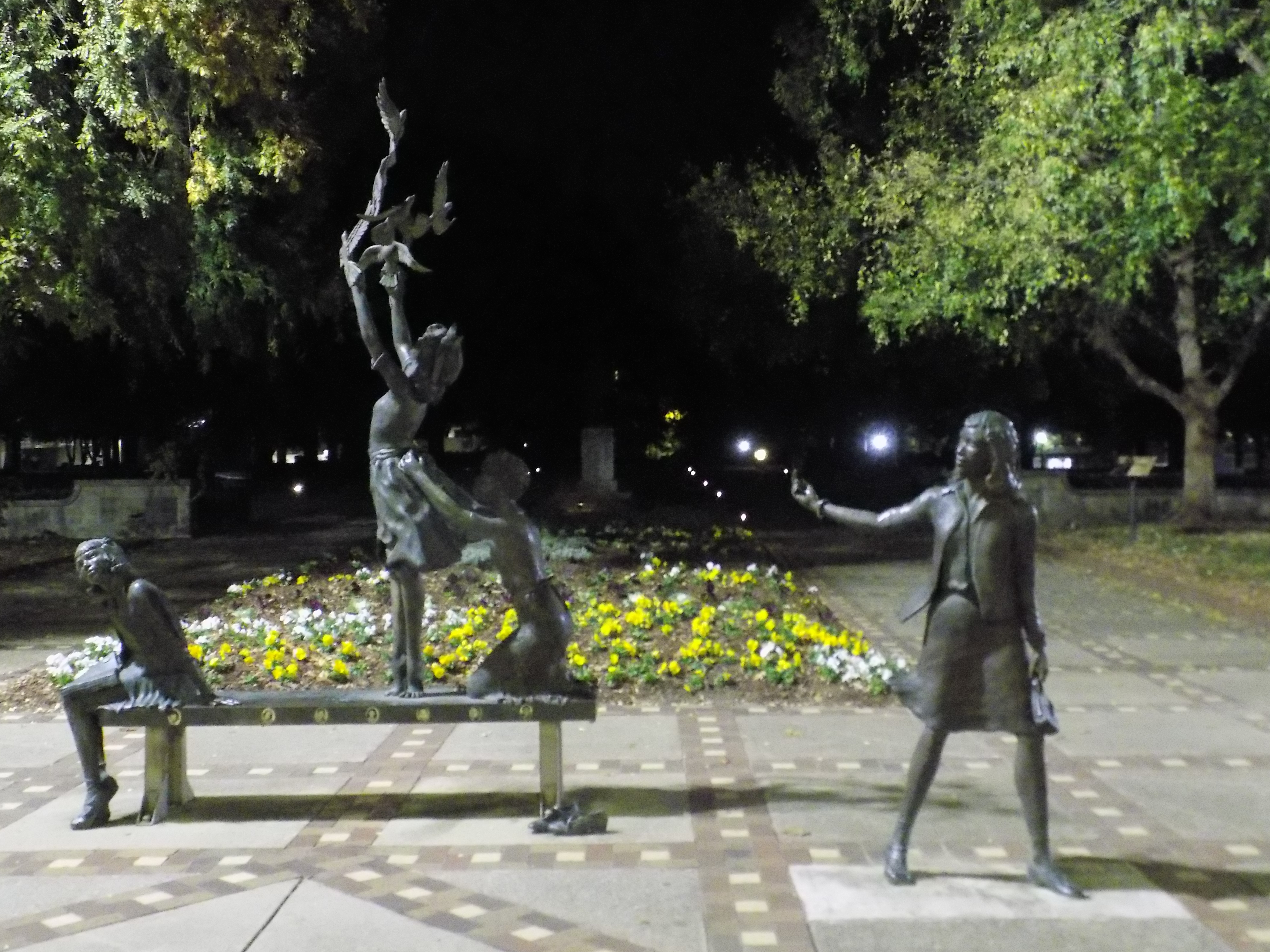
“Four Spirits” by Elizabeth MacQueen
The starting point is a fire hydrant near the “Four Spirits” statue in Kelly Ingram Park, directly across from 16th Street Baptist Church. “Four Spirits” is a memorial to the four young girls who were killed in the church bombing. In Birmingham civil rights history, that fire hydrant has its own significance.
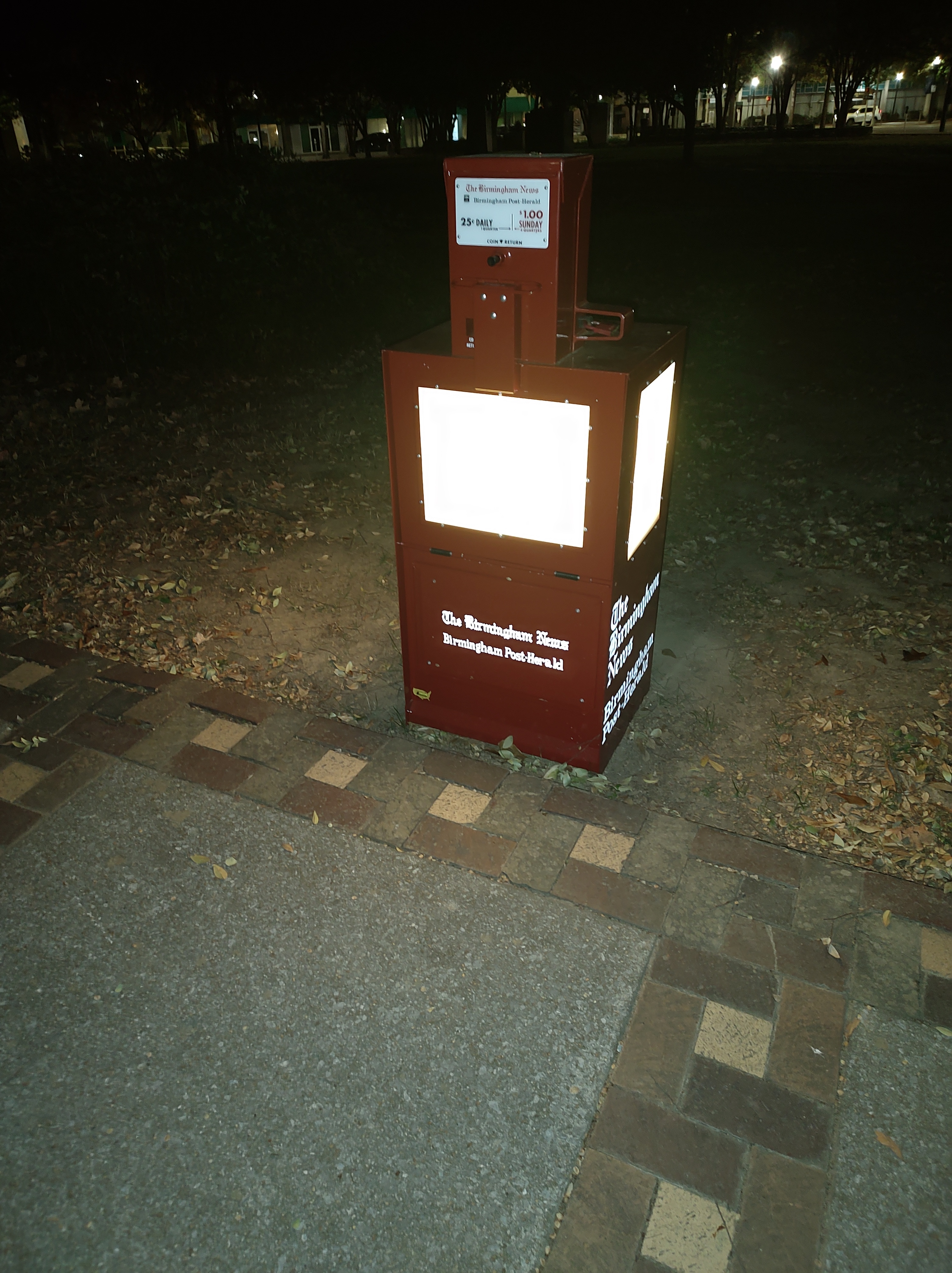
Participants are directed to the center of the park, where a glowing newspaper bin for The Birmingham News / Birmingham Post-Herald stands. Those two daily newspapers no longer exist. Walking back toward and alongside the church, a dumpster glows between parking lots and other lots that are now vacant. On one side of the dumpster are the names of businesses that used to be on those lots, including a synagogue, another church, restaurants, cleaners, a beauty shop. “We preserve what we value” is a theme of Ministry of Culture, a reminder that many things of value may now only be preserved through memory.
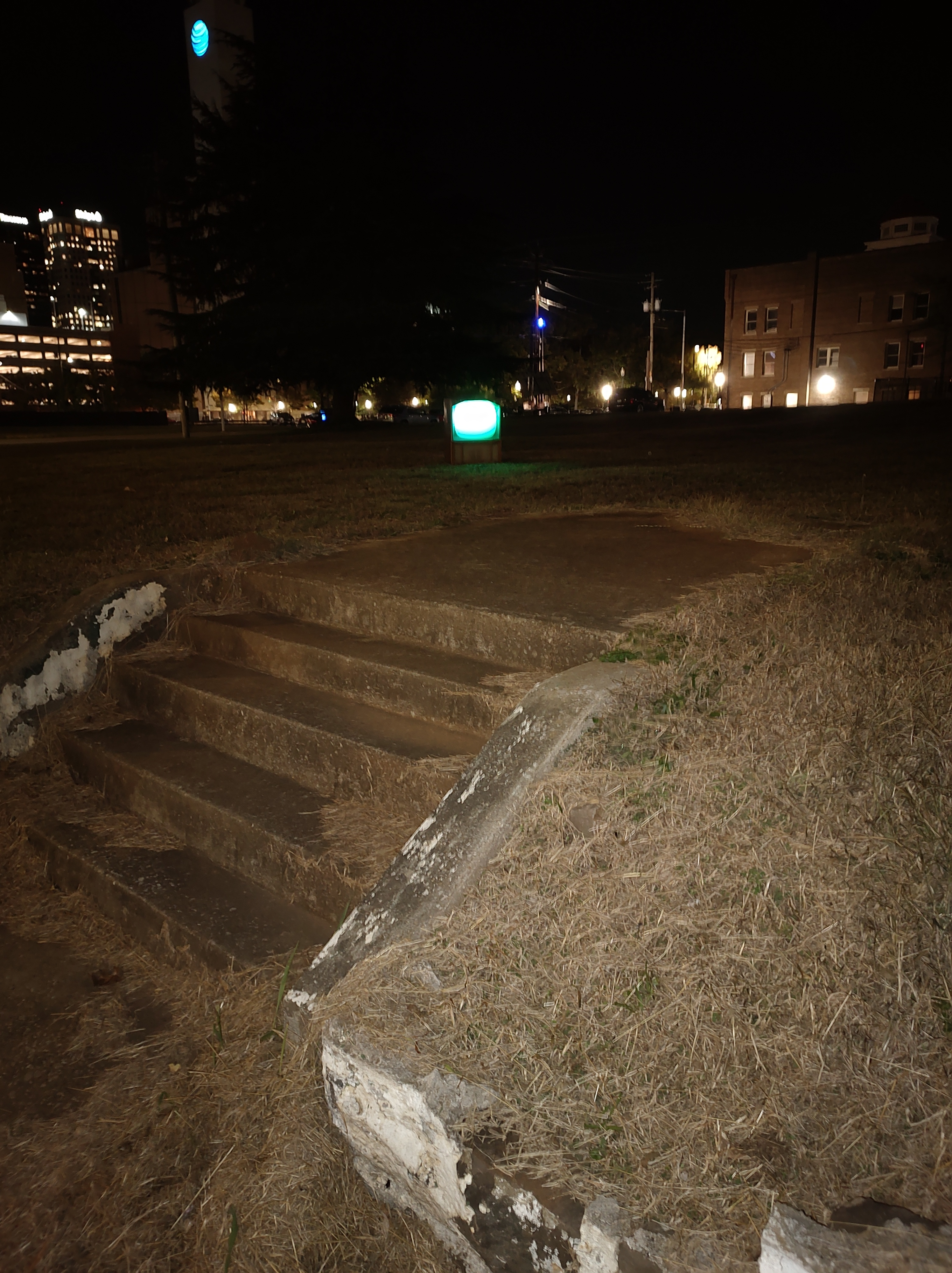 Turning a corner past the dumpster, streetside stone steps that led to porches now lead to vacant lots. But a glowing old-style television sits on a vacant lot where the living room of a house once stood. Beyond the television, the backside of 16th Street Baptist hovers, darkened on a weekday night. Moving on from the television, down a street that is almost too quiet, too empty, there is a corner, another church, a blue mailbox.
From that church it’s a walk down an empty street behind the Birmingham Civil Rights Institute to the A.G. Gaston Motel, one of the enduring landmarks of the Birmingham Campaign, now being renovated. The motel is where the Campaign’s organizers met to strategize their nonviolent protests, to meet the press, and to rest. I recall a postcard in my collection that shows Dr. King sitting in the A.G. Gaston courtyard, surrounded by reporters and cameras. Down the block, in front of the motel’s restaurant, a phone booth glows. After spending time at the A.G. Gaston, the prompt takes the participant back to the corner of Kelly Ingram Park where the walk started not that long ago.
The Sacred Ordinary is dedicated to Birmingham artist Joe Minter, who has collaborated with 1504 in the past. Minter creates his art and installations from what is cast-off, the abandoned and forgotten. In that regard, he is a fitting inspiration for The Sacred Ordinary, which uses a few simple and obsolete totems to invoke time, place, and memory.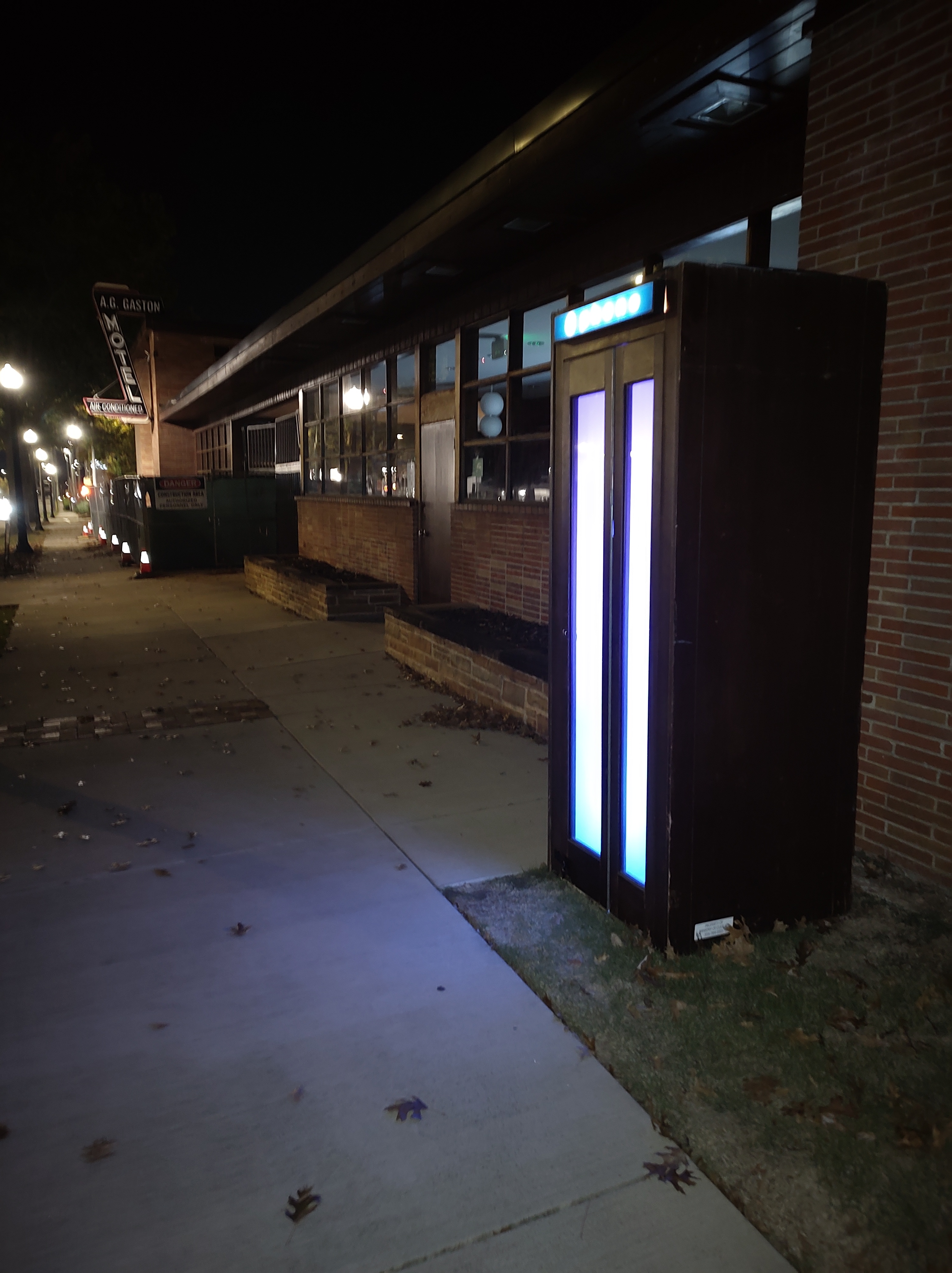 I am old enough to remember Birmingham in 1963. I was an elementary school student in Birmingham public schools. I remember it being grey and overcast on the September Sunday when the church was bombed, not that many miles from the church that I was attending, but that may just be my memory. I remember the newly installed mayor, Albert Boutwell, addressing the city and lamenting the loss; I remember also that he was a segregationist. As my memories kicked in, I wonder what people who were not alive during the Birmingham Campaign might make of The Sacred Ordinary. What about those who never needed to carry an extra coin in case they needed to use the pay phone at the phone booth, who never had the daily paper thrown in the yard, who never saw a television that looked like a big cabinet? Would they care? And what about those who don’t know a whole lot about the civil rights movement, much less Birmingham’s role in it. Will they come?
I saw The Sacred Ordinary several days ago. When I was finished, I walked back to the car, past “Four Spirits,” thinking There wasn’t much to it, was there? That was several days ago. And here’s the thing – I have been thinking about that walk, and what it meant, ever since. I have been thinking about how peaceful and quiet my walk was. I admit I was a little apprehensive about traipsing around the Civil Rights District alone after dark, about being the guy with his phone out in search of strangely lit objects in odd places on dark and abandoned streets. But it was strangely calming to see places that are quite familiar in a whole new, and unrushed, way in the moonlight.
As I was getting back in the car, a man walked out of the park lugging an extra large travel bag on wheels. His name was Richard, he was traveling from Rochester, Minnesota, and he had gotten lost trying to get to the Greyhound Bus Station. (The Google on his phone, it turns out, had sent him to the old bus terminal across from city hall.) He was traveling down to Mexico to stay; he’s an American but he can’t afford to live in this country anymore. We talked for a few minutes. He knew a little bit about the history of 16th Street Baptist Church, about how people had sent donations from “all over the world” when it was bombed. He had been through Birmingham in the eighties and, man, has it changed.
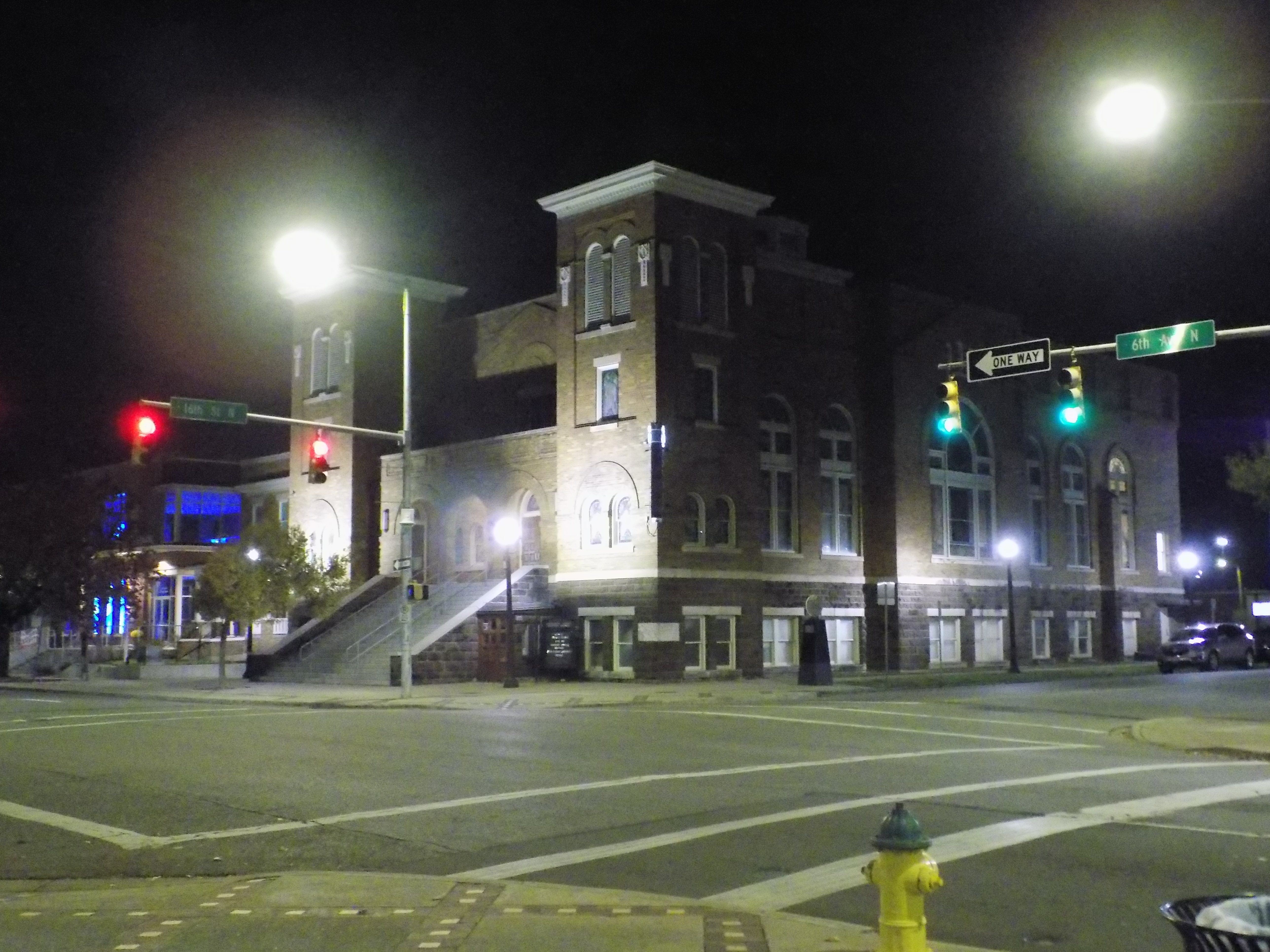
16th Street Baptist Church
I finally told him he was way out of his way if he was going to the bus station and I would give him a ride. “Will you? Thank you, man, that would be great!” When we got to the “Intermodal Facility,” the downtown transportation hub, Richard thanked me heartily, and said he planned to check out Montgomery and Selma on his way down to Mexico. “Birmingham seems like a good place,” he said. “I might come back to visit if I ever decide to come back.”
The Sacred Ordinary will be on view in the Birmingham Civil Rights District until December 13. See more about 1504 Studio here: Narrative Studio For Strategy and Visual Storytelling

